Magnitude Comparator
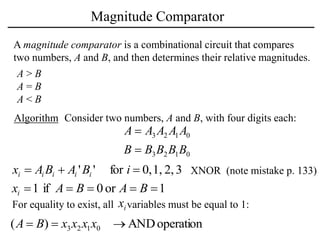
A magnitude comparator is a combinational circuit that compares
two numbers, A and B, and then determines their relative magnitudes.
A > B
A = B
A < B
Algorithm Consider two numbers, A and B, with four digits each:
0
1
2
3
0
1
2
3
B
B
B
B
B
A
A
A
A
A


operation
AND
)
( 0
1
2
3 

 x
x
x
x
B
A
For equality to exist, all variables must be equal to 1:
i
x
3
2,
1,
0,
for
'
' 

 i
B
A
B
A
x i
i
i
i
i
1
or
0
if
1 



 B
A
B
A
xi
XNOR (note mistake p. 133)
Magnitude Comparator
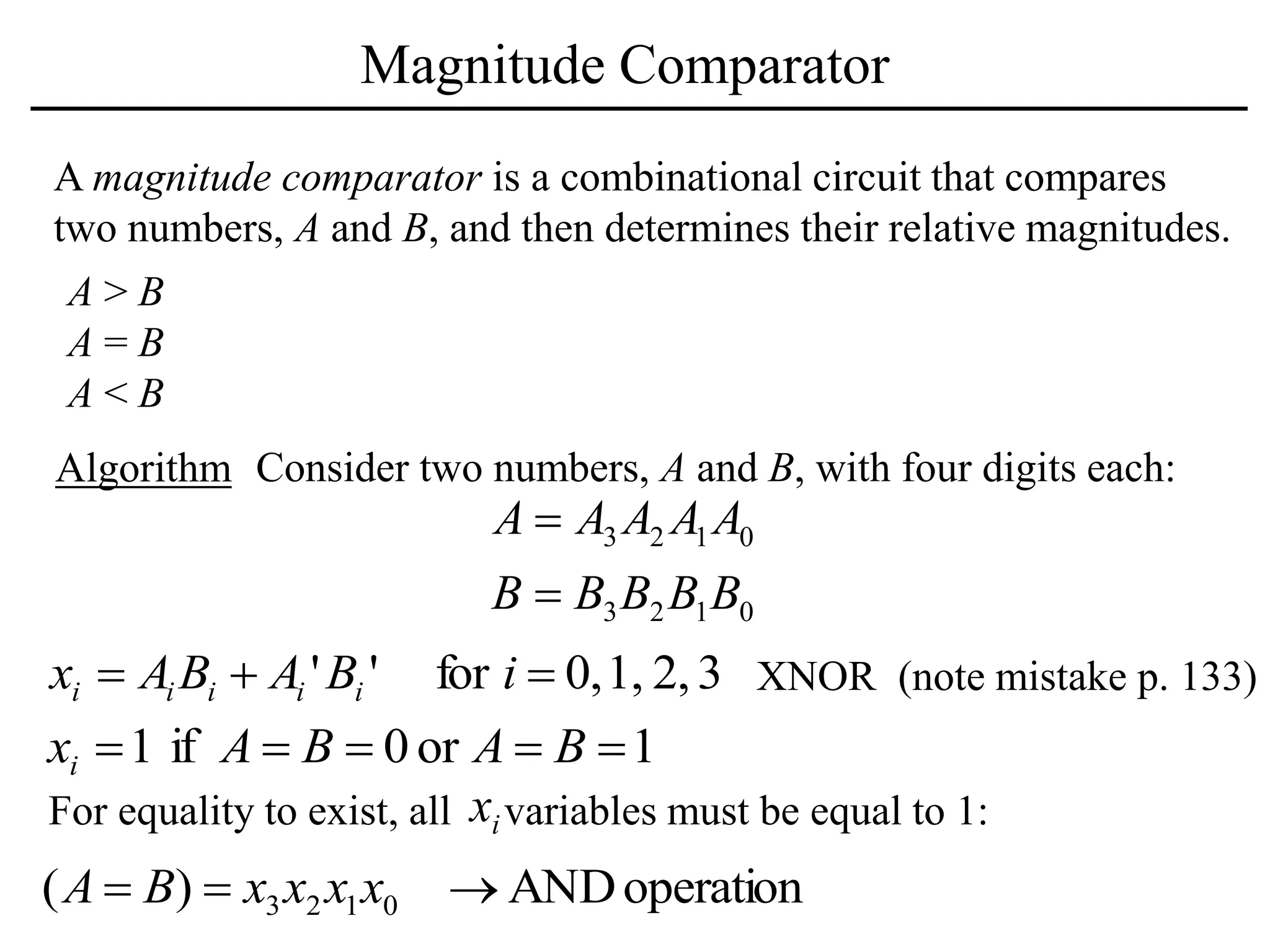
To determine if A is greater than or less than B, we inspect the relative
magnitudes of significant digits.
If the two digits are equal, we compare the next lower significant pair
of digits. The comparison continues until a pair of unequal digits is
reached.
The sequential comparison can be expressed by:
0
'
0
1
2
3
1
'
1
2
3
2
'
2
3
3
'
3
'
0
0
1
2
3
'
1
1
2
3
'
2
2
3
'
3
3
)
(
)
(
B
A
x
x
x
B
A
x
x
B
A
x
B
A
B
A
B
A
x
x
x
B
A
x
x
B
A
x
B
A
B
A










Compare: 1
)
(
0101
and
1010 



 B
A
B
A
1
)
(
1010
and
0101 



 B
A
B
A
'
0
0
1
2
3
'
1
1
2
3
'
2
2
3
'
3
3 B
A
x
x
x
B
A
x
x
B
A
x
B
A 



0
1
2
3 x
x
x
x

0
'
0
1
2
3
1
'
1
2
3
2
'
2
3
3
'
3 B
A
x
x
x
B
A
x
x
B
A
x
B
A 



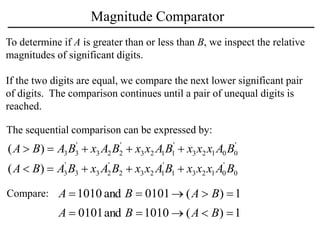
4-bit Magnitude Comparator
XNOR
DECODERS
A decoder is a combinational circuit that converts binary information
from n input lines to an 2n unique output lines.
Applications:
• Microprocessor memory system: selecting different banks of memory.
• Microprocessor I/O: Selecting different devices.
• Microprocessor instruction decoding: Enabling different functional
units.
• Memory: Decoding memory addresses (e.g. in ROM).
•
•
•
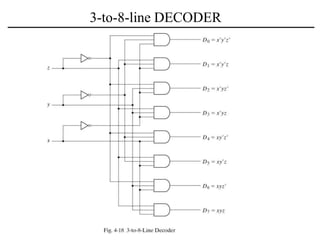
3-to-8-line DECODER
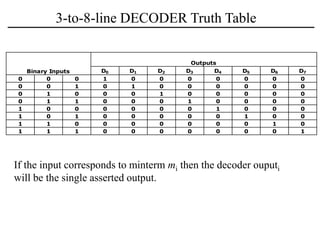
3-to-8-line DECODER Truth Table
D0 D1 D2 D3 D4 D5 D6 D7
0 0 0 1 0 0 0 0 0 0 0
0 0 1 0 1 0 0 0 0 0 0
0 1 0 0 0 1 0 0 0 0 0
0 1 1 0 0 0 1 0 0 0 0
1 0 0 0 0 0 0 1 0 0 0
1 0 1 0 0 0 0 0 1 0 0
1 1 0 0 0 0 0 0 0 1 0
1 1 1 0 0 0 0 0 0 0 1
Binary Inputs
Outputs
If the input corresponds to minterm mi then the decoder ouputi
will be the single asserted output.
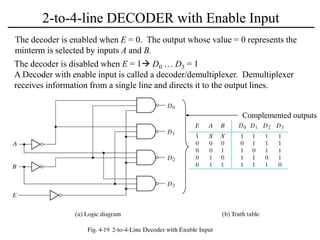
2-to-4-line DECODER with Enable Input
Complemented outputs
The decoder is enabled when E = 0. The output whose value = 0 represents the
minterm is selected by inputs A and B.
The decoder is disabled when E = 1 D0 … D3 = 1
A Decoder with enable input is called a decoder/demultiplexer. Demultiplexer
receives information from a single line and directs it to the output lines.
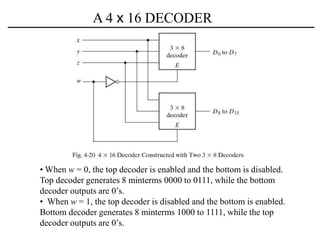
A 4 x 16 DECODER
• When w = 0, the top decoder is enabled and the bottom is disabled.
Top decoder generates 8 minterms 0000 to 0111, while the bottom
decoder outputs are 0’s.
• When w = 1, the top decoder is disabled and the bottom is enabled.
Bottom decoder generates 8 minterms 1000 to 1111, while the top
decoder outputs are 0’s.
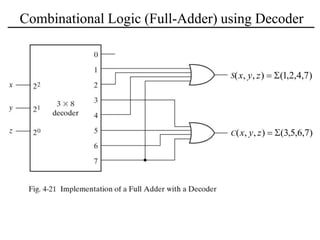
Combinational Logic (Full-Adder) using Decoder
)
7
,
4
,
2
,
1
(
)
,
,
( 

z
y
x
)
7
,
6
,
5
,
3
(
)
,
,
( 

z
y
x
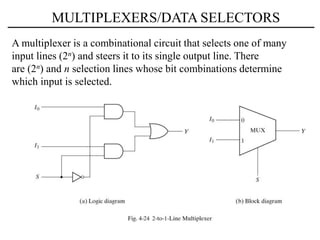
MULTIPLEXERS/DATA SELECTORS
A multiplexer is a combinational circuit that selects one of many
input lines (2n) and steers it to its single output line. There
are (2n) and n selection lines whose bit combinations determine
which input is selected.
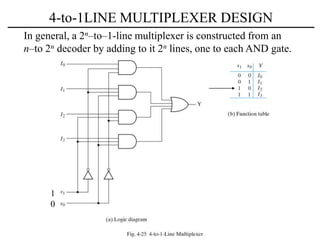
4-to-1LINE MULTIPLEXER DESIGN
1
0
In general, a 2n–to–1-line multiplexer is constructed from an
n–to 2n decoder by adding to it 2n lines, one to each AND gate.
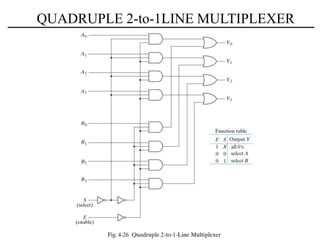
QUADRUPLE 2-to-1LINE MULTIPLEXER
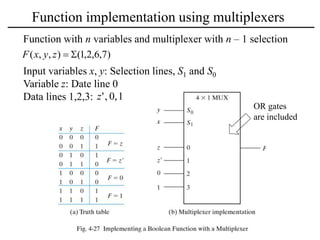
Function implementation using multiplexers
OR gates
are included
)
7
,
6
,
2
,
1
(
)
,
,
( 

z
y
x
F
Function with n variables and multiplexer with n – 1 selection
Input variables x, y: Selection lines, S1 and S0
Variable z: Date line 0
Data lines 1,2,3: 1
,
0
,
'
z
z
z’
0
1
y
x
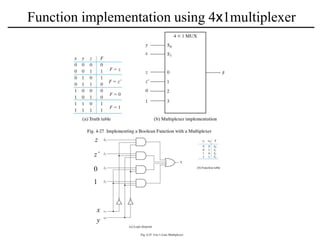
Function implementation using 4x1multiplexer
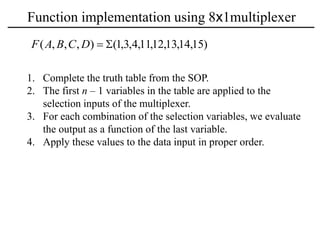
Function implementation using 8x1multiplexer
)
15
,
14
,
13
,
12
,
11
,
4
,
3
,
1
(
)
,
,
,
( 

D
C
B
A
F
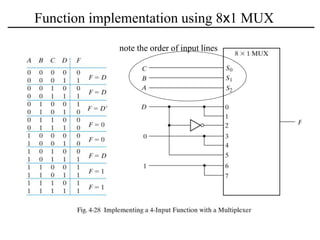
1. Complete the truth table from the SOP.
2. The first n – 1 variables in the table are applied to the
selection inputs of the multiplexer.
3. For each combination of the selection variables, we evaluate
the output as a function of the last variable.
4. Apply these values to the data input in proper order.
Function implementation using 8x1 MUX
note the order of input lines
Three State Gates
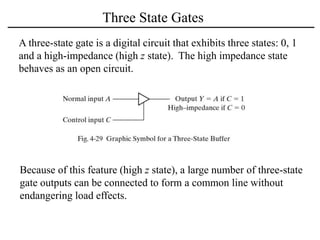
A three-state gate is a digital circuit that exhibits three states: 0, 1
and a high-impedance (high z state). The high impedance state
behaves as an open circuit.
Because of this feature (high z state), a large number of three-state
gate outputs can be connected to form a common line without
endangering load effects.
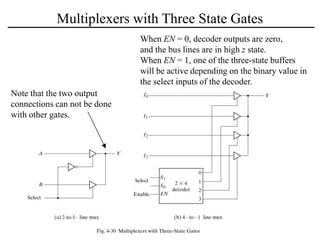
Multiplexers with Three State Gates
Note that the two output
connections can not be done
with other gates.
When EN = 0, decoder outputs are zero,
and the bus lines are in high z state.
When EN = 1, one of the three-state buffers
will be active depending on the binary value in
the select inputs of the decoder.

Magnitude Comparator

  • 1.
    Magnitude Comparator A magnitudecomparator is a combinational circuit that compares two numbers, A and B, and then determines their relative magnitudes. A > B A = B A < B Algorithm Consider two numbers, A and B, with four digits each: 0 1 2 3 0 1 2 3 B B B B B A A A A A   operation AND ) ( 0 1 2 3    x x x x B A For equality to exist, all variables must be equal to 1: i x 3 2, 1, 0, for ' '    i B A B A x i i i i i 1 or 0 if 1      B A B A xi XNOR (note mistake p. 133)
  • 2.
    Magnitude Comparator To determineif A is greater than or less than B, we inspect the relative magnitudes of significant digits. If the two digits are equal, we compare the next lower significant pair of digits. The comparison continues until a pair of unequal digits is reached. The sequential comparison can be expressed by: 0 ' 0 1 2 3 1 ' 1 2 3 2 ' 2 3 3 ' 3 ' 0 0 1 2 3 ' 1 1 2 3 ' 2 2 3 ' 3 3 ) ( ) ( B A x x x B A x x B A x B A B A B A x x x B A x x B A x B A B A           Compare: 1 ) ( 0101 and 1010      B A B A 1 ) ( 1010 and 0101      B A B A
  • 3.
    ' 0 0 1 2 3 ' 1 1 2 3 ' 2 2 3 ' 3 3 B A x x x B A x x B A x B A     0 1 2 3x x x x  0 ' 0 1 2 3 1 ' 1 2 3 2 ' 2 3 3 ' 3 B A x x x B A x x B A x B A     4-bit Magnitude Comparator XNOR
  • 4.
    DECODERS A decoder isa combinational circuit that converts binary information from n input lines to an 2n unique output lines. Applications: • Microprocessor memory system: selecting different banks of memory. • Microprocessor I/O: Selecting different devices. • Microprocessor instruction decoding: Enabling different functional units. • Memory: Decoding memory addresses (e.g. in ROM). • • •
  • 5.
  • 6.
    3-to-8-line DECODER TruthTable D0 D1 D2 D3 D4 D5 D6 D7 0 0 0 1 0 0 0 0 0 0 0 0 0 1 0 1 0 0 0 0 0 0 0 1 0 0 0 1 0 0 0 0 0 0 1 1 0 0 0 1 0 0 0 0 1 0 0 0 0 0 0 1 0 0 0 1 0 1 0 0 0 0 0 1 0 0 1 1 0 0 0 0 0 0 0 1 0 1 1 1 0 0 0 0 0 0 0 1 Binary Inputs Outputs If the input corresponds to minterm mi then the decoder ouputi will be the single asserted output.
  • 7.
    2-to-4-line DECODER withEnable Input Complemented outputs The decoder is enabled when E = 0. The output whose value = 0 represents the minterm is selected by inputs A and B. The decoder is disabled when E = 1 D0 … D3 = 1 A Decoder with enable input is called a decoder/demultiplexer. Demultiplexer receives information from a single line and directs it to the output lines.
  • 8.
    A 4 x16 DECODER • When w = 0, the top decoder is enabled and the bottom is disabled. Top decoder generates 8 minterms 0000 to 0111, while the bottom decoder outputs are 0’s. • When w = 1, the top decoder is disabled and the bottom is enabled. Bottom decoder generates 8 minterms 1000 to 1111, while the top decoder outputs are 0’s.
  • 9.
    Combinational Logic (Full-Adder)using Decoder ) 7 , 4 , 2 , 1 ( ) , , (   z y x ) 7 , 6 , 5 , 3 ( ) , , (   z y x
  • 10.
    MULTIPLEXERS/DATA SELECTORS A multiplexeris a combinational circuit that selects one of many input lines (2n) and steers it to its single output line. There are (2n) and n selection lines whose bit combinations determine which input is selected.
  • 11.
    4-to-1LINE MULTIPLEXER DESIGN 1 0 Ingeneral, a 2n–to–1-line multiplexer is constructed from an n–to 2n decoder by adding to it 2n lines, one to each AND gate.
  • 12.
  • 13.
    Function implementation usingmultiplexers OR gates are included ) 7 , 6 , 2 , 1 ( ) , , (   z y x F Function with n variables and multiplexer with n – 1 selection Input variables x, y: Selection lines, S1 and S0 Variable z: Date line 0 Data lines 1,2,3: 1 , 0 , ' z
  • 14.
  • 15.
    Function implementation using8x1multiplexer ) 15 , 14 , 13 , 12 , 11 , 4 , 3 , 1 ( ) , , , (   D C B A F 1. Complete the truth table from the SOP. 2. The first n – 1 variables in the table are applied to the selection inputs of the multiplexer. 3. For each combination of the selection variables, we evaluate the output as a function of the last variable. 4. Apply these values to the data input in proper order.
  • 16.
    Function implementation using8x1 MUX note the order of input lines
  • 17.
    Three State Gates Athree-state gate is a digital circuit that exhibits three states: 0, 1 and a high-impedance (high z state). The high impedance state behaves as an open circuit. Because of this feature (high z state), a large number of three-state gate outputs can be connected to form a common line without endangering load effects.
  • 18.
    Multiplexers with ThreeState Gates Note that the two output connections can not be done with other gates. When EN = 0, decoder outputs are zero, and the bus lines are in high z state. When EN = 1, one of the three-state buffers will be active depending on the binary value in the select inputs of the decoder.