Change Management Models,
Stakeholder Analysis &
Capacity Building
in
Corporate Reforms
Dr. Elijah Ezendu
FIMC, FCCM, FIIAN, FBDI, FAAFM, FSSM, MIMIS, MIAP, MITD, ACIArb, ACIPM,
PhD, DocM, MBA, CWM, CBDA, CMA, MPM, PME, CSOL, CCIP, CMC, CMgr
“All progress requires change. But not all change
is progress.”
- John Wooden
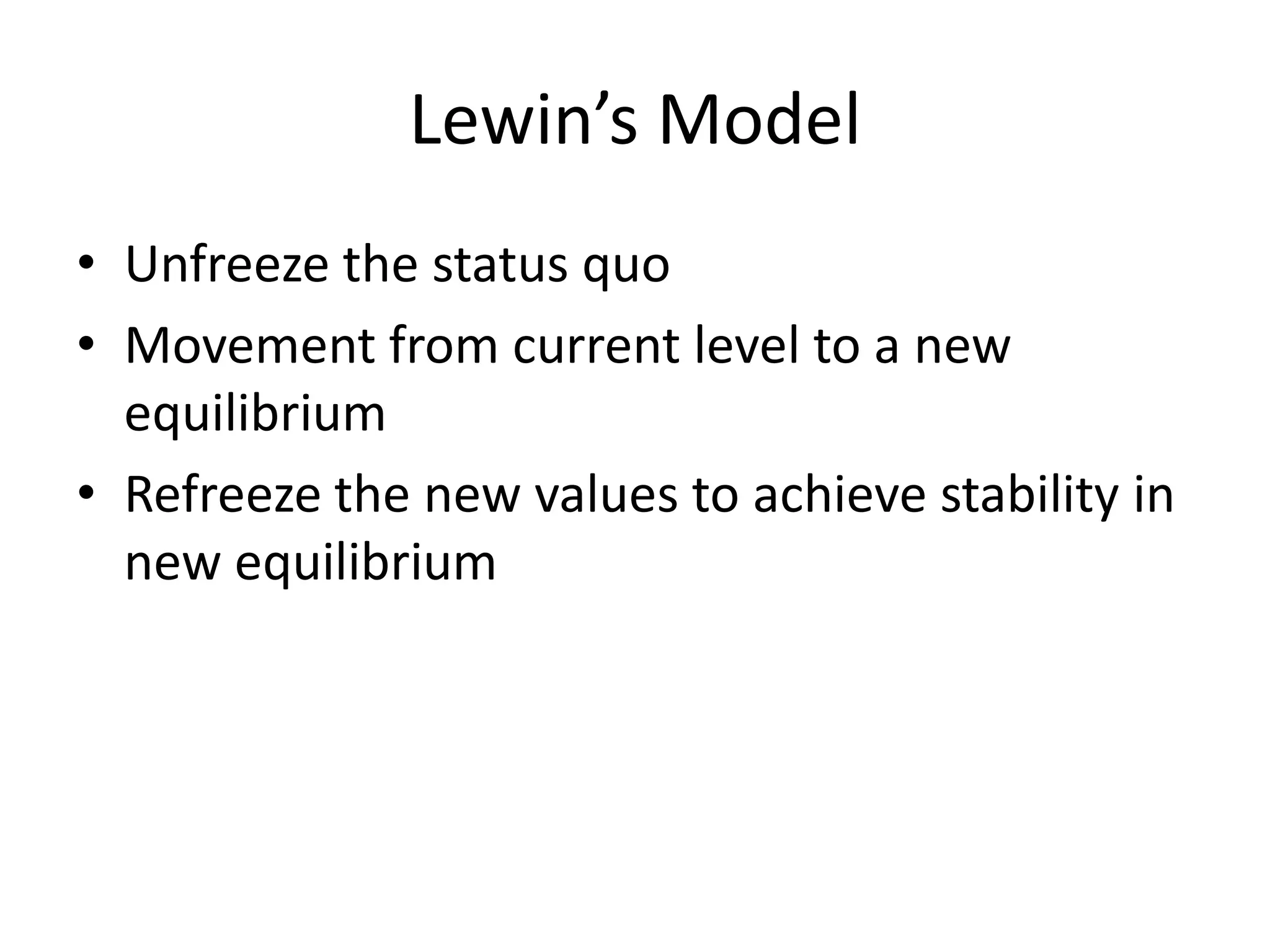
Lewin’s Model
• Unfreeze the status quo
• Movement from current level to a new
equilibrium
• Refreeze the new values to achieve stability in
new equilibrium
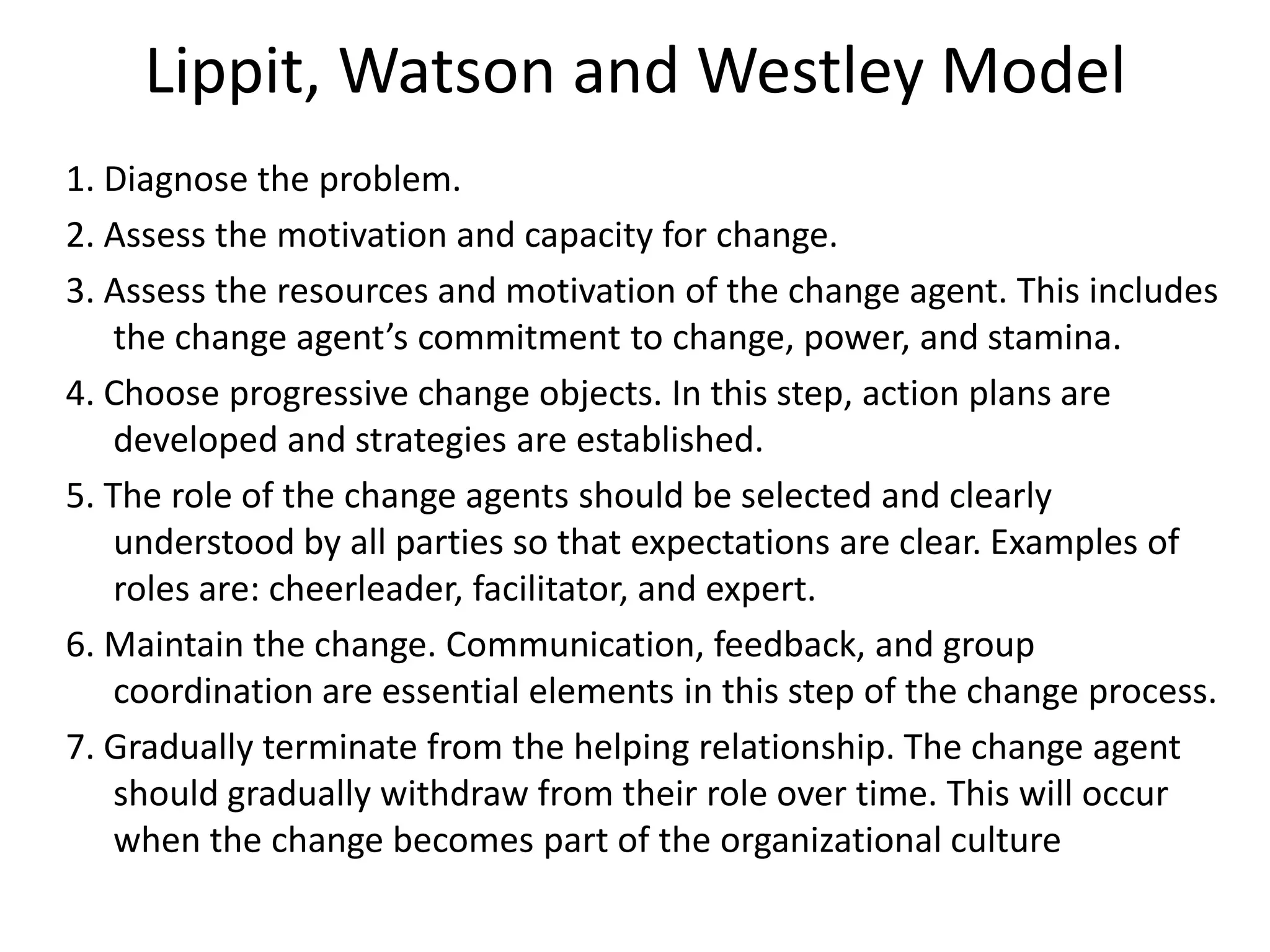
Lippit, Watson and Westley Model
1. Diagnose the problem.
2. Assess the motivation and capacity for change.
3. Assess the resources and motivation of the change agent. This includes
the change agent’s commitment to change, power, and stamina.
4. Choose progressive change objects. In this step, action plans are
developed and strategies are established.
5. The role of the change agents should be selected and clearly
understood by all parties so that expectations are clear. Examples of
roles are: cheerleader, facilitator, and expert.
6. Maintain the change. Communication, feedback, and group
coordination are essential elements in this step of the change process.
7. Gradually terminate from the helping relationship. The change agent
should gradually withdraw from their role over time. This will occur
when the change becomes part of the organizational culture
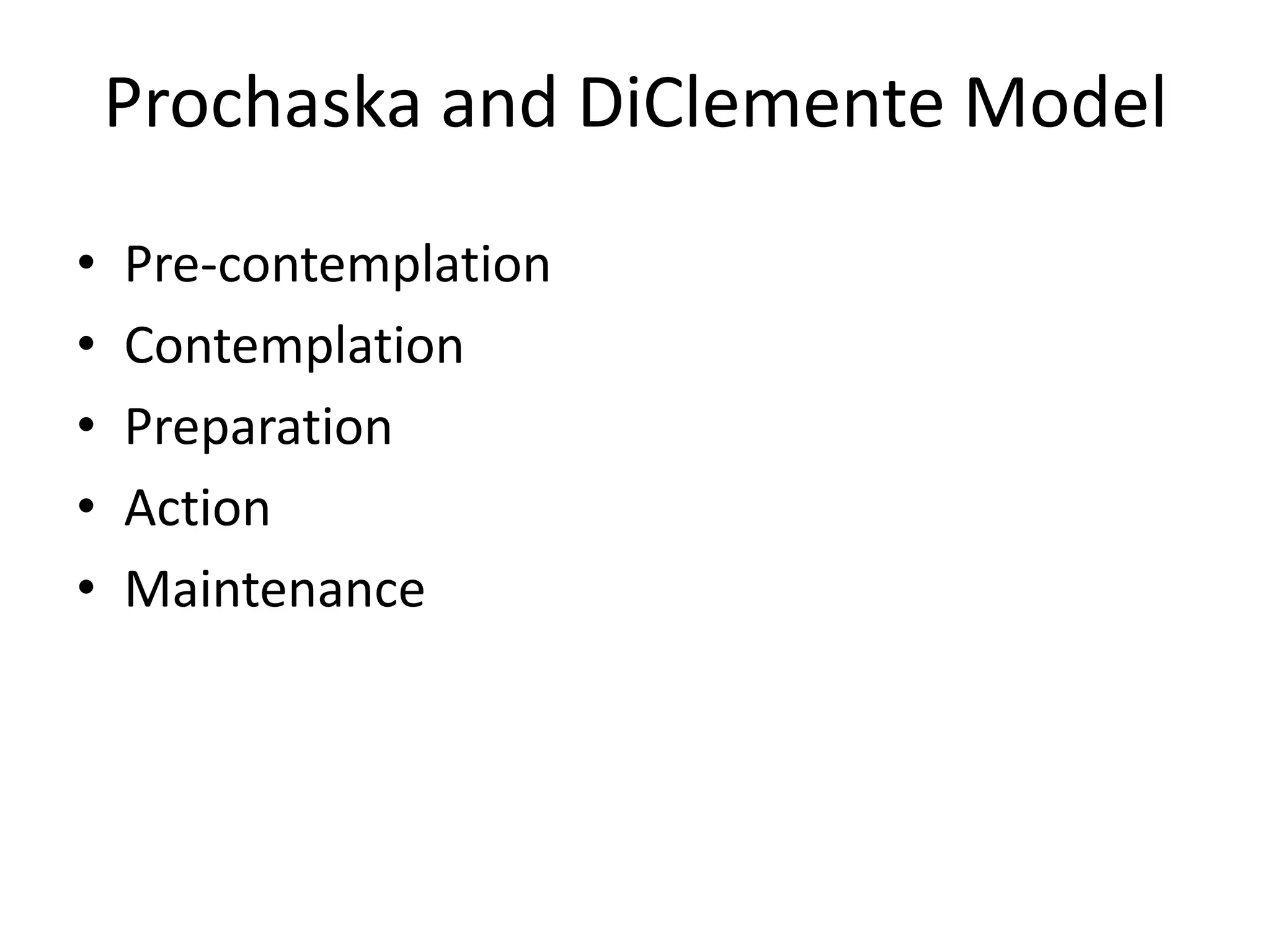
Prochaska and DiClemente Model
• Pre-contemplation
• Contemplation
• Preparation
• Action
• Maintenance
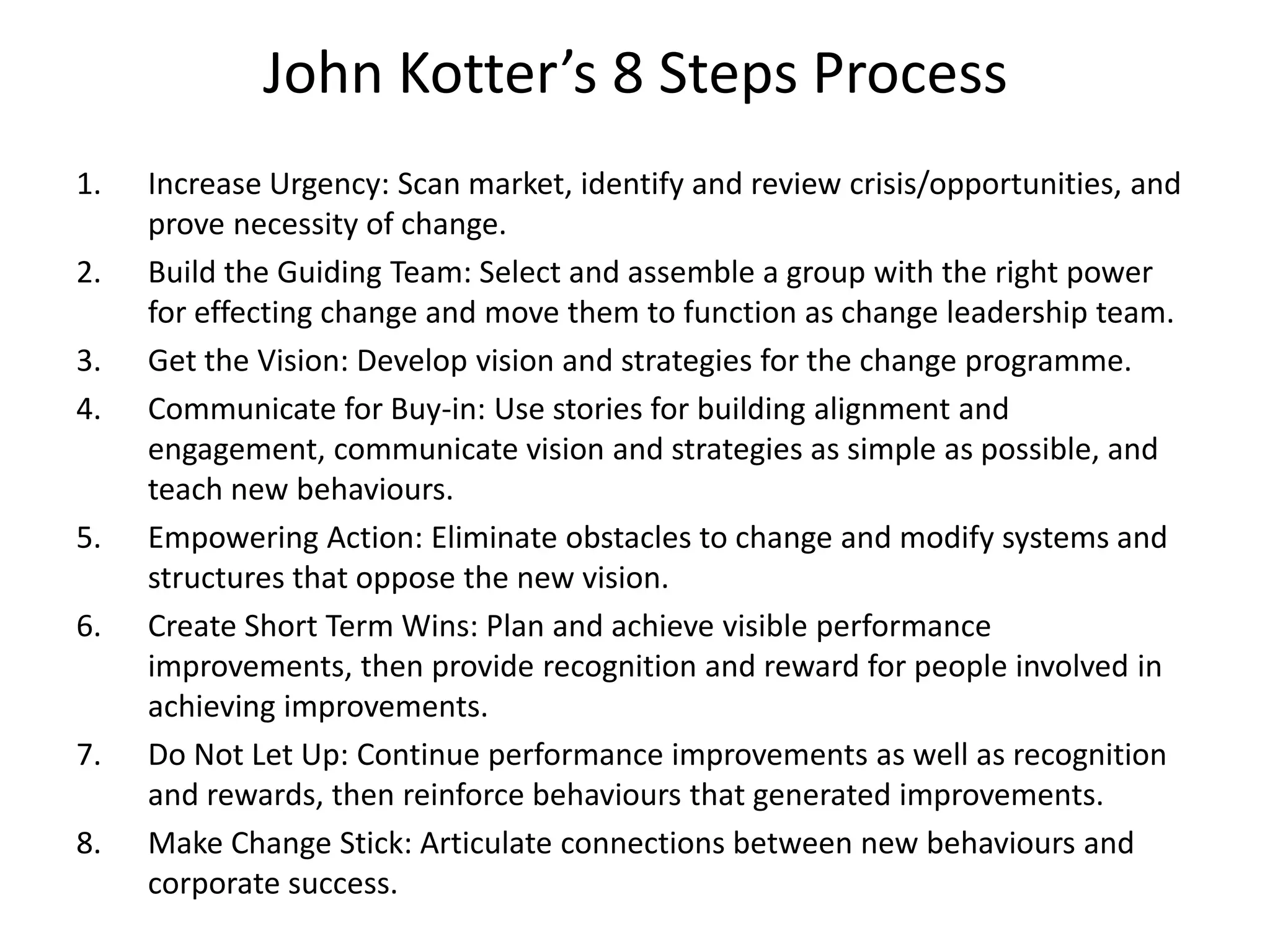
John Kotter’s 8 Steps Process
1. Increase Urgency: Scan market, identify and review crisis/opportunities, and
prove necessity of change.
2. Build the Guiding Team: Select and assemble a group with the right power
for effecting change and move them to function as change leadership team.
3. Get the Vision: Develop vision and strategies for the change programme.
4. Communicate for Buy-in: Use stories for building alignment and
engagement, communicate vision and strategies as simple as possible, and
teach new behaviours.
5. Empowering Action: Eliminate obstacles to change and modify systems and
structures that oppose the new vision.
6. Create Short Term Wins: Plan and achieve visible performance
improvements, then provide recognition and reward for people involved in
achieving improvements.
7. Do Not Let Up: Continue performance improvements as well as recognition
and rewards, then reinforce behaviours that generated improvements.
8. Make Change Stick: Articulate connections between new behaviours and
corporate success.
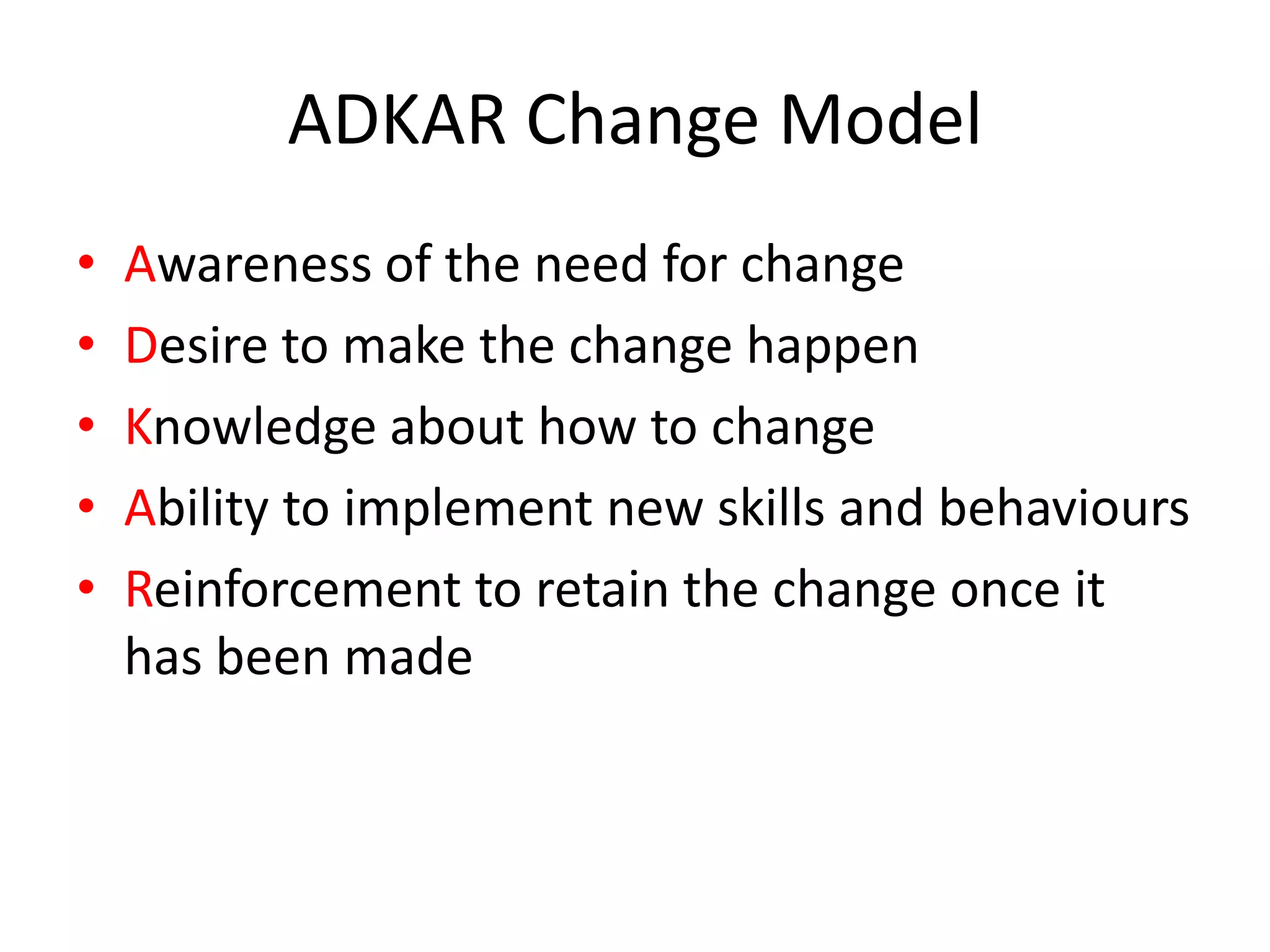
ADKAR Change Model
• Awareness of the need for change
• Desire to make the change happen
• Knowledge about how to change
• Ability to implement new skills and behaviours
• Reinforcement to retain the change once it
has been made
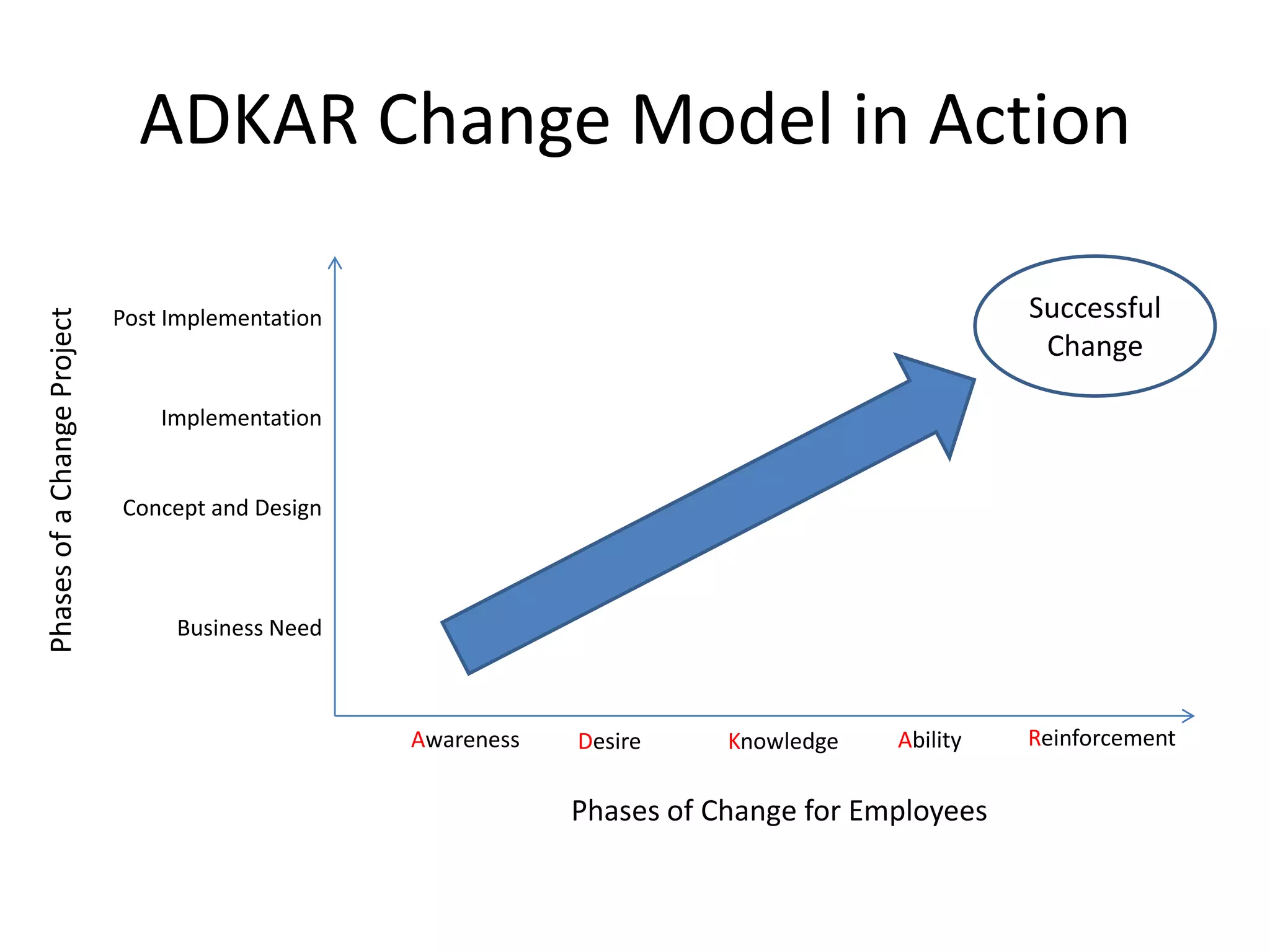
ADKAR Change Model in Action
Post Implementation
Implementation
Concept and Design
Business Need
Awareness Desire Knowledge Ability Reinforcement
Phases of Change for Employees
PhasesofaChangeProject
Successful
Change
Exploratory Engagement
Apply ADKAR change model on a simple change project involving
introduction of process enhancement software in your department.
1.Awareness: List why the change is compulsory and rate awareness of
members of the department on a scale of 1-5.
2.Desire: List good or bad factors that stimulate desire to make change
happen and rate them on a scale of 1-5.
3.Knowledge: List the competence/knowledge and skills required for
implementing the change and rate every member of the department with
regards to possessing stated requirements on a scale of 1-5.
4.Ability: Assess every member of department on ability to perform or act
on the afore-stated knowledge and rate them using a scale of 1-5.
5.Reinforcement: List the reinforcements that will stimulate retention of
the change and rate the reinforcements on a scale of 1-5.
Kubler-Ross Change Model
• Denial
• Anger
• Bargaining
• Depression
• Acceptance
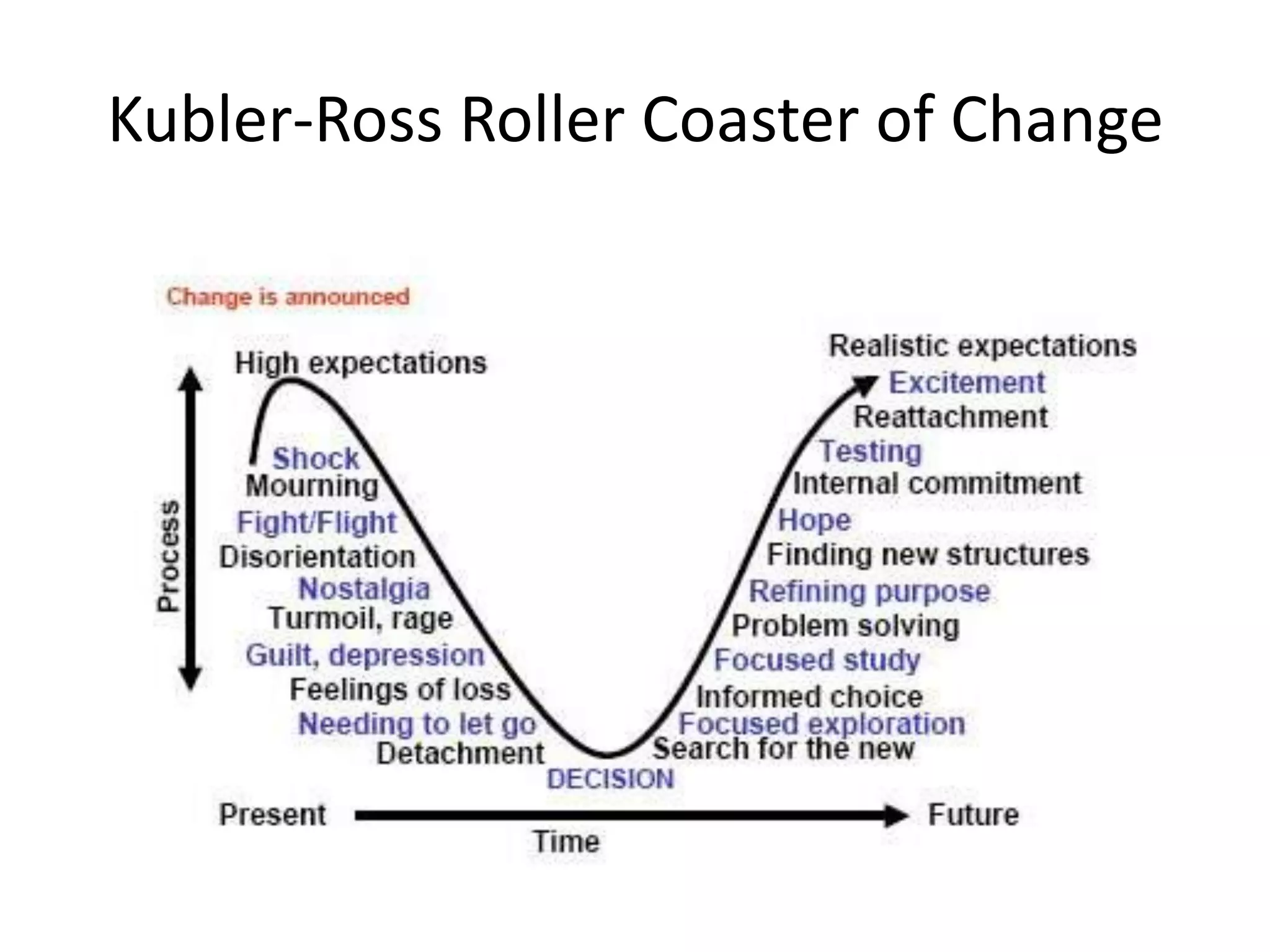
Kubler-Ross Roller Coaster of Change
Richard Beckhard Change Model
• Determining the need for change
• Articulating a desired future
• Assessing the present and what needs to be
changed in order to move to the desired
future
• Getting to the desired future by managing the
transition
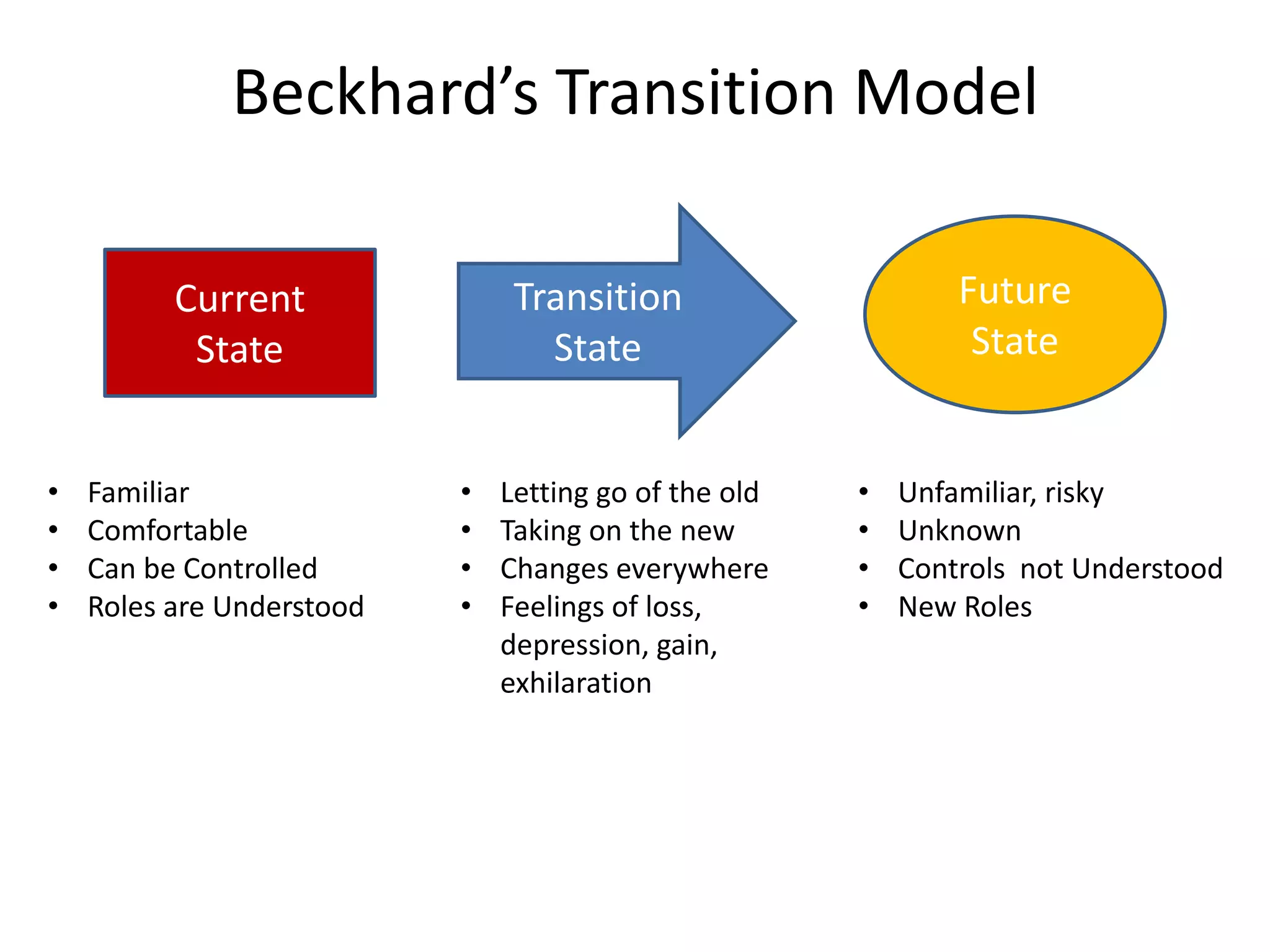
Beckhard’s Transition Model
Current
State
Transition
State
Future
State
• Familiar
• Comfortable
• Can be Controlled
• Roles are Understood
• Letting go of the old
• Taking on the new
• Changes everywhere
• Feelings of loss,
depression, gain,
exhilaration
• Unfamiliar, risky
• Unknown
• Controls not Understood
• New Roles
“A change can work only if the people affected
by it can get through the transition it causes
successfully.”
- William Bridges
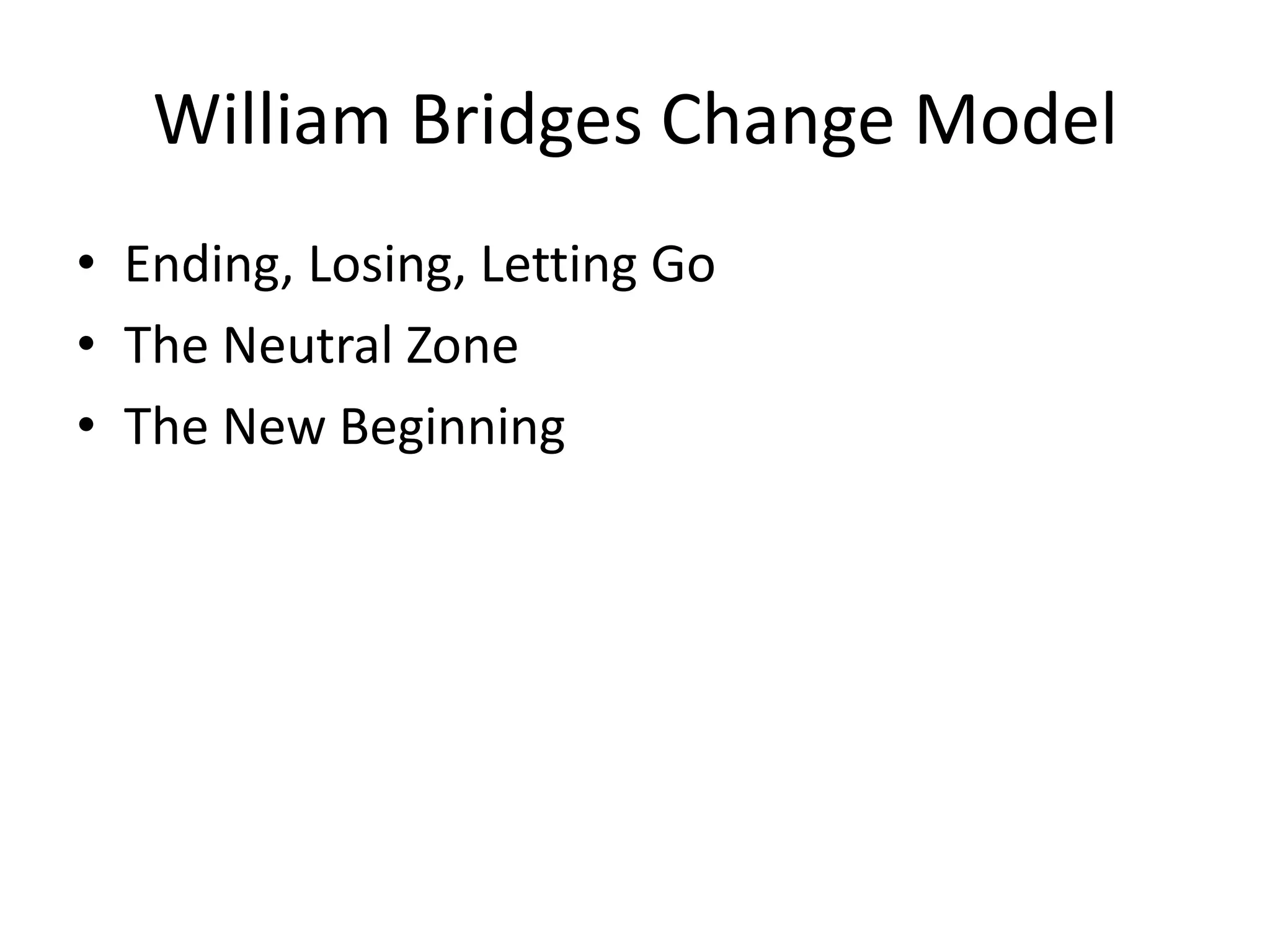
William Bridges Change Model
• Ending, Losing, Letting Go
• The Neutral Zone
• The New Beginning
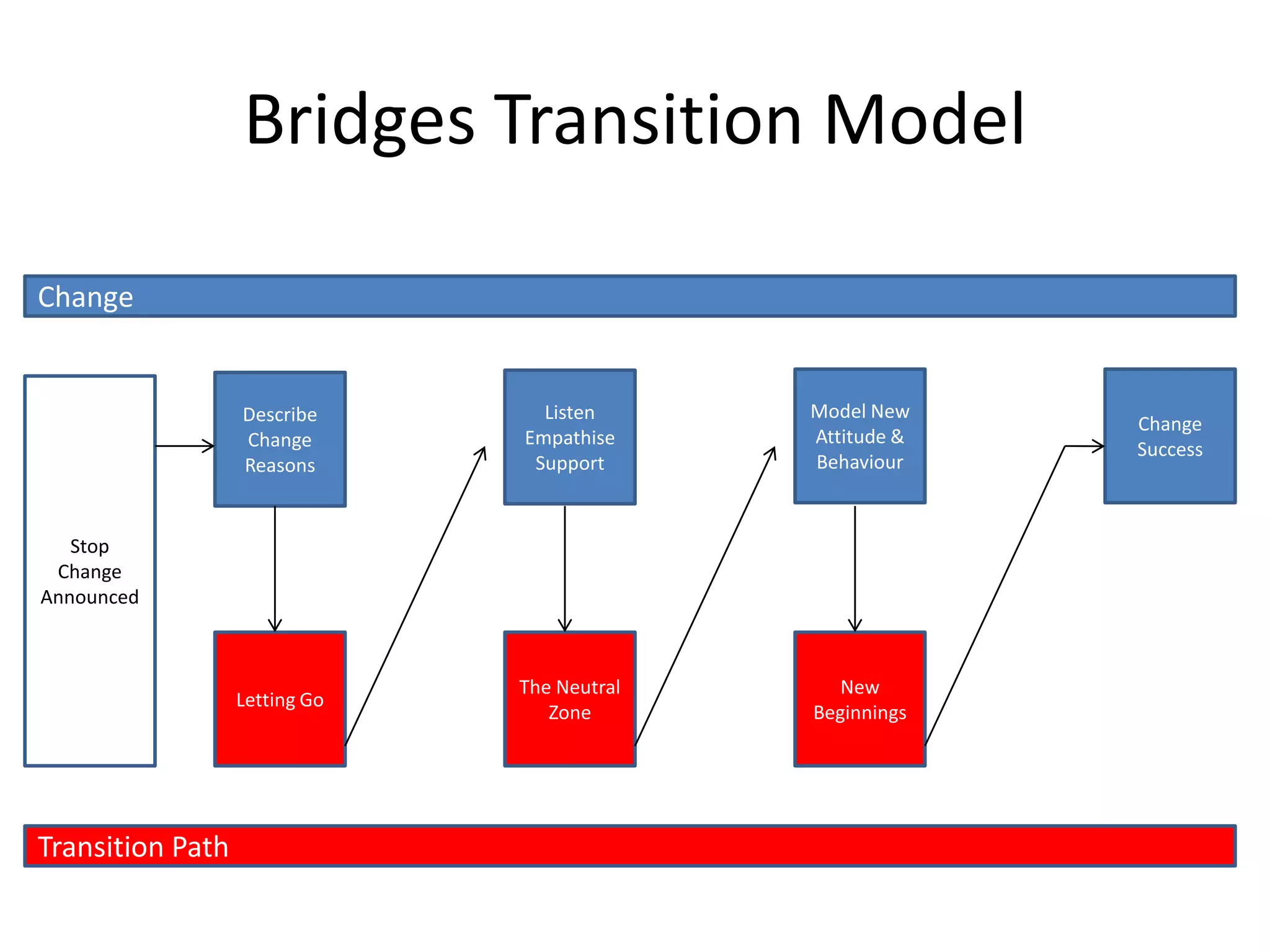
Bridges Transition Model
Stop
Change
Announced
Describe
Change
Reasons
Letting Go
Change
Success
New
Beginnings
Model New
Attitude &
Behaviour
Listen
Empathise
Support
The Neutral
Zone
Change
Transition Path
Similarity and Difference between
Bridges and Lewin’s Model
• Similarity: They are three step processes from
commencement through a mid point to the
end.
• Difference: Bridges model focus on
stimulating people to discover, accept and
embrace their new identities in the new
situation while Lewin’s model provides path
for institutionalising the required behaviour.
“The renewable leader is one who enacts
strategic advantage by building people and
teams who are friendly to change, who adapt
quickly and appropriately to opportunity and
crisis."
- Lisa Jackson and Gerry Schmidt
Edwin Cornelius Snapshot of Change
Readiness that Renewable Leaders
Should Institutionalise
• A workforce that is business literate
• A workforce that has permission to act
• A workforce that will challenge the status quo
• Leadership that encourages a ‘readiness for
change’ culture.
Adapted from Cornelius and Associates
“The definition of a good change management
team is a group of people who know what to
change, know how to accomplish that change
and, above all, carry it out. It helps to operate
technical change under a cultural banner.”
- Robert Heller
Stakeholder Analysis
This is a process of identifying influence,
position, importance and behaviour of
stakeholders, in order to determine necessary
action for the success of intended
programme/project/assignment.
Stakeholder Analysis in
Change Management
Stakeholder analysis provides for identification
of every stakeholder (human, organisational,
institutional, governmental and biota) that
would be impacted by a change programme,
and how each of the stakeholders would
impinge on the same change programme.
How to Conduct Stakeholder Analysis 1
Step 1: Identify relevant stakeholders
Step 2: Ascertain relationships between stakeholders.
Step 3: Identify Interests of each stakeholder.
Step 4: Identify implication of action
Step 5: Ascertain necessary action of organisation
How to Conduct Stakeholder Analysis
2
• Plan
• Establish clear policy framework
• Identify the main stakeholders
• Gather information
• Stakeholder survey
• Arrange findings on stakeholder table
• Ascertain relative importance, influence and
interests of stakeholders
• Recommend fitting action for project and
programmes.
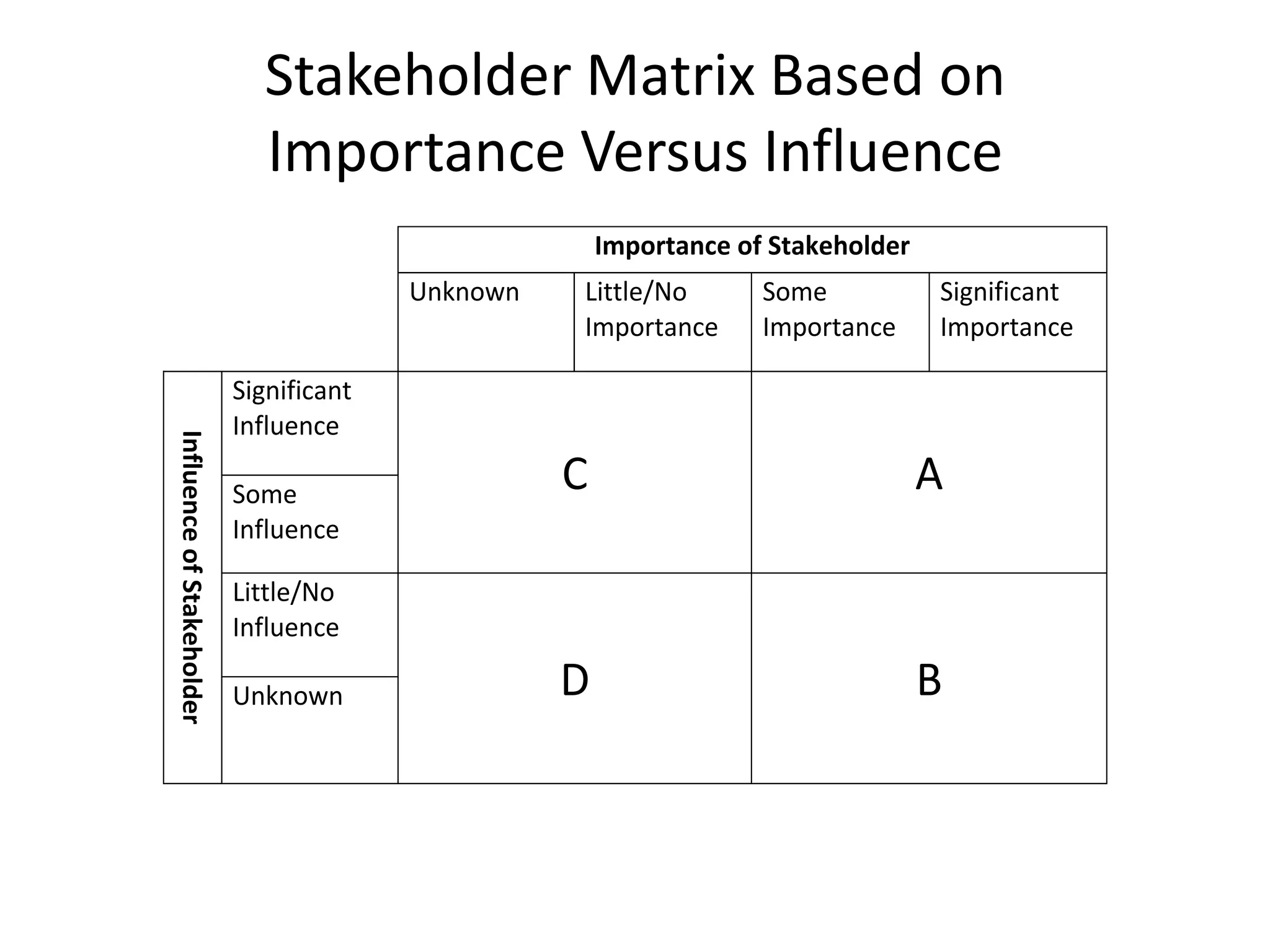
Stakeholder Matrix Based on
Importance Versus Influence
Importance of Stakeholder
Unknown Little/No
Importance
Some
Importance
Significant
Importance
InfluenceofStakeholder
Significant
Influence
C ASome
Influence
Little/No
Influence
D BUnknown
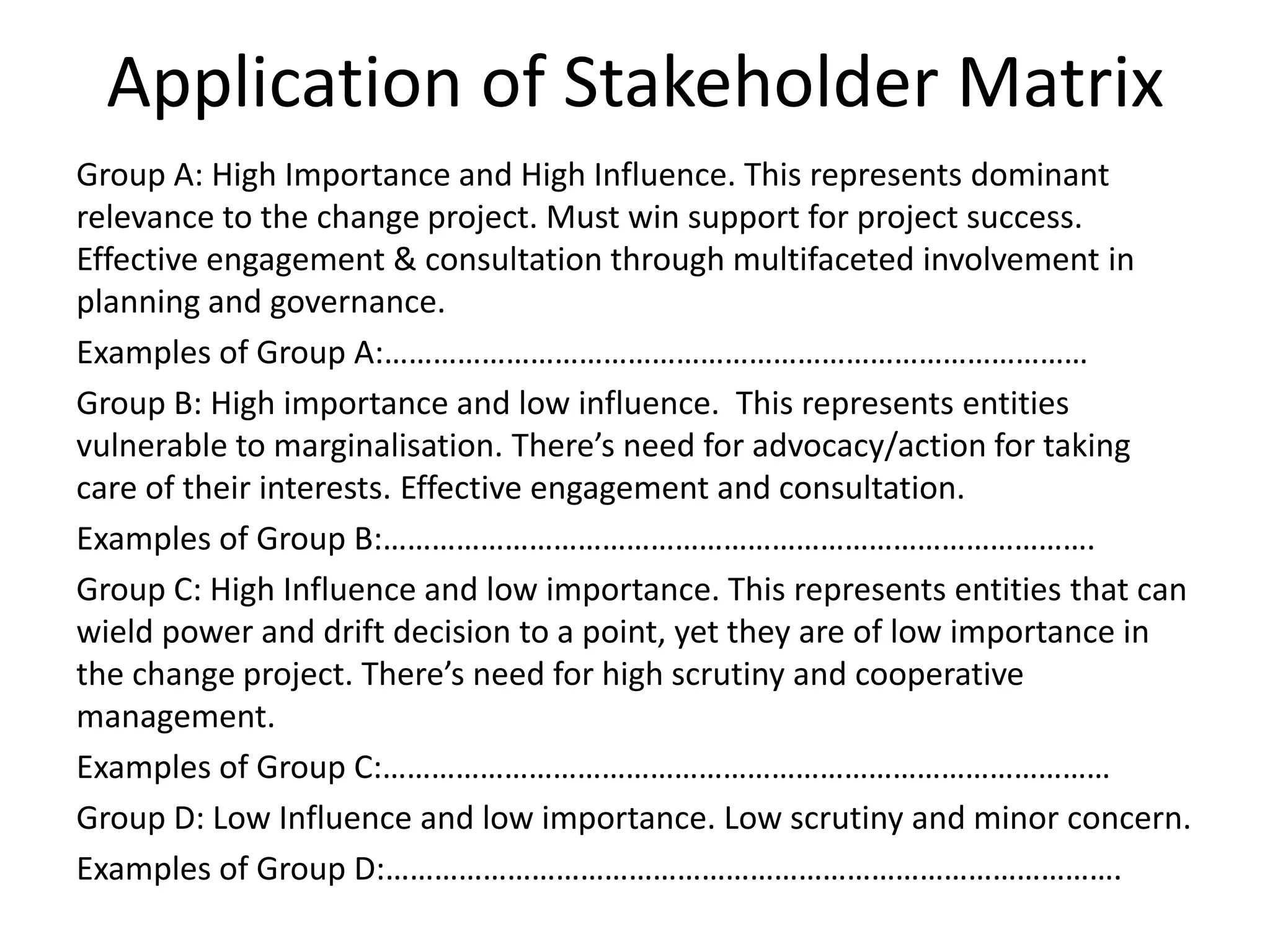
Application of Stakeholder Matrix
Group A: High Importance and High Influence. This represents dominant
relevance to the change project. Must win support for project success.
Effective engagement & consultation through multifaceted involvement in
planning and governance.
Examples of Group A:……………………………………………………………………………
Group B: High importance and low influence. This represents entities
vulnerable to marginalisation. There’s need for advocacy/action for taking
care of their interests. Effective engagement and consultation.
Examples of Group B:…………………………………………………………………………….
Group C: High Influence and low importance. This represents entities that can
wield power and drift decision to a point, yet they are of low importance in
the change project. There’s need for high scrutiny and cooperative
management.
Examples of Group C:………………………………………………………………………………
Group D: Low Influence and low importance. Low scrutiny and minor
concern.
Examples of Group D:……………………………………………………………………………….
Other Factors in Stakeholder Management
• Interests
• Impact of Change
• Reaction to Change
• New Disposition, Behaviour, Skill or
Competence
• Barriers or Resistance
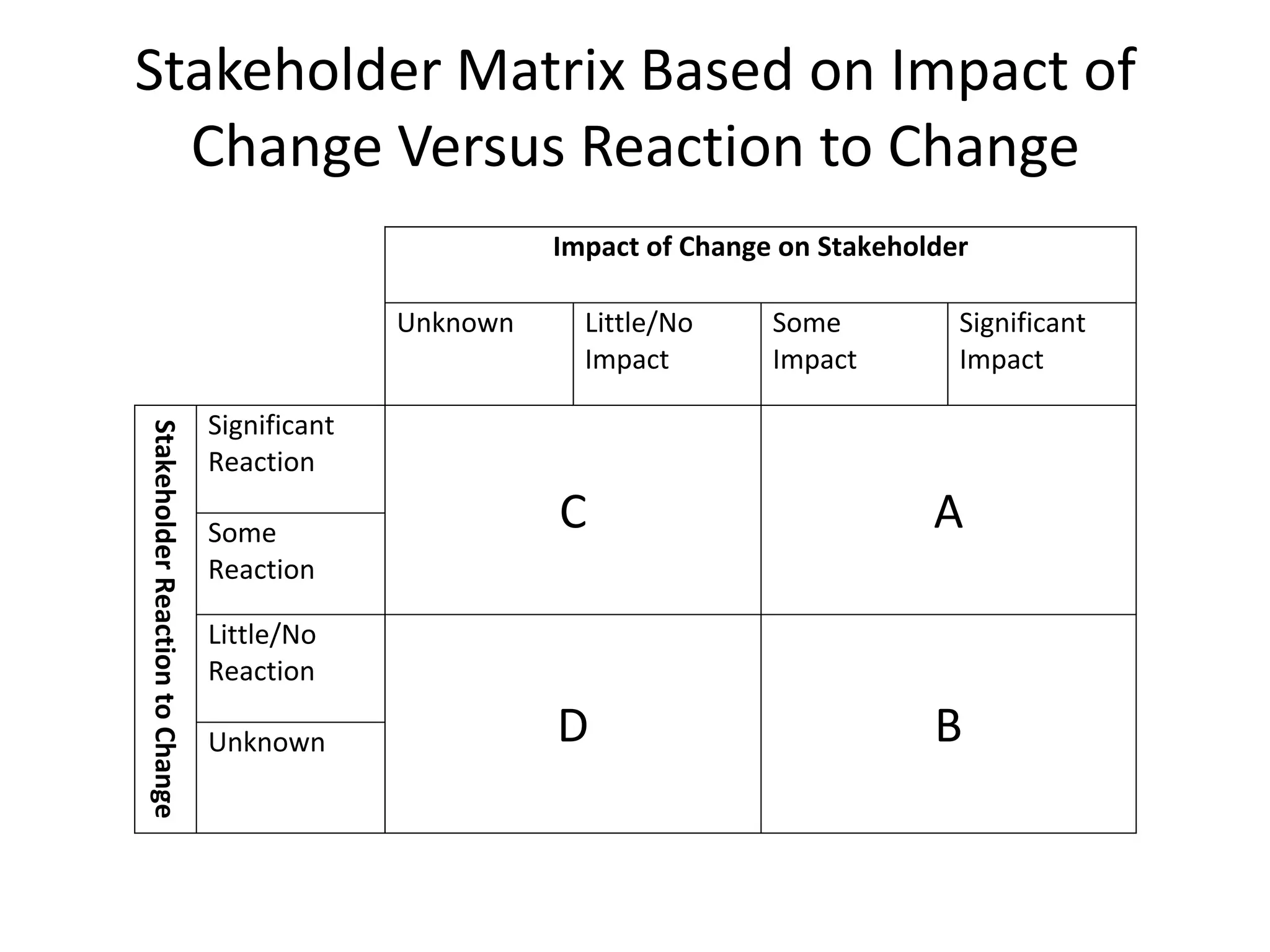
Stakeholder Matrix Based on Impact of
Change Versus Reaction to Change
Impact of Change on Stakeholder
Unknown Little/No
Impact
Some
Impact
Significant
Impact
StakeholderReactiontoChange
Significant
Reaction
C ASome
Reaction
Little/No
Reaction
D BUnknown
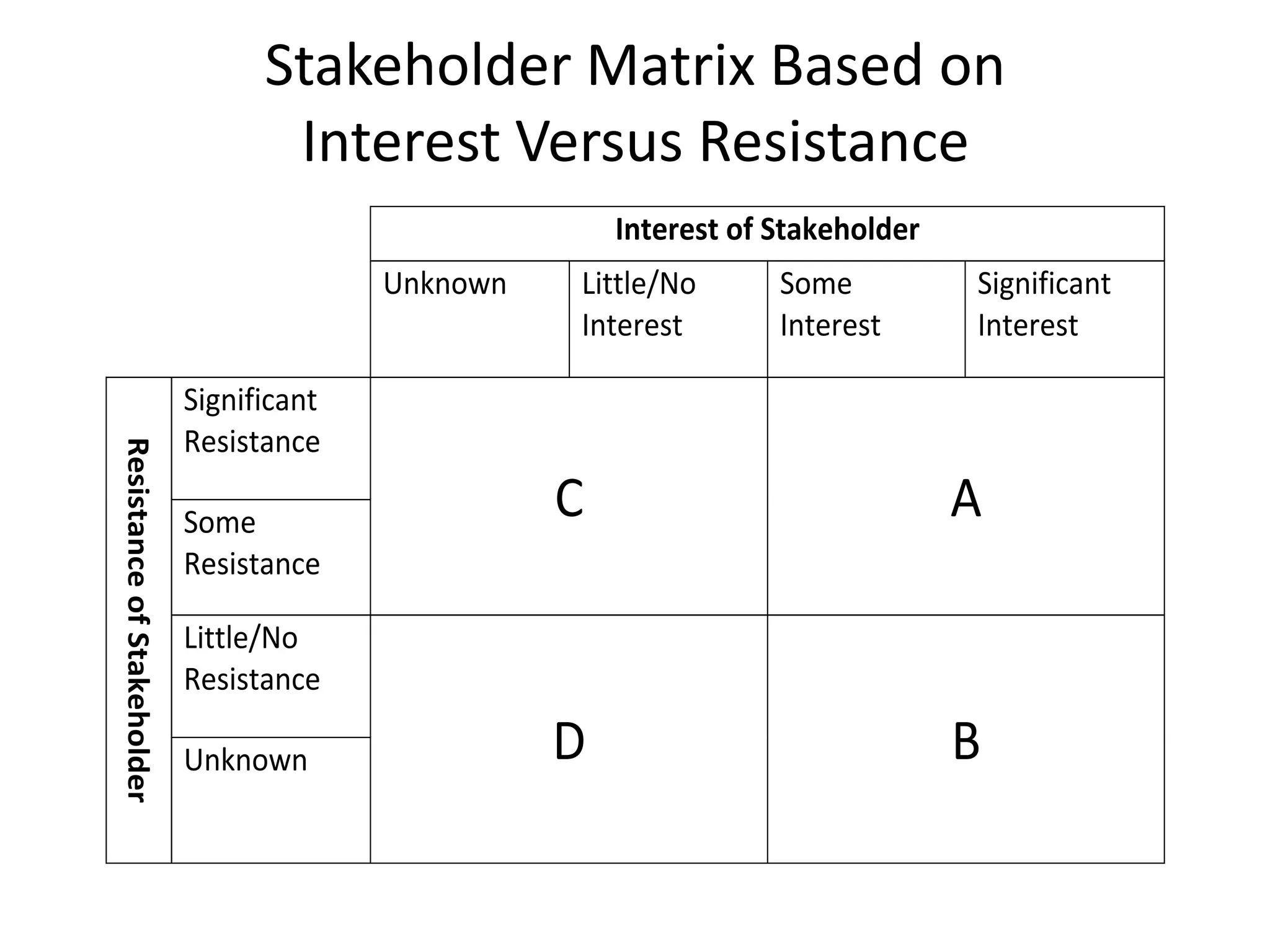
Stakeholder Matrix Based on
Interest Versus Resistance
Interest of Stakeholder
Unknown Little/No
Interest
Some
Interest
Significant
Interest
ResistanceofStakeholder
Significant
Resistance
C ASome
Resistance
Little/No
Resistance
D BUnknown
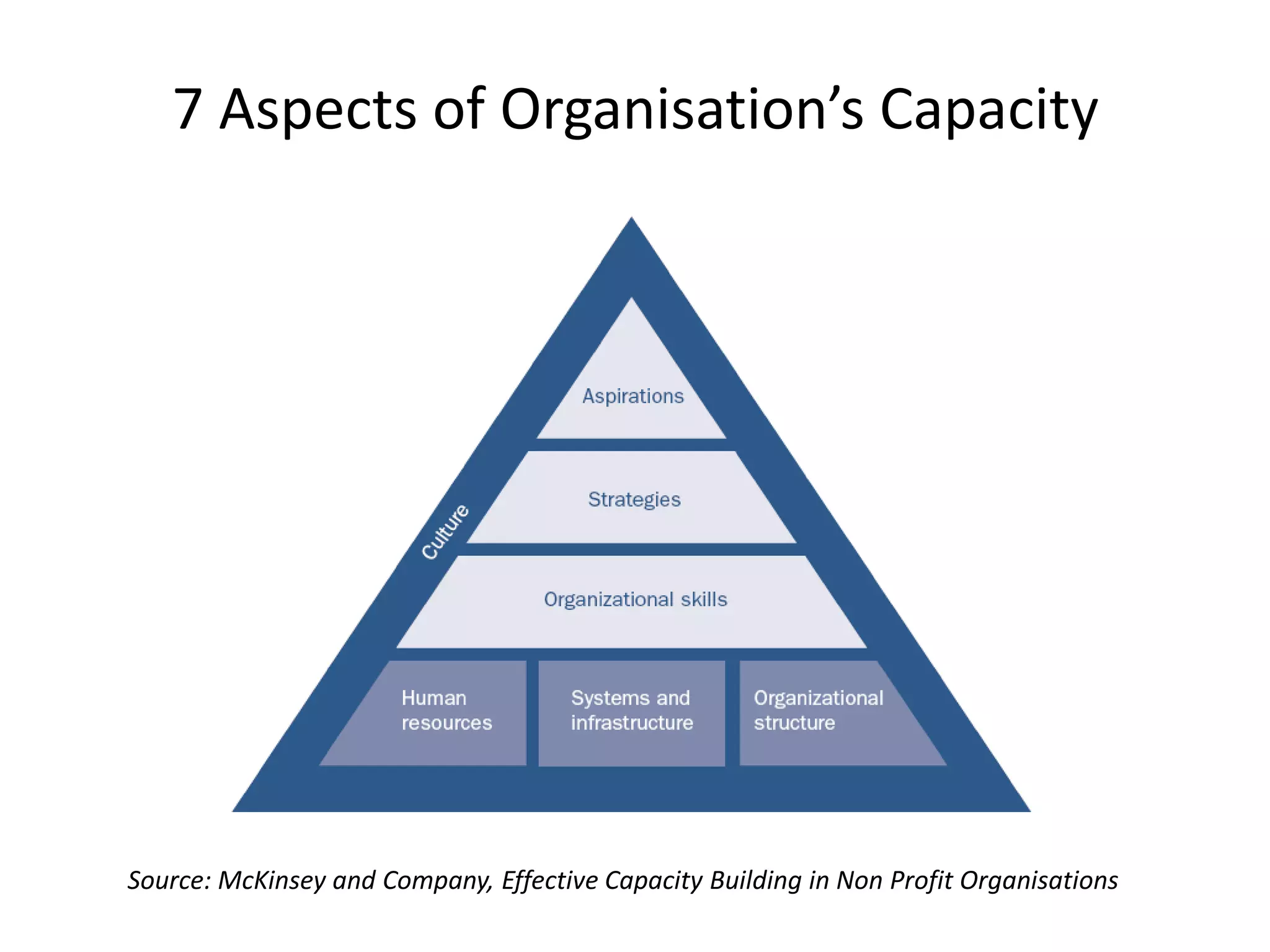
7 Aspects of Organisation’s Capacity
Source: McKinsey and Company, Effective Capacity Building in Non Profit Organisations
Capacity Building for Change Project
Capacity building for change project must
involve workable action plan for putting up
requirement in all aspects of organisational
capacity viz. culture, human resources,
aspirations, strategies, organisational skills,
organisational structure, systems and
infrastructure.
Key Questions for Capacity
Building
• What culture is in place?
• Can the personnel cope with the new frontier?
• What sort of aggregate and individual aspirations exist in your
organisation?
• Have you developed the right strategies for effecting the
change programme?
• Do the people have the right skill-set/competence for
embracing the new work processes?
• Is the current organisational structure appropriate for
attainment of goals of the envisioned change programme?
• Do the systems and infrastructure fit the new processes?
Dr Elijah Ezendu is Award-Winning Business Expert & Certified Management Consultant with expertise
in Interim Management, Strategy, Competitive Intelligence, Transformation, Restructuring, Turnaround
Management, Business Development, Marketing, Project & Cost Management, Leadership, HR, CSR, e-
Business & Software Architecture. He had functioned as Founder, Initiative for Sustainable Business
Equity; Chairman of Board, Charisma Broadcast Film Academy; Group Chief Operating Officer, Idova
Group; CEO, Rubiini (UAE); Special Advisor, RTEAN; Director, MMNA Investments; Chair, Int’l Board of
GCC Business Council (UAE); Senior Partner, Shevach Consulting; Chairman (Certification & Training),
Coordinator (Board of Fellows), Lead Assessor & Governing Council Member, Institute of Management
Consultants, Nigeria; Lead Resource, Centre for Competitive Intelligence Development; Lead
Consultant/ Partner, JK Michaels; Turnaround Project Director, Consolidated Business Holdings Limited;
Technical Director, Gestalt; Chief Operating Officer, Rohan Group; Executive Director (Various Roles),
Fortuna, Gambia & Malta; Chief Advisor/ Partner, D & E; Vice Chairman of Board, Refined Shipping;
Director of Programmes & Governing Council Member, Institute of Business Development, Nigeria;
Member of TDD Committee, International Association of Software Architects, USA; Member of Strategic
Planning and Implementation Committee, Chartered Institute of Personnel Management of Nigeria;
Country Manager (Nigeria) & Adjunct Faculty (MBA Programme), Regent Business School, South Africa;
Adjunct Faculty (MBA Programme), Ladoke Akintola University of Technology; Editor-in-Chief, Cost
Management Journal; Council Member, Institute of Internal Auditors of Nigeria; Member, Board of
Directors (Several Organizations). He holds Doctoral Degree in Management, Master of Business
Administration and Fellow of Professional Institutes in North America, UK & Nigeria. He is Innovator of
Corporate Investment Structure Based on Financials and Intangibles, for valuation highlighting
intangible contributions of host communities and ecological environment: A model celebrated globally
as remedy for unmitigated depreciation of ecological capital and developmental deprivation of host
communities. He had served as Examiner to Professional Institutes and Universities. He had been a
member of Guild of Soundtrack Producers of Nigeria. He's an author and extensively featured speaker.
Thank You

Change Management Models, Stakeholder Analysis & Capacity Building in Corporate Reforms

  • 1.
    Change Management Models, StakeholderAnalysis & Capacity Building in Corporate Reforms Dr. Elijah Ezendu FIMC, FCCM, FIIAN, FBDI, FAAFM, FSSM, MIMIS, MIAP, MITD, ACIArb, ACIPM, PhD, DocM, MBA, CWM, CBDA, CMA, MPM, PME, CSOL, CCIP, CMC, CMgr
  • 2.
    “All progress requireschange. But not all change is progress.” - John Wooden
  • 3.
    Lewin’s Model • Unfreezethe status quo • Movement from current level to a new equilibrium • Refreeze the new values to achieve stability in new equilibrium
  • 4.
    Lippit, Watson andWestley Model 1. Diagnose the problem. 2. Assess the motivation and capacity for change. 3. Assess the resources and motivation of the change agent. This includes the change agent’s commitment to change, power, and stamina. 4. Choose progressive change objects. In this step, action plans are developed and strategies are established. 5. The role of the change agents should be selected and clearly understood by all parties so that expectations are clear. Examples of roles are: cheerleader, facilitator, and expert. 6. Maintain the change. Communication, feedback, and group coordination are essential elements in this step of the change process. 7. Gradually terminate from the helping relationship. The change agent should gradually withdraw from their role over time. This will occur when the change becomes part of the organizational culture
  • 5.
    Prochaska and DiClementeModel • Pre-contemplation • Contemplation • Preparation • Action • Maintenance
  • 6.
    John Kotter’s 8Steps Process 1. Increase Urgency: Scan market, identify and review crisis/opportunities, and prove necessity of change. 2. Build the Guiding Team: Select and assemble a group with the right power for effecting change and move them to function as change leadership team. 3. Get the Vision: Develop vision and strategies for the change programme. 4. Communicate for Buy-in: Use stories for building alignment and engagement, communicate vision and strategies as simple as possible, and teach new behaviours. 5. Empowering Action: Eliminate obstacles to change and modify systems and structures that oppose the new vision. 6. Create Short Term Wins: Plan and achieve visible performance improvements, then provide recognition and reward for people involved in achieving improvements. 7. Do Not Let Up: Continue performance improvements as well as recognition and rewards, then reinforce behaviours that generated improvements. 8. Make Change Stick: Articulate connections between new behaviours and corporate success.
  • 7.
    ADKAR Change Model •Awareness of the need for change • Desire to make the change happen • Knowledge about how to change • Ability to implement new skills and behaviours • Reinforcement to retain the change once it has been made
  • 8.
    ADKAR Change Modelin Action Post Implementation Implementation Concept and Design Business Need Awareness Desire Knowledge Ability Reinforcement Phases of Change for Employees PhasesofaChangeProject Successful Change
  • 9.
    Exploratory Engagement Apply ADKARchange model on a simple change project involving introduction of process enhancement software in your department. 1.Awareness: List why the change is compulsory and rate awareness of members of the department on a scale of 1-5. 2.Desire: List good or bad factors that stimulate desire to make change happen and rate them on a scale of 1-5. 3.Knowledge: List the competence/knowledge and skills required for implementing the change and rate every member of the department with regards to possessing stated requirements on a scale of 1-5. 4.Ability: Assess every member of department on ability to perform or act on the afore-stated knowledge and rate them using a scale of 1-5. 5.Reinforcement: List the reinforcements that will stimulate retention of the change and rate the reinforcements on a scale of 1-5.
  • 10.
    Kubler-Ross Change Model •Denial • Anger • Bargaining • Depression • Acceptance
  • 11.
  • 12.
    Richard Beckhard ChangeModel • Determining the need for change • Articulating a desired future • Assessing the present and what needs to be changed in order to move to the desired future • Getting to the desired future by managing the transition
  • 13.
    Beckhard’s Transition Model Current State Transition State Future State •Familiar • Comfortable • Can be Controlled • Roles are Understood • Letting go of the old • Taking on the new • Changes everywhere • Feelings of loss, depression, gain, exhilaration • Unfamiliar, risky • Unknown • Controls not Understood • New Roles
  • 14.
    “A change canwork only if the people affected by it can get through the transition it causes successfully.” - William Bridges
  • 15.
    William Bridges ChangeModel • Ending, Losing, Letting Go • The Neutral Zone • The New Beginning
  • 16.
    Bridges Transition Model Stop Change Announced Describe Change Reasons LettingGo Change Success New Beginnings Model New Attitude & Behaviour Listen Empathise Support The Neutral Zone Change Transition Path
  • 17.
    Similarity and Differencebetween Bridges and Lewin’s Model • Similarity: They are three step processes from commencement through a mid point to the end. • Difference: Bridges model focus on stimulating people to discover, accept and embrace their new identities in the new situation while Lewin’s model provides path for institutionalising the required behaviour.
  • 18.
    “The renewable leaderis one who enacts strategic advantage by building people and teams who are friendly to change, who adapt quickly and appropriately to opportunity and crisis." - Lisa Jackson and Gerry Schmidt
  • 19.
    Edwin Cornelius Snapshotof Change Readiness that Renewable Leaders Should Institutionalise • A workforce that is business literate • A workforce that has permission to act • A workforce that will challenge the status quo • Leadership that encourages a ‘readiness for change’ culture. Adapted from Cornelius and Associates
  • 20.
    “The definition ofa good change management team is a group of people who know what to change, know how to accomplish that change and, above all, carry it out. It helps to operate technical change under a cultural banner.” - Robert Heller
  • 21.
    Stakeholder Analysis This isa process of identifying influence, position, importance and behaviour of stakeholders, in order to determine necessary action for the success of intended programme/project/assignment.
  • 22.
    Stakeholder Analysis in ChangeManagement Stakeholder analysis provides for identification of every stakeholder (human, organisational, institutional, governmental and biota) that would be impacted by a change programme, and how each of the stakeholders would impinge on the same change programme.
  • 23.
    How to ConductStakeholder Analysis 1 Step 1: Identify relevant stakeholders Step 2: Ascertain relationships between stakeholders. Step 3: Identify Interests of each stakeholder. Step 4: Identify implication of action Step 5: Ascertain necessary action of organisation
  • 24.
    How to ConductStakeholder Analysis 2 • Plan • Establish clear policy framework • Identify the main stakeholders • Gather information • Stakeholder survey • Arrange findings on stakeholder table • Ascertain relative importance, influence and interests of stakeholders • Recommend fitting action for project and programmes.
  • 25.
    Stakeholder Matrix Basedon Importance Versus Influence Importance of Stakeholder Unknown Little/No Importance Some Importance Significant Importance InfluenceofStakeholder Significant Influence C ASome Influence Little/No Influence D BUnknown
  • 26.
    Application of StakeholderMatrix Group A: High Importance and High Influence. This represents dominant relevance to the change project. Must win support for project success. Effective engagement & consultation through multifaceted involvement in planning and governance. Examples of Group A:…………………………………………………………………………… Group B: High importance and low influence. This represents entities vulnerable to marginalisation. There’s need for advocacy/action for taking care of their interests. Effective engagement and consultation. Examples of Group B:……………………………………………………………………………. Group C: High Influence and low importance. This represents entities that can wield power and drift decision to a point, yet they are of low importance in the change project. There’s need for high scrutiny and cooperative management. Examples of Group C:……………………………………………………………………………… Group D: Low Influence and low importance. Low scrutiny and minor concern. Examples of Group D:……………………………………………………………………………….
  • 27.
    Other Factors inStakeholder Management • Interests • Impact of Change • Reaction to Change • New Disposition, Behaviour, Skill or Competence • Barriers or Resistance
  • 28.
    Stakeholder Matrix Basedon Impact of Change Versus Reaction to Change Impact of Change on Stakeholder Unknown Little/No Impact Some Impact Significant Impact StakeholderReactiontoChange Significant Reaction C ASome Reaction Little/No Reaction D BUnknown
  • 29.
    Stakeholder Matrix Basedon Interest Versus Resistance Interest of Stakeholder Unknown Little/No Interest Some Interest Significant Interest ResistanceofStakeholder Significant Resistance C ASome Resistance Little/No Resistance D BUnknown
  • 30.
    7 Aspects ofOrganisation’s Capacity Source: McKinsey and Company, Effective Capacity Building in Non Profit Organisations
  • 31.
    Capacity Building forChange Project Capacity building for change project must involve workable action plan for putting up requirement in all aspects of organisational capacity viz. culture, human resources, aspirations, strategies, organisational skills, organisational structure, systems and infrastructure.
  • 32.
    Key Questions forCapacity Building • What culture is in place? • Can the personnel cope with the new frontier? • What sort of aggregate and individual aspirations exist in your organisation? • Have you developed the right strategies for effecting the change programme? • Do the people have the right skill-set/competence for embracing the new work processes? • Is the current organisational structure appropriate for attainment of goals of the envisioned change programme? • Do the systems and infrastructure fit the new processes?
  • 33.
    Dr Elijah Ezenduis Award-Winning Business Expert & Certified Management Consultant with expertise in Interim Management, Strategy, Competitive Intelligence, Transformation, Restructuring, Turnaround Management, Business Development, Marketing, Project & Cost Management, Leadership, HR, CSR, e- Business & Software Architecture. He had functioned as Founder, Initiative for Sustainable Business Equity; Chairman of Board, Charisma Broadcast Film Academy; Group Chief Operating Officer, Idova Group; CEO, Rubiini (UAE); Special Advisor, RTEAN; Director, MMNA Investments; Chair, Int’l Board of GCC Business Council (UAE); Senior Partner, Shevach Consulting; Chairman (Certification & Training), Coordinator (Board of Fellows), Lead Assessor & Governing Council Member, Institute of Management Consultants, Nigeria; Lead Resource, Centre for Competitive Intelligence Development; Lead Consultant/ Partner, JK Michaels; Turnaround Project Director, Consolidated Business Holdings Limited; Technical Director, Gestalt; Chief Operating Officer, Rohan Group; Executive Director (Various Roles), Fortuna, Gambia & Malta; Chief Advisor/ Partner, D & E; Vice Chairman of Board, Refined Shipping; Director of Programmes & Governing Council Member, Institute of Business Development, Nigeria; Member of TDD Committee, International Association of Software Architects, USA; Member of Strategic Planning and Implementation Committee, Chartered Institute of Personnel Management of Nigeria; Country Manager (Nigeria) & Adjunct Faculty (MBA Programme), Regent Business School, South Africa; Adjunct Faculty (MBA Programme), Ladoke Akintola University of Technology; Editor-in-Chief, Cost Management Journal; Council Member, Institute of Internal Auditors of Nigeria; Member, Board of Directors (Several Organizations). He holds Doctoral Degree in Management, Master of Business Administration and Fellow of Professional Institutes in North America, UK & Nigeria. He is Innovator of Corporate Investment Structure Based on Financials and Intangibles, for valuation highlighting intangible contributions of host communities and ecological environment: A model celebrated globally as remedy for unmitigated depreciation of ecological capital and developmental deprivation of host communities. He had served as Examiner to Professional Institutes and Universities. He had been a member of Guild of Soundtrack Producers of Nigeria. He's an author and extensively featured speaker.
  • 34.