PROCESS CONSULTATION
Manisha Halai
MBA
AVINASHILINGAM
UNIVERSITY
Process Consultation
• “A set of activities on the part of the
consultant that help the Client to perceive,
understand and act upon the process events
that occur in the client’s environment in order
to improve the situation as defined by the
client”.
• (Schein,1999)
Process Consultation
Partnership between client and consultant;
Consultant and client act equal
Client provides knowledge of organization’s
nature,business,and issues
Consultant provides knowledge of techniques,
ways of thinking, and practices that can solve the
problems.
Cont....
Partnership model ensures against false
solutions that may be trendy , clever and
wholesome.
But are not fully applicable and sufficiently
relevant to the particular organizational
development issue.
Cont....
Proper maintenance of mutual responsibility
Client owns the problem and determines the
solutions.
Consultant helps clients to see issues and finds
what needs to be done
 Process Consultant ensures that a real
solution, not an attractive but impermanent
fix ,is obtained
Cont....
Increased capacity for lessons learned
“Masked rider ” consultant -provides a silver
bullet may be widely honoured and cheered
by all
Ammunition doesn’t last and someone has to
be called again.
By providing help that is that’s learning based
PC –ensures increased ability by client to
continue to deal with situation.
Cont ......
Better fit with current Organizational needs
Sharing of problem diagnosis and resolution
leads to shared vision.
Expert consultation have a toolkit of best
practice methods,
But process consultant ensure that tools
which are employed will best fit organization’s
needs and interests.
Process consultation -Focus
1.Built a relationship
Permit consultant and client to deal with reality.
Remove consultants areas of ignorance
Acknowledge consultant’s behaviour as being
always an intervention.
Service of giving clients insight into what is going
on around them.
Cont...
2.Help client figure out what they should do about
the situation.
Clients must be helped to remain proactive.
Clients must own the problem
Clients know true complexity of their situation
and they know what will work in the culture
where they live.
PC Intervention
• Clients do not know what is really wrong and need help
in diagnosing what their problems actually are. But
they ‘’own’’ problem
• Clients do not know what kind of help consultants can
give them
• They need to be helped to know what kind of help to
seek
• Clients have constructive intends to improve things
• ,but they often need help in identifying what to help in
identifying what to improve and how to improve it.
Cont....
Organization can be effective than they are :
o If Managers and employees learn to diagnose
o Manage –strengths and weaknesses
o No org. Is perfect
o Every form of org.-weaknesses
o Compensatory mechanism must be found.
Cont...
• Decision making in hands of clients
• PC model-Pass on skill
• Expert model and doctor-patient model –
remedial and preventive model.
• “Instead of giving people fish , teach them
how to fish” fits this models well
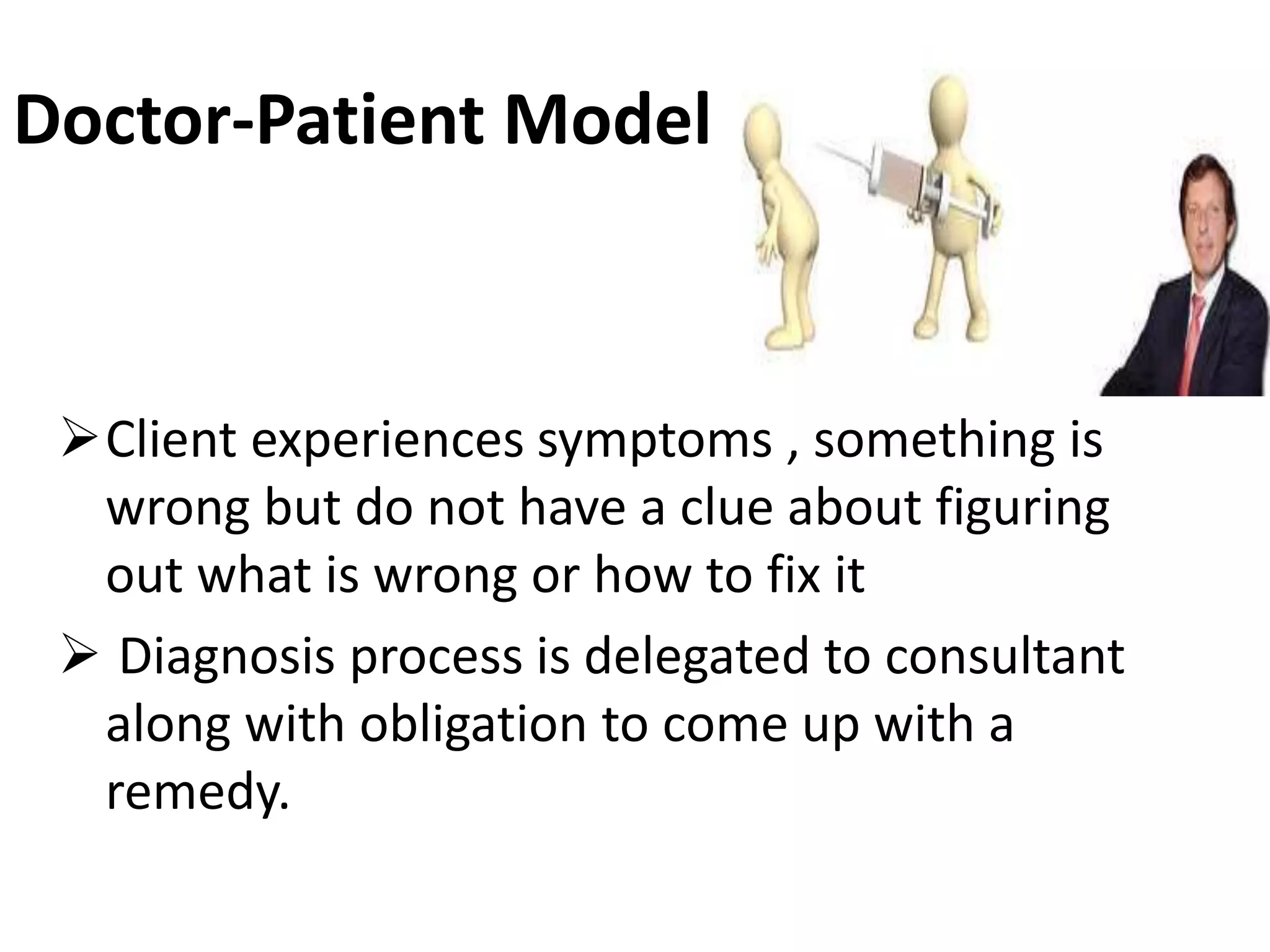
Doctor-Patient Model
Client experiences symptoms , something is
wrong but do not have a clue about figuring
out what is wrong or how to fix it
 Diagnosis process is delegated to consultant
along with obligation to come up with a
remedy.
Cont...
Client –dependent on Consultant until such time
as consultant makes a prescription,
Unless consultant engages client in becoming
more active on his/her own behalf.
Manager detect symptoms of ill health , such as
dropping sales ,high number of customer
complaints , or quality problem but may not
know how to make a diagnosis of what is
causing problems
Assumptions DPM
Client correctly interpreted symptoms and sick
“area”
Client trust diagnostic information –by
consultation
“sick” person or group reveal correct information
necessary to arrive at a diagnosis and cure i.e will
trust doctor enough to “level” with him/her
Cont....
Client is willing to accept and implement
whatever prescription is given.
Patient/client will be able to remain healthy after
he doctor/consultant leaves.
DPM NOTICE
More power lies Consultation-
• She diagnoses , prescribes and administers the
cure
Client dependent on consultant
• Outside consultant can come into situation ,
identify problems and remedy them
Cont....
Model is appeal to Consultant because;
• It empowers them
• Endows them with X-ray vision
• Consultants commend fees-diagnoses and
remedial course of action.
• Analysis and diagnosis leading to specific
written documentation.
• If not incomplete job
Process consultation

Process consultation

  • 1.
  • 2.
    Process Consultation • “Aset of activities on the part of the consultant that help the Client to perceive, understand and act upon the process events that occur in the client’s environment in order to improve the situation as defined by the client”. • (Schein,1999)
  • 3.
    Process Consultation Partnership betweenclient and consultant; Consultant and client act equal Client provides knowledge of organization’s nature,business,and issues Consultant provides knowledge of techniques, ways of thinking, and practices that can solve the problems.
  • 4.
    Cont.... Partnership model ensuresagainst false solutions that may be trendy , clever and wholesome. But are not fully applicable and sufficiently relevant to the particular organizational development issue.
  • 5.
    Cont.... Proper maintenance ofmutual responsibility Client owns the problem and determines the solutions. Consultant helps clients to see issues and finds what needs to be done  Process Consultant ensures that a real solution, not an attractive but impermanent fix ,is obtained
  • 6.
    Cont.... Increased capacity forlessons learned “Masked rider ” consultant -provides a silver bullet may be widely honoured and cheered by all Ammunition doesn’t last and someone has to be called again. By providing help that is that’s learning based PC –ensures increased ability by client to continue to deal with situation.
  • 7.
    Cont ...... Better fitwith current Organizational needs Sharing of problem diagnosis and resolution leads to shared vision. Expert consultation have a toolkit of best practice methods, But process consultant ensure that tools which are employed will best fit organization’s needs and interests.
  • 8.
    Process consultation -Focus 1.Builta relationship Permit consultant and client to deal with reality. Remove consultants areas of ignorance Acknowledge consultant’s behaviour as being always an intervention. Service of giving clients insight into what is going on around them.
  • 9.
    Cont... 2.Help client figureout what they should do about the situation. Clients must be helped to remain proactive. Clients must own the problem Clients know true complexity of their situation and they know what will work in the culture where they live.
  • 10.
    PC Intervention • Clientsdo not know what is really wrong and need help in diagnosing what their problems actually are. But they ‘’own’’ problem • Clients do not know what kind of help consultants can give them • They need to be helped to know what kind of help to seek • Clients have constructive intends to improve things • ,but they often need help in identifying what to help in identifying what to improve and how to improve it.
  • 11.
    Cont.... Organization can beeffective than they are : o If Managers and employees learn to diagnose o Manage –strengths and weaknesses o No org. Is perfect o Every form of org.-weaknesses o Compensatory mechanism must be found.
  • 12.
    Cont... • Decision makingin hands of clients • PC model-Pass on skill • Expert model and doctor-patient model – remedial and preventive model. • “Instead of giving people fish , teach them how to fish” fits this models well
  • 13.
    Doctor-Patient Model Client experiencessymptoms , something is wrong but do not have a clue about figuring out what is wrong or how to fix it  Diagnosis process is delegated to consultant along with obligation to come up with a remedy.
  • 14.
    Cont... Client –dependent onConsultant until such time as consultant makes a prescription, Unless consultant engages client in becoming more active on his/her own behalf. Manager detect symptoms of ill health , such as dropping sales ,high number of customer complaints , or quality problem but may not know how to make a diagnosis of what is causing problems
  • 15.
    Assumptions DPM Client correctlyinterpreted symptoms and sick “area” Client trust diagnostic information –by consultation “sick” person or group reveal correct information necessary to arrive at a diagnosis and cure i.e will trust doctor enough to “level” with him/her
  • 16.
    Cont.... Client is willingto accept and implement whatever prescription is given. Patient/client will be able to remain healthy after he doctor/consultant leaves.
  • 17.
    DPM NOTICE More powerlies Consultation- • She diagnoses , prescribes and administers the cure Client dependent on consultant • Outside consultant can come into situation , identify problems and remedy them
  • 18.
    Cont.... Model is appealto Consultant because; • It empowers them • Endows them with X-ray vision • Consultants commend fees-diagnoses and remedial course of action. • Analysis and diagnosis leading to specific written documentation. • If not incomplete job