
Leading Corporate Change
(Change Management)
You can download these
excellent slides at :
www.HR-Management-Slides.com
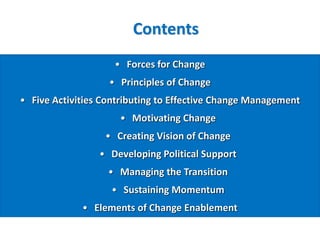
Contents
• Forces for Change
• Principles of Change
• Five Activities Contributing to Effective Change Management
• Motivating Change
• Creating Vision of Change
• Developing Political Support
• Managing the Transition
• Sustaining Momentum
• Elements of Change Enablement
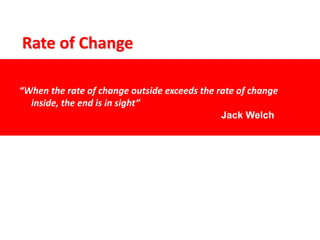
“When the rate of change outside exceeds the rate of change
inside, the end is in sight”
Rate of Change
Jack Welch
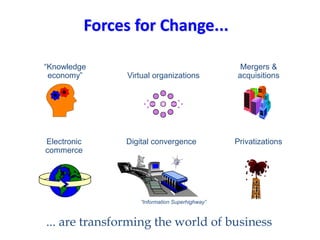
Forces for Change...
Electronic
commerce
Virtual organizations
Digital convergence
“Knowledge
economy”
“Information Superhighway”
... are transforming the world of business
Mergers &
acquisitions
Privatizations
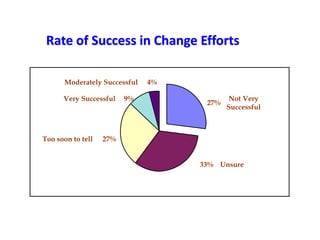
Not Very
Successful
Very Successful
Moderately Successful
Too soon to tell
Unsure33%
27%
27%
9%
4%
Rate of Success in Change Efforts
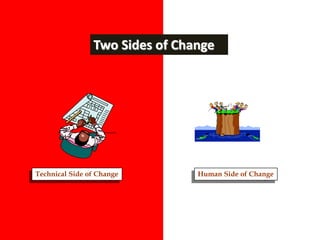
Technical Side of Change Human Side of Change
Two Sides of Change
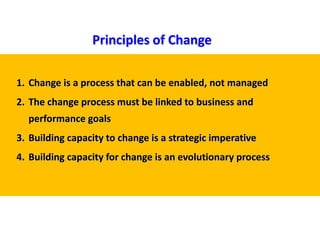
1. Change is a process that can be enabled, not managed
2. The change process must be linked to business and
performance goals
3. Building capacity to change is a strategic imperative
4. Building capacity for change is an evolutionary process
Principles of Change
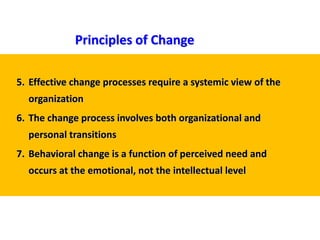
5. Effective change processes require a systemic view of the
organization
6. The change process involves both organizational and
personal transitions
7. Behavioral change is a function of perceived need and
occurs at the emotional, not the intellectual level
Principles of Change
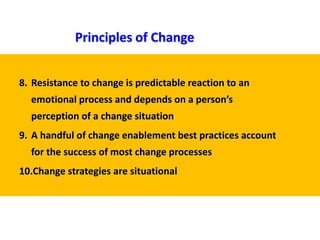
8. Resistance to change is predictable reaction to an
emotional process and depends on a person’s
perception of a change situation
9. A handful of change enablement best practices account
for the success of most change processes
10.Change strategies are situational
Principles of Change
Five Activities Contributing to
Effective Change Management
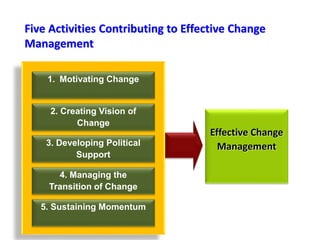
Five Activities Contributing to Effective Change
Management
1. Motivating Change
2. Creating Vision of
Change
3. Developing Political
Support
4. Managing the
Transition of Change
5. Sustaining Momentum
Effective Change
Management
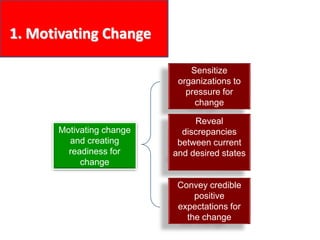
1. Motivating Change
Motivating change
and creating
readiness for
change
Sensitize
organizations to
pressure for
change
Reveal
discrepancies
between current
and desired states
Convey credible
positive
expectations for
the change
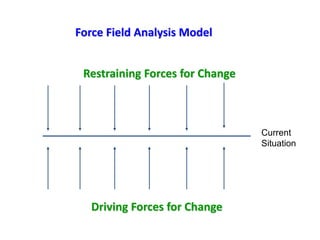
Force Field Analysis Model
Current
Situation
Restraining Forces for Change
Driving Forces for Change
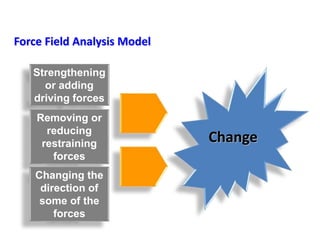
Force Field Analysis Model
Strengthening
or adding
driving forces
Removing or
reducing
restraining
forces
Changing the
direction of
some of the
forces
Change
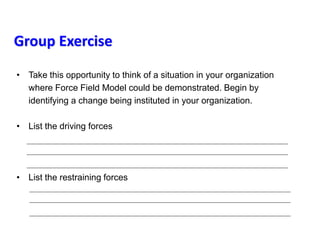
Group Exercise
• Take this opportunity to think of a situation in your organization
where Force Field Model could be demonstrated. Begin by
identifying a change being instituted in your organization.
• List the driving forces
• List the restraining forces
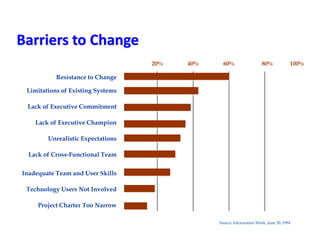
Resistance to Change
20% 40% 60% 80% 100%
Source: Information Week, June 20, 1994
Limitations of Existing Systems
Lack of Executive Commitment
Lack of Executive Champion
Unrealistic Expectations
Lack of Cross-Functional Team
Inadequate Team and User Skills
Technology Users Not Involved
Project Charter Too Narrow
Barriers to Change
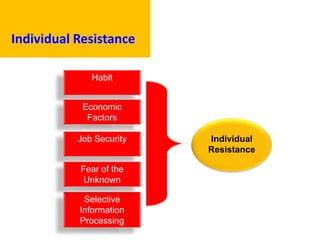
Individual Resistance
Individual
Resistance
Habit
Selective
Information
Processing
Economic
Factors
Job Security
Fear of the
Unknown
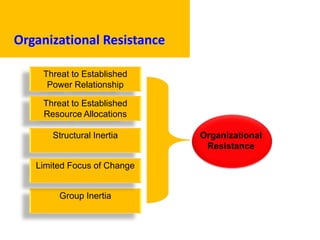
Organizational Resistance
Organizational
Resistance
Threat to Established
Power Relationship
Group Inertia
Threat to Established
Resource Allocations
Structural Inertia
Limited Focus of Change
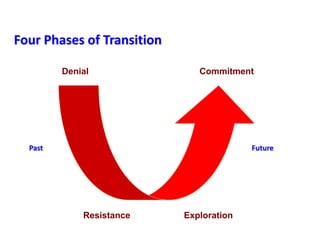
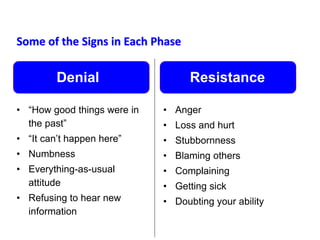
Denial
Resistance Exploration
Past Future
Four Phases of Transition
Commitment
• “How good things were in
the past”
• “It can’t happen here”
• Numbness
• Everything-as-usual
attitude
• Refusing to hear new
information
• Anger
• Loss and hurt
• Stubbornness
• Blaming others
• Complaining
• Getting sick
• Doubting your ability
Some of the Signs in Each Phase
Denial Resistance
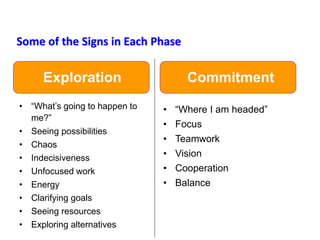
Exploration Commitment
• “What’s going to happen to
me?”
• Seeing possibilities
• Chaos
• Indecisiveness
• Unfocused work
• Energy
• Clarifying goals
• Seeing resources
• Exploring alternatives
• “Where I am headed”
• Focus
• Teamwork
• Vision
• Cooperation
• Balance
Some of the Signs in Each Phase
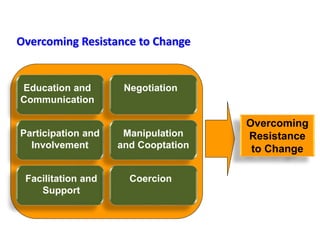
Overcoming Resistance to Change
Education and
Communication
Participation and
Involvement
Facilitation and
Support
Negotiation
Manipulation
and Cooptation
Coercion
Overcoming
Resistance
to Change
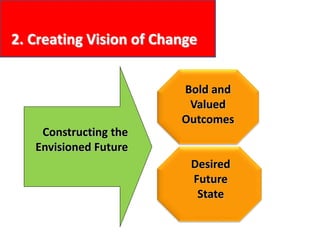
2. Creating Vision of Change
Constructing the
Envisioned Future
Bold and
Valued
Outcomes
Desired
Future
State
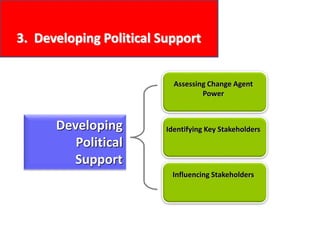
3. Developing Political Support
Assessing Change Agent
Power
Identifying Key Stakeholders
Influencing Stakeholders
Developing
Political
Support
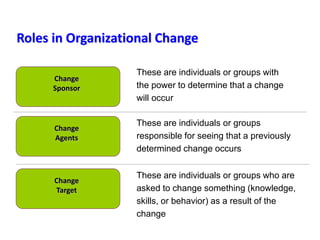
Roles in Organizational Change
Change
Sponsor
Change
Agents
Change
Target
These are individuals or groups with
the power to determine that a change
will occur
These are individuals or groups
responsible for seeing that a previously
determined change occurs
These are individuals or groups who are
asked to change something (knowledge,
skills, or behavior) as a result of the
change
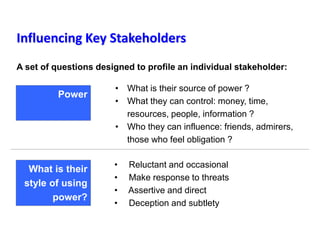
Influencing Key Stakeholders
A set of questions designed to profile an individual stakeholder:
• Reluctant and occasional
• Make response to threats
• Assertive and direct
• Deception and subtlety
What is their
style of using
power?
• What is their source of power ?
• What they can control: money, time,
resources, people, information ?
• Who they can influence: friends, admirers,
those who feel obligation ?
Power
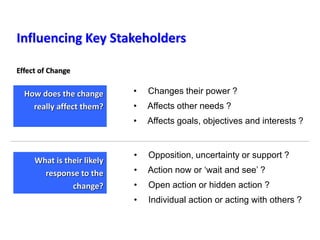
Influencing Key Stakeholders
• Changes their power ?
• Affects other needs ?
• Affects goals, objectives and interests ?
• Opposition, uncertainty or support ?
• Action now or ‘wait and see’ ?
• Open action or hidden action ?
• Individual action or acting with others ?
What is their likely
response to the
change?
How does the change
really affect them?
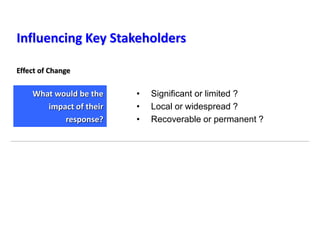
Effect of Change
Influencing Key Stakeholders
• Significant or limited ?
• Local or widespread ?
• Recoverable or permanent ?
What would be the
impact of their
response?
Effect of Change
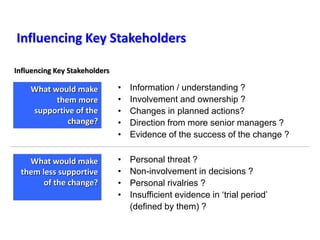
Influencing Key Stakeholders
What would make
them more
supportive of the
change?
• Information / understanding ?
• Involvement and ownership ?
• Changes in planned actions?
• Direction from more senior managers ?
• Evidence of the success of the change ?
What would make
them less supportive
of the change?
• Personal threat ?
• Non-involvement in decisions ?
• Personal rivalries ?
• Insufficient evidence in ‘trial period’
(defined by them) ?
Influencing Key Stakeholders
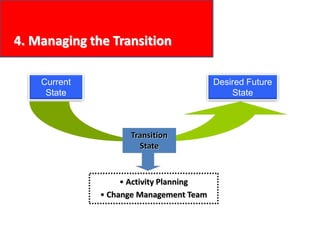
4. Managing the Transition
Current
State
Desired Future
State
Transition
State
• Activity Planning
• Change Management Team
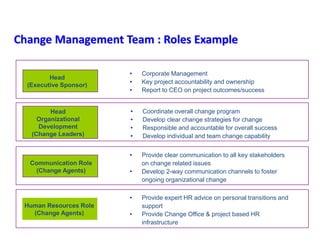
Head
(Executive Sponsor)
Head
Organizational
Development
(Change Leaders)
Communication Role
(Change Agents)
Human Resources Role
(Change Agents)
• Corporate Management
• Key project accountability and ownership
• Report to CEO on project outcomes/success
• Coordinate overall change program
• Develop clear change strategies for change
• Responsible and accountable for overall success
• Develop individual and team change capability
• Provide clear communication to all key stakeholders
on change related issues
• Develop 2-way communication channels to foster
ongoing organizational change
• Provide expert HR advice on personal transitions and
support
• Provide Change Office & project based HR
infrastructure
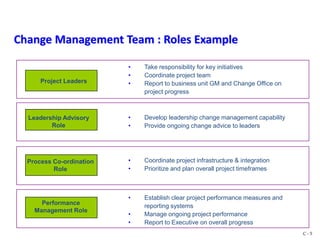
Change Management Team : Roles Example
Project Leaders
• Take responsibility for key initiatives
• Coordinate project team
• Report to business unit GM and Change Office on
project progress
• Develop leadership change management capability
• Provide ongoing change advice to leaders
• Coordinate project infrastructure & integration
• Prioritize and plan overall project timeframes
• Establish clear project performance measures and
reporting systems
• Manage ongoing project performance
• Report to Executive on overall progress
Leadership Advisory
Role
Process Co-ordination
Role
Performance
Management Role
C - 5
Change Management Team : Roles Example
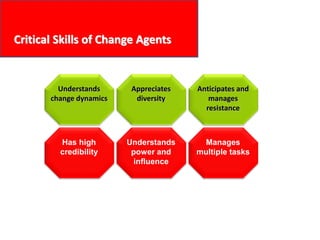
Critical Skills of Change Agents
Understands
change dynamics
Appreciates
diversity
Anticipates and
manages
resistance
Understands
power and
influence
Has high
credibility
Manages
multiple tasks
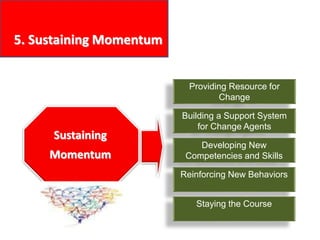
5. Sustaining Momentum
Sustaining
Momentum
Providing Resource for
Change
Building a Support System
for Change Agents
Developing New
Competencies and Skills
Reinforcing New Behaviors
Staying the Course
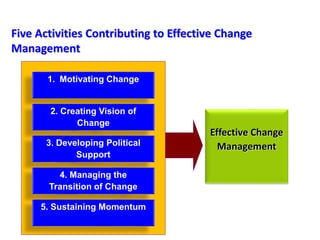
Five Activities Contributing to Effective Change
Management
1. Motivating Change
2. Creating Vision of
Change
3. Developing Political
Support
4. Managing the
Transition of Change
5. Sustaining Momentum
Effective Change
Management
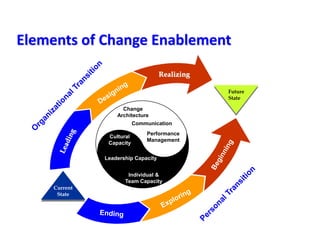
Elements of Change
Enablement
Culture
Capacity
Leadership
Capacity
Individual
& Team Capacity
Future
State
Current
State
Realizing
Leadership Capacity
Individual &
Team Capacity
Change
Architecture
Communication
Performance
Management
Cultural
Capacity
Elements of Change Enablement
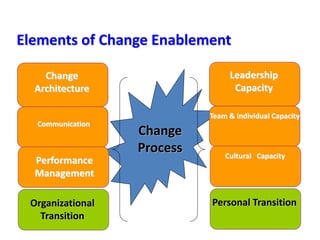
Change
Architecture
Communication
Performance
Management
Organizational
Transition
Leadership
Capacity
Team & Individual Capacity
Cultural Capacity
Personal Transition
Change
Process
Elements of Change Enablement
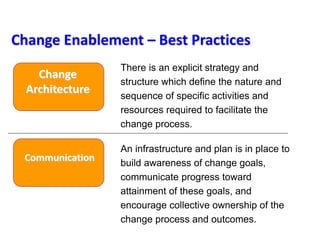
There is an explicit strategy and
structure which define the nature and
sequence of specific activities and
resources required to facilitate the
change process.
Change
Architecture
Communication
An infrastructure and plan is in place to
build awareness of change goals,
communicate progress toward
attainment of these goals, and
encourage collective ownership of the
change process and outcomes.
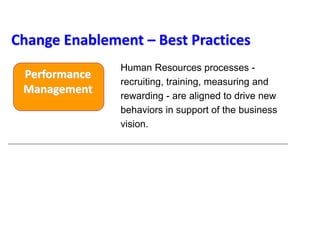
Change Enablement – Best Practices
Human Resources processes -
recruiting, training, measuring and
rewarding - are aligned to drive new
behaviors in support of the business
vision.
Performance
Management
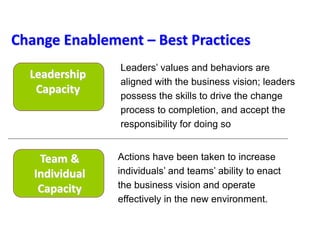
Change Enablement – Best Practices
Leaders’ values and behaviors are
aligned with the business vision; leaders
possess the skills to drive the change
process to completion, and accept the
responsibility for doing so
Leadership
Capacity
Team &
Individual
Capacity
Actions have been taken to increase
individuals’ and teams’ ability to enact
the business vision and operate
effectively in the new environment.
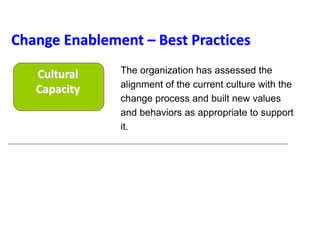
Change Enablement – Best Practices
The organization has assessed the
alignment of the current culture with the
change process and built new values
and behaviors as appropriate to support
it.
Cultural
Capacity
Change Enablement – Best Practices
References / Recommended Further Readings:
1. Thomas Cummings and Christopher Worley, Organization Development
and Change, South Western College Publishing
You can obtain this excellent book at this link: http://www.amazon.com/Organization-Development-InfoTrac-
College-Printed/dp/0324421389/ref=sr_1_1?ie=UTF8&s=books&qid=1219798794&sr=1-1
2. Lynn Fossum, Understanding Organizational Change, Crisp Learning
Publication
You can obtain this excellent book at this link: http://www.amazon.com/Understanding-Organizational-Change-
Converting-Fifty-Minute/dp/0931961718/ref=sr_1_6?ie=UTF8&s=books&qid=1219798960&sr=1-6
End of Material

Change Management PPT Slides

  • 1.
  • 2.
    You can downloadthese excellent slides at : www.HR-Management-Slides.com
  • 3.
    Contents • Forces forChange • Principles of Change • Five Activities Contributing to Effective Change Management • Motivating Change • Creating Vision of Change • Developing Political Support • Managing the Transition • Sustaining Momentum • Elements of Change Enablement
  • 4.
    “When the rateof change outside exceeds the rate of change inside, the end is in sight” Rate of Change Jack Welch
  • 5.
    Forces for Change... Electronic commerce Virtualorganizations Digital convergence “Knowledge economy” “Information Superhighway” ... are transforming the world of business Mergers & acquisitions Privatizations
  • 6.
    Not Very Successful Very Successful ModeratelySuccessful Too soon to tell Unsure33% 27% 27% 9% 4% Rate of Success in Change Efforts
  • 7.
    Technical Side ofChange Human Side of Change Two Sides of Change
  • 8.
    1. Change isa process that can be enabled, not managed 2. The change process must be linked to business and performance goals 3. Building capacity to change is a strategic imperative 4. Building capacity for change is an evolutionary process Principles of Change
  • 9.
    5. Effective changeprocesses require a systemic view of the organization 6. The change process involves both organizational and personal transitions 7. Behavioral change is a function of perceived need and occurs at the emotional, not the intellectual level Principles of Change
  • 10.
    8. Resistance tochange is predictable reaction to an emotional process and depends on a person’s perception of a change situation 9. A handful of change enablement best practices account for the success of most change processes 10.Change strategies are situational Principles of Change
  • 11.
    Five Activities Contributingto Effective Change Management
  • 12.
    Five Activities Contributingto Effective Change Management 1. Motivating Change 2. Creating Vision of Change 3. Developing Political Support 4. Managing the Transition of Change 5. Sustaining Momentum Effective Change Management
  • 13.
    1. Motivating Change Motivatingchange and creating readiness for change Sensitize organizations to pressure for change Reveal discrepancies between current and desired states Convey credible positive expectations for the change
  • 14.
    Force Field AnalysisModel Current Situation Restraining Forces for Change Driving Forces for Change
  • 15.
    Force Field AnalysisModel Strengthening or adding driving forces Removing or reducing restraining forces Changing the direction of some of the forces Change
  • 16.
    Group Exercise • Takethis opportunity to think of a situation in your organization where Force Field Model could be demonstrated. Begin by identifying a change being instituted in your organization. • List the driving forces • List the restraining forces
  • 17.
    Resistance to Change 20%40% 60% 80% 100% Source: Information Week, June 20, 1994 Limitations of Existing Systems Lack of Executive Commitment Lack of Executive Champion Unrealistic Expectations Lack of Cross-Functional Team Inadequate Team and User Skills Technology Users Not Involved Project Charter Too Narrow Barriers to Change
  • 18.
  • 19.
    Organizational Resistance Organizational Resistance Threat toEstablished Power Relationship Group Inertia Threat to Established Resource Allocations Structural Inertia Limited Focus of Change
  • 20.
    Denial Resistance Exploration Past Future FourPhases of Transition Commitment
  • 21.
    • “How goodthings were in the past” • “It can’t happen here” • Numbness • Everything-as-usual attitude • Refusing to hear new information • Anger • Loss and hurt • Stubbornness • Blaming others • Complaining • Getting sick • Doubting your ability Some of the Signs in Each Phase Denial Resistance
  • 22.
    Exploration Commitment • “What’sgoing to happen to me?” • Seeing possibilities • Chaos • Indecisiveness • Unfocused work • Energy • Clarifying goals • Seeing resources • Exploring alternatives • “Where I am headed” • Focus • Teamwork • Vision • Cooperation • Balance Some of the Signs in Each Phase
  • 23.
    Overcoming Resistance toChange Education and Communication Participation and Involvement Facilitation and Support Negotiation Manipulation and Cooptation Coercion Overcoming Resistance to Change
  • 24.
    2. Creating Visionof Change Constructing the Envisioned Future Bold and Valued Outcomes Desired Future State
  • 25.
    3. Developing PoliticalSupport Assessing Change Agent Power Identifying Key Stakeholders Influencing Stakeholders Developing Political Support
  • 26.
    Roles in OrganizationalChange Change Sponsor Change Agents Change Target These are individuals or groups with the power to determine that a change will occur These are individuals or groups responsible for seeing that a previously determined change occurs These are individuals or groups who are asked to change something (knowledge, skills, or behavior) as a result of the change
  • 27.
    Influencing Key Stakeholders Aset of questions designed to profile an individual stakeholder: • Reluctant and occasional • Make response to threats • Assertive and direct • Deception and subtlety What is their style of using power? • What is their source of power ? • What they can control: money, time, resources, people, information ? • Who they can influence: friends, admirers, those who feel obligation ? Power
  • 28.
    Influencing Key Stakeholders •Changes their power ? • Affects other needs ? • Affects goals, objectives and interests ? • Opposition, uncertainty or support ? • Action now or ‘wait and see’ ? • Open action or hidden action ? • Individual action or acting with others ? What is their likely response to the change? How does the change really affect them? Effect of Change
  • 29.
    Influencing Key Stakeholders •Significant or limited ? • Local or widespread ? • Recoverable or permanent ? What would be the impact of their response? Effect of Change
  • 30.
    Influencing Key Stakeholders Whatwould make them more supportive of the change? • Information / understanding ? • Involvement and ownership ? • Changes in planned actions? • Direction from more senior managers ? • Evidence of the success of the change ? What would make them less supportive of the change? • Personal threat ? • Non-involvement in decisions ? • Personal rivalries ? • Insufficient evidence in ‘trial period’ (defined by them) ? Influencing Key Stakeholders
  • 31.
    4. Managing theTransition Current State Desired Future State Transition State • Activity Planning • Change Management Team
  • 32.
    Head (Executive Sponsor) Head Organizational Development (Change Leaders) CommunicationRole (Change Agents) Human Resources Role (Change Agents) • Corporate Management • Key project accountability and ownership • Report to CEO on project outcomes/success • Coordinate overall change program • Develop clear change strategies for change • Responsible and accountable for overall success • Develop individual and team change capability • Provide clear communication to all key stakeholders on change related issues • Develop 2-way communication channels to foster ongoing organizational change • Provide expert HR advice on personal transitions and support • Provide Change Office & project based HR infrastructure Change Management Team : Roles Example
  • 33.
    Project Leaders • Takeresponsibility for key initiatives • Coordinate project team • Report to business unit GM and Change Office on project progress • Develop leadership change management capability • Provide ongoing change advice to leaders • Coordinate project infrastructure & integration • Prioritize and plan overall project timeframes • Establish clear project performance measures and reporting systems • Manage ongoing project performance • Report to Executive on overall progress Leadership Advisory Role Process Co-ordination Role Performance Management Role C - 5 Change Management Team : Roles Example
  • 34.
    Critical Skills ofChange Agents Understands change dynamics Appreciates diversity Anticipates and manages resistance Understands power and influence Has high credibility Manages multiple tasks
  • 35.
    5. Sustaining Momentum Sustaining Momentum ProvidingResource for Change Building a Support System for Change Agents Developing New Competencies and Skills Reinforcing New Behaviors Staying the Course
  • 36.
    Five Activities Contributingto Effective Change Management 1. Motivating Change 2. Creating Vision of Change 3. Developing Political Support 4. Managing the Transition of Change 5. Sustaining Momentum Effective Change Management
  • 37.
  • 38.
    Culture Capacity Leadership Capacity Individual & Team Capacity Future State Current State Realizing LeadershipCapacity Individual & Team Capacity Change Architecture Communication Performance Management Cultural Capacity Elements of Change Enablement
  • 39.
    Change Architecture Communication Performance Management Organizational Transition Leadership Capacity Team & IndividualCapacity Cultural Capacity Personal Transition Change Process Elements of Change Enablement
  • 40.
    There is anexplicit strategy and structure which define the nature and sequence of specific activities and resources required to facilitate the change process. Change Architecture Communication An infrastructure and plan is in place to build awareness of change goals, communicate progress toward attainment of these goals, and encourage collective ownership of the change process and outcomes. Change Enablement – Best Practices
  • 41.
    Human Resources processes- recruiting, training, measuring and rewarding - are aligned to drive new behaviors in support of the business vision. Performance Management Change Enablement – Best Practices
  • 42.
    Leaders’ values andbehaviors are aligned with the business vision; leaders possess the skills to drive the change process to completion, and accept the responsibility for doing so Leadership Capacity Team & Individual Capacity Actions have been taken to increase individuals’ and teams’ ability to enact the business vision and operate effectively in the new environment. Change Enablement – Best Practices
  • 43.
    The organization hasassessed the alignment of the current culture with the change process and built new values and behaviors as appropriate to support it. Cultural Capacity Change Enablement – Best Practices
  • 44.
    References / RecommendedFurther Readings: 1. Thomas Cummings and Christopher Worley, Organization Development and Change, South Western College Publishing You can obtain this excellent book at this link: http://www.amazon.com/Organization-Development-InfoTrac- College-Printed/dp/0324421389/ref=sr_1_1?ie=UTF8&s=books&qid=1219798794&sr=1-1 2. Lynn Fossum, Understanding Organizational Change, Crisp Learning Publication You can obtain this excellent book at this link: http://www.amazon.com/Understanding-Organizational-Change- Converting-Fifty-Minute/dp/0931961718/ref=sr_1_6?ie=UTF8&s=books&qid=1219798960&sr=1-6
  • 45.