
Speaking to Influence Executives
Dr. Elijah Ezendu
FIMC, FCIM, FCCM, FIIAN, FBDI, FAAFM, FSSM, MIMIS, MIAP, MITD, ACIArb, ACIPM,
PhD, DocM, MBA, CWM, CBDA, CMA, MPM, PME, CSOL, CCIP, CMC, CMgr
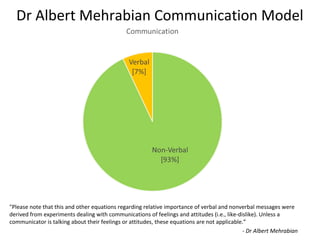
Dr Albert Mehrabian Communication Model
"Please note that this and other equations regarding relative importance of verbal and nonverbal messages were
derived from experiments dealing with communications of feelings and attitudes (i.e., like-dislike). Unless a
communicator is talking about their feelings or attitudes, these equations are not applicable.”
- Dr Albert Mehrabian
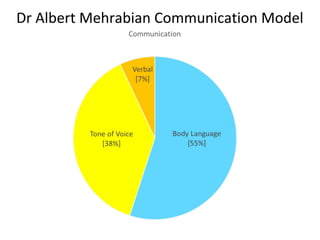
Dr Albert Mehrabian Communication Model
Evaluation of Verbal and Non-Verbal
Communication
Notable speakers and other professionals who had refuted
broad applicability of Mehrabian communication ratio 7/93
include Steve Denning, Susan Trivers, John Windsor, Laura Fitton
and Andrew Abela, citing the premise of Mehrabian research
and his final recommendations.
Nonetheless, most speakers and professionals accept the
importance of both verbal and non-verbal communication, while
claiming one fixed ratio does not fit every condition.
Current Resolution
Most authorities insist non-verbal
communication is more impacting than verbal
communication, and as a result has the capacity
to either derail, oppose and disapprove or
sustain, convey and authenticate a speech.
Key Takeaway
Ensure the depiction of your collective non-
verbal communication aligns effectively with
intended message of verbal communication.
Functions of Nonverbal Communication
 Accent: Punctuating or drawing attention to a verbal
message
 Complement: Expressions/gestures that support but could
not replace verbal message
 Contradict: Expressions or gestures that convey meaning
opposite to that of verbal message
 Regulate: Expressions or gestures that control the pace or
flow of communication
 Repeat: A gesture or expression that can be used alone to
send the same meaning as verbal message
 Substitute: A nonverbal cue that replaces verbal message
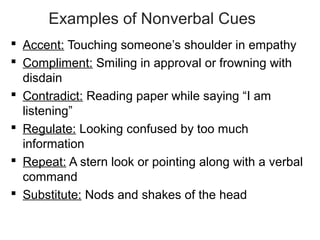
Examples of Nonverbal Cues
 Accent: Touching someone’s shoulder in empathy
 Compliment: Smiling in approval or frowning with
disdain
 Contradict: Reading paper while saying “I am
listening”
 Regulate: Looking confused by too much
information
 Repeat: A stern look or pointing along with a verbal
command
 Substitute: Nods and shakes of the head
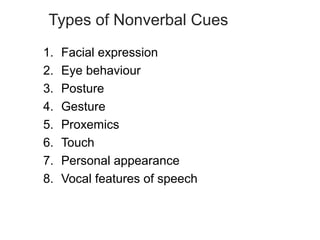
Types of Nonverbal Cues
1. Facial expression
2. Eye behaviour
3. Posture
4. Gesture
5. Proxemics
6. Touch
7. Personal appearance
8. Vocal features of speech
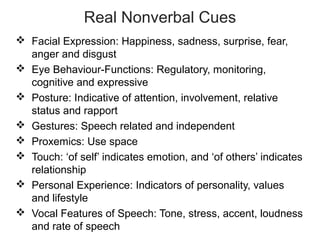
Real Nonverbal Cues
 Facial Expression: Happiness, sadness, surprise, fear,
anger and disgust
 Eye Behaviour-Functions: Regulatory, monitoring,
cognitive and expressive
 Posture: Indicative of attention, involvement, relative
status and rapport
 Gestures: Speech related and independent
 Proxemics: Use space
 Touch: ‘of self’ indicates emotion, and ‘of others’ indicates
relationship
 Personal Experience: Indicators of personality, values
and lifestyle
 Vocal Features of Speech: Tone, stress, accent, loudness
and rate of speech
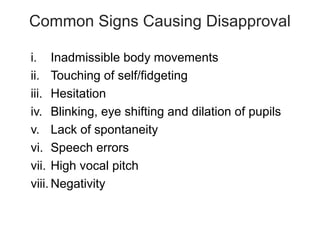
Common Signs Causing Disapproval
i. Inadmissible body movements
ii. Touching of self/fidgeting
iii. Hesitation
iv. Blinking, eye shifting and dilation of pupils
v. Lack of spontaneity
vi. Speech errors
vii. High vocal pitch
viii. Negativity
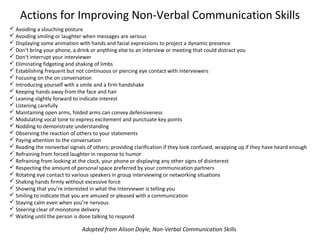
Actions for Improving Non-Verbal Communication Skills
 Avoiding a slouching posture
 Avoiding smiling or laughter when messages are serious
 Displaying some animation with hands and facial expressions to project a dynamic presence
 Don’t bring your phone, a drink or anything else to an interview or meeting that could distract you
 Don’t interrupt your interviewer
 Eliminating fidgeting and shaking of limbs
 Establishing frequent but not continuous or piercing eye contact with interviewers
 Focusing on the conversation
 Introducing yourself with a smile and a firm handshake
 Keeping hands away from the face and hair
 Leaning slightly forward to indicate interest
 Listening carefully
 Maintaining open arms, folded arms can convey defensiveness
 Modulating vocal tone to express excitement and punctuate key points
 Nodding to demonstrate understanding
 Observing the reaction of others to your statements
 Paying attention to the conversation
 Reading the nonverbal signals of others; providing clarification if they look confused, wrapping up if they have heard enough
 Refraining from forced laughter in response to humor
 Refraining from looking at the clock, your phone or displaying any other signs of disinterest
 Respecting the amount of personal space preferred by your communication partners
 Rotating eye contact to various speakers in group interviewing or networking situations
 Shaking hands firmly without excessive force
 Showing that you’re interested in what the interviewer is telling you
 Smiling to indicate that you are amused or pleased with a communication
 Staying calm even when you’re nervous
 Steering clear of monotone delivery
 Waiting until the person is done talking to respond
Adopted from Alison Doyle, Non-Verbal Communication Skills
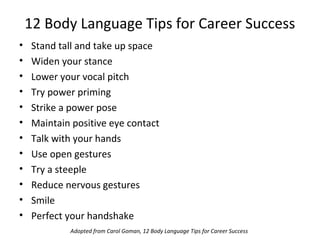
12 Body Language Tips for Career Success
• Stand tall and take up space
• Widen your stance
• Lower your vocal pitch
• Try power priming
• Strike a power pose
• Maintain positive eye contact
• Talk with your hands
• Use open gestures
• Try a steeple
• Reduce nervous gestures
• Smile
• Perfect your handshake
Adopted from Carol Goman, 12 Body Language Tips for Career Success
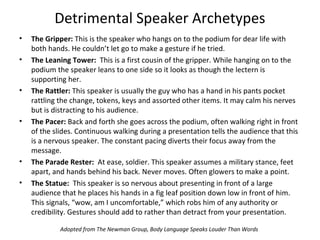
Detrimental Speaker Archetypes
• The Gripper: This is the speaker who hangs on to the podium for dear life with
both hands. He couldn’t let go to make a gesture if he tried.
• The Leaning Tower: This is a first cousin of the gripper. While hanging on to the
podium the speaker leans to one side so it looks as though the lectern is
supporting her.
• The Rattler: This speaker is usually the guy who has a hand in his pants pocket
rattling the change, tokens, keys and assorted other items. It may calm his nerves
but is distracting to his audience.
• The Pacer: Back and forth she goes across the podium, often walking right in front
of the slides. Continuous walking during a presentation tells the audience that this
is a nervous speaker. The constant pacing diverts their focus away from the
message.
• The Parade Rester: At ease, soldier. This speaker assumes a military stance, feet
apart, and hands behind his back. Never moves. Often glowers to make a point.
• The Statue: This speaker is so nervous about presenting in front of a large
audience that he places his hands in a fig leaf position down low in front of him.
This signals, “wow, am I uncomfortable,” which robs him of any authority or
credibility. Gestures should add to rather than detract from your presentation.
Adopted from The Newman Group, Body Language Speaks Louder Than Words
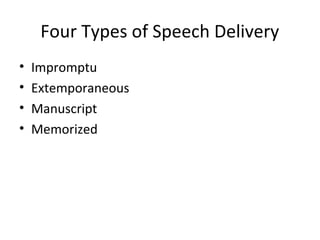
Four Types of Speech Delivery
• Impromptu
• Extemporaneous
• Manuscript
• Memorized
“There are three things to aim at in public
speaking: first, to get into your subject, then to
get your subject into yourself, and lastly, to get
your subject into the heart of your audience.”
– Alexander Gregg
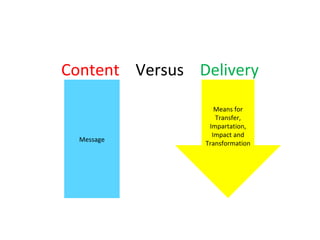
Content Versus Delivery
Message
Means for
Transfer,
Impartation,
Impact and
Transformation
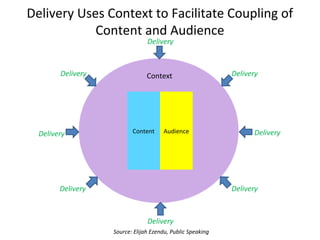
Delivery Uses Context to Facilitate Coupling of Content and Audience
CContent Audience
Context
Delivery
DeliveryDelivery
Delivery Delivery
Delivery Delivery
Delivery
Source: Elijah Ezendu, Public Speaking
“The success of your presentation will be
judged not by the knowledge you send but by
what the listener receives.”
– Lilly Walters
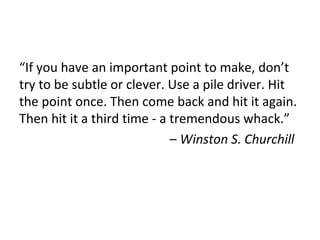
“If you have an important point to make, don’t
try to be subtle or clever. Use a pile driver. Hit
the point once. Then come back and hit it again.
Then hit it a third time - a tremendous whack.”
– Winston S. Churchill
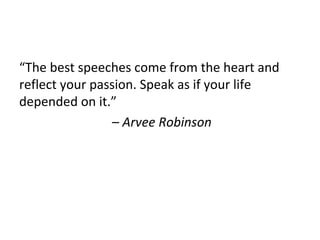
“The best speeches come from the heart and
reflect your passion. Speak as if your life
depended on it.”
– Arvee Robinson
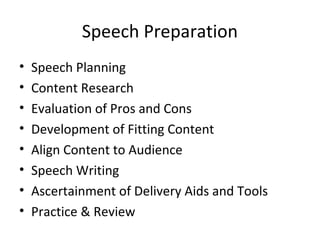
Speech Preparation
• Speech Planning
• Content Research
• Evaluation of Pros and Cons
• Development of Fitting Content
• Align Content to Audience
• Speech Writing
• Ascertainment of Delivery Aids and Tools
• Practice & Review
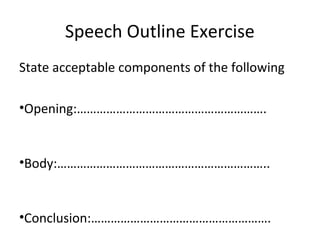
Speech Outline Exercise
State acceptable components of the following
•Opening:………………………………………………….
•Body:………………………………………………………..
•Conclusion:……………………………………………….
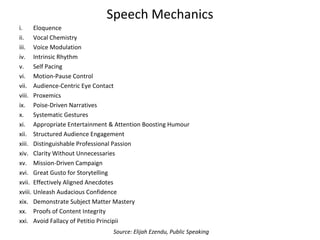
Speech Mechanics
i. Eloquence
ii. Vocal Chemistry
iii. Voice Modulation
iv. Intrinsic Rhythm
v. Self Pacing
vi. Motion-Pause Control
vii. Audience-Centric Eye Contact
viii. Proxemics
ix. Poise-Driven Narratives
x. Systematic Gestures
xi. Appropriate Entertainment & Attention Boosting Humour
xii. Structured Audience Engagement
xiii. Distinguishable Professional Passion
xiv. Clarity Without Unnecessaries
xv. Mission-Driven Campaign
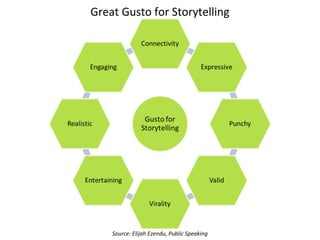
xvi. Great Gusto for Storytelling
xvii. Effectively Aligned Anecdotes
xviii. Unleash Audacious Confidence
xix. Demonstrate Subject Matter Mastery
xx. Proofs of Content Integrity
xxi. Avoid Fallacy of Petitio Principii
Source: Elijah Ezendu, Public Speaking
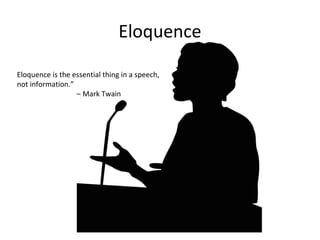
Eloquence
Eloquence is the essential thing in a speech,
not information.”
– Mark Twain
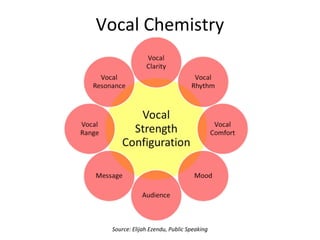
Vocal Chemistry
Source: Elijah Ezendu, Public Speaking
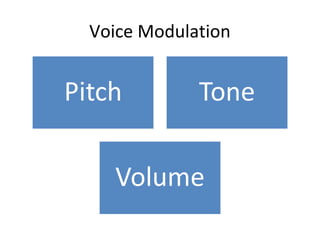
Voice Modulation
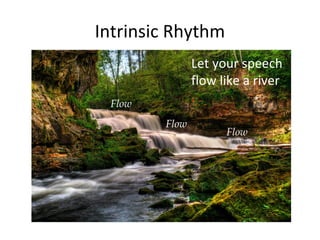
Intrinsic Rhythm
Flow
Let your speech
flow like a river
Flow
Flow
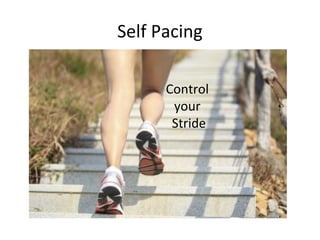
Self Pacing
Control
your
Stride
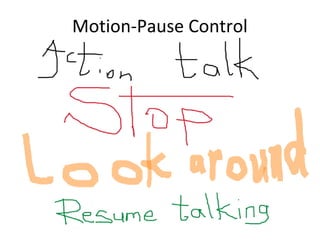
Motion-Pause Control
Audience-Centric Eye Contact
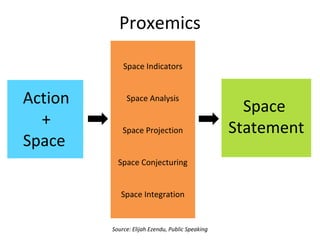
Proxemics
Space Indicators
Space Analysis
Space Projection
Space Conjecturing
Space Integration
Action
+
Space
Space
Statement
Source: Elijah Ezendu, Public Speaking
Poise-Driven Narratives
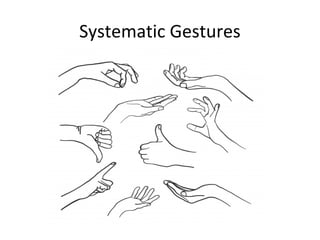
Systematic Gestures
Exercise on Appropriate Entertainment &
Attention Boosting Humour
i. Mention effects of appropriate
entertainment and humour.
ii. Mention effects of inappropriate
entertainment and humour
iii. Mention three critical situations requiring
humour for stimulating audience to be on the
same page with you. Give example of
appropriate humour for each stated situation.
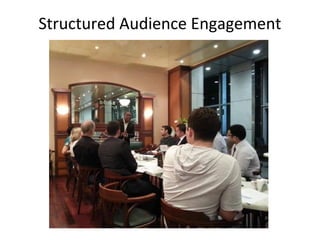
Structured Audience Engagement
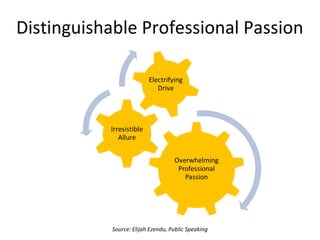
Distinguishable Professional Passion
Source: Elijah Ezendu, Public Speaking
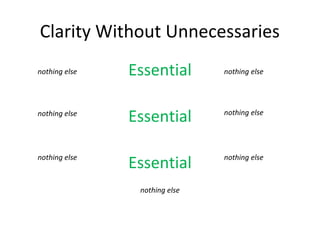
Clarity Without Unnecessaries
Essential
Essential
Essential
nothing else
nothing else
nothing else
nothing elsenothing else
nothing else
nothing else
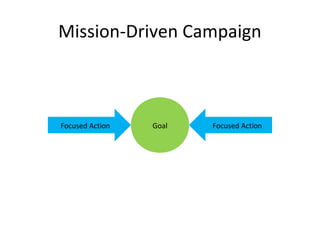
Mission-Driven Campaign
GoalFocused Action Focused Action
Great Gusto for Storytelling
Source: Elijah Ezendu, Public Speaking
Exercise on Effectively Aligned Anecdotes
• What are the features of effectively aligned
anecdote?
…………………………………………………………………………
………………………………………………………………………
………………………………………………………………………
………………………………………………………………………
………………………………………………………………………
………………………………………………………………………
………………………………………………………………………
…
Unleash Audacious Confidence
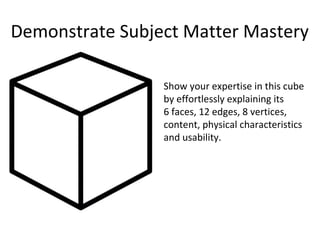
Demonstrate Subject Matter Mastery
Show your expertise on matters of
this cube by effortlessly explaining
its 6 faces, 12 edges, 8 vertices,
content, physical characteristics
and usability.
Proofs of Content Integrity
• Effective Attribution
• Ownership Assurance
• Intellectual Property Compliance
• Intellectual Property Rights Governance
• Declaration of Originality
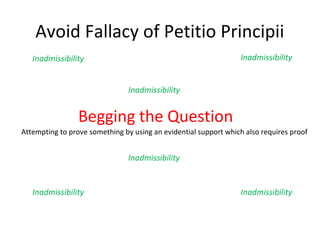
Avoid Fallacy of Petitio Principii
Begging the Question
Attempting to prove something by using an evidential support which also requires proof
InadmissibilityInadmissibility
Inadmissibility
Inadmissibility
Inadmissibility Inadmissibility
“You cannot make a business case that you
should be who you are not.”
- Jeff Bezos
Be methodically discreet while structuring
business cases: Irrespective of intention, avoid
heading to showtime-runway with despicable
falsehood.
Basic Outline of a Business Case
• Executive Summary
• Introduction
• Statement of Problem
• Situation Analysis
• Ascertainment of Suitable Solution Features
• Possible Options for Solution
• Cost-Benefit Analysis
• Expert Advise/ Recommendations
Making an Irresistible Business Case
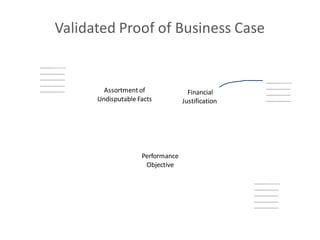
A business case shows rational basis for support of
targeted action or project, by using performance
objectives, financial justification and assortment of
undisputable facts as validated proof.
Irresistibility of business case is directly proportional to
perceived effectuality of validated proof.
Therefore proposed validated proof must stand out as
3R value-input which makes sense to executives and
spawns recognition for characterized effectuality.
3R = Required, Rare & Rewarding
Source: Elijah Ezendu, Public Speaking
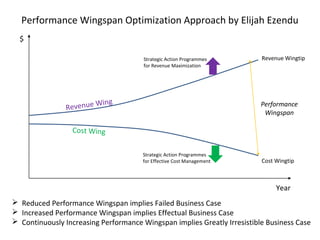
Performance Wingspan Optimization Approach by Elijah Ezendu
 Reduced Performance Wingspan implies Failed Business Case
 Increased Performance Wingspan implies Effectual Business Case
 Continuously Increasing Performance Wingspan implies Greatly Irresistible Business Case
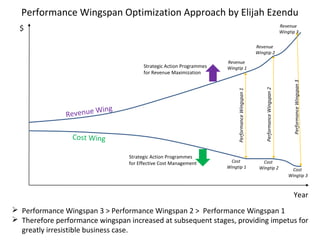
 Performance Wingspan 3 > Performance Wingspan 2 > Performance Wingspan 1
 Therefore performance wingspan increased at subsequent stages, providing impetus for
greatly irresistible business case.
Performance Wingspan Optimization Approach by Elijah Ezendu
Magnetism of Visuals & Infographics
• Use visuals to portray reality of message and gain
acceptance
• Use infographics for depicting key points
• Use appropriate fonts, colours and animation
• Avoid excessive data (data dump)
• Avoid unconnected data which can irritate
executives
• Avoid excessive infographics
• Avoid mind-numbing pictures
• Be sensitive to infographics capable of generating
emotional shock or culture shock
• Avoid Graphic Analysis Paralysis
Coordinating Feasible Influence
i. Persuasion
ii. Emotional Conjunction
iii. Networking
iv. Participatory Governance
v. Social Fusion
vi. Inspiration
vii. 360 Degrees Buy-In
viii. Indispensability
ix. Benefits Based Reasoning
x. Expertise Credibility Based Reasoning
Source: Elijah Ezendu, Public Speaking
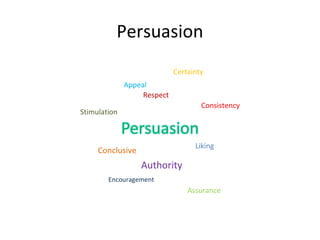
Persuasion
Stimulation
Consistency
Conclusive
Liking
Authority
Respect
Certainty
Assurance
Appeal
Encouragement
Emotional Conjunction
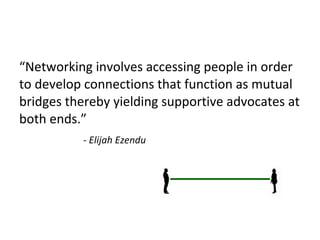
“Networking involves accessing people in order
to develop connections that function as mutual
bridges thereby yielding supportive advocates at
both ends.”
- Elijah Ezendu
Elements of Networks
• Mutual Bridges: Connections built through
interaction.
• Supportive Advocates: People who provide
recommendation and facilitate access to
more networks.
• Network Microstructure: Biological Families,
Psychological Families, Cliques.
• Network Megastructure: Companies,
Institutions, Organisations.
Source: Elijah Ezendu, Networking
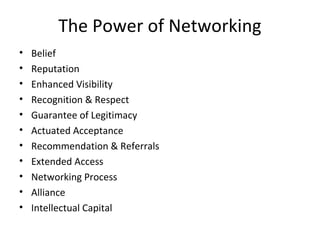
The Power of Networking
• Belief
• Reputation
• Enhanced Visibility
• Recognition & Respect
• Guarantee of Legitimacy
• Actuated Acceptance
• Recommendation & Referrals
• Extended Access
• Networking Process
• Alliance
• Intellectual Capital
Source: Elijah Ezendu, Networking
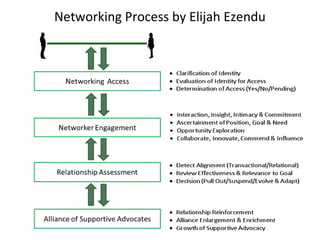
Networking Process involves two or more
people embarking on dynamic interaction to go
through networking access, networker
engagement and relationship assessment for
the purpose of yielding alliance of supportive
advocates.
Networking Process by Elijah Ezendu
Alliance is an open ended agreement between
two or more entities for the purpose of
deploying resources to accomplish specific
objectives.
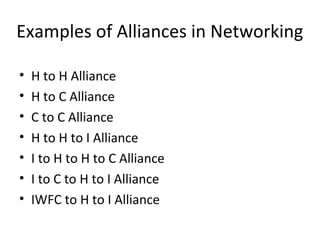
Examples of Alliances in Networking
• H to H Alliance
• H to C Alliance
• C to C Alliance
• H to H to I Alliance
• I to H to H to C Alliance
• I to C to H to I Alliance
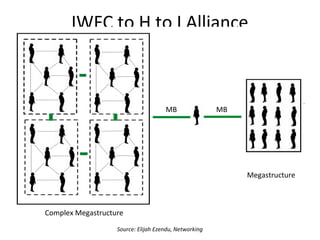
• IWFC to H to I Alliance
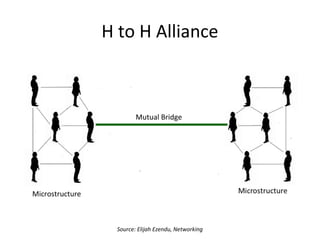
H to H Alliance
Mutual Bridge
Microstructure
Source: Elijah Ezendu, Networking
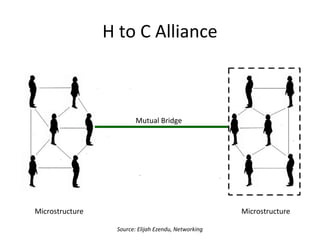
H to C Alliance
Mutual Bridge
Microstructure Microstructure
Source: Elijah Ezendu, Networking
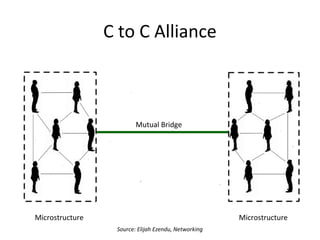
C to C Alliance
Mutual Bridge
Microstructure Microstructure
Source: Elijah Ezendu, Networking
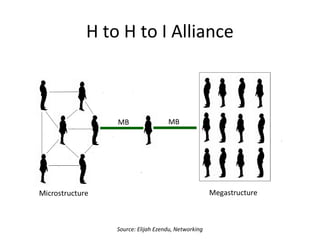
H to H to I Alliance
MB MB
Megastructure
Source: Elijah Ezendu, Networking
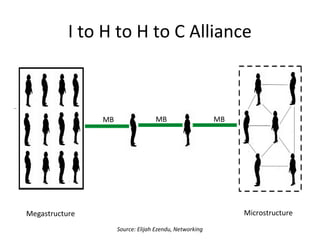
I to H to H to C Alliance
MB MB MB MB
Microstructure
MB MB MB
Source: Elijah Ezendu, Networking
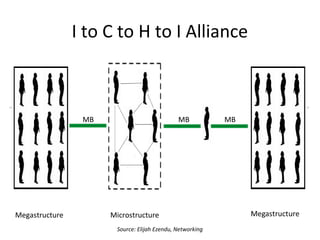
I to C to H to I Alliance
Megastructure Microstructure
MB MB MB
Source: Elijah Ezendu, Networking
IWFC to H to I Alliance
Complex Megastructure
Megastructure
MB MB
Source: Elijah Ezendu, Networking
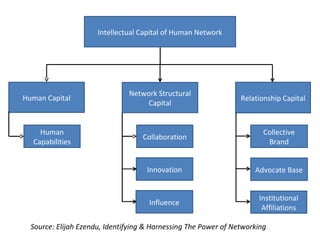
Human Capital Relationship Capital
Network Structural
Capital
Collaboration
Innovation
Influence
Collective
Brand
Advocate Base
Institutional
Affiliations
Human
Capabilities
Intellectual Capital of Human Network
Source: Elijah Ezendu, Identifying & Harnessing The Power of Networking
Participatory Governance
“Participatory Governance involves achieving
topmost audience participation in identification
of engagement components, structure and
direction with the aim of building critical mass
for coalition reinforcement, thereby deliberately
generating speaker-audience harmony.”
- Elijah Ezendu
Social Fusion
Social Fusion is a technique that effective leaders use to connect
and refer the people they know to each other. These
connections are made based on common interests, values, and
projects that people you know might want to collaborate on. If a
connection you make turns into a relationship, you have "fused"
them together with you as a stabilizing force in the relationship.
Source: CultureSync, Social Fusion
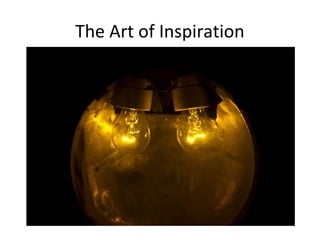
The Art of Inspiration
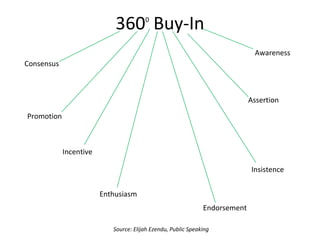
3600
Buy-In
Consensus
Promotion
Incentive
Enthusiasm
Assertion
Insistence
Awareness
Endorsement
Source: Elijah Ezendu, Public Speaking
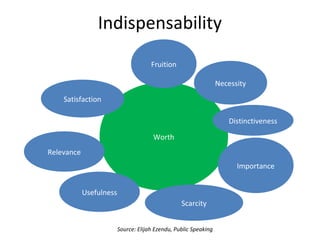
Indispensability
Worth
Importance
Relevance
Necessity
Usefulness
Satisfaction
Fruition
Scarcity
Distinctiveness
Source: Elijah Ezendu, Public Speaking
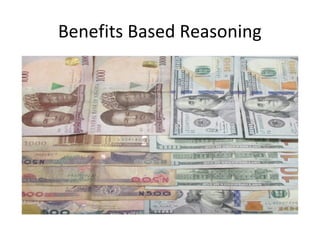
Benefits Based Reasoning
Expertise Credibility Based Reasoning
Exercise
Organize a simple influence experimentation for
purpose of prompting a set of people to accept
you as a well-bred neighbour.
Dr Elijah Ezendu is Award-Winning Business Expert & Certified Management Consultant with expertise in
Interim Management, Strategy, Competitive Intelligence, Transformation, Restructuring, Turnaround
Management, Business Development, Marketing, Project & Cost Management, Leadership, HR, CSR, e-
Business & Software Architecture. He had functioned as Founder, Initiative for Sustainable Business Equity;
Director, Archtalento; Director, Speakers Africana; Chairman of Board, Charisma Broadcast Film Academy;
Group Chief Operating Officer, Idova Group; CEO, Rubiini (UAE); Special Advisor, Road Transport Employers
Association of Nigeria; Director, MMNA Investments; Chair, Int’l Board of GCC Business Council (UAE); Senior
Partner, Shevach Consulting; Chairman (Certification & Training), Coordinator (Board of Fellows), Lead
Assessor & Governing Council Member, Institute of Management Consultants, Nigeria; Lead Resource, Centre
for Competitive Intelligence Development; Lead Consultant/ Partner, JK Michaels; Turnaround Project
Director, Consolidated Business Holdings Limited; Technical Director, Gestalt; Chief Operating Officer, Rohan
Group; Executive Director (Various Roles), Fortuna, Gambia & Malta; Chief Advisor/ Partner, D & E; Vice
Chairman of Board, Refined Shipping; Director of Programmes & Governing Council Member, Institute of
Business Development, Nigeria; Member of TDD Committee, International Association of Software Architects,
USA; Member of Strategic Planning and Implementation Committee, Chartered Institute of Personnel
Management of Nigeria; Country Manager (Nigeria) & Adjunct Faculty (MBA Programme), Regent Business
School, South Africa; Adjunct Faculty (MBA Programme), Ladoke Akintola University of Technology; Editor-in-
Chief, Cost Management Journal; Member of National Executive Council, Institute of Internal Auditors of
Nigeria; Member, Board of Directors (Several Organizations). He holds Doctoral Degree in Management,
Master of Business Administration and Fellow of Professional Institutes in North America, UK & Nigeria. He is
an Innovator of heralded frameworks including Corporate Investment Structure Based on Financials and
Intangibles, for all-inclusive valuation, highlighting intangible contributions of host communities and ecological
environment: A model celebrated internationally (including Social Innovation Side Event of 2016 United
Nations Climate Change Conference COP22 in Marrakech, Morocco) as remedy for unmitigated depreciation
of ecological capital and developmental deprivation of host communities. He had served as Examiner to
various Professional Institutes and External Examiner to Universities. He had been a member of Guild of
Soundtrack Producers of Nigeria. He's an author and extensively featured speaker.
Thank You

Speaking to Influence Executives

  • 1.
    Speaking to InfluenceExecutives Dr. Elijah Ezendu FIMC, FCIM, FCCM, FIIAN, FBDI, FAAFM, FSSM, MIMIS, MIAP, MITD, ACIArb, ACIPM, PhD, DocM, MBA, CWM, CBDA, CMA, MPM, PME, CSOL, CCIP, CMC, CMgr
  • 2.
    Dr Albert MehrabianCommunication Model "Please note that this and other equations regarding relative importance of verbal and nonverbal messages were derived from experiments dealing with communications of feelings and attitudes (i.e., like-dislike). Unless a communicator is talking about their feelings or attitudes, these equations are not applicable.” - Dr Albert Mehrabian
  • 3.
    Dr Albert MehrabianCommunication Model
  • 4.
    Evaluation of Verbaland Non-Verbal Communication Notable speakers and other professionals who had refuted broad applicability of Mehrabian communication ratio 7/93 include Steve Denning, Susan Trivers, John Windsor, Laura Fitton and Andrew Abela, citing the premise of Mehrabian research and his final recommendations. Nonetheless, most speakers and professionals accept the importance of both verbal and non-verbal communication, while claiming one fixed ratio does not fit every condition.
  • 5.
    Current Resolution Most authoritiesinsist non-verbal communication is more impacting than verbal communication, and as a result has the capacity to either derail, oppose and disapprove or sustain, convey and authenticate a speech.
  • 6.
    Key Takeaway Ensure thedepiction of your collective non- verbal communication aligns effectively with intended message of verbal communication.
  • 7.
    Functions of NonverbalCommunication  Accent: Punctuating or drawing attention to a verbal message  Complement: Expressions/gestures that support but could not replace verbal message  Contradict: Expressions or gestures that convey meaning opposite to that of verbal message  Regulate: Expressions or gestures that control the pace or flow of communication  Repeat: A gesture or expression that can be used alone to send the same meaning as verbal message  Substitute: A nonverbal cue that replaces verbal message
  • 8.
    Examples of NonverbalCues  Accent: Touching someone’s shoulder in empathy  Compliment: Smiling in approval or frowning with disdain  Contradict: Reading paper while saying “I am listening”  Regulate: Looking confused by too much information  Repeat: A stern look or pointing along with a verbal command  Substitute: Nods and shakes of the head
  • 9.
    Types of NonverbalCues 1. Facial expression 2. Eye behaviour 3. Posture 4. Gesture 5. Proxemics 6. Touch 7. Personal appearance 8. Vocal features of speech
  • 10.
    Real Nonverbal Cues Facial Expression: Happiness, sadness, surprise, fear, anger and disgust  Eye Behaviour-Functions: Regulatory, monitoring, cognitive and expressive  Posture: Indicative of attention, involvement, relative status and rapport  Gestures: Speech related and independent  Proxemics: Use space  Touch: ‘of self’ indicates emotion, and ‘of others’ indicates relationship  Personal Experience: Indicators of personality, values and lifestyle  Vocal Features of Speech: Tone, stress, accent, loudness and rate of speech
  • 11.
    Common Signs CausingDisapproval i. Inadmissible body movements ii. Touching of self/fidgeting iii. Hesitation iv. Blinking, eye shifting and dilation of pupils v. Lack of spontaneity vi. Speech errors vii. High vocal pitch viii. Negativity
  • 12.
    Actions for ImprovingNon-Verbal Communication Skills  Avoiding a slouching posture  Avoiding smiling or laughter when messages are serious  Displaying some animation with hands and facial expressions to project a dynamic presence  Don’t bring your phone, a drink or anything else to an interview or meeting that could distract you  Don’t interrupt your interviewer  Eliminating fidgeting and shaking of limbs  Establishing frequent but not continuous or piercing eye contact with interviewers  Focusing on the conversation  Introducing yourself with a smile and a firm handshake  Keeping hands away from the face and hair  Leaning slightly forward to indicate interest  Listening carefully  Maintaining open arms, folded arms can convey defensiveness  Modulating vocal tone to express excitement and punctuate key points  Nodding to demonstrate understanding  Observing the reaction of others to your statements  Paying attention to the conversation  Reading the nonverbal signals of others; providing clarification if they look confused, wrapping up if they have heard enough  Refraining from forced laughter in response to humor  Refraining from looking at the clock, your phone or displaying any other signs of disinterest  Respecting the amount of personal space preferred by your communication partners  Rotating eye contact to various speakers in group interviewing or networking situations  Shaking hands firmly without excessive force  Showing that you’re interested in what the interviewer is telling you  Smiling to indicate that you are amused or pleased with a communication  Staying calm even when you’re nervous  Steering clear of monotone delivery  Waiting until the person is done talking to respond Adopted from Alison Doyle, Non-Verbal Communication Skills
  • 13.
    12 Body LanguageTips for Career Success • Stand tall and take up space • Widen your stance • Lower your vocal pitch • Try power priming • Strike a power pose • Maintain positive eye contact • Talk with your hands • Use open gestures • Try a steeple • Reduce nervous gestures • Smile • Perfect your handshake Adopted from Carol Goman, 12 Body Language Tips for Career Success
  • 14.
    Detrimental Speaker Archetypes •The Gripper: This is the speaker who hangs on to the podium for dear life with both hands. He couldn’t let go to make a gesture if he tried. • The Leaning Tower: This is a first cousin of the gripper. While hanging on to the podium the speaker leans to one side so it looks as though the lectern is supporting her. • The Rattler: This speaker is usually the guy who has a hand in his pants pocket rattling the change, tokens, keys and assorted other items. It may calm his nerves but is distracting to his audience. • The Pacer: Back and forth she goes across the podium, often walking right in front of the slides. Continuous walking during a presentation tells the audience that this is a nervous speaker. The constant pacing diverts their focus away from the message. • The Parade Rester: At ease, soldier. This speaker assumes a military stance, feet apart, and hands behind his back. Never moves. Often glowers to make a point. • The Statue: This speaker is so nervous about presenting in front of a large audience that he places his hands in a fig leaf position down low in front of him. This signals, “wow, am I uncomfortable,” which robs him of any authority or credibility. Gestures should add to rather than detract from your presentation. Adopted from The Newman Group, Body Language Speaks Louder Than Words
  • 15.
    Four Types ofSpeech Delivery • Impromptu • Extemporaneous • Manuscript • Memorized
  • 16.
    “There are threethings to aim at in public speaking: first, to get into your subject, then to get your subject into yourself, and lastly, to get your subject into the heart of your audience.” – Alexander Gregg
  • 17.
    Content Versus Delivery Message Meansfor Transfer, Impartation, Impact and Transformation
  • 18.
    Delivery Uses Contextto Facilitate Coupling of Content and Audience CContent Audience Context Delivery DeliveryDelivery Delivery Delivery Delivery Delivery Delivery Source: Elijah Ezendu, Public Speaking
  • 19.
    “The success ofyour presentation will be judged not by the knowledge you send but by what the listener receives.” – Lilly Walters
  • 20.
    “If you havean important point to make, don’t try to be subtle or clever. Use a pile driver. Hit the point once. Then come back and hit it again. Then hit it a third time - a tremendous whack.” – Winston S. Churchill
  • 21.
    “The best speechescome from the heart and reflect your passion. Speak as if your life depended on it.” – Arvee Robinson
  • 22.
    Speech Preparation • SpeechPlanning • Content Research • Evaluation of Pros and Cons • Development of Fitting Content • Align Content to Audience • Speech Writing • Ascertainment of Delivery Aids and Tools • Practice & Review
  • 23.
    Speech Outline Exercise Stateacceptable components of the following •Opening:…………………………………………………. •Body:……………………………………………………….. •Conclusion:……………………………………………….
  • 24.
    Speech Mechanics i. Eloquence ii.Vocal Chemistry iii. Voice Modulation iv. Intrinsic Rhythm v. Self Pacing vi. Motion-Pause Control vii. Audience-Centric Eye Contact viii. Proxemics ix. Poise-Driven Narratives x. Systematic Gestures xi. Appropriate Entertainment & Attention Boosting Humour xii. Structured Audience Engagement xiii. Distinguishable Professional Passion xiv. Clarity Without Unnecessaries xv. Mission-Driven Campaign xvi. Great Gusto for Storytelling xvii. Effectively Aligned Anecdotes xviii. Unleash Audacious Confidence xix. Demonstrate Subject Matter Mastery xx. Proofs of Content Integrity xxi. Avoid Fallacy of Petitio Principii Source: Elijah Ezendu, Public Speaking
  • 25.
    Eloquence Eloquence is theessential thing in a speech, not information.” – Mark Twain
  • 26.
    Vocal Chemistry Source: ElijahEzendu, Public Speaking
  • 27.
  • 28.
    Intrinsic Rhythm Flow Let yourspeech flow like a river Flow Flow
  • 29.
  • 30.
  • 31.
  • 32.
    Proxemics Space Indicators Space Analysis SpaceProjection Space Conjecturing Space Integration Action + Space Space Statement Source: Elijah Ezendu, Public Speaking
  • 33.
  • 34.
  • 35.
    Exercise on AppropriateEntertainment & Attention Boosting Humour i. Mention effects of appropriate entertainment and humour. ii. Mention effects of inappropriate entertainment and humour iii. Mention three critical situations requiring humour for stimulating audience to be on the same page with you. Give example of appropriate humour for each stated situation.
  • 36.
  • 37.
    Distinguishable Professional Passion Source:Elijah Ezendu, Public Speaking
  • 38.
    Clarity Without Unnecessaries Essential Essential Essential nothingelse nothing else nothing else nothing elsenothing else nothing else nothing else
  • 39.
  • 40.
    Great Gusto forStorytelling Source: Elijah Ezendu, Public Speaking
  • 41.
    Exercise on EffectivelyAligned Anecdotes • What are the features of effectively aligned anecdote? ………………………………………………………………………… ……………………………………………………………………… ……………………………………………………………………… ……………………………………………………………………… ……………………………………………………………………… ……………………………………………………………………… ……………………………………………………………………… …
  • 42.
  • 43.
    Demonstrate Subject MatterMastery Show your expertise on matters of this cube by effortlessly explaining its 6 faces, 12 edges, 8 vertices, content, physical characteristics and usability.
  • 44.
    Proofs of ContentIntegrity • Effective Attribution • Ownership Assurance • Intellectual Property Compliance • Intellectual Property Rights Governance • Declaration of Originality
  • 45.
    Avoid Fallacy ofPetitio Principii Begging the Question Attempting to prove something by using an evidential support which also requires proof InadmissibilityInadmissibility Inadmissibility Inadmissibility Inadmissibility Inadmissibility
  • 46.
    “You cannot makea business case that you should be who you are not.” - Jeff Bezos
  • 47.
    Be methodically discreetwhile structuring business cases: Irrespective of intention, avoid heading to showtime-runway with despicable falsehood.
  • 48.
    Basic Outline ofa Business Case • Executive Summary • Introduction • Statement of Problem • Situation Analysis • Ascertainment of Suitable Solution Features • Possible Options for Solution • Cost-Benefit Analysis • Expert Advise/ Recommendations
  • 49.
    Making an IrresistibleBusiness Case A business case shows rational basis for support of targeted action or project, by using performance objectives, financial justification and assortment of undisputable facts as validated proof. Irresistibility of business case is directly proportional to perceived effectuality of validated proof. Therefore proposed validated proof must stand out as 3R value-input which makes sense to executives and spawns recognition for characterized effectuality. 3R = Required, Rare & Rewarding Source: Elijah Ezendu, Public Speaking
  • 51.
    Performance Wingspan OptimizationApproach by Elijah Ezendu  Reduced Performance Wingspan implies Failed Business Case  Increased Performance Wingspan implies Effectual Business Case  Continuously Increasing Performance Wingspan implies Greatly Irresistible Business Case
  • 52.
     Performance Wingspan3 > Performance Wingspan 2 > Performance Wingspan 1  Therefore performance wingspan increased at subsequent stages, providing impetus for greatly irresistible business case. Performance Wingspan Optimization Approach by Elijah Ezendu
  • 53.
    Magnetism of Visuals& Infographics • Use visuals to portray reality of message and gain acceptance • Use infographics for depicting key points • Use appropriate fonts, colours and animation • Avoid excessive data (data dump) • Avoid unconnected data which can irritate executives • Avoid excessive infographics • Avoid mind-numbing pictures • Be sensitive to infographics capable of generating emotional shock or culture shock • Avoid Graphic Analysis Paralysis
  • 54.
    Coordinating Feasible Influence i.Persuasion ii. Emotional Conjunction iii. Networking iv. Participatory Governance v. Social Fusion vi. Inspiration vii. 360 Degrees Buy-In viii. Indispensability ix. Benefits Based Reasoning x. Expertise Credibility Based Reasoning Source: Elijah Ezendu, Public Speaking
  • 55.
  • 56.
  • 57.
    “Networking involves accessingpeople in order to develop connections that function as mutual bridges thereby yielding supportive advocates at both ends.” - Elijah Ezendu
  • 58.
    Elements of Networks •Mutual Bridges: Connections built through interaction. • Supportive Advocates: People who provide recommendation and facilitate access to more networks. • Network Microstructure: Biological Families, Psychological Families, Cliques. • Network Megastructure: Companies, Institutions, Organisations. Source: Elijah Ezendu, Networking
  • 59.
    The Power ofNetworking • Belief • Reputation • Enhanced Visibility • Recognition & Respect • Guarantee of Legitimacy • Actuated Acceptance • Recommendation & Referrals • Extended Access • Networking Process • Alliance • Intellectual Capital Source: Elijah Ezendu, Networking
  • 60.
    Networking Process involvestwo or more people embarking on dynamic interaction to go through networking access, networker engagement and relationship assessment for the purpose of yielding alliance of supportive advocates.
  • 61.
    Networking Process byElijah Ezendu
  • 63.
    Alliance is anopen ended agreement between two or more entities for the purpose of deploying resources to accomplish specific objectives.
  • 64.
    Examples of Alliancesin Networking • H to H Alliance • H to C Alliance • C to C Alliance • H to H to I Alliance • I to H to H to C Alliance • I to C to H to I Alliance • IWFC to H to I Alliance
  • 65.
    H to HAlliance Mutual Bridge Microstructure Source: Elijah Ezendu, Networking
  • 66.
    H to CAlliance Mutual Bridge Microstructure Microstructure Source: Elijah Ezendu, Networking
  • 67.
    C to CAlliance Mutual Bridge Microstructure Microstructure Source: Elijah Ezendu, Networking
  • 68.
    H to Hto I Alliance MB MB Megastructure Source: Elijah Ezendu, Networking
  • 69.
    I to Hto H to C Alliance MB MB MB MB Microstructure MB MB MB Source: Elijah Ezendu, Networking
  • 70.
    I to Cto H to I Alliance Megastructure Microstructure MB MB MB Source: Elijah Ezendu, Networking
  • 71.
    IWFC to Hto I Alliance Complex Megastructure Megastructure MB MB Source: Elijah Ezendu, Networking
  • 72.
    Human Capital RelationshipCapital Network Structural Capital Collaboration Innovation Influence Collective Brand Advocate Base Institutional Affiliations Human Capabilities Intellectual Capital of Human Network Source: Elijah Ezendu, Identifying & Harnessing The Power of Networking
  • 73.
    Participatory Governance “Participatory Governanceinvolves achieving topmost audience participation in identification of engagement components, structure and direction with the aim of building critical mass for coalition reinforcement, thereby deliberately generating speaker-audience harmony.” - Elijah Ezendu
  • 74.
    Social Fusion Social Fusionis a technique that effective leaders use to connect and refer the people they know to each other. These connections are made based on common interests, values, and projects that people you know might want to collaborate on. If a connection you make turns into a relationship, you have "fused" them together with you as a stabilizing force in the relationship. Source: CultureSync, Social Fusion
  • 75.
    The Art ofInspiration
  • 76.
  • 77.
  • 78.
  • 79.
  • 80.
    Exercise Organize a simpleinfluence experimentation for purpose of prompting a set of people to accept you as a well-bred neighbour.
  • 81.
    Dr Elijah Ezenduis Award-Winning Business Expert & Certified Management Consultant with expertise in Interim Management, Strategy, Competitive Intelligence, Transformation, Restructuring, Turnaround Management, Business Development, Marketing, Project & Cost Management, Leadership, HR, CSR, e- Business & Software Architecture. He had functioned as Founder, Initiative for Sustainable Business Equity; Director, Archtalento; Director, Speakers Africana; Chairman of Board, Charisma Broadcast Film Academy; Group Chief Operating Officer, Idova Group; CEO, Rubiini (UAE); Special Advisor, Road Transport Employers Association of Nigeria; Director, MMNA Investments; Chair, Int’l Board of GCC Business Council (UAE); Senior Partner, Shevach Consulting; Chairman (Certification & Training), Coordinator (Board of Fellows), Lead Assessor & Governing Council Member, Institute of Management Consultants, Nigeria; Lead Resource, Centre for Competitive Intelligence Development; Lead Consultant/ Partner, JK Michaels; Turnaround Project Director, Consolidated Business Holdings Limited; Technical Director, Gestalt; Chief Operating Officer, Rohan Group; Executive Director (Various Roles), Fortuna, Gambia & Malta; Chief Advisor/ Partner, D & E; Vice Chairman of Board, Refined Shipping; Director of Programmes & Governing Council Member, Institute of Business Development, Nigeria; Member of TDD Committee, International Association of Software Architects, USA; Member of Strategic Planning and Implementation Committee, Chartered Institute of Personnel Management of Nigeria; Country Manager (Nigeria) & Adjunct Faculty (MBA Programme), Regent Business School, South Africa; Adjunct Faculty (MBA Programme), Ladoke Akintola University of Technology; Editor-in- Chief, Cost Management Journal; Member of National Executive Council, Institute of Internal Auditors of Nigeria; Member, Board of Directors (Several Organizations). He holds Doctoral Degree in Management, Master of Business Administration and Fellow of Professional Institutes in North America, UK & Nigeria. He is an Innovator of heralded frameworks including Corporate Investment Structure Based on Financials and Intangibles, for all-inclusive valuation, highlighting intangible contributions of host communities and ecological environment: A model celebrated internationally (including Social Innovation Side Event of 2016 United Nations Climate Change Conference COP22 in Marrakech, Morocco) as remedy for unmitigated depreciation of ecological capital and developmental deprivation of host communities. He had served as Examiner to various Professional Institutes and External Examiner to Universities. He had been a member of Guild of Soundtrack Producers of Nigeria. He's an author and extensively featured speaker.
  • 82.