Stakeholder Analysis
Objectives for this session: By the end of this session, you should be able to describe: A definition of ‘stakeholders’ for your organisation How the concept of ‘stakeholders’ relates to concepts of the organisation The purpose of Stakeholder Analysis Some common forms of Stakeholder Analysis Stakeholder Mapping techniques
A ‘Stakeholder’ is: Any person or organisation who can be positively or negatively impacted by, or cause an impact on the actions of a company. (Freeman, 1984) The individuals and constituencies that contribute, either voluntarily or involuntarily, to its wealth-creating capacity and activities, and are therefore its potential beneficiaries and / or risk bearers. (Post, Preston & Sachs, 2002)
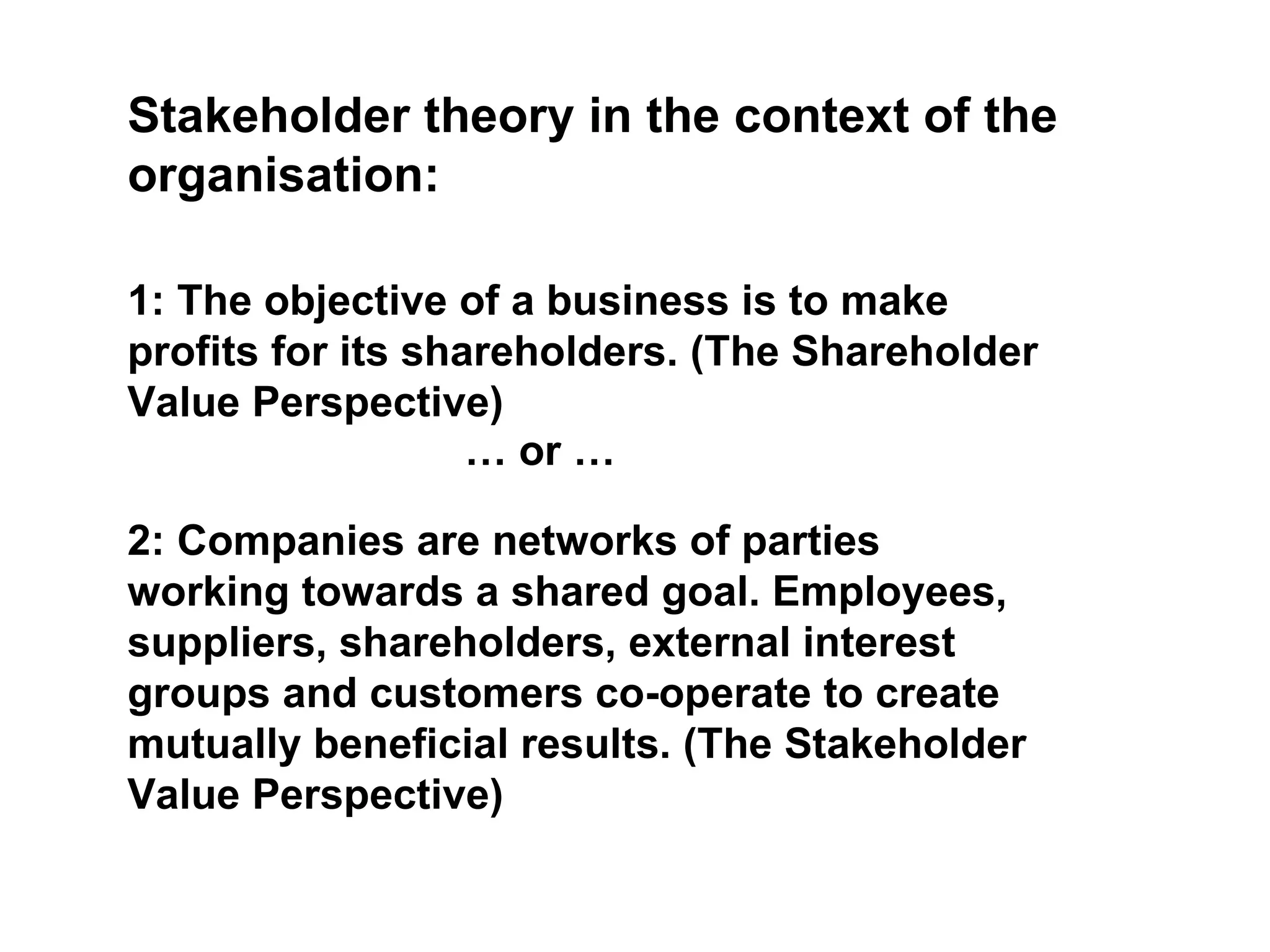
Stakeholder theory in the context of the organisation: 1: The objective of a business is to make profits for its shareholders. (The Shareholder Value Perspective) 2: Companies are networks of parties working towards a shared goal. Employees, suppliers, shareholders, external interest groups and customers co-operate to create mutually beneficial results. (The Stakeholder Value Perspective) …  or …
Why use Stakeholder Analysis? Identify the stakeholders likely to be affected by or influence the activities of the organisation Assess how those stakeholders could be impacted or impact upon the organisation Anticipate the consequences of any change in the organisation’s activities Identify stakeholders’ ‘success criteria’ Assure a successful outcome for the organisation by developing co-operation with stakeholders ( see:  Customer Focus)
Meeting stakeholder needs: Where does your organisation create stakeholder value? How can you do that better? Can you eliminate or reduce focus on processes which do not add stakeholder value? How do you communicate with stakeholders? Do your communications encourage stakeholder exchange? Do you communicate the stakeholder value?
Who are the Stakeholders?
A typical list of Stakeholders would include: Owners, stockholders & investors Banks and creditors Partners & suppliers Buyers, customers & prospects Management Employees, unions, works councils Competitors Government & regulators: local, national, international Professional and industry associations Media: local, national, trade, financial NGOs Communities & other interest groups
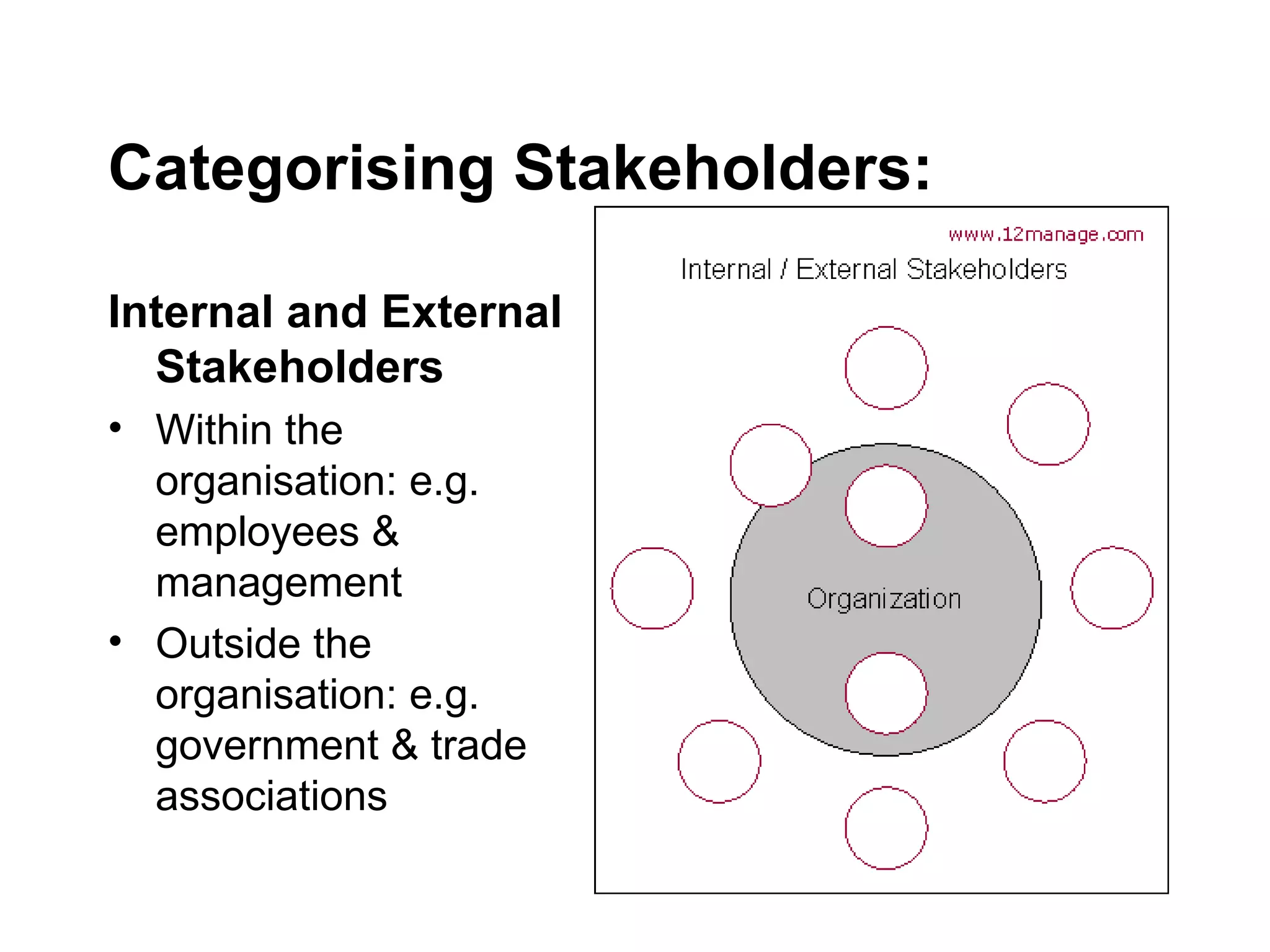
Categorising Stakeholders: Internal and External Stakeholders Within the organisation: e.g. employees & management Outside the organisation: e.g. government & trade associations
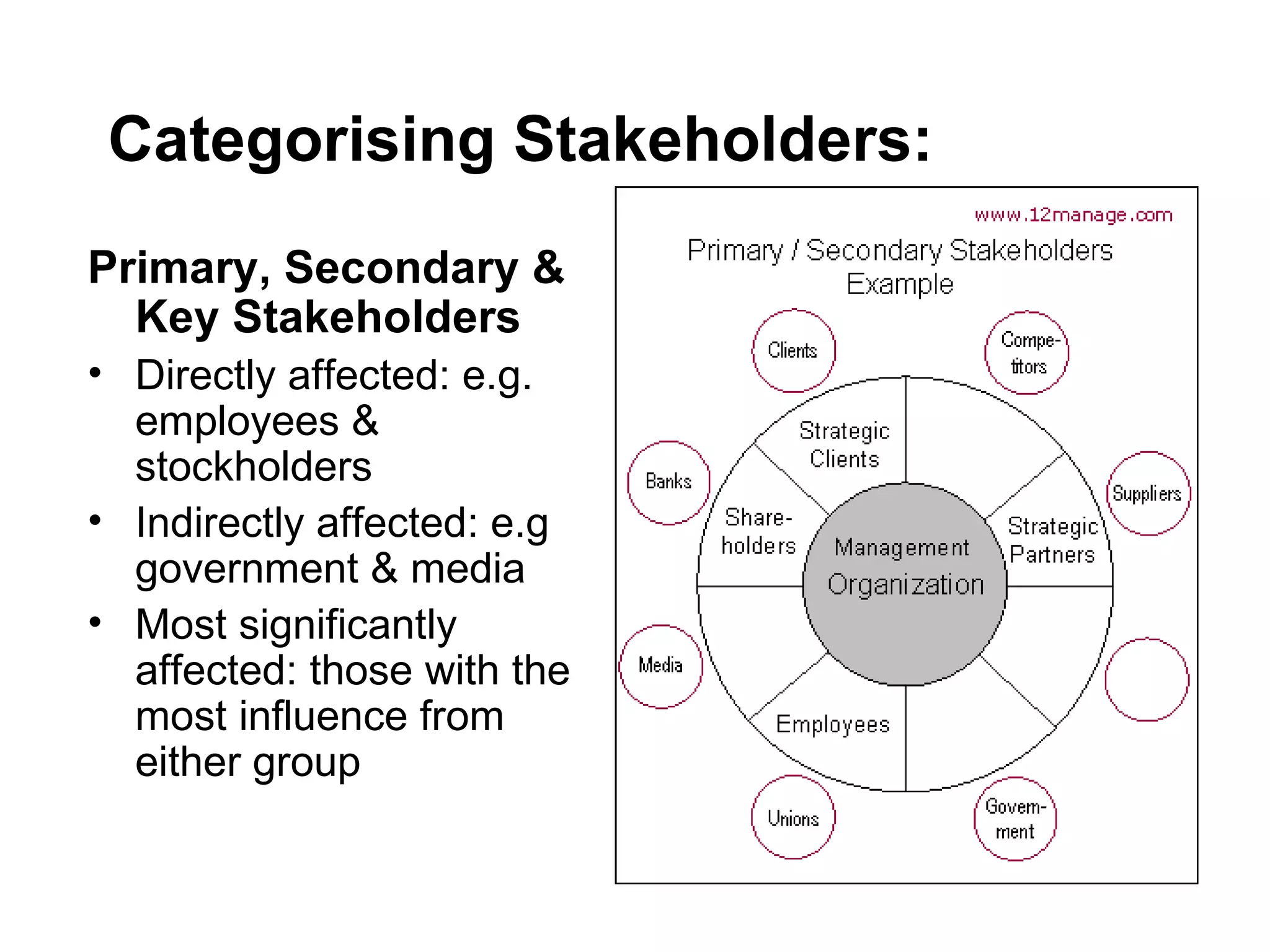
Categorising Stakeholders: Primary, Secondary & Key Stakeholders Directly affected: e.g. employees & stockholders Indirectly affected: e.g government & media Most significantly affected: those with the most influence from either group
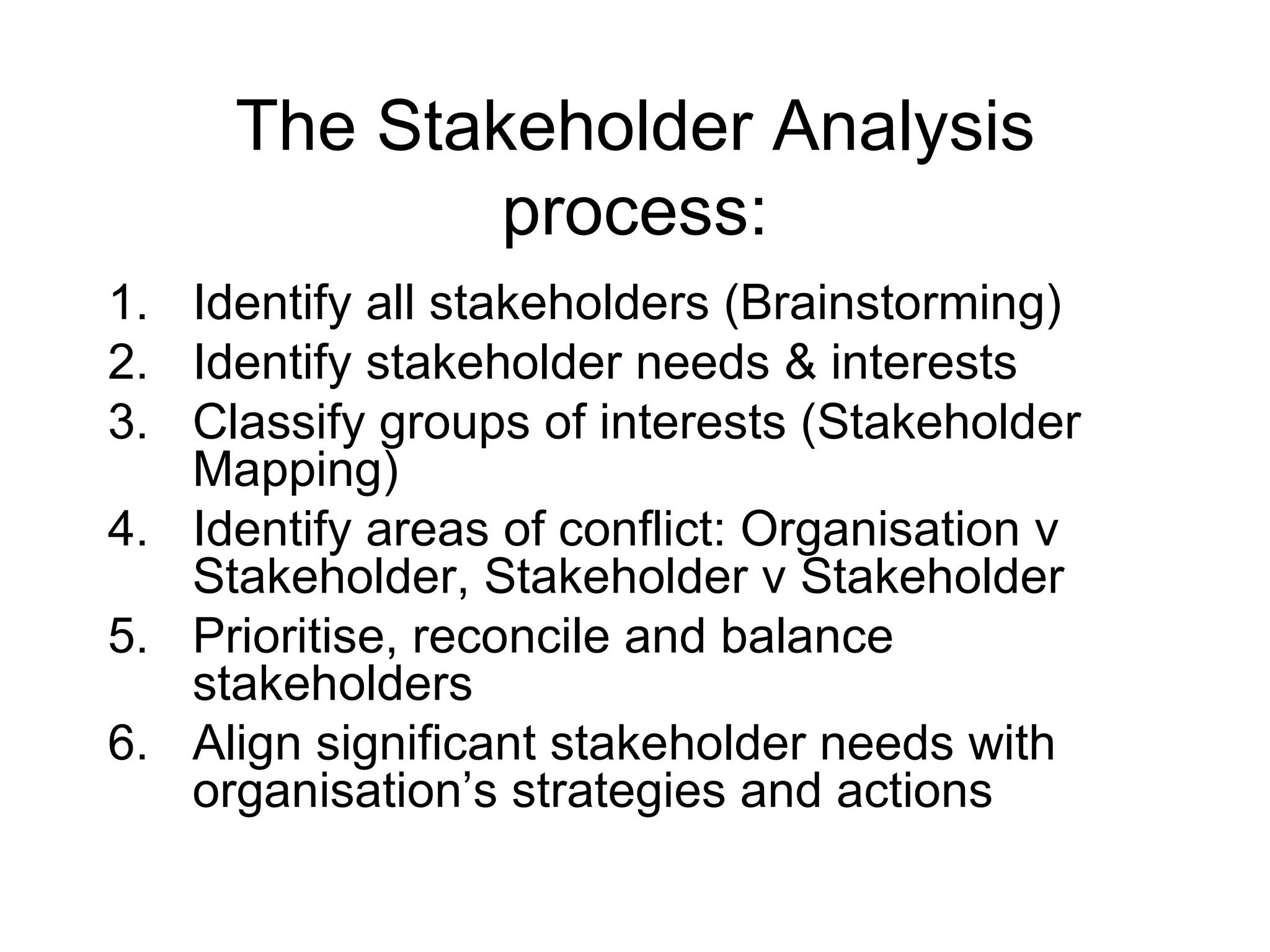
The Stakeholder Analysis process: Identify all stakeholders (Brainstorming) Identify stakeholder needs & interests Classify groups of interests (Stakeholder Mapping) Identify areas of conflict: Organisation v Stakeholder, Stakeholder v Stakeholder Prioritise, reconcile and balance stakeholders Align significant stakeholder needs with organisation’s strategies and actions
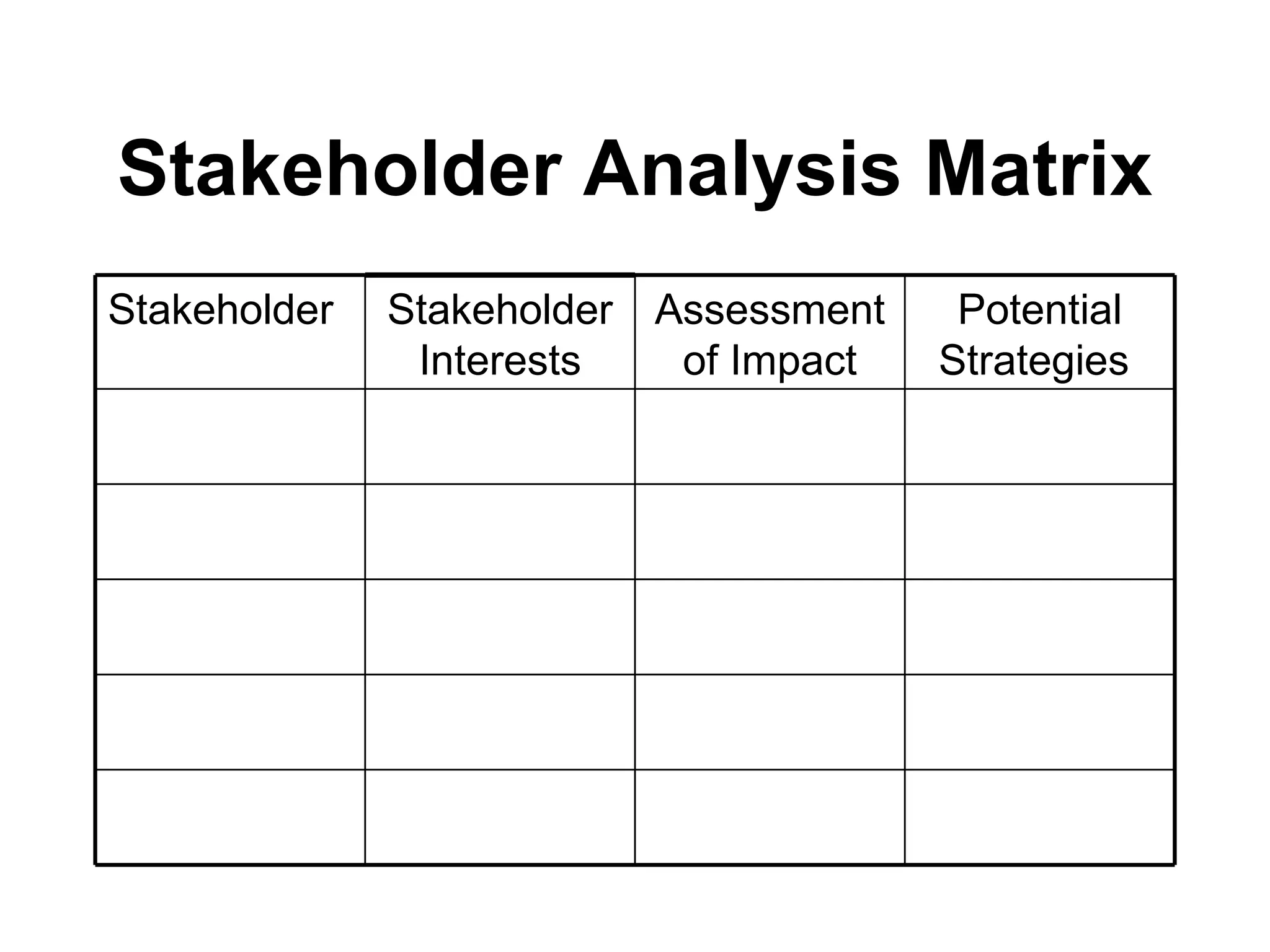
Stakeholder Analysis Matrix   Potential Strategies  Assessment of Impact Stakeholder Interests Stakeholder
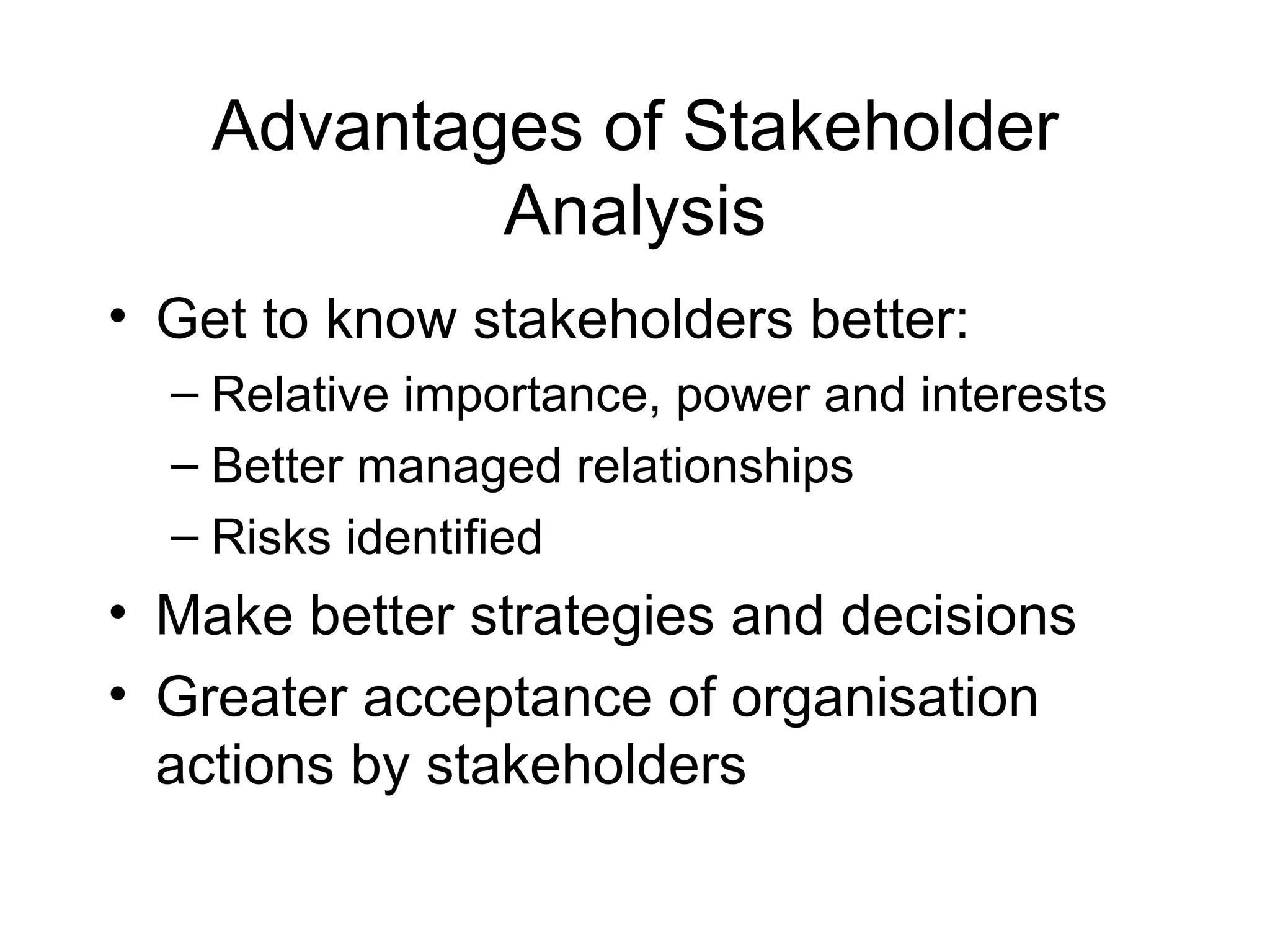
Advantages of Stakeholder Analysis Get to know stakeholders better: Relative importance, power and interests  Better managed relationships Risks identified  Make better strategies and decisions Greater acceptance of organisation actions by stakeholders
Disadvantages of Stakeholder Analysis Best done on continuous basis Assessment of analysis may be subjective Maybe not all stakeholder interests can be met at the same time Focus on most important stakeholder Balance & reconcile all interests according to importance or urgency
Stakeholder Mapping Several techniques for categorising stakeholders Helps identify which stakeholders may support or oppose change / organisation’s actions Which stakeholders are the most powerful, have most influence Help decision makers formalise / prioritise strategies
The Power / Dynamism Matrix Classifies stakeholders in relation to the power they hold and their aptitude for action (dynamism) Can be used to indicate where political effort should be made before instigating change
 
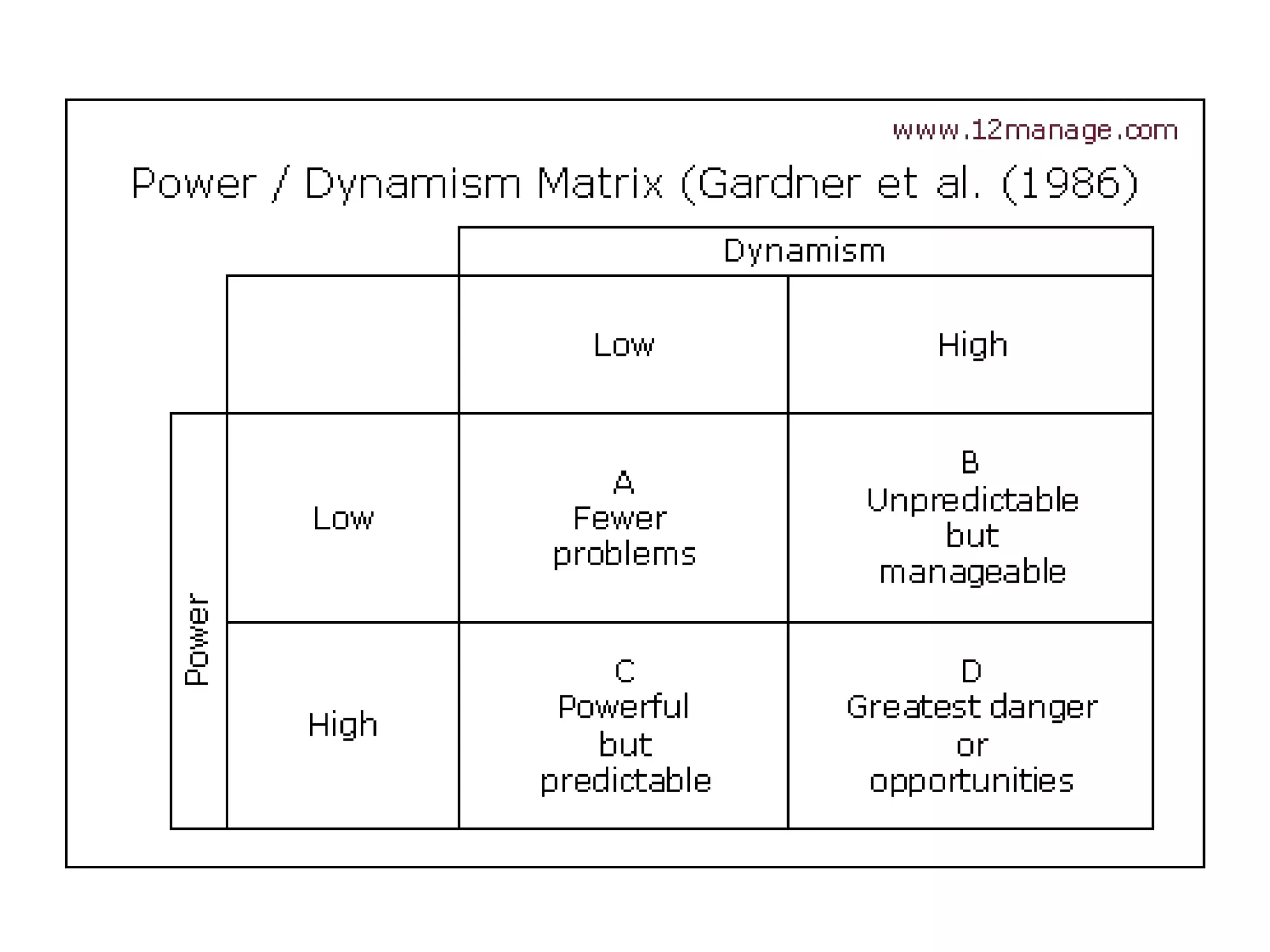
Power / Dynamism Matrix: Stakeholders in groups A & B : are the easiest to deal with. Stakeholders in group C : are important because thy are powerful. But low dynamism means their reaction is predictable and expectations can be managed. Stakeholders in section D : Need most management attention because they are powerful and reaction is difficult to predict. May need to ‘trial’ new strategies with them.
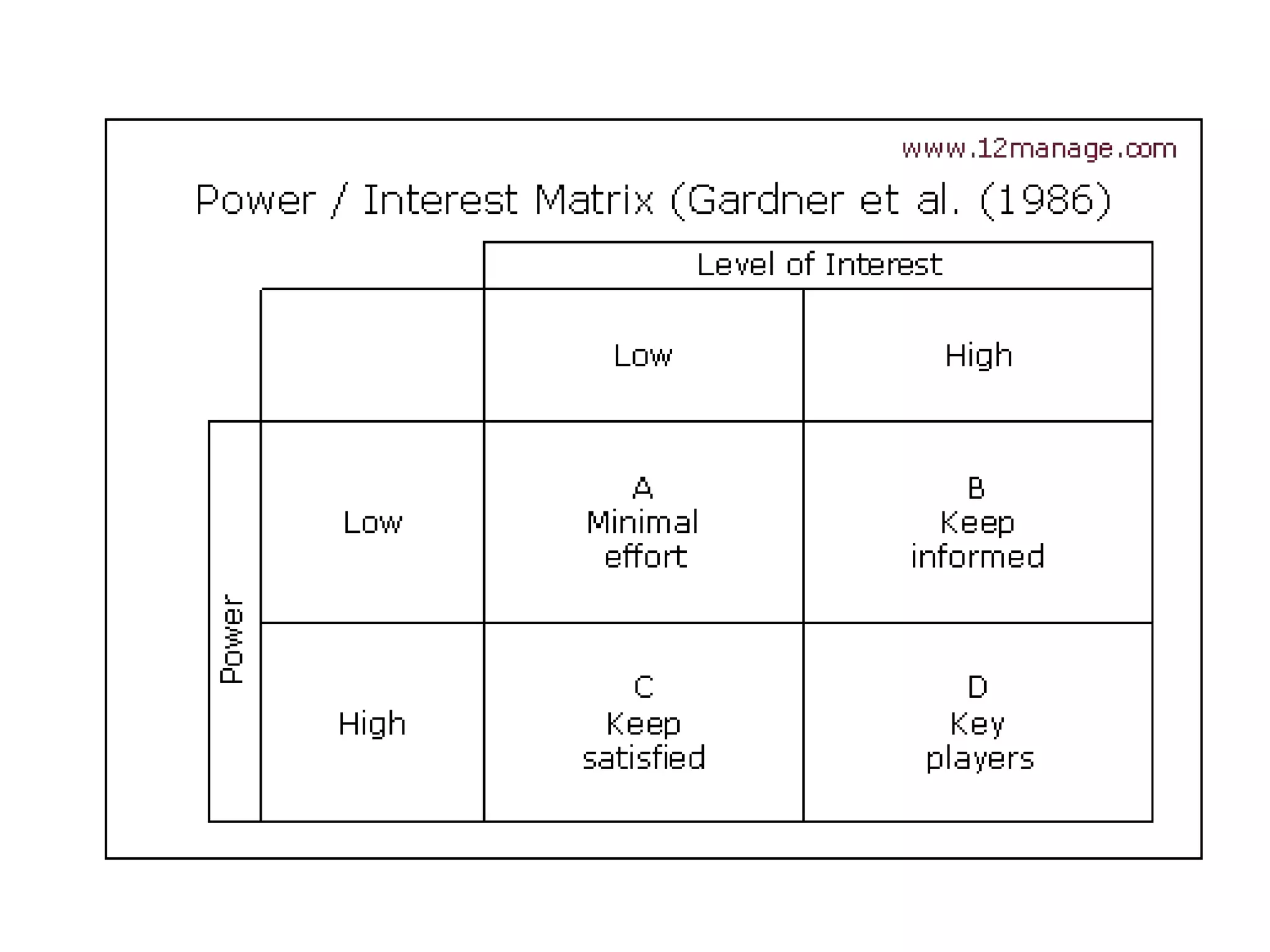
The Power / Interest Matrix Classifies stakeholders in relation to their power and the extent to which they are likely to show interest in the actions of the organisation. Can be used to indicate the nature of the relationship which should be adopted with each group
 
Power / Interest Matrix: Stakeholders in group A:  Need only minimum effort an monitoring Stakeholders in group B:  Should be kept informed as they may be able to influence more powerful stakeholders Stakeholders in group C:  Are powerful, but level of interest is low. Generally expected to be passive, but may move into group D on an issue of particular interest Stakeholders in group D:  Are both powerful and interested. Their co-operation is of key importance for new strategies
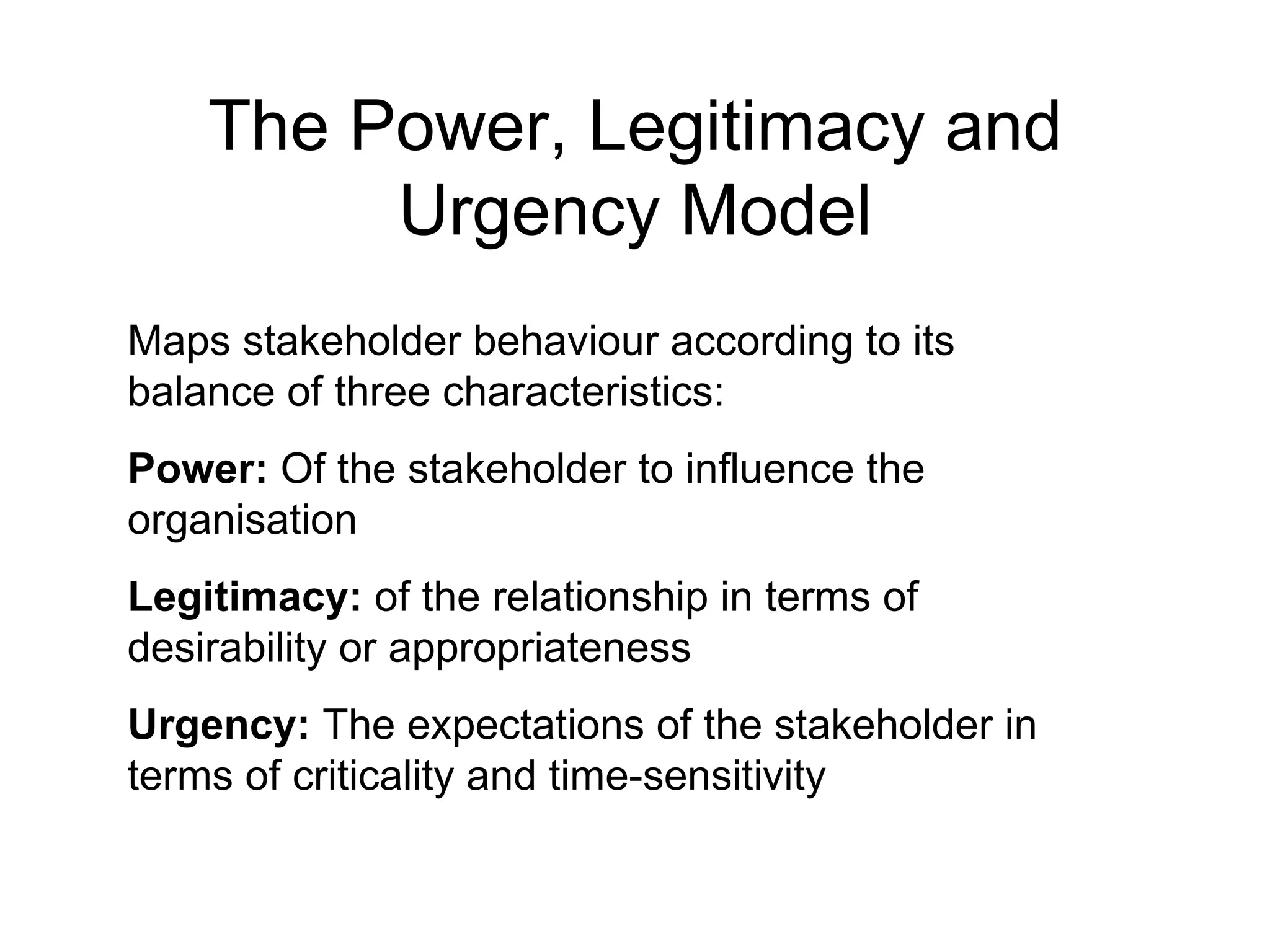
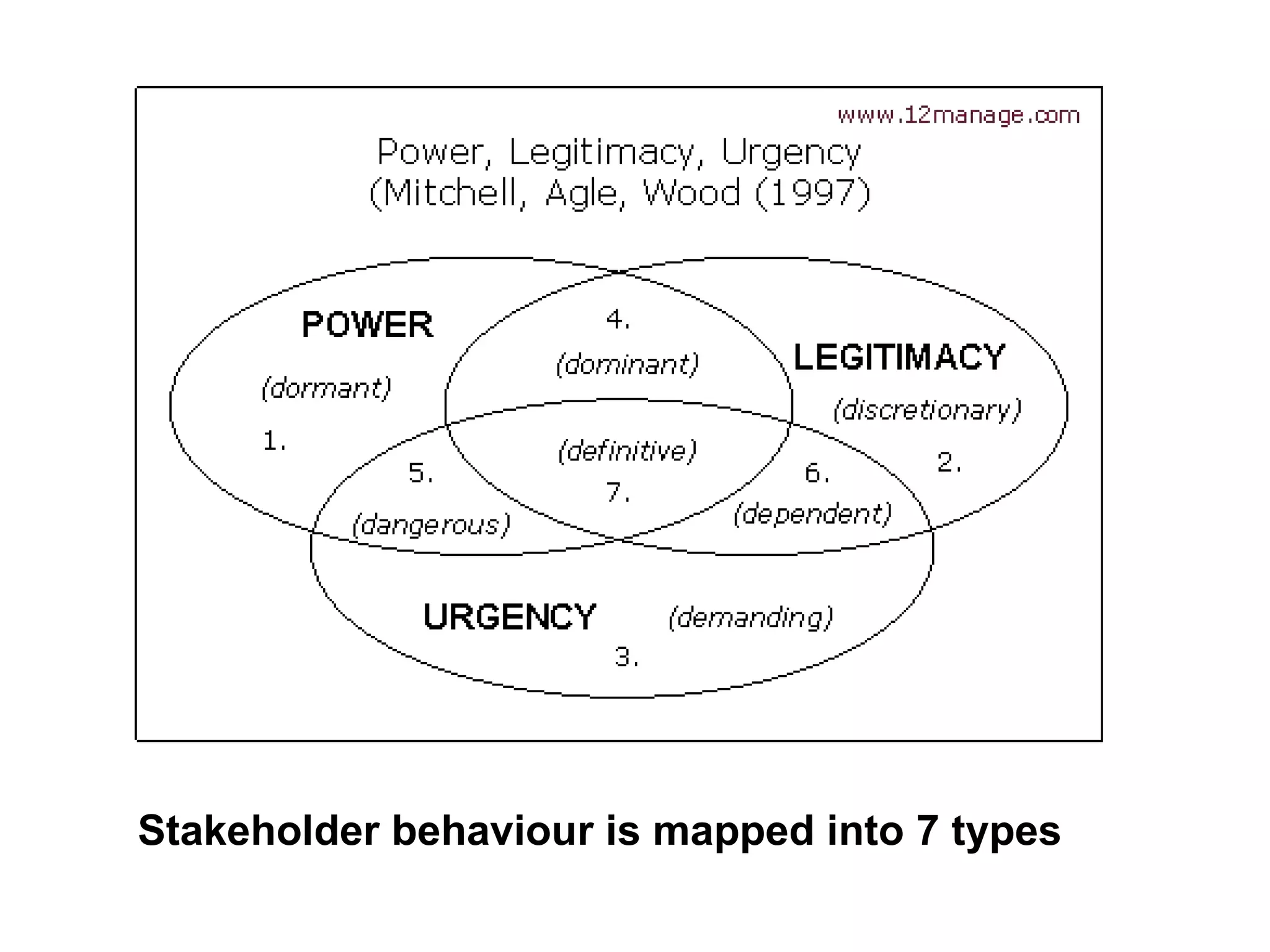
The Power, Legitimacy and Urgency Model Maps stakeholder behaviour according to its balance of three characteristics: Power:  Of the stakeholder to influence the organisation Legitimacy:  of the relationship in terms of desirability or appropriateness Urgency:  The expectations of the stakeholder in terms of criticality and time-sensitivity
Stakeholder behaviour is mapped into 7 types
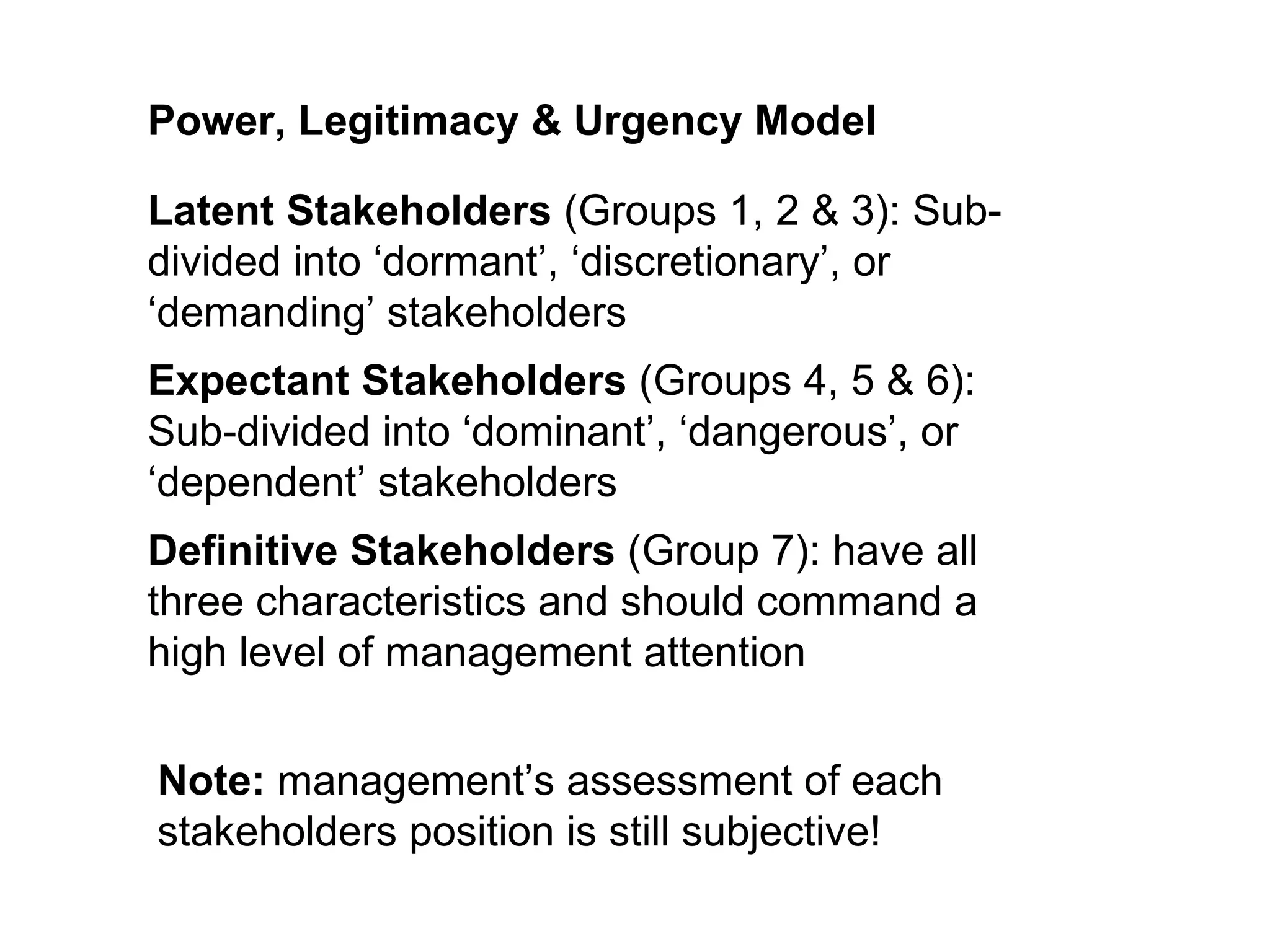
Power, Legitimacy & Urgency Model Latent Stakeholders  (Groups 1, 2 & 3): Sub-divided into ‘dormant’, ‘discretionary’, or ‘demanding’ stakeholders Expectant Stakeholders  (Groups 4, 5 & 6): Sub-divided into ‘dominant’, ‘dangerous’, or ‘dependent’ stakeholders Definitive Stakeholders  (Group 7): have all three characteristics and should command a high level of management attention Note:  management’s assessment of each stakeholders position is still subjective!
In conclusion: You should now be able to describe: What is meant by a ‘stakeholder’. Who your organisation’s stakeholders are How Stakeholder Analysis can help you prioritise stakeholders for management attention How you can categorise stakeholders How Stakeholder Mapping can help identify key stakeholder groups

Stakeholder Analysis

  • 1.
  • 2.
    Objectives for thissession: By the end of this session, you should be able to describe: A definition of ‘stakeholders’ for your organisation How the concept of ‘stakeholders’ relates to concepts of the organisation The purpose of Stakeholder Analysis Some common forms of Stakeholder Analysis Stakeholder Mapping techniques
  • 3.
    A ‘Stakeholder’ is:Any person or organisation who can be positively or negatively impacted by, or cause an impact on the actions of a company. (Freeman, 1984) The individuals and constituencies that contribute, either voluntarily or involuntarily, to its wealth-creating capacity and activities, and are therefore its potential beneficiaries and / or risk bearers. (Post, Preston & Sachs, 2002)
  • 4.
    Stakeholder theory inthe context of the organisation: 1: The objective of a business is to make profits for its shareholders. (The Shareholder Value Perspective) 2: Companies are networks of parties working towards a shared goal. Employees, suppliers, shareholders, external interest groups and customers co-operate to create mutually beneficial results. (The Stakeholder Value Perspective) … or …
  • 5.
    Why use StakeholderAnalysis? Identify the stakeholders likely to be affected by or influence the activities of the organisation Assess how those stakeholders could be impacted or impact upon the organisation Anticipate the consequences of any change in the organisation’s activities Identify stakeholders’ ‘success criteria’ Assure a successful outcome for the organisation by developing co-operation with stakeholders ( see: Customer Focus)
  • 6.
    Meeting stakeholder needs:Where does your organisation create stakeholder value? How can you do that better? Can you eliminate or reduce focus on processes which do not add stakeholder value? How do you communicate with stakeholders? Do your communications encourage stakeholder exchange? Do you communicate the stakeholder value?
  • 7.
    Who are theStakeholders?
  • 8.
    A typical listof Stakeholders would include: Owners, stockholders & investors Banks and creditors Partners & suppliers Buyers, customers & prospects Management Employees, unions, works councils Competitors Government & regulators: local, national, international Professional and industry associations Media: local, national, trade, financial NGOs Communities & other interest groups
  • 9.
    Categorising Stakeholders: Internaland External Stakeholders Within the organisation: e.g. employees & management Outside the organisation: e.g. government & trade associations
  • 10.
    Categorising Stakeholders: Primary,Secondary & Key Stakeholders Directly affected: e.g. employees & stockholders Indirectly affected: e.g government & media Most significantly affected: those with the most influence from either group
  • 11.
    The Stakeholder Analysisprocess: Identify all stakeholders (Brainstorming) Identify stakeholder needs & interests Classify groups of interests (Stakeholder Mapping) Identify areas of conflict: Organisation v Stakeholder, Stakeholder v Stakeholder Prioritise, reconcile and balance stakeholders Align significant stakeholder needs with organisation’s strategies and actions
  • 12.
    Stakeholder Analysis Matrix Potential Strategies Assessment of Impact Stakeholder Interests Stakeholder
  • 13.
    Advantages of StakeholderAnalysis Get to know stakeholders better: Relative importance, power and interests Better managed relationships Risks identified Make better strategies and decisions Greater acceptance of organisation actions by stakeholders
  • 14.
    Disadvantages of StakeholderAnalysis Best done on continuous basis Assessment of analysis may be subjective Maybe not all stakeholder interests can be met at the same time Focus on most important stakeholder Balance & reconcile all interests according to importance or urgency
  • 15.
    Stakeholder Mapping Severaltechniques for categorising stakeholders Helps identify which stakeholders may support or oppose change / organisation’s actions Which stakeholders are the most powerful, have most influence Help decision makers formalise / prioritise strategies
  • 16.
    The Power /Dynamism Matrix Classifies stakeholders in relation to the power they hold and their aptitude for action (dynamism) Can be used to indicate where political effort should be made before instigating change
  • 17.
  • 18.
    Power / DynamismMatrix: Stakeholders in groups A & B : are the easiest to deal with. Stakeholders in group C : are important because thy are powerful. But low dynamism means their reaction is predictable and expectations can be managed. Stakeholders in section D : Need most management attention because they are powerful and reaction is difficult to predict. May need to ‘trial’ new strategies with them.
  • 19.
    The Power /Interest Matrix Classifies stakeholders in relation to their power and the extent to which they are likely to show interest in the actions of the organisation. Can be used to indicate the nature of the relationship which should be adopted with each group
  • 20.
  • 21.
    Power / InterestMatrix: Stakeholders in group A: Need only minimum effort an monitoring Stakeholders in group B: Should be kept informed as they may be able to influence more powerful stakeholders Stakeholders in group C: Are powerful, but level of interest is low. Generally expected to be passive, but may move into group D on an issue of particular interest Stakeholders in group D: Are both powerful and interested. Their co-operation is of key importance for new strategies
  • 22.
    The Power, Legitimacyand Urgency Model Maps stakeholder behaviour according to its balance of three characteristics: Power: Of the stakeholder to influence the organisation Legitimacy: of the relationship in terms of desirability or appropriateness Urgency: The expectations of the stakeholder in terms of criticality and time-sensitivity
  • 23.
    Stakeholder behaviour ismapped into 7 types
  • 24.
    Power, Legitimacy &Urgency Model Latent Stakeholders (Groups 1, 2 & 3): Sub-divided into ‘dormant’, ‘discretionary’, or ‘demanding’ stakeholders Expectant Stakeholders (Groups 4, 5 & 6): Sub-divided into ‘dominant’, ‘dangerous’, or ‘dependent’ stakeholders Definitive Stakeholders (Group 7): have all three characteristics and should command a high level of management attention Note: management’s assessment of each stakeholders position is still subjective!
  • 25.
    In conclusion: Youshould now be able to describe: What is meant by a ‘stakeholder’. Who your organisation’s stakeholders are How Stakeholder Analysis can help you prioritise stakeholders for management attention How you can categorise stakeholders How Stakeholder Mapping can help identify key stakeholder groups