Change Management in a Project
Environment
5 December 2022
© 2022 Association for Project Management 2
Improve the change
capability of
organisations, teams
and individuals
The Enabling Change SIG aims to develop and sustain
individual practitioner, team and organisational change
capability by facilitating access to and exploration of change
methods, standards, case studies and good practices
AGENDA
1. Change Management – Setting the Scene
2. The relationship between Project & Change Management
3. Change and the Individual
4. Change and the Organisation
5. Change Management Approaches
6. Change Management in Practice
7. Summary
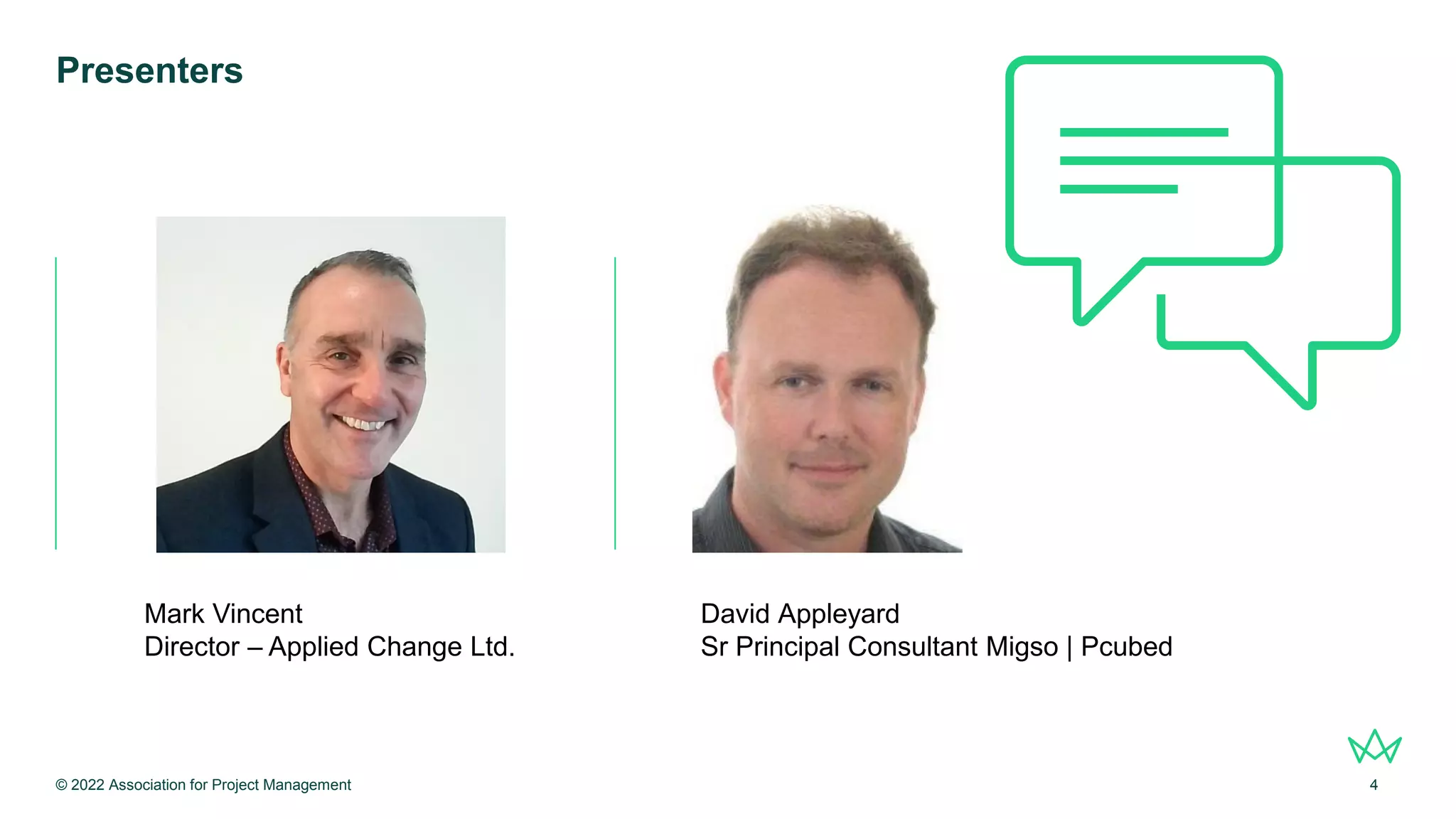
Presenters
© 2022 Association for Project Management 4
Mark Vincent
Director – Applied Change Ltd.
David Appleyard
Sr Principal Consultant Migso | Pcubed
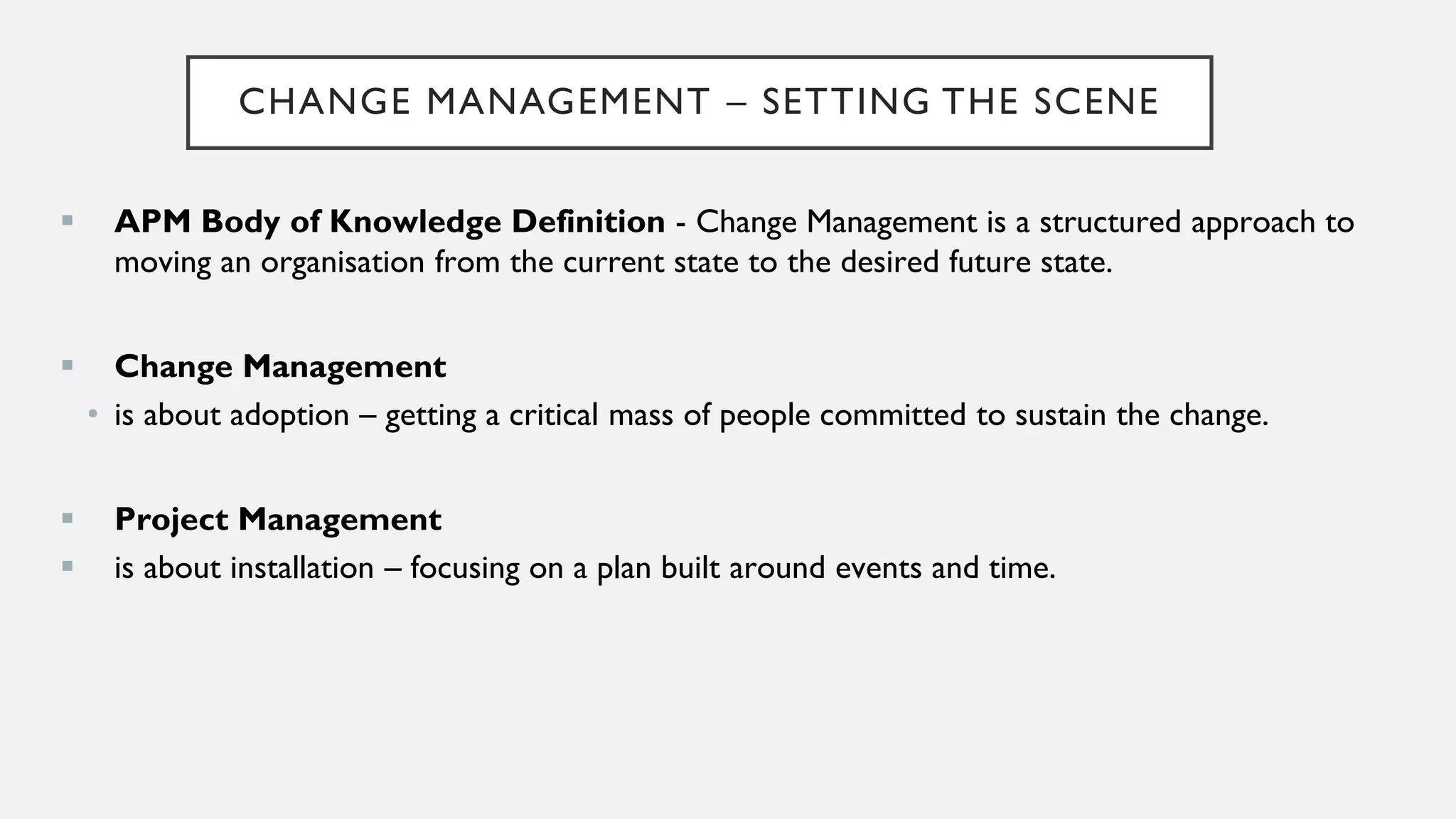
CHANGE MANAGEMENT – SETTING THE SCENE
▪ APM Body of Knowledge Definition - Change Management is a structured approach to
moving an organisation from the current state to the desired future state.
▪ Change Management
• is about adoption – getting a critical mass of people committed to sustain the change.
▪ Project Management
▪ is about installation – focusing on a plan built around events and time.
WHAT IS CHANGE MANAGEMENT?
😊😔😴☹️
🙄🤔🤨😍
CHANGE DONE UNTO YOU
Key Slides
▪ Kubler Ross Change Curve (every one goes through change)
▪ Understanding Maslov – Whats in it for me (need to build from the base)
▪ Winning over hearts and minds (appealing to emotions
▪ Learning dip – expect diminished competence
CHANGE YOU LEAD
Key Slides
▪ Build a Vision
▪ Understand and communicate the “Why”
▪ Build a guiding coalition
▪ Appeal to emotions
▪ - Use stories
▪ - Use levers
▪ Measure and gather feedback
WHAT DOES CHANGE MANAGEMENT DO?
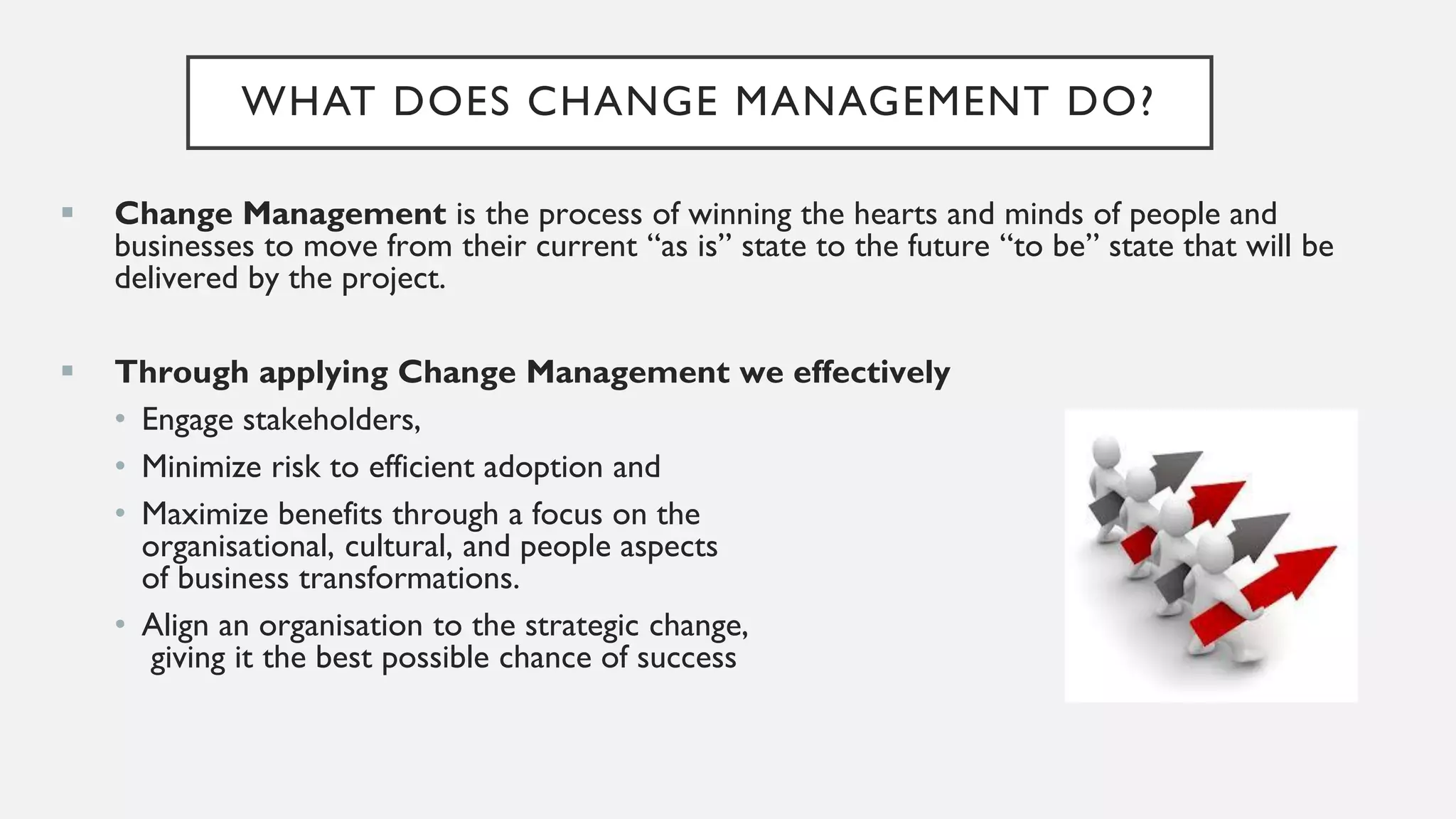
▪ Change Management is the process of winning the hearts and minds of people and
businesses to move from their current “as is” state to the future “to be” state that will be
delivered by the project.
▪ Through applying Change Management we effectively
• Engage stakeholders,
• Minimize risk to efficient adoption and
• Maximize benefits through a focus on the
organisational, cultural, and people aspects
of business transformations.
• Align an organisation to the strategic change,
giving it the best possible chance of success
WHAT CHANGE MANAGEMENT IS NOT!
Change Management in this context is not
• IT Change Management in relation to the InformationTechnology
Infrastructure Library (ITIL), a set of practices for IT Service
Management.
• Change Control of scope, milestones, etc. in project management.
• Change Control within Quality Management Systems (QMS) and
InformationTechnology (IT) systems, which is a formal process used to
ensure that changes to a product or system are introduced in a
controlled and coordinated manner.
STOP
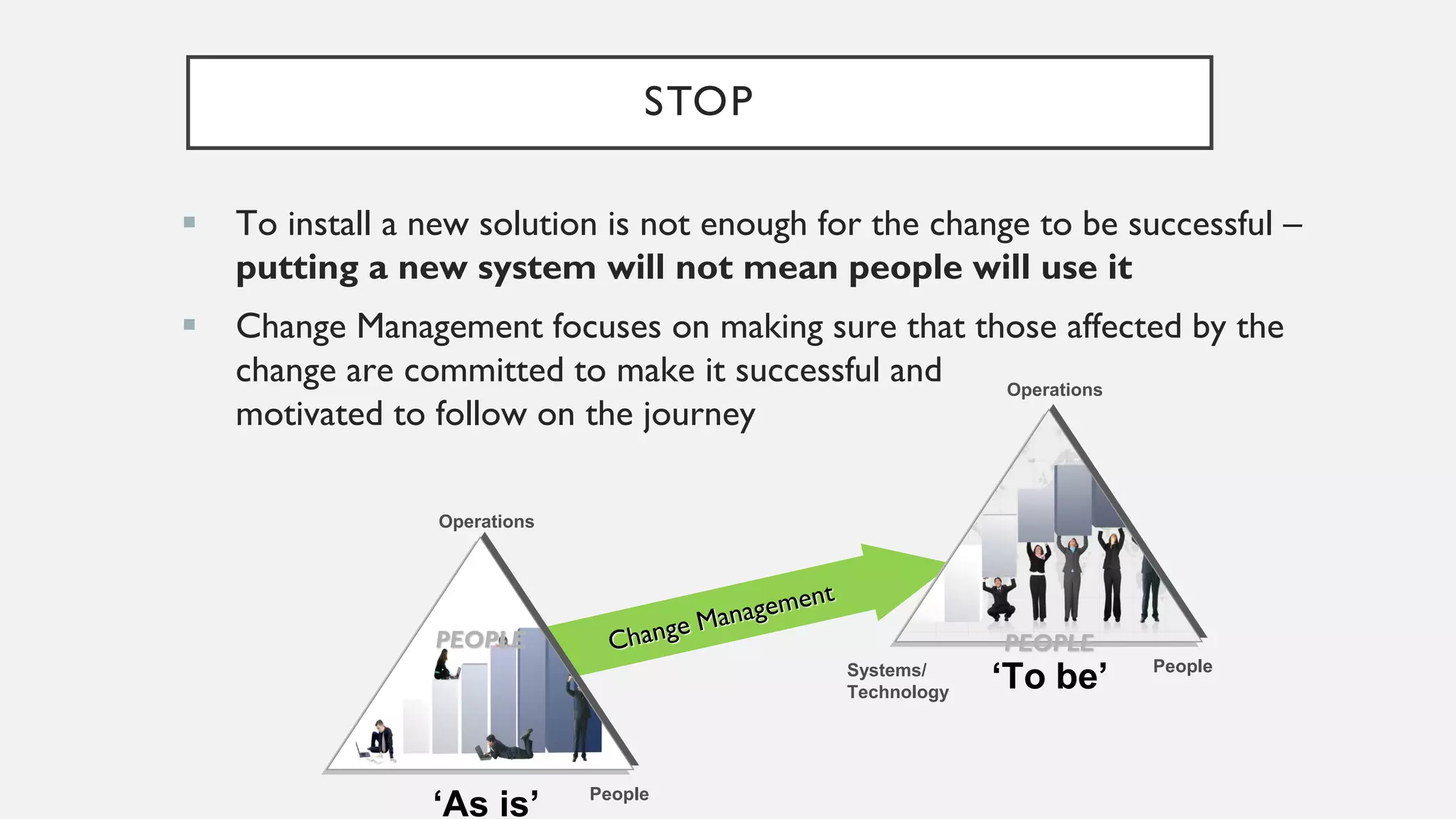
▪ To install a new solution is not enough for the change to be successful –
putting a new system will not mean people will use it
▪ Change Management focuses on making sure that those affected by the
change are committed to make it successful and
motivated to follow on the journey
‘To be’
PEOPLE
People
Systems/
Technology
Operations
‘As is’
PEOPLE
People
Operations
WHY IS CHANGE MANAGEMENT IMPORTANT?
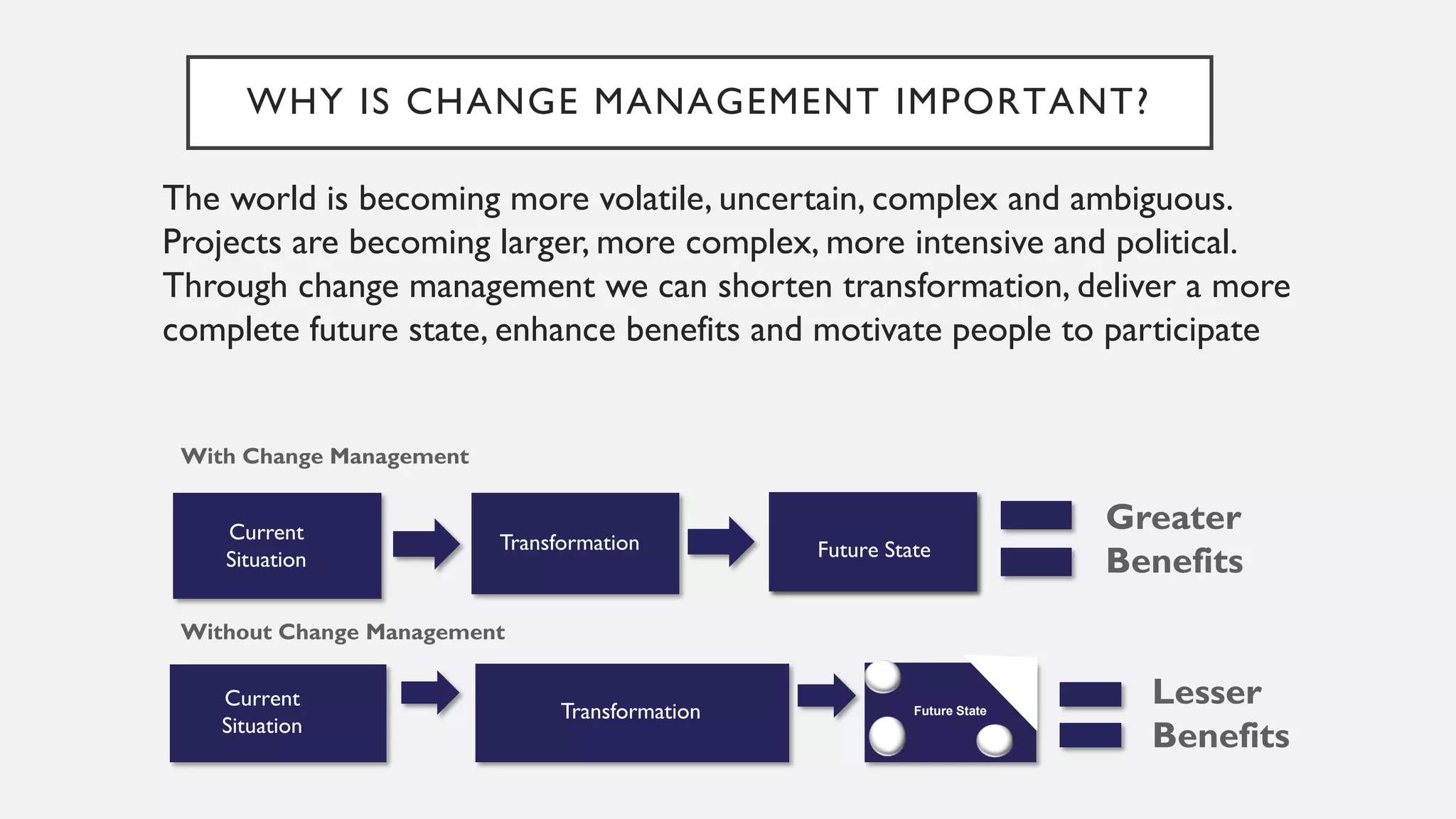
The world is becoming more volatile, uncertain, complex and ambiguous.
Projects are becoming larger, more complex, more intensive and political.
Through change management we can shorten transformation, deliver a more
complete future state, enhance benefits and motivate people to participate
Current
Situation
Transformation Future State
Greater
Benefits
With Change Management
Without Change Management
Current
Situation
Transformation
Lesser
Benefits
Future State
WHY IS CHANGE MANAGEMENT IMPORTANT?
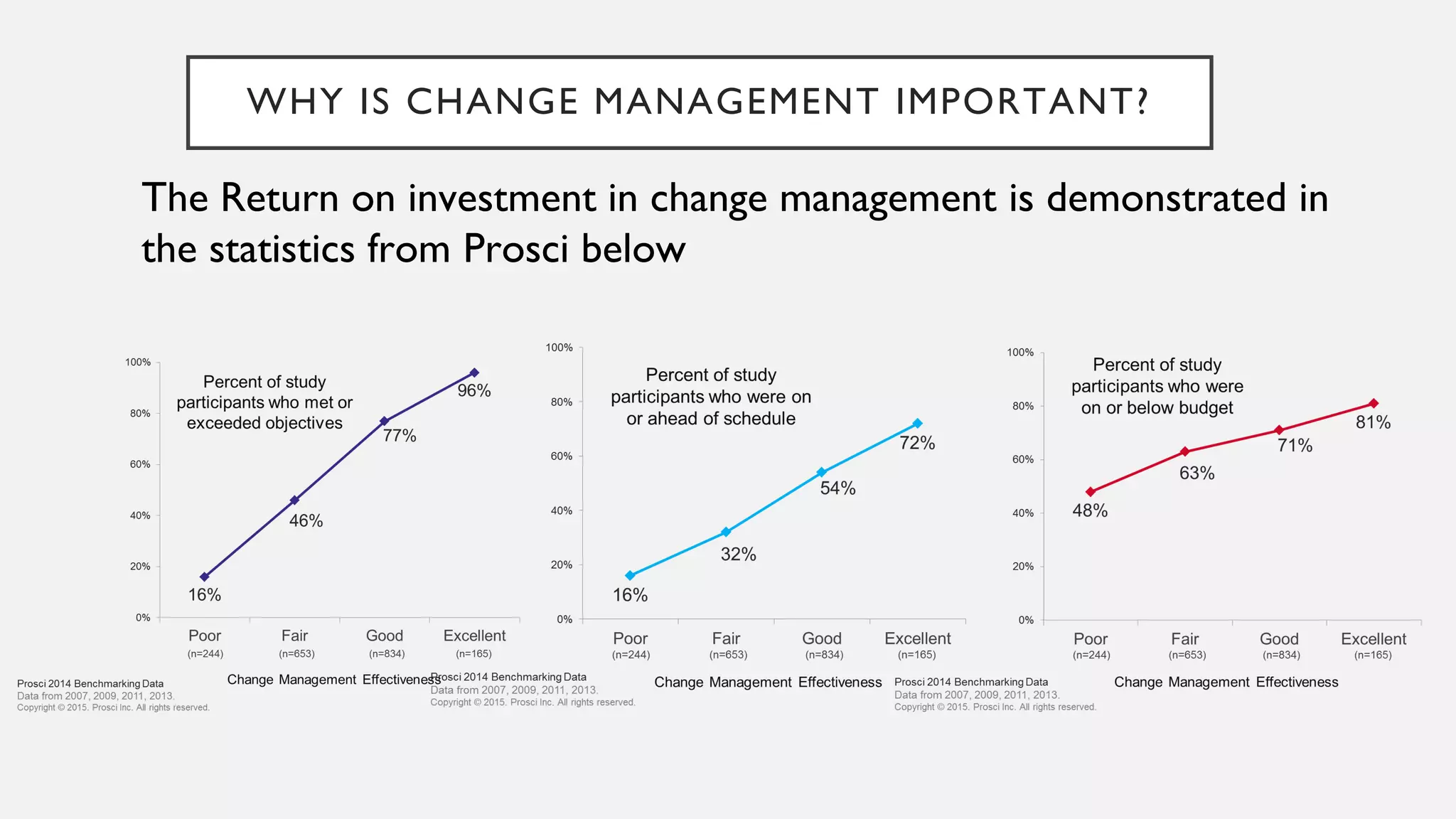
The Return on investment in change management is demonstrated in
the statistics from Prosci below
CHANGE AND
THE
INDIVIDUAL
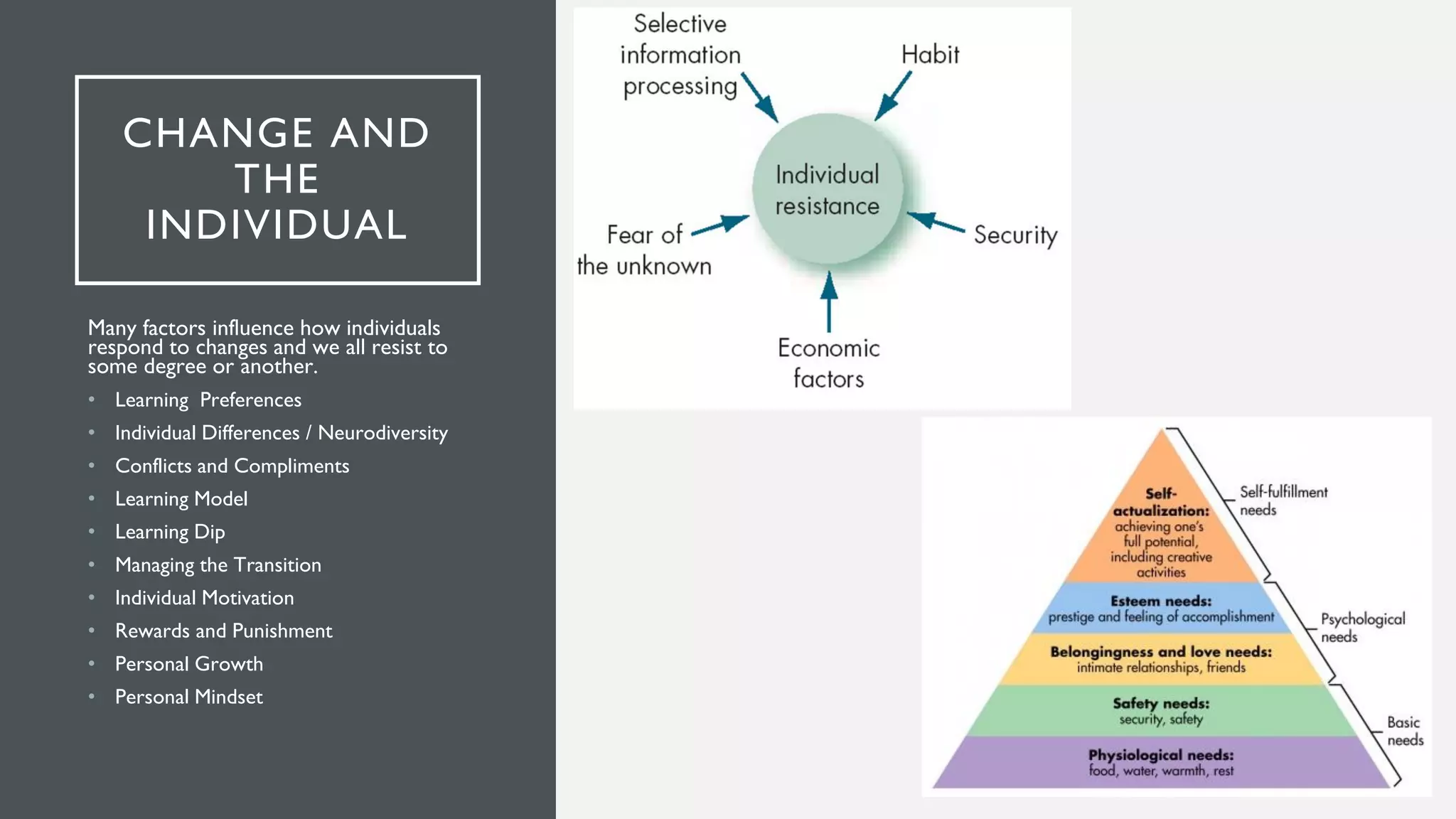
Many factors influence how individuals
respond to changes and we all resist to
some degree or another.
• Learning Preferences
• Individual Differences / Neurodiversity
• Conflicts and Compliments
• Learning Model
• Learning Dip
• Managing the Transition
• Individual Motivation
• Rewards and Punishment
• Personal Growth
• Personal Mindset
INDIVIDUAL
CHANGE
JOURNEY
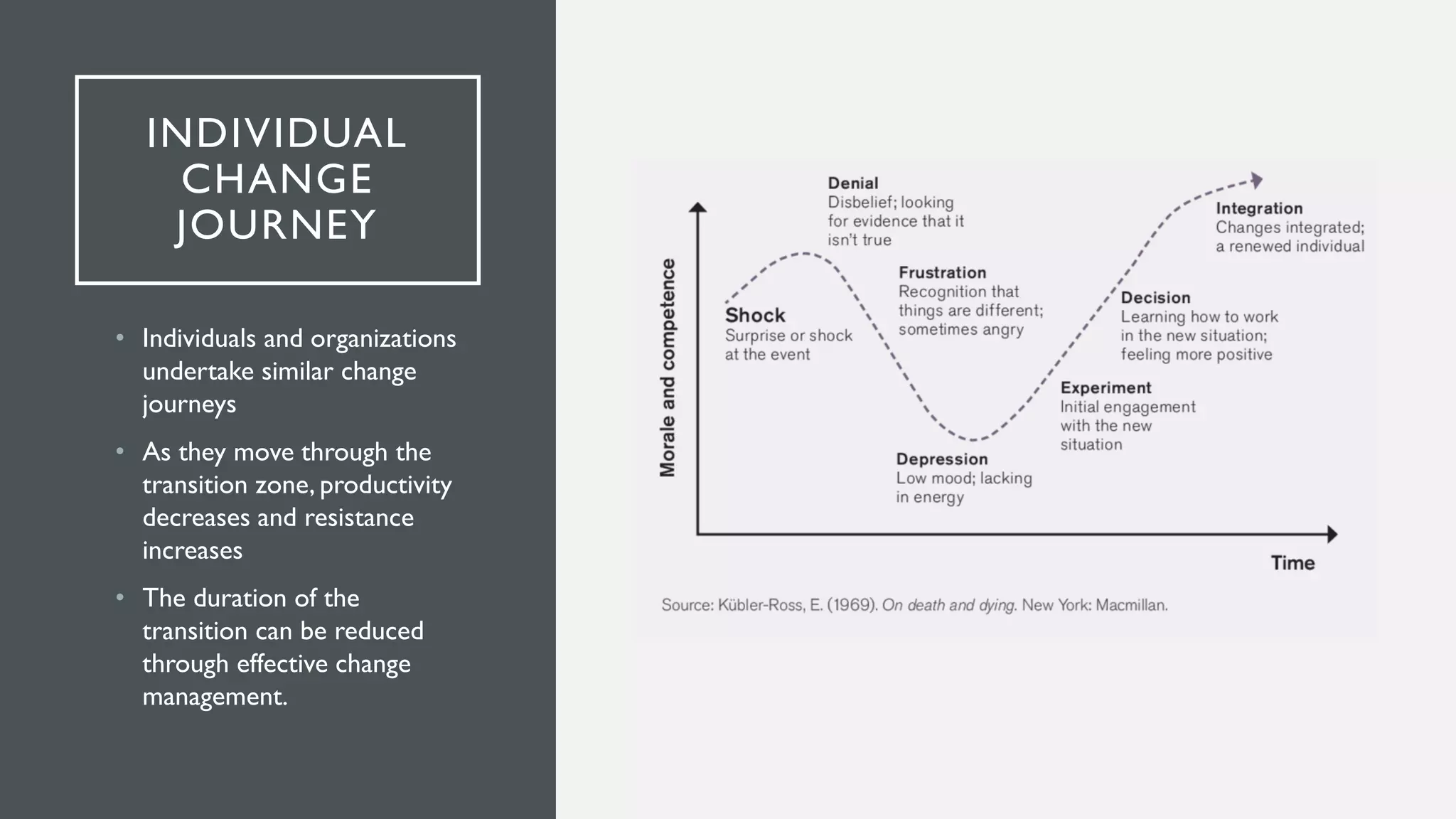
• Individuals and organizations
undertake similar change
journeys
• As they move through the
transition zone, productivity
decreases and resistance
increases
• The duration of the
transition can be reduced
through effective change
management.
THE LEARNING
DIP
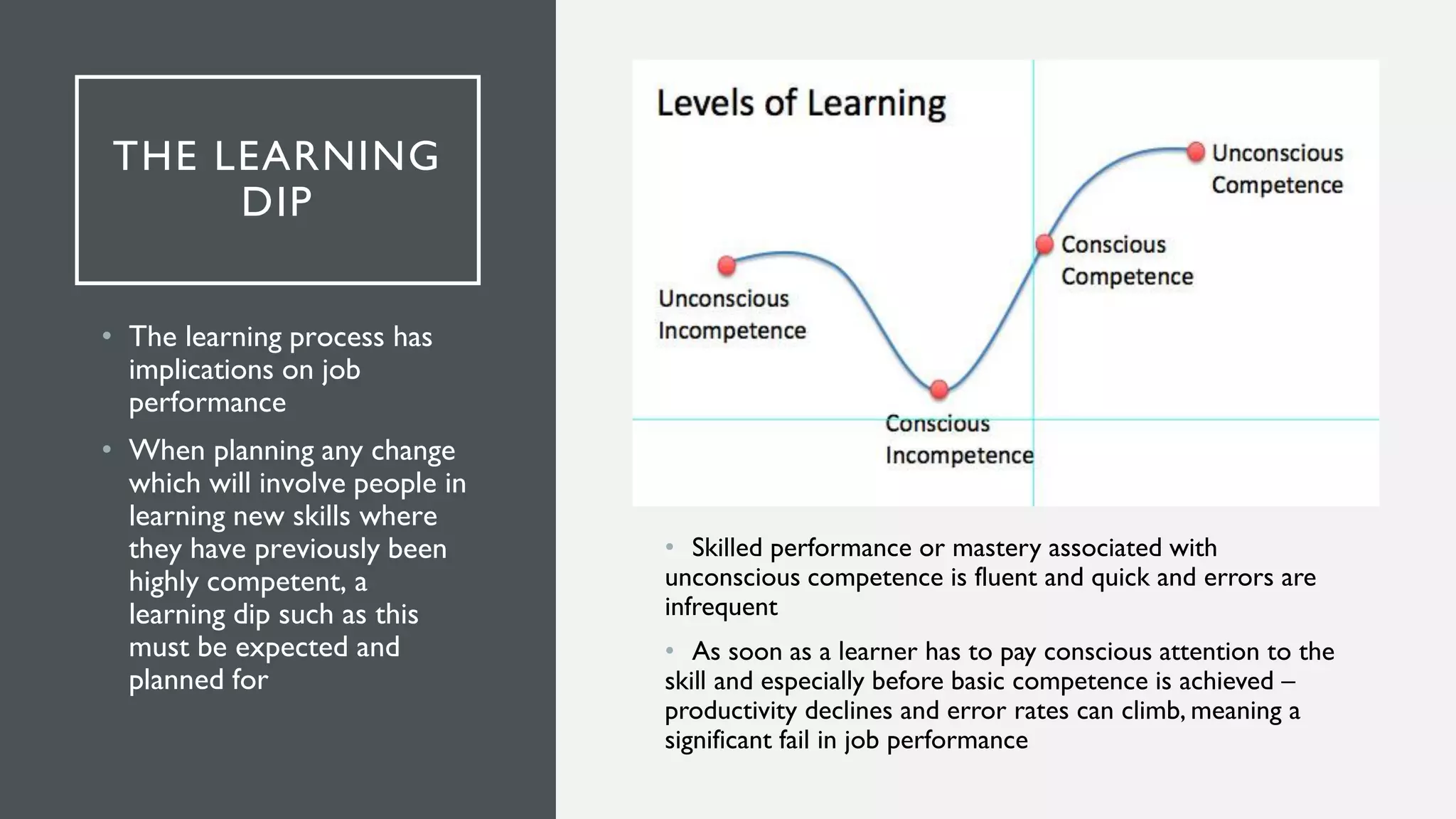
• The learning process has
implications on job
performance
• When planning any change
which will involve people in
learning new skills where
they have previously been
highly competent, a
learning dip such as this
must be expected and
planned for
• Skilled performance or mastery associated with
unconscious competence is fluent and quick and errors are
infrequent
• As soon as a learner has to pay conscious attention to the
skill and especially before basic competence is achieved –
productivity declines and error rates can climb, meaning a
significant fail in job performance
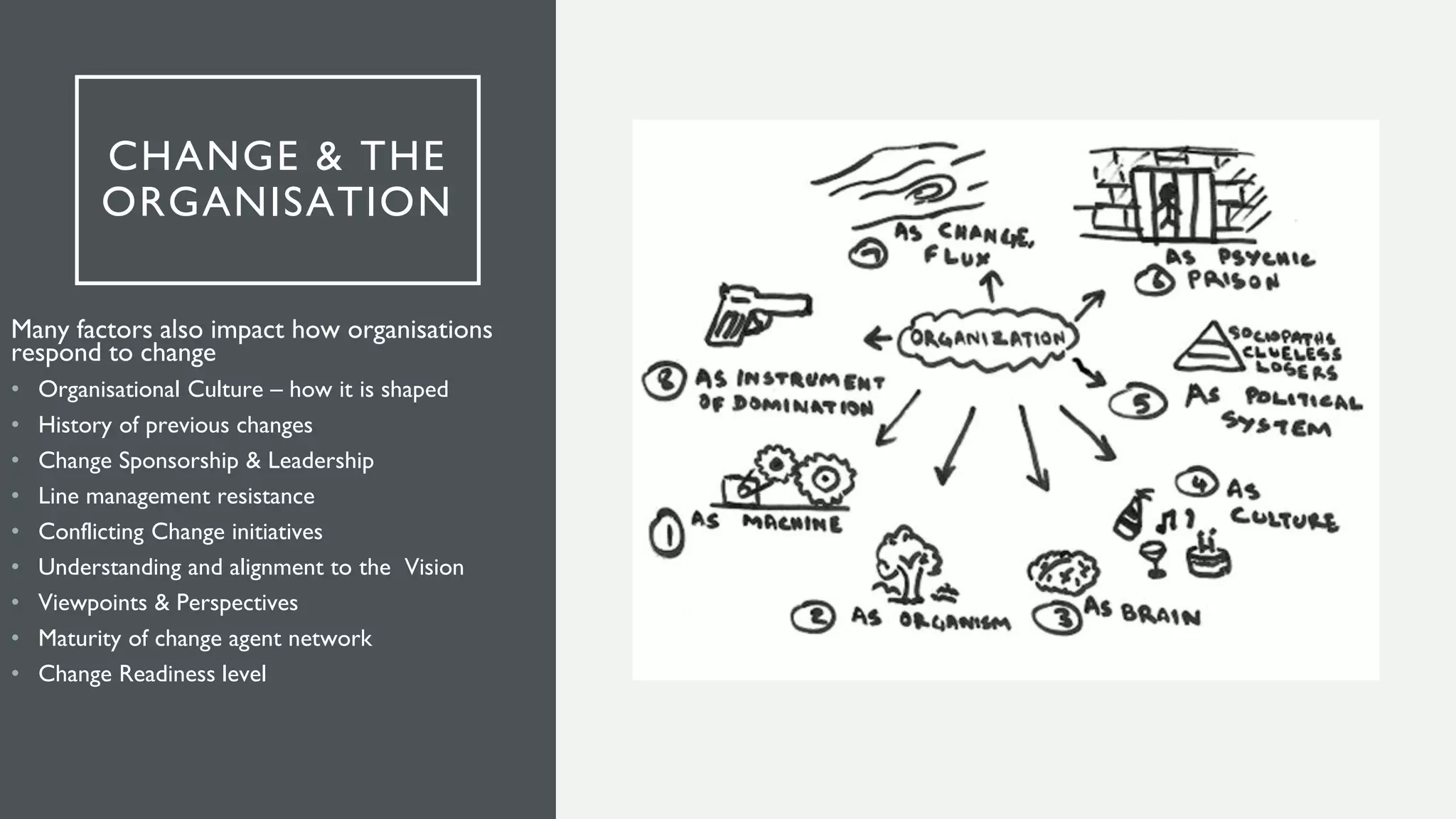
CHANGE & THE
ORGANISATION
Many factors also impact how organisations
respond to change
• Organisational Culture – how it is shaped
• History of previous changes
• Change Sponsorship & Leadership
• Line management resistance
• Conflicting Change initiatives
• Understanding and alignment to the Vision
• Viewpoints & Perspectives
• Maturity of change agent network
• Change Readiness level
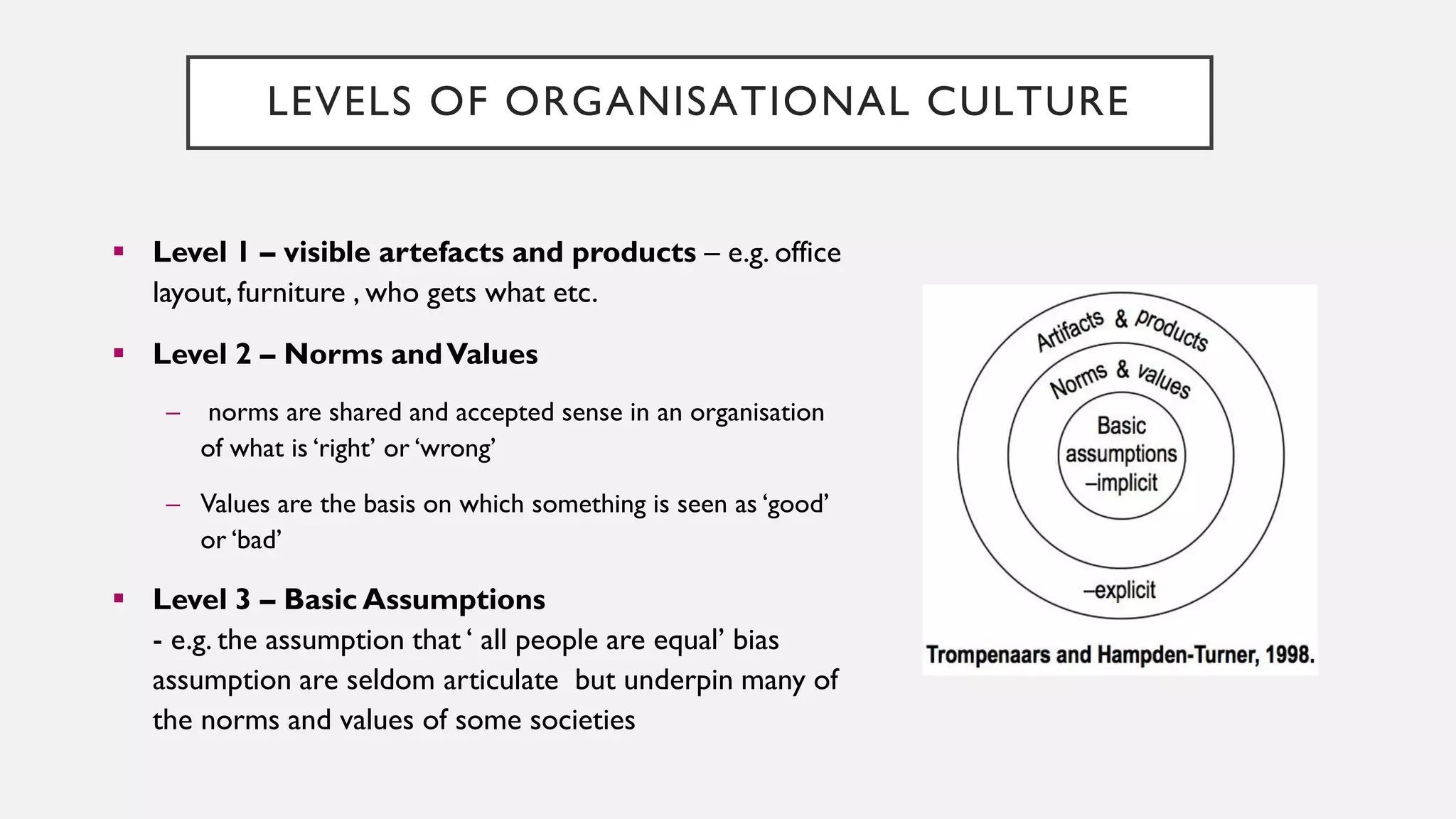
LEVELS OF ORGANISATIONAL CULTURE
▪ Level 1 – visible artefacts and products – e.g. office
layout, furniture , who gets what etc.
▪ Level 2 – Norms andValues
– norms are shared and accepted sense in an organisation
of what is ‘right’ or ‘wrong’
– Values are the basis on which something is seen as ‘good’
or ‘bad’
▪ Level 3 – Basic Assumptions
- e.g. the assumption that ‘ all people are equal’ bias
assumption are seldom articulate but underpin many of
the norms and values of some societies
APPROACHES TO CHANGE MANAGEMENT
▪ Leaders are looking for ways to reduce the risk and failure levels of their
organisations’ change initiatives, and using a structured, co-ordinated approach to
change helps prepare for planned and unplanned changes.
▪ Different ways of managing change are termed methodologies, frameworks, models
and approaches, and definition of these are as follows:
• Methodology – a system of methods used in a particular area of study or activity
• Framework – a basic structure underlying a system, concept, or text
• Model – a representation of a person or thing or of a proposed structure
• Approach – a way of dealing with a situation or problem
APPROACHES TO CHANGE MANAGEMENT
▪ Approach should be overarching and holistic
▪ Approach should be integrated with the organisation strategy
▪ Practical to deploy
▪ Understandable and not too technical in language
▪ Structured
▪ Must identify change success factors and benefits
▪ Must be communicated throughout the organisation
▪ Must take into consideration the culture of the organisation
▪ Consider scale and type of change
▪ Must consider the individual and what will motivate them to come on the journey
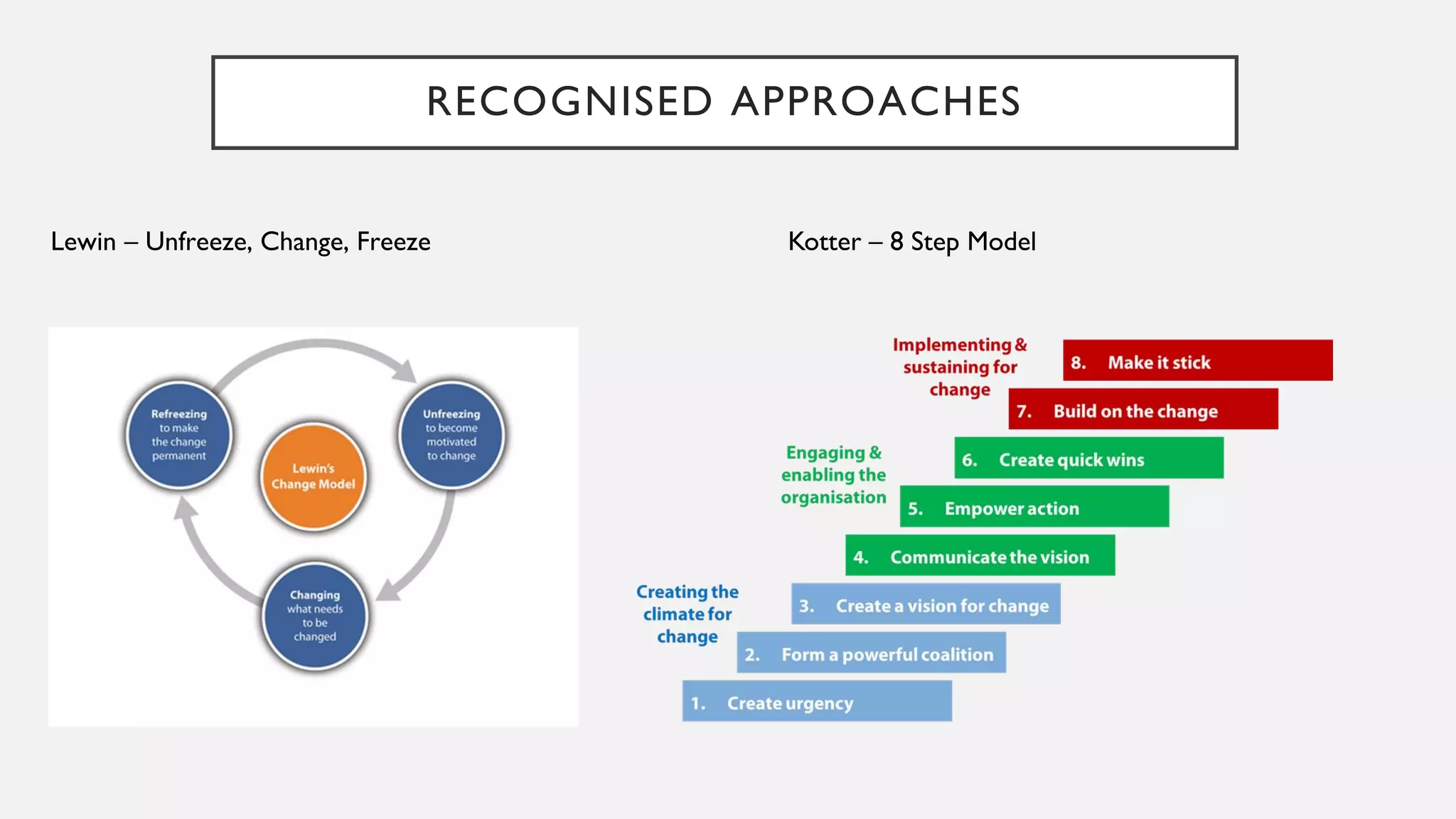
RECOGNISED APPROACHES
Lewin – Unfreeze, Change, Freeze Kotter – 8 Step Model
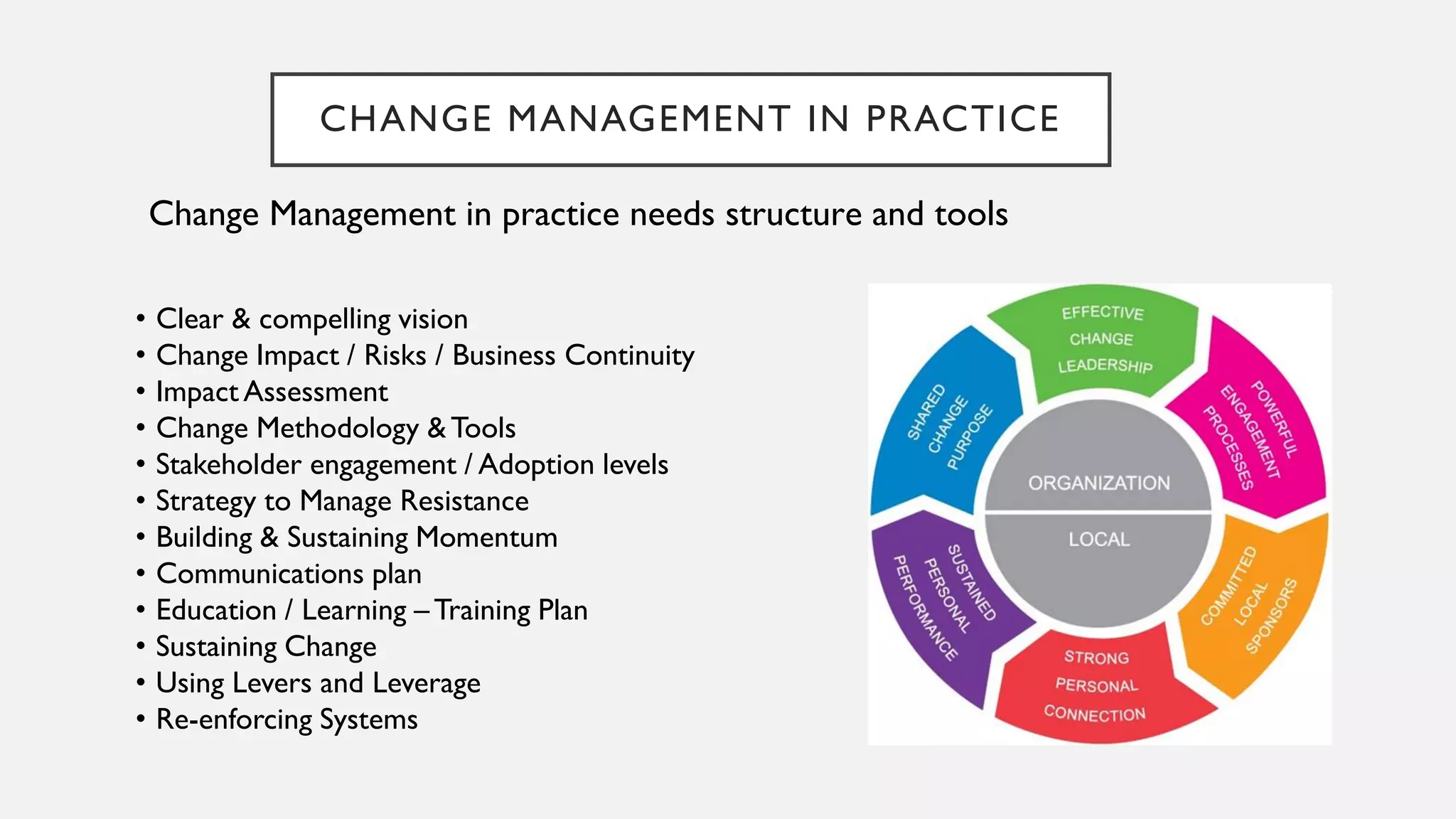
CHANGE MANAGEMENT IN PRACTICE
• Clear & compelling vision
• Change Impact / Risks / Business Continuity
• Impact Assessment
• Change Methodology &Tools
• Stakeholder engagement / Adoption levels
• Strategy to Manage Resistance
• Building & Sustaining Momentum
• Communications plan
• Education / Learning –Training Plan
• Sustaining Change
• Using Levers and Leverage
• Re-enforcing Systems
Change Management in practice needs structure and tools
UNDERSTAND WHY?
• To be able to effectively engage with stakeholders and communicate the change, a
Change Manager must understand and be able to articulate why the change is
required. This is crucial to encourage stakeholder to follow and to build a critical
mass of support.
• The key questions at a early stage of any change
• What is changing?
• Why do we need to change?
• What is the risk of not changing?
• Drivers for the change may be varied, but understanding internal and external forces
driving the change helps with communication and making a business case for the
change
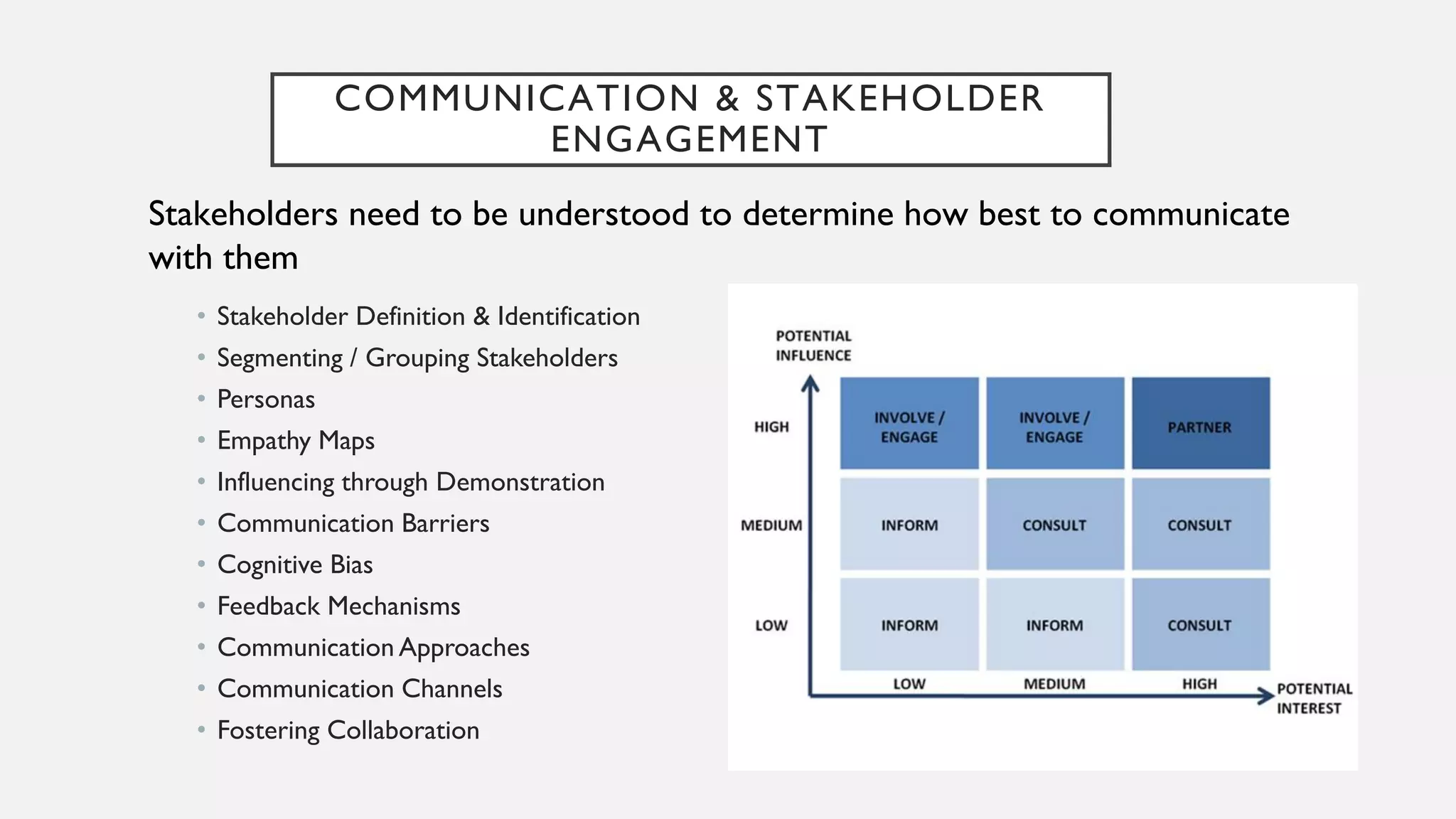
COMMUNICATION & STAKEHOLDER
ENGAGEMENT
Stakeholders need to be understood to determine how best to communicate
with them
• Stakeholder Definition & Identification
• Segmenting / Grouping Stakeholders
• Personas
• Empathy Maps
• Influencing through Demonstration
• Communication Barriers
• Cognitive Bias
• Feedback Mechanisms
• Communication Approaches
• Communication Channels
• Fostering Collaboration
BUILD A COMPELLING VISION
Establish and agree a clear vision of the “To Be” state with stakeholders.This is crucial to
develop desire, inspire the team and keep it focussed.
Visions should describe people, process and technology
People
•How will it contribute to customers/employees/community?
•How will the relationship with suppliers change?
•How will people work together?
Process
•How will success be measured?
•What benefits will be achieved?
Technology
•How will it be deployed?
A vision is not a
marketing tag-line. It is
an agreed compelling
view of the “to be”
state that can be
shared with the wider
stakeholder group to
excite and develop
desire for the change
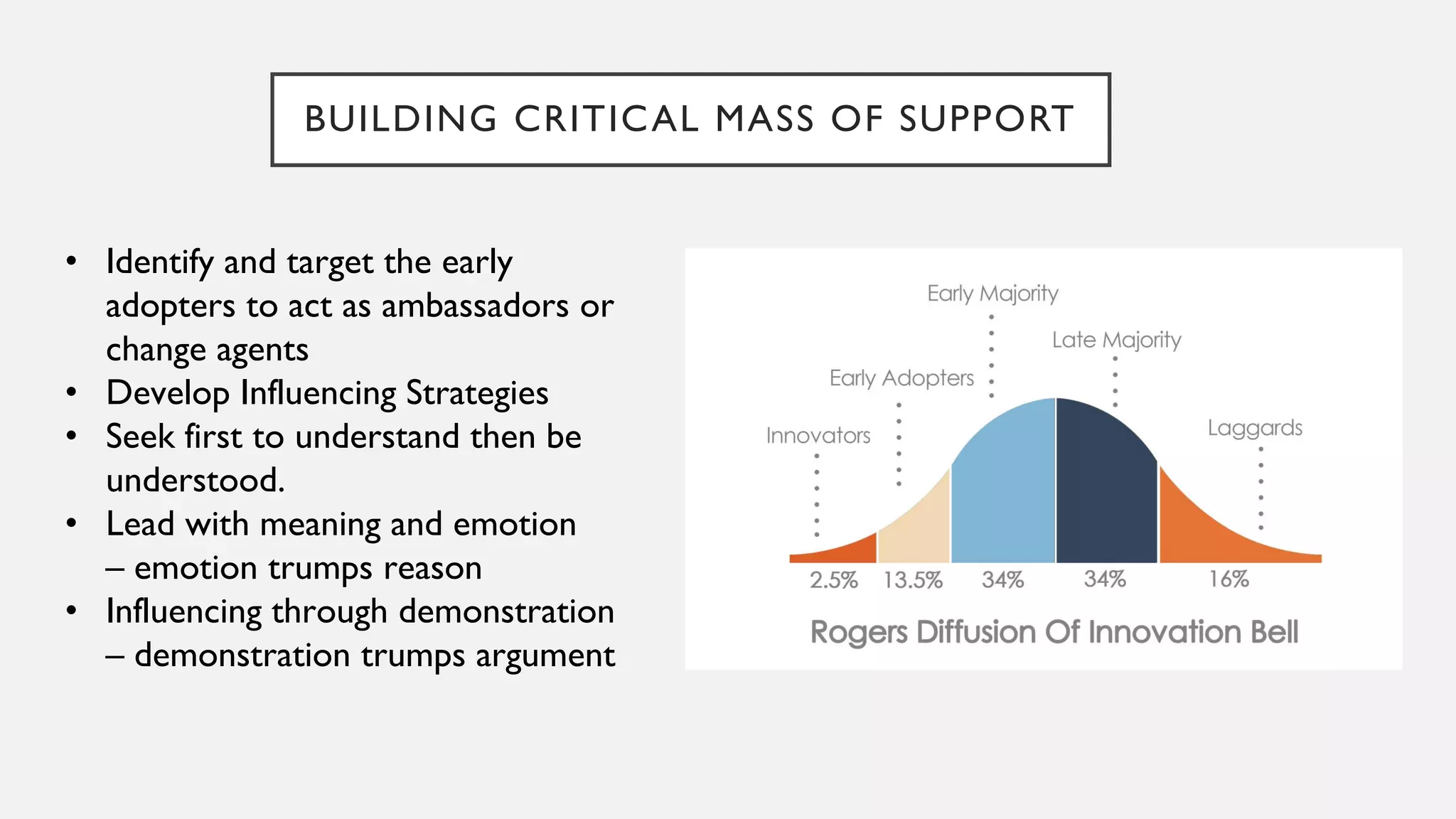
BUILDING CRITICAL MASS OF SUPPORT
• Identify and target the early
adopters to act as ambassadors or
change agents
• Develop Influencing Strategies
• Seek first to understand then be
understood.
• Lead with meaning and emotion
– emotion trumps reason
• Influencing through demonstration
– demonstration trumps argument
APPEALING TO HEARTS &
MINDS
For successful communication and engagement
your approach must appeal to people’s hearts as
well as minds
Use both logical reasoning to explain the drivers
and approach to change and also appeal to their
emotions:
• Use symbolic actions and symbolism
• Use metaphors
• Use narrative and storytelling
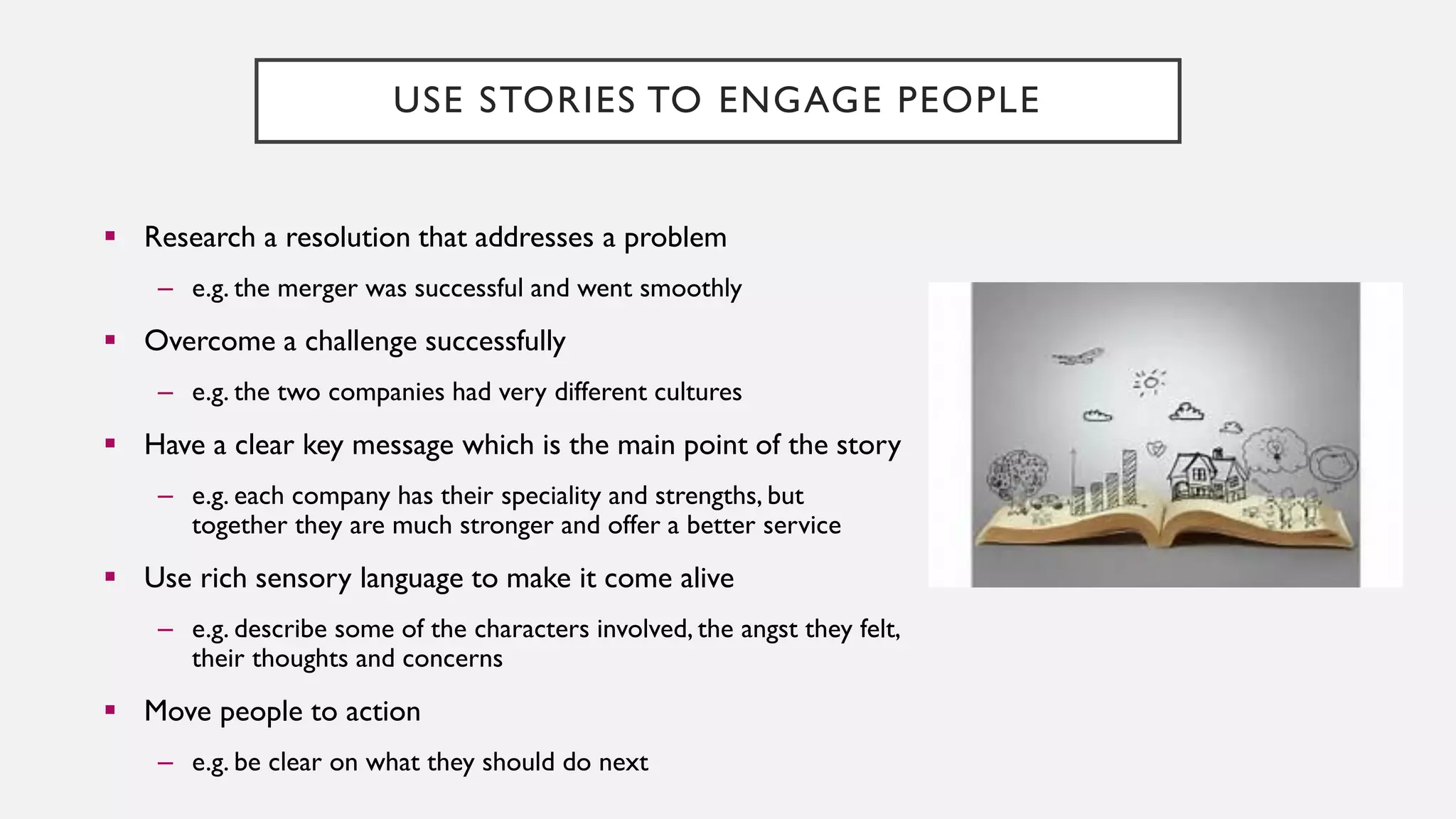
USE STORIES TO ENGAGE PEOPLE
▪ Research a resolution that addresses a problem
– e.g. the merger was successful and went smoothly
▪ Overcome a challenge successfully
– e.g. the two companies had very different cultures
▪ Have a clear key message which is the main point of the story
– e.g. each company has their speciality and strengths, but
together they are much stronger and offer a better service
▪ Use rich sensory language to make it come alive
– e.g. describe some of the characters involved, the angst they felt,
their thoughts and concerns
▪ Move people to action
– e.g. be clear on what they should do next
USE FEEDBACK MECHANISMS
• Feedback lets the sender know how the message has been received , it turns the
communication into a two way process
• Feedback allows a more meaningful exchange to take place and enables the receiver to be
equally involved in the process
• During communication, feedback provides valuable information about whether a message has
been understood as it was intended
• To make this work the sender must be prepared to listen to the incoming feedback and
respond accordingly
• Gathering feedback from people throughout a change initiative, both individually and
collectively, is an effective activity to monitor the effectiveness of communication efforts
USE APPROPRIATE LEVERS
▪ Structural – implicit in the way the organisation is controlled and the way the elements of the
organisation are grouped together or managed separately. This can include leveraging
management or sponsors for support.
▪ Procedural – imposed by the process a person needs to follow, so the change becomes
embedded into how things are done and is not optional as later parts of work cannot be
completed until the new way of working has been completed
▪ Emotional – exert an internal pressure to change such as guilt, pride or a feeling of
involvement and social belonging
▪ Encourage the right behaviour and deal decisively with behaviour that could undermine the
success of the change
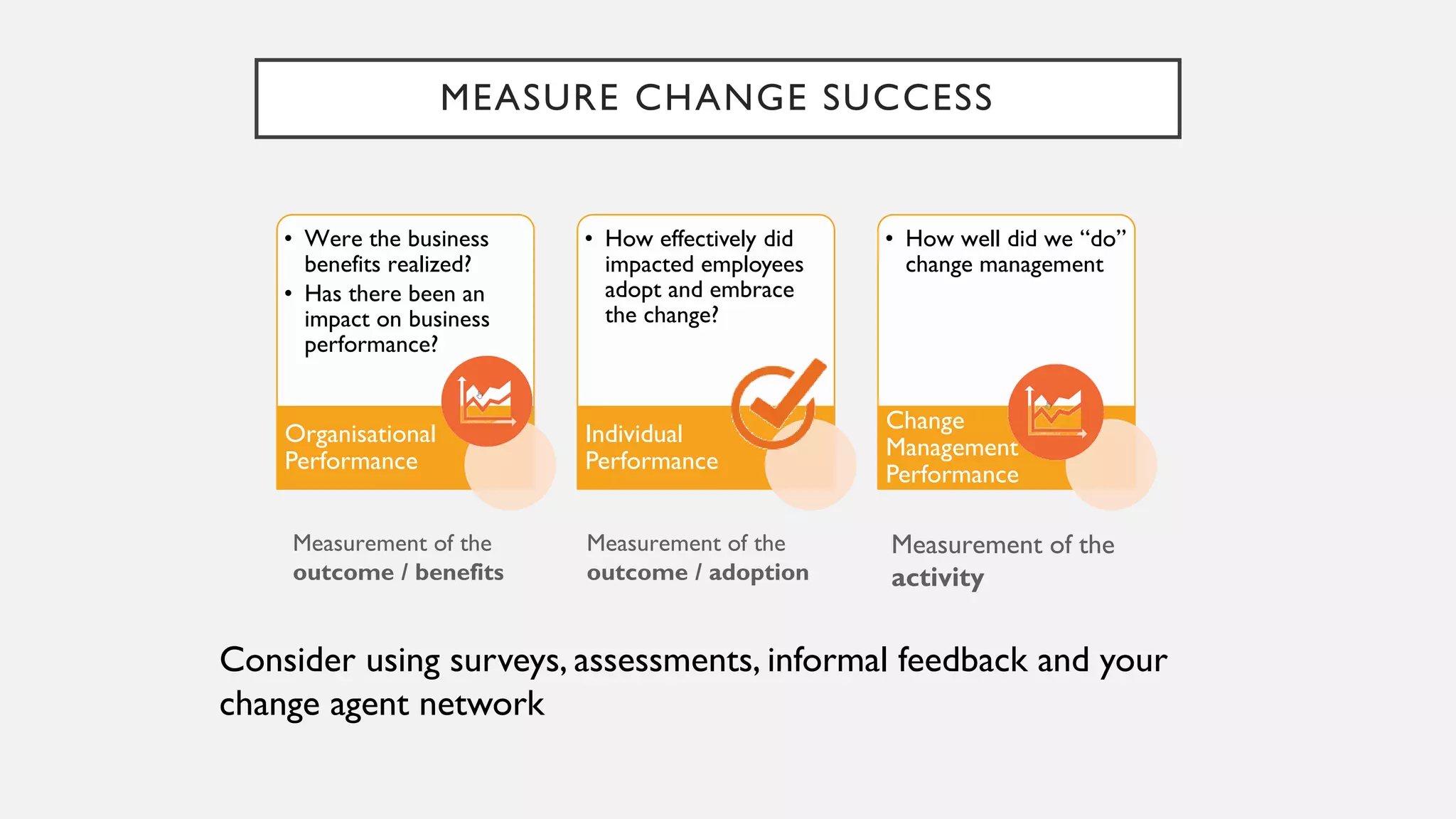
MEASURE CHANGE SUCCESS
• Were the business
benefits realized?
• Has there been an
impact on business
performance?
Organisational
Performance
• How effectively did
impacted employees
adopt and embrace
the change?
Individual
Performance
• How well did we “do”
change management
Change
Management
Performance
Measurement of the
outcome / benefits
Measurement of the
outcome / adoption
Measurement of the
activity
Consider using surveys, assessments, informal feedback and your
change agent network
KEY SUCCESS FACTORS
• Formulate a clear vision and strategy, supported by well-defined benefits
• Ensure strong leadership and sponsorship
• Define and follow a well-structured and integrated approach
• Understand, engage with, build commitment from and support key
stakeholders
• Build a strong change team with the necessary capabilities for success
• Measure the success of the change initiative
REFERENCE SOURCES
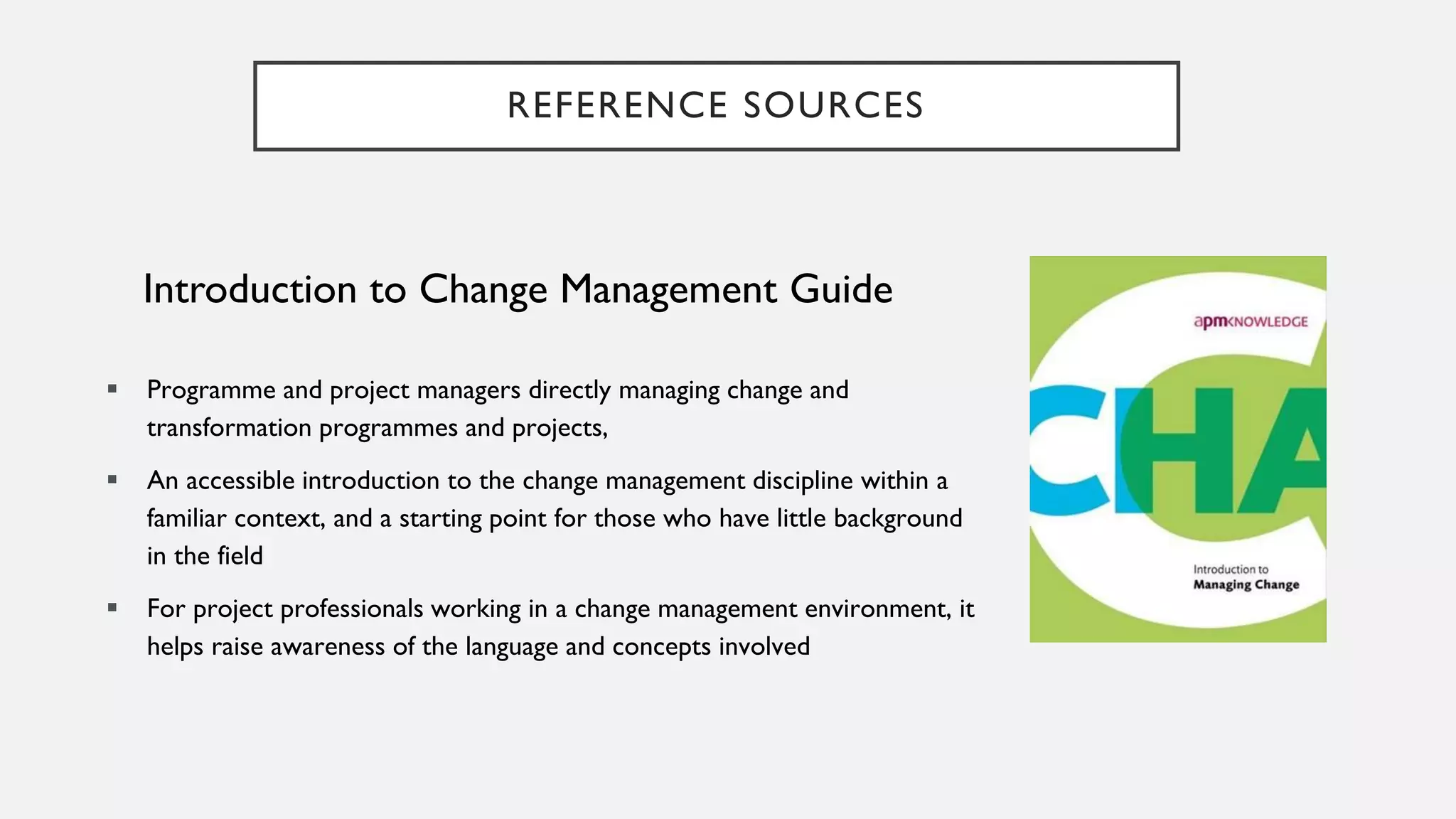
Introduction to Change Management Guide
▪ Programme and project managers directly managing change and
transformation programmes and projects,
▪ An accessible introduction to the change management discipline within a
familiar context, and a starting point for those who have little background
in the field
▪ For project professionals working in a change management environment, it
helps raise awareness of the language and concepts involved
PROFESSIONAL HORIZONS
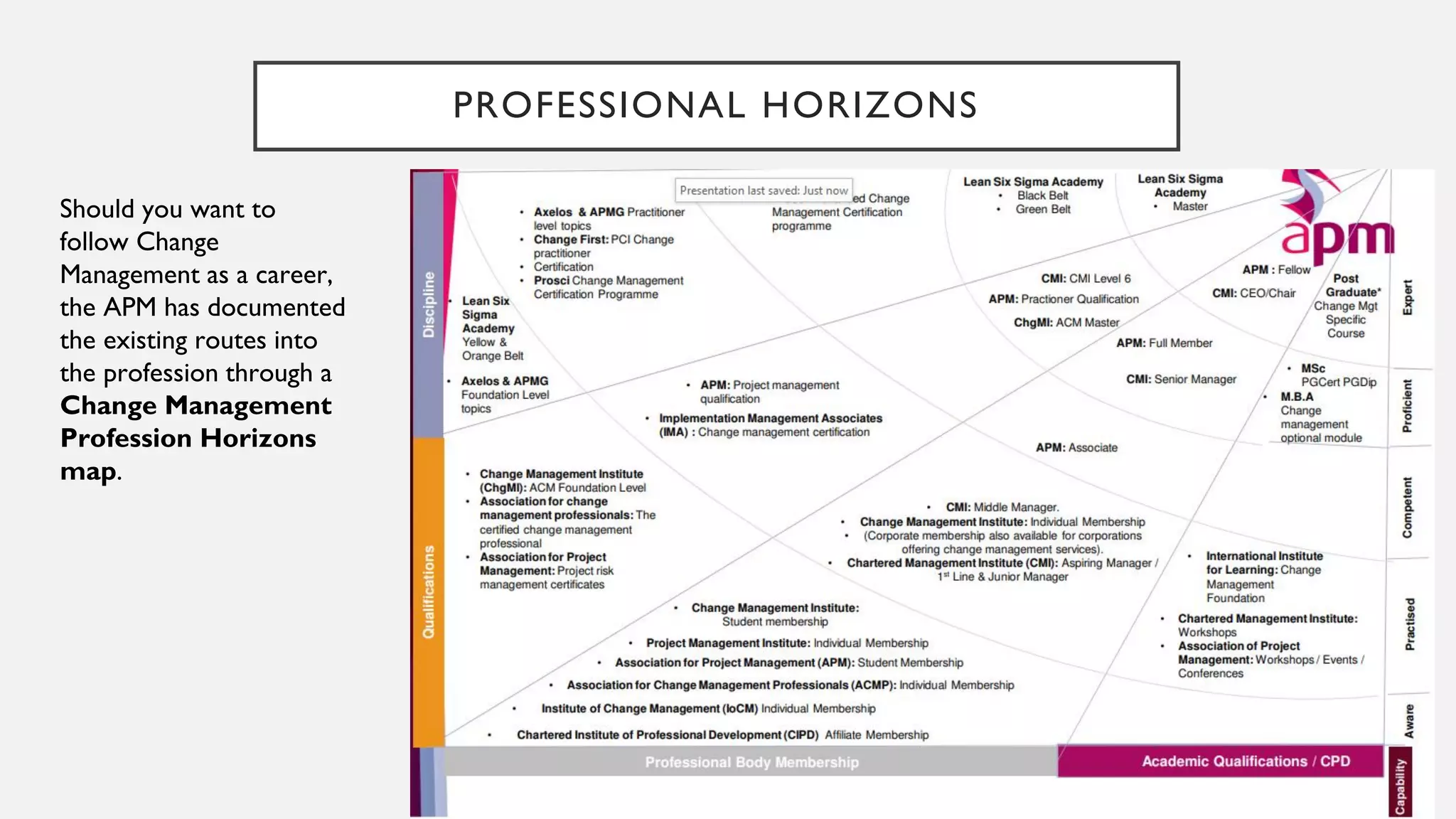
Should you want to
follow Change
Management as a career,
the APM has documented
the existing routes into
the profession through a
Change Management
Profession Horizons
map.
CONCLUSION
▪ It’s all about the people
▪ Change takes time – build this into your plans
▪ Start with a vision – make sure its clear
▪ Engage the Stakeholders
▪ Recognise anyTrade Offs
▪ Work with the Willing
▪ Communicate even if you don’t have all the answers
▪ Listen / Feedback / Action
▪ Try and discover what are Silent One’s Thinking
▪ Learn and Adapt, Constantly Evaluate

Change management in a project environment webinar, 5 December 2022

  • 1.
    Change Management ina Project Environment 5 December 2022
  • 2.
    © 2022 Associationfor Project Management 2 Improve the change capability of organisations, teams and individuals The Enabling Change SIG aims to develop and sustain individual practitioner, team and organisational change capability by facilitating access to and exploration of change methods, standards, case studies and good practices
  • 3.
    AGENDA 1. Change Management– Setting the Scene 2. The relationship between Project & Change Management 3. Change and the Individual 4. Change and the Organisation 5. Change Management Approaches 6. Change Management in Practice 7. Summary
  • 4.
    Presenters © 2022 Associationfor Project Management 4 Mark Vincent Director – Applied Change Ltd. David Appleyard Sr Principal Consultant Migso | Pcubed
  • 5.
    CHANGE MANAGEMENT –SETTING THE SCENE ▪ APM Body of Knowledge Definition - Change Management is a structured approach to moving an organisation from the current state to the desired future state. ▪ Change Management • is about adoption – getting a critical mass of people committed to sustain the change. ▪ Project Management ▪ is about installation – focusing on a plan built around events and time.
  • 6.
    WHAT IS CHANGEMANAGEMENT? 😊😔😴☹️ 🙄🤔🤨😍
  • 7.
    CHANGE DONE UNTOYOU Key Slides ▪ Kubler Ross Change Curve (every one goes through change) ▪ Understanding Maslov – Whats in it for me (need to build from the base) ▪ Winning over hearts and minds (appealing to emotions ▪ Learning dip – expect diminished competence
  • 8.
    CHANGE YOU LEAD KeySlides ▪ Build a Vision ▪ Understand and communicate the “Why” ▪ Build a guiding coalition ▪ Appeal to emotions ▪ - Use stories ▪ - Use levers ▪ Measure and gather feedback
  • 9.
    WHAT DOES CHANGEMANAGEMENT DO? ▪ Change Management is the process of winning the hearts and minds of people and businesses to move from their current “as is” state to the future “to be” state that will be delivered by the project. ▪ Through applying Change Management we effectively • Engage stakeholders, • Minimize risk to efficient adoption and • Maximize benefits through a focus on the organisational, cultural, and people aspects of business transformations. • Align an organisation to the strategic change, giving it the best possible chance of success
  • 10.
    WHAT CHANGE MANAGEMENTIS NOT! Change Management in this context is not • IT Change Management in relation to the InformationTechnology Infrastructure Library (ITIL), a set of practices for IT Service Management. • Change Control of scope, milestones, etc. in project management. • Change Control within Quality Management Systems (QMS) and InformationTechnology (IT) systems, which is a formal process used to ensure that changes to a product or system are introduced in a controlled and coordinated manner.
  • 11.
    STOP ▪ To installa new solution is not enough for the change to be successful – putting a new system will not mean people will use it ▪ Change Management focuses on making sure that those affected by the change are committed to make it successful and motivated to follow on the journey ‘To be’ PEOPLE People Systems/ Technology Operations ‘As is’ PEOPLE People Operations
  • 12.
    WHY IS CHANGEMANAGEMENT IMPORTANT? The world is becoming more volatile, uncertain, complex and ambiguous. Projects are becoming larger, more complex, more intensive and political. Through change management we can shorten transformation, deliver a more complete future state, enhance benefits and motivate people to participate Current Situation Transformation Future State Greater Benefits With Change Management Without Change Management Current Situation Transformation Lesser Benefits Future State
  • 13.
    WHY IS CHANGEMANAGEMENT IMPORTANT? The Return on investment in change management is demonstrated in the statistics from Prosci below
  • 14.
    CHANGE AND THE INDIVIDUAL Many factorsinfluence how individuals respond to changes and we all resist to some degree or another. • Learning Preferences • Individual Differences / Neurodiversity • Conflicts and Compliments • Learning Model • Learning Dip • Managing the Transition • Individual Motivation • Rewards and Punishment • Personal Growth • Personal Mindset
  • 15.
    INDIVIDUAL CHANGE JOURNEY • Individuals andorganizations undertake similar change journeys • As they move through the transition zone, productivity decreases and resistance increases • The duration of the transition can be reduced through effective change management.
  • 16.
    THE LEARNING DIP • Thelearning process has implications on job performance • When planning any change which will involve people in learning new skills where they have previously been highly competent, a learning dip such as this must be expected and planned for • Skilled performance or mastery associated with unconscious competence is fluent and quick and errors are infrequent • As soon as a learner has to pay conscious attention to the skill and especially before basic competence is achieved – productivity declines and error rates can climb, meaning a significant fail in job performance
  • 17.
    CHANGE & THE ORGANISATION Manyfactors also impact how organisations respond to change • Organisational Culture – how it is shaped • History of previous changes • Change Sponsorship & Leadership • Line management resistance • Conflicting Change initiatives • Understanding and alignment to the Vision • Viewpoints & Perspectives • Maturity of change agent network • Change Readiness level
  • 18.
    LEVELS OF ORGANISATIONALCULTURE ▪ Level 1 – visible artefacts and products – e.g. office layout, furniture , who gets what etc. ▪ Level 2 – Norms andValues – norms are shared and accepted sense in an organisation of what is ‘right’ or ‘wrong’ – Values are the basis on which something is seen as ‘good’ or ‘bad’ ▪ Level 3 – Basic Assumptions - e.g. the assumption that ‘ all people are equal’ bias assumption are seldom articulate but underpin many of the norms and values of some societies
  • 19.
    APPROACHES TO CHANGEMANAGEMENT ▪ Leaders are looking for ways to reduce the risk and failure levels of their organisations’ change initiatives, and using a structured, co-ordinated approach to change helps prepare for planned and unplanned changes. ▪ Different ways of managing change are termed methodologies, frameworks, models and approaches, and definition of these are as follows: • Methodology – a system of methods used in a particular area of study or activity • Framework – a basic structure underlying a system, concept, or text • Model – a representation of a person or thing or of a proposed structure • Approach – a way of dealing with a situation or problem
  • 20.
    APPROACHES TO CHANGEMANAGEMENT ▪ Approach should be overarching and holistic ▪ Approach should be integrated with the organisation strategy ▪ Practical to deploy ▪ Understandable and not too technical in language ▪ Structured ▪ Must identify change success factors and benefits ▪ Must be communicated throughout the organisation ▪ Must take into consideration the culture of the organisation ▪ Consider scale and type of change ▪ Must consider the individual and what will motivate them to come on the journey
  • 21.
    RECOGNISED APPROACHES Lewin –Unfreeze, Change, Freeze Kotter – 8 Step Model
  • 22.
    CHANGE MANAGEMENT INPRACTICE • Clear & compelling vision • Change Impact / Risks / Business Continuity • Impact Assessment • Change Methodology &Tools • Stakeholder engagement / Adoption levels • Strategy to Manage Resistance • Building & Sustaining Momentum • Communications plan • Education / Learning –Training Plan • Sustaining Change • Using Levers and Leverage • Re-enforcing Systems Change Management in practice needs structure and tools
  • 23.
    UNDERSTAND WHY? • Tobe able to effectively engage with stakeholders and communicate the change, a Change Manager must understand and be able to articulate why the change is required. This is crucial to encourage stakeholder to follow and to build a critical mass of support. • The key questions at a early stage of any change • What is changing? • Why do we need to change? • What is the risk of not changing? • Drivers for the change may be varied, but understanding internal and external forces driving the change helps with communication and making a business case for the change
  • 24.
    COMMUNICATION & STAKEHOLDER ENGAGEMENT Stakeholdersneed to be understood to determine how best to communicate with them • Stakeholder Definition & Identification • Segmenting / Grouping Stakeholders • Personas • Empathy Maps • Influencing through Demonstration • Communication Barriers • Cognitive Bias • Feedback Mechanisms • Communication Approaches • Communication Channels • Fostering Collaboration
  • 25.
    BUILD A COMPELLINGVISION Establish and agree a clear vision of the “To Be” state with stakeholders.This is crucial to develop desire, inspire the team and keep it focussed. Visions should describe people, process and technology People •How will it contribute to customers/employees/community? •How will the relationship with suppliers change? •How will people work together? Process •How will success be measured? •What benefits will be achieved? Technology •How will it be deployed? A vision is not a marketing tag-line. It is an agreed compelling view of the “to be” state that can be shared with the wider stakeholder group to excite and develop desire for the change
  • 26.
    BUILDING CRITICAL MASSOF SUPPORT • Identify and target the early adopters to act as ambassadors or change agents • Develop Influencing Strategies • Seek first to understand then be understood. • Lead with meaning and emotion – emotion trumps reason • Influencing through demonstration – demonstration trumps argument
  • 27.
    APPEALING TO HEARTS& MINDS For successful communication and engagement your approach must appeal to people’s hearts as well as minds Use both logical reasoning to explain the drivers and approach to change and also appeal to their emotions: • Use symbolic actions and symbolism • Use metaphors • Use narrative and storytelling
  • 28.
    USE STORIES TOENGAGE PEOPLE ▪ Research a resolution that addresses a problem – e.g. the merger was successful and went smoothly ▪ Overcome a challenge successfully – e.g. the two companies had very different cultures ▪ Have a clear key message which is the main point of the story – e.g. each company has their speciality and strengths, but together they are much stronger and offer a better service ▪ Use rich sensory language to make it come alive – e.g. describe some of the characters involved, the angst they felt, their thoughts and concerns ▪ Move people to action – e.g. be clear on what they should do next
  • 29.
    USE FEEDBACK MECHANISMS •Feedback lets the sender know how the message has been received , it turns the communication into a two way process • Feedback allows a more meaningful exchange to take place and enables the receiver to be equally involved in the process • During communication, feedback provides valuable information about whether a message has been understood as it was intended • To make this work the sender must be prepared to listen to the incoming feedback and respond accordingly • Gathering feedback from people throughout a change initiative, both individually and collectively, is an effective activity to monitor the effectiveness of communication efforts
  • 30.
    USE APPROPRIATE LEVERS ▪Structural – implicit in the way the organisation is controlled and the way the elements of the organisation are grouped together or managed separately. This can include leveraging management or sponsors for support. ▪ Procedural – imposed by the process a person needs to follow, so the change becomes embedded into how things are done and is not optional as later parts of work cannot be completed until the new way of working has been completed ▪ Emotional – exert an internal pressure to change such as guilt, pride or a feeling of involvement and social belonging ▪ Encourage the right behaviour and deal decisively with behaviour that could undermine the success of the change
  • 31.
    MEASURE CHANGE SUCCESS •Were the business benefits realized? • Has there been an impact on business performance? Organisational Performance • How effectively did impacted employees adopt and embrace the change? Individual Performance • How well did we “do” change management Change Management Performance Measurement of the outcome / benefits Measurement of the outcome / adoption Measurement of the activity Consider using surveys, assessments, informal feedback and your change agent network
  • 32.
    KEY SUCCESS FACTORS •Formulate a clear vision and strategy, supported by well-defined benefits • Ensure strong leadership and sponsorship • Define and follow a well-structured and integrated approach • Understand, engage with, build commitment from and support key stakeholders • Build a strong change team with the necessary capabilities for success • Measure the success of the change initiative
  • 33.
    REFERENCE SOURCES Introduction toChange Management Guide ▪ Programme and project managers directly managing change and transformation programmes and projects, ▪ An accessible introduction to the change management discipline within a familiar context, and a starting point for those who have little background in the field ▪ For project professionals working in a change management environment, it helps raise awareness of the language and concepts involved
  • 34.
    PROFESSIONAL HORIZONS Should youwant to follow Change Management as a career, the APM has documented the existing routes into the profession through a Change Management Profession Horizons map.
  • 35.
    CONCLUSION ▪ It’s allabout the people ▪ Change takes time – build this into your plans ▪ Start with a vision – make sure its clear ▪ Engage the Stakeholders ▪ Recognise anyTrade Offs ▪ Work with the Willing ▪ Communicate even if you don’t have all the answers ▪ Listen / Feedback / Action ▪ Try and discover what are Silent One’s Thinking ▪ Learn and Adapt, Constantly Evaluate