Managing and
Implementing Change,
Innovation and Projects
Thursday 15 June 2017
Links to relevant mandatory units
Level 3
• M&L 24 Principles of people
management AC1.1 –
AC1.5, AC2.1- AC2.4, AC3.7 -
A3.8, AC4.1 – 4.5, AC6.1-6.4
• M&L 15 Principles of
leadership and
management
• M&L 11 Manage team
performance
Level 5
• M&L 45 Contribute to the
development of a strategic
plan
Some thoughts..
In a progressive country change is constant;
...change... is inevitable ~ Benjamin Disraeli
(1804-1881)
It is not the strongest of the species that
survives, nor the most intelligent, but the one
most responsive to change.
~ Charles Darwin (1809-1882)
Objectives
• Understand the reasons organisations need to change.
• Introduction to some theoretical change models.
• Understand how to conduct an environmental and
organisational analysis
• Ideas about managing the people during change
• How to identify an opportunity to change
• How to assess the benefits and risks of change
• How to create a change implementation plan.
• How to manage projects
• How to use different project management tools
Driving change is often about
influencing other stakeholders and
others by negotiation…
What is change?
Change can be regarded as the process of
“analysing the past to elicit the present actions
required for the future”.
It involves moving from a present state, through
a transition state, to a future desired state.
Rosabeth Moss Kanter
Change Management is ……
‘ the application of a structured process and set
of tools for leading the people side of change to
achieve a desired outcome ‘
Prosci Change Management Model
Change can be….
• Small or big
• Planned or unplanned
• Fast or slow
• How it is perceived by stakeholders is really
important
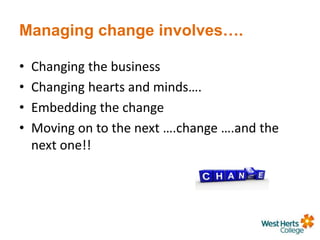
Managing change involves….
• Changing the business
• Changing hearts and minds….
• Embedding the change
• Moving on to the next ….change ….and the
next one!!
Exercise - Why do organisations need to
or choose to change and innovate ?
• Consider the internal environment and the
external environment ?
• What sort of change would that involve ?
- organisational
- people
- products
- services
- stakeholder impact
Why do organisations change and
innovate ?
• Crisis: e.g. 9/11 Buncefield
• Performance Gaps- goals
and objectives are not being
met
• New Technology - more
efficient and economical
methods to perform work.
• Identification of
Opportunities - to increase
competitiveness.
• Reaction to Internal &
External Pressure:
customers, environment,
legislation, shareholders,
employees, competitors,
stakeholders
• Mergers & Acquisitions:
Mergers and acquisitions can
mean duel functions being
redundant
• Change for the sake of
change: new CEO to
demonstrate effectiveness
• ‘Sounds Good/ Us too’ other
organisations are doing the
same .
• Planned Abandonment -
declining products, markets, or
subsidiaries and allocating
resources
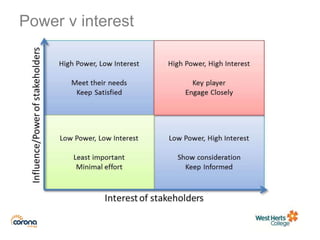
Why analyse stakeholder power and
interest … ??
• The opinions of the most
powerful can influence
what you achieve
• Involvement at all times
makes it likely they will
support you
• Likely to improve the
quality of your work or
change.
• Can help you with
resources
e.g change or projects
• Communicating well and
frequently develops
relationships
• Helps you prioritise and
helps with time
management challenges
• Keeps you focussed on
what's really important
about what you do.
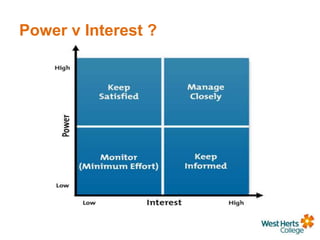
Power v Interest ?
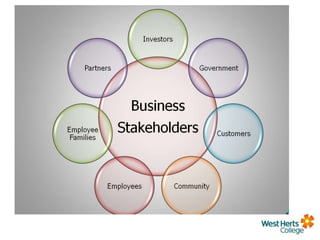
Exercise – review who your
stakeholders are….
• Who are affected by your work ?
• Who has influence or power over it ?
• Who has an interest in its successful or
unsuccessful conclusion.?
• … and who are the people in these groups
who are really key contacts and how do you
want to communicate with them?
Other considerations…
• What financial or
emotional interest do they
have in the change?
• What motivates them ?
• What information do they
want from you?
• How do they want to
receive information from
you?
• What is the best way of
communicating your
message to them?
• Who influences their
opinions
• Are these stakeholders
highly influential ?
• If you can’t meet their
needs or expectations
how will you influence or
negotiate with them?
• Have you talked to them
??
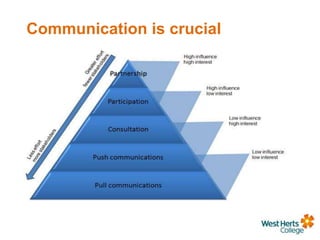
Communication is crucial
Avoid …. please
• Assuming you know what the stakeholders are
thinking
• Trading the interests of one group off against
another
• Ignoring the concerns of stakeholder groups
that are critical to the organisation e.g
customers
• Neglecting the interests of important
stakeholders
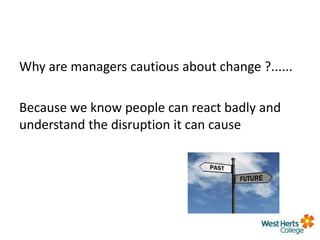
Why are managers cautious about change ?......
Because we know people can react badly and
understand the disruption it can cause
Types of change
• Developmental – what already exists is
continually improved but no radical progress is
achieved or aimed at
• Transitional - A shift in the way a process is
completed, designed to increase efficiency.
• Transformational - A move in an organisation
of culture of business in strategy and
processes
Change Management Models
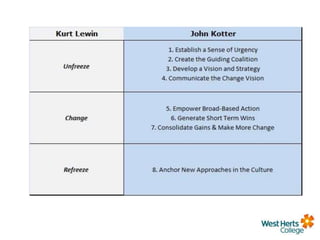
• Kurt Lewin 3 stage change model
• William Bridges Change vs Transition
• Kubher Ross – the emotional response to change
• John Kotter 8 Step Change Model
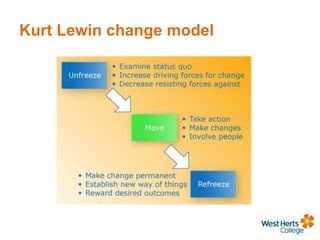
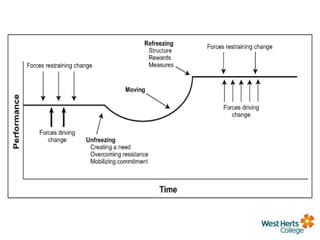
Kurt Lewin change model
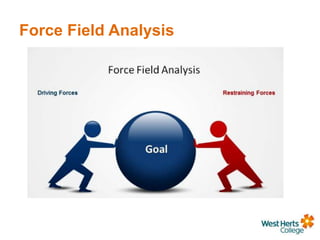
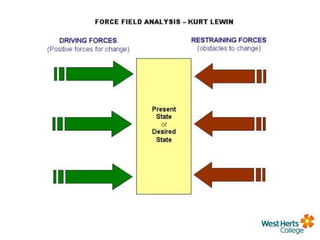
Force Field Analysis
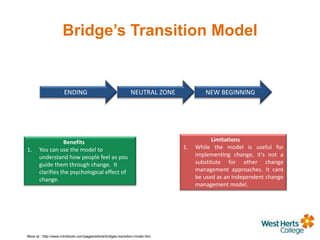
Bridges-Transitional model (1991)
• Differentiates between change and transition
• Change is situational and happens without
people transitioning
• Transition is psychological and is a three phase
process
• People gradually accept the details of the new
situation and the changes that come with it.
Bridge’s Transition Model
Benefits
1. You can use the model to
understand how people feel as you
guide them through change. It
clarifies the psychological effect of
change.
Limitations
1. While the model is useful for
implementing change, it's not a
substitute for other change
management approaches. It cant
be used as an independent change
management model.
ENDING NEUTRAL ZONE NEW BEGINNING
More at : http://www.mindtools.com/pages/article/bridges-transition-model.htm
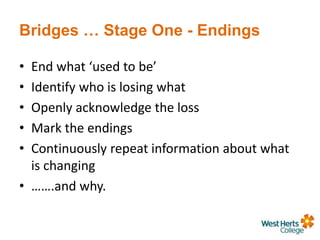
Bridges … Stage One - Endings
• End what ‘used to be’
• Identify who is losing what
• Openly acknowledge the loss
• Mark the endings
• Continuously repeat information about what
is changing
• …….and why.
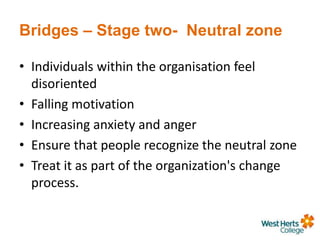
Bridges – Stage two- Neutral zone
• Individuals within the organisation feel
disoriented
• Falling motivation
• Increasing anxiety and anger
• Ensure that people recognize the neutral zone
• Treat it as part of the organization's change
process.
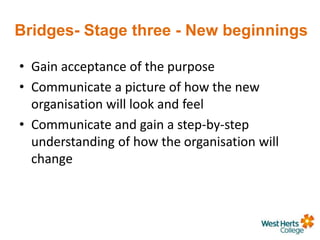
Bridges- Stage three - New beginnings
• Gain acceptance of the purpose
• Communicate a picture of how the new
organisation will look and feel
• Communicate and gain a step-by-step
understanding of how the organisation will
change
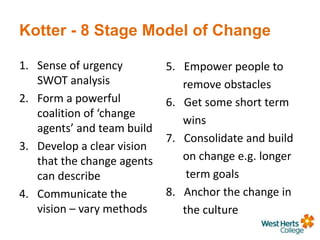
Kotter - 8 Stage Model of Change
1. Sense of urgency
SWOT analysis
2. Form a powerful
coalition of ‘change
agents’ and team build
3. Develop a clear vision
that the change agents
can describe
4. Communicate the
vision – vary methods
5. Empower people to
remove obstacles
6. Get some short term
wins
7. Consolidate and build
on change e.g. longer
term goals
8. Anchor the change in
the culture
Change Management / analysis
Tools
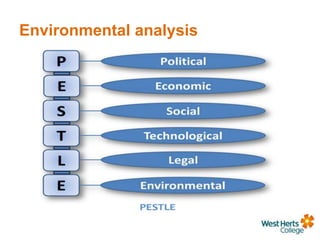
• PESTEL Analysis
• Force field Analysis
• Risk Assessment
• Impact Assessment
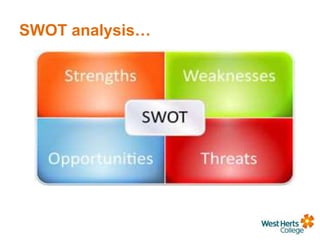
SWOT analysis…
Environmental analysis
Group Exercise….. PESTLE?
• Where is the organisation now ?
• What are the challenges ?
• What are the threats or opportunities ?
• What would be the benefits of change ?
Why people resist change
• Loss of control
• Personal uncertainty about the future
• Concern about competence
• More work / less work
• Concern over resources
• Past resentments
• Real threats or perceived threats
• Individual past experiences of change
Dealing with the resistance to
change
• Explaining the Why – the context
• Be positive but realistic
• Lead from the front
• Remember and remind what didn’t work in the past
• Education and communication
• Participation and involvement
• Facilitation and support
• Negotiation and agreement
• Explicit and implicit persuasion
• Begin to change something quickly
Communication – the 4P’s
• Purpose - Describe why you are making the change
• Picture – what is the vision ..describe what the future
will look like
• Plan - Describe the steps you need to take to get
there
• Part -Describe the part you need the specific
employee to play; specify your requests and their
objectives
Change management plan… what it
should cover- remember SMART !
• Objectives clearly defined
• Forecasting and planning changes proposed
• Arranging and controlling changes/ variations
in the project as they occur
• Risks and mitigation
• Analysing and adjusting changes as required
• Monitoring & evaluating- agile planning
Project Management
What is a project?
• It's a temporary endeavor undertaken to
create a unique product, service or result.
• (Project Management Institute)
• Project management is the application of
knowledge, skills, tools, and techniques to
project activities to meet the project
requirements.
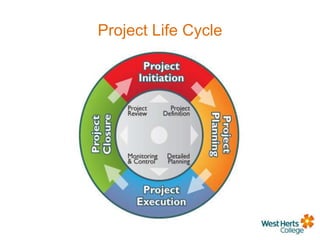
Project Life Cycle
Exercise
What can possibly go wrong …..
• Process ?
• People ?
• Stakeholders ?
Examples of some project planning
tools
• Brainstorming
• Fishbone diagrams
• Force Field analysis
• Stakeholder analysis
• Critical path analysis (PERT)
• Gantt Charts
• Project planning documentation
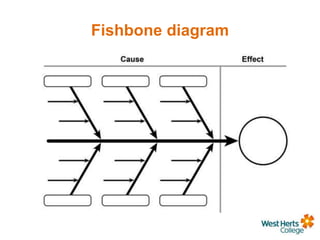
Fishbone diagram
Fishbone diagrams
• Used to analyse cause and effect
• Analyse completed diagram
• What are the interdependencies
• What is this telling you?
• What can you fix? What can’t you fix? What
resources do you have ?
• What would make the most difference if you
fixed it.
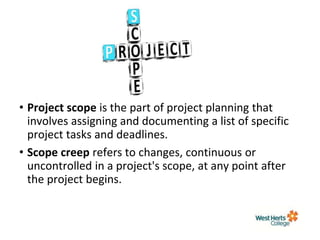
• Project scope is the part of project planning that
involves assigning and documenting a list of specific
project tasks and deadlines.
• Scope creep refers to changes, continuous or
uncontrolled in a project's scope, at any point after
the project begins.
Project Scope - is the part of
project planning that involves:
• Review Project Objectives
• Definition and Feasibility
• Arrange Project Team Meeting
• Select Team Members
• Assign tasks and responsibilities
• Create Risk and Quality logs
• Create project plan
• Detailed Planning
• Include tasks and agreed deadlines
• Circulate to project team members
Project Planning
• Receive Project Mandate
• Review Project Objectives
– Definition and Feasibility
• Arrange Project Team
Meeting
– Select Team Members
– Assign tasks and
responsibilities
– Create Risk and Quality logs
• Create project plan
– Detailed Planning
– Include tasks and agreed
deadlines
– Circulate to project team
members
• Monitor & Control Project
– Project Milestones and
deadlines
– Risk, Cost, Time and Quality
Management
• Pre Launch Project Review
– Prepare clients both internal
and external
• Project Launch
– Inform clients both internal
and external
• Post Launch Project Review
– What did and what didn’t
work well
– Contingency planning for
future projects
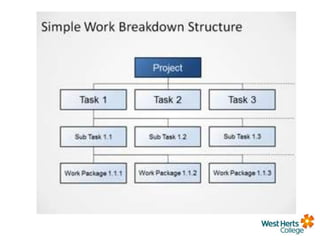
Work breakdown structure (WBS)
• The list of the tasks of your project
• Provides a solid foundation for planning and
scheduling
• Breaks down projects into manageable work
packages (chunks)
• Provides a way to estimate project costs
accurately
Work Breakdown structure
• Makes sure no important deliverables get
forgotten
• Helps a project manager with resource
allocation
• Can provide a proven and repeatable
approach to planning projects
• Provides an ideal tool for team brainstorming
and for promoting team cohesion
• Is useful for allocating activity
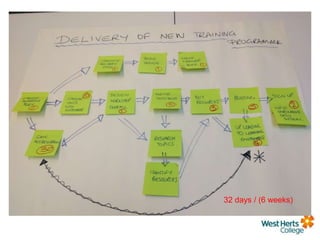
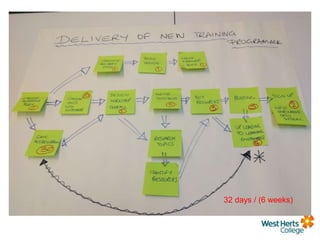
Critical Path Analysis (PERT)
• PERT stands for Programme Evaluation Review
Technique.
• Identifies tasks, how long it will take to
undertake each task and the order in which
they need to be undertaken
• Identifies the longest path through project –
gives an indication of how long project will
take
• Helps you develop your Gantt chart
32 days / (6 weeks)
Critical Path Analysis
• It’s visual
• You can involve the project team and brain
storm the tasks
• It is flexible – easy to rearrange order
• Can help you identify tasks you may have
forgotten
• Can help you identify where you may be able
to reduce time frames – ‘what can you do
quicker?’
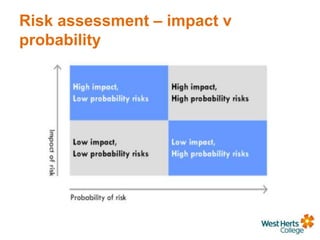
Risk assessment – impact v
probability
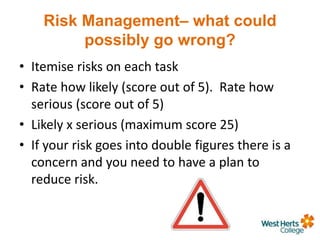
Risk Management– what could
possibly go wrong?
• Itemise risks on each task
• Rate how likely (score out of 5). Rate how
serious (score out of 5)
• Likely x serious (maximum score 25)
• If your risk goes into double figures there is a
concern and you need to have a plan to
reduce risk.
32 days / (6 weeks)
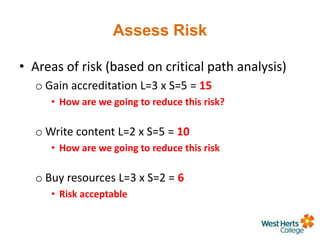
Assess Risk
• Areas of risk (based on critical path analysis)
o Gain accreditation L=3 x S=5 = 15
• How are we going to reduce this risk?
o Write content L=2 x S=5 = 10
• How are we going to reduce this risk
o Buy resources L=3 x S=2 = 6
• Risk acceptable
Gantt Chart
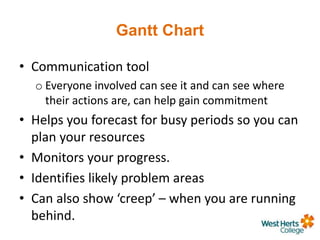
• Communication tool
o Everyone involved can see it and can see where
their actions are, can help gain commitment
• Helps you forecast for busy periods so you can
plan your resources
• Monitors your progress.
• Identifies likely problem areas
• Can also show ‘creep’ – when you are running
behind.
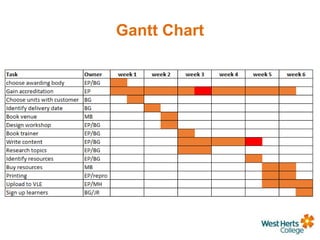
Gantt Chart
Gantt Chart
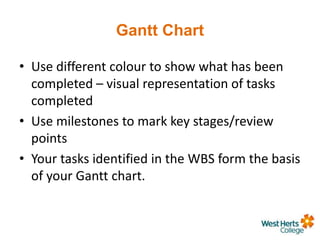
• Use different colour to show what has been
completed – visual representation of tasks
completed
• Use milestones to mark key stages/review
points
• Your tasks identified in the WBS form the basis
of your Gantt chart.
Power v interest
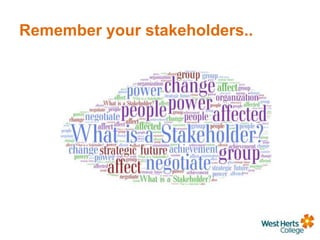
Remember your stakeholders..
Next sessions…29th June
• Level 3 – Principles of business and review
• Level 5 – Business process and review

Day 4 innovaton and change management

  • 1.
    Managing and Implementing Change, Innovationand Projects Thursday 15 June 2017
  • 2.
    Links to relevantmandatory units Level 3 • M&L 24 Principles of people management AC1.1 – AC1.5, AC2.1- AC2.4, AC3.7 - A3.8, AC4.1 – 4.5, AC6.1-6.4 • M&L 15 Principles of leadership and management • M&L 11 Manage team performance Level 5 • M&L 45 Contribute to the development of a strategic plan
  • 3.
    Some thoughts.. In aprogressive country change is constant; ...change... is inevitable ~ Benjamin Disraeli (1804-1881) It is not the strongest of the species that survives, nor the most intelligent, but the one most responsive to change. ~ Charles Darwin (1809-1882)
  • 4.
    Objectives • Understand thereasons organisations need to change. • Introduction to some theoretical change models. • Understand how to conduct an environmental and organisational analysis • Ideas about managing the people during change • How to identify an opportunity to change • How to assess the benefits and risks of change • How to create a change implementation plan. • How to manage projects • How to use different project management tools
  • 5.
    Driving change isoften about influencing other stakeholders and others by negotiation…
  • 7.
    What is change? Changecan be regarded as the process of “analysing the past to elicit the present actions required for the future”. It involves moving from a present state, through a transition state, to a future desired state. Rosabeth Moss Kanter
  • 8.
    Change Management is…… ‘ the application of a structured process and set of tools for leading the people side of change to achieve a desired outcome ‘ Prosci Change Management Model
  • 9.
    Change can be…. •Small or big • Planned or unplanned • Fast or slow • How it is perceived by stakeholders is really important
  • 10.
    Managing change involves…. •Changing the business • Changing hearts and minds…. • Embedding the change • Moving on to the next ….change ….and the next one!!
  • 11.
    Exercise - Whydo organisations need to or choose to change and innovate ? • Consider the internal environment and the external environment ? • What sort of change would that involve ? - organisational - people - products - services - stakeholder impact
  • 12.
    Why do organisationschange and innovate ? • Crisis: e.g. 9/11 Buncefield • Performance Gaps- goals and objectives are not being met • New Technology - more efficient and economical methods to perform work. • Identification of Opportunities - to increase competitiveness. • Reaction to Internal & External Pressure: customers, environment, legislation, shareholders, employees, competitors, stakeholders • Mergers & Acquisitions: Mergers and acquisitions can mean duel functions being redundant • Change for the sake of change: new CEO to demonstrate effectiveness • ‘Sounds Good/ Us too’ other organisations are doing the same . • Planned Abandonment - declining products, markets, or subsidiaries and allocating resources
  • 14.
    Why analyse stakeholderpower and interest … ?? • The opinions of the most powerful can influence what you achieve • Involvement at all times makes it likely they will support you • Likely to improve the quality of your work or change. • Can help you with resources e.g change or projects • Communicating well and frequently develops relationships • Helps you prioritise and helps with time management challenges • Keeps you focussed on what's really important about what you do.
  • 15.
  • 16.
    Exercise – reviewwho your stakeholders are…. • Who are affected by your work ? • Who has influence or power over it ? • Who has an interest in its successful or unsuccessful conclusion.? • … and who are the people in these groups who are really key contacts and how do you want to communicate with them?
  • 17.
    Other considerations… • Whatfinancial or emotional interest do they have in the change? • What motivates them ? • What information do they want from you? • How do they want to receive information from you? • What is the best way of communicating your message to them? • Who influences their opinions • Are these stakeholders highly influential ? • If you can’t meet their needs or expectations how will you influence or negotiate with them? • Have you talked to them ??
  • 18.
  • 19.
    Avoid …. please •Assuming you know what the stakeholders are thinking • Trading the interests of one group off against another • Ignoring the concerns of stakeholder groups that are critical to the organisation e.g customers • Neglecting the interests of important stakeholders
  • 20.
    Why are managerscautious about change ?...... Because we know people can react badly and understand the disruption it can cause
  • 21.
    Types of change •Developmental – what already exists is continually improved but no radical progress is achieved or aimed at • Transitional - A shift in the way a process is completed, designed to increase efficiency. • Transformational - A move in an organisation of culture of business in strategy and processes
  • 22.
    Change Management Models •Kurt Lewin 3 stage change model • William Bridges Change vs Transition • Kubher Ross – the emotional response to change • John Kotter 8 Step Change Model
  • 23.
  • 25.
  • 27.
    Bridges-Transitional model (1991) •Differentiates between change and transition • Change is situational and happens without people transitioning • Transition is psychological and is a three phase process • People gradually accept the details of the new situation and the changes that come with it.
  • 28.
    Bridge’s Transition Model Benefits 1.You can use the model to understand how people feel as you guide them through change. It clarifies the psychological effect of change. Limitations 1. While the model is useful for implementing change, it's not a substitute for other change management approaches. It cant be used as an independent change management model. ENDING NEUTRAL ZONE NEW BEGINNING More at : http://www.mindtools.com/pages/article/bridges-transition-model.htm
  • 29.
    Bridges … StageOne - Endings • End what ‘used to be’ • Identify who is losing what • Openly acknowledge the loss • Mark the endings • Continuously repeat information about what is changing • …….and why.
  • 30.
    Bridges – Stagetwo- Neutral zone • Individuals within the organisation feel disoriented • Falling motivation • Increasing anxiety and anger • Ensure that people recognize the neutral zone • Treat it as part of the organization's change process.
  • 31.
    Bridges- Stage three- New beginnings • Gain acceptance of the purpose • Communicate a picture of how the new organisation will look and feel • Communicate and gain a step-by-step understanding of how the organisation will change
  • 32.
    Kotter - 8Stage Model of Change 1. Sense of urgency SWOT analysis 2. Form a powerful coalition of ‘change agents’ and team build 3. Develop a clear vision that the change agents can describe 4. Communicate the vision – vary methods 5. Empower people to remove obstacles 6. Get some short term wins 7. Consolidate and build on change e.g. longer term goals 8. Anchor the change in the culture
  • 34.
    Change Management /analysis Tools • PESTEL Analysis • Force field Analysis • Risk Assessment • Impact Assessment
  • 35.
  • 36.
  • 37.
    Group Exercise….. PESTLE? •Where is the organisation now ? • What are the challenges ? • What are the threats or opportunities ? • What would be the benefits of change ?
  • 38.
    Why people resistchange • Loss of control • Personal uncertainty about the future • Concern about competence • More work / less work • Concern over resources • Past resentments • Real threats or perceived threats • Individual past experiences of change
  • 39.
    Dealing with theresistance to change • Explaining the Why – the context • Be positive but realistic • Lead from the front • Remember and remind what didn’t work in the past • Education and communication • Participation and involvement • Facilitation and support • Negotiation and agreement • Explicit and implicit persuasion • Begin to change something quickly
  • 40.
    Communication – the4P’s • Purpose - Describe why you are making the change • Picture – what is the vision ..describe what the future will look like • Plan - Describe the steps you need to take to get there • Part -Describe the part you need the specific employee to play; specify your requests and their objectives
  • 41.
    Change management plan…what it should cover- remember SMART ! • Objectives clearly defined • Forecasting and planning changes proposed • Arranging and controlling changes/ variations in the project as they occur • Risks and mitigation • Analysing and adjusting changes as required • Monitoring & evaluating- agile planning
  • 42.
  • 43.
    What is aproject? • It's a temporary endeavor undertaken to create a unique product, service or result. • (Project Management Institute) • Project management is the application of knowledge, skills, tools, and techniques to project activities to meet the project requirements.
  • 44.
  • 45.
    Exercise What can possiblygo wrong ….. • Process ? • People ? • Stakeholders ?
  • 46.
    Examples of someproject planning tools • Brainstorming • Fishbone diagrams • Force Field analysis • Stakeholder analysis • Critical path analysis (PERT) • Gantt Charts • Project planning documentation
  • 47.
  • 48.
    Fishbone diagrams • Usedto analyse cause and effect • Analyse completed diagram • What are the interdependencies • What is this telling you? • What can you fix? What can’t you fix? What resources do you have ? • What would make the most difference if you fixed it.
  • 50.
    • Project scopeis the part of project planning that involves assigning and documenting a list of specific project tasks and deadlines. • Scope creep refers to changes, continuous or uncontrolled in a project's scope, at any point after the project begins.
  • 51.
    Project Scope -is the part of project planning that involves: • Review Project Objectives • Definition and Feasibility • Arrange Project Team Meeting • Select Team Members • Assign tasks and responsibilities • Create Risk and Quality logs • Create project plan • Detailed Planning • Include tasks and agreed deadlines • Circulate to project team members
  • 52.
    Project Planning • ReceiveProject Mandate • Review Project Objectives – Definition and Feasibility • Arrange Project Team Meeting – Select Team Members – Assign tasks and responsibilities – Create Risk and Quality logs • Create project plan – Detailed Planning – Include tasks and agreed deadlines – Circulate to project team members • Monitor & Control Project – Project Milestones and deadlines – Risk, Cost, Time and Quality Management • Pre Launch Project Review – Prepare clients both internal and external • Project Launch – Inform clients both internal and external • Post Launch Project Review – What did and what didn’t work well – Contingency planning for future projects
  • 53.
    Work breakdown structure(WBS) • The list of the tasks of your project • Provides a solid foundation for planning and scheduling • Breaks down projects into manageable work packages (chunks) • Provides a way to estimate project costs accurately
  • 54.
    Work Breakdown structure •Makes sure no important deliverables get forgotten • Helps a project manager with resource allocation • Can provide a proven and repeatable approach to planning projects • Provides an ideal tool for team brainstorming and for promoting team cohesion • Is useful for allocating activity
  • 55.
    Critical Path Analysis(PERT) • PERT stands for Programme Evaluation Review Technique. • Identifies tasks, how long it will take to undertake each task and the order in which they need to be undertaken • Identifies the longest path through project – gives an indication of how long project will take • Helps you develop your Gantt chart
  • 56.
    32 days /(6 weeks)
  • 57.
    Critical Path Analysis •It’s visual • You can involve the project team and brain storm the tasks • It is flexible – easy to rearrange order • Can help you identify tasks you may have forgotten • Can help you identify where you may be able to reduce time frames – ‘what can you do quicker?’
  • 58.
    Risk assessment –impact v probability
  • 59.
    Risk Management– whatcould possibly go wrong? • Itemise risks on each task • Rate how likely (score out of 5). Rate how serious (score out of 5) • Likely x serious (maximum score 25) • If your risk goes into double figures there is a concern and you need to have a plan to reduce risk.
  • 60.
    32 days /(6 weeks)
  • 61.
    Assess Risk • Areasof risk (based on critical path analysis) o Gain accreditation L=3 x S=5 = 15 • How are we going to reduce this risk? o Write content L=2 x S=5 = 10 • How are we going to reduce this risk o Buy resources L=3 x S=2 = 6 • Risk acceptable
  • 62.
    Gantt Chart • Communicationtool o Everyone involved can see it and can see where their actions are, can help gain commitment • Helps you forecast for busy periods so you can plan your resources • Monitors your progress. • Identifies likely problem areas • Can also show ‘creep’ – when you are running behind.
  • 63.
  • 64.
    Gantt Chart • Usedifferent colour to show what has been completed – visual representation of tasks completed • Use milestones to mark key stages/review points • Your tasks identified in the WBS form the basis of your Gantt chart.
  • 65.
  • 66.
  • 67.
    Next sessions…29th June •Level 3 – Principles of business and review • Level 5 – Business process and review