Achieving Competitive Advantage
Through
Strategic Corporate Social Responsibility
Dr. Elijah Ezendu
FIMC, FCIM, FRSA, FCCM, FIIAN, FBDI, FAAFM, FSSM, MIMIS, MIAP, MITD, ACIArb, ACIPM,
PhD, DocM, MBA, CWM, CBDA, CMA, MPM, PME, CSOL, CCIP, CMC, CMgr
“Social responsibility (is the) responsibility of an
organisation for the impacts of its decisions and
activities on society and the environment through
transparent and ethical behaviour that is
consistent with sustainable development,
including the health and welfare of society; takes
into account the expectations of stakeholders; is
in compliance with applicable law and consistent
with international norms of behaviour; and is
integrated throughout the organisation.”
Source: ISO 26000 Working Group on Social Responsibility
ISO 26000 is the international standard
developed to help organizations effectively
assess and address those social responsibilities
that are relevant and significant to their mission
and vision; operations and processes;
customers, employees, communities, and other
stakeholders; and environmental impact.
Source: American Society for Quality (ASQ)
ISO 26000:2010 provides guidance rather than
requirements, so it cannot be certified to unlike
some other well-known ISO standards. Instead,
it helps clarify what social responsibility is, helps
businesses and organizations translate principles
into effective actions and shares best practices
relating to social responsibility, globally.
Source: International Organization for Standardization (ISO)
IWA 26:2017 provides guidance on using ISO
26000:2010 to organizations.
It also provides guidance on how to apply a
management system approach when using ISO
26000:2010.
Source: International Organization for Standardization (ISO)
Four Guidance Streams of ISO 26000:2010
Seven Fundamental Principles of SR
Seven Core Subjects and Issues in SR
Social Responsibiliy Recognition
&
Stakeholders Engagement
Organisational Integration
of
Socially Responsible Behaviour
Seven Overaching Principles of SR
Accountability
Transparency
Ethical Behaviour
Respect for Stakeholder Interest
Respect for Rule of Law
Respect for International Norms of Behaviour
Respect for Human Rights
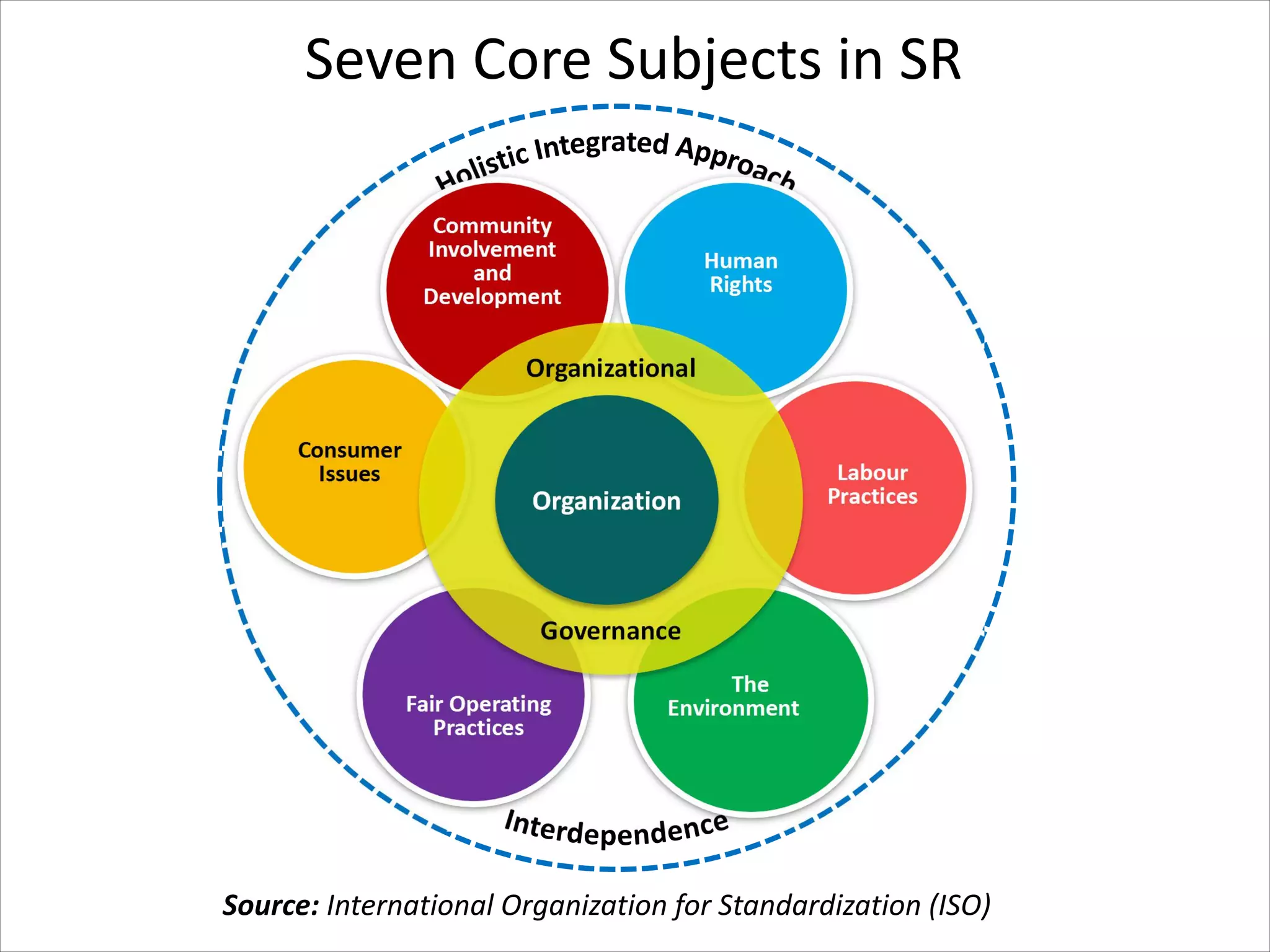
Seven Core Subjects in SR
Source: International Organization for Standardization (ISO)
Three Dimensions of Sustainability
Dimensions of CSR
• Internal Dimension: This focuses on
organisational practices with respect to
internal stakeholders that should be aligned to
corporate social responsibility standards and
international norms of business practices..
• External Dimension: This focuses on an
organisations practices towards external
stakeholders. This should be in accordance
with corporate social responsibility standards
and international norms of business practices.
Internal Dimension
Human
Resource
Management
Corporate
Agility to
Change
Environmental
Impact
Management
Safety and
Health
External Dimension
Business Partners
Human Rights
Local
Communities
“There is no way to avoid paying serious attention to
corporate citizenship: The costs of failing are simply
too high…There are countless win-win opportunities
waiting to be discovered: Every activity in a firm’s
value chain overlaps in some way with social factors
– everything from how you buy or procure to how
you do your research – yet very few companies have
thought about this. The goal is to leverage your
company’s unique capabilities in supporting social
causes, and improve your competitive context at the
same time. The job of today’s leaders is to stop being
defensive and start thinking systematically about
corporate responsibility.”
- Professor Michael Porter, Harvard Business School
Corporate Responsibilities
Ethical Responsibilities
Social Responsibilities
Legal Responsibilities
Economic Responsibilities
Four Phases of CSR
• Corporate Social Stewardship (1950s – 1960s)
• Corporate Social Responsiveness (1960s – 1970s)
• Corporate/ Business Ethics (1980s – 1990s)
• Corporate/ Global Citizenship (1990s – 2000s)
Stakeholder Groups
Tertiary
(Powerless)
Secondary
(Sociopolitical)
Primary
(Economic)
ProgressiveMaturity Issues of Trust and Change in Models of CSR
Factors that Promote CSR
üGlobalization
üAdvances in Communication
üSustainable Development
üGovernance
üLeadership
üCompetitive Advantage
üConsumerism
üAdvocacy
üEthical Culture
CSR versus Law
Organisations tend to choose between legal
compliance mentality and ethical compliance
mentality.
Legal compliance mentality focuses on observance of
laws pertaining to health and safety, environmental
protection, bribery and corruption, taxation,
consumers, corporate governance, workers and
human rights.
Ethical Compliance mentality directs proactive activities
towards furthering sustainable development and CSR
engineered innovation while acting in pursuit of
business excellence
CSR Implementation Framework
What? (Task Delineation) How? (Checkpoints on the journey)
1. Conduct a CSR assessment  Assemble a CSR team
 Develop a working definition of CSR
 Identify legal requirements
 Review corporate documents, processes and activities, and internal capacity
 Identify and engage key stakeholders
2. Develop a CSR strategy  Build support with CEO, senior management and employees
 Research what others are doing, and assess the value of recognized CSR instruments
 Prepare a matrix of proposed CSR actions
 Develop ideas for proceeding and the business case for them
 Decide on direction, approach, boundaries and focus areas
3. Develop CSR commitments  Do a scan of CSR commitments
 Hold discussions with major stakeholders
 Create a working group to develop the commitments
 Prepare a preliminary draft
 Consult with affected stakeholders
4. Implement CSR commitments  Develop an integrated CSR decision-making structure
 Prepare and implement a CSR business plan
 Set measurable targets and identify performance measures
 Design and conduct CSR training
 Establish mechanisms for addressing problematic behaviour
 Create internal and external communication plans
 Make commitments public
5. Assure and report on progress  Measure and assure performance
 Engage stakeholders
 Report on performance, internally and externally
6. Evaluate and improve  Evaluate performance
 Identify opportunities for improvement
 Engage stakeholders
Source: Paul Hohnen, Corporate Social Responsibility, An Implementation Guide
Plan
Do
Check
Improve
CSR Strategy
This is a firm’s road map for accomplishing its
obligations in corporate social responsibilities
and should consider factors such as
stakeholder interests, competitors’ CSR
inclinations, priority areas, acceptable
approach and process for ascertainment of
performance.
Common Mistakes in CSR
• Lack of vision
• Scale of change
• Sub-strategic management
• Risk/opportunity roles
• Selective hearing
• Maintaining old structures
• “One World” approaches
• Uneven approaches
• Non-participative management
• Failure to see CSR as innovation
Source: Anders & Winst Company
Factors to Consider in
Business Case for CSR
• Areas in which a company can build competitive advantage
• Short and Long term goals
• Benefits
• Higher cost efficiency for organisational activities
• Risk of each opportunity
• Influence of stakeholders
• Areas of great gain
• Cost of implementation
• Implications of programme
“We believe that the leading global companies
of 2020 will be those that provide goods and
services and reach new customers in ways that
address the world’s major challenges –
including poverty, climate change, resource
depletion, globalization, and demographic
shifts.”
- Niall Fitzgerald, Former CEO & Chairman, Unilever
Examples of Ethical Compliance to
Challenges of CSR
• Jebsen & Jessen stopped producing chainsaws in
order to stop contributing to deforestation.
• Toyota’s commitment to champion zero emission by
producing Prius hybrid petrol/electric model.
Current CSR Approaches
Social
Responsibility
Performance
Strategic
CSR
Altruistic
CSR
Legal CSR
Ethical
CSR
Legal CSR Action for compliance
Ethical CSR Act beyond compliance to achieve damage
prevention
Altruistic CSR Act for philanthropy
Strategic CSR Act in alignment of philanthropy as primal
driver for fulfilment of vision and mission
through goodwill accumulation, combative
branding, reputation enhancement, social
value repositioning, reciprocal investment
elicitation, competitive differentiation,
robust inimitability and structured
community-targeted synchronization.
Aligning CSR for Competitive Advantage
• Deconstruction of Vision & Mission
• Assessment & Evaluation of Opportunities and Risks
• Identifying & Exploiting Contributions & Effects of Value Chain
• Identifying & Exploiting Contributions & Effects of Micro-
Environmental Factors and Macro-Environmental Factors
• Development of CSR Initiative Options
• Structured Convergence of CSR Initiative Options to Vision,
Mission and Strategic Imperatives
• Identifying & Deploying Critical Success Factors
• Resolve & Capture Competitive Advantage from Social
Responsibility Performance
Ezendu's Framework for Eliminating
Strategic Dissonance
Paired Social Performance Impact and
Corporate Strategic Intent Achieved
RQ
T
Social Performance Impact
Corporate Strategic Intent Achieved
RQ
T
Region of Strategic Dissonance
Effectuated by Poor Corporate
Strategic Intent Achieved
Ezendu's Framework for Eliminating
Strategic Dissonance
Paired Social Performance Impact and
Corporate Strategic Intent Achieved
RQ
T
Social Performance Impact
Corporate Strategic Intent Achieved
RQ
T
Region of Strategic Dissonance
Effectuated by Dismal Social
Performance Impact
Ezendu's Framework for Eliminating
Strategic Dissonance
• Evaluate relative quantity of corporate
strategic intent achieved and social
performance impact
• Conduct precursor analysis to ascertain
causality profile of strategic dissonance
• Identify causes and aggravating context
• Delineate components of aggravating context
• Execute elimination of strategic dissonance
• Corporate Agility
• Continuous Responsiveness
• Periodic Actionable Intelligence
• Critical Innovativeness
• Advanced Counter-Combative Strategies
• Systematic Embedded Restructuring
• Effective Stakeholder Engagement
• Preserving & Growing Domain of Uniqueness
Key Requirements for Sustaining
Competitive Advantage
SR Guidance Materials
UN Instruments
• United Nations Global Compact
• U.N. Universal Declaration of Human Rights
• U.N. Guiding Principles on Business and Human Rights
• ILO Conventions and Recommendations
• U.N. Agenda 2030 (Sustainable Development Goals)
ISO Standards
• ISO 14000 Family – Environmental Management
• ISO 9000 Family – Quality Management
• ISO 45001 - Health and Safety Management Systems (draft)
• ISO 20400 – Sustainable Procurement (draft)
• ISO 37001 – Anti-Bribery Management Systems
Other Guidelines Constituting International Norms
• OECD Guidelines on Multinational Enterprises
• OHSAS 18001
• Social Accountability 8000
• Global Reporting Initiative
• Food Alliance Certification
• World Business Council for Sustainable Development 10 Messages by which to Operate
• Green Globe Company Standard
• Environmental and Social Standards of International Finance Corporation
• Equator Principles
• Standards, Certification and Accreditation of Forest Stewardship Council
• Principles for Responsible Investment
• Transparency International Business Principles
• Voluntary Principles on Security and Human Rights
Role Play
..............................................................................
..............................................................................
..............................................................................
..............................................................................
..............................................................................
..............................................................................
..............................................................................
..............................................................................
Dr Elijah Ezendu is Award-Winning Business Expert & Certified Management Consultant with expertise in Interim
Management, Strategy, Competitive Intelligence, Transformation, Restructuring, Turnaround Management, Business
Development, Marketing, Project & Cost Management, Leadership, HR, CSR, e-Business & Software Architecture. He
had functioned as Member of Commission on Environmental, Economic, and Social Policy at International Union for
Conservation of Nature, Switzerland; Founder, Elijah Ezendu Professional Services; Founder, Initiative for Sustainable
Business Equity; Director, Archtalento; Director, Speakers Africana; Chairman Advisory Board, Igbo Filmmakers Forum;
Chairman of Board, Motus Health Initiative; Chairman of Board, Charisma Broadcast Film Academy; Group Chief
Operating Officer, Idova Group; CEO, Rubiini (UAE); Special Advisor, Road Transport Employers Association of Nigeria;
Director, MMNA Investments; Chair, Int’l Board of GCC Business Council (UAE); Senior Partner, Shevach Consulting;
Chairman (Certification & Training), Chairman (Board of Fellows), Lead Assessor & Governing Council Member, Institute
of Management Consultants, Nigeria; Lead Resource, Centre for Competitive Intelligence Development; Lead
Consultant/ Partner, JK Michaels; Turnaround Project Director, Consolidated Business Holdings Limited; Technical
Director, Gestalt; Chief Operating Officer, Rohan Group; Executive Director (Various Roles), Fortuna, Gambia & Malta;
Partner, D & E; Vice Chairman of Board, Refined Shipping; Director of Programmes & Governing Council Member,
Institute of Business Development, Nigeria; Member of TDD Committee, International Association of Software
Architects, USA; Member of Strategic Planning and Implementation Committee, Chartered Institute of Personnel
Management of Nigeria; Country Manager (Nigeria) & Adjunct Faculty (MBA Programme), Regent Business School,
South Africa; Adjunct Faculty (MBA Programme), Ladoke Akintola University of Technology; Editor-in-Chief, Cost
Management Journal; Member of National Executive Council, Institute of Internal Auditors of Nigeria; Member, Board
of Directors (Several Organizations). He holds Doctoral Degree in Management, Master of Business Administration and
Fellow of Professional Institutes in North America, UK & Nigeria. He is an Innovator of heralded frameworks: Among
other things, Corporate Investment Structure Based on Financials and Intangibles, for all-inclusive valuation,
highlighting intangible contributions of host communities and ecological environment. It’s a model celebrated
internationally (including Social Innovation Side Event of 2016 United Nations Climate Change Conference COP22 in
Marrakech, Morocco) as remedy for unmitigated depreciation of ecological capital and developmental deprivation of
host communities. He had served as Examiner to Professional Institutes and External Examiner to Universities. He
officiated as Judge at various International and National Awards. He had been a member of Guild of Soundtrack
Producers of Nigeria, as a Musical Artist contributing to film development in Nollywood. He's an author and extensively
featured speaker, who had delivered keynote speeches, technical papers, summit disquisitions and diverse training
listings across countries.
Thank You

Achieving Competitive Advantage Through Strategic Corporate Social Responsibility

  • 1.
    Achieving Competitive Advantage Through StrategicCorporate Social Responsibility Dr. Elijah Ezendu FIMC, FCIM, FRSA, FCCM, FIIAN, FBDI, FAAFM, FSSM, MIMIS, MIAP, MITD, ACIArb, ACIPM, PhD, DocM, MBA, CWM, CBDA, CMA, MPM, PME, CSOL, CCIP, CMC, CMgr
  • 2.
    “Social responsibility (isthe) responsibility of an organisation for the impacts of its decisions and activities on society and the environment through transparent and ethical behaviour that is consistent with sustainable development, including the health and welfare of society; takes into account the expectations of stakeholders; is in compliance with applicable law and consistent with international norms of behaviour; and is integrated throughout the organisation.” Source: ISO 26000 Working Group on Social Responsibility
  • 3.
    ISO 26000 isthe international standard developed to help organizations effectively assess and address those social responsibilities that are relevant and significant to their mission and vision; operations and processes; customers, employees, communities, and other stakeholders; and environmental impact. Source: American Society for Quality (ASQ)
  • 4.
    ISO 26000:2010 providesguidance rather than requirements, so it cannot be certified to unlike some other well-known ISO standards. Instead, it helps clarify what social responsibility is, helps businesses and organizations translate principles into effective actions and shares best practices relating to social responsibility, globally. Source: International Organization for Standardization (ISO)
  • 5.
    IWA 26:2017 providesguidance on using ISO 26000:2010 to organizations. It also provides guidance on how to apply a management system approach when using ISO 26000:2010. Source: International Organization for Standardization (ISO)
  • 6.
    Four Guidance Streamsof ISO 26000:2010 Seven Fundamental Principles of SR Seven Core Subjects and Issues in SR Social Responsibiliy Recognition & Stakeholders Engagement Organisational Integration of Socially Responsible Behaviour
  • 7.
    Seven Overaching Principlesof SR Accountability Transparency Ethical Behaviour Respect for Stakeholder Interest Respect for Rule of Law Respect for International Norms of Behaviour Respect for Human Rights
  • 8.
    Seven Core Subjectsin SR Source: International Organization for Standardization (ISO)
  • 9.
    Three Dimensions ofSustainability
  • 10.
    Dimensions of CSR •Internal Dimension: This focuses on organisational practices with respect to internal stakeholders that should be aligned to corporate social responsibility standards and international norms of business practices.. • External Dimension: This focuses on an organisations practices towards external stakeholders. This should be in accordance with corporate social responsibility standards and international norms of business practices.
  • 11.
  • 12.
  • 13.
    “There is noway to avoid paying serious attention to corporate citizenship: The costs of failing are simply too high…There are countless win-win opportunities waiting to be discovered: Every activity in a firm’s value chain overlaps in some way with social factors – everything from how you buy or procure to how you do your research – yet very few companies have thought about this. The goal is to leverage your company’s unique capabilities in supporting social causes, and improve your competitive context at the same time. The job of today’s leaders is to stop being defensive and start thinking systematically about corporate responsibility.” - Professor Michael Porter, Harvard Business School
  • 14.
    Corporate Responsibilities Ethical Responsibilities SocialResponsibilities Legal Responsibilities Economic Responsibilities
  • 15.
    Four Phases ofCSR • Corporate Social Stewardship (1950s – 1960s) • Corporate Social Responsiveness (1960s – 1970s) • Corporate/ Business Ethics (1980s – 1990s) • Corporate/ Global Citizenship (1990s – 2000s)
  • 16.
  • 17.
    ProgressiveMaturity Issues ofTrust and Change in Models of CSR
  • 18.
    Factors that PromoteCSR üGlobalization üAdvances in Communication üSustainable Development üGovernance üLeadership üCompetitive Advantage üConsumerism üAdvocacy üEthical Culture
  • 19.
    CSR versus Law Organisationstend to choose between legal compliance mentality and ethical compliance mentality. Legal compliance mentality focuses on observance of laws pertaining to health and safety, environmental protection, bribery and corruption, taxation, consumers, corporate governance, workers and human rights. Ethical Compliance mentality directs proactive activities towards furthering sustainable development and CSR engineered innovation while acting in pursuit of business excellence
  • 20.
    CSR Implementation Framework What?(Task Delineation) How? (Checkpoints on the journey) 1. Conduct a CSR assessment  Assemble a CSR team  Develop a working definition of CSR  Identify legal requirements  Review corporate documents, processes and activities, and internal capacity  Identify and engage key stakeholders 2. Develop a CSR strategy  Build support with CEO, senior management and employees  Research what others are doing, and assess the value of recognized CSR instruments  Prepare a matrix of proposed CSR actions  Develop ideas for proceeding and the business case for them  Decide on direction, approach, boundaries and focus areas 3. Develop CSR commitments  Do a scan of CSR commitments  Hold discussions with major stakeholders  Create a working group to develop the commitments  Prepare a preliminary draft  Consult with affected stakeholders 4. Implement CSR commitments  Develop an integrated CSR decision-making structure  Prepare and implement a CSR business plan  Set measurable targets and identify performance measures  Design and conduct CSR training  Establish mechanisms for addressing problematic behaviour  Create internal and external communication plans  Make commitments public 5. Assure and report on progress  Measure and assure performance  Engage stakeholders  Report on performance, internally and externally 6. Evaluate and improve  Evaluate performance  Identify opportunities for improvement  Engage stakeholders Source: Paul Hohnen, Corporate Social Responsibility, An Implementation Guide Plan Do Check Improve
  • 21.
    CSR Strategy This isa firm’s road map for accomplishing its obligations in corporate social responsibilities and should consider factors such as stakeholder interests, competitors’ CSR inclinations, priority areas, acceptable approach and process for ascertainment of performance.
  • 22.
    Common Mistakes inCSR • Lack of vision • Scale of change • Sub-strategic management • Risk/opportunity roles • Selective hearing • Maintaining old structures • “One World” approaches • Uneven approaches • Non-participative management • Failure to see CSR as innovation Source: Anders & Winst Company
  • 23.
    Factors to Considerin Business Case for CSR • Areas in which a company can build competitive advantage • Short and Long term goals • Benefits • Higher cost efficiency for organisational activities • Risk of each opportunity • Influence of stakeholders • Areas of great gain • Cost of implementation • Implications of programme
  • 24.
    “We believe thatthe leading global companies of 2020 will be those that provide goods and services and reach new customers in ways that address the world’s major challenges – including poverty, climate change, resource depletion, globalization, and demographic shifts.” - Niall Fitzgerald, Former CEO & Chairman, Unilever
  • 25.
    Examples of EthicalCompliance to Challenges of CSR • Jebsen & Jessen stopped producing chainsaws in order to stop contributing to deforestation. • Toyota’s commitment to champion zero emission by producing Prius hybrid petrol/electric model.
  • 26.
  • 27.
    Legal CSR Actionfor compliance Ethical CSR Act beyond compliance to achieve damage prevention Altruistic CSR Act for philanthropy Strategic CSR Act in alignment of philanthropy as primal driver for fulfilment of vision and mission through goodwill accumulation, combative branding, reputation enhancement, social value repositioning, reciprocal investment elicitation, competitive differentiation, robust inimitability and structured community-targeted synchronization.
  • 28.
    Aligning CSR forCompetitive Advantage • Deconstruction of Vision & Mission • Assessment & Evaluation of Opportunities and Risks • Identifying & Exploiting Contributions & Effects of Value Chain • Identifying & Exploiting Contributions & Effects of Micro- Environmental Factors and Macro-Environmental Factors • Development of CSR Initiative Options • Structured Convergence of CSR Initiative Options to Vision, Mission and Strategic Imperatives • Identifying & Deploying Critical Success Factors • Resolve & Capture Competitive Advantage from Social Responsibility Performance
  • 29.
    Ezendu's Framework forEliminating Strategic Dissonance Paired Social Performance Impact and Corporate Strategic Intent Achieved RQ T Social Performance Impact Corporate Strategic Intent Achieved RQ T Region of Strategic Dissonance Effectuated by Poor Corporate Strategic Intent Achieved
  • 30.
    Ezendu's Framework forEliminating Strategic Dissonance Paired Social Performance Impact and Corporate Strategic Intent Achieved RQ T Social Performance Impact Corporate Strategic Intent Achieved RQ T Region of Strategic Dissonance Effectuated by Dismal Social Performance Impact
  • 31.
    Ezendu's Framework forEliminating Strategic Dissonance • Evaluate relative quantity of corporate strategic intent achieved and social performance impact • Conduct precursor analysis to ascertain causality profile of strategic dissonance • Identify causes and aggravating context • Delineate components of aggravating context • Execute elimination of strategic dissonance
  • 32.
    • Corporate Agility •Continuous Responsiveness • Periodic Actionable Intelligence • Critical Innovativeness • Advanced Counter-Combative Strategies • Systematic Embedded Restructuring • Effective Stakeholder Engagement • Preserving & Growing Domain of Uniqueness Key Requirements for Sustaining Competitive Advantage
  • 33.
    SR Guidance Materials UNInstruments • United Nations Global Compact • U.N. Universal Declaration of Human Rights • U.N. Guiding Principles on Business and Human Rights • ILO Conventions and Recommendations • U.N. Agenda 2030 (Sustainable Development Goals) ISO Standards • ISO 14000 Family – Environmental Management • ISO 9000 Family – Quality Management • ISO 45001 - Health and Safety Management Systems (draft) • ISO 20400 – Sustainable Procurement (draft) • ISO 37001 – Anti-Bribery Management Systems Other Guidelines Constituting International Norms • OECD Guidelines on Multinational Enterprises • OHSAS 18001 • Social Accountability 8000 • Global Reporting Initiative • Food Alliance Certification • World Business Council for Sustainable Development 10 Messages by which to Operate • Green Globe Company Standard • Environmental and Social Standards of International Finance Corporation • Equator Principles • Standards, Certification and Accreditation of Forest Stewardship Council • Principles for Responsible Investment • Transparency International Business Principles • Voluntary Principles on Security and Human Rights
  • 34.
  • 35.
    Dr Elijah Ezenduis Award-Winning Business Expert & Certified Management Consultant with expertise in Interim Management, Strategy, Competitive Intelligence, Transformation, Restructuring, Turnaround Management, Business Development, Marketing, Project & Cost Management, Leadership, HR, CSR, e-Business & Software Architecture. He had functioned as Member of Commission on Environmental, Economic, and Social Policy at International Union for Conservation of Nature, Switzerland; Founder, Elijah Ezendu Professional Services; Founder, Initiative for Sustainable Business Equity; Director, Archtalento; Director, Speakers Africana; Chairman Advisory Board, Igbo Filmmakers Forum; Chairman of Board, Motus Health Initiative; Chairman of Board, Charisma Broadcast Film Academy; Group Chief Operating Officer, Idova Group; CEO, Rubiini (UAE); Special Advisor, Road Transport Employers Association of Nigeria; Director, MMNA Investments; Chair, Int’l Board of GCC Business Council (UAE); Senior Partner, Shevach Consulting; Chairman (Certification & Training), Chairman (Board of Fellows), Lead Assessor & Governing Council Member, Institute of Management Consultants, Nigeria; Lead Resource, Centre for Competitive Intelligence Development; Lead Consultant/ Partner, JK Michaels; Turnaround Project Director, Consolidated Business Holdings Limited; Technical Director, Gestalt; Chief Operating Officer, Rohan Group; Executive Director (Various Roles), Fortuna, Gambia & Malta; Partner, D & E; Vice Chairman of Board, Refined Shipping; Director of Programmes & Governing Council Member, Institute of Business Development, Nigeria; Member of TDD Committee, International Association of Software Architects, USA; Member of Strategic Planning and Implementation Committee, Chartered Institute of Personnel Management of Nigeria; Country Manager (Nigeria) & Adjunct Faculty (MBA Programme), Regent Business School, South Africa; Adjunct Faculty (MBA Programme), Ladoke Akintola University of Technology; Editor-in-Chief, Cost Management Journal; Member of National Executive Council, Institute of Internal Auditors of Nigeria; Member, Board of Directors (Several Organizations). He holds Doctoral Degree in Management, Master of Business Administration and Fellow of Professional Institutes in North America, UK & Nigeria. He is an Innovator of heralded frameworks: Among other things, Corporate Investment Structure Based on Financials and Intangibles, for all-inclusive valuation, highlighting intangible contributions of host communities and ecological environment. It’s a model celebrated internationally (including Social Innovation Side Event of 2016 United Nations Climate Change Conference COP22 in Marrakech, Morocco) as remedy for unmitigated depreciation of ecological capital and developmental deprivation of host communities. He had served as Examiner to Professional Institutes and External Examiner to Universities. He officiated as Judge at various International and National Awards. He had been a member of Guild of Soundtrack Producers of Nigeria, as a Musical Artist contributing to film development in Nollywood. He's an author and extensively featured speaker, who had delivered keynote speeches, technical papers, summit disquisitions and diverse training listings across countries.
  • 36.