Download the full version and explore a variety of ebooks
or textbooks at https://ebookmass.com
Organizational Change: An Action-Oriented Toolkit
Third Edition – Ebook PDF Version
_____ Tap the link below to start your download _____
https://ebookmass.com/product/organizational-change-an-
action-oriented-toolkit-third-edition-ebook-pdf-version/
Find ebooks or textbooks at ebookmass.com today!
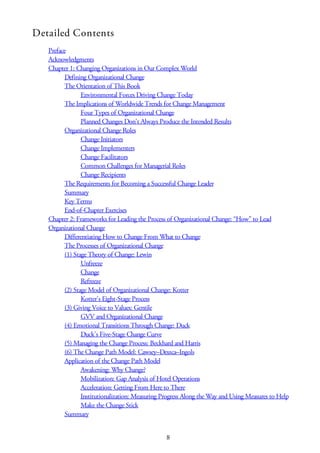
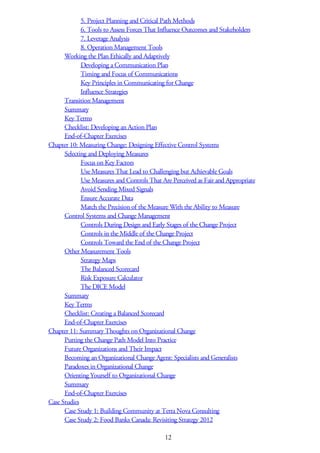
Detailed Contents
Preface
Acknowledgments
Chapter 1: Changing Organizations in Our Complex World
Defining Organizational Change
The Orientation of This Book
Environmental Forces Driving Change Today
The Implications of Worldwide Trends for Change Management
Four Types of Organizational Change
Planned Changes Don’t Always Produce the Intended Results
Organizational Change Roles
Change Initiators
Change Implementers
Change Facilitators
Common Challenges for Managerial Roles
Change Recipients
The Requirements for Becoming a Successful Change Leader
Summary
Key Terms
End-of-Chapter Exercises
Chapter 2: Frameworks for Leading the Process of Organizational Change: “How” to Lead
Organizational Change
Differentiating How to Change From What to Change
The Processes of Organizational Change
(1) Stage Theory of Change: Lewin
Unfreeze
Change
Refreeze
(2) Stage Model of Organizational Change: Kotter
Kotter’s Eight-Stage Process
(3) Giving Voice to Values: Gentile
GVV and Organizational Change
(4) Emotional Transitions Through Change: Duck
Duck’s Five-Stage Change Curve
(5) Managing the Change Process: Beckhard and Harris
(6) The Change Path Model: Cawsey–Deszca–Ingols
Application of the Change Path Model
Awakening: Why Change?
Mobilization: Gap Analysis of Hotel Operations
Acceleration: Getting From Here to There
Institutionalization: Measuring Progress Along the Way and Using Measures to Help
Make the Change Stick
Summary
8
Key Terms
End-of-Chapter Exercises
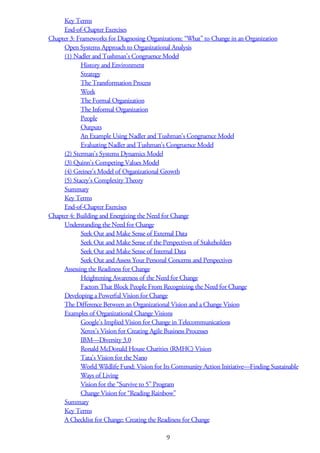
Chapter 3: Frameworks for Diagnosing Organizations: “What” to Change in an Organization
Open Systems Approach to Organizational Analysis
(1) Nadler and Tushman’s Congruence Model
History and Environment
Strategy
The Transformation Process
Work
The Formal Organization
The Informal Organization
People
Outputs
An Example Using Nadler and Tushman’s Congruence Model
Evaluating Nadler and Tushman’s Congruence Model
(2) Sterman’s Systems Dynamics Model
(3) Quinn’s Competing Values Model
(4) Greiner’s Model of Organizational Growth
(5) Stacey’s Complexity Theory
Summary
Key Terms
End-of-Chapter Exercises
Chapter 4: Building and Energizing the Need for Change
Understanding the Need for Change
Seek Out and Make Sense of External Data
Seek Out and Make Sense of the Perspectives of Stakeholders
Seek Out and Make Sense of Internal Data
Seek Out and Assess Your Personal Concerns and Perspectives
Assessing the Readiness for Change
Heightening Awareness of the Need for Change
Factors That Block People From Recognizing the Need for Change
Developing a Powerful Vision for Change
The Difference Between an Organizational Vision and a Change Vision
Examples of Organizational Change Visions
Google’s Implied Vision for Change in Telecommunications
Xerox’s Vision for Creating Agile Business Processes
IBM—Diversity 3.0
Ronald McDonald House Charities (RMHC) Vision
Tata’s Vision for the Nano
World Wildlife Fund: Vision for Its Community Action Initiative—Finding Sustainable
Ways of Living
Vision for the “Survive to 5” Program
Change Vision for “Reading Rainbow”
Summary
Key Terms
A Checklist for Change: Creating the Readiness for Change
9
End-of-Chapter Exercises
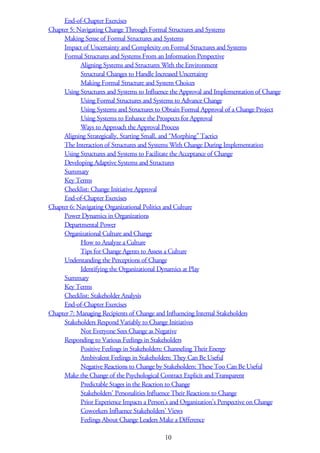
Chapter 5: Navigating Change Through Formal Structures and Systems
Making Sense of Formal Structures and Systems
Impact of Uncertainty and Complexity on Formal Structures and Systems
Formal Structures and Systems From an Information Perspective
Aligning Systems and Structures With the Environment
Structural Changes to Handle Increased Uncertainty
Making Formal Structure and System Choices
Using Structures and Systems to Influence the Approval and Implementation of Change
Using Formal Structures and Systems to Advance Change
Using Systems and Structures to Obtain Formal Approval of a Change Project
Using Systems to Enhance the Prospects for Approval
Ways to Approach the Approval Process
Aligning Strategically, Starting Small, and “Morphing” Tactics
The Interaction of Structures and Systems With Change During Implementation
Using Structures and Systems to Facilitate the Acceptance of Change
Developing Adaptive Systems and Structures
Summary
Key Terms
Checklist: Change Initiative Approval
End-of-Chapter Exercises
Chapter 6: Navigating Organizational Politics and Culture
Power Dynamics in Organizations
Departmental Power
Organizational Culture and Change
How to Analyze a Culture
Tips for Change Agents to Assess a Culture
Understanding the Perceptions of Change
Identifying the Organizational Dynamics at Play
Summary
Key Terms
Checklist: Stakeholder Analysis
End-of-Chapter Exercises
Chapter 7: Managing Recipients of Change and Influencing Internal Stakeholders
Stakeholders Respond Variably to Change Initiatives
Not Everyone Sees Change as Negative
Responding to Various Feelings in Stakeholders
Positive Feelings in Stakeholders: Channeling Their Energy
Ambivalent Feelings in Stakeholders: They Can Be Useful
Negative Reactions to Change by Stakeholders: These Too Can Be Useful
Make the Change of the Psychological Contract Explicit and Transparent
Predictable Stages in the Reaction to Change
Stakeholders’ Personalities Influence Their Reactions to Change
Prior Experience Impacts a Person’s and Organization’s Perspective on Change
Coworkers Influence Stakeholders’ Views
Feelings About Change Leaders Make a Difference
10
Integrity Is One Antidote to Skepticism and Cynicism
Avoiding Coercion But Pushing Hard: The Sweet Spot?
Creating Consistent Signals From Systems and Processes
Steps to Minimize the Negative Effects of Change
Engagement
Timeliness
Two-Way Communication
Make Continuous Improvement the Norm
Encourage People to Be Change Agents and Avoid the Recipient Trap
Summary
Key Terms
Checklist: How to Manage and Minimize Cynicism About Change
End-of-Chapter Exercises
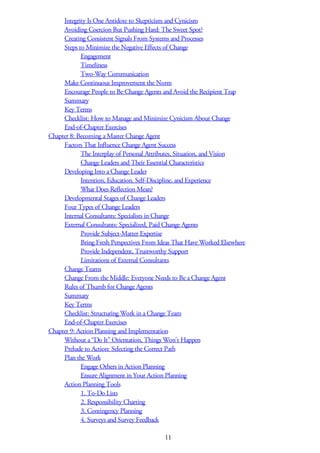
Chapter 8: Becoming a Master Change Agent
Factors That Influence Change Agent Success
The Interplay of Personal Attributes, Situation, and Vision
Change Leaders and Their Essential Characteristics
Developing Into a Change Leader
Intention, Education, Self-Discipline, and Experience
What Does Reflection Mean?
Developmental Stages of Change Leaders
Four Types of Change Leaders
Internal Consultants: Specialists in Change
External Consultants: Specialized, Paid Change Agents
Provide Subject-Matter Expertise
Bring Fresh Perspectives From Ideas That Have Worked Elsewhere
Provide Independent, Trustworthy Support
Limitations of External Consultants
Change Teams
Change From the Middle: Everyone Needs to Be a Change Agent
Rules of Thumb for Change Agents
Summary
Key Terms
Checklist: Structuring Work in a Change Team
End-of-Chapter Exercises
Chapter 9: Action Planning and Implementation
Without a “Do It” Orientation, Things Won’t Happen
Prelude to Action: Selecting the Correct Path
Plan the Work
Engage Others in Action Planning
Ensure Alignment in Your Action Planning
Action Planning Tools
1. To-Do Lists
2. Responsibility Charting
3. Contingency Planning
4. Surveys and Survey Feedback
11
5. Project Planning and Critical Path Methods
6. Tools to Assess Forces That Influence Outcomes and Stakeholders
7. Leverage Analysis
8. Operation Management Tools
Working the Plan Ethically and Adaptively
Developing a Communication Plan
Timing and Focus of Communications
Key Principles in Communicating for Change
Influence Strategies
Transition Management
Summary
Key Terms
Checklist: Developing an Action Plan
End-of-Chapter Exercises
Chapter 10: Measuring Change: Designing Effective Control Systems
Selecting and Deploying Measures
Focus on Key Factors
Use Measures That Lead to Challenging but Achievable Goals
Use Measures and Controls That Are Perceived as Fair and Appropriate
Avoid Sending Mixed Signals
Ensure Accurate Data
Match the Precision of the Measure With the Ability to Measure
Control Systems and Change Management
Controls During Design and Early Stages of the Change Project
Controls in the Middle of the Change Project
Controls Toward the End of the Change Project
Other Measurement Tools
Strategy Maps
The Balanced Scorecard
Risk Exposure Calculator
The DICE Model
Summary
Key Terms
Checklist: Creating a Balanced Scorecard
End-of-Chapter Exercises
Chapter 11: Summary Thoughts on Organizational Change
Putting the Change Path Model Into Practice
Future Organizations and Their Impact
Becoming an Organizational Change Agent: Specialists and Generalists
Paradoxes in Organizational Change
Orienting Yourself to Organizational Change
Summary
End-of-Chapter Exercises
Case Studies
Case Study 1: Building Community at Terra Nova Consulting
Case Study 2: Food Banks Canada: Revisiting Strategy 2012
12
Case Study 3: “Not an Option to Even Consider:” Contending With the Pressures to
Compromise
Case Study 4: Diego Curtiz at Highland State University
Case Study 5: Ellen Zane—Leading Change at Tufts/NEMC
Case Study 6: Ellen Zane at Tufts Medical Center: Spring 2011
Notes
Index
About the Authors
13
14
Preface
Since the publishing of the second edition of this text, the world has continued to churn in very challenging
ways. Uneven and shifting global patterns of growth, sluggish Western economies, continuing fallout from the
financial crisis, stubbornly high unemployment levels in much of the world, and heightened global uncertainty
in matters related to health, safety, and security define the terrain. Their consequences continue to unfold. The
massive credit crisis was followed by unprecedented worldwide government stimulus spending, followed by
sovereign debt crises, followed by . . . ??? Wars and insurrections in parts of Africa, the Ukraine, and much of
the Middle East; deteriorating international relationships involving major powers; fears of global pandemics
(Ebola and MERS); and the rise of ISIS and Boko Haram and their unprecedented inhumanity have shaken all
organizations, big or small, public or private. They have also made us, your authors, much more aware of the
extreme influence of the external environment on the internal workings of an organization. As we point out in
our book, even the smallest of firms have to adapt when banks refuse them normal credit, and even the largest
and most successful of firms have to learn how to adapt when disruptive technologies or rapid social and
political changes alter their realities.
Our models have always included and often started with events external to the organization. We have always
argued that change leaders need to scan their environments and be aware of trends and crises in those
environments. The events of the past two years have reinforced our sense of this even more. Managers must be
sensitive to what happens around them, know how to make sense of this, and then have the skills and abilities
that will allow them to both react effectively to the internal and external challenges and remain constant in
their visions and dreams of how to make their organizations and the world a better place to live.
A corollary of this is that organizations need a response capability that is unprecedented, because we’re playing
on a global stage of increasing complexity and uncertainty. If you are a bank, you need a capital ratio that
would have been unprecedented a few years ago. If you are a major organization, you need to build in
flexibility into your structures, policies, and plans. If you are a public sector organization, you need to be
sensitive to how capricious granting agencies or funders will be when revenues dry up. In today’s world,
organizational resilience and adaptability gain new prominence.
Further, we are faced with a continuing reality that change is endemic. All managers are change managers. All
good managers are change leaders. The management job involves creating, anticipating, encouraging, engaging
others, and responding positively to change. This has been a theme of this book which continues. Change
management is for everyone. Change management emerges from the bottom and middle of the organization as
much as from the top. It will be those key leaders who are embedded in the organization who will enable the
needed adaptation of the organization to its environment. Middle managers need to be key change
leaders.
In addition to the above, we have used feedback on the second edition to strengthen the pragmatic orientation
that we had developed. The major themes of action orientation, analysis tied with doing, the management of a
nonlinear world, and the bridging of the “Knowing–Doing” gap continue to be central. At the same time, we
have tried to shift to a more user-friendly, action perspective. To make the material more accessible to a
diversity of readers, some theoretical material has been altered, some of our models have been clarified and
simplified, and some of our language and formatting has been modified.
15
As we stated in the preface to the first edition, our motivation for this book was to fill a gap we saw in the
marketplace. Our challenge was to develop a book that not only gave prescriptive advice, “how-to-do-it lists,”
but one that also provided up-to-date theory without getting sidetracked by academic theoretical complexities.
We hope that we have captured the management experience with change so that our manuscript assists all those
who must deal with change, not just senior executives or organizational development specialists. Although
there is much in this book for the senior executive and organizational development specialist, our intent was to
create a book that would be valuable to a broad cross section of the workforce.
Our personal beliefs form the basis for the book. Even as academics, we have a bias for action. We believe that
“doing is healthy.” Taking action creates influence and demands responses from others. While we believe in the
need for excellent analysis, we know that action itself provides opportunities for feedback and learning that can
improve the action. Finally, we have a strong belief in the worth of people. In particular, we believe that one of
the greatest sources of improvement is the untapped potential to be found in the people of the organization.
We recognize that this book is not an easy read. It is not meant to be. It is meant as a serious text for those
involved in change—that is, all managers! We hope you find it a book that you will want to keep and pull
from your shelf in the years ahead, when you need to lead change and you want help thinking it through.
Your authors,
Tupper, Gene, and Cynthia
16
Acknowledgments
We would like to acknowledge the many people who have helped to make this book possible. Our students
and their reactions to the ideas and materials continue to be a source of inspiration. Cynthia’s Leadership and
Organizational Change course, spring 2014, included Mshael Alessa, Daniella Comito, Katrice Krumplys, Jill
Peterson, and other students who applied the concepts in this book and made a difference through their change
projects at Simmons College.
Managers, executives, and frontline employees that we have known have provided insights, case examples, and
applications while keeping us focused on what is useful and relevant. Ellen Zane, former CEO of Tufts
Medical Center, Boston, is an inspiring change leader; her turnaround story at Tufts Medical Center appeared
in the second edition of this book and is published again in this third edition. Cynthia has also been fortunate
to work with and learn from Gretchen Fox, founder and former CEO, FOX Relocation Management
Corporation. The story of how she changed her small firm appeared in the second edition of the book and the
case continues to be available through Harvard Business Publishing (http://hbr.org/product/fox-relocation-
management-corp/an/NA0096-PDF-ENG). Katharine Schmidt, a former student of Gene‘s and the CEO of
Food Banks Canada, is another of the inspiring leaders who opened her organization to us and allowed us to
learn from their experience, and share it with you in this edition.
Several colleagues have provided guidance and feedback along the way that have helped us test our logic and
develop our thinking and writing. Cynthia would like to especially thank Professor Mary Shapiro, a colleague
at the School of Management, Simmons College, who read each chapter thoroughly and gave insightful
feedback on the manuscript. Dr. Paul Myers, consultant, Boulder, CO, read Chapters 2 and 3 with a fine-
tooth comb and gave us astute criticism, allowing us—paradoxically—to both simplify and add complexity to
those chapters.
Our research assistants have provided valuable support. John Schappert and Charles Newell assisted with the
search for relevant research articles, reports of change initiatives, and websites of interest.
We owe a HUGE THANKS to Paige Tobie. She searched for articles and web-based materials, participated in
our conference calls, made sure ideas and changes didn’t get lost, and kept us on track, on time, and working
with the right versions of the manuscript. She provided valuable input on drafts of the manuscript from a
student/practitioner’s perspective, and then read the entire manuscript one last time, catching problematic
areas. She did all these tasks while retaining her sense of humor and remaining a pleasure to work with. Thank
you so very much, Paige: You have been a wonderful project manager, researcher, and colleague!
As with the last edition, our partners Heather Cawsey, Bertha Welzel, and Steve Spitz tolerated our moods,
our myopia to other things that needed doing, and the early mornings and late nights spent on the manuscript.
They helped us work our way through ideas and sections that were problematic, and they kept us smiling and
grounded when frustration mounted.
Our editors at Sage have been excellent. They moved the project along and made a difficult process fun (well,
most of the time). Thank you, Maggie Stanley, our acquisitions editor, for keeping us on task and on time (or
trying to keep us on time . . . ). We appreciate your style of gentle nudges. Nicole Mangona, editorial assistant,
was constantly on top of the various parts of the book and helped us push through to the end.
17
Finally, we would like to recognize the reviewers who provided us with valuable feedback on the second
edition. Their constructive, positive feedback and their excellent suggestions were valued. We thought carefully
about how to incorporate their suggestions into this third edition of the book. Thank you, Jeff Zimmerman,
Northern Kentucky University; Lorraine M. Henderson, Nazareth College of Rochester; Ross A. Wirth,
Franklin University; Ericka Kimball, Augsburg College; Whitney McIntyre Miller, Northern Kentucky
University; Sandra R. Bryant, Tiffin University; John Anthony DiCicco, Curry College; and Paul M. Terry,
University of South Florida. In short, our thanks to all who made this book possible.
18
Chapter 1 Changing Organizations in Our Complex
World
It is not the strongest of the species that survive, nor the most intelligent, but the most responsive
to change.
Chapter Overview
The chapter defines organizational change as “planned alteration of organizational components to improve the effectiveness of
organizations.”
The orientation of this book is to assist change managers or potential change leaders to be more effective in their change
activities.
The social, demographic, technological, political, and economic forces pushing the need for change are outlined.
Four types of organizational change are discussed: tuning, adapting, reorienting, and re-creating.
Four change roles found in organizations are described: change initiators, change implementers, change facilitators, and change
recipients and stakeholders. The terms change leader and change agent are used interchangeably and could mean any of the four
roles.
The difficulties in creating successful change are highlighted, and then some of the characteristics of successful change leaders are
described.
Organizations fill our world. We place our children into day care, seek out support services for our elderly, and
consume information and recreational services supplied by other organizations. We work at for-profit or not-
for-profit organizations. We rely on organizations to deliver the services we need: food, water, electricity, and
sanitation and look to governmental organizations for a variety of services that we hope will keep us safe,
secure, well governed, and successful. We depend on health organizations when we are sick. We use religious
organizations to help our spiritual lives. We assume that most of our children’s education will be delivered by
formal educational organizations. In other words, organizations are everywhere. Organizations are how we get
things done. This is not just a human phenomenon—it extends to plants and animals—look at a bee colony, a
reef, a lion pride, or an elephant herd and you’ll see organizations at work.
And these organizations are changing—some of them declining and failing, while others successfully adapt or
evolve, to meet the shifting realities and demands of their environments. What exactly is organizational change?
What do we mean when we talk about it?
Defining Organizational Change
When we think of organizational change, we think of major changes: mergers, acquisitions, buyouts,
downsizing, restructuring, the launch of new products, and the outsourcing of major organizational activities.
We can also think of lesser changes: departmental reorganizations, installations of new technology and
incentive systems, shutting particular manufacturing lines, or opening new branches in other parts of the
country—fine-tuning changes to improve the efficiency and operations of our organizations.
In this book, when we talk about organizational change, we refer to planned alterations of organizational
components to improve the effectiveness of the organization. Organizational components are the
organizational mission, vision, values, culture, strategy, goals, structure, processes or systems, technology, and
people in an organization. When organizations enhance their effectiveness, they increase their ability to generate
19
value for those they serve.*
The reasons for change are often ambiguous. Is the change internally or externally driven? In winter 2014, Tim
Hortons (a Canada-based coffee restaurant chain) announced that it was aiming to open 1,000 new stores
globally by 2018, joining their network of 3,468 outlets in Canada, 807 in the United States, and 29 in the
Persian Gulf. It has also been busy revising its menu to shore up flattening same-store sales, adding Wi-Fi
access, undertaking major store remodeling, and making changes to its sustainability and corporate social
responsibility initiatives. What is driving these changes? The executives reported that they were undertaking
these actions in response to competitive pressures, customer needs, market opportunities, and the desire to
align their efforts with their values. For Tim Hortons, the drivers of change are coming from both the internal
and external environment. Dunkin’ Donuts, a much larger U.S. chain with similarities to Tim Hortons’
business model and competitive pressures, seems to be pursuing similar adaptive responses.1 It is essential for
managers to be sensitive to what is happening inside and outside the organization, and adapt to those changes
in the environment.†
Note that, by our definition and focus, organizational change is intentional and planned. Someone in the
organization has taken an initiative to alter a significant organizational component. This means a shift in
something relatively permanent. Usually, something formal or systemic has to be altered. For example, a new
customer relations system may be introduced that captures customer satisfaction and reports it to managers; or
a new division is created and people are allocated to that division in response to a new organizational vision.
Simply doing more of the same is not an organizational change. For example, increasing existing sales efforts in
response to a competitor’s activities would not be classified as an organizational change. However, the
restructuring of a sales force into two groups (key account managers and general account managers) or the
modification of service offerings would be, even though these changes could well be in response to a
competitor’s activities rather than a more proactive initiative.
Some organizational components, such as structures and systems, are concrete and thus easier to understand
when contemplating change. For example, assembly lines can be reordered or have new technologies applied.
The change is definable and the end point clear when it is done. Similarly, the alteration of a reward system or
job design is concrete and can be documented. The creation of new positions, subunits, or departments is
equally obvious. Such organizational changes are tangible and thus may be easier to make happen, because they
are easier to understand.
When the change target is more deeply imbedded in the organization and is intangible, the change challenge is
magnified. For example, a shift in organizational culture is difficult to engineer. A change leader can plan a
change from an authoritarian to a more participative culture, but the initiatives required to bring about the
change and the sequencing of those initiatives are trickier to get a hold of than more concrete change initiatives.
Simply announcing a new strategy or vision does not mean that anything significant will change since: “You
need to get the vision off the walls and into the halls.”2 A more manageable way to think of such a culture
change is to identify concrete changes that reinforce the desired culture. If management alters reward systems,
shifts decision making downward, and creates participative management committees, then management
increases the likelihood that it will create cultural change over time. Sustained behavioral change occurs when
people in the organization understand, accept, and act. Through their actions, the new vision or strategy
becomes real.3
The target of change needs to be considered carefully. Often, managers choose concrete tangible changes
20
because they are easiest to plan for and can be seen. For example, it is relatively easy to focus on pay and give
monetary incentives in an attempt to address employee morale. But the root cause of these issues might be
managerial styles or processes—much more difficult to recognize and address. In addition, intervening through
compensation may have unanticipated consequences and actually worsen the problem. An example of this can
be found in the story below.
In this example, if the original analysis had been accepted, turnover rates might have declined since staff may
have been persuaded to stay for higher wages. But the agency would be facing monetary issues and would have
had a festering morale problem.
Change at a Social Service Agency
In a mid-sized social service agency’s family services division, turnover rates climbed to more than 20%, causing serious issues with
service delivery and quality of service. The manager of the division argued that staff were leaving because of wages. According to him,
children’s aid societies’ wages were higher and staff left to join those organizations. Upon investigation, senior management learned
of morale problems arising from the directive, noninclusive management style of the manager. Instead of altering pay rates, which
would have caused significant budgetary and equity problems throughout the organization, senior management replaced the manager
and moved him to a project role. Within months, turnover rates dropped to less than 10% and the manager decided to leave the
agency.4
The Orientation of This Book
The focus, then, of this book is on organizational change as a planned activity designed to improve the
organization’s effectiveness. Changes that are random (occur simply due to chance) or unplanned are not the
types of organizational change that this book will explore, except, insofar, as they serve as the stimulus for
planned change initiatives. Similarly, changes that may be planned but do not have a clear link to attempts to
improve organizational effectiveness are not considered. That is, changes made solely for personal reasons—for
personal gain, for example—fall outside the intended focus of this book.
There is a story of two stonecutters. The first, when asked what he was doing, responded, “I am shaping
this stone to fit in that wall.” The second, however, said, “I am helping to build a cathedral.”
The jobs of the two stonecutters might be the same, but their perspectives are dramatically different. The
personal outcomes of satisfaction and organizational commitment will likely be much higher for the visionary
stonecutter than for the “just doing my job” stonecutter. Finally, the differences in satisfaction and
commitment may well lead to different organizational results. After all, if you are building a cathedral, you
might be more motivated to stay late, to take extra care, to find ways to improve things, and to help others
when help is needed.
In other words, the organizational member who has a broader perspective on the value of his or her
contributions and on the task at hand is likely to be a more committed and capable contributor. As a result, we
take a perspective that encourages change leaders to take a holistic perspective on the change and to be widely
inclusive in letting employees know what changes are needed and are happening.
If employees have no sense of the intended vision and see themselves as “just doing a job,” it is likely that any
organizational change will be difficult to understand, be resisted, and cause personal trauma. On the other
hand, if employees “get” the vision of the organization and understand the direction and perspective of where
21
the organization is going and why, they are more likely to embrace their future role—even if that future means
they leave the organization.5
This book is aimed at those who want to be involved in change and wish to take positive action. We
encourage readers to escape from passive, negative change recipient positions and to move to more active and
healthy roles—those of change initiators, facilitators, and implementers. Readers may be in middle-manager
roles or may be students hoping to enter managerial roles. Or they may be leaders of change within an
organization or a subunit. The book is also intended for the informal leaders in organizations who are driving
change, sometimes in spite of their bosses. They might believe that their bosses “should” be driving the change
but don’t see it happening, and so they see it as up to them to make change happen regardless of the action or
inaction of their managers.
This book has an action, “how to do it” emphasis. Nothing happens unless we, the people, make it happen. As
one wag put it, “The truth is—the cavalry aren’t coming!” There will be no cavalry charging over the hill to
save us. It is up to us to make the changes needed. At the same time, this “how-to” orientation is paired with a
focus on developing a deep understanding of organizations. Without such an understanding, what needs to be
changed, and what the critical success factors are, change efforts will be much more difficult. This twin theme,
of knowing both how to do it and what to do, underpins the structure of this book and our approach to
change. To paraphrase Zig Ziglar: “It’s not what happens to you that matters. It’s how you respond that makes
a difference.”6
Change capability is a core managerial competence. Without skills in change management, individuals
cannot operate effectively in today’s fluctuating, shifting organizations.7 Senior management may set the
organizational direction, but, in this decentralized organizational world, it is up to managers and employees to
shift the organization to accomplish the new goals and objectives. To do this, change-management skills are
paramount. In many organizations, those managers are looked to for insights, innovative ideas, and initiatives
that will make a positive difference in their firms. Investigate firms such as Google, the Mayo Clinic, Cisco,
and others listed among the 100 best to work for here and offshore, and you will find many examples of firms
embracing these practices.8 They do so with a realistic appreciation for the fact that change management is
often more difficult than we anticipate. We believe, as do Pfeffer and Sutton, that there is a Knowing–Doing
gap.9 Knowing the concepts and understanding the theory behind organizational change are not enough. This
book is designed to provide practicing and prospective managers with the tools they will need to be effective
change agents.
Environmental Forces Driving Change Today
Much change starts with shifts in an organization’s environment. For example, government legislation dealing
with employment law pushes new equity concerns through hiring practices. Globalization means that
marketing, research and development, production, and other parts of an organization (e.g., customer service’s
call centers) can be moved around the world and/or outsourced. International alliances form and reform. These
and related factors mean an organization’s competition is often global in nature, rather than local. New
technologies allow purchasing to link to production within an integrated supply chain, changing forever
supplier–customer relationships. Concerns over global warming, sustainability, and environmental practices
give rise to new laws, standards, and shifts in consumer preferences for products and firms that exhibit superior
environmental performance. A competitor succeeds in attracting an organization’s largest customer and upsets
management’s assumptions about the marketplace. Each of these external happenings will drive and push the
22
need for change. These factors are summed up in the acronym PESTE. PESTE factors include political,
economic, social, technological, and ecological/environmental factors that describe the environment or context
of an organization.
These are not simply private sector realities. Not-for-profits, hospitals, schools, and governments all experience
these environmental challenges as the world shrinks and the seeming pace of change accelerates and increases in
complexity. Not-for-profits or NGOs (nongovernmental organizations) and various governmental bodies
respond to hunger in war-torn Somalia and Syria, public universities and hospitals respond to for-profit
competitors. Governments around the world deal with issues related to enhancing their economic
competitiveness and attract employment, hopefully in sustainable and socially responsible ways. No one is
immune.
Sometimes organizations are caught by surprise by environmental shifts, while other organizations have
anticipated and planned for new situations. For example, management may have systems to track the perceived
quality and value of its products versus its competition’s. Benchmarking data might show that its quality is
beginning to lag behind that of a key competitor or it might be instrumental in identifying product changes
that can lead to market advantages. These environmental scanning and early warning systems allow for action
before customers are lost or provide paths to new customers and/or new services. Toyota had such systems in
place, but management appears to have responded inadequately.
It’s beyond the scope of this book to provide an in-depth treatment of all of the various trends and alterations
in the environment. However, we will highlight below some of the important trends to sensitize readers to
their environments. As is always the case, organizations find themselves influenced by fundamental forces:
changing social, cultural, and demographic patterns; spectacular technological achievements that transform how
we do business; concerns about the physical environment and social responsibility that are producing demands
for changes in our products and business practices; a global marketplace that sends us competing worldwide
and brings competition to our doorsteps; political and legal forces that have the potential to transform the
competitive landscape; continued political uncertainty in many countries that has the potential to introduce
chaos into world markets; and the aftermath of the economic turmoil that rocked the world economy in
2008, 2009, and 2010.
The Changing Demographic, Social, and Cultural Environment
Age Matters.
The social, cultural, and economic environment will be dramatically altered by demography. Demographic
changes in the Western world and parts of Asia mean that aging populations will gray the face of Europe,
Canada, China, and Japan.14 The financial warning bells are already being sounded. Even before the huge
government deficits of 2009 and beyond that Western nations have been digging themselves out from under,
Standard & Poor’s predicted that the average net government debt-to-GDP ratio for industrialized nations will
increase from 33% in 2005 to 180% by 2050, due to rising pension and health care costs,15 if changes are not
undertaken.
Although the United States will age less quickly, Europe and Japan will face a dependency crisis of senior
citizens requiring medical care and pension support. By 2050, the median age in the United States is projected
to be 36.2 versus 52.7 in Europe. The United States will keep itself younger through immigration and a birth
23
rate that is close to replacement level,16 though even here growth assumptions have come under question as
the rate of immigration has declined in the aftermath of the economic slowdown and questions around
emigration policies remain highly politicized. Even with this influx, if nothing changes, Standard & Poor’s
estimates the U.S. governmental debt-to-GDP ratio will grow to 472% of GDP by 2050, due mainly to
pension and health care costs.17 Aging European countries will be around 300–400% of GDP, despite older
populations, due to more cost-efficient approaches to these areas. On the high side, Japan is predicted to reach
729%. Europe’s population is projected to peak in 2015 at around 400 million, while the United States passes
that number in 2020 and continues to grow thereafter.
Throughout the world, fertility rates are falling and falling fast.18 In 1974, only 24 countries had fertility rates
below replacement levels. By 2009, more than 70 countries had rates below 2.1. In some countries, the swings
are dramatic. The fertility rate in Iran dropped from 7 in 1984 to 1.9 in 2009, a huge shift.
Source: U.N. Population Division.
Some see a close tie between female education, fertility rates, and economic growth. When economies are
poor, the fertility rate is high and there are many young dependents relying on working adults and older
siblings for sustenance. When fertility rates drop, there is a bulge of people, meaning the ratio of working
adults to dependents increases, leading to an increase in per capita wealth. Mexico and China are examples of
this currently. When this bulge ages, dependent, nonworking seniors become a larger percentage of the
population, so these advantages tend to disappear over time, as incomes rise and fertility rates fall.19 As
discussed above, this has happened and is happening in Europe and Japan. India, Africa, and Mexico are
examples of areas with a smaller proportion of dependents (the young and the old) relative to their working
populations, and this is something referred to as an economic dividend. However, it is only a dividend if the
population has the skills and abilities needed, and there is infrastructure and policies in place to support such
employment—something many developing nations are finding very challenging.20
These demographic shifts can take decades to work their way through, and the economic implications for
organizations are significant. Imagine 400 to 500 million relatively wealthy Americans and the impact that will
have on global economic power, assuming that pension and health care challenges are effectively managed.
Consumer spending in emerging economies is expected to more than double from $4 trillion to more than $9
24
trillion in the next 10 years.21 Also imagine the impact of a graying Europe and Japan’s declining workforce.
Some estimates put the fiscal problems in providing pensions and health care for senior citizens at 250% of
national income in Germany and France.22
Pension costs can become a huge competitive disadvantage at the company level as well. At General Motors,
there were 2.5 retirees for every active worker in 2002. These so-called “legacy” costs were $900 per vehicle at
that time due to pension and health care obligations. These costs rose to $1,800 by 200623 and retired
employee–related costs were one of the key reasons that GM sought bankruptcy relief in 2009.
Companies appear to be ill prepared to deal with this aging population.24 Both private and public sector
employers are waking up to these pressures and attempting to bring about changes to their pension programs
that will be more sustainable, but the journey will not be easy. Public pushback to reductions in pension
income and other entitlement programs has been strong, and even relatively modest proposals for shifts to
policies such as increasing the age of retirement by a year or two have faced widespread resistance. This is
resistance that scares politicians because these are also people who are most likely to vote and who are also
feeling vulnerable as they find their savings are insufficient to sustain their lifestyle.25
An aging population also provides new market opportunities—would you have predicted that the average age
of a motorcycle purchaser would be over 49? That’s Harley-Davidson’s experience.26
With aging populations, organizations can expect pressures to manage age prejudice more effectively. Subtle
discrimination based on age will not be accepted. Innovative solutions will be welcomed by aging members of
the workforce and an increasing necessity for employers. See the story below.
Did Toyota or GM Know About the Safety Defects?
Misreading the Environment and Associated Risks
On April 5, 2010, the U.S. government’s transportation department stated it would seek $16.4 million from Toyota for not
notifying the government about potential accelerator pedal problems. “In taking the step, federal authorities are sending the
strongest signal yet that they believe the carmaker deliberately concealed safety information from them.”10
Did Toyota know about these deficiencies and respond by denying they existed and covering up? If so, this is an example of an
inappropriate organizational response to environmental stimuli.
The same question could be asked of General Motors concerning ignition switch problems in the Cobalt and other brands. By GM’s
admission, they first became aware of this problem in 2001. It was the subject of a technical service bulletin in 2005, but there was
no recall until 2014, in the aftermath of multiple deaths and injuries, mounting public scrutiny, and lawsuits. The global recall
totaled 2.6 million vehicles by May 2014, there have been humiliating U.S. congressional hearings, Mary Barra (GM’s new CEO)
has publically apologized, and GM is seeking immunity from the courts for lawsuits related to periods before its 2009 bankruptcy.
To say this has the potential to undermine confidence in GM and its brand would be a gross understatement and points to the
danger of failing to act and implement needed changes in a timely manner.11
The Risks of Excessive Push From the External Environment
The financial crisis of 2008 occurred because banks failed to comprehend the risks they took with asset-backed securities and other
derivatives. Incentive systems drove bankers to take on excessive risks for excessive profits. They denied the evidence presented to
them, and when the bubble burst, the results were catastrophic. For example, when warned by his chief risk officer, who proposed
shutting down the mortgage business in 2004, the head of Lehman Brothers threatened to fire him! This rush for profits drove many
banks. Chuck Prince, the head of Citigroup at the time, just before the credit markets seized up in August 2007, said: “As long as
the music is playing, you’ve got to get up and dance. We’re still dancing.”12
Clearly both bankers misread the ethical and business implications of what was going on inside their firms. Either there was
25
collective myopia at work with respect to mounting evidence of excessive risk from very credible sources13
or the rewards and short-
term performance pressures were such that they chose not to attend to the warning clouds.
Older Workers Can’t Be Ignored
“The day is coming when employers are going to embrace the value of older workers. They don’t have a choice,” writes Kerry
Hannon. Demographic and fiscal realities are making the retention of older members of the workforce escalate in importance and
give rise to the innovations in working relationships, from full time to flexible work relationships and contract positions. Some
employers are realizing the benefits that these employees can bring with them and are recognizing the importance of investing in
them before their knowledge walks out the door. Employers that fail to adjust their approach to older employees could find
themselves seriously at risk as U.S. labor markets reflect the demographic realities.27
KPMG has publically recognized the benefits, noting that “older workers tend to be more dedicated to staying with the company, a
plus for clients who like to build a relationship with a consultant they can count on to be around for years.”28
Diversity Matters
Other demographic issues will provide opportunities and challenges. In the United States, Latinos will play a
role in transforming organizations. The numbers of Latinos jumped from 35.3 million during the 1990s, to
50.5 million or 16% of the population in 2010 (up from 13% in 2000), making them the largest ethnic/racial
group in the United States. They are also much younger (27 versus the national average age of 37.2), and 63%
of its members have been born in the United States. Significantly, the largest growth often is in “hyper-
growth” Latino destinations such as Nevada and Georgia,29 some of which have seen an increase of more than
300% in Latino populations since 1980. The immigration component of this growth rate was adversely
affected by the U.S. economic downturn and improvements in the Mexican economy, but it is predicted to
continue upward due to domestic population growth, plus the impact that a return to economic health will
have on immigration. One of the outcomes of hyper-growth in certain urban areas has been an imbalance of
Latino males and females. In the non-Latino population, the ratio of males to females is 96:100. In the Latino
population, ratios as high as 118:100 are seen in the hyper-growth destinations.30 While the specific
implications for businesses are unclear, the general need for response and change is not. Notions of cultural
norms (including those around English literacy and dominant language used) and markets could be shattered
by such demographic shifts.
There have also been significant demographic shifts in Europe and parts of Asia, as people move from
disadvantaged areas (economic, social, and political) in search of greater opportunities, security, and social
justice. These trends are likely to continue, and as in the United States, they provide both challenges and
opportunities. For countries like France and Austria, they help to moderate the effects of an aging population
by providing new entrants to the workforce and new customers for products and services. However, they also
represent integration challenges in terms of needed services and there has been a backlash from some groups,
who see them as both an economic and social threat. Resistance to immigration reform in the United States,
the tightening of emigration rules in Canada, and the rise of anti-immigration political parties in Western
Europe are evidence of this.
Our assumptions about families and gender will continue to be challenged in the workplace and marketplace
of the future. Diversity, inclusiveness, and equity issues will challenge organizations with unpredictable results.
The heated debates that occurred in the United States in 2006 concerning legislation related to illegal or
undocumented immigrants, temporary workers, and family unification continue to provoke passionate
positions and no resolution as of 2014. In Europe, debate around these topics has given rise to some electoral
success by what used to be fringe parties, and isolated examples of violence. Some nations have implemented
26
laws around certain religious practices (typically associated with dress and visible symbols in schools and
workplaces) that are viewed by many as discriminatory.31 Matters related to same-sex marriage, gender
identity, and gender equity continue to be challenging for many organizations, as laws and behavioral norms
related to what is acceptable slowly evolve. The front-page coverage devoted to the drafting by the St. Louis
Rams of Michael Sam, the first openly gay professional football player, testifies to the attention and emotions
these matters can generate.32 In too many parts of the world they represent life and death issues.
In some nations, employment- and human rights–related legislation have gone a long way toward advancing
the interests and acceptance of diversity, by providing guidance, rules of conduct, and sanctions for those who
fail to comply. However, issues related to race and diversity still need to be attended to by organizations.
Participation and career advancement rates and salary level differences continue to attract the attention of
politicians, the public, and the courts. Further, they constrain the development of talent in organizations and
have adverse consequences on multiple levels—from the ability to attract and retain to performance and
attitudinal outcomes that can, in turn, influence the culture and work climate of the firm.33
What happens when this boils over? In 2014 the intense news coverage and disciplining of Donald Sterling, the
owner of the Los Angeles Clippers NBA franchise, for racist comments made during a private conversation,
point to the extreme distress it caused members of the team and the reputational and brand consequences his
behavior had on the franchise and the league itself. Only the swift actions of NBA Commissioner Adam Silver
contained the damage, facilitated the sale of the franchise, and clearly signaled what was expected of owners.34
Risks in this area are not just related to the actions of senior management. Social media exposure extends the
risks to all levels of the firm, where postings from organizational members can and do go viral with adverse
consequences (more will be said about this later). Employees in the United States have certain protections
when it comes to discussing working conditions with others online. In the case of fast-food restaurants, this
has manifested itself into a very public national campaign to increase the minimum wage from $7.50 to
$15.00 per hour. This campaign began on social media and firms are finding they must respond very carefully,
in part because of the public’s connection to a workforce where matters of age, gender, race, ethnicity, and
economic fairness are very visible.35
When employee postings go over the line on matters of race, gender, diversity, and equity, firms need to act
and be seen to be acting quickly and appropriately in order to control damage.36 Being viewed as proactive and
progressive in these areas can create advantages for firms in terms of attraction, retention, and the commitment
levels of employees and customers. Firms such as TD Bank communicate this commitment very publically
and have been recognized as one of the best employers by Diversity Inc., Corporate Knights, and the Human
Rights Campaign.37 Multinational corporations, such as IBM, view workforce diversity management as a
strategic tool for sustaining and growing the enterprise.38 That doesn’t mean it is easy. Google has sought to
increase the diversity of its workforce for several years. In May 2014 it publically recognized its current lack of
diversity (30% women, 2% black, and 3% Hispanic), and committed itself to aggressively address this
through significant external and internal initiatives geared to attracting more individuals from these groups to
technical careers and Google.39 Smaller and medium-size firms (particularly tech start-ups) are increasingly
recognizing the importance of this, as they attempt to scale their operations.
Race, gender, age, and diversity-related challenges multiply once organizations extend their footprints
internationally. Differing rules, regulations, cultural norms, and values add to the change leadership challenges
that need to be managed, as people learn to work with one another in efficient, effective, and socially
27
appropriate ways. Think of the workforce challenges that a North American, Brazilian, or Indian firm needs to
address when establishing their presence in a different part of the world. How will they deal with norms and
values in these areas that run contrary to their core values? This is not just an issue for larger organizations.
Increasingly, smaller firms find themselves facing international challenges as they seek to grow. These come in
many forms—from managing virtual, globally dispersed teams and supply chains, to dealing with the
complexities of joint ventures. While the challenges can seem daunting, an increasing number of small and
midsize companies are succeeding on the global stage. A study of 75 such firms highlights the strategies and
tactics that have produced positive results. Change leadership skills in these firms play a critical role in their
survival and success.40
The Physical Environment and Social Responsibility Matters
Concerns over global warming, the degradation of the environment, sustainability, and social responsibility
have escalated societal pressure for change at the intergovernmental, governmental, multinational and national
corporate, and community levels. Accountability for what is referred to as the “triple bottom line” is leading
firms to issue audited statements that report on economic, social, and ecological performance with the goal of
sustainability in mind.41 The 2013 fire and building collapse involving garment suppliers in Bangladesh
(1,100 workers killed) and the 2014 spread of the Ebola virus in West Africa intersect with questions about
the role of multinational corporations in the health and safety of people in developing countries. The 2010
pictures of BP’s oil well gushing millions of gallons into the Gulf of Mexico combined with pictures of oil-
coated pelicans, drought, extreme heat, storm-related flooding, and disappearing ice masses reinforce the
message that action is urgently needed. These pressures will intensify in the years ahead. There is also mounting
evidence of the advantages that can accrue to organizations that think about these issues proactively and align
their strategies and actions with their commitment to sustainability and corporate social responsibility.42
New Technologies
In addition to responding to environmental and demographic changes in the workplace and marketplace,
organizations and their leaders must embrace the trite but true statements about the impact of technological
change. Underpinning technological change is the sweeping impact that the digitization of information is
having. The quantity of data available to managers is mind-boggling. It is estimated that digital data will grow
from 400 billion gigabytes of Web-enabled data in 2013 to 40 trillion gigabytes by 2020.43 The explosion in
the amount of data available will be aided by the impact of inexpensive nano-scale microelectronics that will
allow us to add sensors and collection capacity to just about anything. Data mining is becoming an
increasingly common function in organizations that seek to transform data into information.44
The following list of technological innovations points to the breadth of changes we can anticipate. This is not
the stuff of science fiction. In most of these areas applications are already present and costs are declining
rapidly:
Software that writes its own code, reducing human error
Health care by cell phone and laptop
Vertical farming to save space and increase yield45
Mobile Internet, the Internet of Things, cloud technology, and crowd sourcing
The automation of knowledge work
28
Advanced robotics, from industrial applications to surgery
Wearable computing, from basic data gathering to human augmentation and computer–brain interfaces
Autonomous and near autonomous vehicles
Next-generation genomics, from agricultural applications to substance production (e.g., fuel) and disease
treatment applications
Renewable energy and energy storage breakthroughs that will change energy access and cost equations
3-D printing for applications as varied as the production of auto parts and human body parts
Advanced materials (e.g., nano technology) for a host of applications that will result in dramatic
reductions in weight and improvements in strength, flexibility, and connectivity
Advanced oil and gas exploration and recovery technologies46
Technology has woven our world together. The number of international air passengers rose from 75 million in
1970 to an estimated 2.9 billion in 2012.47 The cost of a 3-minute phone call from the United States to
England dropped from more than $8 in 1976 to less than $0.06 in 2014 when VoIP (voice over Internet
protocol) is used for a call to a landline or cell phone. The number of transborder calls in the United States was
200 million in 1980.48 Estimates of the numbers today are in the tens of billions. VoIP has disrupted
traditional long-distance telephone markets dramatically, and the proliferation of alternative communication
channels, including SMS texting, BBM (Blackberry Messenger), Facebook, and their equivalents on other
platforms have transformed the communication landscape. There were a total of 6.8 billion cell phones in use
in 2013, meaning one for almost every person alive.49 In 2013, an estimated 968 million smartphones were
shipped, meaning access to digital information and apps for everything from weather forecasts to online
purchasing and the transfer of funds. Even those without access to a bank or smartphone can transfer cash
safely and securely on a regular cell phone in some developing parts of the world—google “M-Pesa” for an
example of this.50
Our embrace of digital technology and connectedness has opened the world to us and made it incredibly
accessible, but it has come with costs. Security concerns related to viruses and hacking have also escalated, and
serious breaches are a common occurrence. The Ponemon Institute estimates that in the United States alone,
110 million adults had their personal information exposed by hackers during a 12-month period in 2013. The
cost to firms responding to these threats and breaches are in the billions, and that doesn’t include the damage
done to customer trust/loyalty. Costs related to online fraud and identity theft are in the billions and growing
rapidly. These issues will not go away any time soon.51 Issues related to the loss of privacy, industrial
espionage, and sabotage involving both firms and government agencies have also become common.52 On a
business-to-business level, supply chains woven together through software allows them to operate effectively
and efficiently, while at the same time opening them to risks.53
With the Internet, students around the globe can access the same quality of information that the best
researchers have, if it is in the public domain (which is increasingly the case) and if their government hasn’t
censored access to it. At the same time, the technology that has made the world smaller has also produced a
technological divide between haves and have-nots that has the potential to produce social and political
instability. Aspects of the gap are closing, as is seen in the growth of cell phones, smartphones, and Internet
access in the developing world. Laptops and tablets are now available at well under $100, and the cost in India
has dropped to below $50.54 Lack of access to clean water, sufficient food, and needed medication is less likely
to be tolerated in silence when media images tell people that others have an abundance of such resources and
lack the will to share. Events such as the Arab Spring, Occupy Wall Street, and the 2014 election of Narendra
29
Modi as India’s prime minister point to the power this technology has in mobilizing public interest and action.
Technology transforms relationships. Facebook, LinkedIn, Twitter, and their equivalents keep us connected, a
third of U.S. newlyweds in 2012 were reported to have met online, and people have even been found
attempting to text in their sleep.55
The New Change Tool on the Block
Social media has fundamentally altered thinking about change management. It has changed how information is framed, who frames
it, and how quickly it migrates from the few to the many. It can stimulate interest, understanding, involvement, and commitment to
your initiative. Or it can create anxiety and confusion and be used to mobilize opposition and resistance by those opposed. The one
thing it can’t be is be ignored!
Our purpose is not to catalogue all new and emerging technologies. Rather, our intent is to signal to change leaders the importance
of paying attention to technological trends and the impact they may have on organizations, now and in the future. As a result of
these forces, product development and life cycles are shortened, marketing channels are changing, and managers must respond in a
time-paced fashion. Competitors can leapfrog organizations and drop once-market-leaders into obsolescence through a technological
breakthrough. The advantages of vertical integration can vanish as technical insights in one segment of the business drive down the
costs, migrate the technology through outsourcing to other segments, or otherwise alter the value chain in other ways that had not
been anticipated.
Is this overstating the importance of paying attention to how rapidly technological and social change can alter the competitive
landscape? BlackBerry went from creating and dominating the smartphone business to less than 3% market share in five years.
Dramatic downsizing and reinvention are now the order of the day, as the BlackBerry executives search for new paths forward and
renewed market relevance.56
Now shift your thoughts to the automotive sector. What will the emergence of self-driving electric
vehicles mean for manufacturers and their suppliers and distributors? What will they mean for city planners, urban transit, and the
taxi driver? Prototypes are currently driving on the streets of Mountain View, California, and expectations are that these sorts of
vehicles will be for sale in a few years.57
The watchwords for change leaders are to be aware of technological trends and to be proactive in their consideration of how to
respond to organizationally relevant ones.
Political Changes
The external political landscape of an organization is a reality that change leaders need pay attention to and
figure out how to engage. Even the largest of multinationals has minimal impact on shaping the worldwide
geo-political landscape and the focus of governing bodies.58 However, if they are attentive and nimble, their
interests will be better served.
The collapse of the Soviet Empire gave rise to optimism in the West that democracy and the market economy
were the natural order of things, the only viable option for modern society.59 With the end of communism in
Russia, there was the sense that there was no serious competitor to free-market democracy and the belief
existed that the world would gradually move to competitive capitalism with market discipline.
Of course, this optimism was not realized. Nationalistic border quarrels (India–Pakistan, for example)
continue. Some African countries have become less committed to democracy (Zimbabwe and Ethiopia).
Nation-states have dissolved into microstates (Yugoslavia and Sudan) or had portions annexed as in the case of
Crimea. While American power may be dominant worldwide, September 11, 2001 (9/11), demonstrated that
even the dominant power cannot guarantee safety. Non–nation–states and religious groups have become actors
on the global stage. The Middle East, North Africa, and Central Asia continue to be in turmoil, creating
political and economic uncertainty.
Changes in the economic performance of nations have also altered the geo-political landscape. Growth in
China and India, though it has slowed, continues to advance much more than twice the rate of the developed
30
world.60 They led the world out of the 2007–2008 crash, and have now been joined by other African and
Asian nations that are experiencing more rapid economic growth than the developed world. However, grinding
poverty rates, though improving, are still the reality for hundreds of millions of people who live in these
areas.61
As organizations become global, they need to clarify their own ethical standards. Not only will they need to
understand the rules and regulations, they will also have to determine what norms of conduct they will work
to establish for their organizational members, and what constitutes acceptable and unacceptable behavior. Peter
Eigen, chairman of Transparency International, states: “Political elites and their cronies continue to take
kickbacks at every opportunity. Hand-in-glove with corrupt business people, they are trapping whole nations
in poverty and hampering sustainable development. Corruption is perceived to be dangerously high in poor
parts of the world, but also in many countries whose firms invest in developing nations.”62 Left unaddressed,
this political corruption becomes imbedded in organizations. Transparency International finds bribery most
common in public works/construction and arms and defense as compared with agriculture.63 The accounting
and governance scandals of 2001 to 2002 (Enron and WorldCom), followed by an almost uninterrupted series
of major ethical lapses in global financial services/banking, pharmaceutical, and government sectors (to name
just three), have created public demands for more transparency, accountability, regulations with teeth, and
heightened expectations that firms should be expected to behave in socially responsible manners. Some
companies, Hewlett-Packard, H&M, Tesco, Loblaw, and Apple, for example, have responded by requiring
that they and the participants in their supply chain adhere to a set of specified ethical standards. Further, they
are committed to working with their suppliers to ensure they reach these standards.64
The politics of globalization and the environment have created opportunities and issues for organizations. The
United States’ Obama administration appears committed to the introduction of new green energy initiatives.
The desire to reduce the environmental impact and the United States’ dependence on foreign oil and coal has
meant subsidy programs for new technologies and opportunities for businesses in those fields. It has also led to
an explosion of energy recovery methods such as fracking, which bring with them their own ethical issues.
Some organizations are restructuring themselves to seize such opportunities. For example, Siemens has
reorganized itself into three sectors—industry, energy, and health care—to focus on megatrends.65 Senge and
his colleagues argued that the new environmentalism would be driven by innovation and would result in
radical new technologies, products, processes, and business models.66 The rapid rates of market penetration for
such technologies and the decline in their costs are evidence that Senge was right.
The politics of the world are not the everyday focus of all managers, but change leaders need to understand
their influence on market development and attractiveness, competitiveness, and the resulting pressures on
boards and executives. Firms doing business in jurisdictions such as Russia, China, and Argentina know this all
too well. Issues related to climate change, water and food security, power, urbanization/smart cities, public
transport, immigration, health care, education, trade, employment, and our overall health and safety will
continue to influence political discussion and decision making at all levels—from the local to the international
context. A sudden transformation of the political landscape can trash the best-laid strategic plan.
Successful change leaders will have a keen sense of the opportunities and dangers involved in global, national,
and local political shifts. If they are behaving in a manner consistent with corporate social responsibility, they
will also have a keen sense of the opportunities and dangers related to the issues themselves.
31
The Economy
In 2007, the world economy crashed into financial crisis and appeared headed for a 1930s depression. Trillions
of dollars of asset-backed paper became valueless, seemingly overnight. Investors and pension funds lost 20%
of their value. Global stock markets shrank by $30 trillion, or half their value.67 The American housing
market, which provided an illusory asset base, collapsed and led to the credit crisis. Firms that were chastised
for having too much cash on hand and were seen as missing opportunities suddenly became the survivors when
credit vanished. At the individual firm level, the economic crisis led to layoffs and bankruptcies. Firms saw
their order books shrink and business disappear. Entire industries, such as the automotive industry, were
overwhelmed and certain large automotive manufacturers perhaps would have vanished if not for government
bailouts. An example of the impact on one small firm is shown in the story below.
Governments responded to the economic crisis with Keynesian abandon. G20 countries ran huge deficits as
governments tried to stimulate their economies out of recession. America’s federal deficit hit 10% of GDP in
2009, and the overall debt to GDP went from 65% in 2007 to over 100% in 2012.69 In December 2010,
economists were talking about a slow recovery in America and an almost nonexistent one in Europe, and they
were right.70 Economists also predicted that China would have an 8.6% GDP growth and 11.1% investment
growth, with significant growth also predicted for India and the other BRIC nations. While growth in these
economies has not been as robust as expected, most have performed relatively well. Clearly, there has been a
shift in the economic order of the world.71
The lessons from the economic crisis are centered on risk management and capacity building. In a world where
everything is interconnected, organizations need to be able to respond quickly. In order to do so, organizations
need the capacity to weather such challenges. Ideally, organizations will incorporate the mechanisms to
anticipate these challenges and adapt into management, leadership, and the underlying social fabric of the firm.
In many situations, these anticipatory mechanisms will not be available and organizations will need to rely on
their ability to adapt and change as the environment shifts.
See Toolkit Exercise 1.2 to practice thinking about environmental forces facing your organization and
their implications.
The Impact of the 2007–2009 Recession on a Small Business
Serge Gaudet operates a wholesale/retail drapery and window blind business in the small Canadian town of Sturgeon Falls, Ontario.
The world economic crisis suddenly became real when banks would no longer extend him credit. In his words, “I had signed orders,
contracts in hand, and my bank refused my line of credit so that I could buy the inventory. How was I to finance this deal? I had the
contract and it was with a government hospital. Surely, this was credit worthy? What else could I do?”
Mr. Gaudet managed through the crisis by negotiating newer, tougher terms with his bank. But the lack of credit was not his only
problem. “Normally, I bid on requests for proposals and win a reasonable percentage of them,” he reported. “Suddenly, there was
nothing to bid on. Nothing. Every institution that was going to buy blinds was waiting—waiting for government aid that was very
slow in coming. It was touch and go whether I could last until new contracts came in.”
Mr. Gaudet’s story is typical of the situation faced by many small businesses as they struggled through the economic crisis of 2007–
2009. Many did not survive. Those that did were able to do so because they had low overhead and debt.68
The Implications of Worldwide Trends for Change
Management
32
The economic globalization of the world, the demographic and social shifts in the Western and developing
world, technological changes, environmental and ecological pressures, and the upheaval and political and
economic uncertainties that flair up around the globe form the reality of organizational environments.
Predicting specific short-run changes is a fool’s errand. Nevertheless, change leaders need to have a keen sense of
just how these seemingly external events impact internal organizational dynamics. “How will external changes
drive strategy and internal adjustments and investments?” has become a critical question that change leaders
need to address. For example, the rise of the sharing economy has disrupted traditional business structures of
the hotel and taxi business. Airbnb and Uber have both capitalized on globalization trends and technological
innovations to improve access to information relevant to travelers, increase social trust, and through these
mechanisms change the way that people travel.72
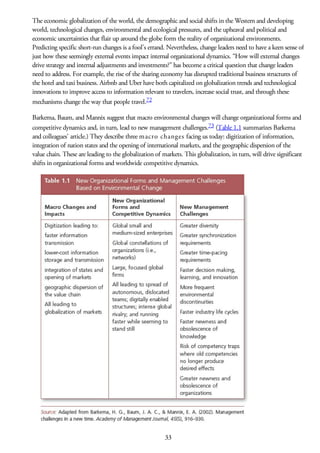
Barkema, Baum, and Mannix suggest that macro environmental changes will change organizational forms and
competitive dynamics and, in turn, lead to new management challenges.73 (Table 1.1 summarizes Barkema
and colleagues’ article.) They describe three macro changes facing us today: digitization of information,
integration of nation states and the opening of international markets, and the geographic dispersion of the
value chain. These are leading to the globalization of markets. This globalization, in turn, will drive significant
shifts in organizational forms and worldwide competitive dynamics.
33
Source: Adapted from Barkema, H. G., Baum, J. A. C., & Mannix, E. A. (2002). Management challenges in a new
time. Academy of Management Journal, 45(5), 916–930.
The early decades of the 21st century suggest accelerated change in comparison to the latter part of the 20th
century. Diversity, synchronization and time-pacing requirements, decision making, the frequency of
environmental discontinuities, quick industry life cycles and in consequence product and service obsolescence,
and competency traps all suggest greater complexity and a more rapid organizational pace for today and
tomorrow. Barkema et al. argue that much change today deals with mid-level change—change that is more
than incremental but not truly revolutionary. As such, middle managers will play increasingly significant roles
in making change effective in their organizations in both evolutionary and revolutionary scenarios.
Four Types of Organizational Change
Organizational changes come in many shapes and sizes: mergers, acquisitions, buyouts, downsizing,
restructuring, outsourcing the human resource function or computer services, departmental reorganizations,
installations of new incentive systems, shutting particular manufacturing lines or opening new branches in
other parts of the country, and the list goes on. All of these describe specific organizational changes. The
literature on organizational change classifies such changes into two types, episodic or discontinuous change and
continuous change. That is, change can be dramatic and sudden—the introduction of a new technology that
makes a business obsolete or new government regulations that immediately shift the competitive landscape. Or
change can be much more gradual, such as the alteration of core competencies of an organization through
training and adding key individuals.
Under dramatic or episodic change, organizations are seen as having significant inertia. Change is infrequent
and discontinuous. Re-engineering programs are examples of this type of change and can be viewed as planned
examples of injecting significant change into an organization. On the other hand, under continuous change,
organizations are seen as more emergent and self-organizing, where change is constant, evolving, and
cumulative.74 Japanese automobile manufacturers have led the way in this area with kaizen programs focused
on encouraging continuous change. In the technology sectors, collaborative approaches, facilitated by social
networks that extend beyond corporate boundaries and even crowd sourcing, are giving rise to continuous
change models for organizational adaptation, growth, and renewal.75
A second dimension of change is whether it occurs in a proactive, planned, and programmatic fashion or
reactively in response to external events. Programmatic or planned change occurs when managers anticipate
events and shift their organizations as a result. For example, Intel, a multinational semiconductor chip maker
headquartered in California, anticipates and appears to encourage a cycle of computer chip obsolescence.76 As a
result, the organization has been designed to handle this obsolescence. Alternately, shifts in an organization’s
external world lead to a reaction on the part of the organization. For example, the emergence of low-cost
airlines has led to traditional carriers employing reactive strategies, such as cutting routes, costs, and service
levels in an attempt to adapt.77
Nadler and Tushman combine these two dimensions in a useful model illustrating different types of change
(see Table 1.2). They define four categories of change: tuning, adapting, redirecting or reorienting, and
overhauling or re-creating.
34
Source: Adapted from Nadler, D. A., & Tushman, M. (1989, August). Organizational frame bending: Principles
for managing reorientation. Academy of Management Executive, 3(3), 196.
Tuning is defined as small, relatively minor changes made on an ongoing basis in a deliberate attempt to
improve the efficiency or effectiveness of the organization. Responsibility for acting on these sorts of changes
typically rests with middle management. Most improvement change initiatives that grow out of existing
quality-improvement programs would fall into this category. Adapting is viewed as relatively minor changes
made in response to external stimuli—a reaction to things observed in the environment such as competitors’
moves or customer shifts. Relatively minor changes to customer servicing caused by reports of customer
dissatisfaction or defection to a competitor provide an example of this sort of change, and once again,
responsibility for such changes tends to reside within the role of middle managers.
Redirecting or reorienting involves major, strategic change resulting from planned programs. These
frame-bending shifts are designed to provide new perspectives and directions in a significant way. For example,
a shift in a firm to truly develop a customer service organization and culture would fall in this category.
Finally, overhauling or re-creation is the dramatic shift that occurs in reaction to major external events.
Often there is a crisis situation that forces the change—thus, the emergence of low-cost carriers forced
traditional airlines to re-create what they do. Likewise, the credit crisis bankrupted General Motors and forced
a complete overhaul and downsizing of the company.
The impact of the change increases as we move from minor alterations and fine-tuning to changes that require
us to reorient and re-create the organization. Not surprisingly, reorienting and re-creating an organization is
35
Other documents randomly have
different content
contend that Nazareth formerly stood eastward of its present
situation, upon a more elevated spot. Dr. E. D. Clarke, however,
remarks that the situation of the modern town answers exactly to
the description of St. Luke. “Induced, by the words of the Gospel, to
examine the place more attentively than we should otherwise have
done, we went, as it is written, out of the city, ‘to the brow of the hill
whereon the city is built,’ and came to a precipice corresponding to
the words of the evangelist. It is above the Maronite church, and,
probably, the precise spot alluded to by the text.”
NAZARITES, those under the ancient law who engaged by a vow
to abstain from wine and all intoxicating liquors, to let their hair
grow, not to enter any house polluted by having a dead corpse in it,
nor to be present at any funeral. If, by accident, any one should
have died in their presence, they recommenced the whole of their
consecration and Nazariteship. This vow generally lasted eight days,
sometimes a month, and sometimes their whole lives. When the
time of their Nazariteship was expired, the priest brought the person
to the door of the temple, who there offered to the Lord a he-lamb
for a burnt-offering, a she-lamb for an expiatory sacrifice, and a ram
for a peace-offering. They offered, likewise, loaves and cakes, with
wine, for libations. After all was sacrificed and offered, the priest, or
some other, shaved the head of the Nazarite at the door of the
tabernacle, and burned his hair on the fire of the altar. Then the
priest put into the hands of the Nazarite the shoulder of the ram
roasted, with a loaf and a cake, which the Nazarite returning into the
hands of the priest, he offered them to the Lord, lifting them up in
the presence of the Nazarite. And from this time he might again
drink wine, his Nazariteship being accomplished.
Perpetual Nazarites, as Samson and John the Baptist, were
consecrated to their Nazariteship by their parents, and continued all
their lives in this state, without drinking wine or cutting their hair.
Those who made a vow of Nazariteship out of Palestine, and could
not come to the temple when their vow was expired, contented
themselves with observing the abstinence required by the law, and
cutting off their hair in the place where they were: the offerings and
sacrifices prescribed by Moses, to be offered at the temple, by
themselves or by others for them, they deferred till a convenient
opportunity. Hence it was that St. Paul, being at Corinth, and having
made the vow of a Nazarite, had his hair cut off at Cenchrea, a port
of Corinth, and deferred the rest of his vow till he came to
Jerusalem, Acts xviii, 18. When a person found he was not in a
condition to make a vow of Nazariteship, or had not leisure fully to
perform it, he contented himself by contributing to the expense of
sacrifices and offerings of those who had made and were fulfilling
this vow; and by this means he became a partaker in such
Nazariteship. When St. Paul came to Jerusalem, A. D. 58, St. James,
with other brethren, said to him, that to quiet the minds of the
converted Jews he should join himself to four persons who had a
vow of Nazariteship, and contribute to their charges and
ceremonies; by which the new converts would perceive that he did
not totally disregard the law, as they had been led to suppose, Acts
xxi, 23, 24. The institution of Nazaritism is involved in much
mystery; and no satisfactory reason has ever been given of it. This is
certain, that it had the approbation of God, and may be considered
as affording a good example of self-denial in order to be given up to
the study of the law, and the practice of exact righteousness.
NEBO, the name of an idol of the Babylonians: Bel boweth down,
Nebo stoopeth,” Isaiah xlvi, 1. The word Nebo comes from a root
that signifies to prophesy,” and therefore may stand for an oracle.
There is some probability in the opinion of Calmet, that Bel and
Nebo are but one and the same deity, and that Isaiah made use of
these names as synonymous. The god Bel was the oracle of the
Babylonians. The name Nebo, or Nabo, is found in the composition
of the names of several princes of Babylon; as Nabonassar,
Nabopolassar, Nebuchadnezzar, Nebuzar-adan, Nebushasban, &c.
NEBUCHADNEZZAR THE GREAT, son and successor of
Nabopolassar, succeeded to the kingdom of Chaldea, A. M. 3399.
Some time previously to this, Nabopolassar had associated him in
the kingdom, and sent him to recover Carchemish, which had been
conquered from him four years before by Necho, king of Egypt.
Nebuchadnezzar, having been successful, marched against the
governor of Phenicia, and Jehoiakim, king of Judah, who was
tributary to Necho, king of Egypt. He took Jehoiakim, and put him in
chains in order to carry him captive to Babylon; but afterward left
him in Judea, on condition of paying a large tribute. He took away
several persons from Jerusalem; among others Daniel, Hananiah,
Mishael, and Azariah, all of the royal family, whom the king of
Babylon caused to be carefully instructed in the language and in the
learning of the Chaldeans, that they might be employed at court,
Dan. i. Nabopolassar dying about the end of A. M. 3399,
Nebuchadnezzar, who was then either in Egypt or in Judea, hastened
to Babylon, leaving to his generals the care of bringing to Chaldea
the captives whom he had taken in Syria, Judea, Phenicia, and
Egypt; for, according to Berosus, he had subdued all those countries.
He distributed these captives into several colonies; and deposited
the sacred vessels of the temple of Jerusalem, and other rich spoils
in the temple of Belus. Jehoiakim, king of Judah, continued three
years in fealty to King Nebuchadnezzar; but being then weary of
paying tribute, he threw off the yoke. The king of Chaldea sent
troops of Chaldeans, Syrians, Moabites, and Ammonites, who
harassed Judea during three or four years, and at last Jehoiakim was
besieged and taken in Jerusalem, put to death, and his body thrown
to the birds of the air, according to the predictions of Jeremiah. See
Jehoiakim.
In the mean time, Nebuchadnezzar being at Babylon in the second
year of his reign, had a mysterious dream, in which he saw a statue
composed of several metals, a head of gold, a breast of silver, belly
and thighs of brass, legs of iron, and feet half of iron and half clay;
and a little stone rolling by its own impulse from the mountain struck
the statue and broke it. This dream gave him great uneasiness, yet it
faded away from his memory, and he could not recover more than
the general impression of it. He ordered all his diviners and
interpreters of dreams to be sent for; but none could tell him the
dream or the interpretation: and, in wrath, he sentenced them all to
death, which was about to be put in execution, when Daniel was
informed of it. He went immediately to the king, and desired him to
respite the sentence a little, and he would endeavour to satisfy his
desire. God in the night revealed to him the king’s dream, and also
the interpretation: Thou,” said Daniel, art represented by the golden
head of the statue. After thee will arise a kingdom inferior to thine,
represented by the breast of silver; and after this, another, still
inferior, denoted by the belly and thighs of brass. After these three
empires,” which are the Chaldeans, Persians, and Greeks, will arise a
fourth, denoted by the legs of iron,” the Romans. Under this last
empire God will raise a new one, of greater strength, power, and
extent, than all the others. This last is that of the Messiah,
represented by the little stone coming out from the mountain and
overthrowing the statue.” Then the king raised Daniel to great
honour, set him over all the wise men of Babylon, and give him the
government of that province. At his request he granted to Shadrach,
Meshach, and Abednego, the oversight of the works of the same
province of Babylon.
In the same year, as Dr. Hales thinks, in which he had this dream,
he erected a golden statue, whose height was sixty cubits, and
breadth six cubits, in the plains of Dura, in the province of Babylon.
Having appointed a day for the dedication of this statue, he
assembled the principal officers of his kingdom, and published by a
herald, that all should adore this image, at the sound of music, on
penalty of being cast into a burning fiery furnace. The result, as to
the three Jews, companions of Daniel, who would not bend the knee
to the image, is stated in Dan. iii. Daniel probably was absent. The
effect of the miracle was so great that Nebuchadnezzar gave glory to
the God of Shadrach, Meshach, and Abednego; and he exalted the
three Hebrews to great dignity in the province of Babylon, Dan. iv.
Jehoiachin, king of Judah, having revolted against
Nebuchadnezzar, this prince besieged him in Jerusalem, and forced
him to surrender. Nebuchadnezzar took him, with his chief officers,
captive to Babylon, with his mother, his wives, and the best
workmen of Jerusalem, to the number of ten thousand men. Among
the captives were Mordecai, the uncle of Esther, and Ezekiel the
prophet. He took, also, all the vessels of gold which Solomon made
for the temple, and the king’s treasury, and he set up Mattaniah,
Jehoiachin’s uncle by his father’s side, whom he named Zedekiah.
This prince continued faithful to Nebuchadnezzar nine years: being
then weary of subjection, he revolted, and confederated with the
neighbouring princes. The king of Babylon came into Judea, reduced
the chief places of the country, and besieged Jerusalem: but
Pharaoh-Hophra coming out of Egypt to assist Zedekiah,
Nebuchadnezzar overcame him in battle, and forced him to retire
into his own country. After this he returned to the siege of
Jerusalem, and was three hundred and ninety days before the place
before he could take it. But in the eleventh year of Zedekiah, A. M.
3416, the city was taken. Zedekiah attempted to escape, but was
taken and brought to Nebuchadnezzar, who was then at Riblah in
Syria. The king of Babylon condemned him to die, caused his
children to be put to death in his presence, and then bored out his
eyes, loaded him with chains, and sent him to Babylon.
Three years after the Jewish war Nebuchadnezzar besieged the
city of Tyre, which siege held thirteen years. But during this interval,
he made war, also, on the Sidonians, Moabites, Ammonites, and
Idumeans; and these he treated in nearly the same manner as the
Jews. Josephus says these wars happened five years after the
destruction of Jerusalem, consequently in A. M. 3421. The city of
Tyre was taken in A. M. 3432. Ithobaal, who was then king, was put
to death, and Baal succeeded him. The Lord, as a reward to the
army of Nebuchadnezzar, which had lain so long before Tyre, gave
up to them Egypt and its spoils. Nebuchadnezzar made an easy
conquest of it, because the Egyptians were divided by civil wars
among themselves: he enriched himself with booty, and returned in
triumph to Babylon, with a great number of captives. Being now at
peace, he applied himself to the adorning, aggrandizing, and
enriching of Babylon with magnificent buildings. To him some ascribe
those famous gardens, supported by arches, reckoned among the
wonders of the world; and also the walls of Babylon, though many
give the honour of this work to Semiramis.
About this time Nebuchadnezzar had a dream of a great tree,
loaded with fruit. Suddenly, an angel descending from heaven,
commanded that the tree should be cut down, but that the root
should be preserved in the earth, Dan. iv. The king sent for all the
diviners in the country, but none could explain his dream, till Daniel,
by divine revelation, showed that it represented his present
greatness, his signal approaching humiliation, and his restoration to
reason and dignity. A year after, as Nebuchadnezzar was walking on
his palace at Babylon, he began to say, Is not this great Babylon,
which I have built for the house of the kingdom, by the might of my
power, and for the honour of my majesty?” and scarcely had he
pronounced these words, when he fell into a distemper or
distraction, which so altered his imagination that he fled into the
fields and assumed the manners of an ox. After having been seven
years in this state, God opened his eyes, his understanding was
restored to him, and he recovered his royal dignity.
Nebuchadnezzar died, A. M. 3442, after having reigned forty-three
years. Megasthenes, quoted by Eusebius, says, that this prince
having ascended to the top of his palace, was there seized with a fit
of divine enthusiasm, and cried out, O Babylonians, I declare to you
a misfortune, that neither our father Belus, nor Queen Baltis has
been able to prevent. A Persian mule shall one day come into this
country, who, supported by the power of your gods, shall bring you
into slavery. He shall be assisted by the Mede, the glory of the
Assyrians.” This Persian mule is Cyrus, whose mother was a Mede,
and whose father was a Persian. The Mede who assisted Cyrus was
Cyaxares, or Darius the Mede. This story at least shows that the
Heathens had traditions of an extraordinary kind respecting this
monarch, and that the fate of Babylon had been the subject of
prophecy.
NEBUZAR-ADAN, a general of Nebuchadnezzar’s army, and the
chief officer of his household. He managed the siege of Jerusalem,
and made himself master of the city, while his sovereign was at
Riblah in Syria, 2 Kings xxv; Jer. xxxix; xl; lii.
NECESSITARIANS. The doctrine of necessity regards the origin of
human actions, and the specific mode of the divine government; and
it seems to be the immediate result of the materiality of man; for
mechanism is the undoubted consequence of materialism. Hence all
materialists are of course necessitarians; but it does not follow that
all necessitarians are or must be materialists. Whatever is done by a
cause or power that is irresistible, is by necessity; in which sense
this term is opposed to freedom. Man is, therefore, a necessary
agent, if all his actions be so determined by the causes preceding
each action, that not one past action could possibly not have come
to pass, or have been otherwise than it hath been; and not one
future action can possibly not come to pass, or be otherwise than it
shall be. But man is a free agent, if he be able at any time, in the
circumstances in which he is placed, to do different things; or, in
other words, if he be not unavoidably determined in every point of
time by the circumstances he is in, and the causes he is under, to do
that one thing he does, and not possibly to do any other thing. This
abstruse subject has occasioned much controversy, and has been
debated by writers of the first eminence, from Hobbes and Clarke, to
Priestley and Gregory. The anti-necessitarians allege, that the
doctrine of necessity charges God as the author of sin; that it takes
away the freedom of the will; renders man unaccountable to his
Maker; makes sin to be no evil, and morality or virtue to be no good;
and that it precludes the use of means, and is of the most gloomy
tendency. The necessitarians, on the other hand, deny these to be
legitimate consequences of their doctrine, which they declare to be
the most consistent mode of explaining the divine government; and
they observe, that the Deity acts no more immorally in decreeing
vicious actions, than in permitting all those irregularities which he
could so easily have prevented. All necessity, say they, doth not take
away freedom. The actions of a man may be at one and the same
time both free and necessary. Thus, it was infallibly certain that
Judas would betray Christ, yet he did it voluntarily; Jesus Christ
necessarily became man, and died, yet he acted freely. A good man
doth naturally and necessarily love his children, yet voluntarily. They
insist that necessity doth not render actions less morally good; for, if
necessary virtue be neither moral nor praiseworthy, it will follow that
God himself is not a moral being, because he is a necessary one;
and the obedience of Christ cannot be good, because it was
necessary. Farther, say they, necessity does not preclude the use of
means; for means are no less appointed than the end. It was
ordained that Christ should be delivered up to death; but he could
not have been betrayed without a betrayer, nor crucified without
crucifiers. That it is not a gloomy doctrine they allege, because
nothing can be more consolatory than to believe, that all things are
under the direction of an all-wise Being, that his kingdom ruleth over
all, and that he doeth all things well. They also urge, that to deny
necessity, is to deny the foreknowledge of God, and to wrest the
sceptre from the hand of the Creator, and to place that capricious
and undefinable principle, the self-determining power of man, upon
the throne of the universe. In these statements there is obviously a
confused use of terms in different meanings, so as to mislead the
unwary. For instance: necessity is confounded with certainty; but an
action may be certain, though free; that is to say, certain to an
omniscient Being, who knows how a free agent will finally resolve;
but this certainty is, in fact, a quality of the prescient Being, not that
of the action, to which, however, men delusively transfer it. Again:
God is called a necessary Being, which, if it mean any thing,
signifies, as to his moral acts, that he can only act right. But then
this is a wrong application of the term necessity, which properly
implies such a constraint upon actions, exercised ab extra, as
renders choice or will impossible. But such necessity cannot exist as
to the supreme Being. Again: the obedience of Christ unto death
was necessary, that is to say, unless he had died guilty man could
not have been forgiven; but this could not make the act of the Jews
who put him to death a necessary act, that is to say, a forced and
constrained one; nor did this necessity affect the act of Christ
himself, who acted voluntarily, and might have left man without
salvation. That the Jews acted freely, is evident from their being
held liable to punishment, although unconsciously they accomplished
the great designs of Heaven, which, however, was no excuse for
their crime. Finally: as to the allegation, that the doctrine of free
agency puts man’s self-determining power upon the throne of the
universe, that view proceeds upon notions unworthy of God, as
though he could not accomplish his plans without compelling and
controlling all things by a fixed fate; whereas it is both more glorious
to him, and certainly more in accordance with the Scriptures, to say
that he has a perfect foresight of the manner in which all creatures
will act, and that he, by a profound and infinite wisdom,
subordinates every thing without violence to the evolution and
accomplishment of his own glorious purposes.
The doctrine of necessity is nearly connected with that of
predestination, which, of late years, has assumed a form very
different from that which it formerly possessed; for, instead of being
considered as a point to be determined almost entirely by the sacred
writings, it has, in the hands of a number of able writers, in a great
measure resolved itself into a question of natural religion, under the
head of the philosophical liberty or necessity of the will; or, whether
all human actions are, or are not, necessarily determined by motives
arising from the character which God has impressed on our minds,
and the train of circumstances amidst which his providence has
placed us? The Calvinistic doctrine of predestination is, that God for
his own glory, hath foreordained whatsoever comes to pass.” The
scheme of philosophical necessity, as stated by the most celebrated
necessitarian of the age, is, that every thing is predetermined by the
divine Being; that whatever has been, must have been; and that
whatever will be, must be; that all events are preordained by infinite
wisdom and unlimited goodness; that the will, in all its
determinations, is governed by the state of mind; that the state of
mind is, in every instance, determined by the Deity; and that there is
a continued chain of causes and effects, of motives and actions,
inseparably connected, and originating from the condition in which
we are brought into existence by the Author of our being.” On the
other hand, it is justly remarked, that “those who believe the being
and perfections of God, and a state of retribution, in which he will
reward and punish mankind according to the diversity of their
actions, will find it difficult to reconcile the justice of punishment
with the necessity of crimes punished. And they that believe all that
the Scripture says on the one hand, of the eternity of future
punishments, and on the other, of God’s compassion to sinners, and
his solemn assurance that he desires not their death, will find the
difficulty greatly increased.” It is doubtless an article of the Christian
faith, that God will reward or punish every man hereafter according
to his actions in this life. But we cannot maintain his justice in this
particular, if men’s actions be necessary either in their own nature,
or by the divine decrees. Activity and self-determining powers are
the foundation of all morality; and to prove that such powers belong
to man, it is urged that we ourselves are conscious of possessing
them. We blame and condemn ourselves when we do amiss; but
guilt, and inward sense of shame, and remorse of conscience, are
feelings which are inconsistent with the scheme of necessity. It is
also agreed that some actions deserve praise, and afford an inward
satisfaction; but for this, there would be no foundation, if we were
invincibly determined in every volition: so that approbation and
blame are consequent on free actions only. Nor is the matter at all
relieved by bringing in a chain of circumstances as motives
necessarily to determine the will. This comes to the same result in
sound argument, as though there was an immediate coäction of
omnipotent power compelling one kind of volitions only; which is
utterly irreconcilable to all just notions of the nature and operations
of will, and to all accountability. Necessity, in the sense of irresistible
control, and the doctrine of Scripture, cannot coëxist.
NECROMANCY, νεκρομαντεία, is the art of raising up the ghosts of
deceased persons, to get information from them concerning future
events. This practice, no doubt, the Israelites brought with them
from Egypt, which affected to be the mother of such occult sciences;
and from thence it spread into the neighbouring countries, and soon
infected all the east. The injunction of the law is very express
against this vice; and the punishment to be inflicted on the
practisers of it was stoning to death, Lev. xx, 27. What forms of
enchantment were used in the practice of necromancy we are at a
loss to know, because we read of none that the pythoness of Endor
employed; however, that there were several rites, spells, and
invocations used upon these occasions, we may learn from almost
every ancient author, but from none more particularly than from
Lucan in his Pharsalia. Whether the art of conversing with the dead
was mere imposture, or grounded upon diabolical agency, is a
question which has been disputed in all ages.
NEHEMIAH professes himself the author of the book which bears
his name, in the very beginning of it, and he uniformly writes in the
first person. He was of the tribe of Judah, and was probably born at
Babylon during the captivity. He was so distinguished for his family
and attainments, as to be selected for the office of cup bearer to the
king of Persia, a situation of great honour and emolument. He was
made governor of Judea, upon his own application, by Artaxerxes
Longimanus; and his book, which in the Hebrew canon was joined to
that of Ezra, gives an account of his appointment and administration
through a space of about thirty-six years to A. M. 3595, at which
time the Scripture history closes; and, consequently, the historical
books, from Joshua to Nehemiah inclusive, contain the history of the
Jewish people from the death of Moses, A. M. 2553, to the
reformation established by Nehemiah, after the return from captivity,
being a period of one thousand and forty-two years.
NEOLOGY. This term, which signifies new doctrine, has been used
to designate a species of theology and Biblical criticism which has of
late years much prevailed among the Protestant divines of Germany,
and the professors of their universities. It is now, however, more
frequently termed rationalism, and is supposed to occupy a sort of
middle place between the orthodox system and pure deism. The
German divines themselves speak of naturalism, rationalism, and
supernaturalism. The term naturalism arose first in the sixteenth
century, and was spread in the seventeenth. It was understood to be
the system of those who allowed no other knowledge of religion
than the natural, which man could shape out by his own strength,
and, consequently, excluded all supernatural revelation. As to the
different forms of naturalism, theologians say there are three: the
first, which they call Pelagianism, and which considers human
dispositions and notions as perfectly pure, and the religious
knowledge derived from them as sufficiently explicit. A grosser kind
denies all particular revelation; and the grossest of all considers the
world as God. Rationalism has been thus explained: Those who are
generally termed rationalists,” says Dr. Bretschneider, admit
universally in Christianity, a divine, benevolent, and positive
appointment for the good of mankind, and Jesus as a messenger of
Divine Providence, believing that the true and everlasting word of
God is contained in the Holy Scripture, and that by the same the
welfare of mankind will be obtained and extended. But they deny
therein a supernatural and miraculous working of God, and consider
the object of Christianity to be that of introducing into the world
such a religion as reason can comprehend; and they distinguish the
essential from the unessential, and what is local and temporary from
that which is universal and permanent in Christianity.” There is,
however, a third class of divines who in fact differ very little from
this, though very widely in profession. They affect to allow a
revealing operation of God, but establish on internal proofs rather
than on miracles the divine nature of Christianity. They allow that
revelation may contain much out of the power of reason to explain,
but say that it should assert nothing contrary to reason, but rather
what may be proved by it. Supernaturalism consists in general in the
conviction that God has revealed himself supernaturally and
immediately. The notion of a miracle cannot well be separated from
such a revelation, whether it happens out of, on, or in men. What is
revealed may belong to the order of nature, but an order higher and
unknown to us, which we could never have known without miracles,
and cannot bring under the laws of nature.
The difference between the naturalists and the rationalists, as Mr.
Rose justly remarks, is not quite so wide either as it would appear to
be at first sight, or as one of them assuredly wishes it to appear. For
if I receive a system, be it of religion, of morals, or of politics, only
so far as it approves itself to my reason, whatever be the authority
that presents it to me, it is idle to say that I receive the system out
of any respect to that authority. I receive it only because my reason
approves it; and I should, of course, do so if an authority of far
inferior value were to present the system to me. This is what that
division of rationalists, which professes to receive Christianity, and at
the same time to make reason the supreme arbiter in matters of
faith, has done. Their system, in a word, is this: They assume
certain general principles, which they maintain to be the necessary
deductions of reason from an extended and unprejudiced
contemplation of the natural and moral order of things, and to be in
themselves immutable and universal. Consequently, any thing which,
on however good authority, may be advanced in apparent opposition
to them must either be rejected as unworthy of rational belief, or, at
least, explained away till it is made to accord with the assumed
principles; and the truth or falsehood of all doctrines proposed is to
be decided according to their agreement or disagreement with those
principles.
It is easy, then, to anticipate how, with such principles, the Biblical
critics of Germany, distinguished as many of them have been for
learning, would proceed to interpret the Scriptures. Many of the
sacred books and parts of others have, of course, been rejected by
them as spurious, the strongest external evidence being thought by
them insufficient to prove the truth of what was determined to be
contradictory to their reason; and the inspiration of the rest was
understood in no higher a sense, to use the language of one of their
professors, than the expressions of Cicero as to the inspiration of the
poets, or those of Quintilian respecting Plato. It would be disgusting,
says Rose, to go through all the strange fancies which were set
afloat, and which tended only to set Scripture on the same footing
as an ingenious but improbable romance. They all proceeded from
the determination that whatever was not intelligible was incredible,
that only what was of familiar and easy explanation deserved belief,
and that all which was miraculous and mysterious in Scripture must
be rejected; and they rested perpetually on notions and reasonings
which were in themselves miracles of incredibility. But there were
many of the German divines of this rationalist period who went
much farther, and who imputed a deception to our Lord and his
disciples, not for evil but for good purposes. In reading or in hearing
of these wretched productions, the mind is divided between disgust
at folly, and indignation at wickedness. What can be said for the
heart which could suppose that the founders of Christianity could
have taught the sublime and holy doctrines of the Gospel with a lie
in their hearts and on their lips? or for the intellect which could
believe that ambitious and designing men would encounter years of
poverty, and shame, and danger, with no prospect but that of an
ignominious death? But where the supernatural and miraculous
accounts were not rejected, they were, by many of the most
eminent of these writers, explained away by a monstrous ingenuity,
which, on any other subject, and applied to any ancient classic or
other writer, would provoke the most contemptuous ridicule. When
Korah, Dathan, and Abiram were swallowed up, Moses had
previously secretly undermined the earth.” Jacob wrestled with the
angel in a dream;” and a rheumatic pain in his thigh during sleep
suggested the incident in his dream of the angel touching the sinew
of his thigh. Professor Paulus gravely explains the miracle of the
tribute money thus: That Christ only meant to give a moral lesson,
that is, that we are not, if we can avoid it by trifling sacrifices, to
give offence to our brethren; that he probably reasoned thus with
St. Peter: Though there is no real occasion for us to pay the tribute,
yet, as we may be reckoned as enemies of the temple, and not
attended to when we wish to teach what is good, why should not
you who are a fisherman,” a remark which might very properly be
made at a place where St. Peter had been engaged in a fishery for
two years, “and can easily do it, go and get enough to pay the
demand? Go, then, to the sea, cast your hook, and take up ϖρῶτον
ἴχθυν, the first and best fish.” St. Peter was not to stay longer at his
work this time than to gain the required money: ϖρῶτος often refers
not to number but to time; and ἴχθυν may undoubtedly be taken as
a collective. St. Peter must either have caught so many fish as would
be reckoned worth a stater at Capernaum, (so near to a sea rich in
fish,) or one so large and fine as would have been valued at that
sum. As it was uncertain whether one or more would be necessary,
the expression is indefinite, τὸν ἀναϐάντα ϖρῶτον ἴχθυν; [the fish
first coming up;] but it would not be ambiguous to St. Peter, as the
necessity and the event would give it a fixed meaning. Ἀνοίξας τὸ
ϛόμα. [Opening the mouth.] This opening of the mouth might have
different objects, which must be fixed by the context. If the
fisherman opens the mouth of a fish caught with a hook, he does it
first to release him from the hook; for if he hangs long he is less
saleable: he soon decays. The circumstantiality in the account is
picturesque. Take the hook out his mouth!” Ἑυρήσεις ἑυρίσκειν is
used in Greek in a more extended sense than the German finden, as
in Xenophon, where it is to get by selling.” When such a word is
used of saleable articles, like fish, and in a connection which requires
the getting a piece of money, it is clear that getting by sale and not
by finding is referred to. “And this from a professor’s chair!” In like
manner the miracle of feeding the five thousand in the desert is
resolved into the opportune passing by of a caravan with provisions,
of which the hungry multitude were allowed to partake, according to
eastern hospitality; and the Apostles were merely employed in
conveying it out in baskets. Christ’s walking upon the sea is
explained by his walking upon the sea shore, and St. Peter’s walking
on the sea is resolved into swimming. The miracles of healing were
the effect of fancy operating favourably upon the disorders; and
Ananias and Sapphira died of a fright; with many other absurdities,
half dreams and half blasphemies; and of which the above are given
but as a specimen.
The first step in this sorrowful gradation down to a depth of
falsehood and blasphemy, into which certainly no body of Christian
ministers, so large, so learned, and influential, in any age or period
of the church ever before fell, was, contempt for the authority of the
divines of the Reformation, and of the subsequent age. They were
about to set out on a voyage of discovery; and it was necessary to
assume that truth still inhabited some terra incognita, [unknown
region,] to which neither Luther, Melancthon, nor their early
disciples, had ever found access. One of this school is pleased,
indeed, to denominate the whole even of the seventeenth and the
first half of the eighteenth century, the age of theological barbarism;
an age, notwithstanding, which produced in the Lutheran church
alone Calovius, Schmidt, Hackspan, Walther, Glass, and the
Carpzoffs, and others, as many and as great writers as any church
can boast in an equal space of time; writers whose works are, or
ought to be, in the hands of the theological student. The general
statements of the innovators amount to this, that the divines of the
age of which we speak had neither the inclination nor the power to
do any thing but fortify their own systems, which were dogmatical,
and not to search out truth for themselves from Scripture; that
theology, as a science, was left from the epoch of the Reformation
as it had been received from the schoolmen; that the interpretation
of the Bible was made the slave, not the mistress, of dogmatical
theology, as it ought to be.
The vain conceit that the doctrines of religion were capable of
philosophic demonstration, which obtained among the followers of
Wolf, is considered by Mr. Rose as having hastened onward the
progress of error. We find some of them not content with applying
demonstration to the truth of the system, but endeavouring to
establish each separate dogma, the Trinity, the nature of the
Redeemer, the incarnation, the eternity of punishment, on
philosophical and, strange as it may appear, some of these truths on
mathematical, grounds. We have had instances of this in our own
country; and the reason why they have done little injury is, that
none of those who thus presumed, whether learned or half learned,
had success enough to form a school. So far as such a theory does
obtain influence, it must necessarily be mischievous. The first
authors may hold the mysteries of Christianity sacred; they may
fancy that they can render faith in them more easy by affecting
demonstrative evidence, which, indeed, were the subjects capable of
it, would render faith unnecessary; but they are equally guilty of a
vain presumption in their own powers, and of a want of real
reverence to God, and to his revelation. With them, this boast of
demonstration generally ends in the rejection of some truth, or the
adoption of some positive error; while their followers fail not to
bound over the limits at which they have stopped. The fallacy of the
whole lies in assuming that divine things are on the same level with
those which the human mind can grasp, and may therefore be
compared with them. One of these consequences must therefore
follow: either that the mind is exalted above its own sphere, or that
divine things are brought down below theirs. In the former case, a
dogmatical pride is the result; in the latter, the scheme of revelation
is stripped of its divinity, and sinks gradually into a system of human
philosophy, with the empty name of a revelation still appended to it
to save appearances. What can bear the test of the philosophical
standard is retained, and what cannot be thus proved is, by degrees,
rejected; so that the Scripture is no longer the ground of religious
truth; but a sort of witness to be compelled to assent to any
conclusions at which this philosophy may arrive.
The effect in Germany was speedily developed, though Wolf, the
founder of this school, and most of his followers, were pious and
faithful Christians. By carrying demonstrative evidence beyond its
own province, they had nurtured in their followers a vain confidence
in human reason; and the next and still more fatal step was, that it
was the province of human reason in an enlightened and intellectual
age to perfect Christianity, which, it was contended, had hitherto
existed in a low and degraded state, and to perfect that system of
which the elements only were contained in the Scripture. All restraint
was broken by this principle. Philosophy, good and bad, was left to
build up these elements” according to its own views; and as, after
all, many of these elements were found to be too untractable and
too rudely shaped to accord with the plans of these manifold
constructions, formed according to every pattern,” except that in the
mount;” when the stone could not be squared and framed by any art
which these builders possessed, it was rejected,” even to the head
stone of the corner.” Semler appears to have been the author of that
famous theory of accommodation, which, in the hands of his
followers, says Mr. Rose, became the most formidable weapon ever
devised for the destruction of Christianity.” As far as Germany is
concerned, this language is not too strong; and we may add, that it
was the most impudent theory ever advocated by men professing
still to be Christians, and one, the avowal of which can scarcely be
accounted for, except on the ground, that as, because of their
interests, it was not convenient for these teachers of theology and
ministers of the German churches to disavow Christianity altogether;
it was devised and maintained, in order to connect the profits of the
Christian profession with substantial and almost undisguised deism.
This theory was, that we are not to take all the declarations of
Scripture as addressed to us; but to consider them as, in many
points, purposely adapted to the feelings and dispositions of the age
when they originated; but by no means to be received by another
and more enlightened period; that, in fact, Jesus himself and his
Apostles had accommodated themselves in their doctrines to the
barbarism, ignorance, and prejudices of the Jews; and that it was
therefore our duty to reject the whole of this temporary part of
Christianity, and retain only what is substantial and eternal. In plain
words they assumed, as the very basis of their Scriptural
interpretations, the blasphemous principle, that our Lord and his
Apostles taught, or, at least, connived at doctrines absolutely false,
rather than they would consent to shock the prejudices of their
hearers! This principle is shown at length by Mr. Rose, to run
through the whole maze of error into which this body of Protestant
divines themselves wandered, and led their flocks. Thus the chairs of
theology and the very pulpits were turned into the seats of the
scornful;” and where doctrines were at all preached, they were too
frequently of this daring and infidel character. It became even, at
least, a negative good, that the sermons delivered were often
discourses on the best modes of cultivating corn and wine, and the
preachers employed the Sabbath and the church in instructing their
flocks how to choose the best kinds of potatoes, or to enforce upon
them the benefits of vaccination. Undisguised infidelity has in no
country treated the grand evidences of the truth of Christianity with
greater contumely, or been more offensive in its attacks upon the
prophets, or more ridiculous in its attempts to account, on natural
principles, for the miracles. Extremes of every kind were produced,
philosophic mysticism, pantheism, and atheism.
We have hitherto referred chiefly to Mr. Rose’s work on this awful
declension in the Lutheran and other continental churches. In a work
on the same subject by Mr. Pusey, the stages of the apostasy are
more carefully marked, and more copiously and deeply investigated.
Our limits will, however, but allow us to advert to two or three
points. In Mr. Pusey’s account of the state of German theology in the
seventeenth century, he opens to us the sources of the evil. Francke,
he observes, assigns as a reason for attaching the more value to the
opportunities provided at Halle for the study of Scripture, that “in
former times, and in those which are scarcely past, one generally
found at universities opportunities for every thing rather than a solid
study of God’s word.” In all my university years,” says Knapp, I was
not happy enough to hear a lecture upon the whole of Scripture; we
should have regarded it as a great blessing which came down from
heaven.” It is said to be one only of many instances, that at Leipzig,
Carpzoff, having in his lectures for one half year completed the first
chapter of Isaiah, did not again lecture on the Bible for twenty years,
while Olearius suspended his for ten. Yet Olearius, as well as Alberti,
Spener says, were diligent theologians, but that most pains were
employed on doctrinal theology and controversy.” It is, moreover, a
painful speaking fact, which is mentioned by Francke, (1709,) that in
Leipzig, the great mart of literature as well as of trade, “twenty years
ago, in no bookseller’s shop was either Bible or Testament to be
found.” Of the passages in Francke, which prove the same state of
things, I will select one or two only: Youth are sent to the
universities with a moderate knowledge of Latin; but of Greek, and
especially of Hebrew next to none. And it would even then have
been well, if what had been neglected before had been made up in
the universities. There, however, most are borne, as by a torrent,
with the multitude; they flock to logical, metaphysical, ethical,
polemical, physical, pneumatical lectures, and what not; treating
least of all those things whose benefit is most permanent in their
future office, especially deferring, and at last neglecting, the study of
the sacred languages.” “To this is added, that, they comfort
themselves, that in examinations for orders these things are not
generally much attended to. Hence most who are anxious about a
maintenance, hurry to those things which may hasten their
promotion, attend above all things a lecture on the art of preaching,
and if they can remain so long at the university, one on doctrinal
theology, (would that all were anxious about a salutary knowledge of
the sacred doctrines,) and having committed these things to paper
and memory, return home, as if excellently armed against Satan, are
examined, preach, are promoted, provide for their families.” And
having spoken farther on the superficial knowledge, pedantry, and
other faults of those few who acquired knowledge of these subjects,
he sums up: As the vernacular Scriptures are ordinarily neglected or
ill employed by the illiterate, so are the original by the lettered:
whence there cannot but arise either ignorance in matters of faith,
or an unfruitful and vain knowledge; a pleasurable fancy is
substituted for the substance of the faith; impiety daily increases. In
a word, from the neglect of Scripture all impiety is derived; and so
again from the impiety or unbelief of men, there is derived a
contempt of Scripture, or at all events an abuse, and an absurd and
perverted employment of it: and hence follows either a neglect of
the original languages, or a senseless method, or an unfitting
employment of them; which evils, since they are continued from the
teachers to the disciples, the corrupted state of the schools and
universities continually increases: and these we cannot remedy,
unless we can prevail upon ourselves to make the word of God our
first object, to look for Christ in it, and to embrace him, when found,
with genuine faith, and perseveringly to follow him.” Pfaff thus
describes the previous state of doctrinal theology: All the compendia
of holy doctrines, which have hitherto appeared, are of such a
character, that, though their excellence has been hitherto extolled by
the common praise of our countrymen, and they still enjoy
considerable reputation, (suâ utique luce niteat,) they can even on
this ground not be satisfactory to our age,--that since one system
was extracted and worked out of the other, with a very few
variations, they dwell uniformly on the same string; and that
metaphysical clang of causes, which sounds somewhat harshly and
unpleasantly to well cultivated ears, constantly reverberates in them,
the same terms uniformly recurring in all. To this is added, that a
certain coldness appears to prevail in the common mode of treating
these subjects, especially in the practical topics of theology; these
being set forth as theoretical propositions, so that scarcely any life or
any religious influence finds its way into the minds of readers; and
the edification of mind, (though it should be the principal object in
sacred theology,) derived from them is very slight. Nor does it
appear less a subject of blame, that various theological τόποι, and
those the very chief, are here altogether omitted; that every thing is
choked with the thorns of scholasticism; and that divine truths are
often made secondary to the zeal for authority: nor is there
sufficient reference to the language of the symbolical books, to the
promotion of the peace of the church, to the exhibition of what is of
real importance in controverted points, and of the unreality of the
mere logomachies, with which all theology abounds; nor again, to
destroy theological pedantry and a sectarian spirit, or to treat the
subjects themselves in a style becoming to them: but most of all,
sufficient pains are not bestowed upon that which is of chief
importance, the building up the kingdom of God in the hearts of
men, and the influencing their hearts more thoroughly with vivid
conceptions of true Christianity.”
Yet these were but effects of a still higher cause,--the rapid decay
of piety in this century, of which the statements of Mr. Pusey, and
the authorities he quotes, present a melancholy picture. Speaking of
J. V. Andrea, he says, the want of practical religious instruction in the
early schools, the perverted state of all education, the extravagance
and dissoluteness of the universities, the total unfitness of the
teachers whom they sent forth and authorized, the degraded state
of general as well as of theological science, the interested motives
for entering into holy orders, the canvassing for benefices, the
simony in obtaining them, the especial neglect of the poorer, the bad
lives, the carelessness and bitter controversies of the preachers, and
the general corruption of manners in all ranks, are again and again
the subjects of his deep regrets or of his censure. “After the
evangelic church,” he says, in an energetic comparison of the evils
which reigned in the beginning of this period with those which had
occasioned the yoke of Rome to be broken, “after the evangelic
church had thrown off the yoke of human inventions, they should
have bowed their neck under the easy yoke of the Lord. But now
one set of human inventions are but exchanged for another, equally,
or indeed very little, human; and these are called the word of God,
though in reality things are nothing milder than before. Idols were
cast out, but the idols of sins are worshipped. The primacy of the
pope is denied, but we constitute lesser popes. The bishops are
abrogated, but ministers are still introduced or cast out at will;
simony came into ill repute, but who now rejects a hand laden with
gold? the monks were reproached for indolence,--as if there were
too much study at our universities; the monasteries were dissolved,-
-to stand empty, or to be stalls for cattle; the regularly recurring
prayers are abolished, yet so that now most pray not at all; the
public fasts were laid aside, now the command of Christ is held to be
but useless words; not to say any thing of blasphemers, adulterers,
extortioners,” &c. After many testimonies of a similar and even
stronger kind from other pious divines, who lifted up their voice
strongly but almost ineffectually against the growing corruption of
the universities, the clergy, and the people, Mr. Pusey adds the
following passages from Francke: “The works of the flesh are done
openly and unrestrainedly, with so little shame, that one who does
not approve of many things not consistent with the truth which is in
Jesus, would almost be enrolled among heretics. Ambition, pride,
love of pleasure, luxury, impurity, wantonness, and all the crop of
foulest wickednesses which spring from these; injustice also, avarice,
and a species of rivalry among all vices every where sensibly
increases, atheism joining itself with epicurism and libertinism. Thus
while Christ is held to, while orthodoxy is presented as a shield, all
imitation of Christ, all anxiety for true and spiritual holiness, “without
which no one shall see the Lord,” nay, all the decorum befitting a
Christian, is banished, is exterminated, that it may not disturb the
societies of perverse men.” Into the state of the clergy he enters
more fully in another work. I remember,” he says, “that a theologian
of no common learning, piety, and practical knowledge, νῦν ἐν
ἁγίοις, told me, that a certain monarch, at his suggestion, applied to
a university, where there was a large concourse of students of
theology, for two candidates for holy orders, who, by the excellence
and purity of their doctrine, and by holiness of life, might serve as
an example to the congregation committed to their charge; the
professors candidly answered that there was no such student of
theology among them. Nor is this surprising. I remember that
Kortholt used to say with pain, that in the disgraceful strifes,
disturbances, and tumults in the universities, which were, alas, but
too frequent, it scarcely ever happened that theological students
were not found to be accomplices, nay, the chiefs. I remember that
another theologian often lamented, that there was such a dearth in
the church of such persons as the Apostle would alone think worthy
of the ministerial functions, that it was to be regarded as a
happiness if, of many applicants, some one of outwardly decent life
could at length be found.”
With several happy exceptions, and the raising up of a few pious
people in some places, and a partial revival of evangelical doctrines,
which, however, often ran at length into mysticism and
antinomianism, the evil, both doctrinally and morally, continued to
increase to our own day; for if any ask what has been the moral
effect of the appalling apostasy of the teachers of religion, above
described, upon the people of Germany, the answer may be given
from one of these rationalizing divines themselves, whose statement
is not therefore likely to be too highly coloured. It is from a
pamphlet of Bretschneider, published in 1822, and the substance is,
Indifference to religion among all classes; that formerly the Bible
used to be in every house, but now the people either do not possess
it, or, as formerly, read it; that few attend the churches, which are
now too large, though fifty years ago they were too small; that few
honour the Sabbath; that there are now few students of theology,
compared with those in law and medicine; that if things go on so,
there will shortly not be persons to supply the various ecclesiastical
offices; that preaching had fallen into contempt; and that distrust
and suspicion of the doctrines of Christianity prevailed among all
classes.” Melancholy as this picture is, nothing in it can surprise any
one, except that the very persons who have created the evil should
themselves be astonished at its existence, or even affect to be so.
But the mercy of God has begun to answer the prayers of the few
faithful who are left as the gleanings of grapes after the vintage; and
to revive, in some active, learned, and influential men, the spirit of
primitive faith and zeal. The effect of the exertions of these excellent
men, both from the professor’s chair, the pulpit, and the press, has
been considerable; and it is remarked by Mr. Rose, that no small
degree of disgust at the past follies of the rationalists prevails; that
the cold and comfortless nature of their system has been perceived;
that a party of truly Christian views has arisen; and that there is a
disposition alike in the people, the better part of the divines, and the
philosophers, to return to that revealed religion which alone can give
them comfort and peace. It is equally clear that some at least of the
governments perceive the dangerous tendency of the rationalist
opinions, and that they are sincerely desirous of promoting a better
state of religious feeling.
We close this article with the excellent remarks of Dr. Tittman of
Dresden, on the neological interpreters: What is the interpretation of
the Scriptures, if it relies not on words, but things, not on the
assistance of languages, but on the decrees of reason that is, of
modern philosophy? What is all religion, what the knowledge of
divine things, what are faith and hope placed in Christ, what is all
Christianity, if human reason and philosophy is the only fountain of
divine wisdom, and the supreme judge in the matter of religion?
What is the doctrine of Christ and the Apostles more than some
philosophical system? But what, then, I pray you, is, to deny, to
blaspheme Jesus the Lord, to render his divine mission doubtful, nay
vain and useless, to impugn his doctrine, to disfigure it shamefully,
to attack it, to expose it to ridicule, and, if possible, to suppress it, to
remove all Christianity out of religion, and to bound religion within
the narrow limits of reason alone, to deride miracles, and hold them
up to derision, to accuse them as vain, to bring them into disrepute,
to torture sacred Scripture into seeming agreement with the fancies
of human wisdom, to alloy it with human conjectures, to bring it into
contempt, and to break down its divine authority, to undermine, to
shake, to overthrow utterly the foundations of Christian faith? What
else can be the event than this, as all history, a most weighty
witness in this matter, informs us, namely, that when sacred
Scripture, its grammatical interpretation and a sound knowledge of
languages are, as it were, despised and banished, all religion should
be contemned, shaken, corrupted, troubled, undermined, utterly
overturned, and should be entirely removed and reduced to natural
religion; or that it should end in a mystical theology, than which
nothing was ever more pernicious to the Christian doctrine, and be
converted into an empty μυθολογία, or even into a poetical system,
hiding every thing in figures and fictions, to which latter system not
a few of the sacred orators and theologians of our time seem chiefly
inclined.”
NEOMENIA, νεομηνία, new moon, Col. ii, 16, a Greek word,
signifying the first day of the moon or month. The Hebrews had a
particular veneration for the first day of every month; and Moses
appointed peculiar sacrifices for the day, Num. xxviii, 11, 12; but he
gave no orders that it should be kept as a holy day, nor can it be
proved that the ancients observed it so: it was a festival of merely
voluntary devotion. It appears that even from the time of Saul they
made, on this day, a sort of family entertainment, since David ought
then to have been at the king’s table; and Saul took his absence
amiss, 1 Sam. xx, 5, 18. Moses insinuates that, beside the national
sacrifices then regularly offered, every private person had his
particular sacrifices of devotion, Num. x, 10. The beginning of the
month was proclaimed by sound of trumpet, at the offering of the
solemn sacrifices. But the most celebrated neomenia was that at the
beginning of the civil year, or first day of the month Tizri, Lev. xxiii,
24. This was a sacred day, on which no servile labour was
performed; on this they offered public or national burnt-sacrifices,
and sounded the trumpets in the temple. In the kingdom of the ten
tribes, the serious among the people used to assemble at the houses
of the prophets, to hear their instructions. The Shunamite, who
entertained Elisha, proposing to visit that prophet, her husband said
to her, Why do you go to-day, since it is neither Sabbath nor new
moon?” 2 Kings iv, 23. Isaiah declares that the Lord abhors the new
moons, the Sabbaths, and other days of festival and assembly of
those Jews who in other things neglected his laws, Isaiah i, 13, 14.
Ezekiel says that the burnt-offerings offered on the day of the new
moon were provided at the king’s expense, and that on this day was
to be opened the eastern gate of the court of the priests, Ezek. xiv,
17; xlvi, 1, 2; 1 Chron. xxiii, 31; 2 Chron. viii, 13. Judith kept no fast
on festival days, or on the new moon, Judith viii, 6. The modern
Jews keep the neomenia only as a feast of devotion, to be observed
or not at pleasure. They think it rather belongs to the women than
to the men. The women forbear work, and indulge a little more on
this day than on others. In the prayers of the synagogue, they read
from Psalm cxiii, to cxviii. They bring forth the roll of the law, and
read therein to four persons. They call to remembrance the sacrifice
that on this day used to be offered in the temple. On the evening of
the Sabbath which follows the new moon, or some other evening
following, when the new moon first appears, they assemble and pray
to God, as the Creator of the planets, and the restorer of the new
moon; raising themselves toward heaven, they entreat of God to be
preserved from misfortune; then, after mentioning David, they salute
each other, and separate. See Moon.
NEONOMIANISM, so called from the Greek νέος, new, and νόμος,
law. This is not the appellation of a separate sect, but of those both
among Arminians and Calvinists who regard Christianity as a new
law, mitigated in its requisitions for the sake of Christ. This opinion
has many modifications, and has been held by persons very greatly
differing from each other in the consequences to which they carry it,
and in the principles from which they deduce it. One opinion is, that
the new covenant of grace which, through the medium of Christ’s
death, the Father made with men, consists, according to this system,
not in our being justified by faith, as it apprehends the righteousness
of Christ; but in this, that God, abrogating the exaction of perfect
legal obedience, reputes or accepts of faith itself, and the imperfect
obedience of faith, instead of the perfect obedience of the law, and
graciously accounts them worthy of the reward of eternal life.
Toward the close of the seventeenth century, a controversy was
agitated among the English Dissenters, in which the one side, who
were partial to the writings of Dr. Crisp, were charged with
antinomianism, and the other, who favoured those of Mr. Baxter,
were accused of neonomianism. Dr. Daniel Williams was a principal
writer on what was called the neonomian side.
The following objection, among others, was made by several
ministers in 1692, against Dr. Williams’s Gospel Truth Stated,” &c:
“To supply the room of the moral law, vacated by him, he turns the
Gospel into a new law, in keeping of which we shall be justified for
the sake of Christ’s righteousness, making qualifications and acts of
ours a disposing subordinate righteousness, whereby we become
capable of being justified by Christ’s righteousness.” To this, among
other things, he answers: “The difference is not, 1. Whether the
Gospel be a new law in the Socinian, popish, or Arminian sense. This
I deny. Nor, 2. Is faith, or any other grace or acts of ours, any
atonement for sin, satisfaction to justice, meriting qualification, or
any part of that righteousness for which we are justified at God our
Creator’s bar. This I deny in places innumerable. Nor, 3. Whether the
Gospel be a law more new than is implied in the first promise to
fallen Adam, proposed to Cain, and obeyed by Abel, to the
differencing him from his unbelieving brother. This I deny. 4. Nor
whether the Gospel be a law that allows sin, when it accepts such
graces as true, though short of perfection, to be the conditions of
our personal interest in the benefits purchased by Christ. This I
deny. 5. Nor whether the Gospel be a law, the promises whereof
entitle the performers of its conditions to the benefits as of debt.
This I deny. The difference is, 1. Is the Gospel a law in this sense;
namely, God in Christ thereby commandeth sinners to repent of sin,
and receive Christ by a true operative faith, promising that
thereupon they shall be united to him, justified by his righteousness,
pardoned, and adopted; and that, persevering in faith and true
holiness, they shall be finally saved; also threatening that if any shall
die impenitent, unbelieving, ungodly, rejecters of his grace, they
shall perish without relief, and endure sorer punishments than if
these offers had not been made to them? 2. Hath the Gospel a
sanction, that is, doth Christ therein enforce his commands of faith,
repentance, and perseverance, by the foresaid promises and
threatenings, as motives to our obedience? Both these I affirm, and
they deny; saying, the Gospel in the largest sense is an absolute
promise without precepts and conditions, and a Gospel threat is a
bull. 3. Do the Gospel promises of benefits to certain graces, and its
threats that those benefits shall be withheld, and the contrary evils
inflicted for the neglect of such graces, render these graces the
condition of our personal title to those benefits? This they deny, and
I affirm,” &c.
It does not appear to have been a question in this controversy,
whether God in his word commands sinners to repent, and believe in
Christ, nor whether he promises life to believers, and threatens
death to unbelievers; but whether it be the Gospel under the form of
a new law that thus commands or threatens, or the moral law on its
behalf, and whether its promises to believing render such believing a
condition of the things promised. In another controversy, however,
which arose about forty years afterward among the same people, it
became a question whether God did by his word, call it law or
Gospel, command unregenerate sinners to repent and believe in
Christ, or do any thing also, which is spiritually good. Of those who
took the affirmative side of this question, one party maintained it on
the ground of the Gospel being a new law, consisting of commands,
promises, and threatenings, the terms or conditions of which were
repentance, faith, and sincere obedience. But those who first
engaged in the controversy, though they allowed the encouragement
to repent and believe to arise merely from the grace of the Gospel,
yet considered the formal obligation to do so as arising merely from
the moral law, which, requiring supreme love to God, requires
acquiescence in any revelation which he shall at any time make
known.
NERO. The Emperor Nero is not named in Scripture; but he is
indicated by his title of emperor, and by his surname Cæsar. To him
St. Paul appealed after his imprisonment by Felix, and his
examination by Festus, who was swayed by the Jews. St. Paul was
therefore carried to Rome, where he arrived A. D. 61. Here he
continued two years, preaching the Gospel with freedom, till he
became famous even in the emperor’s court, in which were many
Christians; for he salutes the Philippians in the name of the brethren
who were of the household of Cæsar, that is, of Nero’s court, Phil. i,
12, 13; iv, 22. We have no particular information how he cleared
himself from the accusations of the Jews, whether by answering
before Nero, or whether his enemies dropped their prosecutions,
which seems probable, Acts xxviii, 21. However, it appears that he
was liberated in the year 63. Nero is reckoned the first persecutor of
the Christian church: his persecution was A. D. 64. Nero, the most
cruel and savage of all men, and also the most wicked and
depraved, began his persecution against the Christian church, A. D.
64, on pretence of the burning of Rome, of which some have
thought himself to be the author. He endeavoured to throw all the
odium on the Christians: those were seized first that were known
publicly as such, and by their means many others were discovered.
They were condemned to death, and were even insulted in their
sufferings. Some were sewed up in skins of beasts, and then
exposed to dogs to be torn in pieces; some were nailed to crosses;
others perished by fire. The latter were sewed up in pitched
coverings, which, being set on fire, served as torches to the people,
and were lighted up in the night. Nero gave leave to use his own
gardens, as the scene of all these cruelties. From this time edicts
were published against the Christians, and many martyrs suffered,
especially in Italy. St. Peter and St. Paul are thought to have suffered
martyrdom, consequent on this persecution, A. D. 65. The revolt of
the Jews from the Romans happened about A. D. 65 and 66, in the
twelfth and thirteenth of Nero. The city of Jerusalem making an
insurrection, A. D. 66, Florus there slew three thousand six hundred
persons, and thus began the war. A little while afterward, those of
Jerusalem killed the Roman garrison. Cestius on this came to
Jerusalem to suppress the sedition; but he was forced to retire, after
having besieged it about six weeks, and was routed in his retreat, A.
D. 66. About the end of the same year, Nero gave Vespasian the
command of his troops against the Jews. This general carried on the
war in Galilee and Judea during A. D. 67 and 68, the thirteenth and
fourteenth of Nero. But Nero killing himself in the fourteenth year of
his reign, Jerusalem was not besieged till after his death, A. D. 70,
the first and second of Vespasian.
NESTORIANS, a denomination which arose in the fifth century,
from Nestorius, bishop of Constantinople; a man of considerable
learning and eloquence, and of an independent spirit. The Catholic
clergy were fond of calling the Virgin Mary Mother of God,” to which
Nestorius objected, as implying that she was mother of the divine
nature, which he very properly denied; and this raised against him,
from Cyril and others, the cry of heresy, and perhaps led him into
some improper forms of expression and explication. It is generally
agreed, however, by the moderns, that Nestorius showed a much
better spirit in controversy than his antagonist, St. Cyril. As to the
doctrine of the trinity, it does not appear that Nestorius differed from
his antagonists, admitting the coëquality of the divine Persons; but
he was charged with maintaining two distinct persons, as well as
natures, in the mysterious character of Christ. This, however, he
Welcome to our website – the perfect destination for book lovers and
knowledge seekers. We believe that every book holds a new world,
offering opportunities for learning, discovery, and personal growth.
That’s why we are dedicated to bringing you a diverse collection of
books, ranging from classic literature and specialized publications to
self-development guides and children's books.
More than just a book-buying platform, we strive to be a bridge
connecting you with timeless cultural and intellectual values. With an
elegant, user-friendly interface and a smart search system, you can
quickly find the books that best suit your interests. Additionally,
our special promotions and home delivery services help you save time
and fully enjoy the joy of reading.
Join us on a journey of knowledge exploration, passion nurturing, and
personal growth every day!
ebookmasss.com

Organizational Change: An Action-Oriented Toolkit Third Edition – Ebook PDF Version

  • 1.
    Download the fullversion and explore a variety of ebooks or textbooks at https://ebookmass.com Organizational Change: An Action-Oriented Toolkit Third Edition – Ebook PDF Version _____ Tap the link below to start your download _____ https://ebookmass.com/product/organizational-change-an- action-oriented-toolkit-third-edition-ebook-pdf-version/ Find ebooks or textbooks at ebookmass.com today!
  • 3.
    Detailed Contents Preface Acknowledgments Chapter 1:Changing Organizations in Our Complex World Defining Organizational Change The Orientation of This Book Environmental Forces Driving Change Today The Implications of Worldwide Trends for Change Management Four Types of Organizational Change Planned Changes Don’t Always Produce the Intended Results Organizational Change Roles Change Initiators Change Implementers Change Facilitators Common Challenges for Managerial Roles Change Recipients The Requirements for Becoming a Successful Change Leader Summary Key Terms End-of-Chapter Exercises Chapter 2: Frameworks for Leading the Process of Organizational Change: “How” to Lead Organizational Change Differentiating How to Change From What to Change The Processes of Organizational Change (1) Stage Theory of Change: Lewin Unfreeze Change Refreeze (2) Stage Model of Organizational Change: Kotter Kotter’s Eight-Stage Process (3) Giving Voice to Values: Gentile GVV and Organizational Change (4) Emotional Transitions Through Change: Duck Duck’s Five-Stage Change Curve (5) Managing the Change Process: Beckhard and Harris (6) The Change Path Model: Cawsey–Deszca–Ingols Application of the Change Path Model Awakening: Why Change? Mobilization: Gap Analysis of Hotel Operations Acceleration: Getting From Here to There Institutionalization: Measuring Progress Along the Way and Using Measures to Help Make the Change Stick Summary 8
  • 4.
    Key Terms End-of-Chapter Exercises Chapter3: Frameworks for Diagnosing Organizations: “What” to Change in an Organization Open Systems Approach to Organizational Analysis (1) Nadler and Tushman’s Congruence Model History and Environment Strategy The Transformation Process Work The Formal Organization The Informal Organization People Outputs An Example Using Nadler and Tushman’s Congruence Model Evaluating Nadler and Tushman’s Congruence Model (2) Sterman’s Systems Dynamics Model (3) Quinn’s Competing Values Model (4) Greiner’s Model of Organizational Growth (5) Stacey’s Complexity Theory Summary Key Terms End-of-Chapter Exercises Chapter 4: Building and Energizing the Need for Change Understanding the Need for Change Seek Out and Make Sense of External Data Seek Out and Make Sense of the Perspectives of Stakeholders Seek Out and Make Sense of Internal Data Seek Out and Assess Your Personal Concerns and Perspectives Assessing the Readiness for Change Heightening Awareness of the Need for Change Factors That Block People From Recognizing the Need for Change Developing a Powerful Vision for Change The Difference Between an Organizational Vision and a Change Vision Examples of Organizational Change Visions Google’s Implied Vision for Change in Telecommunications Xerox’s Vision for Creating Agile Business Processes IBM—Diversity 3.0 Ronald McDonald House Charities (RMHC) Vision Tata’s Vision for the Nano World Wildlife Fund: Vision for Its Community Action Initiative—Finding Sustainable Ways of Living Vision for the “Survive to 5” Program Change Vision for “Reading Rainbow” Summary Key Terms A Checklist for Change: Creating the Readiness for Change 9
  • 5.
    End-of-Chapter Exercises Chapter 5:Navigating Change Through Formal Structures and Systems Making Sense of Formal Structures and Systems Impact of Uncertainty and Complexity on Formal Structures and Systems Formal Structures and Systems From an Information Perspective Aligning Systems and Structures With the Environment Structural Changes to Handle Increased Uncertainty Making Formal Structure and System Choices Using Structures and Systems to Influence the Approval and Implementation of Change Using Formal Structures and Systems to Advance Change Using Systems and Structures to Obtain Formal Approval of a Change Project Using Systems to Enhance the Prospects for Approval Ways to Approach the Approval Process Aligning Strategically, Starting Small, and “Morphing” Tactics The Interaction of Structures and Systems With Change During Implementation Using Structures and Systems to Facilitate the Acceptance of Change Developing Adaptive Systems and Structures Summary Key Terms Checklist: Change Initiative Approval End-of-Chapter Exercises Chapter 6: Navigating Organizational Politics and Culture Power Dynamics in Organizations Departmental Power Organizational Culture and Change How to Analyze a Culture Tips for Change Agents to Assess a Culture Understanding the Perceptions of Change Identifying the Organizational Dynamics at Play Summary Key Terms Checklist: Stakeholder Analysis End-of-Chapter Exercises Chapter 7: Managing Recipients of Change and Influencing Internal Stakeholders Stakeholders Respond Variably to Change Initiatives Not Everyone Sees Change as Negative Responding to Various Feelings in Stakeholders Positive Feelings in Stakeholders: Channeling Their Energy Ambivalent Feelings in Stakeholders: They Can Be Useful Negative Reactions to Change by Stakeholders: These Too Can Be Useful Make the Change of the Psychological Contract Explicit and Transparent Predictable Stages in the Reaction to Change Stakeholders’ Personalities Influence Their Reactions to Change Prior Experience Impacts a Person’s and Organization’s Perspective on Change Coworkers Influence Stakeholders’ Views Feelings About Change Leaders Make a Difference 10
  • 6.
    Integrity Is OneAntidote to Skepticism and Cynicism Avoiding Coercion But Pushing Hard: The Sweet Spot? Creating Consistent Signals From Systems and Processes Steps to Minimize the Negative Effects of Change Engagement Timeliness Two-Way Communication Make Continuous Improvement the Norm Encourage People to Be Change Agents and Avoid the Recipient Trap Summary Key Terms Checklist: How to Manage and Minimize Cynicism About Change End-of-Chapter Exercises Chapter 8: Becoming a Master Change Agent Factors That Influence Change Agent Success The Interplay of Personal Attributes, Situation, and Vision Change Leaders and Their Essential Characteristics Developing Into a Change Leader Intention, Education, Self-Discipline, and Experience What Does Reflection Mean? Developmental Stages of Change Leaders Four Types of Change Leaders Internal Consultants: Specialists in Change External Consultants: Specialized, Paid Change Agents Provide Subject-Matter Expertise Bring Fresh Perspectives From Ideas That Have Worked Elsewhere Provide Independent, Trustworthy Support Limitations of External Consultants Change Teams Change From the Middle: Everyone Needs to Be a Change Agent Rules of Thumb for Change Agents Summary Key Terms Checklist: Structuring Work in a Change Team End-of-Chapter Exercises Chapter 9: Action Planning and Implementation Without a “Do It” Orientation, Things Won’t Happen Prelude to Action: Selecting the Correct Path Plan the Work Engage Others in Action Planning Ensure Alignment in Your Action Planning Action Planning Tools 1. To-Do Lists 2. Responsibility Charting 3. Contingency Planning 4. Surveys and Survey Feedback 11
  • 7.
    5. Project Planningand Critical Path Methods 6. Tools to Assess Forces That Influence Outcomes and Stakeholders 7. Leverage Analysis 8. Operation Management Tools Working the Plan Ethically and Adaptively Developing a Communication Plan Timing and Focus of Communications Key Principles in Communicating for Change Influence Strategies Transition Management Summary Key Terms Checklist: Developing an Action Plan End-of-Chapter Exercises Chapter 10: Measuring Change: Designing Effective Control Systems Selecting and Deploying Measures Focus on Key Factors Use Measures That Lead to Challenging but Achievable Goals Use Measures and Controls That Are Perceived as Fair and Appropriate Avoid Sending Mixed Signals Ensure Accurate Data Match the Precision of the Measure With the Ability to Measure Control Systems and Change Management Controls During Design and Early Stages of the Change Project Controls in the Middle of the Change Project Controls Toward the End of the Change Project Other Measurement Tools Strategy Maps The Balanced Scorecard Risk Exposure Calculator The DICE Model Summary Key Terms Checklist: Creating a Balanced Scorecard End-of-Chapter Exercises Chapter 11: Summary Thoughts on Organizational Change Putting the Change Path Model Into Practice Future Organizations and Their Impact Becoming an Organizational Change Agent: Specialists and Generalists Paradoxes in Organizational Change Orienting Yourself to Organizational Change Summary End-of-Chapter Exercises Case Studies Case Study 1: Building Community at Terra Nova Consulting Case Study 2: Food Banks Canada: Revisiting Strategy 2012 12
  • 8.
    Case Study 3:“Not an Option to Even Consider:” Contending With the Pressures to Compromise Case Study 4: Diego Curtiz at Highland State University Case Study 5: Ellen Zane—Leading Change at Tufts/NEMC Case Study 6: Ellen Zane at Tufts Medical Center: Spring 2011 Notes Index About the Authors 13
  • 9.
  • 10.
    Preface Since the publishingof the second edition of this text, the world has continued to churn in very challenging ways. Uneven and shifting global patterns of growth, sluggish Western economies, continuing fallout from the financial crisis, stubbornly high unemployment levels in much of the world, and heightened global uncertainty in matters related to health, safety, and security define the terrain. Their consequences continue to unfold. The massive credit crisis was followed by unprecedented worldwide government stimulus spending, followed by sovereign debt crises, followed by . . . ??? Wars and insurrections in parts of Africa, the Ukraine, and much of the Middle East; deteriorating international relationships involving major powers; fears of global pandemics (Ebola and MERS); and the rise of ISIS and Boko Haram and their unprecedented inhumanity have shaken all organizations, big or small, public or private. They have also made us, your authors, much more aware of the extreme influence of the external environment on the internal workings of an organization. As we point out in our book, even the smallest of firms have to adapt when banks refuse them normal credit, and even the largest and most successful of firms have to learn how to adapt when disruptive technologies or rapid social and political changes alter their realities. Our models have always included and often started with events external to the organization. We have always argued that change leaders need to scan their environments and be aware of trends and crises in those environments. The events of the past two years have reinforced our sense of this even more. Managers must be sensitive to what happens around them, know how to make sense of this, and then have the skills and abilities that will allow them to both react effectively to the internal and external challenges and remain constant in their visions and dreams of how to make their organizations and the world a better place to live. A corollary of this is that organizations need a response capability that is unprecedented, because we’re playing on a global stage of increasing complexity and uncertainty. If you are a bank, you need a capital ratio that would have been unprecedented a few years ago. If you are a major organization, you need to build in flexibility into your structures, policies, and plans. If you are a public sector organization, you need to be sensitive to how capricious granting agencies or funders will be when revenues dry up. In today’s world, organizational resilience and adaptability gain new prominence. Further, we are faced with a continuing reality that change is endemic. All managers are change managers. All good managers are change leaders. The management job involves creating, anticipating, encouraging, engaging others, and responding positively to change. This has been a theme of this book which continues. Change management is for everyone. Change management emerges from the bottom and middle of the organization as much as from the top. It will be those key leaders who are embedded in the organization who will enable the needed adaptation of the organization to its environment. Middle managers need to be key change leaders. In addition to the above, we have used feedback on the second edition to strengthen the pragmatic orientation that we had developed. The major themes of action orientation, analysis tied with doing, the management of a nonlinear world, and the bridging of the “Knowing–Doing” gap continue to be central. At the same time, we have tried to shift to a more user-friendly, action perspective. To make the material more accessible to a diversity of readers, some theoretical material has been altered, some of our models have been clarified and simplified, and some of our language and formatting has been modified. 15
  • 11.
    As we statedin the preface to the first edition, our motivation for this book was to fill a gap we saw in the marketplace. Our challenge was to develop a book that not only gave prescriptive advice, “how-to-do-it lists,” but one that also provided up-to-date theory without getting sidetracked by academic theoretical complexities. We hope that we have captured the management experience with change so that our manuscript assists all those who must deal with change, not just senior executives or organizational development specialists. Although there is much in this book for the senior executive and organizational development specialist, our intent was to create a book that would be valuable to a broad cross section of the workforce. Our personal beliefs form the basis for the book. Even as academics, we have a bias for action. We believe that “doing is healthy.” Taking action creates influence and demands responses from others. While we believe in the need for excellent analysis, we know that action itself provides opportunities for feedback and learning that can improve the action. Finally, we have a strong belief in the worth of people. In particular, we believe that one of the greatest sources of improvement is the untapped potential to be found in the people of the organization. We recognize that this book is not an easy read. It is not meant to be. It is meant as a serious text for those involved in change—that is, all managers! We hope you find it a book that you will want to keep and pull from your shelf in the years ahead, when you need to lead change and you want help thinking it through. Your authors, Tupper, Gene, and Cynthia 16
  • 12.
    Acknowledgments We would liketo acknowledge the many people who have helped to make this book possible. Our students and their reactions to the ideas and materials continue to be a source of inspiration. Cynthia’s Leadership and Organizational Change course, spring 2014, included Mshael Alessa, Daniella Comito, Katrice Krumplys, Jill Peterson, and other students who applied the concepts in this book and made a difference through their change projects at Simmons College. Managers, executives, and frontline employees that we have known have provided insights, case examples, and applications while keeping us focused on what is useful and relevant. Ellen Zane, former CEO of Tufts Medical Center, Boston, is an inspiring change leader; her turnaround story at Tufts Medical Center appeared in the second edition of this book and is published again in this third edition. Cynthia has also been fortunate to work with and learn from Gretchen Fox, founder and former CEO, FOX Relocation Management Corporation. The story of how she changed her small firm appeared in the second edition of the book and the case continues to be available through Harvard Business Publishing (http://hbr.org/product/fox-relocation- management-corp/an/NA0096-PDF-ENG). Katharine Schmidt, a former student of Gene‘s and the CEO of Food Banks Canada, is another of the inspiring leaders who opened her organization to us and allowed us to learn from their experience, and share it with you in this edition. Several colleagues have provided guidance and feedback along the way that have helped us test our logic and develop our thinking and writing. Cynthia would like to especially thank Professor Mary Shapiro, a colleague at the School of Management, Simmons College, who read each chapter thoroughly and gave insightful feedback on the manuscript. Dr. Paul Myers, consultant, Boulder, CO, read Chapters 2 and 3 with a fine- tooth comb and gave us astute criticism, allowing us—paradoxically—to both simplify and add complexity to those chapters. Our research assistants have provided valuable support. John Schappert and Charles Newell assisted with the search for relevant research articles, reports of change initiatives, and websites of interest. We owe a HUGE THANKS to Paige Tobie. She searched for articles and web-based materials, participated in our conference calls, made sure ideas and changes didn’t get lost, and kept us on track, on time, and working with the right versions of the manuscript. She provided valuable input on drafts of the manuscript from a student/practitioner’s perspective, and then read the entire manuscript one last time, catching problematic areas. She did all these tasks while retaining her sense of humor and remaining a pleasure to work with. Thank you so very much, Paige: You have been a wonderful project manager, researcher, and colleague! As with the last edition, our partners Heather Cawsey, Bertha Welzel, and Steve Spitz tolerated our moods, our myopia to other things that needed doing, and the early mornings and late nights spent on the manuscript. They helped us work our way through ideas and sections that were problematic, and they kept us smiling and grounded when frustration mounted. Our editors at Sage have been excellent. They moved the project along and made a difficult process fun (well, most of the time). Thank you, Maggie Stanley, our acquisitions editor, for keeping us on task and on time (or trying to keep us on time . . . ). We appreciate your style of gentle nudges. Nicole Mangona, editorial assistant, was constantly on top of the various parts of the book and helped us push through to the end. 17
  • 13.
    Finally, we wouldlike to recognize the reviewers who provided us with valuable feedback on the second edition. Their constructive, positive feedback and their excellent suggestions were valued. We thought carefully about how to incorporate their suggestions into this third edition of the book. Thank you, Jeff Zimmerman, Northern Kentucky University; Lorraine M. Henderson, Nazareth College of Rochester; Ross A. Wirth, Franklin University; Ericka Kimball, Augsburg College; Whitney McIntyre Miller, Northern Kentucky University; Sandra R. Bryant, Tiffin University; John Anthony DiCicco, Curry College; and Paul M. Terry, University of South Florida. In short, our thanks to all who made this book possible. 18
  • 14.
    Chapter 1 ChangingOrganizations in Our Complex World It is not the strongest of the species that survive, nor the most intelligent, but the most responsive to change. Chapter Overview The chapter defines organizational change as “planned alteration of organizational components to improve the effectiveness of organizations.” The orientation of this book is to assist change managers or potential change leaders to be more effective in their change activities. The social, demographic, technological, political, and economic forces pushing the need for change are outlined. Four types of organizational change are discussed: tuning, adapting, reorienting, and re-creating. Four change roles found in organizations are described: change initiators, change implementers, change facilitators, and change recipients and stakeholders. The terms change leader and change agent are used interchangeably and could mean any of the four roles. The difficulties in creating successful change are highlighted, and then some of the characteristics of successful change leaders are described. Organizations fill our world. We place our children into day care, seek out support services for our elderly, and consume information and recreational services supplied by other organizations. We work at for-profit or not- for-profit organizations. We rely on organizations to deliver the services we need: food, water, electricity, and sanitation and look to governmental organizations for a variety of services that we hope will keep us safe, secure, well governed, and successful. We depend on health organizations when we are sick. We use religious organizations to help our spiritual lives. We assume that most of our children’s education will be delivered by formal educational organizations. In other words, organizations are everywhere. Organizations are how we get things done. This is not just a human phenomenon—it extends to plants and animals—look at a bee colony, a reef, a lion pride, or an elephant herd and you’ll see organizations at work. And these organizations are changing—some of them declining and failing, while others successfully adapt or evolve, to meet the shifting realities and demands of their environments. What exactly is organizational change? What do we mean when we talk about it? Defining Organizational Change When we think of organizational change, we think of major changes: mergers, acquisitions, buyouts, downsizing, restructuring, the launch of new products, and the outsourcing of major organizational activities. We can also think of lesser changes: departmental reorganizations, installations of new technology and incentive systems, shutting particular manufacturing lines, or opening new branches in other parts of the country—fine-tuning changes to improve the efficiency and operations of our organizations. In this book, when we talk about organizational change, we refer to planned alterations of organizational components to improve the effectiveness of the organization. Organizational components are the organizational mission, vision, values, culture, strategy, goals, structure, processes or systems, technology, and people in an organization. When organizations enhance their effectiveness, they increase their ability to generate 19
  • 15.
    value for thosethey serve.* The reasons for change are often ambiguous. Is the change internally or externally driven? In winter 2014, Tim Hortons (a Canada-based coffee restaurant chain) announced that it was aiming to open 1,000 new stores globally by 2018, joining their network of 3,468 outlets in Canada, 807 in the United States, and 29 in the Persian Gulf. It has also been busy revising its menu to shore up flattening same-store sales, adding Wi-Fi access, undertaking major store remodeling, and making changes to its sustainability and corporate social responsibility initiatives. What is driving these changes? The executives reported that they were undertaking these actions in response to competitive pressures, customer needs, market opportunities, and the desire to align their efforts with their values. For Tim Hortons, the drivers of change are coming from both the internal and external environment. Dunkin’ Donuts, a much larger U.S. chain with similarities to Tim Hortons’ business model and competitive pressures, seems to be pursuing similar adaptive responses.1 It is essential for managers to be sensitive to what is happening inside and outside the organization, and adapt to those changes in the environment.† Note that, by our definition and focus, organizational change is intentional and planned. Someone in the organization has taken an initiative to alter a significant organizational component. This means a shift in something relatively permanent. Usually, something formal or systemic has to be altered. For example, a new customer relations system may be introduced that captures customer satisfaction and reports it to managers; or a new division is created and people are allocated to that division in response to a new organizational vision. Simply doing more of the same is not an organizational change. For example, increasing existing sales efforts in response to a competitor’s activities would not be classified as an organizational change. However, the restructuring of a sales force into two groups (key account managers and general account managers) or the modification of service offerings would be, even though these changes could well be in response to a competitor’s activities rather than a more proactive initiative. Some organizational components, such as structures and systems, are concrete and thus easier to understand when contemplating change. For example, assembly lines can be reordered or have new technologies applied. The change is definable and the end point clear when it is done. Similarly, the alteration of a reward system or job design is concrete and can be documented. The creation of new positions, subunits, or departments is equally obvious. Such organizational changes are tangible and thus may be easier to make happen, because they are easier to understand. When the change target is more deeply imbedded in the organization and is intangible, the change challenge is magnified. For example, a shift in organizational culture is difficult to engineer. A change leader can plan a change from an authoritarian to a more participative culture, but the initiatives required to bring about the change and the sequencing of those initiatives are trickier to get a hold of than more concrete change initiatives. Simply announcing a new strategy or vision does not mean that anything significant will change since: “You need to get the vision off the walls and into the halls.”2 A more manageable way to think of such a culture change is to identify concrete changes that reinforce the desired culture. If management alters reward systems, shifts decision making downward, and creates participative management committees, then management increases the likelihood that it will create cultural change over time. Sustained behavioral change occurs when people in the organization understand, accept, and act. Through their actions, the new vision or strategy becomes real.3 The target of change needs to be considered carefully. Often, managers choose concrete tangible changes 20
  • 16.
    because they areeasiest to plan for and can be seen. For example, it is relatively easy to focus on pay and give monetary incentives in an attempt to address employee morale. But the root cause of these issues might be managerial styles or processes—much more difficult to recognize and address. In addition, intervening through compensation may have unanticipated consequences and actually worsen the problem. An example of this can be found in the story below. In this example, if the original analysis had been accepted, turnover rates might have declined since staff may have been persuaded to stay for higher wages. But the agency would be facing monetary issues and would have had a festering morale problem. Change at a Social Service Agency In a mid-sized social service agency’s family services division, turnover rates climbed to more than 20%, causing serious issues with service delivery and quality of service. The manager of the division argued that staff were leaving because of wages. According to him, children’s aid societies’ wages were higher and staff left to join those organizations. Upon investigation, senior management learned of morale problems arising from the directive, noninclusive management style of the manager. Instead of altering pay rates, which would have caused significant budgetary and equity problems throughout the organization, senior management replaced the manager and moved him to a project role. Within months, turnover rates dropped to less than 10% and the manager decided to leave the agency.4 The Orientation of This Book The focus, then, of this book is on organizational change as a planned activity designed to improve the organization’s effectiveness. Changes that are random (occur simply due to chance) or unplanned are not the types of organizational change that this book will explore, except, insofar, as they serve as the stimulus for planned change initiatives. Similarly, changes that may be planned but do not have a clear link to attempts to improve organizational effectiveness are not considered. That is, changes made solely for personal reasons—for personal gain, for example—fall outside the intended focus of this book. There is a story of two stonecutters. The first, when asked what he was doing, responded, “I am shaping this stone to fit in that wall.” The second, however, said, “I am helping to build a cathedral.” The jobs of the two stonecutters might be the same, but their perspectives are dramatically different. The personal outcomes of satisfaction and organizational commitment will likely be much higher for the visionary stonecutter than for the “just doing my job” stonecutter. Finally, the differences in satisfaction and commitment may well lead to different organizational results. After all, if you are building a cathedral, you might be more motivated to stay late, to take extra care, to find ways to improve things, and to help others when help is needed. In other words, the organizational member who has a broader perspective on the value of his or her contributions and on the task at hand is likely to be a more committed and capable contributor. As a result, we take a perspective that encourages change leaders to take a holistic perspective on the change and to be widely inclusive in letting employees know what changes are needed and are happening. If employees have no sense of the intended vision and see themselves as “just doing a job,” it is likely that any organizational change will be difficult to understand, be resisted, and cause personal trauma. On the other hand, if employees “get” the vision of the organization and understand the direction and perspective of where 21
  • 17.
    the organization isgoing and why, they are more likely to embrace their future role—even if that future means they leave the organization.5 This book is aimed at those who want to be involved in change and wish to take positive action. We encourage readers to escape from passive, negative change recipient positions and to move to more active and healthy roles—those of change initiators, facilitators, and implementers. Readers may be in middle-manager roles or may be students hoping to enter managerial roles. Or they may be leaders of change within an organization or a subunit. The book is also intended for the informal leaders in organizations who are driving change, sometimes in spite of their bosses. They might believe that their bosses “should” be driving the change but don’t see it happening, and so they see it as up to them to make change happen regardless of the action or inaction of their managers. This book has an action, “how to do it” emphasis. Nothing happens unless we, the people, make it happen. As one wag put it, “The truth is—the cavalry aren’t coming!” There will be no cavalry charging over the hill to save us. It is up to us to make the changes needed. At the same time, this “how-to” orientation is paired with a focus on developing a deep understanding of organizations. Without such an understanding, what needs to be changed, and what the critical success factors are, change efforts will be much more difficult. This twin theme, of knowing both how to do it and what to do, underpins the structure of this book and our approach to change. To paraphrase Zig Ziglar: “It’s not what happens to you that matters. It’s how you respond that makes a difference.”6 Change capability is a core managerial competence. Without skills in change management, individuals cannot operate effectively in today’s fluctuating, shifting organizations.7 Senior management may set the organizational direction, but, in this decentralized organizational world, it is up to managers and employees to shift the organization to accomplish the new goals and objectives. To do this, change-management skills are paramount. In many organizations, those managers are looked to for insights, innovative ideas, and initiatives that will make a positive difference in their firms. Investigate firms such as Google, the Mayo Clinic, Cisco, and others listed among the 100 best to work for here and offshore, and you will find many examples of firms embracing these practices.8 They do so with a realistic appreciation for the fact that change management is often more difficult than we anticipate. We believe, as do Pfeffer and Sutton, that there is a Knowing–Doing gap.9 Knowing the concepts and understanding the theory behind organizational change are not enough. This book is designed to provide practicing and prospective managers with the tools they will need to be effective change agents. Environmental Forces Driving Change Today Much change starts with shifts in an organization’s environment. For example, government legislation dealing with employment law pushes new equity concerns through hiring practices. Globalization means that marketing, research and development, production, and other parts of an organization (e.g., customer service’s call centers) can be moved around the world and/or outsourced. International alliances form and reform. These and related factors mean an organization’s competition is often global in nature, rather than local. New technologies allow purchasing to link to production within an integrated supply chain, changing forever supplier–customer relationships. Concerns over global warming, sustainability, and environmental practices give rise to new laws, standards, and shifts in consumer preferences for products and firms that exhibit superior environmental performance. A competitor succeeds in attracting an organization’s largest customer and upsets management’s assumptions about the marketplace. Each of these external happenings will drive and push the 22
  • 18.
    need for change.These factors are summed up in the acronym PESTE. PESTE factors include political, economic, social, technological, and ecological/environmental factors that describe the environment or context of an organization. These are not simply private sector realities. Not-for-profits, hospitals, schools, and governments all experience these environmental challenges as the world shrinks and the seeming pace of change accelerates and increases in complexity. Not-for-profits or NGOs (nongovernmental organizations) and various governmental bodies respond to hunger in war-torn Somalia and Syria, public universities and hospitals respond to for-profit competitors. Governments around the world deal with issues related to enhancing their economic competitiveness and attract employment, hopefully in sustainable and socially responsible ways. No one is immune. Sometimes organizations are caught by surprise by environmental shifts, while other organizations have anticipated and planned for new situations. For example, management may have systems to track the perceived quality and value of its products versus its competition’s. Benchmarking data might show that its quality is beginning to lag behind that of a key competitor or it might be instrumental in identifying product changes that can lead to market advantages. These environmental scanning and early warning systems allow for action before customers are lost or provide paths to new customers and/or new services. Toyota had such systems in place, but management appears to have responded inadequately. It’s beyond the scope of this book to provide an in-depth treatment of all of the various trends and alterations in the environment. However, we will highlight below some of the important trends to sensitize readers to their environments. As is always the case, organizations find themselves influenced by fundamental forces: changing social, cultural, and demographic patterns; spectacular technological achievements that transform how we do business; concerns about the physical environment and social responsibility that are producing demands for changes in our products and business practices; a global marketplace that sends us competing worldwide and brings competition to our doorsteps; political and legal forces that have the potential to transform the competitive landscape; continued political uncertainty in many countries that has the potential to introduce chaos into world markets; and the aftermath of the economic turmoil that rocked the world economy in 2008, 2009, and 2010. The Changing Demographic, Social, and Cultural Environment Age Matters. The social, cultural, and economic environment will be dramatically altered by demography. Demographic changes in the Western world and parts of Asia mean that aging populations will gray the face of Europe, Canada, China, and Japan.14 The financial warning bells are already being sounded. Even before the huge government deficits of 2009 and beyond that Western nations have been digging themselves out from under, Standard & Poor’s predicted that the average net government debt-to-GDP ratio for industrialized nations will increase from 33% in 2005 to 180% by 2050, due to rising pension and health care costs,15 if changes are not undertaken. Although the United States will age less quickly, Europe and Japan will face a dependency crisis of senior citizens requiring medical care and pension support. By 2050, the median age in the United States is projected to be 36.2 versus 52.7 in Europe. The United States will keep itself younger through immigration and a birth 23
  • 19.
    rate that isclose to replacement level,16 though even here growth assumptions have come under question as the rate of immigration has declined in the aftermath of the economic slowdown and questions around emigration policies remain highly politicized. Even with this influx, if nothing changes, Standard & Poor’s estimates the U.S. governmental debt-to-GDP ratio will grow to 472% of GDP by 2050, due mainly to pension and health care costs.17 Aging European countries will be around 300–400% of GDP, despite older populations, due to more cost-efficient approaches to these areas. On the high side, Japan is predicted to reach 729%. Europe’s population is projected to peak in 2015 at around 400 million, while the United States passes that number in 2020 and continues to grow thereafter. Throughout the world, fertility rates are falling and falling fast.18 In 1974, only 24 countries had fertility rates below replacement levels. By 2009, more than 70 countries had rates below 2.1. In some countries, the swings are dramatic. The fertility rate in Iran dropped from 7 in 1984 to 1.9 in 2009, a huge shift. Source: U.N. Population Division. Some see a close tie between female education, fertility rates, and economic growth. When economies are poor, the fertility rate is high and there are many young dependents relying on working adults and older siblings for sustenance. When fertility rates drop, there is a bulge of people, meaning the ratio of working adults to dependents increases, leading to an increase in per capita wealth. Mexico and China are examples of this currently. When this bulge ages, dependent, nonworking seniors become a larger percentage of the population, so these advantages tend to disappear over time, as incomes rise and fertility rates fall.19 As discussed above, this has happened and is happening in Europe and Japan. India, Africa, and Mexico are examples of areas with a smaller proportion of dependents (the young and the old) relative to their working populations, and this is something referred to as an economic dividend. However, it is only a dividend if the population has the skills and abilities needed, and there is infrastructure and policies in place to support such employment—something many developing nations are finding very challenging.20 These demographic shifts can take decades to work their way through, and the economic implications for organizations are significant. Imagine 400 to 500 million relatively wealthy Americans and the impact that will have on global economic power, assuming that pension and health care challenges are effectively managed. Consumer spending in emerging economies is expected to more than double from $4 trillion to more than $9 24
  • 20.
    trillion in thenext 10 years.21 Also imagine the impact of a graying Europe and Japan’s declining workforce. Some estimates put the fiscal problems in providing pensions and health care for senior citizens at 250% of national income in Germany and France.22 Pension costs can become a huge competitive disadvantage at the company level as well. At General Motors, there were 2.5 retirees for every active worker in 2002. These so-called “legacy” costs were $900 per vehicle at that time due to pension and health care obligations. These costs rose to $1,800 by 200623 and retired employee–related costs were one of the key reasons that GM sought bankruptcy relief in 2009. Companies appear to be ill prepared to deal with this aging population.24 Both private and public sector employers are waking up to these pressures and attempting to bring about changes to their pension programs that will be more sustainable, but the journey will not be easy. Public pushback to reductions in pension income and other entitlement programs has been strong, and even relatively modest proposals for shifts to policies such as increasing the age of retirement by a year or two have faced widespread resistance. This is resistance that scares politicians because these are also people who are most likely to vote and who are also feeling vulnerable as they find their savings are insufficient to sustain their lifestyle.25 An aging population also provides new market opportunities—would you have predicted that the average age of a motorcycle purchaser would be over 49? That’s Harley-Davidson’s experience.26 With aging populations, organizations can expect pressures to manage age prejudice more effectively. Subtle discrimination based on age will not be accepted. Innovative solutions will be welcomed by aging members of the workforce and an increasing necessity for employers. See the story below. Did Toyota or GM Know About the Safety Defects? Misreading the Environment and Associated Risks On April 5, 2010, the U.S. government’s transportation department stated it would seek $16.4 million from Toyota for not notifying the government about potential accelerator pedal problems. “In taking the step, federal authorities are sending the strongest signal yet that they believe the carmaker deliberately concealed safety information from them.”10 Did Toyota know about these deficiencies and respond by denying they existed and covering up? If so, this is an example of an inappropriate organizational response to environmental stimuli. The same question could be asked of General Motors concerning ignition switch problems in the Cobalt and other brands. By GM’s admission, they first became aware of this problem in 2001. It was the subject of a technical service bulletin in 2005, but there was no recall until 2014, in the aftermath of multiple deaths and injuries, mounting public scrutiny, and lawsuits. The global recall totaled 2.6 million vehicles by May 2014, there have been humiliating U.S. congressional hearings, Mary Barra (GM’s new CEO) has publically apologized, and GM is seeking immunity from the courts for lawsuits related to periods before its 2009 bankruptcy. To say this has the potential to undermine confidence in GM and its brand would be a gross understatement and points to the danger of failing to act and implement needed changes in a timely manner.11 The Risks of Excessive Push From the External Environment The financial crisis of 2008 occurred because banks failed to comprehend the risks they took with asset-backed securities and other derivatives. Incentive systems drove bankers to take on excessive risks for excessive profits. They denied the evidence presented to them, and when the bubble burst, the results were catastrophic. For example, when warned by his chief risk officer, who proposed shutting down the mortgage business in 2004, the head of Lehman Brothers threatened to fire him! This rush for profits drove many banks. Chuck Prince, the head of Citigroup at the time, just before the credit markets seized up in August 2007, said: “As long as the music is playing, you’ve got to get up and dance. We’re still dancing.”12 Clearly both bankers misread the ethical and business implications of what was going on inside their firms. Either there was 25
  • 21.
    collective myopia atwork with respect to mounting evidence of excessive risk from very credible sources13 or the rewards and short- term performance pressures were such that they chose not to attend to the warning clouds. Older Workers Can’t Be Ignored “The day is coming when employers are going to embrace the value of older workers. They don’t have a choice,” writes Kerry Hannon. Demographic and fiscal realities are making the retention of older members of the workforce escalate in importance and give rise to the innovations in working relationships, from full time to flexible work relationships and contract positions. Some employers are realizing the benefits that these employees can bring with them and are recognizing the importance of investing in them before their knowledge walks out the door. Employers that fail to adjust their approach to older employees could find themselves seriously at risk as U.S. labor markets reflect the demographic realities.27 KPMG has publically recognized the benefits, noting that “older workers tend to be more dedicated to staying with the company, a plus for clients who like to build a relationship with a consultant they can count on to be around for years.”28 Diversity Matters Other demographic issues will provide opportunities and challenges. In the United States, Latinos will play a role in transforming organizations. The numbers of Latinos jumped from 35.3 million during the 1990s, to 50.5 million or 16% of the population in 2010 (up from 13% in 2000), making them the largest ethnic/racial group in the United States. They are also much younger (27 versus the national average age of 37.2), and 63% of its members have been born in the United States. Significantly, the largest growth often is in “hyper- growth” Latino destinations such as Nevada and Georgia,29 some of which have seen an increase of more than 300% in Latino populations since 1980. The immigration component of this growth rate was adversely affected by the U.S. economic downturn and improvements in the Mexican economy, but it is predicted to continue upward due to domestic population growth, plus the impact that a return to economic health will have on immigration. One of the outcomes of hyper-growth in certain urban areas has been an imbalance of Latino males and females. In the non-Latino population, the ratio of males to females is 96:100. In the Latino population, ratios as high as 118:100 are seen in the hyper-growth destinations.30 While the specific implications for businesses are unclear, the general need for response and change is not. Notions of cultural norms (including those around English literacy and dominant language used) and markets could be shattered by such demographic shifts. There have also been significant demographic shifts in Europe and parts of Asia, as people move from disadvantaged areas (economic, social, and political) in search of greater opportunities, security, and social justice. These trends are likely to continue, and as in the United States, they provide both challenges and opportunities. For countries like France and Austria, they help to moderate the effects of an aging population by providing new entrants to the workforce and new customers for products and services. However, they also represent integration challenges in terms of needed services and there has been a backlash from some groups, who see them as both an economic and social threat. Resistance to immigration reform in the United States, the tightening of emigration rules in Canada, and the rise of anti-immigration political parties in Western Europe are evidence of this. Our assumptions about families and gender will continue to be challenged in the workplace and marketplace of the future. Diversity, inclusiveness, and equity issues will challenge organizations with unpredictable results. The heated debates that occurred in the United States in 2006 concerning legislation related to illegal or undocumented immigrants, temporary workers, and family unification continue to provoke passionate positions and no resolution as of 2014. In Europe, debate around these topics has given rise to some electoral success by what used to be fringe parties, and isolated examples of violence. Some nations have implemented 26
  • 22.
    laws around certainreligious practices (typically associated with dress and visible symbols in schools and workplaces) that are viewed by many as discriminatory.31 Matters related to same-sex marriage, gender identity, and gender equity continue to be challenging for many organizations, as laws and behavioral norms related to what is acceptable slowly evolve. The front-page coverage devoted to the drafting by the St. Louis Rams of Michael Sam, the first openly gay professional football player, testifies to the attention and emotions these matters can generate.32 In too many parts of the world they represent life and death issues. In some nations, employment- and human rights–related legislation have gone a long way toward advancing the interests and acceptance of diversity, by providing guidance, rules of conduct, and sanctions for those who fail to comply. However, issues related to race and diversity still need to be attended to by organizations. Participation and career advancement rates and salary level differences continue to attract the attention of politicians, the public, and the courts. Further, they constrain the development of talent in organizations and have adverse consequences on multiple levels—from the ability to attract and retain to performance and attitudinal outcomes that can, in turn, influence the culture and work climate of the firm.33 What happens when this boils over? In 2014 the intense news coverage and disciplining of Donald Sterling, the owner of the Los Angeles Clippers NBA franchise, for racist comments made during a private conversation, point to the extreme distress it caused members of the team and the reputational and brand consequences his behavior had on the franchise and the league itself. Only the swift actions of NBA Commissioner Adam Silver contained the damage, facilitated the sale of the franchise, and clearly signaled what was expected of owners.34 Risks in this area are not just related to the actions of senior management. Social media exposure extends the risks to all levels of the firm, where postings from organizational members can and do go viral with adverse consequences (more will be said about this later). Employees in the United States have certain protections when it comes to discussing working conditions with others online. In the case of fast-food restaurants, this has manifested itself into a very public national campaign to increase the minimum wage from $7.50 to $15.00 per hour. This campaign began on social media and firms are finding they must respond very carefully, in part because of the public’s connection to a workforce where matters of age, gender, race, ethnicity, and economic fairness are very visible.35 When employee postings go over the line on matters of race, gender, diversity, and equity, firms need to act and be seen to be acting quickly and appropriately in order to control damage.36 Being viewed as proactive and progressive in these areas can create advantages for firms in terms of attraction, retention, and the commitment levels of employees and customers. Firms such as TD Bank communicate this commitment very publically and have been recognized as one of the best employers by Diversity Inc., Corporate Knights, and the Human Rights Campaign.37 Multinational corporations, such as IBM, view workforce diversity management as a strategic tool for sustaining and growing the enterprise.38 That doesn’t mean it is easy. Google has sought to increase the diversity of its workforce for several years. In May 2014 it publically recognized its current lack of diversity (30% women, 2% black, and 3% Hispanic), and committed itself to aggressively address this through significant external and internal initiatives geared to attracting more individuals from these groups to technical careers and Google.39 Smaller and medium-size firms (particularly tech start-ups) are increasingly recognizing the importance of this, as they attempt to scale their operations. Race, gender, age, and diversity-related challenges multiply once organizations extend their footprints internationally. Differing rules, regulations, cultural norms, and values add to the change leadership challenges that need to be managed, as people learn to work with one another in efficient, effective, and socially 27
  • 23.
    appropriate ways. Thinkof the workforce challenges that a North American, Brazilian, or Indian firm needs to address when establishing their presence in a different part of the world. How will they deal with norms and values in these areas that run contrary to their core values? This is not just an issue for larger organizations. Increasingly, smaller firms find themselves facing international challenges as they seek to grow. These come in many forms—from managing virtual, globally dispersed teams and supply chains, to dealing with the complexities of joint ventures. While the challenges can seem daunting, an increasing number of small and midsize companies are succeeding on the global stage. A study of 75 such firms highlights the strategies and tactics that have produced positive results. Change leadership skills in these firms play a critical role in their survival and success.40 The Physical Environment and Social Responsibility Matters Concerns over global warming, the degradation of the environment, sustainability, and social responsibility have escalated societal pressure for change at the intergovernmental, governmental, multinational and national corporate, and community levels. Accountability for what is referred to as the “triple bottom line” is leading firms to issue audited statements that report on economic, social, and ecological performance with the goal of sustainability in mind.41 The 2013 fire and building collapse involving garment suppliers in Bangladesh (1,100 workers killed) and the 2014 spread of the Ebola virus in West Africa intersect with questions about the role of multinational corporations in the health and safety of people in developing countries. The 2010 pictures of BP’s oil well gushing millions of gallons into the Gulf of Mexico combined with pictures of oil- coated pelicans, drought, extreme heat, storm-related flooding, and disappearing ice masses reinforce the message that action is urgently needed. These pressures will intensify in the years ahead. There is also mounting evidence of the advantages that can accrue to organizations that think about these issues proactively and align their strategies and actions with their commitment to sustainability and corporate social responsibility.42 New Technologies In addition to responding to environmental and demographic changes in the workplace and marketplace, organizations and their leaders must embrace the trite but true statements about the impact of technological change. Underpinning technological change is the sweeping impact that the digitization of information is having. The quantity of data available to managers is mind-boggling. It is estimated that digital data will grow from 400 billion gigabytes of Web-enabled data in 2013 to 40 trillion gigabytes by 2020.43 The explosion in the amount of data available will be aided by the impact of inexpensive nano-scale microelectronics that will allow us to add sensors and collection capacity to just about anything. Data mining is becoming an increasingly common function in organizations that seek to transform data into information.44 The following list of technological innovations points to the breadth of changes we can anticipate. This is not the stuff of science fiction. In most of these areas applications are already present and costs are declining rapidly: Software that writes its own code, reducing human error Health care by cell phone and laptop Vertical farming to save space and increase yield45 Mobile Internet, the Internet of Things, cloud technology, and crowd sourcing The automation of knowledge work 28
  • 24.
    Advanced robotics, fromindustrial applications to surgery Wearable computing, from basic data gathering to human augmentation and computer–brain interfaces Autonomous and near autonomous vehicles Next-generation genomics, from agricultural applications to substance production (e.g., fuel) and disease treatment applications Renewable energy and energy storage breakthroughs that will change energy access and cost equations 3-D printing for applications as varied as the production of auto parts and human body parts Advanced materials (e.g., nano technology) for a host of applications that will result in dramatic reductions in weight and improvements in strength, flexibility, and connectivity Advanced oil and gas exploration and recovery technologies46 Technology has woven our world together. The number of international air passengers rose from 75 million in 1970 to an estimated 2.9 billion in 2012.47 The cost of a 3-minute phone call from the United States to England dropped from more than $8 in 1976 to less than $0.06 in 2014 when VoIP (voice over Internet protocol) is used for a call to a landline or cell phone. The number of transborder calls in the United States was 200 million in 1980.48 Estimates of the numbers today are in the tens of billions. VoIP has disrupted traditional long-distance telephone markets dramatically, and the proliferation of alternative communication channels, including SMS texting, BBM (Blackberry Messenger), Facebook, and their equivalents on other platforms have transformed the communication landscape. There were a total of 6.8 billion cell phones in use in 2013, meaning one for almost every person alive.49 In 2013, an estimated 968 million smartphones were shipped, meaning access to digital information and apps for everything from weather forecasts to online purchasing and the transfer of funds. Even those without access to a bank or smartphone can transfer cash safely and securely on a regular cell phone in some developing parts of the world—google “M-Pesa” for an example of this.50 Our embrace of digital technology and connectedness has opened the world to us and made it incredibly accessible, but it has come with costs. Security concerns related to viruses and hacking have also escalated, and serious breaches are a common occurrence. The Ponemon Institute estimates that in the United States alone, 110 million adults had their personal information exposed by hackers during a 12-month period in 2013. The cost to firms responding to these threats and breaches are in the billions, and that doesn’t include the damage done to customer trust/loyalty. Costs related to online fraud and identity theft are in the billions and growing rapidly. These issues will not go away any time soon.51 Issues related to the loss of privacy, industrial espionage, and sabotage involving both firms and government agencies have also become common.52 On a business-to-business level, supply chains woven together through software allows them to operate effectively and efficiently, while at the same time opening them to risks.53 With the Internet, students around the globe can access the same quality of information that the best researchers have, if it is in the public domain (which is increasingly the case) and if their government hasn’t censored access to it. At the same time, the technology that has made the world smaller has also produced a technological divide between haves and have-nots that has the potential to produce social and political instability. Aspects of the gap are closing, as is seen in the growth of cell phones, smartphones, and Internet access in the developing world. Laptops and tablets are now available at well under $100, and the cost in India has dropped to below $50.54 Lack of access to clean water, sufficient food, and needed medication is less likely to be tolerated in silence when media images tell people that others have an abundance of such resources and lack the will to share. Events such as the Arab Spring, Occupy Wall Street, and the 2014 election of Narendra 29
  • 25.
    Modi as India’sprime minister point to the power this technology has in mobilizing public interest and action. Technology transforms relationships. Facebook, LinkedIn, Twitter, and their equivalents keep us connected, a third of U.S. newlyweds in 2012 were reported to have met online, and people have even been found attempting to text in their sleep.55 The New Change Tool on the Block Social media has fundamentally altered thinking about change management. It has changed how information is framed, who frames it, and how quickly it migrates from the few to the many. It can stimulate interest, understanding, involvement, and commitment to your initiative. Or it can create anxiety and confusion and be used to mobilize opposition and resistance by those opposed. The one thing it can’t be is be ignored! Our purpose is not to catalogue all new and emerging technologies. Rather, our intent is to signal to change leaders the importance of paying attention to technological trends and the impact they may have on organizations, now and in the future. As a result of these forces, product development and life cycles are shortened, marketing channels are changing, and managers must respond in a time-paced fashion. Competitors can leapfrog organizations and drop once-market-leaders into obsolescence through a technological breakthrough. The advantages of vertical integration can vanish as technical insights in one segment of the business drive down the costs, migrate the technology through outsourcing to other segments, or otherwise alter the value chain in other ways that had not been anticipated. Is this overstating the importance of paying attention to how rapidly technological and social change can alter the competitive landscape? BlackBerry went from creating and dominating the smartphone business to less than 3% market share in five years. Dramatic downsizing and reinvention are now the order of the day, as the BlackBerry executives search for new paths forward and renewed market relevance.56 Now shift your thoughts to the automotive sector. What will the emergence of self-driving electric vehicles mean for manufacturers and their suppliers and distributors? What will they mean for city planners, urban transit, and the taxi driver? Prototypes are currently driving on the streets of Mountain View, California, and expectations are that these sorts of vehicles will be for sale in a few years.57 The watchwords for change leaders are to be aware of technological trends and to be proactive in their consideration of how to respond to organizationally relevant ones. Political Changes The external political landscape of an organization is a reality that change leaders need pay attention to and figure out how to engage. Even the largest of multinationals has minimal impact on shaping the worldwide geo-political landscape and the focus of governing bodies.58 However, if they are attentive and nimble, their interests will be better served. The collapse of the Soviet Empire gave rise to optimism in the West that democracy and the market economy were the natural order of things, the only viable option for modern society.59 With the end of communism in Russia, there was the sense that there was no serious competitor to free-market democracy and the belief existed that the world would gradually move to competitive capitalism with market discipline. Of course, this optimism was not realized. Nationalistic border quarrels (India–Pakistan, for example) continue. Some African countries have become less committed to democracy (Zimbabwe and Ethiopia). Nation-states have dissolved into microstates (Yugoslavia and Sudan) or had portions annexed as in the case of Crimea. While American power may be dominant worldwide, September 11, 2001 (9/11), demonstrated that even the dominant power cannot guarantee safety. Non–nation–states and religious groups have become actors on the global stage. The Middle East, North Africa, and Central Asia continue to be in turmoil, creating political and economic uncertainty. Changes in the economic performance of nations have also altered the geo-political landscape. Growth in China and India, though it has slowed, continues to advance much more than twice the rate of the developed 30
  • 26.
    world.60 They ledthe world out of the 2007–2008 crash, and have now been joined by other African and Asian nations that are experiencing more rapid economic growth than the developed world. However, grinding poverty rates, though improving, are still the reality for hundreds of millions of people who live in these areas.61 As organizations become global, they need to clarify their own ethical standards. Not only will they need to understand the rules and regulations, they will also have to determine what norms of conduct they will work to establish for their organizational members, and what constitutes acceptable and unacceptable behavior. Peter Eigen, chairman of Transparency International, states: “Political elites and their cronies continue to take kickbacks at every opportunity. Hand-in-glove with corrupt business people, they are trapping whole nations in poverty and hampering sustainable development. Corruption is perceived to be dangerously high in poor parts of the world, but also in many countries whose firms invest in developing nations.”62 Left unaddressed, this political corruption becomes imbedded in organizations. Transparency International finds bribery most common in public works/construction and arms and defense as compared with agriculture.63 The accounting and governance scandals of 2001 to 2002 (Enron and WorldCom), followed by an almost uninterrupted series of major ethical lapses in global financial services/banking, pharmaceutical, and government sectors (to name just three), have created public demands for more transparency, accountability, regulations with teeth, and heightened expectations that firms should be expected to behave in socially responsible manners. Some companies, Hewlett-Packard, H&M, Tesco, Loblaw, and Apple, for example, have responded by requiring that they and the participants in their supply chain adhere to a set of specified ethical standards. Further, they are committed to working with their suppliers to ensure they reach these standards.64 The politics of globalization and the environment have created opportunities and issues for organizations. The United States’ Obama administration appears committed to the introduction of new green energy initiatives. The desire to reduce the environmental impact and the United States’ dependence on foreign oil and coal has meant subsidy programs for new technologies and opportunities for businesses in those fields. It has also led to an explosion of energy recovery methods such as fracking, which bring with them their own ethical issues. Some organizations are restructuring themselves to seize such opportunities. For example, Siemens has reorganized itself into three sectors—industry, energy, and health care—to focus on megatrends.65 Senge and his colleagues argued that the new environmentalism would be driven by innovation and would result in radical new technologies, products, processes, and business models.66 The rapid rates of market penetration for such technologies and the decline in their costs are evidence that Senge was right. The politics of the world are not the everyday focus of all managers, but change leaders need to understand their influence on market development and attractiveness, competitiveness, and the resulting pressures on boards and executives. Firms doing business in jurisdictions such as Russia, China, and Argentina know this all too well. Issues related to climate change, water and food security, power, urbanization/smart cities, public transport, immigration, health care, education, trade, employment, and our overall health and safety will continue to influence political discussion and decision making at all levels—from the local to the international context. A sudden transformation of the political landscape can trash the best-laid strategic plan. Successful change leaders will have a keen sense of the opportunities and dangers involved in global, national, and local political shifts. If they are behaving in a manner consistent with corporate social responsibility, they will also have a keen sense of the opportunities and dangers related to the issues themselves. 31
  • 27.
    The Economy In 2007,the world economy crashed into financial crisis and appeared headed for a 1930s depression. Trillions of dollars of asset-backed paper became valueless, seemingly overnight. Investors and pension funds lost 20% of their value. Global stock markets shrank by $30 trillion, or half their value.67 The American housing market, which provided an illusory asset base, collapsed and led to the credit crisis. Firms that were chastised for having too much cash on hand and were seen as missing opportunities suddenly became the survivors when credit vanished. At the individual firm level, the economic crisis led to layoffs and bankruptcies. Firms saw their order books shrink and business disappear. Entire industries, such as the automotive industry, were overwhelmed and certain large automotive manufacturers perhaps would have vanished if not for government bailouts. An example of the impact on one small firm is shown in the story below. Governments responded to the economic crisis with Keynesian abandon. G20 countries ran huge deficits as governments tried to stimulate their economies out of recession. America’s federal deficit hit 10% of GDP in 2009, and the overall debt to GDP went from 65% in 2007 to over 100% in 2012.69 In December 2010, economists were talking about a slow recovery in America and an almost nonexistent one in Europe, and they were right.70 Economists also predicted that China would have an 8.6% GDP growth and 11.1% investment growth, with significant growth also predicted for India and the other BRIC nations. While growth in these economies has not been as robust as expected, most have performed relatively well. Clearly, there has been a shift in the economic order of the world.71 The lessons from the economic crisis are centered on risk management and capacity building. In a world where everything is interconnected, organizations need to be able to respond quickly. In order to do so, organizations need the capacity to weather such challenges. Ideally, organizations will incorporate the mechanisms to anticipate these challenges and adapt into management, leadership, and the underlying social fabric of the firm. In many situations, these anticipatory mechanisms will not be available and organizations will need to rely on their ability to adapt and change as the environment shifts. See Toolkit Exercise 1.2 to practice thinking about environmental forces facing your organization and their implications. The Impact of the 2007–2009 Recession on a Small Business Serge Gaudet operates a wholesale/retail drapery and window blind business in the small Canadian town of Sturgeon Falls, Ontario. The world economic crisis suddenly became real when banks would no longer extend him credit. In his words, “I had signed orders, contracts in hand, and my bank refused my line of credit so that I could buy the inventory. How was I to finance this deal? I had the contract and it was with a government hospital. Surely, this was credit worthy? What else could I do?” Mr. Gaudet managed through the crisis by negotiating newer, tougher terms with his bank. But the lack of credit was not his only problem. “Normally, I bid on requests for proposals and win a reasonable percentage of them,” he reported. “Suddenly, there was nothing to bid on. Nothing. Every institution that was going to buy blinds was waiting—waiting for government aid that was very slow in coming. It was touch and go whether I could last until new contracts came in.” Mr. Gaudet’s story is typical of the situation faced by many small businesses as they struggled through the economic crisis of 2007– 2009. Many did not survive. Those that did were able to do so because they had low overhead and debt.68 The Implications of Worldwide Trends for Change Management 32
  • 28.
    The economic globalizationof the world, the demographic and social shifts in the Western and developing world, technological changes, environmental and ecological pressures, and the upheaval and political and economic uncertainties that flair up around the globe form the reality of organizational environments. Predicting specific short-run changes is a fool’s errand. Nevertheless, change leaders need to have a keen sense of just how these seemingly external events impact internal organizational dynamics. “How will external changes drive strategy and internal adjustments and investments?” has become a critical question that change leaders need to address. For example, the rise of the sharing economy has disrupted traditional business structures of the hotel and taxi business. Airbnb and Uber have both capitalized on globalization trends and technological innovations to improve access to information relevant to travelers, increase social trust, and through these mechanisms change the way that people travel.72 Barkema, Baum, and Mannix suggest that macro environmental changes will change organizational forms and competitive dynamics and, in turn, lead to new management challenges.73 (Table 1.1 summarizes Barkema and colleagues’ article.) They describe three macro changes facing us today: digitization of information, integration of nation states and the opening of international markets, and the geographic dispersion of the value chain. These are leading to the globalization of markets. This globalization, in turn, will drive significant shifts in organizational forms and worldwide competitive dynamics. 33
  • 29.
    Source: Adapted fromBarkema, H. G., Baum, J. A. C., & Mannix, E. A. (2002). Management challenges in a new time. Academy of Management Journal, 45(5), 916–930. The early decades of the 21st century suggest accelerated change in comparison to the latter part of the 20th century. Diversity, synchronization and time-pacing requirements, decision making, the frequency of environmental discontinuities, quick industry life cycles and in consequence product and service obsolescence, and competency traps all suggest greater complexity and a more rapid organizational pace for today and tomorrow. Barkema et al. argue that much change today deals with mid-level change—change that is more than incremental but not truly revolutionary. As such, middle managers will play increasingly significant roles in making change effective in their organizations in both evolutionary and revolutionary scenarios. Four Types of Organizational Change Organizational changes come in many shapes and sizes: mergers, acquisitions, buyouts, downsizing, restructuring, outsourcing the human resource function or computer services, departmental reorganizations, installations of new incentive systems, shutting particular manufacturing lines or opening new branches in other parts of the country, and the list goes on. All of these describe specific organizational changes. The literature on organizational change classifies such changes into two types, episodic or discontinuous change and continuous change. That is, change can be dramatic and sudden—the introduction of a new technology that makes a business obsolete or new government regulations that immediately shift the competitive landscape. Or change can be much more gradual, such as the alteration of core competencies of an organization through training and adding key individuals. Under dramatic or episodic change, organizations are seen as having significant inertia. Change is infrequent and discontinuous. Re-engineering programs are examples of this type of change and can be viewed as planned examples of injecting significant change into an organization. On the other hand, under continuous change, organizations are seen as more emergent and self-organizing, where change is constant, evolving, and cumulative.74 Japanese automobile manufacturers have led the way in this area with kaizen programs focused on encouraging continuous change. In the technology sectors, collaborative approaches, facilitated by social networks that extend beyond corporate boundaries and even crowd sourcing, are giving rise to continuous change models for organizational adaptation, growth, and renewal.75 A second dimension of change is whether it occurs in a proactive, planned, and programmatic fashion or reactively in response to external events. Programmatic or planned change occurs when managers anticipate events and shift their organizations as a result. For example, Intel, a multinational semiconductor chip maker headquartered in California, anticipates and appears to encourage a cycle of computer chip obsolescence.76 As a result, the organization has been designed to handle this obsolescence. Alternately, shifts in an organization’s external world lead to a reaction on the part of the organization. For example, the emergence of low-cost airlines has led to traditional carriers employing reactive strategies, such as cutting routes, costs, and service levels in an attempt to adapt.77 Nadler and Tushman combine these two dimensions in a useful model illustrating different types of change (see Table 1.2). They define four categories of change: tuning, adapting, redirecting or reorienting, and overhauling or re-creating. 34
  • 30.
    Source: Adapted fromNadler, D. A., & Tushman, M. (1989, August). Organizational frame bending: Principles for managing reorientation. Academy of Management Executive, 3(3), 196. Tuning is defined as small, relatively minor changes made on an ongoing basis in a deliberate attempt to improve the efficiency or effectiveness of the organization. Responsibility for acting on these sorts of changes typically rests with middle management. Most improvement change initiatives that grow out of existing quality-improvement programs would fall into this category. Adapting is viewed as relatively minor changes made in response to external stimuli—a reaction to things observed in the environment such as competitors’ moves or customer shifts. Relatively minor changes to customer servicing caused by reports of customer dissatisfaction or defection to a competitor provide an example of this sort of change, and once again, responsibility for such changes tends to reside within the role of middle managers. Redirecting or reorienting involves major, strategic change resulting from planned programs. These frame-bending shifts are designed to provide new perspectives and directions in a significant way. For example, a shift in a firm to truly develop a customer service organization and culture would fall in this category. Finally, overhauling or re-creation is the dramatic shift that occurs in reaction to major external events. Often there is a crisis situation that forces the change—thus, the emergence of low-cost carriers forced traditional airlines to re-create what they do. Likewise, the credit crisis bankrupted General Motors and forced a complete overhaul and downsizing of the company. The impact of the change increases as we move from minor alterations and fine-tuning to changes that require us to reorient and re-create the organization. Not surprisingly, reorienting and re-creating an organization is 35
  • 31.
    Other documents randomlyhave different content
  • 32.
    contend that Nazarethformerly stood eastward of its present situation, upon a more elevated spot. Dr. E. D. Clarke, however, remarks that the situation of the modern town answers exactly to the description of St. Luke. “Induced, by the words of the Gospel, to examine the place more attentively than we should otherwise have done, we went, as it is written, out of the city, ‘to the brow of the hill whereon the city is built,’ and came to a precipice corresponding to the words of the evangelist. It is above the Maronite church, and, probably, the precise spot alluded to by the text.” NAZARITES, those under the ancient law who engaged by a vow to abstain from wine and all intoxicating liquors, to let their hair grow, not to enter any house polluted by having a dead corpse in it, nor to be present at any funeral. If, by accident, any one should have died in their presence, they recommenced the whole of their consecration and Nazariteship. This vow generally lasted eight days, sometimes a month, and sometimes their whole lives. When the time of their Nazariteship was expired, the priest brought the person to the door of the temple, who there offered to the Lord a he-lamb for a burnt-offering, a she-lamb for an expiatory sacrifice, and a ram for a peace-offering. They offered, likewise, loaves and cakes, with wine, for libations. After all was sacrificed and offered, the priest, or some other, shaved the head of the Nazarite at the door of the tabernacle, and burned his hair on the fire of the altar. Then the priest put into the hands of the Nazarite the shoulder of the ram roasted, with a loaf and a cake, which the Nazarite returning into the hands of the priest, he offered them to the Lord, lifting them up in the presence of the Nazarite. And from this time he might again drink wine, his Nazariteship being accomplished. Perpetual Nazarites, as Samson and John the Baptist, were consecrated to their Nazariteship by their parents, and continued all their lives in this state, without drinking wine or cutting their hair. Those who made a vow of Nazariteship out of Palestine, and could not come to the temple when their vow was expired, contented themselves with observing the abstinence required by the law, and cutting off their hair in the place where they were: the offerings and sacrifices prescribed by Moses, to be offered at the temple, by
  • 33.
    themselves or byothers for them, they deferred till a convenient opportunity. Hence it was that St. Paul, being at Corinth, and having made the vow of a Nazarite, had his hair cut off at Cenchrea, a port of Corinth, and deferred the rest of his vow till he came to Jerusalem, Acts xviii, 18. When a person found he was not in a condition to make a vow of Nazariteship, or had not leisure fully to perform it, he contented himself by contributing to the expense of sacrifices and offerings of those who had made and were fulfilling this vow; and by this means he became a partaker in such Nazariteship. When St. Paul came to Jerusalem, A. D. 58, St. James, with other brethren, said to him, that to quiet the minds of the converted Jews he should join himself to four persons who had a vow of Nazariteship, and contribute to their charges and ceremonies; by which the new converts would perceive that he did not totally disregard the law, as they had been led to suppose, Acts xxi, 23, 24. The institution of Nazaritism is involved in much mystery; and no satisfactory reason has ever been given of it. This is certain, that it had the approbation of God, and may be considered as affording a good example of self-denial in order to be given up to the study of the law, and the practice of exact righteousness. NEBO, the name of an idol of the Babylonians: Bel boweth down, Nebo stoopeth,” Isaiah xlvi, 1. The word Nebo comes from a root that signifies to prophesy,” and therefore may stand for an oracle. There is some probability in the opinion of Calmet, that Bel and Nebo are but one and the same deity, and that Isaiah made use of these names as synonymous. The god Bel was the oracle of the Babylonians. The name Nebo, or Nabo, is found in the composition of the names of several princes of Babylon; as Nabonassar, Nabopolassar, Nebuchadnezzar, Nebuzar-adan, Nebushasban, &c. NEBUCHADNEZZAR THE GREAT, son and successor of Nabopolassar, succeeded to the kingdom of Chaldea, A. M. 3399. Some time previously to this, Nabopolassar had associated him in the kingdom, and sent him to recover Carchemish, which had been conquered from him four years before by Necho, king of Egypt. Nebuchadnezzar, having been successful, marched against the governor of Phenicia, and Jehoiakim, king of Judah, who was
  • 34.
    tributary to Necho,king of Egypt. He took Jehoiakim, and put him in chains in order to carry him captive to Babylon; but afterward left him in Judea, on condition of paying a large tribute. He took away several persons from Jerusalem; among others Daniel, Hananiah, Mishael, and Azariah, all of the royal family, whom the king of Babylon caused to be carefully instructed in the language and in the learning of the Chaldeans, that they might be employed at court, Dan. i. Nabopolassar dying about the end of A. M. 3399, Nebuchadnezzar, who was then either in Egypt or in Judea, hastened to Babylon, leaving to his generals the care of bringing to Chaldea the captives whom he had taken in Syria, Judea, Phenicia, and Egypt; for, according to Berosus, he had subdued all those countries. He distributed these captives into several colonies; and deposited the sacred vessels of the temple of Jerusalem, and other rich spoils in the temple of Belus. Jehoiakim, king of Judah, continued three years in fealty to King Nebuchadnezzar; but being then weary of paying tribute, he threw off the yoke. The king of Chaldea sent troops of Chaldeans, Syrians, Moabites, and Ammonites, who harassed Judea during three or four years, and at last Jehoiakim was besieged and taken in Jerusalem, put to death, and his body thrown to the birds of the air, according to the predictions of Jeremiah. See Jehoiakim. In the mean time, Nebuchadnezzar being at Babylon in the second year of his reign, had a mysterious dream, in which he saw a statue composed of several metals, a head of gold, a breast of silver, belly and thighs of brass, legs of iron, and feet half of iron and half clay; and a little stone rolling by its own impulse from the mountain struck the statue and broke it. This dream gave him great uneasiness, yet it faded away from his memory, and he could not recover more than the general impression of it. He ordered all his diviners and interpreters of dreams to be sent for; but none could tell him the dream or the interpretation: and, in wrath, he sentenced them all to death, which was about to be put in execution, when Daniel was informed of it. He went immediately to the king, and desired him to respite the sentence a little, and he would endeavour to satisfy his desire. God in the night revealed to him the king’s dream, and also
  • 35.
    the interpretation: Thou,”said Daniel, art represented by the golden head of the statue. After thee will arise a kingdom inferior to thine, represented by the breast of silver; and after this, another, still inferior, denoted by the belly and thighs of brass. After these three empires,” which are the Chaldeans, Persians, and Greeks, will arise a fourth, denoted by the legs of iron,” the Romans. Under this last empire God will raise a new one, of greater strength, power, and extent, than all the others. This last is that of the Messiah, represented by the little stone coming out from the mountain and overthrowing the statue.” Then the king raised Daniel to great honour, set him over all the wise men of Babylon, and give him the government of that province. At his request he granted to Shadrach, Meshach, and Abednego, the oversight of the works of the same province of Babylon. In the same year, as Dr. Hales thinks, in which he had this dream, he erected a golden statue, whose height was sixty cubits, and breadth six cubits, in the plains of Dura, in the province of Babylon. Having appointed a day for the dedication of this statue, he assembled the principal officers of his kingdom, and published by a herald, that all should adore this image, at the sound of music, on penalty of being cast into a burning fiery furnace. The result, as to the three Jews, companions of Daniel, who would not bend the knee to the image, is stated in Dan. iii. Daniel probably was absent. The effect of the miracle was so great that Nebuchadnezzar gave glory to the God of Shadrach, Meshach, and Abednego; and he exalted the three Hebrews to great dignity in the province of Babylon, Dan. iv. Jehoiachin, king of Judah, having revolted against Nebuchadnezzar, this prince besieged him in Jerusalem, and forced him to surrender. Nebuchadnezzar took him, with his chief officers, captive to Babylon, with his mother, his wives, and the best workmen of Jerusalem, to the number of ten thousand men. Among the captives were Mordecai, the uncle of Esther, and Ezekiel the prophet. He took, also, all the vessels of gold which Solomon made for the temple, and the king’s treasury, and he set up Mattaniah, Jehoiachin’s uncle by his father’s side, whom he named Zedekiah. This prince continued faithful to Nebuchadnezzar nine years: being
  • 36.
    then weary ofsubjection, he revolted, and confederated with the neighbouring princes. The king of Babylon came into Judea, reduced the chief places of the country, and besieged Jerusalem: but Pharaoh-Hophra coming out of Egypt to assist Zedekiah, Nebuchadnezzar overcame him in battle, and forced him to retire into his own country. After this he returned to the siege of Jerusalem, and was three hundred and ninety days before the place before he could take it. But in the eleventh year of Zedekiah, A. M. 3416, the city was taken. Zedekiah attempted to escape, but was taken and brought to Nebuchadnezzar, who was then at Riblah in Syria. The king of Babylon condemned him to die, caused his children to be put to death in his presence, and then bored out his eyes, loaded him with chains, and sent him to Babylon. Three years after the Jewish war Nebuchadnezzar besieged the city of Tyre, which siege held thirteen years. But during this interval, he made war, also, on the Sidonians, Moabites, Ammonites, and Idumeans; and these he treated in nearly the same manner as the Jews. Josephus says these wars happened five years after the destruction of Jerusalem, consequently in A. M. 3421. The city of Tyre was taken in A. M. 3432. Ithobaal, who was then king, was put to death, and Baal succeeded him. The Lord, as a reward to the army of Nebuchadnezzar, which had lain so long before Tyre, gave up to them Egypt and its spoils. Nebuchadnezzar made an easy conquest of it, because the Egyptians were divided by civil wars among themselves: he enriched himself with booty, and returned in triumph to Babylon, with a great number of captives. Being now at peace, he applied himself to the adorning, aggrandizing, and enriching of Babylon with magnificent buildings. To him some ascribe those famous gardens, supported by arches, reckoned among the wonders of the world; and also the walls of Babylon, though many give the honour of this work to Semiramis. About this time Nebuchadnezzar had a dream of a great tree, loaded with fruit. Suddenly, an angel descending from heaven, commanded that the tree should be cut down, but that the root should be preserved in the earth, Dan. iv. The king sent for all the diviners in the country, but none could explain his dream, till Daniel,
  • 37.
    by divine revelation,showed that it represented his present greatness, his signal approaching humiliation, and his restoration to reason and dignity. A year after, as Nebuchadnezzar was walking on his palace at Babylon, he began to say, Is not this great Babylon, which I have built for the house of the kingdom, by the might of my power, and for the honour of my majesty?” and scarcely had he pronounced these words, when he fell into a distemper or distraction, which so altered his imagination that he fled into the fields and assumed the manners of an ox. After having been seven years in this state, God opened his eyes, his understanding was restored to him, and he recovered his royal dignity. Nebuchadnezzar died, A. M. 3442, after having reigned forty-three years. Megasthenes, quoted by Eusebius, says, that this prince having ascended to the top of his palace, was there seized with a fit of divine enthusiasm, and cried out, O Babylonians, I declare to you a misfortune, that neither our father Belus, nor Queen Baltis has been able to prevent. A Persian mule shall one day come into this country, who, supported by the power of your gods, shall bring you into slavery. He shall be assisted by the Mede, the glory of the Assyrians.” This Persian mule is Cyrus, whose mother was a Mede, and whose father was a Persian. The Mede who assisted Cyrus was Cyaxares, or Darius the Mede. This story at least shows that the Heathens had traditions of an extraordinary kind respecting this monarch, and that the fate of Babylon had been the subject of prophecy. NEBUZAR-ADAN, a general of Nebuchadnezzar’s army, and the chief officer of his household. He managed the siege of Jerusalem, and made himself master of the city, while his sovereign was at Riblah in Syria, 2 Kings xxv; Jer. xxxix; xl; lii. NECESSITARIANS. The doctrine of necessity regards the origin of human actions, and the specific mode of the divine government; and it seems to be the immediate result of the materiality of man; for mechanism is the undoubted consequence of materialism. Hence all materialists are of course necessitarians; but it does not follow that all necessitarians are or must be materialists. Whatever is done by a cause or power that is irresistible, is by necessity; in which sense
  • 38.
    this term isopposed to freedom. Man is, therefore, a necessary agent, if all his actions be so determined by the causes preceding each action, that not one past action could possibly not have come to pass, or have been otherwise than it hath been; and not one future action can possibly not come to pass, or be otherwise than it shall be. But man is a free agent, if he be able at any time, in the circumstances in which he is placed, to do different things; or, in other words, if he be not unavoidably determined in every point of time by the circumstances he is in, and the causes he is under, to do that one thing he does, and not possibly to do any other thing. This abstruse subject has occasioned much controversy, and has been debated by writers of the first eminence, from Hobbes and Clarke, to Priestley and Gregory. The anti-necessitarians allege, that the doctrine of necessity charges God as the author of sin; that it takes away the freedom of the will; renders man unaccountable to his Maker; makes sin to be no evil, and morality or virtue to be no good; and that it precludes the use of means, and is of the most gloomy tendency. The necessitarians, on the other hand, deny these to be legitimate consequences of their doctrine, which they declare to be the most consistent mode of explaining the divine government; and they observe, that the Deity acts no more immorally in decreeing vicious actions, than in permitting all those irregularities which he could so easily have prevented. All necessity, say they, doth not take away freedom. The actions of a man may be at one and the same time both free and necessary. Thus, it was infallibly certain that Judas would betray Christ, yet he did it voluntarily; Jesus Christ necessarily became man, and died, yet he acted freely. A good man doth naturally and necessarily love his children, yet voluntarily. They insist that necessity doth not render actions less morally good; for, if necessary virtue be neither moral nor praiseworthy, it will follow that God himself is not a moral being, because he is a necessary one; and the obedience of Christ cannot be good, because it was necessary. Farther, say they, necessity does not preclude the use of means; for means are no less appointed than the end. It was ordained that Christ should be delivered up to death; but he could not have been betrayed without a betrayer, nor crucified without
  • 39.
    crucifiers. That itis not a gloomy doctrine they allege, because nothing can be more consolatory than to believe, that all things are under the direction of an all-wise Being, that his kingdom ruleth over all, and that he doeth all things well. They also urge, that to deny necessity, is to deny the foreknowledge of God, and to wrest the sceptre from the hand of the Creator, and to place that capricious and undefinable principle, the self-determining power of man, upon the throne of the universe. In these statements there is obviously a confused use of terms in different meanings, so as to mislead the unwary. For instance: necessity is confounded with certainty; but an action may be certain, though free; that is to say, certain to an omniscient Being, who knows how a free agent will finally resolve; but this certainty is, in fact, a quality of the prescient Being, not that of the action, to which, however, men delusively transfer it. Again: God is called a necessary Being, which, if it mean any thing, signifies, as to his moral acts, that he can only act right. But then this is a wrong application of the term necessity, which properly implies such a constraint upon actions, exercised ab extra, as renders choice or will impossible. But such necessity cannot exist as to the supreme Being. Again: the obedience of Christ unto death was necessary, that is to say, unless he had died guilty man could not have been forgiven; but this could not make the act of the Jews who put him to death a necessary act, that is to say, a forced and constrained one; nor did this necessity affect the act of Christ himself, who acted voluntarily, and might have left man without salvation. That the Jews acted freely, is evident from their being held liable to punishment, although unconsciously they accomplished the great designs of Heaven, which, however, was no excuse for their crime. Finally: as to the allegation, that the doctrine of free agency puts man’s self-determining power upon the throne of the universe, that view proceeds upon notions unworthy of God, as though he could not accomplish his plans without compelling and controlling all things by a fixed fate; whereas it is both more glorious to him, and certainly more in accordance with the Scriptures, to say that he has a perfect foresight of the manner in which all creatures will act, and that he, by a profound and infinite wisdom,
  • 40.
    subordinates every thingwithout violence to the evolution and accomplishment of his own glorious purposes. The doctrine of necessity is nearly connected with that of predestination, which, of late years, has assumed a form very different from that which it formerly possessed; for, instead of being considered as a point to be determined almost entirely by the sacred writings, it has, in the hands of a number of able writers, in a great measure resolved itself into a question of natural religion, under the head of the philosophical liberty or necessity of the will; or, whether all human actions are, or are not, necessarily determined by motives arising from the character which God has impressed on our minds, and the train of circumstances amidst which his providence has placed us? The Calvinistic doctrine of predestination is, that God for his own glory, hath foreordained whatsoever comes to pass.” The scheme of philosophical necessity, as stated by the most celebrated necessitarian of the age, is, that every thing is predetermined by the divine Being; that whatever has been, must have been; and that whatever will be, must be; that all events are preordained by infinite wisdom and unlimited goodness; that the will, in all its determinations, is governed by the state of mind; that the state of mind is, in every instance, determined by the Deity; and that there is a continued chain of causes and effects, of motives and actions, inseparably connected, and originating from the condition in which we are brought into existence by the Author of our being.” On the other hand, it is justly remarked, that “those who believe the being and perfections of God, and a state of retribution, in which he will reward and punish mankind according to the diversity of their actions, will find it difficult to reconcile the justice of punishment with the necessity of crimes punished. And they that believe all that the Scripture says on the one hand, of the eternity of future punishments, and on the other, of God’s compassion to sinners, and his solemn assurance that he desires not their death, will find the difficulty greatly increased.” It is doubtless an article of the Christian faith, that God will reward or punish every man hereafter according to his actions in this life. But we cannot maintain his justice in this particular, if men’s actions be necessary either in their own nature,
  • 41.
    or by thedivine decrees. Activity and self-determining powers are the foundation of all morality; and to prove that such powers belong to man, it is urged that we ourselves are conscious of possessing them. We blame and condemn ourselves when we do amiss; but guilt, and inward sense of shame, and remorse of conscience, are feelings which are inconsistent with the scheme of necessity. It is also agreed that some actions deserve praise, and afford an inward satisfaction; but for this, there would be no foundation, if we were invincibly determined in every volition: so that approbation and blame are consequent on free actions only. Nor is the matter at all relieved by bringing in a chain of circumstances as motives necessarily to determine the will. This comes to the same result in sound argument, as though there was an immediate coäction of omnipotent power compelling one kind of volitions only; which is utterly irreconcilable to all just notions of the nature and operations of will, and to all accountability. Necessity, in the sense of irresistible control, and the doctrine of Scripture, cannot coëxist. NECROMANCY, νεκρομαντεία, is the art of raising up the ghosts of deceased persons, to get information from them concerning future events. This practice, no doubt, the Israelites brought with them from Egypt, which affected to be the mother of such occult sciences; and from thence it spread into the neighbouring countries, and soon infected all the east. The injunction of the law is very express against this vice; and the punishment to be inflicted on the practisers of it was stoning to death, Lev. xx, 27. What forms of enchantment were used in the practice of necromancy we are at a loss to know, because we read of none that the pythoness of Endor employed; however, that there were several rites, spells, and invocations used upon these occasions, we may learn from almost every ancient author, but from none more particularly than from Lucan in his Pharsalia. Whether the art of conversing with the dead was mere imposture, or grounded upon diabolical agency, is a question which has been disputed in all ages. NEHEMIAH professes himself the author of the book which bears his name, in the very beginning of it, and he uniformly writes in the first person. He was of the tribe of Judah, and was probably born at
  • 42.
    Babylon during thecaptivity. He was so distinguished for his family and attainments, as to be selected for the office of cup bearer to the king of Persia, a situation of great honour and emolument. He was made governor of Judea, upon his own application, by Artaxerxes Longimanus; and his book, which in the Hebrew canon was joined to that of Ezra, gives an account of his appointment and administration through a space of about thirty-six years to A. M. 3595, at which time the Scripture history closes; and, consequently, the historical books, from Joshua to Nehemiah inclusive, contain the history of the Jewish people from the death of Moses, A. M. 2553, to the reformation established by Nehemiah, after the return from captivity, being a period of one thousand and forty-two years. NEOLOGY. This term, which signifies new doctrine, has been used to designate a species of theology and Biblical criticism which has of late years much prevailed among the Protestant divines of Germany, and the professors of their universities. It is now, however, more frequently termed rationalism, and is supposed to occupy a sort of middle place between the orthodox system and pure deism. The German divines themselves speak of naturalism, rationalism, and supernaturalism. The term naturalism arose first in the sixteenth century, and was spread in the seventeenth. It was understood to be the system of those who allowed no other knowledge of religion than the natural, which man could shape out by his own strength, and, consequently, excluded all supernatural revelation. As to the different forms of naturalism, theologians say there are three: the first, which they call Pelagianism, and which considers human dispositions and notions as perfectly pure, and the religious knowledge derived from them as sufficiently explicit. A grosser kind denies all particular revelation; and the grossest of all considers the world as God. Rationalism has been thus explained: Those who are generally termed rationalists,” says Dr. Bretschneider, admit universally in Christianity, a divine, benevolent, and positive appointment for the good of mankind, and Jesus as a messenger of Divine Providence, believing that the true and everlasting word of God is contained in the Holy Scripture, and that by the same the welfare of mankind will be obtained and extended. But they deny
  • 43.
    therein a supernaturaland miraculous working of God, and consider the object of Christianity to be that of introducing into the world such a religion as reason can comprehend; and they distinguish the essential from the unessential, and what is local and temporary from that which is universal and permanent in Christianity.” There is, however, a third class of divines who in fact differ very little from this, though very widely in profession. They affect to allow a revealing operation of God, but establish on internal proofs rather than on miracles the divine nature of Christianity. They allow that revelation may contain much out of the power of reason to explain, but say that it should assert nothing contrary to reason, but rather what may be proved by it. Supernaturalism consists in general in the conviction that God has revealed himself supernaturally and immediately. The notion of a miracle cannot well be separated from such a revelation, whether it happens out of, on, or in men. What is revealed may belong to the order of nature, but an order higher and unknown to us, which we could never have known without miracles, and cannot bring under the laws of nature. The difference between the naturalists and the rationalists, as Mr. Rose justly remarks, is not quite so wide either as it would appear to be at first sight, or as one of them assuredly wishes it to appear. For if I receive a system, be it of religion, of morals, or of politics, only so far as it approves itself to my reason, whatever be the authority that presents it to me, it is idle to say that I receive the system out of any respect to that authority. I receive it only because my reason approves it; and I should, of course, do so if an authority of far inferior value were to present the system to me. This is what that division of rationalists, which professes to receive Christianity, and at the same time to make reason the supreme arbiter in matters of faith, has done. Their system, in a word, is this: They assume certain general principles, which they maintain to be the necessary deductions of reason from an extended and unprejudiced contemplation of the natural and moral order of things, and to be in themselves immutable and universal. Consequently, any thing which, on however good authority, may be advanced in apparent opposition to them must either be rejected as unworthy of rational belief, or, at
  • 44.
    least, explained awaytill it is made to accord with the assumed principles; and the truth or falsehood of all doctrines proposed is to be decided according to their agreement or disagreement with those principles. It is easy, then, to anticipate how, with such principles, the Biblical critics of Germany, distinguished as many of them have been for learning, would proceed to interpret the Scriptures. Many of the sacred books and parts of others have, of course, been rejected by them as spurious, the strongest external evidence being thought by them insufficient to prove the truth of what was determined to be contradictory to their reason; and the inspiration of the rest was understood in no higher a sense, to use the language of one of their professors, than the expressions of Cicero as to the inspiration of the poets, or those of Quintilian respecting Plato. It would be disgusting, says Rose, to go through all the strange fancies which were set afloat, and which tended only to set Scripture on the same footing as an ingenious but improbable romance. They all proceeded from the determination that whatever was not intelligible was incredible, that only what was of familiar and easy explanation deserved belief, and that all which was miraculous and mysterious in Scripture must be rejected; and they rested perpetually on notions and reasonings which were in themselves miracles of incredibility. But there were many of the German divines of this rationalist period who went much farther, and who imputed a deception to our Lord and his disciples, not for evil but for good purposes. In reading or in hearing of these wretched productions, the mind is divided between disgust at folly, and indignation at wickedness. What can be said for the heart which could suppose that the founders of Christianity could have taught the sublime and holy doctrines of the Gospel with a lie in their hearts and on their lips? or for the intellect which could believe that ambitious and designing men would encounter years of poverty, and shame, and danger, with no prospect but that of an ignominious death? But where the supernatural and miraculous accounts were not rejected, they were, by many of the most eminent of these writers, explained away by a monstrous ingenuity, which, on any other subject, and applied to any ancient classic or
  • 45.
    other writer, wouldprovoke the most contemptuous ridicule. When Korah, Dathan, and Abiram were swallowed up, Moses had previously secretly undermined the earth.” Jacob wrestled with the angel in a dream;” and a rheumatic pain in his thigh during sleep suggested the incident in his dream of the angel touching the sinew of his thigh. Professor Paulus gravely explains the miracle of the tribute money thus: That Christ only meant to give a moral lesson, that is, that we are not, if we can avoid it by trifling sacrifices, to give offence to our brethren; that he probably reasoned thus with St. Peter: Though there is no real occasion for us to pay the tribute, yet, as we may be reckoned as enemies of the temple, and not attended to when we wish to teach what is good, why should not you who are a fisherman,” a remark which might very properly be made at a place where St. Peter had been engaged in a fishery for two years, “and can easily do it, go and get enough to pay the demand? Go, then, to the sea, cast your hook, and take up ϖρῶτον ἴχθυν, the first and best fish.” St. Peter was not to stay longer at his work this time than to gain the required money: ϖρῶτος often refers not to number but to time; and ἴχθυν may undoubtedly be taken as a collective. St. Peter must either have caught so many fish as would be reckoned worth a stater at Capernaum, (so near to a sea rich in fish,) or one so large and fine as would have been valued at that sum. As it was uncertain whether one or more would be necessary, the expression is indefinite, τὸν ἀναϐάντα ϖρῶτον ἴχθυν; [the fish first coming up;] but it would not be ambiguous to St. Peter, as the necessity and the event would give it a fixed meaning. Ἀνοίξας τὸ ϛόμα. [Opening the mouth.] This opening of the mouth might have different objects, which must be fixed by the context. If the fisherman opens the mouth of a fish caught with a hook, he does it first to release him from the hook; for if he hangs long he is less saleable: he soon decays. The circumstantiality in the account is picturesque. Take the hook out his mouth!” Ἑυρήσεις ἑυρίσκειν is used in Greek in a more extended sense than the German finden, as in Xenophon, where it is to get by selling.” When such a word is used of saleable articles, like fish, and in a connection which requires the getting a piece of money, it is clear that getting by sale and not
  • 46.
    by finding isreferred to. “And this from a professor’s chair!” In like manner the miracle of feeding the five thousand in the desert is resolved into the opportune passing by of a caravan with provisions, of which the hungry multitude were allowed to partake, according to eastern hospitality; and the Apostles were merely employed in conveying it out in baskets. Christ’s walking upon the sea is explained by his walking upon the sea shore, and St. Peter’s walking on the sea is resolved into swimming. The miracles of healing were the effect of fancy operating favourably upon the disorders; and Ananias and Sapphira died of a fright; with many other absurdities, half dreams and half blasphemies; and of which the above are given but as a specimen. The first step in this sorrowful gradation down to a depth of falsehood and blasphemy, into which certainly no body of Christian ministers, so large, so learned, and influential, in any age or period of the church ever before fell, was, contempt for the authority of the divines of the Reformation, and of the subsequent age. They were about to set out on a voyage of discovery; and it was necessary to assume that truth still inhabited some terra incognita, [unknown region,] to which neither Luther, Melancthon, nor their early disciples, had ever found access. One of this school is pleased, indeed, to denominate the whole even of the seventeenth and the first half of the eighteenth century, the age of theological barbarism; an age, notwithstanding, which produced in the Lutheran church alone Calovius, Schmidt, Hackspan, Walther, Glass, and the Carpzoffs, and others, as many and as great writers as any church can boast in an equal space of time; writers whose works are, or ought to be, in the hands of the theological student. The general statements of the innovators amount to this, that the divines of the age of which we speak had neither the inclination nor the power to do any thing but fortify their own systems, which were dogmatical, and not to search out truth for themselves from Scripture; that theology, as a science, was left from the epoch of the Reformation as it had been received from the schoolmen; that the interpretation of the Bible was made the slave, not the mistress, of dogmatical theology, as it ought to be.
  • 47.
    The vain conceitthat the doctrines of religion were capable of philosophic demonstration, which obtained among the followers of Wolf, is considered by Mr. Rose as having hastened onward the progress of error. We find some of them not content with applying demonstration to the truth of the system, but endeavouring to establish each separate dogma, the Trinity, the nature of the Redeemer, the incarnation, the eternity of punishment, on philosophical and, strange as it may appear, some of these truths on mathematical, grounds. We have had instances of this in our own country; and the reason why they have done little injury is, that none of those who thus presumed, whether learned or half learned, had success enough to form a school. So far as such a theory does obtain influence, it must necessarily be mischievous. The first authors may hold the mysteries of Christianity sacred; they may fancy that they can render faith in them more easy by affecting demonstrative evidence, which, indeed, were the subjects capable of it, would render faith unnecessary; but they are equally guilty of a vain presumption in their own powers, and of a want of real reverence to God, and to his revelation. With them, this boast of demonstration generally ends in the rejection of some truth, or the adoption of some positive error; while their followers fail not to bound over the limits at which they have stopped. The fallacy of the whole lies in assuming that divine things are on the same level with those which the human mind can grasp, and may therefore be compared with them. One of these consequences must therefore follow: either that the mind is exalted above its own sphere, or that divine things are brought down below theirs. In the former case, a dogmatical pride is the result; in the latter, the scheme of revelation is stripped of its divinity, and sinks gradually into a system of human philosophy, with the empty name of a revelation still appended to it to save appearances. What can bear the test of the philosophical standard is retained, and what cannot be thus proved is, by degrees, rejected; so that the Scripture is no longer the ground of religious truth; but a sort of witness to be compelled to assent to any conclusions at which this philosophy may arrive.
  • 48.
    The effect inGermany was speedily developed, though Wolf, the founder of this school, and most of his followers, were pious and faithful Christians. By carrying demonstrative evidence beyond its own province, they had nurtured in their followers a vain confidence in human reason; and the next and still more fatal step was, that it was the province of human reason in an enlightened and intellectual age to perfect Christianity, which, it was contended, had hitherto existed in a low and degraded state, and to perfect that system of which the elements only were contained in the Scripture. All restraint was broken by this principle. Philosophy, good and bad, was left to build up these elements” according to its own views; and as, after all, many of these elements were found to be too untractable and too rudely shaped to accord with the plans of these manifold constructions, formed according to every pattern,” except that in the mount;” when the stone could not be squared and framed by any art which these builders possessed, it was rejected,” even to the head stone of the corner.” Semler appears to have been the author of that famous theory of accommodation, which, in the hands of his followers, says Mr. Rose, became the most formidable weapon ever devised for the destruction of Christianity.” As far as Germany is concerned, this language is not too strong; and we may add, that it was the most impudent theory ever advocated by men professing still to be Christians, and one, the avowal of which can scarcely be accounted for, except on the ground, that as, because of their interests, it was not convenient for these teachers of theology and ministers of the German churches to disavow Christianity altogether; it was devised and maintained, in order to connect the profits of the Christian profession with substantial and almost undisguised deism. This theory was, that we are not to take all the declarations of Scripture as addressed to us; but to consider them as, in many points, purposely adapted to the feelings and dispositions of the age when they originated; but by no means to be received by another and more enlightened period; that, in fact, Jesus himself and his Apostles had accommodated themselves in their doctrines to the barbarism, ignorance, and prejudices of the Jews; and that it was therefore our duty to reject the whole of this temporary part of
  • 49.
    Christianity, and retainonly what is substantial and eternal. In plain words they assumed, as the very basis of their Scriptural interpretations, the blasphemous principle, that our Lord and his Apostles taught, or, at least, connived at doctrines absolutely false, rather than they would consent to shock the prejudices of their hearers! This principle is shown at length by Mr. Rose, to run through the whole maze of error into which this body of Protestant divines themselves wandered, and led their flocks. Thus the chairs of theology and the very pulpits were turned into the seats of the scornful;” and where doctrines were at all preached, they were too frequently of this daring and infidel character. It became even, at least, a negative good, that the sermons delivered were often discourses on the best modes of cultivating corn and wine, and the preachers employed the Sabbath and the church in instructing their flocks how to choose the best kinds of potatoes, or to enforce upon them the benefits of vaccination. Undisguised infidelity has in no country treated the grand evidences of the truth of Christianity with greater contumely, or been more offensive in its attacks upon the prophets, or more ridiculous in its attempts to account, on natural principles, for the miracles. Extremes of every kind were produced, philosophic mysticism, pantheism, and atheism. We have hitherto referred chiefly to Mr. Rose’s work on this awful declension in the Lutheran and other continental churches. In a work on the same subject by Mr. Pusey, the stages of the apostasy are more carefully marked, and more copiously and deeply investigated. Our limits will, however, but allow us to advert to two or three points. In Mr. Pusey’s account of the state of German theology in the seventeenth century, he opens to us the sources of the evil. Francke, he observes, assigns as a reason for attaching the more value to the opportunities provided at Halle for the study of Scripture, that “in former times, and in those which are scarcely past, one generally found at universities opportunities for every thing rather than a solid study of God’s word.” In all my university years,” says Knapp, I was not happy enough to hear a lecture upon the whole of Scripture; we should have regarded it as a great blessing which came down from heaven.” It is said to be one only of many instances, that at Leipzig,
  • 50.
    Carpzoff, having inhis lectures for one half year completed the first chapter of Isaiah, did not again lecture on the Bible for twenty years, while Olearius suspended his for ten. Yet Olearius, as well as Alberti, Spener says, were diligent theologians, but that most pains were employed on doctrinal theology and controversy.” It is, moreover, a painful speaking fact, which is mentioned by Francke, (1709,) that in Leipzig, the great mart of literature as well as of trade, “twenty years ago, in no bookseller’s shop was either Bible or Testament to be found.” Of the passages in Francke, which prove the same state of things, I will select one or two only: Youth are sent to the universities with a moderate knowledge of Latin; but of Greek, and especially of Hebrew next to none. And it would even then have been well, if what had been neglected before had been made up in the universities. There, however, most are borne, as by a torrent, with the multitude; they flock to logical, metaphysical, ethical, polemical, physical, pneumatical lectures, and what not; treating least of all those things whose benefit is most permanent in their future office, especially deferring, and at last neglecting, the study of the sacred languages.” “To this is added, that, they comfort themselves, that in examinations for orders these things are not generally much attended to. Hence most who are anxious about a maintenance, hurry to those things which may hasten their promotion, attend above all things a lecture on the art of preaching, and if they can remain so long at the university, one on doctrinal theology, (would that all were anxious about a salutary knowledge of the sacred doctrines,) and having committed these things to paper and memory, return home, as if excellently armed against Satan, are examined, preach, are promoted, provide for their families.” And having spoken farther on the superficial knowledge, pedantry, and other faults of those few who acquired knowledge of these subjects, he sums up: As the vernacular Scriptures are ordinarily neglected or ill employed by the illiterate, so are the original by the lettered: whence there cannot but arise either ignorance in matters of faith, or an unfruitful and vain knowledge; a pleasurable fancy is substituted for the substance of the faith; impiety daily increases. In a word, from the neglect of Scripture all impiety is derived; and so
  • 51.
    again from theimpiety or unbelief of men, there is derived a contempt of Scripture, or at all events an abuse, and an absurd and perverted employment of it: and hence follows either a neglect of the original languages, or a senseless method, or an unfitting employment of them; which evils, since they are continued from the teachers to the disciples, the corrupted state of the schools and universities continually increases: and these we cannot remedy, unless we can prevail upon ourselves to make the word of God our first object, to look for Christ in it, and to embrace him, when found, with genuine faith, and perseveringly to follow him.” Pfaff thus describes the previous state of doctrinal theology: All the compendia of holy doctrines, which have hitherto appeared, are of such a character, that, though their excellence has been hitherto extolled by the common praise of our countrymen, and they still enjoy considerable reputation, (suâ utique luce niteat,) they can even on this ground not be satisfactory to our age,--that since one system was extracted and worked out of the other, with a very few variations, they dwell uniformly on the same string; and that metaphysical clang of causes, which sounds somewhat harshly and unpleasantly to well cultivated ears, constantly reverberates in them, the same terms uniformly recurring in all. To this is added, that a certain coldness appears to prevail in the common mode of treating these subjects, especially in the practical topics of theology; these being set forth as theoretical propositions, so that scarcely any life or any religious influence finds its way into the minds of readers; and the edification of mind, (though it should be the principal object in sacred theology,) derived from them is very slight. Nor does it appear less a subject of blame, that various theological τόποι, and those the very chief, are here altogether omitted; that every thing is choked with the thorns of scholasticism; and that divine truths are often made secondary to the zeal for authority: nor is there sufficient reference to the language of the symbolical books, to the promotion of the peace of the church, to the exhibition of what is of real importance in controverted points, and of the unreality of the mere logomachies, with which all theology abounds; nor again, to destroy theological pedantry and a sectarian spirit, or to treat the
  • 52.
    subjects themselves ina style becoming to them: but most of all, sufficient pains are not bestowed upon that which is of chief importance, the building up the kingdom of God in the hearts of men, and the influencing their hearts more thoroughly with vivid conceptions of true Christianity.” Yet these were but effects of a still higher cause,--the rapid decay of piety in this century, of which the statements of Mr. Pusey, and the authorities he quotes, present a melancholy picture. Speaking of J. V. Andrea, he says, the want of practical religious instruction in the early schools, the perverted state of all education, the extravagance and dissoluteness of the universities, the total unfitness of the teachers whom they sent forth and authorized, the degraded state of general as well as of theological science, the interested motives for entering into holy orders, the canvassing for benefices, the simony in obtaining them, the especial neglect of the poorer, the bad lives, the carelessness and bitter controversies of the preachers, and the general corruption of manners in all ranks, are again and again the subjects of his deep regrets or of his censure. “After the evangelic church,” he says, in an energetic comparison of the evils which reigned in the beginning of this period with those which had occasioned the yoke of Rome to be broken, “after the evangelic church had thrown off the yoke of human inventions, they should have bowed their neck under the easy yoke of the Lord. But now one set of human inventions are but exchanged for another, equally, or indeed very little, human; and these are called the word of God, though in reality things are nothing milder than before. Idols were cast out, but the idols of sins are worshipped. The primacy of the pope is denied, but we constitute lesser popes. The bishops are abrogated, but ministers are still introduced or cast out at will; simony came into ill repute, but who now rejects a hand laden with gold? the monks were reproached for indolence,--as if there were too much study at our universities; the monasteries were dissolved,- -to stand empty, or to be stalls for cattle; the regularly recurring prayers are abolished, yet so that now most pray not at all; the public fasts were laid aside, now the command of Christ is held to be but useless words; not to say any thing of blasphemers, adulterers,
  • 53.
    extortioners,” &c. Aftermany testimonies of a similar and even stronger kind from other pious divines, who lifted up their voice strongly but almost ineffectually against the growing corruption of the universities, the clergy, and the people, Mr. Pusey adds the following passages from Francke: “The works of the flesh are done openly and unrestrainedly, with so little shame, that one who does not approve of many things not consistent with the truth which is in Jesus, would almost be enrolled among heretics. Ambition, pride, love of pleasure, luxury, impurity, wantonness, and all the crop of foulest wickednesses which spring from these; injustice also, avarice, and a species of rivalry among all vices every where sensibly increases, atheism joining itself with epicurism and libertinism. Thus while Christ is held to, while orthodoxy is presented as a shield, all imitation of Christ, all anxiety for true and spiritual holiness, “without which no one shall see the Lord,” nay, all the decorum befitting a Christian, is banished, is exterminated, that it may not disturb the societies of perverse men.” Into the state of the clergy he enters more fully in another work. I remember,” he says, “that a theologian of no common learning, piety, and practical knowledge, νῦν ἐν ἁγίοις, told me, that a certain monarch, at his suggestion, applied to a university, where there was a large concourse of students of theology, for two candidates for holy orders, who, by the excellence and purity of their doctrine, and by holiness of life, might serve as an example to the congregation committed to their charge; the professors candidly answered that there was no such student of theology among them. Nor is this surprising. I remember that Kortholt used to say with pain, that in the disgraceful strifes, disturbances, and tumults in the universities, which were, alas, but too frequent, it scarcely ever happened that theological students were not found to be accomplices, nay, the chiefs. I remember that another theologian often lamented, that there was such a dearth in the church of such persons as the Apostle would alone think worthy of the ministerial functions, that it was to be regarded as a happiness if, of many applicants, some one of outwardly decent life could at length be found.”
  • 54.
    With several happyexceptions, and the raising up of a few pious people in some places, and a partial revival of evangelical doctrines, which, however, often ran at length into mysticism and antinomianism, the evil, both doctrinally and morally, continued to increase to our own day; for if any ask what has been the moral effect of the appalling apostasy of the teachers of religion, above described, upon the people of Germany, the answer may be given from one of these rationalizing divines themselves, whose statement is not therefore likely to be too highly coloured. It is from a pamphlet of Bretschneider, published in 1822, and the substance is, Indifference to religion among all classes; that formerly the Bible used to be in every house, but now the people either do not possess it, or, as formerly, read it; that few attend the churches, which are now too large, though fifty years ago they were too small; that few honour the Sabbath; that there are now few students of theology, compared with those in law and medicine; that if things go on so, there will shortly not be persons to supply the various ecclesiastical offices; that preaching had fallen into contempt; and that distrust and suspicion of the doctrines of Christianity prevailed among all classes.” Melancholy as this picture is, nothing in it can surprise any one, except that the very persons who have created the evil should themselves be astonished at its existence, or even affect to be so. But the mercy of God has begun to answer the prayers of the few faithful who are left as the gleanings of grapes after the vintage; and to revive, in some active, learned, and influential men, the spirit of primitive faith and zeal. The effect of the exertions of these excellent men, both from the professor’s chair, the pulpit, and the press, has been considerable; and it is remarked by Mr. Rose, that no small degree of disgust at the past follies of the rationalists prevails; that the cold and comfortless nature of their system has been perceived; that a party of truly Christian views has arisen; and that there is a disposition alike in the people, the better part of the divines, and the philosophers, to return to that revealed religion which alone can give them comfort and peace. It is equally clear that some at least of the governments perceive the dangerous tendency of the rationalist
  • 55.
    opinions, and thatthey are sincerely desirous of promoting a better state of religious feeling. We close this article with the excellent remarks of Dr. Tittman of Dresden, on the neological interpreters: What is the interpretation of the Scriptures, if it relies not on words, but things, not on the assistance of languages, but on the decrees of reason that is, of modern philosophy? What is all religion, what the knowledge of divine things, what are faith and hope placed in Christ, what is all Christianity, if human reason and philosophy is the only fountain of divine wisdom, and the supreme judge in the matter of religion? What is the doctrine of Christ and the Apostles more than some philosophical system? But what, then, I pray you, is, to deny, to blaspheme Jesus the Lord, to render his divine mission doubtful, nay vain and useless, to impugn his doctrine, to disfigure it shamefully, to attack it, to expose it to ridicule, and, if possible, to suppress it, to remove all Christianity out of religion, and to bound religion within the narrow limits of reason alone, to deride miracles, and hold them up to derision, to accuse them as vain, to bring them into disrepute, to torture sacred Scripture into seeming agreement with the fancies of human wisdom, to alloy it with human conjectures, to bring it into contempt, and to break down its divine authority, to undermine, to shake, to overthrow utterly the foundations of Christian faith? What else can be the event than this, as all history, a most weighty witness in this matter, informs us, namely, that when sacred Scripture, its grammatical interpretation and a sound knowledge of languages are, as it were, despised and banished, all religion should be contemned, shaken, corrupted, troubled, undermined, utterly overturned, and should be entirely removed and reduced to natural religion; or that it should end in a mystical theology, than which nothing was ever more pernicious to the Christian doctrine, and be converted into an empty μυθολογία, or even into a poetical system, hiding every thing in figures and fictions, to which latter system not a few of the sacred orators and theologians of our time seem chiefly inclined.” NEOMENIA, νεομηνία, new moon, Col. ii, 16, a Greek word, signifying the first day of the moon or month. The Hebrews had a
  • 56.
    particular veneration forthe first day of every month; and Moses appointed peculiar sacrifices for the day, Num. xxviii, 11, 12; but he gave no orders that it should be kept as a holy day, nor can it be proved that the ancients observed it so: it was a festival of merely voluntary devotion. It appears that even from the time of Saul they made, on this day, a sort of family entertainment, since David ought then to have been at the king’s table; and Saul took his absence amiss, 1 Sam. xx, 5, 18. Moses insinuates that, beside the national sacrifices then regularly offered, every private person had his particular sacrifices of devotion, Num. x, 10. The beginning of the month was proclaimed by sound of trumpet, at the offering of the solemn sacrifices. But the most celebrated neomenia was that at the beginning of the civil year, or first day of the month Tizri, Lev. xxiii, 24. This was a sacred day, on which no servile labour was performed; on this they offered public or national burnt-sacrifices, and sounded the trumpets in the temple. In the kingdom of the ten tribes, the serious among the people used to assemble at the houses of the prophets, to hear their instructions. The Shunamite, who entertained Elisha, proposing to visit that prophet, her husband said to her, Why do you go to-day, since it is neither Sabbath nor new moon?” 2 Kings iv, 23. Isaiah declares that the Lord abhors the new moons, the Sabbaths, and other days of festival and assembly of those Jews who in other things neglected his laws, Isaiah i, 13, 14. Ezekiel says that the burnt-offerings offered on the day of the new moon were provided at the king’s expense, and that on this day was to be opened the eastern gate of the court of the priests, Ezek. xiv, 17; xlvi, 1, 2; 1 Chron. xxiii, 31; 2 Chron. viii, 13. Judith kept no fast on festival days, or on the new moon, Judith viii, 6. The modern Jews keep the neomenia only as a feast of devotion, to be observed or not at pleasure. They think it rather belongs to the women than to the men. The women forbear work, and indulge a little more on this day than on others. In the prayers of the synagogue, they read from Psalm cxiii, to cxviii. They bring forth the roll of the law, and read therein to four persons. They call to remembrance the sacrifice that on this day used to be offered in the temple. On the evening of the Sabbath which follows the new moon, or some other evening
  • 57.
    following, when thenew moon first appears, they assemble and pray to God, as the Creator of the planets, and the restorer of the new moon; raising themselves toward heaven, they entreat of God to be preserved from misfortune; then, after mentioning David, they salute each other, and separate. See Moon. NEONOMIANISM, so called from the Greek νέος, new, and νόμος, law. This is not the appellation of a separate sect, but of those both among Arminians and Calvinists who regard Christianity as a new law, mitigated in its requisitions for the sake of Christ. This opinion has many modifications, and has been held by persons very greatly differing from each other in the consequences to which they carry it, and in the principles from which they deduce it. One opinion is, that the new covenant of grace which, through the medium of Christ’s death, the Father made with men, consists, according to this system, not in our being justified by faith, as it apprehends the righteousness of Christ; but in this, that God, abrogating the exaction of perfect legal obedience, reputes or accepts of faith itself, and the imperfect obedience of faith, instead of the perfect obedience of the law, and graciously accounts them worthy of the reward of eternal life. Toward the close of the seventeenth century, a controversy was agitated among the English Dissenters, in which the one side, who were partial to the writings of Dr. Crisp, were charged with antinomianism, and the other, who favoured those of Mr. Baxter, were accused of neonomianism. Dr. Daniel Williams was a principal writer on what was called the neonomian side. The following objection, among others, was made by several ministers in 1692, against Dr. Williams’s Gospel Truth Stated,” &c: “To supply the room of the moral law, vacated by him, he turns the Gospel into a new law, in keeping of which we shall be justified for the sake of Christ’s righteousness, making qualifications and acts of ours a disposing subordinate righteousness, whereby we become capable of being justified by Christ’s righteousness.” To this, among other things, he answers: “The difference is not, 1. Whether the Gospel be a new law in the Socinian, popish, or Arminian sense. This I deny. Nor, 2. Is faith, or any other grace or acts of ours, any atonement for sin, satisfaction to justice, meriting qualification, or
  • 58.
    any part ofthat righteousness for which we are justified at God our Creator’s bar. This I deny in places innumerable. Nor, 3. Whether the Gospel be a law more new than is implied in the first promise to fallen Adam, proposed to Cain, and obeyed by Abel, to the differencing him from his unbelieving brother. This I deny. 4. Nor whether the Gospel be a law that allows sin, when it accepts such graces as true, though short of perfection, to be the conditions of our personal interest in the benefits purchased by Christ. This I deny. 5. Nor whether the Gospel be a law, the promises whereof entitle the performers of its conditions to the benefits as of debt. This I deny. The difference is, 1. Is the Gospel a law in this sense; namely, God in Christ thereby commandeth sinners to repent of sin, and receive Christ by a true operative faith, promising that thereupon they shall be united to him, justified by his righteousness, pardoned, and adopted; and that, persevering in faith and true holiness, they shall be finally saved; also threatening that if any shall die impenitent, unbelieving, ungodly, rejecters of his grace, they shall perish without relief, and endure sorer punishments than if these offers had not been made to them? 2. Hath the Gospel a sanction, that is, doth Christ therein enforce his commands of faith, repentance, and perseverance, by the foresaid promises and threatenings, as motives to our obedience? Both these I affirm, and they deny; saying, the Gospel in the largest sense is an absolute promise without precepts and conditions, and a Gospel threat is a bull. 3. Do the Gospel promises of benefits to certain graces, and its threats that those benefits shall be withheld, and the contrary evils inflicted for the neglect of such graces, render these graces the condition of our personal title to those benefits? This they deny, and I affirm,” &c. It does not appear to have been a question in this controversy, whether God in his word commands sinners to repent, and believe in Christ, nor whether he promises life to believers, and threatens death to unbelievers; but whether it be the Gospel under the form of a new law that thus commands or threatens, or the moral law on its behalf, and whether its promises to believing render such believing a condition of the things promised. In another controversy, however,
  • 59.
    which arose aboutforty years afterward among the same people, it became a question whether God did by his word, call it law or Gospel, command unregenerate sinners to repent and believe in Christ, or do any thing also, which is spiritually good. Of those who took the affirmative side of this question, one party maintained it on the ground of the Gospel being a new law, consisting of commands, promises, and threatenings, the terms or conditions of which were repentance, faith, and sincere obedience. But those who first engaged in the controversy, though they allowed the encouragement to repent and believe to arise merely from the grace of the Gospel, yet considered the formal obligation to do so as arising merely from the moral law, which, requiring supreme love to God, requires acquiescence in any revelation which he shall at any time make known. NERO. The Emperor Nero is not named in Scripture; but he is indicated by his title of emperor, and by his surname Cæsar. To him St. Paul appealed after his imprisonment by Felix, and his examination by Festus, who was swayed by the Jews. St. Paul was therefore carried to Rome, where he arrived A. D. 61. Here he continued two years, preaching the Gospel with freedom, till he became famous even in the emperor’s court, in which were many Christians; for he salutes the Philippians in the name of the brethren who were of the household of Cæsar, that is, of Nero’s court, Phil. i, 12, 13; iv, 22. We have no particular information how he cleared himself from the accusations of the Jews, whether by answering before Nero, or whether his enemies dropped their prosecutions, which seems probable, Acts xxviii, 21. However, it appears that he was liberated in the year 63. Nero is reckoned the first persecutor of the Christian church: his persecution was A. D. 64. Nero, the most cruel and savage of all men, and also the most wicked and depraved, began his persecution against the Christian church, A. D. 64, on pretence of the burning of Rome, of which some have thought himself to be the author. He endeavoured to throw all the odium on the Christians: those were seized first that were known publicly as such, and by their means many others were discovered. They were condemned to death, and were even insulted in their
  • 60.
    sufferings. Some weresewed up in skins of beasts, and then exposed to dogs to be torn in pieces; some were nailed to crosses; others perished by fire. The latter were sewed up in pitched coverings, which, being set on fire, served as torches to the people, and were lighted up in the night. Nero gave leave to use his own gardens, as the scene of all these cruelties. From this time edicts were published against the Christians, and many martyrs suffered, especially in Italy. St. Peter and St. Paul are thought to have suffered martyrdom, consequent on this persecution, A. D. 65. The revolt of the Jews from the Romans happened about A. D. 65 and 66, in the twelfth and thirteenth of Nero. The city of Jerusalem making an insurrection, A. D. 66, Florus there slew three thousand six hundred persons, and thus began the war. A little while afterward, those of Jerusalem killed the Roman garrison. Cestius on this came to Jerusalem to suppress the sedition; but he was forced to retire, after having besieged it about six weeks, and was routed in his retreat, A. D. 66. About the end of the same year, Nero gave Vespasian the command of his troops against the Jews. This general carried on the war in Galilee and Judea during A. D. 67 and 68, the thirteenth and fourteenth of Nero. But Nero killing himself in the fourteenth year of his reign, Jerusalem was not besieged till after his death, A. D. 70, the first and second of Vespasian. NESTORIANS, a denomination which arose in the fifth century, from Nestorius, bishop of Constantinople; a man of considerable learning and eloquence, and of an independent spirit. The Catholic clergy were fond of calling the Virgin Mary Mother of God,” to which Nestorius objected, as implying that she was mother of the divine nature, which he very properly denied; and this raised against him, from Cyril and others, the cry of heresy, and perhaps led him into some improper forms of expression and explication. It is generally agreed, however, by the moderns, that Nestorius showed a much better spirit in controversy than his antagonist, St. Cyril. As to the doctrine of the trinity, it does not appear that Nestorius differed from his antagonists, admitting the coëquality of the divine Persons; but he was charged with maintaining two distinct persons, as well as natures, in the mysterious character of Christ. This, however, he
  • 61.
    Welcome to ourwebsite – the perfect destination for book lovers and knowledge seekers. We believe that every book holds a new world, offering opportunities for learning, discovery, and personal growth. That’s why we are dedicated to bringing you a diverse collection of books, ranging from classic literature and specialized publications to self-development guides and children's books. More than just a book-buying platform, we strive to be a bridge connecting you with timeless cultural and intellectual values. With an elegant, user-friendly interface and a smart search system, you can quickly find the books that best suit your interests. Additionally, our special promotions and home delivery services help you save time and fully enjoy the joy of reading. Join us on a journey of knowledge exploration, passion nurturing, and personal growth every day! ebookmasss.com