Ten Key Frameworks for Effective Change Management
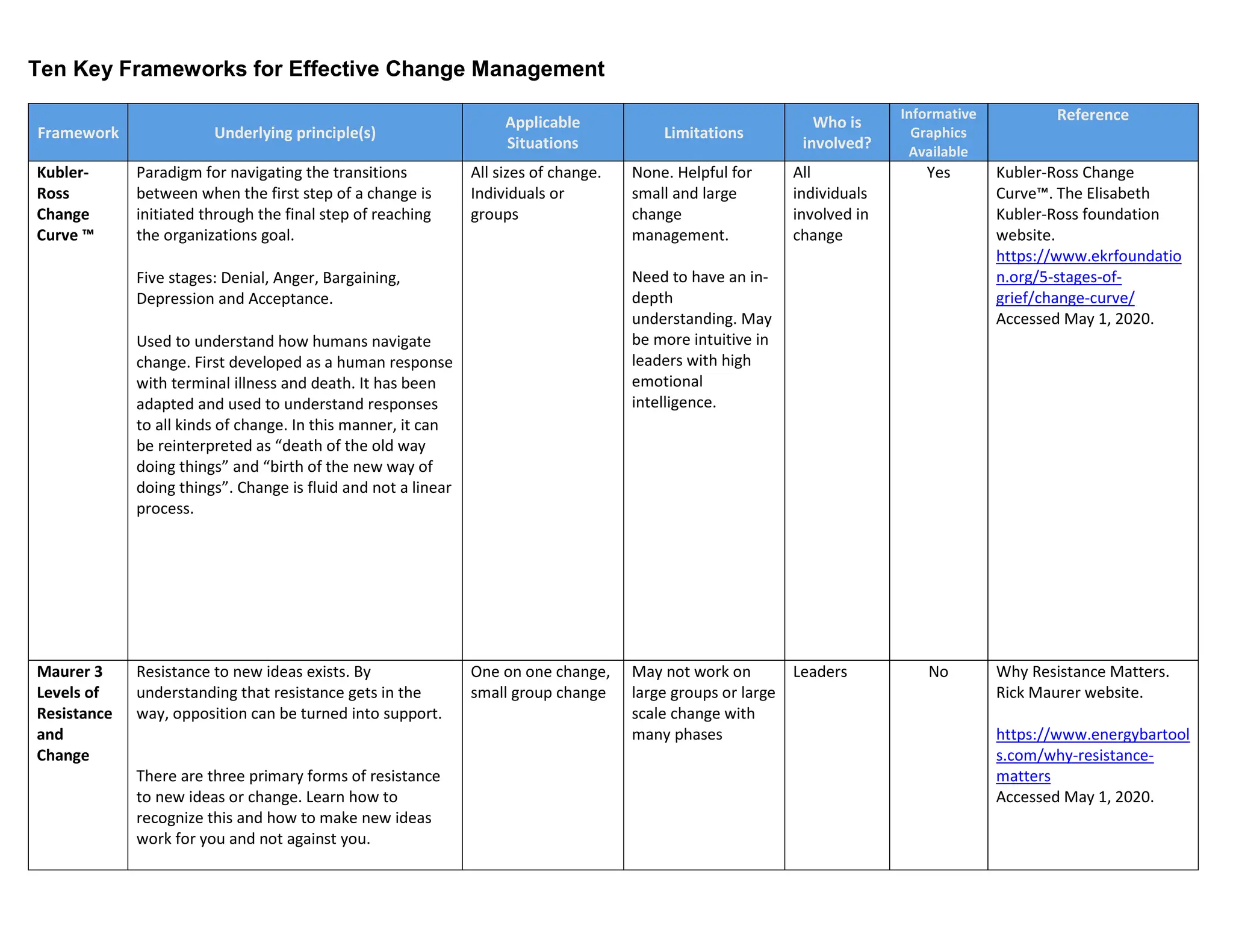
Framework Underlying principle(s)
Applicable
Situations
Limitations
Who is
involved?
Informative
Graphics
Available
Reference
Kubler-
Ross
Change
Curve ™
Paradigm for navigating the transitions
between when the first step of a change is
initiated through the final step of reaching
the organizations goal.
Five stages: Denial, Anger, Bargaining,
Depression and Acceptance.
Used to understand how humans navigate
change. First developed as a human response
with terminal illness and death. It has been
adapted and used to understand responses
to all kinds of change. In this manner, it can
be reinterpreted as “death of the old way
doing things” and “birth of the new way of
doing things”. Change is fluid and not a linear
process.
All sizes of change.
Individuals or
groups
None. Helpful for
small and large
change
management.
Need to have an in-
depth
understanding. May
be more intuitive in
leaders with high
emotional
intelligence.
All
individuals
involved in
change
Yes Kubler-Ross Change
Curve™. The Elisabeth
Kubler-Ross foundation
website.
https://www.ekrfoundatio
n.org/5-stages-of-
grief/change-curve/
Accessed May 1, 2020.
Maurer 3
Levels of
Resistance
and
Change
Resistance to new ideas exists. By
understanding that resistance gets in the
way, opposition can be turned into support.
There are three primary forms of resistance
to new ideas or change. Learn how to
recognize this and how to make new ideas
work for you and not against you.
One on one change,
small group change
May not work on
large groups or large
scale change with
many phases
Leaders No Why Resistance Matters.
Rick Maurer website.
https://www.energybartool
s.com/why-resistance-
matters
Accessed May 1, 2020.
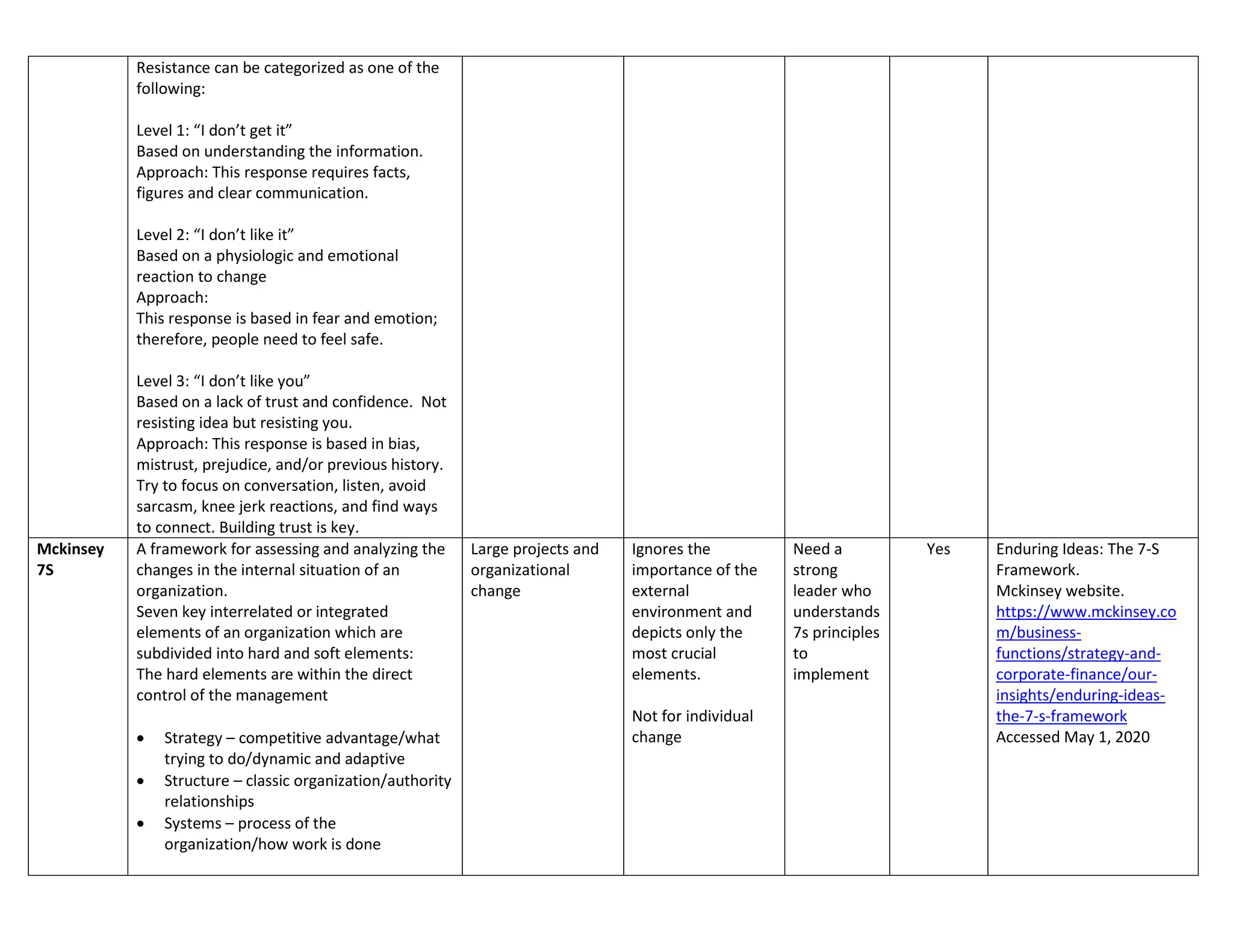
Resistance can be categorized as one of the
following:
Level 1: “I don’t get it”
Based on understanding the information.
Approach: This response requires facts,
figures and clear communication.
Level 2: “I don’t like it”
Based on a physiologic and emotional
reaction to change
Approach:
This response is based in fear and emotion;
therefore, people need to feel safe.
Level 3: “I don’t like you”
Based on a lack of trust and confidence. Not
resisting idea but resisting you.
Approach: This response is based in bias,
mistrust, prejudice, and/or previous history.
Try to focus on conversation, listen, avoid
sarcasm, knee jerk reactions, and find ways
to connect. Building trust is key.
Mckinsey
7S
A framework for assessing and analyzing the
changes in the internal situation of an
organization.
Seven key interrelated or integrated
elements of an organization which are
subdivided into hard and soft elements:
The hard elements are within the direct
control of the management
• Strategy – competitive advantage/what
trying to do/dynamic and adaptive
• Structure – classic organization/authority
relationships
• Systems – process of the
organization/how work is done
Large projects and
organizational
change
Ignores the
importance of the
external
environment and
depicts only the
most crucial
elements.
Not for individual
change
Need a
strong
leader who
understands
7s principles
to
implement
Yes Enduring Ideas: The 7-S
Framework.
Mckinsey website.
https://www.mckinsey.co
m/business-
functions/strategy-and-
corporate-finance/our-
insights/enduring-ideas-
the-7-s-framework
Accessed May 1, 2020
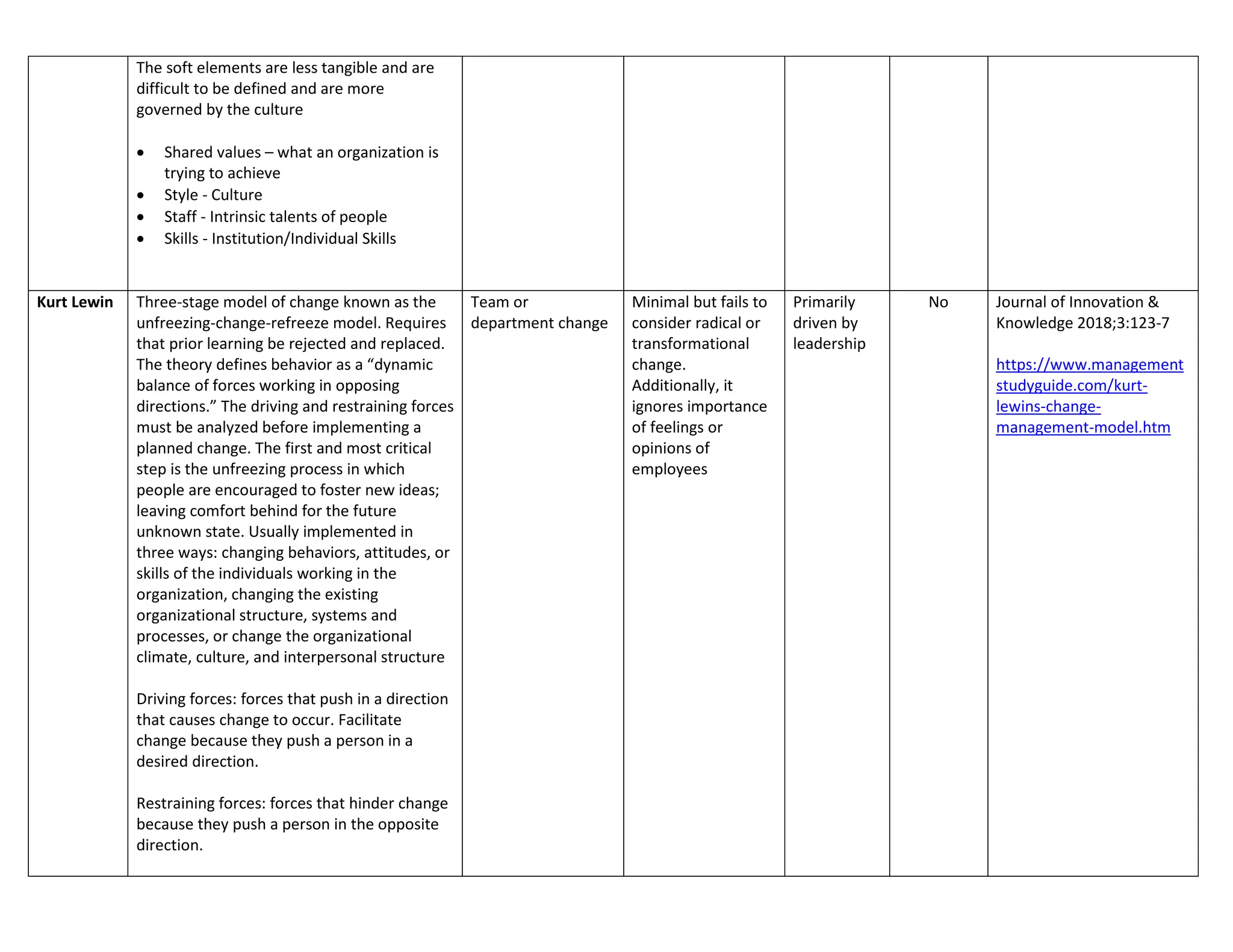
The soft elements are less tangible and are
difficult to be defined and are more
governed by the culture
• Shared values – what an organization is
trying to achieve
• Style - Culture
• Staff - Intrinsic talents of people
• Skills - Institution/Individual Skills
Kurt Lewin Three-stage model of change known as the
unfreezing-change-refreeze model. Requires
that prior learning be rejected and replaced.
The theory defines behavior as a “dynamic
balance of forces working in opposing
directions.” The driving and restraining forces
must be analyzed before implementing a
planned change. The first and most critical
step is the unfreezing process in which
people are encouraged to foster new ideas;
leaving comfort behind for the future
unknown state. Usually implemented in
three ways: changing behaviors, attitudes, or
skills of the individuals working in the
organization, changing the existing
organizational structure, systems and
processes, or change the organizational
climate, culture, and interpersonal structure
Driving forces: forces that push in a direction
that causes change to occur. Facilitate
change because they push a person in a
desired direction.
Restraining forces: forces that hinder change
because they push a person in the opposite
direction.
Team or
department change
Minimal but fails to
consider radical or
transformational
change.
Additionally, it
ignores importance
of feelings or
opinions of
employees
Primarily
driven by
leadership
No Journal of Innovation &
Knowledge 2018;3:123-7
https://www.management
studyguide.com/kurt-
lewins-change-
management-model.htm
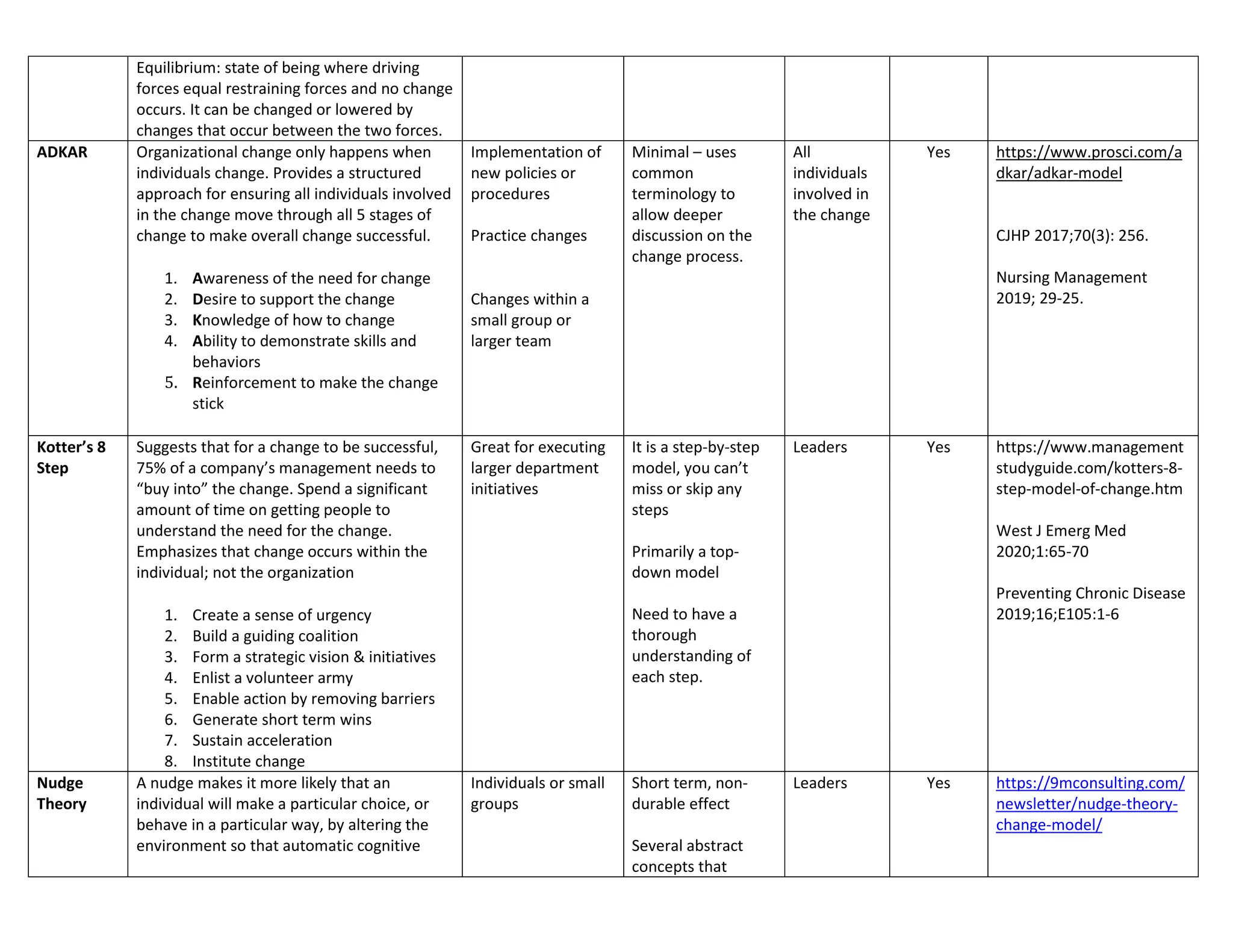
Equilibrium: state of being where driving
forces equal restraining forces and no change
occurs. It can be changed or lowered by
changes that occur between the two forces.
ADKAR Organizational change only happens when
individuals change. Provides a structured
approach for ensuring all individuals involved
in the change move through all 5 stages of
change to make overall change successful.
1. Awareness of the need for change
2. Desire to support the change
3. Knowledge of how to change
4. Ability to demonstrate skills and
behaviors
5. Reinforcement to make the change
stick
Implementation of
new policies or
procedures
Practice changes
Changes within a
small group or
larger team
Minimal – uses
common
terminology to
allow deeper
discussion on the
change process.
All
individuals
involved in
the change
Yes https://www.prosci.com/a
dkar/adkar-model
CJHP 2017;70(3): 256.
Nursing Management
2019; 29-25.
Kotter’s 8
Step
Suggests that for a change to be successful,
75% of a company’s management needs to
“buy into” the change. Spend a significant
amount of time on getting people to
understand the need for the change.
Emphasizes that change occurs within the
individual; not the organization
1. Create a sense of urgency
2. Build a guiding coalition
3. Form a strategic vision & initiatives
4. Enlist a volunteer army
5. Enable action by removing barriers
6. Generate short term wins
7. Sustain acceleration
8. Institute change
Great for executing
larger department
initiatives
It is a step-by-step
model, you can’t
miss or skip any
steps
Primarily a top-
down model
Need to have a
thorough
understanding of
each step.
Leaders Yes https://www.management
studyguide.com/kotters-8-
step-model-of-change.htm
West J Emerg Med
2020;1:65-70
Preventing Chronic Disease
2019;16;E105:1-6
Nudge
Theory
A nudge makes it more likely that an
individual will make a particular choice, or
behave in a particular way, by altering the
environment so that automatic cognitive
Individuals or small
groups
Short term, non-
durable effect
Several abstract
concepts that
Leaders Yes https://9mconsulting.com/
newsletter/nudge-theory-
change-model/
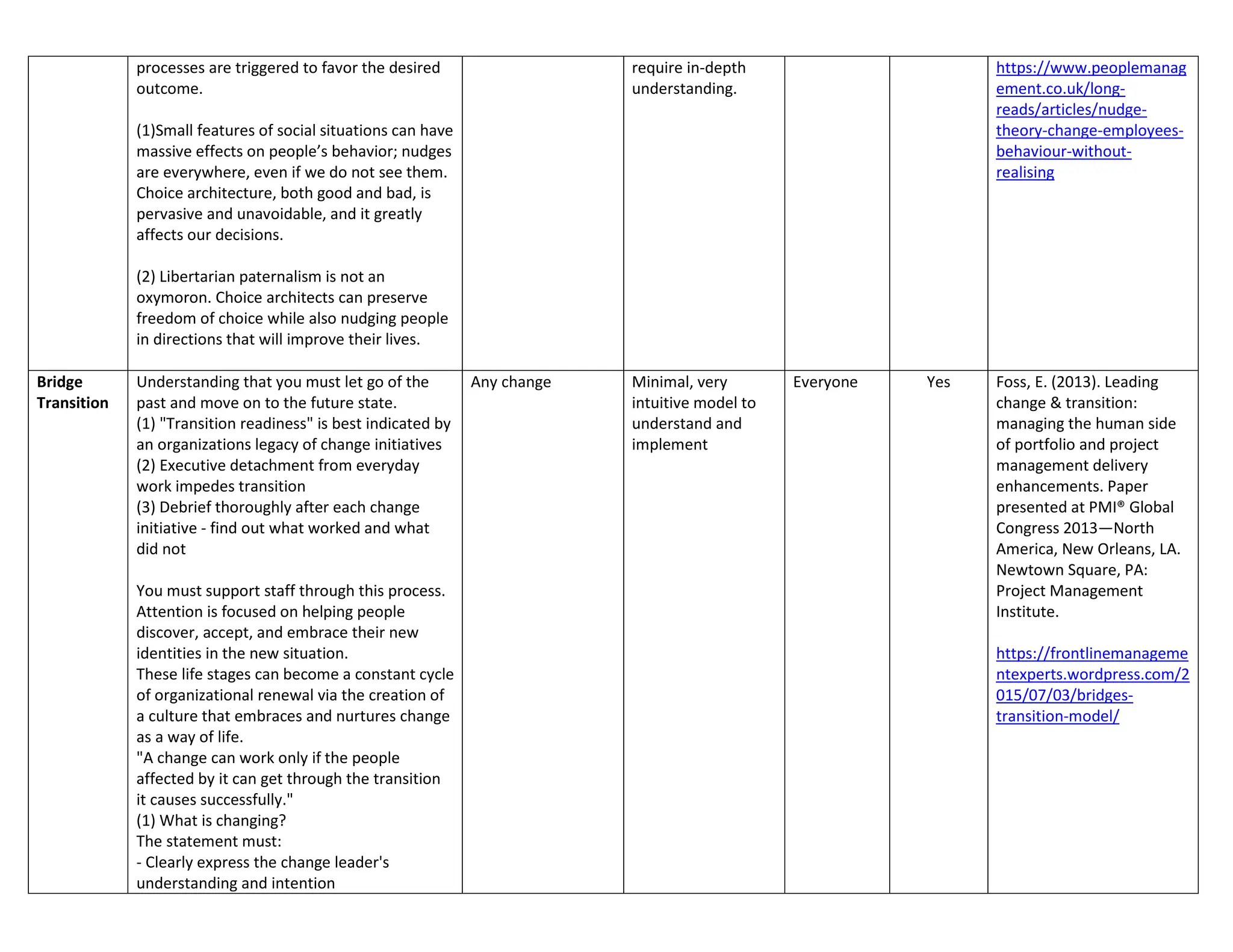
processes are triggered to favor the desired
outcome.
(1)Small features of social situations can have
massive effects on people’s behavior; nudges
are everywhere, even if we do not see them.
Choice architecture, both good and bad, is
pervasive and unavoidable, and it greatly
affects our decisions.
(2) Libertarian paternalism is not an
oxymoron. Choice architects can preserve
freedom of choice while also nudging people
in directions that will improve their lives.
require in-depth
understanding.
https://www.peoplemanag
ement.co.uk/long-
reads/articles/nudge-
theory-change-employees-
behaviour-without-
realising
Bridge
Transition
Understanding that you must let go of the
past and move on to the future state.
(1) "Transition readiness" is best indicated by
an organizations legacy of change initiatives
(2) Executive detachment from everyday
work impedes transition
(3) Debrief thoroughly after each change
initiative - find out what worked and what
did not
You must support staff through this process.
Attention is focused on helping people
discover, accept, and embrace their new
identities in the new situation.
These life stages can become a constant cycle
of organizational renewal via the creation of
a culture that embraces and nurtures change
as a way of life.
"A change can work only if the people
affected by it can get through the transition
it causes successfully."
(1) What is changing?
The statement must:
- Clearly express the change leader's
understanding and intention
Any change Minimal, very
intuitive model to
understand and
implement
Everyone Yes Foss, E. (2013). Leading
change & transition:
managing the human side
of portfolio and project
management delivery
enhancements. Paper
presented at PMI® Global
Congress 2013—North
America, New Orleans, LA.
Newtown Square, PA:
Project Management
Institute.
https://frontlinemanageme
ntexperts.wordpress.com/2
015/07/03/bridges-
transition-model/
- Link the change to the drivers that make it
necessary
- "Sell the problem before you try to sell the
solution."
- Not use jargon
- Be under 60 seconds in duration
(2) What will actually be different because of
the change?
William Bridges says: "I go into organizations
where a change initiative is well underway,
and I ask what will be different when the
change is done-and no one can answer the
question."
"A change may seem very important and very
real to the leader, but to the people who
have to make it work it seems quite abstract
and vague until actual differences that it will
make begin to become clear... the drive to
get those differences clear should be an
important priority on the planners' list of
things to do."
(3) Who's going to lose what?
suggests that the transition starts with a loss
- a letting go of the old ways of how things
were before the change: "...we often say...
that you don't cross the line separating
change management from transition
management until you have asked 'Who will
lose [or has lost] what?
Satir
Change
At the heart of the Satir Change Model, is the
conviction that it is always possible for things
to get better. However, this takes time and
things usually get worse before they get
better.
1) Late Status Quo - how things are
shortly before you become aware of the
major and disruptive change.
Team of structure
change
Very few, Intuitive
model. Transitioning
between stages
encouraging team
members to openly
communicate is key.
Yes Satir Change Model -
Change Management
Training from Epm
Denis -
https://expertprogramman
agement.com/2018/10/sati
r-change-model/. Accessed
5/5/20
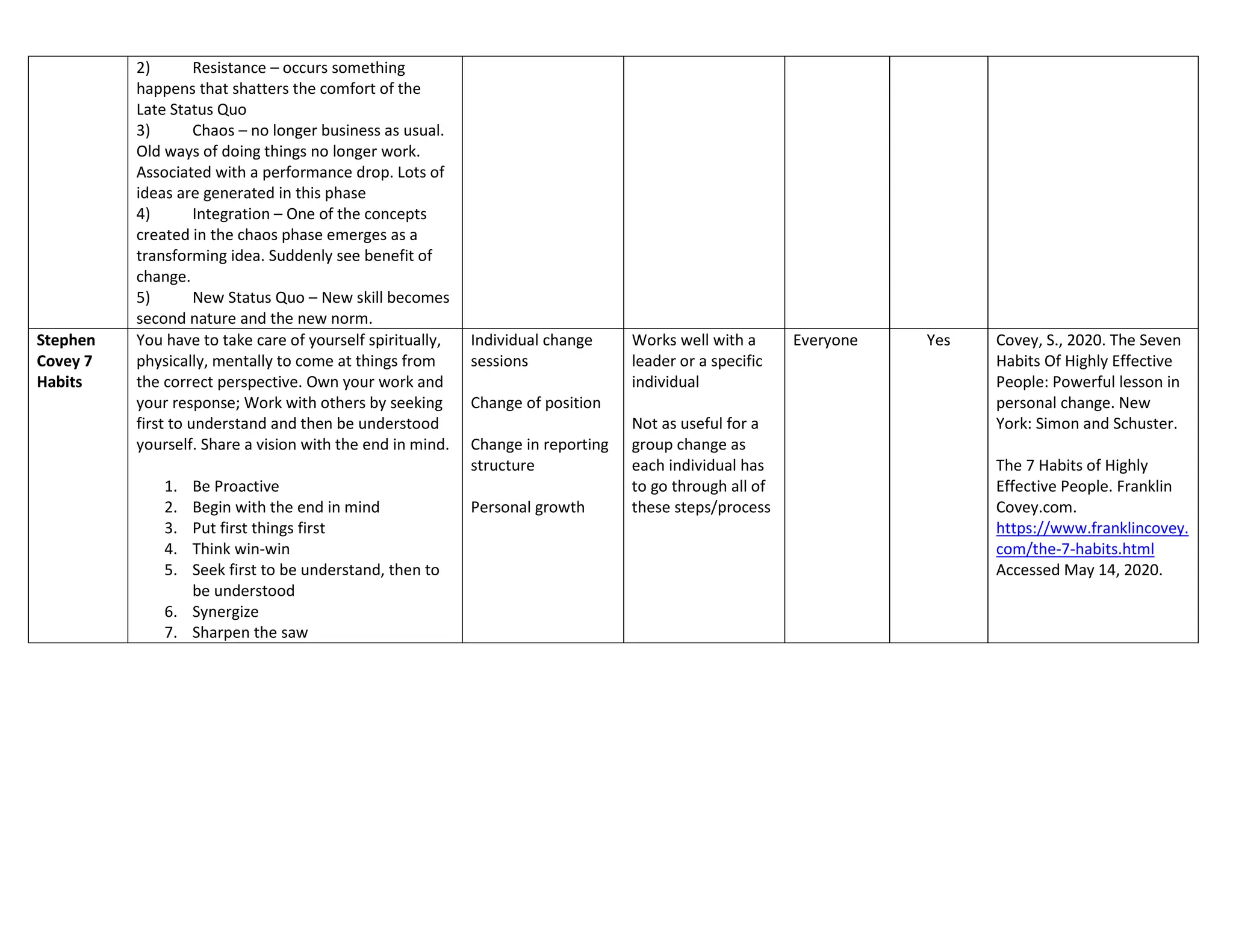
2) Resistance – occurs something
happens that shatters the comfort of the
Late Status Quo
3) Chaos – no longer business as usual.
Old ways of doing things no longer work.
Associated with a performance drop. Lots of
ideas are generated in this phase
4) Integration – One of the concepts
created in the chaos phase emerges as a
transforming idea. Suddenly see benefit of
change.
5) New Status Quo – New skill becomes
second nature and the new norm.
Stephen
Covey 7
Habits
You have to take care of yourself spiritually,
physically, mentally to come at things from
the correct perspective. Own your work and
your response; Work with others by seeking
first to understand and then be understood
yourself. Share a vision with the end in mind.
1. Be Proactive
2. Begin with the end in mind
3. Put first things first
4. Think win-win
5. Seek first to be understand, then to
be understood
6. Synergize
7. Sharpen the saw
Individual change
sessions
Change of position
Change in reporting
structure
Personal growth
Works well with a
leader or a specific
individual
Not as useful for a
group change as
each individual has
to go through all of
these steps/process
Everyone Yes Covey, S., 2020. The Seven
Habits Of Highly Effective
People: Powerful lesson in
personal change. New
York: Simon and Schuster.
The 7 Habits of Highly
Effective People. Franklin
Covey.com.
https://www.franklincovey.
com/the-7-habits.html
Accessed May 14, 2020.

Ten-Key-Frameworks-for-Effective-Change-Management.pdf

  • 1.
    Ten Key Frameworksfor Effective Change Management Framework Underlying principle(s) Applicable Situations Limitations Who is involved? Informative Graphics Available Reference Kubler- Ross Change Curve ™ Paradigm for navigating the transitions between when the first step of a change is initiated through the final step of reaching the organizations goal. Five stages: Denial, Anger, Bargaining, Depression and Acceptance. Used to understand how humans navigate change. First developed as a human response with terminal illness and death. It has been adapted and used to understand responses to all kinds of change. In this manner, it can be reinterpreted as “death of the old way doing things” and “birth of the new way of doing things”. Change is fluid and not a linear process. All sizes of change. Individuals or groups None. Helpful for small and large change management. Need to have an in- depth understanding. May be more intuitive in leaders with high emotional intelligence. All individuals involved in change Yes Kubler-Ross Change Curve™. The Elisabeth Kubler-Ross foundation website. https://www.ekrfoundatio n.org/5-stages-of- grief/change-curve/ Accessed May 1, 2020. Maurer 3 Levels of Resistance and Change Resistance to new ideas exists. By understanding that resistance gets in the way, opposition can be turned into support. There are three primary forms of resistance to new ideas or change. Learn how to recognize this and how to make new ideas work for you and not against you. One on one change, small group change May not work on large groups or large scale change with many phases Leaders No Why Resistance Matters. Rick Maurer website. https://www.energybartool s.com/why-resistance- matters Accessed May 1, 2020.
  • 2.
    Resistance can becategorized as one of the following: Level 1: “I don’t get it” Based on understanding the information. Approach: This response requires facts, figures and clear communication. Level 2: “I don’t like it” Based on a physiologic and emotional reaction to change Approach: This response is based in fear and emotion; therefore, people need to feel safe. Level 3: “I don’t like you” Based on a lack of trust and confidence. Not resisting idea but resisting you. Approach: This response is based in bias, mistrust, prejudice, and/or previous history. Try to focus on conversation, listen, avoid sarcasm, knee jerk reactions, and find ways to connect. Building trust is key. Mckinsey 7S A framework for assessing and analyzing the changes in the internal situation of an organization. Seven key interrelated or integrated elements of an organization which are subdivided into hard and soft elements: The hard elements are within the direct control of the management • Strategy – competitive advantage/what trying to do/dynamic and adaptive • Structure – classic organization/authority relationships • Systems – process of the organization/how work is done Large projects and organizational change Ignores the importance of the external environment and depicts only the most crucial elements. Not for individual change Need a strong leader who understands 7s principles to implement Yes Enduring Ideas: The 7-S Framework. Mckinsey website. https://www.mckinsey.co m/business- functions/strategy-and- corporate-finance/our- insights/enduring-ideas- the-7-s-framework Accessed May 1, 2020
  • 3.
    The soft elementsare less tangible and are difficult to be defined and are more governed by the culture • Shared values – what an organization is trying to achieve • Style - Culture • Staff - Intrinsic talents of people • Skills - Institution/Individual Skills Kurt Lewin Three-stage model of change known as the unfreezing-change-refreeze model. Requires that prior learning be rejected and replaced. The theory defines behavior as a “dynamic balance of forces working in opposing directions.” The driving and restraining forces must be analyzed before implementing a planned change. The first and most critical step is the unfreezing process in which people are encouraged to foster new ideas; leaving comfort behind for the future unknown state. Usually implemented in three ways: changing behaviors, attitudes, or skills of the individuals working in the organization, changing the existing organizational structure, systems and processes, or change the organizational climate, culture, and interpersonal structure Driving forces: forces that push in a direction that causes change to occur. Facilitate change because they push a person in a desired direction. Restraining forces: forces that hinder change because they push a person in the opposite direction. Team or department change Minimal but fails to consider radical or transformational change. Additionally, it ignores importance of feelings or opinions of employees Primarily driven by leadership No Journal of Innovation & Knowledge 2018;3:123-7 https://www.management studyguide.com/kurt- lewins-change- management-model.htm
  • 4.
    Equilibrium: state ofbeing where driving forces equal restraining forces and no change occurs. It can be changed or lowered by changes that occur between the two forces. ADKAR Organizational change only happens when individuals change. Provides a structured approach for ensuring all individuals involved in the change move through all 5 stages of change to make overall change successful. 1. Awareness of the need for change 2. Desire to support the change 3. Knowledge of how to change 4. Ability to demonstrate skills and behaviors 5. Reinforcement to make the change stick Implementation of new policies or procedures Practice changes Changes within a small group or larger team Minimal – uses common terminology to allow deeper discussion on the change process. All individuals involved in the change Yes https://www.prosci.com/a dkar/adkar-model CJHP 2017;70(3): 256. Nursing Management 2019; 29-25. Kotter’s 8 Step Suggests that for a change to be successful, 75% of a company’s management needs to “buy into” the change. Spend a significant amount of time on getting people to understand the need for the change. Emphasizes that change occurs within the individual; not the organization 1. Create a sense of urgency 2. Build a guiding coalition 3. Form a strategic vision & initiatives 4. Enlist a volunteer army 5. Enable action by removing barriers 6. Generate short term wins 7. Sustain acceleration 8. Institute change Great for executing larger department initiatives It is a step-by-step model, you can’t miss or skip any steps Primarily a top- down model Need to have a thorough understanding of each step. Leaders Yes https://www.management studyguide.com/kotters-8- step-model-of-change.htm West J Emerg Med 2020;1:65-70 Preventing Chronic Disease 2019;16;E105:1-6 Nudge Theory A nudge makes it more likely that an individual will make a particular choice, or behave in a particular way, by altering the environment so that automatic cognitive Individuals or small groups Short term, non- durable effect Several abstract concepts that Leaders Yes https://9mconsulting.com/ newsletter/nudge-theory- change-model/
  • 5.
    processes are triggeredto favor the desired outcome. (1)Small features of social situations can have massive effects on people’s behavior; nudges are everywhere, even if we do not see them. Choice architecture, both good and bad, is pervasive and unavoidable, and it greatly affects our decisions. (2) Libertarian paternalism is not an oxymoron. Choice architects can preserve freedom of choice while also nudging people in directions that will improve their lives. require in-depth understanding. https://www.peoplemanag ement.co.uk/long- reads/articles/nudge- theory-change-employees- behaviour-without- realising Bridge Transition Understanding that you must let go of the past and move on to the future state. (1) "Transition readiness" is best indicated by an organizations legacy of change initiatives (2) Executive detachment from everyday work impedes transition (3) Debrief thoroughly after each change initiative - find out what worked and what did not You must support staff through this process. Attention is focused on helping people discover, accept, and embrace their new identities in the new situation. These life stages can become a constant cycle of organizational renewal via the creation of a culture that embraces and nurtures change as a way of life. "A change can work only if the people affected by it can get through the transition it causes successfully." (1) What is changing? The statement must: - Clearly express the change leader's understanding and intention Any change Minimal, very intuitive model to understand and implement Everyone Yes Foss, E. (2013). Leading change & transition: managing the human side of portfolio and project management delivery enhancements. Paper presented at PMI® Global Congress 2013—North America, New Orleans, LA. Newtown Square, PA: Project Management Institute. https://frontlinemanageme ntexperts.wordpress.com/2 015/07/03/bridges- transition-model/
  • 6.
    - Link thechange to the drivers that make it necessary - "Sell the problem before you try to sell the solution." - Not use jargon - Be under 60 seconds in duration (2) What will actually be different because of the change? William Bridges says: "I go into organizations where a change initiative is well underway, and I ask what will be different when the change is done-and no one can answer the question." "A change may seem very important and very real to the leader, but to the people who have to make it work it seems quite abstract and vague until actual differences that it will make begin to become clear... the drive to get those differences clear should be an important priority on the planners' list of things to do." (3) Who's going to lose what? suggests that the transition starts with a loss - a letting go of the old ways of how things were before the change: "...we often say... that you don't cross the line separating change management from transition management until you have asked 'Who will lose [or has lost] what? Satir Change At the heart of the Satir Change Model, is the conviction that it is always possible for things to get better. However, this takes time and things usually get worse before they get better. 1) Late Status Quo - how things are shortly before you become aware of the major and disruptive change. Team of structure change Very few, Intuitive model. Transitioning between stages encouraging team members to openly communicate is key. Yes Satir Change Model - Change Management Training from Epm Denis - https://expertprogramman agement.com/2018/10/sati r-change-model/. Accessed 5/5/20
  • 7.
    2) Resistance –occurs something happens that shatters the comfort of the Late Status Quo 3) Chaos – no longer business as usual. Old ways of doing things no longer work. Associated with a performance drop. Lots of ideas are generated in this phase 4) Integration – One of the concepts created in the chaos phase emerges as a transforming idea. Suddenly see benefit of change. 5) New Status Quo – New skill becomes second nature and the new norm. Stephen Covey 7 Habits You have to take care of yourself spiritually, physically, mentally to come at things from the correct perspective. Own your work and your response; Work with others by seeking first to understand and then be understood yourself. Share a vision with the end in mind. 1. Be Proactive 2. Begin with the end in mind 3. Put first things first 4. Think win-win 5. Seek first to be understand, then to be understood 6. Synergize 7. Sharpen the saw Individual change sessions Change of position Change in reporting structure Personal growth Works well with a leader or a specific individual Not as useful for a group change as each individual has to go through all of these steps/process Everyone Yes Covey, S., 2020. The Seven Habits Of Highly Effective People: Powerful lesson in personal change. New York: Simon and Schuster. The 7 Habits of Highly Effective People. Franklin Covey.com. https://www.franklincovey. com/the-7-habits.html Accessed May 14, 2020.