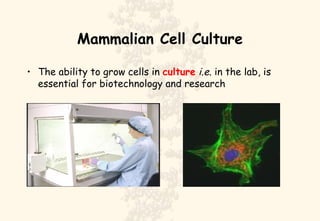
Mammalian Cell Culture The ability to grow cells in  culture   i.e.  in the lab, is essential for biotechnology and research
Applications of cell culture 1 RESEARCH (small scale usage) growing bacterial cells for basic gene manipulation culturing mammalian cells to observe the effects of drugs and hormones on the functioning of cells  e.g.  cancer studies producing new plants
Applications of cell culture 2 BIOTECHNOLOGY (large scale usage) agriculture  e.g.  silage production pharmaceuticals  e.g.  genetically engineered bacteria to produce insulin food production  e.g.  brewing and baking biodegradation  e.g.  sewage treatment
Conditions needed for cell culture In order for cells to grow, the conditions must be just right for each cell type. The cytologist must  therefore consider the following: Growth medium Type of growth container or fermenter Temperature pH Gas exchange Aseptic conditions Method for monitoring cell growth Safety measures and implications
Aseptic conditions To avoid contamination of growth media and  cultures All inanimate and living objects, including the atmosphere carry large numbers of microorganisms.  A variety of techniques can be used to provide these conditions: e.g.  sterilisation of all utensils and media using  heat .  For example, using an autoclave (steam under pressure, necessary for bacterial spores) Growth of pure cultures
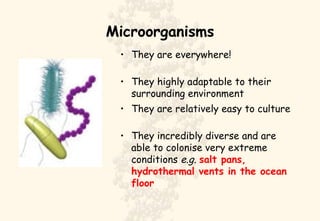
Microorganisms They are everywhere! They highly adaptable to their surrounding environment They are relatively easy to culture They incredibly diverse and are able to colonise very extreme conditions  e.g.   salt pans, hydrothermal vents in the ocean floor
Classes of Microorganisms There are 2 recognised categories of micro-organism: 1.   Unicellular Algae / PHOTOTROPHS : use  sunlight  to make their own food 1.   Bacteria & Yeasts (Fungi) / HETEROTROPHS : need more complex media containing an organic carbon source and other compounds  e.g.   amino acids
Culture & Uses Food industry - cheese production, baking, wine & beer Chemical production  e.g.  acetone Bases of food chains Commensal bacteria in digestive tract Production of therapeutic compounds  e.g.  insulin [See Scholar: Batch & Continuous culture]
Microbial Growth Culture Requirements A few litres can be made in the lab Thousands  of litres can be made industrially Micro-organisms are grown in a medium that supplies them with all nutrients necessary for growth. This depends on … the  type  of cell the  final purpose  of the cell the  by-products
Microbial Growth Culture Requirements Important factors that must always be considered are: the nutrient media temperature pH gaseous environment light Unicellular algae ,  bacteria & yeast  can be grown as  batch cultures  - no dilution is needed until max. density is reached. Growth can be limited by nutrient availability  i.e.  at the end of exponential growth
Nutrient Media Chosen to imitate an organism’s natural environment Generally supplies all the essential nutrients A medium is classed as any solid or liquid preparation specifically for growth, storage or transport of micro-organisms Must be at the correct pH and the correct gaseous concentration for the organisms to grow
Nutrient Media There are 2 types of media commonly used: 1.  Complex media  - this has one or more crude sources of nutrients and their exact chemical composition and components are not known. Generally used for routine cultures 2.  Defined media  - otherwise known as synthetic media containing chemically known compounds and components which are in a relatively pure form REMEMBER:  all media must be  STERILE  before use !!!
Mammalian Cell Culture Many animal cells and tissues can be removed from an organism and cultured artifically. This allows the cell’s activities to be investigated  e.g.  control of the cell cycle
The process of culturing Mammalian Cells Once the cells are obtained from animal tissues or other cell lines they are placed in a flat culture vessel that lies on its  side The cells stick or  adhere  to the inside of the vessel as they grow in the medium Most animal cells are  ‘ANCHORAGE-DEPENDENT’   i.e.  they need something to hold on to These cells usually form a  monolayer  that will eventually cover the entire surface of the  medium
At this point, called  confluence , it is necessary to subculture the cells into a fresh medium N.B.   Cells that are associated with body fluids such as blood cells are  NON-ANCHORAGE DEPENDENT  and can be grown in suspension. Again, it is necessary to regularly subculture the cells into fresh medium N.B.   All media and culture vessels are  STERILISED  to prevent the growth of micro-organisms
Mammalian Cell Growth Media Contains … - mixture of  glucose ,  amino   acids ,  salts ,  water and   antibiotics - sometimes  BASIC  GROWTH SERUM  is added [This is animal serum prepared from blood and  contains additional factors e.g. Platelet Derived  Growth Factor,which enhances growth, 5-10% added  or Fetal Bovine Serum (FBS) ] - pH indicator   e.g.  phenol red: this shows  changes in pH due to waste production  (pH decreases     red  to  yellow ) *  Finally, the media must be incubated at the appropriate temperature for the chosen cells  e.g.  human cells - 37 o c *
Categories Of Mammalian Cell Cultures There are 2 categories of animal cell cultures: (1) Primary cultures: These cells are taken directly from fresh  tissue. The  disadvantage  is that the cells have a  limited lifespan; the cells only divide so many  times in culture, so therefore long term  culturing is difficult
Process of Cell Collection The cells are treated with a proteolytic enzyme  e.g.  trypsin, to separate out the fragments into single cells. The  advantage  of this process is that cells can be  collected  and  cloned . This is useful to  isolate  a mutant cell line  i.e.  deriving  secondary cell cultures  otherwise known as ...
(2)  Continuous Cell Lines These cells have an acquired capacity for infinite growth and division  [they are immortal] They are derived from tumours or the cells have been  transplanted  [neo-plastic - produce cancer if transplanted into animals]   so they have lost their sensitivity to factors associated with growth control. Generally, these cells will lose their anchorage dependence facility and so are often easier to culture
Continuous Cell Lines The advantage of using continuous cell lines is that they can be  cloned . This allows easy : isolation  of mutant cells investigation  of cell growth production  of hybrid cells in biotechnology This routine procedure is used to produce important pharmaceuticals  e.g.  vaccines and hormones
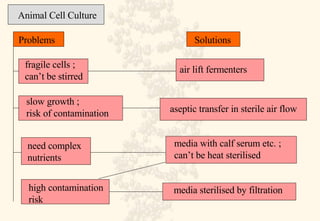
Animal Cell Culture Solutions fragile cells ; can’t be stirred air lift fermenters slow growth ; risk of contamination Problems aseptic transfer in sterile air flow need complex  nutrients media with calf serum etc. ; can’t be heat sterilised media sterilised by filtration high contamination  risk
Bacterial & Fungal Cultures Much easier to grow than mammalian cells ! Bacteria and Fungi require much  simpler  growth media requirements and culture conditions compared to animal cells. [See previous notes]

Cell Culture

  • 1.
    Mammalian Cell CultureThe ability to grow cells in culture i.e. in the lab, is essential for biotechnology and research
  • 2.
    Applications of cellculture 1 RESEARCH (small scale usage) growing bacterial cells for basic gene manipulation culturing mammalian cells to observe the effects of drugs and hormones on the functioning of cells e.g. cancer studies producing new plants
  • 3.
    Applications of cellculture 2 BIOTECHNOLOGY (large scale usage) agriculture e.g. silage production pharmaceuticals e.g. genetically engineered bacteria to produce insulin food production e.g. brewing and baking biodegradation e.g. sewage treatment
  • 4.
    Conditions needed forcell culture In order for cells to grow, the conditions must be just right for each cell type. The cytologist must therefore consider the following: Growth medium Type of growth container or fermenter Temperature pH Gas exchange Aseptic conditions Method for monitoring cell growth Safety measures and implications
  • 5.
    Aseptic conditions Toavoid contamination of growth media and cultures All inanimate and living objects, including the atmosphere carry large numbers of microorganisms. A variety of techniques can be used to provide these conditions: e.g. sterilisation of all utensils and media using heat . For example, using an autoclave (steam under pressure, necessary for bacterial spores) Growth of pure cultures
  • 6.
    Microorganisms They areeverywhere! They highly adaptable to their surrounding environment They are relatively easy to culture They incredibly diverse and are able to colonise very extreme conditions e.g. salt pans, hydrothermal vents in the ocean floor
  • 7.
    Classes of MicroorganismsThere are 2 recognised categories of micro-organism: 1. Unicellular Algae / PHOTOTROPHS : use sunlight to make their own food 1. Bacteria & Yeasts (Fungi) / HETEROTROPHS : need more complex media containing an organic carbon source and other compounds e.g. amino acids
  • 8.
    Culture & UsesFood industry - cheese production, baking, wine & beer Chemical production e.g. acetone Bases of food chains Commensal bacteria in digestive tract Production of therapeutic compounds e.g. insulin [See Scholar: Batch & Continuous culture]
  • 9.
    Microbial Growth CultureRequirements A few litres can be made in the lab Thousands of litres can be made industrially Micro-organisms are grown in a medium that supplies them with all nutrients necessary for growth. This depends on … the type of cell the final purpose of the cell the by-products
  • 10.
    Microbial Growth CultureRequirements Important factors that must always be considered are: the nutrient media temperature pH gaseous environment light Unicellular algae , bacteria & yeast can be grown as batch cultures - no dilution is needed until max. density is reached. Growth can be limited by nutrient availability i.e. at the end of exponential growth
  • 11.
    Nutrient Media Chosento imitate an organism’s natural environment Generally supplies all the essential nutrients A medium is classed as any solid or liquid preparation specifically for growth, storage or transport of micro-organisms Must be at the correct pH and the correct gaseous concentration for the organisms to grow
  • 12.
    Nutrient Media Thereare 2 types of media commonly used: 1. Complex media - this has one or more crude sources of nutrients and their exact chemical composition and components are not known. Generally used for routine cultures 2. Defined media - otherwise known as synthetic media containing chemically known compounds and components which are in a relatively pure form REMEMBER: all media must be STERILE before use !!!
  • 13.
    Mammalian Cell CultureMany animal cells and tissues can be removed from an organism and cultured artifically. This allows the cell’s activities to be investigated e.g. control of the cell cycle
  • 14.
    The process ofculturing Mammalian Cells Once the cells are obtained from animal tissues or other cell lines they are placed in a flat culture vessel that lies on its side The cells stick or adhere to the inside of the vessel as they grow in the medium Most animal cells are ‘ANCHORAGE-DEPENDENT’ i.e. they need something to hold on to These cells usually form a monolayer that will eventually cover the entire surface of the medium
  • 15.
    At this point,called confluence , it is necessary to subculture the cells into a fresh medium N.B. Cells that are associated with body fluids such as blood cells are NON-ANCHORAGE DEPENDENT and can be grown in suspension. Again, it is necessary to regularly subculture the cells into fresh medium N.B. All media and culture vessels are STERILISED to prevent the growth of micro-organisms
  • 16.
    Mammalian Cell GrowthMedia Contains … - mixture of glucose , amino acids , salts , water and antibiotics - sometimes BASIC GROWTH SERUM is added [This is animal serum prepared from blood and contains additional factors e.g. Platelet Derived Growth Factor,which enhances growth, 5-10% added or Fetal Bovine Serum (FBS) ] - pH indicator e.g. phenol red: this shows changes in pH due to waste production (pH decreases  red to yellow ) * Finally, the media must be incubated at the appropriate temperature for the chosen cells e.g. human cells - 37 o c *
  • 17.
    Categories Of MammalianCell Cultures There are 2 categories of animal cell cultures: (1) Primary cultures: These cells are taken directly from fresh tissue. The disadvantage is that the cells have a limited lifespan; the cells only divide so many times in culture, so therefore long term culturing is difficult
  • 18.
    Process of CellCollection The cells are treated with a proteolytic enzyme e.g. trypsin, to separate out the fragments into single cells. The advantage of this process is that cells can be collected and cloned . This is useful to isolate a mutant cell line i.e. deriving secondary cell cultures otherwise known as ...
  • 19.
    (2) ContinuousCell Lines These cells have an acquired capacity for infinite growth and division [they are immortal] They are derived from tumours or the cells have been transplanted [neo-plastic - produce cancer if transplanted into animals] so they have lost their sensitivity to factors associated with growth control. Generally, these cells will lose their anchorage dependence facility and so are often easier to culture
  • 20.
    Continuous Cell LinesThe advantage of using continuous cell lines is that they can be cloned . This allows easy : isolation of mutant cells investigation of cell growth production of hybrid cells in biotechnology This routine procedure is used to produce important pharmaceuticals e.g. vaccines and hormones
  • 21.
    Animal Cell CultureSolutions fragile cells ; can’t be stirred air lift fermenters slow growth ; risk of contamination Problems aseptic transfer in sterile air flow need complex nutrients media with calf serum etc. ; can’t be heat sterilised media sterilised by filtration high contamination risk
  • 22.
    Bacterial & FungalCultures Much easier to grow than mammalian cells ! Bacteria and Fungi require much simpler growth media requirements and culture conditions compared to animal cells. [See previous notes]