PRIMARY CULTURE AND
CELL LINE
By
KAUSHAL KUMAR SAHU
Assistant Professor (Ad Hoc)
Department of Biotechnology
Govt. Digvijay Autonomous P. G. College
Raj-Nandgaon ( C. G. )
Content
• Introduction
• Primary Culture
• Steps In Primary Culture
• Isolation Of Tissue
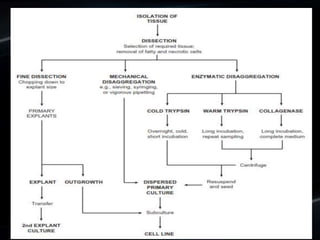
• Dissection And/Or Disaggregation
• Types Of Primary Culture
– Primary Explant Culture
– Enzymatic Disaggregation
– Mechanical Disaggregation
• Cell Line( Finite & Continuous)
• Naming A Cell Line
• Choosing A Cell Line
• Maintenance Of Cell Line
• Conclusion
• reference
What is animal tissue culture
• Animal cell culture basically involves the in
vitro maintenance and propagation of animal
cells in a suitable nutrient media.
• Thus culturing is a process of growing cells
artificially.
• Types of animal tissue culture
1.organ culture 2.primary explant culture
3.cell culture
Primary Culture
• A primary culture refers to the starting culture
of cells, tissue or organs, taken directly from
an organism. Thus the primary culture is initial
culture before first subculture.
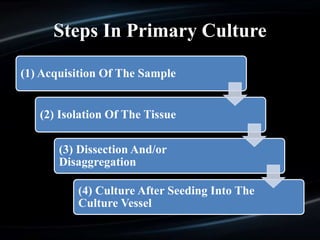
Steps In Primary Culture
(1) Acquisition Of The Sample
(2) Isolation Of The Tissue
(3) Dissection And/or
Disaggregation
(4) Culture After Seeding Into The
Culture Vessel
Isolation of tissue
• Medical ethical rules.
• Containment level (human in a class 2).
• Sterilize site use in isolation.
• Removal the tissue aseptically and transfer it
to the tissue culture in dissection BSS.
• If delay in transferring tissue( 40 C up to 72 h)
• Mouse embryos dissection(before 13-14 day)
Dissection And/or Disaggregation
• Fat and necrotic tissues are best removed
during dissection.
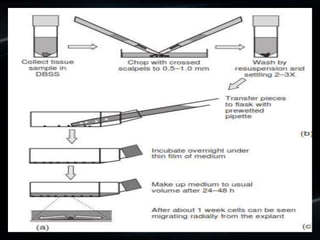
• The tissue should be chopped finely with
sharp scalpels to cause minimum damage.
• Enzymes used for disaggregation should be
removed subsequently by gentle
centrifugation.
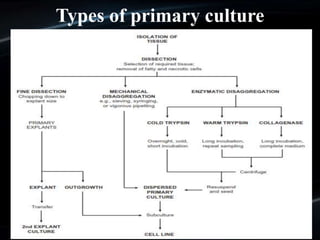
Types of primary culture
Primary Explant Culture
• The primary explant technique was the original
method developed by Harrison [1907], Carrel
[1912].
• As originally performed, a fragment of tissue
was embedded in blood plasma or lymph,
mixed with heterologous serum and embryo
extract, and placed on a cover slip that was
inverted over a concavity slide.
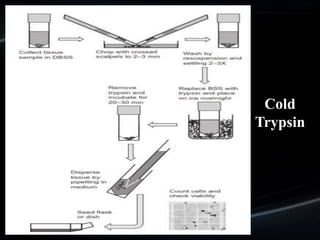
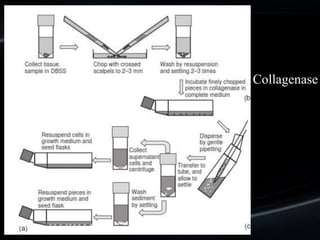
Enzymatic Disaggregation
• Cell–cell adhesion in tissues is mediated by a
variety of homotypic interacting glycopeptides
(cell adhesion molecules, or CAMs). (Cadherins,
Integrins, Fibronectin & laminin)
• Enzyme are neutralized or inactivated or inhibited
after the used.
• Increasing the purity of an enzyme will give
better control and less toxicity with increased
specificity but may result in less disaggregation
potency.
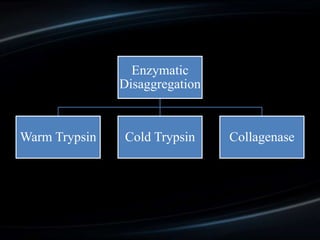
Enzymatic
Disaggregation
Warm Trypsin Cold Trypsin Collagenase
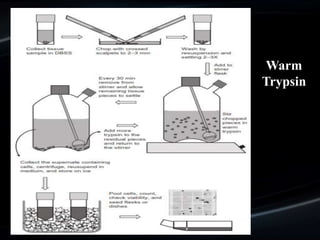
Warm
Trypsin
Cold
Trypsin
Collagenase
spillage: collecting the cells
that spill out when the tissue
is carefully sliced and the slices
scraped [Lasfargues, 1973].
sieving: pressingthe dissected
tissue through a series of
sieves for which the mesh is
gradually reduced in size.
syringing: forcing
the tissue fragments through a
syringe (with or without a
wide-gauge needle) [Zaroff et
al., 1961]
pipetting
MECHANICAL
DISAGGREGATION
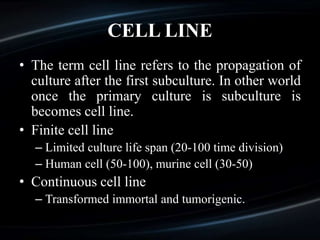
CELL LINE
• The term cell line refers to the propagation of
culture after the first subculture. In other world
once the primary culture is subculture is
becomes cell line.
• Finite cell line
– Limited culture life span (20-100 time division)
– Human cell (50-100), murine cell (30-50)
• Continuous cell line
– Transformed immortal and tumorigenic.
NAMING A CELL LINE
• New cell lines are given a code or designation
eg.
• NHB = Normal Human Brain
• NHB1 = Normal Human Brain cell line no 1
• NHB2-1= Normal Human Brain cell line no 2
clone no 1
Choosing a cell line
• Finite or continuous
– A continuous cell line generally is easier to
maintain, grows faster, clones more easily,
produces a higher cell yield per flask, and is more
readily adapted to serum-free medium.
• Normal or Transformed
– The researcher should decide whether the cell line
should be malignantly transformed or not.
– 3T3-swiss cell or BHK-21
• Species
– Nonhuman cell lines have fewer biohazards
restrictions and have advantage that the original tissue
may be more accessible
• Growth characteristics
– Population doubling time
– Plating efficiency
– Growth fraction
– Ability to grow in suspension
• Availability
– If the researcher uses a finite cell line he or she should
make sure that there is enough stocks available
– If the researcher uses a continuous cell line he or she
should make sure that authenticated stocks are
available
• Validation
– The researcher has to make sure that the selected
cell line is not a result of cross-contaminations.
• Phenotypic expression
– The researcher has to make sure that the selected
cell line is made to express the right characteristics
• Stability
– The researcher has to make sure that the selected
cell line is stable
Maintenance of cell culture
• Cell morphology
• Replacement of media
– Cell concentration
– A decrease in pH (fall 0.1/day =no harm)
(fall 0.4/day = harmful)
– Cell type
– Morphological changes
Reference
• Culture of Animal Cells- R. Ian Freshney
• Biotechnology- U. Satayanarayan

Primary culture and cell line

  • 1.
    PRIMARY CULTURE AND CELLLINE By KAUSHAL KUMAR SAHU Assistant Professor (Ad Hoc) Department of Biotechnology Govt. Digvijay Autonomous P. G. College Raj-Nandgaon ( C. G. )
  • 2.
    Content • Introduction • PrimaryCulture • Steps In Primary Culture • Isolation Of Tissue • Dissection And/Or Disaggregation • Types Of Primary Culture – Primary Explant Culture – Enzymatic Disaggregation – Mechanical Disaggregation • Cell Line( Finite & Continuous) • Naming A Cell Line • Choosing A Cell Line • Maintenance Of Cell Line • Conclusion • reference
  • 3.
    What is animaltissue culture • Animal cell culture basically involves the in vitro maintenance and propagation of animal cells in a suitable nutrient media. • Thus culturing is a process of growing cells artificially. • Types of animal tissue culture 1.organ culture 2.primary explant culture 3.cell culture
  • 4.
    Primary Culture • Aprimary culture refers to the starting culture of cells, tissue or organs, taken directly from an organism. Thus the primary culture is initial culture before first subculture.
  • 5.
    Steps In PrimaryCulture (1) Acquisition Of The Sample (2) Isolation Of The Tissue (3) Dissection And/or Disaggregation (4) Culture After Seeding Into The Culture Vessel
  • 6.
    Isolation of tissue •Medical ethical rules. • Containment level (human in a class 2). • Sterilize site use in isolation. • Removal the tissue aseptically and transfer it to the tissue culture in dissection BSS. • If delay in transferring tissue( 40 C up to 72 h) • Mouse embryos dissection(before 13-14 day)
  • 7.
    Dissection And/or Disaggregation •Fat and necrotic tissues are best removed during dissection. • The tissue should be chopped finely with sharp scalpels to cause minimum damage. • Enzymes used for disaggregation should be removed subsequently by gentle centrifugation.
  • 8.
  • 9.
    Primary Explant Culture •The primary explant technique was the original method developed by Harrison [1907], Carrel [1912]. • As originally performed, a fragment of tissue was embedded in blood plasma or lymph, mixed with heterologous serum and embryo extract, and placed on a cover slip that was inverted over a concavity slide.
  • 11.
    Enzymatic Disaggregation • Cell–celladhesion in tissues is mediated by a variety of homotypic interacting glycopeptides (cell adhesion molecules, or CAMs). (Cadherins, Integrins, Fibronectin & laminin) • Enzyme are neutralized or inactivated or inhibited after the used. • Increasing the purity of an enzyme will give better control and less toxicity with increased specificity but may result in less disaggregation potency.
  • 12.
  • 13.
  • 14.
  • 15.
  • 16.
    spillage: collecting thecells that spill out when the tissue is carefully sliced and the slices scraped [Lasfargues, 1973]. sieving: pressingthe dissected tissue through a series of sieves for which the mesh is gradually reduced in size. syringing: forcing the tissue fragments through a syringe (with or without a wide-gauge needle) [Zaroff et al., 1961] pipetting MECHANICAL DISAGGREGATION
  • 17.
    CELL LINE • Theterm cell line refers to the propagation of culture after the first subculture. In other world once the primary culture is subculture is becomes cell line. • Finite cell line – Limited culture life span (20-100 time division) – Human cell (50-100), murine cell (30-50) • Continuous cell line – Transformed immortal and tumorigenic.
  • 19.
    NAMING A CELLLINE • New cell lines are given a code or designation eg. • NHB = Normal Human Brain • NHB1 = Normal Human Brain cell line no 1 • NHB2-1= Normal Human Brain cell line no 2 clone no 1
  • 20.
    Choosing a cellline • Finite or continuous – A continuous cell line generally is easier to maintain, grows faster, clones more easily, produces a higher cell yield per flask, and is more readily adapted to serum-free medium. • Normal or Transformed – The researcher should decide whether the cell line should be malignantly transformed or not. – 3T3-swiss cell or BHK-21
  • 21.
    • Species – Nonhumancell lines have fewer biohazards restrictions and have advantage that the original tissue may be more accessible • Growth characteristics – Population doubling time – Plating efficiency – Growth fraction – Ability to grow in suspension • Availability – If the researcher uses a finite cell line he or she should make sure that there is enough stocks available – If the researcher uses a continuous cell line he or she should make sure that authenticated stocks are available
  • 22.
    • Validation – Theresearcher has to make sure that the selected cell line is not a result of cross-contaminations. • Phenotypic expression – The researcher has to make sure that the selected cell line is made to express the right characteristics • Stability – The researcher has to make sure that the selected cell line is stable
  • 23.
    Maintenance of cellculture • Cell morphology • Replacement of media – Cell concentration – A decrease in pH (fall 0.1/day =no harm) (fall 0.4/day = harmful) – Cell type – Morphological changes
  • 24.
    Reference • Culture ofAnimal Cells- R. Ian Freshney • Biotechnology- U. Satayanarayan