Symbiotic Relationships - Parasitism - Commensalism - Mutualism SYMBIOSIS  refers to relationships between organisms of  DIFFERENT  species that show an intimate association with each other Symbiotic relationships provide at least  ONE  of the participating species with a nutritional advantage 3 types of symbiosis have been recognised depending on the nature of the relationship:
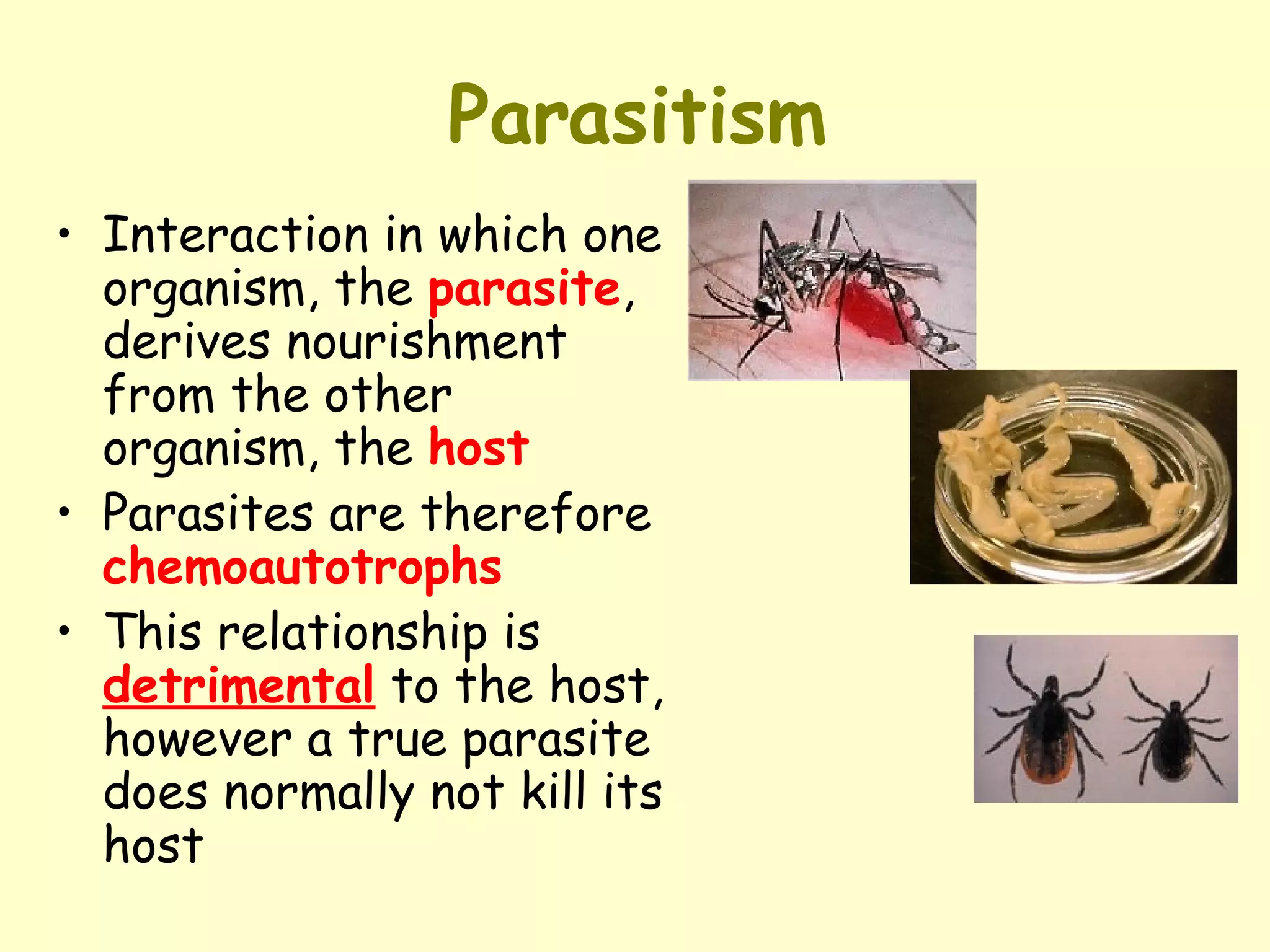
Parasitism Interaction in which one organism, the   parasite , derives nourishment from the other organism, the   host Parasites are therefore  chemoautotrophs This relationship is  detrimental  to the host,  however a true parasite does normally not kill its host
Obligate vs Facultative Most parasites are  OBLIGATE  - that is they  must  live parasitically and die when their host dies  Obligate parasites also have very few specialised structures for feeding or locomotion Some fungi are  FACULTATIVE  parasites since they can continue to feed saprophytically once their host has died Fewer facultative parasites have evolved as they must form complicated systems to detect, take in and digest food. Due to natural selection they would be at a disadvantage to obligate parasites.
Parasite Types ECTOPARASITES   - remain  external  to the host e.g.   ticks, fleas, leeches   ENDOPARASITES - live  inside  the body of the host  e.g.   liver flukes, tapeworms, malarial parasites
MICROPARASITES They are  small  and have a  short  generation time  e.g.   viruses, bacteria and protozoans [ Plasmodium spp ] The duration of infection is short compared to the life span of the host
MACROPARASITES Longer generation time and tendency to persist causing continual reinfection  e.g.   roundworms tapeworms and fungi   Intermediate hosts more common
Parasite Transmission Many parasites complete their entire lifecycle  on  or  in  a single host organism However, many  alternate  between 2 or more host species, specialising on a different host species at each stage in their lifecycle 2 general types of transmission: VERTICAL :  from mother    offspring  e.g.  HIV HORIZONTAL : between members of a population Direct Contact   e.g.  Headlice Resistant Stages   e.g.  Liver fluke Secondary host species / Vectors   e.g.  Mosquitoes
Parasite Transmission  Case Study: MALARIA Malaria  is a mosquito-borne disease caused by a parasite  Plasmodium falciparum ,  P. vivax ,  P. ovale  and  P. malariae People with malaria often experience fever, chills, and flu-like illness  Left untreated, they may develop severe complications and die Almost 85% of the world's malaria occurs in sub-Saharan Africa  Each year 350-500 million cases of malaria occur worldwide, and over one million people die, most of them young children in sub-Saharan Africa
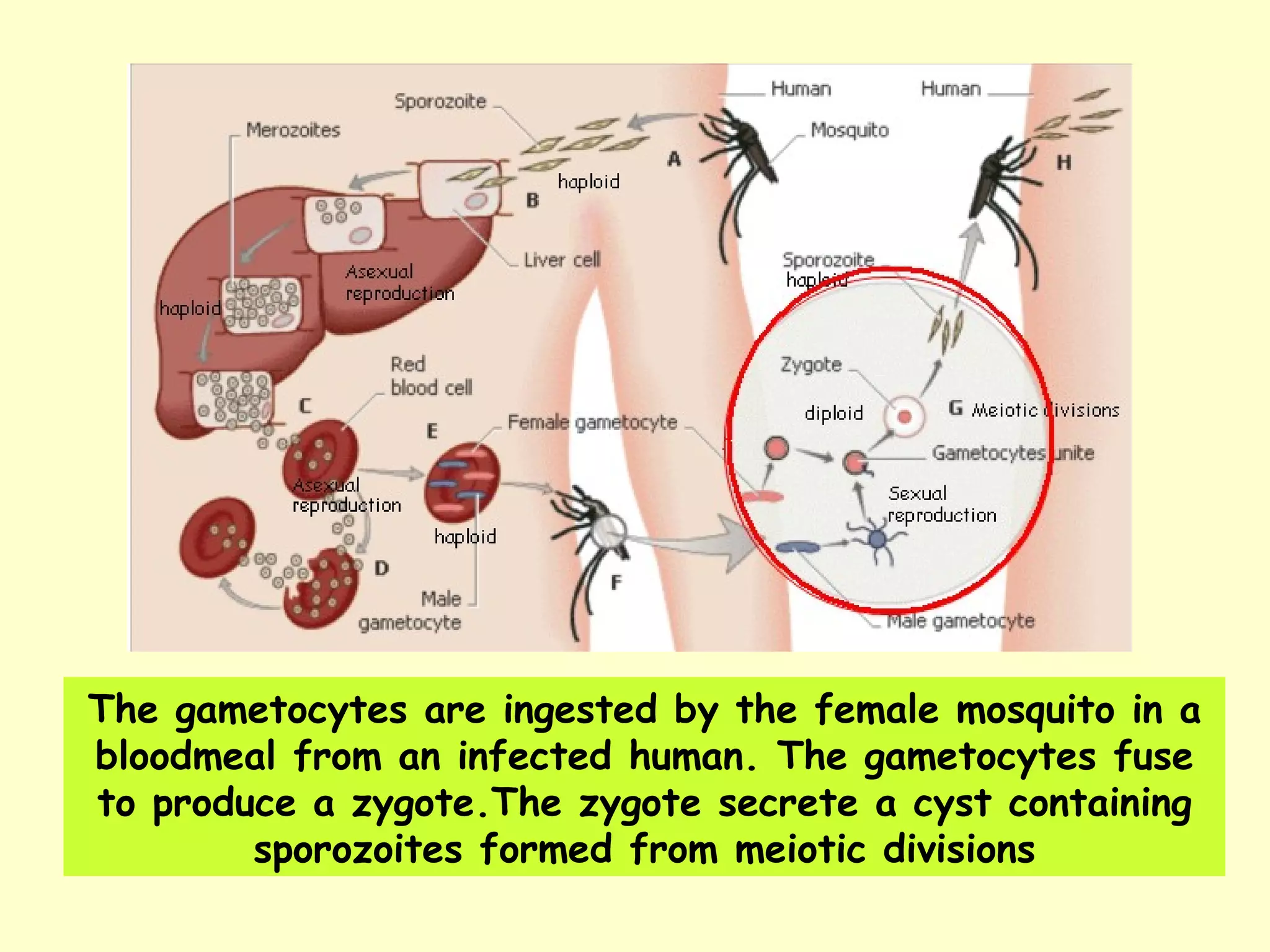
Humans are the  INTERMEDIATE HOST  and  RESERVOIR  of the parasite, and the mosquito is the  DEFINITIVE HOST  and  VECTOR .  Female   anopheline mosquitoes become infected only if they take a blood meal from a person whose blood contains mature male and female stages of the parasite.  A cycle of development and multiplication then begins with union of the male and female   gametocytes in the stomach of the mosquito and ends with parasites, called sporozoites, in its salivary glands, which are infective to humans.  The time required for the complete maturation of the parasite in the mosquito varies and   depends on the Plasmodium species and external temperature.   Lifecycle of Malaria Parasite 1 2 3
The gametocytes are ingested by the female mosquito in a bloodmeal from an infected human. The gametocytes fuse to produce a zygote.The zygote secrete a cyst containing sporozoites formed from meiotic divisions
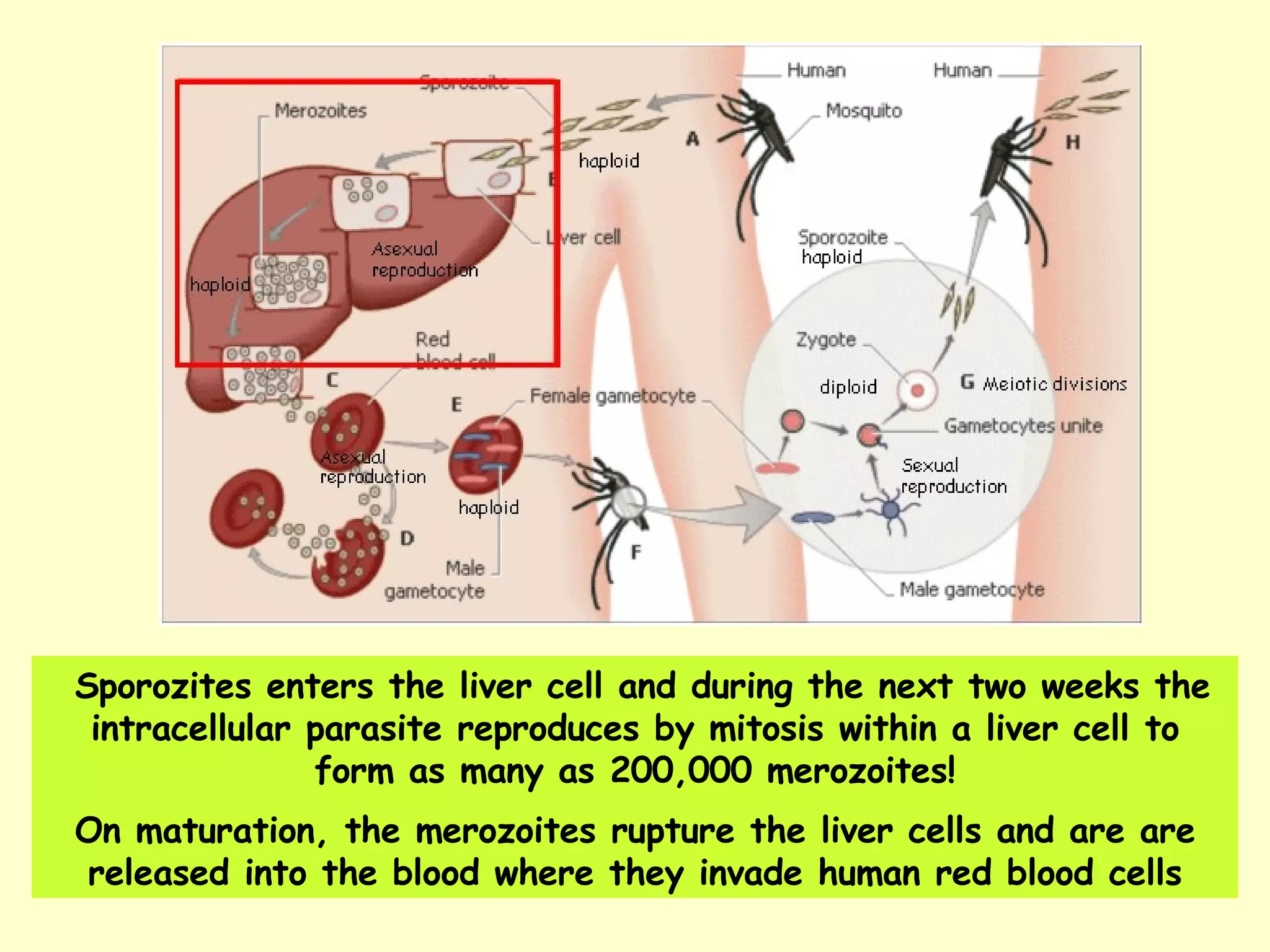
Sporozites enters the liver cell and during the next two weeks the intracellular parasite reproduces by mitosis within a liver cell to form as many as 200,000 merozoites! On maturation, the merozoites rupture the liver cells and are are released into the blood where they invade human red blood cells
In the red blood cells, the parasite matures asexually to produce another 10-20 merozoites which in turn can rupture the red blood cell and invade more liver cells or red blood cells
[ Animation ]
Evolution of Host/Parasite relationship Most parasitic relationships are very specific and complex  The parasite and the host have  co-evolved   This means that the host has developed a  defence mechanism   e.g.   immune system or hydrochloric acid in the stomach , to prevent the parasite from causing any harm if it has entered the body.  The  longer  the relationship has existed, the more  host specific  the parasite becomes
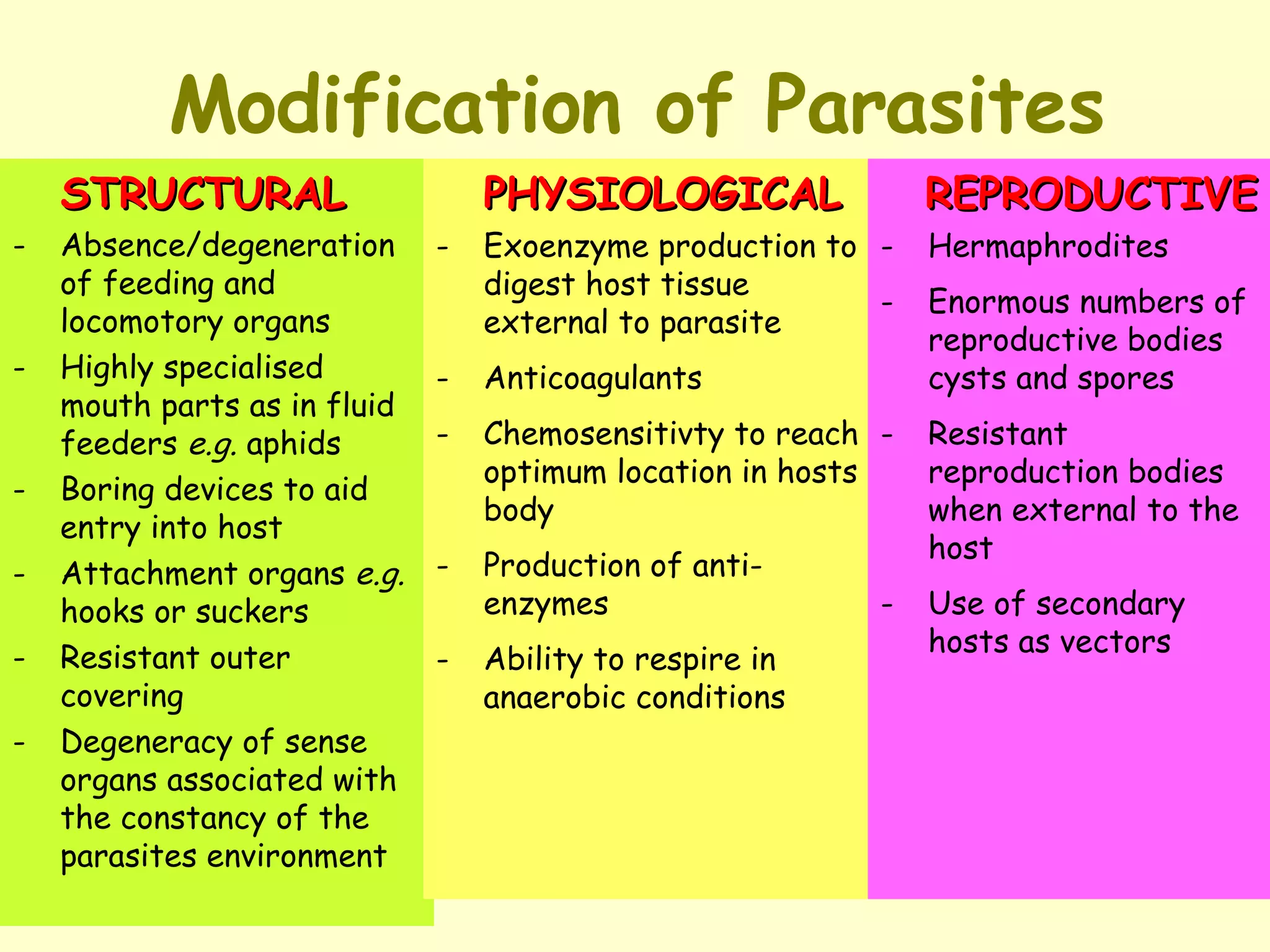
Modification of Parasites STRUCTURAL - Absence/degeneration of feeding and locomotory organs - Highly specialised mouth parts as in fluid feeders  e.g.  aphids - Boring devices to aid entry into host - Attachment organs  e.g.  hooks or suckers - Resistant outer covering - Degeneracy of sense organs associated with the constancy of the parasites environment PHYSIOLOGICAL - Exoenzyme production to digest host tissue external to parasite  - Anticoagulants  - Chemosensitivty to reach optimum location in hosts body  - Production of anti-enzymes  - Ability to respire in anaerobic conditions REPRODUCTIVE - Hermaphrodites  - Enormous numbers of reproductive bodies cysts and spores - Resistant reproduction bodies when external to the host - Use of secondary hosts as vectors
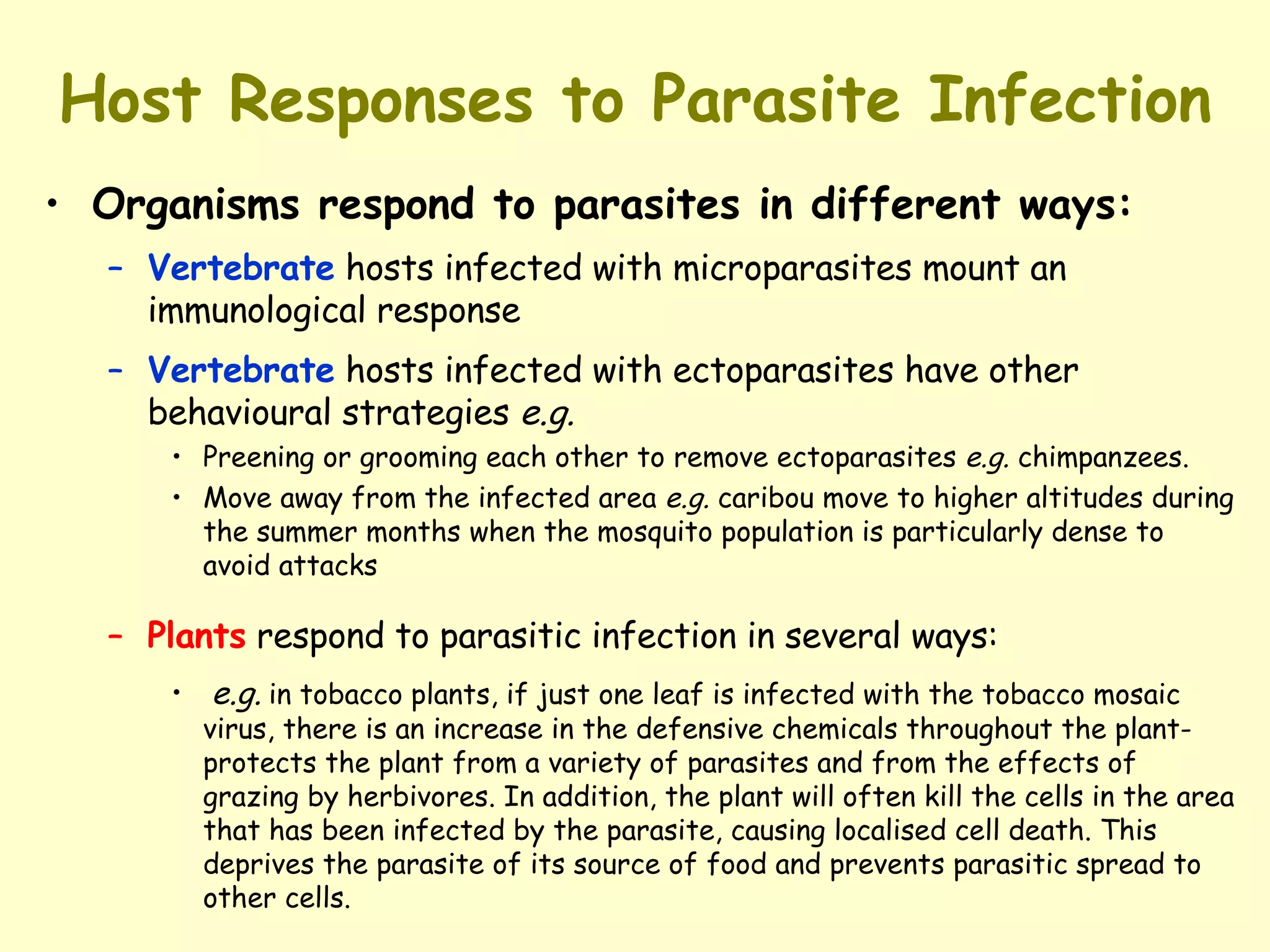
Host Responses to Parasite Infection Organisms respond to parasites in different ways: Vertebrate  hosts infected with microparasites mount an immunological response Vertebrate  hosts infected with ectoparasites have other behavioural strategies  e.g. Preening or grooming each other to remove ectoparasites  e.g.  chimpanzees.  Move away from the infected area  e.g.  caribou move to higher altitudes during the summer months when the mosquito population is particularly dense to avoid attacks Plants  respond to parasitic infection in several ways: e.g.   in tobacco plants, if just one leaf is infected with the tobacco mosaic virus, there is an increase in the defensive chemicals throughout the plant-protects the plant from a variety of parasites and from the effects of grazing by herbivores. In addition, the plant will often kill the cells in the area that has been infected by the parasite, causing localised cell death. This deprives the parasite of its source of food and prevents parasitic spread to other cells.
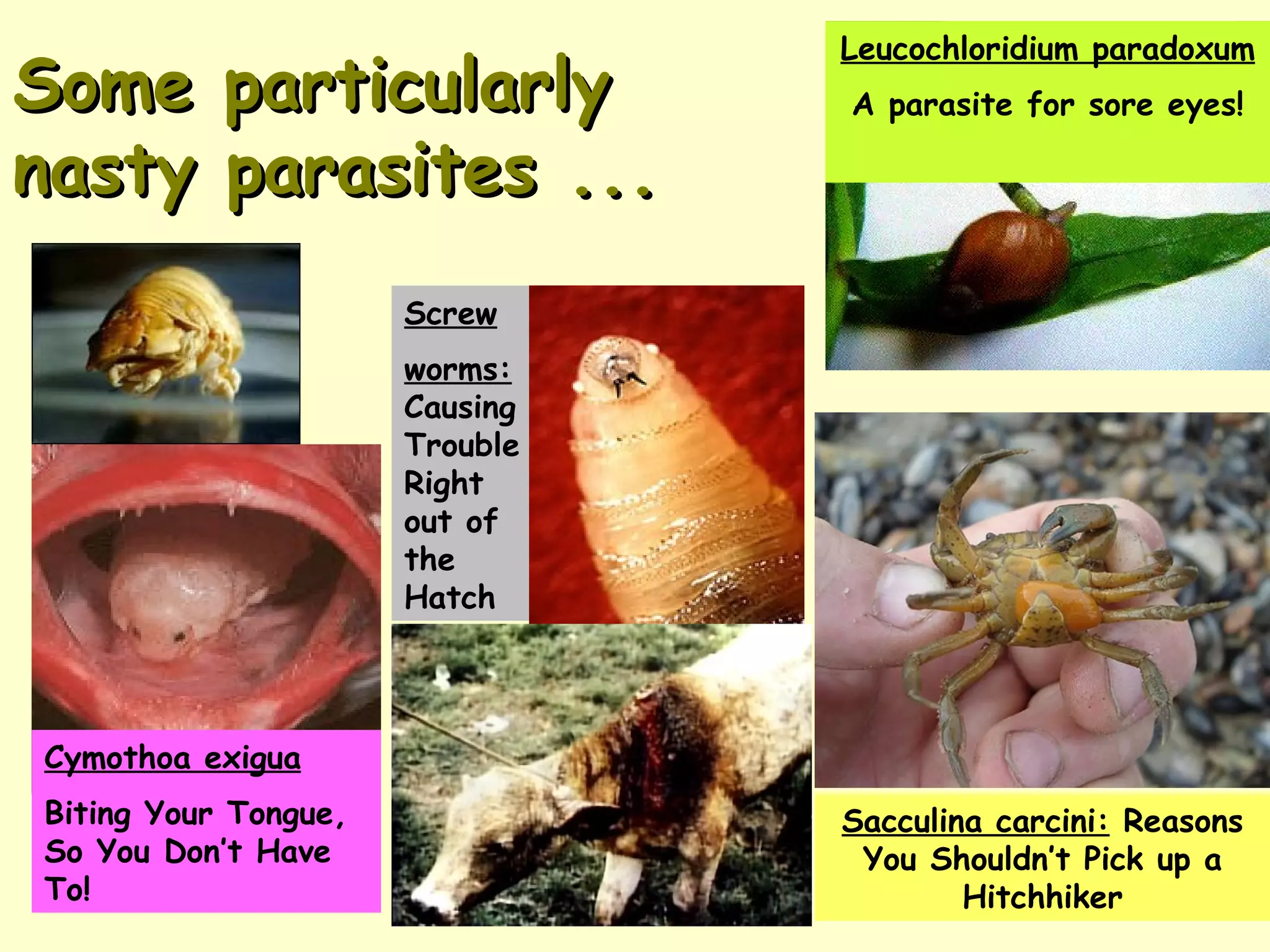
Some particularly nasty parasites ... Leucochloridium paradoxum A parasite for sore eyes! Cymothoa exigua   Biting Your Tongue, So You Don’t Have To! Sacculina carcini:  Reasons You Shouldn’t Pick up a Hitchhiker Screw worms:  Causing Trouble Right out of the Hatch
Koch’s Postulates There may be several different organisms growing in an infected sample, although most will have appeared after the initial disease has weakened the host.  Koch's postulates need to be satisfied in order to identify the organism that is causing a disease Koch was one of the original researchers into tuberculosis, in the 19th century. In an attempt to define what an infectious disease actually is, he formulated his famous postulates, which now bears his name. Basically if, 1. An organism can be isolated from a host suffering from the disease  AND 2. The organism can be cultured in the laboratory  AND   3. The organism causes the same disease when introduced into another host AND 4. The organism can be re-isolated from that host   THEN The organism is the  cause  of the disease and the disease  is  an infectious disease
Commensalism An interaction between species where  neither species is dependent  on the other for its existence, but in this case  only  ONE  of the partners benefits  from the association In the strictest truth very few of these relationships exist, as it is very unlikely the two organisms can live together without them affecting each other  Most examples of commensalism relationships are  feeding  or  protection
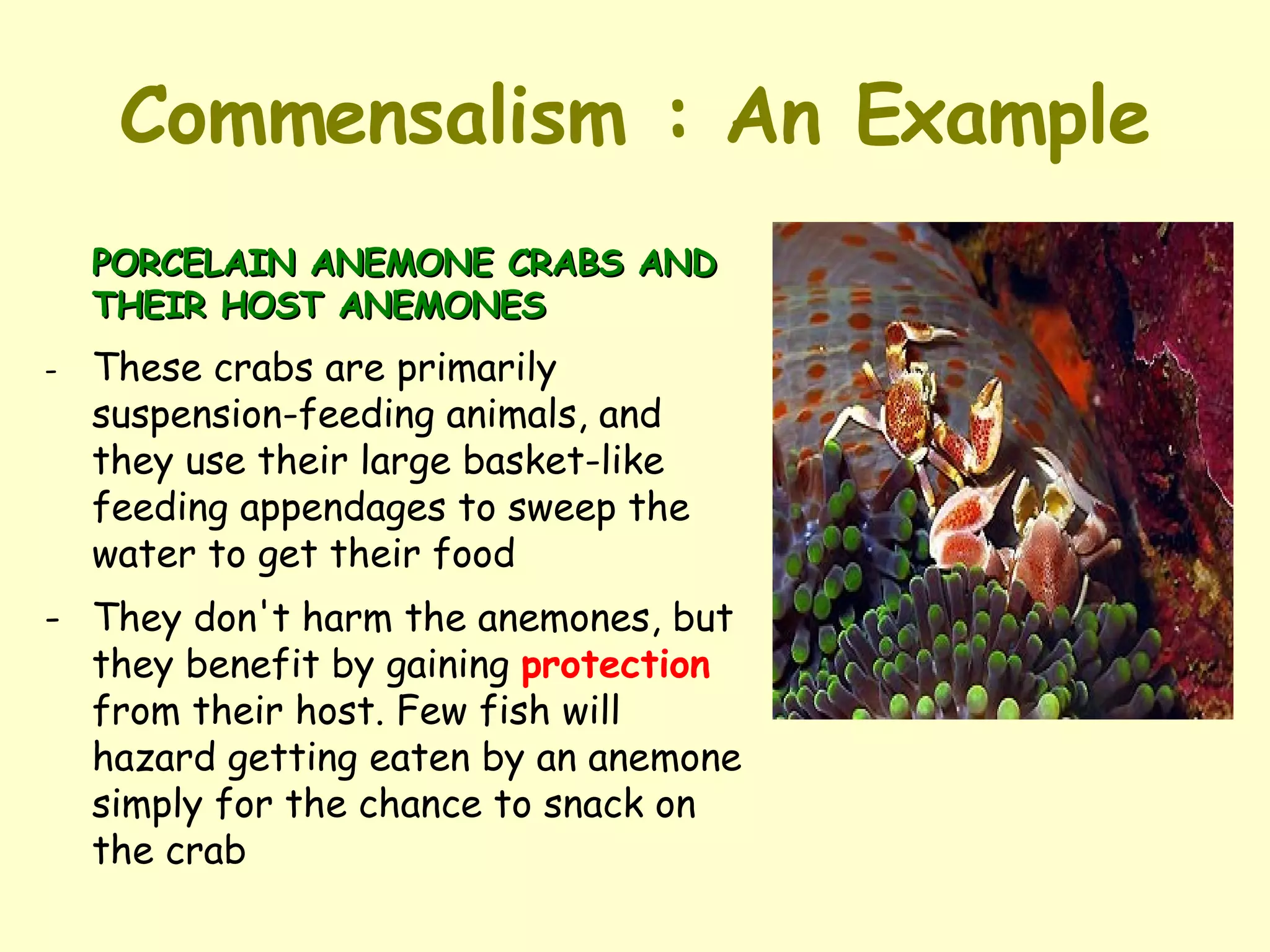
Commensalism : An Example PORCELAIN ANEMONE CRABS AND THEIR HOST ANEMONES - These crabs are primarily suspension-feeding animals, and they use their large basket-like feeding appendages to sweep the water to get their food - They don't harm the anemones, but they benefit by gaining  protection  from their host. Few fish will hazard getting eaten by an anemone simply for the chance to snack on the crab
Mutualism An interspecific interaction that benefits  BOTH  species They exchange  food  or provide  shelter  or protection, but may still be able to live an independent life In return for shelter, the clownfish cleans the anemones, chasing away their predators and dropping scraps of food for the anemone to eat
Mutualism: examples There are many different examples of mutualistic relationships:   Plants and microbes  e.g.   rhizobium in root nodules   Protists and fungi  e.g.   lichen   Terrestrial plants and insects,  e.g.   pollination  Animals and protists/bacteria  e.g.   ruminants, corals   Animals and other animals  e.g.   crocodile and plover bird
All orchids depend on fungi called  mycorrhizae  at some point during their life cycle The fungi grow partly on the root and aid the plant in the  uptake of nutrients The fungi benefit as they ingest some of the  food  from plant photosynthesis
Most plants have to search through the soil with their roots to find nitrogen which is a critical nutrient required for growth Legumes, however, form symbiotic relationships with  Rhizobium   bacteria The  Rhizobium  live in little nodules in the roots of the legumes and fix atmospheric nitrogen into ammonium or nitrate, forms of nitrogen that can be used by the plant  i.e.   Rhizobium  turn air into fertiliser!  The  plant  benefits because it gains nitrogen.  The  bacteria  benefit because they get sugars and nutrients to survive                                                                          
[ HANDOUT! ]

Symbiotic Relationships

  • 1.
    Symbiotic Relationships -Parasitism - Commensalism - Mutualism SYMBIOSIS refers to relationships between organisms of DIFFERENT species that show an intimate association with each other Symbiotic relationships provide at least ONE of the participating species with a nutritional advantage 3 types of symbiosis have been recognised depending on the nature of the relationship:
  • 2.
    Parasitism Interaction inwhich one organism, the parasite , derives nourishment from the other organism, the host Parasites are therefore chemoautotrophs This relationship is detrimental to the host, however a true parasite does normally not kill its host
  • 3.
    Obligate vs FacultativeMost parasites are OBLIGATE - that is they must live parasitically and die when their host dies Obligate parasites also have very few specialised structures for feeding or locomotion Some fungi are FACULTATIVE parasites since they can continue to feed saprophytically once their host has died Fewer facultative parasites have evolved as they must form complicated systems to detect, take in and digest food. Due to natural selection they would be at a disadvantage to obligate parasites.
  • 4.
    Parasite Types ECTOPARASITES - remain external to the host e.g. ticks, fleas, leeches ENDOPARASITES - live inside the body of the host e.g. liver flukes, tapeworms, malarial parasites
  • 5.
    MICROPARASITES They are small and have a short generation time e.g. viruses, bacteria and protozoans [ Plasmodium spp ] The duration of infection is short compared to the life span of the host
  • 6.
    MACROPARASITES Longer generationtime and tendency to persist causing continual reinfection e.g. roundworms tapeworms and fungi Intermediate hosts more common
  • 7.
    Parasite Transmission Manyparasites complete their entire lifecycle on or in a single host organism However, many alternate between 2 or more host species, specialising on a different host species at each stage in their lifecycle 2 general types of transmission: VERTICAL : from mother  offspring e.g. HIV HORIZONTAL : between members of a population Direct Contact e.g. Headlice Resistant Stages e.g. Liver fluke Secondary host species / Vectors e.g. Mosquitoes
  • 8.
    Parasite Transmission Case Study: MALARIA Malaria is a mosquito-borne disease caused by a parasite Plasmodium falciparum , P. vivax , P. ovale and P. malariae People with malaria often experience fever, chills, and flu-like illness Left untreated, they may develop severe complications and die Almost 85% of the world's malaria occurs in sub-Saharan Africa Each year 350-500 million cases of malaria occur worldwide, and over one million people die, most of them young children in sub-Saharan Africa
  • 9.
    Humans are the INTERMEDIATE HOST and RESERVOIR of the parasite, and the mosquito is the DEFINITIVE HOST and VECTOR . Female anopheline mosquitoes become infected only if they take a blood meal from a person whose blood contains mature male and female stages of the parasite. A cycle of development and multiplication then begins with union of the male and female gametocytes in the stomach of the mosquito and ends with parasites, called sporozoites, in its salivary glands, which are infective to humans. The time required for the complete maturation of the parasite in the mosquito varies and depends on the Plasmodium species and external temperature. Lifecycle of Malaria Parasite 1 2 3
  • 10.
    The gametocytes areingested by the female mosquito in a bloodmeal from an infected human. The gametocytes fuse to produce a zygote.The zygote secrete a cyst containing sporozoites formed from meiotic divisions
  • 11.
    Sporozites enters theliver cell and during the next two weeks the intracellular parasite reproduces by mitosis within a liver cell to form as many as 200,000 merozoites! On maturation, the merozoites rupture the liver cells and are are released into the blood where they invade human red blood cells
  • 12.
    In the redblood cells, the parasite matures asexually to produce another 10-20 merozoites which in turn can rupture the red blood cell and invade more liver cells or red blood cells
  • 13.
  • 14.
    Evolution of Host/Parasiterelationship Most parasitic relationships are very specific and complex The parasite and the host have co-evolved This means that the host has developed a defence mechanism e.g. immune system or hydrochloric acid in the stomach , to prevent the parasite from causing any harm if it has entered the body. The longer the relationship has existed, the more host specific the parasite becomes
  • 15.
    Modification of ParasitesSTRUCTURAL - Absence/degeneration of feeding and locomotory organs - Highly specialised mouth parts as in fluid feeders e.g. aphids - Boring devices to aid entry into host - Attachment organs e.g. hooks or suckers - Resistant outer covering - Degeneracy of sense organs associated with the constancy of the parasites environment PHYSIOLOGICAL - Exoenzyme production to digest host tissue external to parasite - Anticoagulants - Chemosensitivty to reach optimum location in hosts body - Production of anti-enzymes - Ability to respire in anaerobic conditions REPRODUCTIVE - Hermaphrodites - Enormous numbers of reproductive bodies cysts and spores - Resistant reproduction bodies when external to the host - Use of secondary hosts as vectors
  • 16.
    Host Responses toParasite Infection Organisms respond to parasites in different ways: Vertebrate hosts infected with microparasites mount an immunological response Vertebrate hosts infected with ectoparasites have other behavioural strategies e.g. Preening or grooming each other to remove ectoparasites e.g. chimpanzees. Move away from the infected area e.g. caribou move to higher altitudes during the summer months when the mosquito population is particularly dense to avoid attacks Plants respond to parasitic infection in several ways: e.g. in tobacco plants, if just one leaf is infected with the tobacco mosaic virus, there is an increase in the defensive chemicals throughout the plant-protects the plant from a variety of parasites and from the effects of grazing by herbivores. In addition, the plant will often kill the cells in the area that has been infected by the parasite, causing localised cell death. This deprives the parasite of its source of food and prevents parasitic spread to other cells.
  • 17.
    Some particularly nastyparasites ... Leucochloridium paradoxum A parasite for sore eyes! Cymothoa exigua Biting Your Tongue, So You Don’t Have To! Sacculina carcini: Reasons You Shouldn’t Pick up a Hitchhiker Screw worms: Causing Trouble Right out of the Hatch
  • 18.
    Koch’s Postulates Theremay be several different organisms growing in an infected sample, although most will have appeared after the initial disease has weakened the host. Koch's postulates need to be satisfied in order to identify the organism that is causing a disease Koch was one of the original researchers into tuberculosis, in the 19th century. In an attempt to define what an infectious disease actually is, he formulated his famous postulates, which now bears his name. Basically if, 1. An organism can be isolated from a host suffering from the disease AND 2. The organism can be cultured in the laboratory AND 3. The organism causes the same disease when introduced into another host AND 4. The organism can be re-isolated from that host THEN The organism is the cause of the disease and the disease is an infectious disease
  • 19.
    Commensalism An interactionbetween species where neither species is dependent on the other for its existence, but in this case only ONE of the partners benefits from the association In the strictest truth very few of these relationships exist, as it is very unlikely the two organisms can live together without them affecting each other Most examples of commensalism relationships are feeding or protection
  • 20.
    Commensalism : AnExample PORCELAIN ANEMONE CRABS AND THEIR HOST ANEMONES - These crabs are primarily suspension-feeding animals, and they use their large basket-like feeding appendages to sweep the water to get their food - They don't harm the anemones, but they benefit by gaining protection from their host. Few fish will hazard getting eaten by an anemone simply for the chance to snack on the crab
  • 21.
    Mutualism An interspecificinteraction that benefits BOTH species They exchange food or provide shelter or protection, but may still be able to live an independent life In return for shelter, the clownfish cleans the anemones, chasing away their predators and dropping scraps of food for the anemone to eat
  • 22.
    Mutualism: examples Thereare many different examples of mutualistic relationships: Plants and microbes e.g. rhizobium in root nodules Protists and fungi e.g. lichen Terrestrial plants and insects, e.g. pollination Animals and protists/bacteria e.g. ruminants, corals Animals and other animals e.g. crocodile and plover bird
  • 23.
    All orchids dependon fungi called mycorrhizae at some point during their life cycle The fungi grow partly on the root and aid the plant in the uptake of nutrients The fungi benefit as they ingest some of the food from plant photosynthesis
  • 24.
    Most plants haveto search through the soil with their roots to find nitrogen which is a critical nutrient required for growth Legumes, however, form symbiotic relationships with Rhizobium bacteria The Rhizobium live in little nodules in the roots of the legumes and fix atmospheric nitrogen into ammonium or nitrate, forms of nitrogen that can be used by the plant i.e. Rhizobium turn air into fertiliser! The plant benefits because it gains nitrogen. The bacteria benefit because they get sugars and nutrients to survive                                                                          
  • 25.