The Cytoskeleton The eukaryotic cell is a 3D structure. It has a cytoskeleton anchored to proteins in the plasma membrane These proteins both maintain shape and allow movement The cytoskeleton is a dynamic structure, as the microfilaments and microtubules can depolymerise and repolymerise very easily MICROFILAMENTS MICROTUBULES INTERMEDIATE FILAMENTS
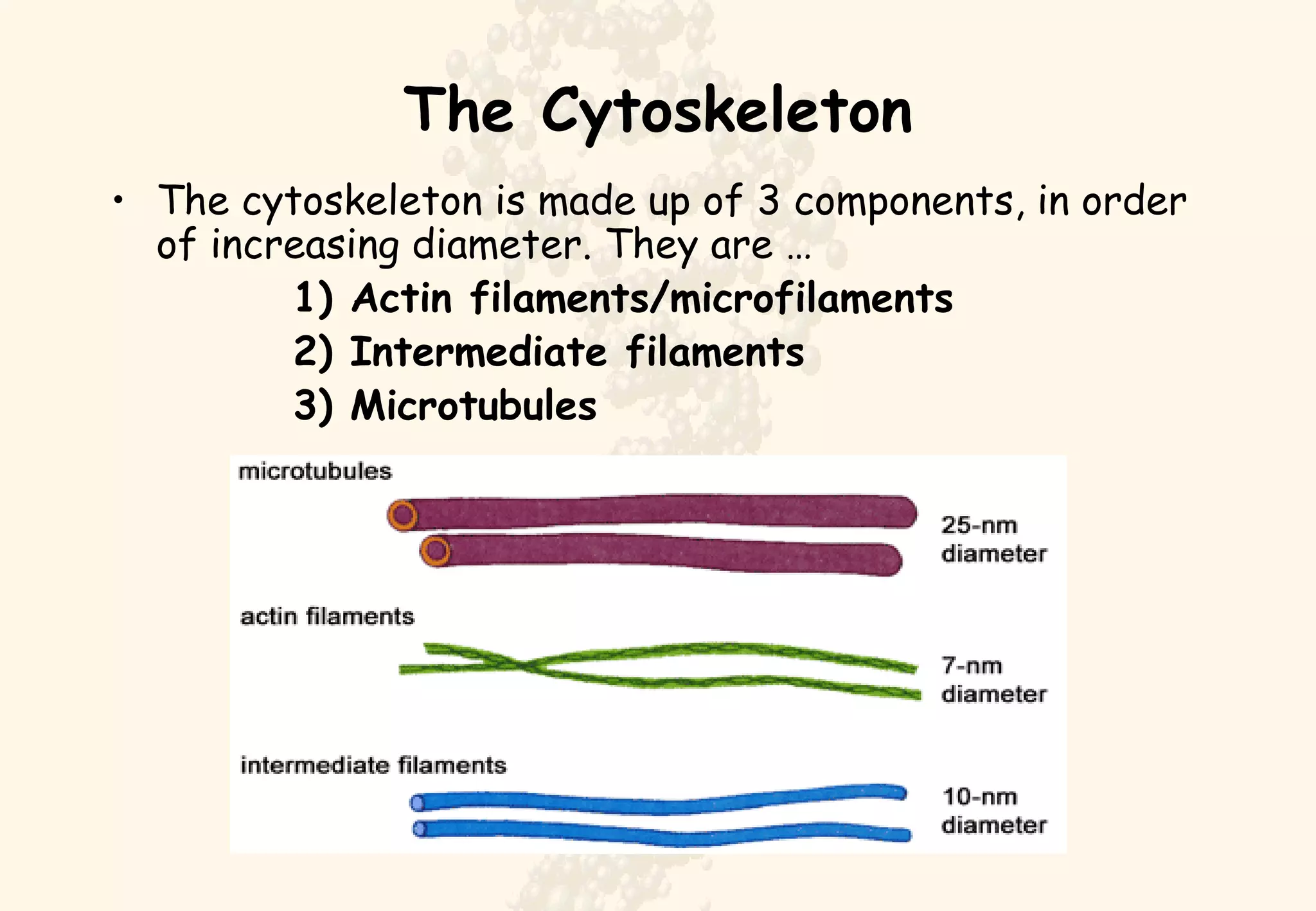
The Cytoskeleton The cytoskeleton is made up of 3 components, in order of increasing diameter. They are … 1) Actin filaments/microfilaments 2) Intermediate filaments 3) Microtubules
1) Microfilaments These are composed of actin (protein) They are arranged as 2 strands of protein molecules twisted together to give a rope-like structure about 7nm in diameter These are present throughout the cell but are most highly concentrated just inside the plasma membrane They are important in all  cell movement  and  contraction Actin fibres in a cell stained with a fluorescent strain specific for actin
2) Intermediate Filaments These are about 10nm in diameter and are composed of tough fibrous protein strands twisted together They are very stable structures in the cell and provide  mechanical strength  to animal cells which lack the strong cell walls of plants Intermediate filaments can be anchored between the membrane to provide extra support   The nucleus in epithelial cells is held within the cell by a basketlike network of intermediate filaments made of keratins which have been stained here using a fluorescent stain
3) Microtubules These are hollow tubes (like straws) composed of tubulin protein (a globular protein)  The tubulin protein subunits of microtubules associate in a cylindrical arrangement to generate the final microtubule - a relatively rigid structure Microtubules only form around a centrosome (organising centre) The centrosome provides a “nucleus” from which the microtubules form. These are important in cell division as part of the spindle fibre network and can move components within the cell Microtubules growing in vitro from an isolated centrosome
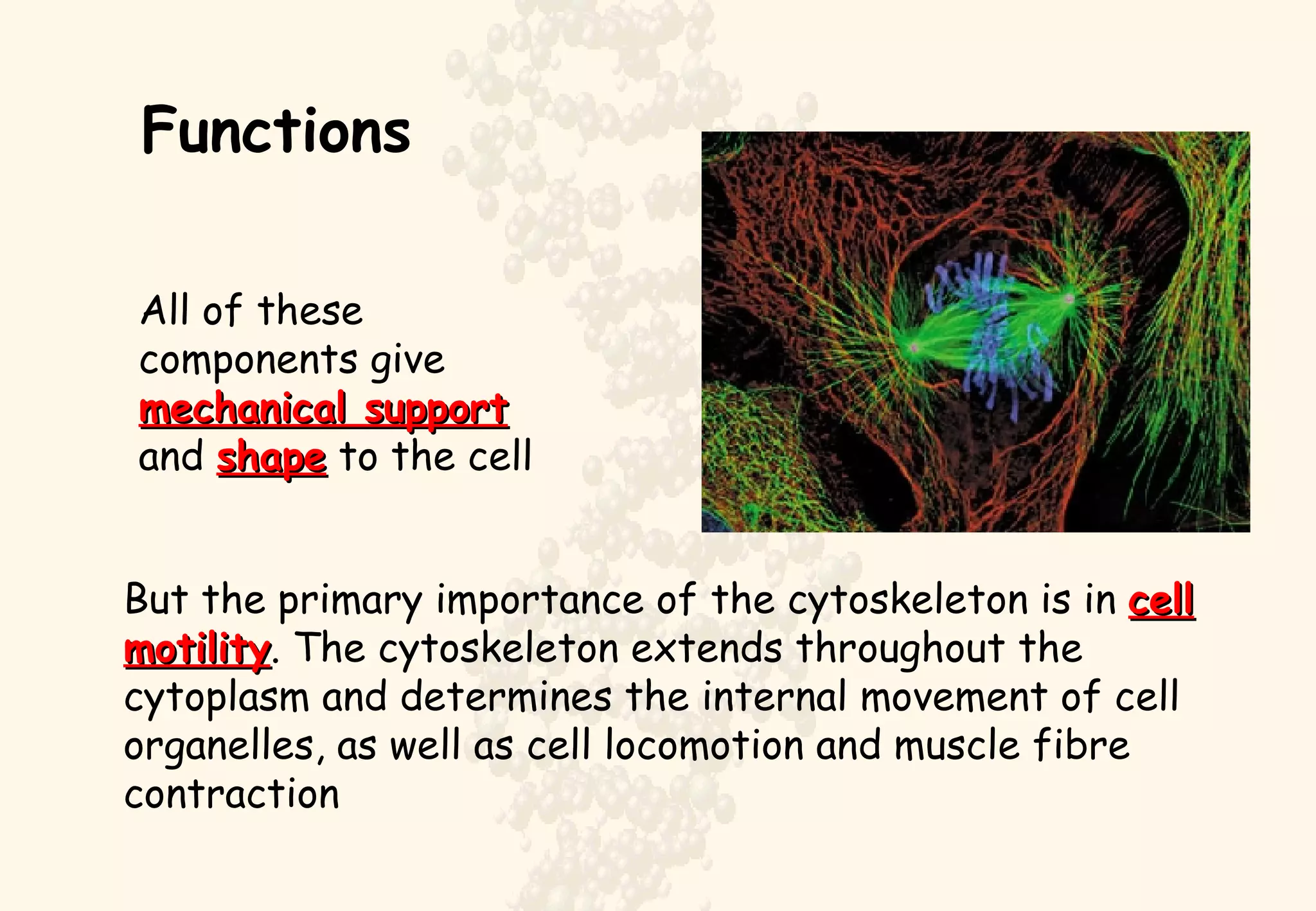
Functions But the primary importance of the cytoskeleton is in  cell motility . The cytoskeleton extends throughout the cytoplasm and determines the internal movement of cell organelles, as well as cell locomotion and muscle fibre contraction All of these components give  mechanical support  and  shape  to the cell

Cytoskeleton

  • 1.
    The Cytoskeleton Theeukaryotic cell is a 3D structure. It has a cytoskeleton anchored to proteins in the plasma membrane These proteins both maintain shape and allow movement The cytoskeleton is a dynamic structure, as the microfilaments and microtubules can depolymerise and repolymerise very easily MICROFILAMENTS MICROTUBULES INTERMEDIATE FILAMENTS
  • 2.
    The Cytoskeleton Thecytoskeleton is made up of 3 components, in order of increasing diameter. They are … 1) Actin filaments/microfilaments 2) Intermediate filaments 3) Microtubules
  • 3.
    1) Microfilaments Theseare composed of actin (protein) They are arranged as 2 strands of protein molecules twisted together to give a rope-like structure about 7nm in diameter These are present throughout the cell but are most highly concentrated just inside the plasma membrane They are important in all cell movement and contraction Actin fibres in a cell stained with a fluorescent strain specific for actin
  • 4.
    2) Intermediate FilamentsThese are about 10nm in diameter and are composed of tough fibrous protein strands twisted together They are very stable structures in the cell and provide mechanical strength to animal cells which lack the strong cell walls of plants Intermediate filaments can be anchored between the membrane to provide extra support The nucleus in epithelial cells is held within the cell by a basketlike network of intermediate filaments made of keratins which have been stained here using a fluorescent stain
  • 5.
    3) Microtubules Theseare hollow tubes (like straws) composed of tubulin protein (a globular protein) The tubulin protein subunits of microtubules associate in a cylindrical arrangement to generate the final microtubule - a relatively rigid structure Microtubules only form around a centrosome (organising centre) The centrosome provides a “nucleus” from which the microtubules form. These are important in cell division as part of the spindle fibre network and can move components within the cell Microtubules growing in vitro from an isolated centrosome
  • 6.
    Functions But theprimary importance of the cytoskeleton is in cell motility . The cytoskeleton extends throughout the cytoplasm and determines the internal movement of cell organelles, as well as cell locomotion and muscle fibre contraction All of these components give mechanical support and shape to the cell