CELL CULTURING
Girija Maganti
M.Pharm
(pharmacology)
What is Cell Culture?
Cell culture refers to the removal of cells
from an animal or plant and their subsequent
growth in a favorable artificial environment.
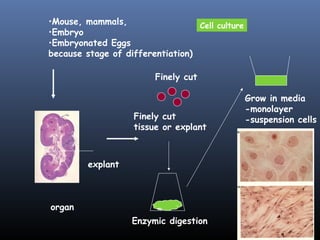
•Mouse, mammals,
•Embryo
•Embryonated Eggs
because stage of differentiation)
organ
explant
Grow in media
-monolayer
-suspension cells
Cell culture
Finely cut
Finely cut
tissue or explant
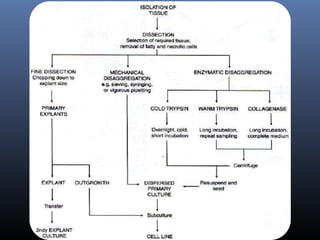
Enzymic digestion
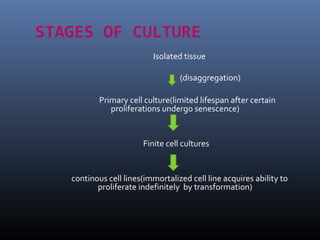
STAGES OF CULTURE
Isolated tissue
(disaggregation)
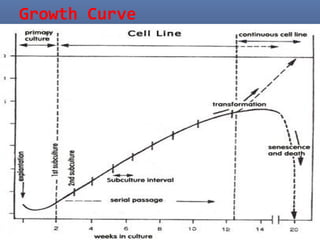
Primary cell culture(limited lifespan after certain
proliferations undergo senescence)
Finite cell cultures
continous cell lines(immortalized cell line acquires ability to
proliferate indefinitely by transformation)
Growth Curve
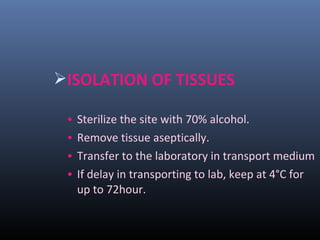
ISOLATION OF TISSUES
• Sterilize the site with 70% alcohol.
• Remove tissue aseptically.
• Transfer to the laboratory in transport medium
• If delay in transporting to lab, keep at 4°C for
up to 72hour.
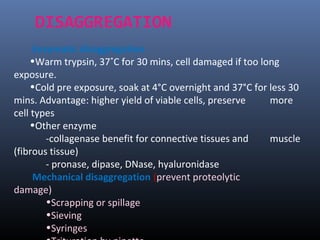
Enzymatic disaggregation
•Warm trypsin, 37˚C for 30 mins, cell damaged if too long
exposure.
•Cold pre exposure, soak at 4°C overnight and 37°C for less 30
mins. Advantage: higher yield of viable cells, preserve more
cell types
•Other enzyme
-collagenase benefit for connective tissues and muscle
(fibrous tissue)
- pronase, dipase, DNase, hyaluronidase
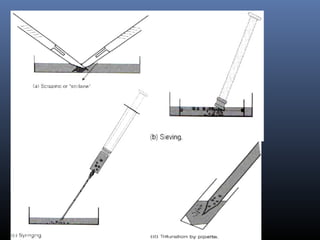
Mechanical disaggregation (prevent proteolytic
damage)
•Scrapping or spillage
•Sieving
•Syringes
DISAGGREGATION
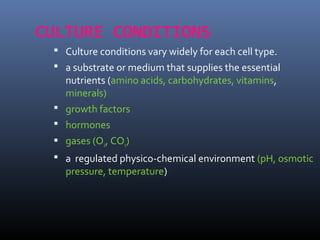
CULTURE CONDITIONS
 Culture conditions vary widely for each cell type.
 a substrate or medium that supplies the essential
nutrients (amino acids, carbohydrates, vitamins,
minerals)
 growth factors
 hormones
 gases (O2, CO2)
 a regulated physico-chemical environment (pH, osmotic
pressure, temperature)
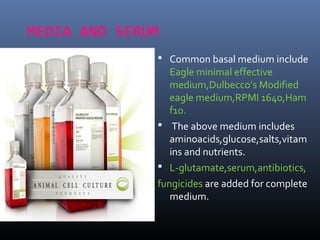
MEDIA AND SERUM
 Common basal medium include
Eagle minimal effective
medium,Dulbecco’s Modified
eagle medium,RPMI 1640,Ham
f10.
 The above medium includes
aminoacids,glucose,salts,vitam
ins and nutrients.
 L-glutamate,serum,antibiotics,
fungicides are added for complete
medium.
 Serum may or may not be used
 Most frequently used serum-fetal calf serum
 Less expensive sera such as horse or calf sera
can be used.
 Serum supports growth of cell.
 Antibiotics and fungicides prevent microbial
contamination.
 Some cell types like primary cell requrie
additional supliments(collagen
,fibronectin,epidermal growth factor)to attach
culture vessel and proliferate.
 Sterility of the medium is tested by incubating
small aliquot at 37°c for 48 hours,ifany microial
growth the medium should be discarded.
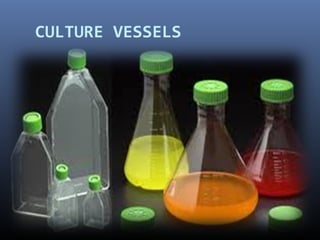
CULTURE VESSELS
MODES OF PROPAGATION
 Depending on their origin, animal cells grow
either as adherent monolayers or in
suspension.
 Adherent cells are anchorage dependent and
propagate as monolayer attached to the cell
culture vessel.
 Eg:cells derived from tissues
 Suspension cells:proliferate without being
attached to a substratum.
Eg:haemopoietic cell,cells derived from
tumours
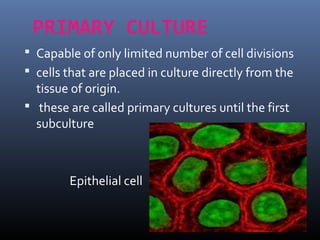
PRIMARY CULTURE
 Capable of only limited number of cell divisions
 cells that are placed in culture directly from the
tissue of origin.
 these are called primary cultures until the first
subculture
Epithelial cell
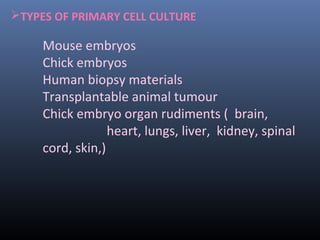
TYPES OF PRIMARY CELL CULTURE
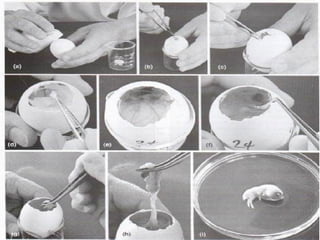
Mouse embryos
Chick embryos
Human biopsy materials
Transplantable animal tumour
Chick embryo organ rudiments ( brain,
heart, lungs, liver, kidney, spinal
cord, skin,)
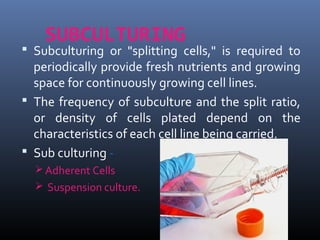
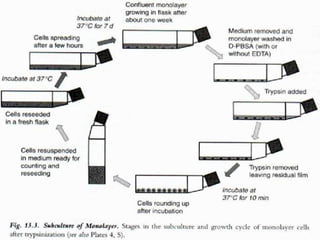
SUBCULTURING
 Subculturing or "splitting cells," is required to
periodically provide fresh nutrients and growing
space for continuously growing cell lines.
 The frequency of subculture and the split ratio,
or density of cells plated depend on the
characteristics of each cell line being carried.
 Sub culturing -
 Adherent Cells
 Suspension culture.
CONTINOUS CELL LINES
• After the first subculture, primary culture may
be called secondary cultures, and thereafter, if
continued passage is possible, a continous cell
line are formed.
• An established or immortalised cell line has
acquired the ability to proliferate indefinitely
either through random mutation or deliberate
modification, such as artificial expression of the
telomerase gene.
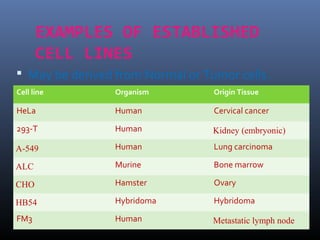
EXAMPLES OF ESTABLISHED
CELL LINES
 May be derived from Normal or Tumor cells.
Cell line Organism Origin Tissue
HeLa Human Cervical cancer
293-T Human Kidney (embryonic)
A-549 Human Lung carcinoma
ALC Murine Bone marrow
CHO Hamster Ovary
HB54 Hybridoma Hybridoma
FM3 Human Metastatic lymph node
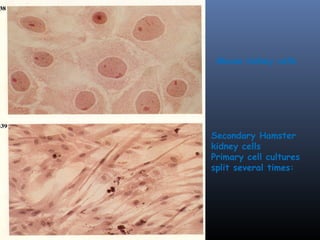
Mouse kidney cells
Secondary Hamster
kidney cells
Primary cell cultures
split several times:
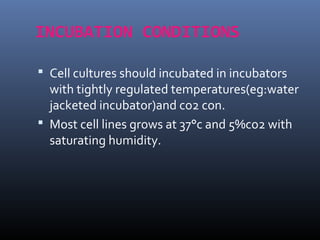
INCUBATION CONDITIONS
 Cell cultures should incubated in incubators
with tightly regulated temperatures(eg:water
jacketed incubator)and co2 con.
 Most cell lines grows at 37°c and 5%co2 with
saturating humidity.
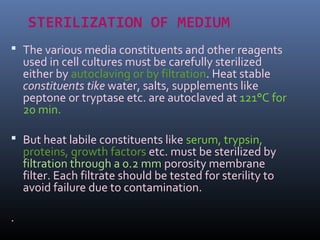
STERILIZATION OF MEDIUM
 The various media constituents and other reagents
used in cell cultures must be carefully sterilized
either by autoclaving or by filtration. Heat stable
constituents tike water, salts, supplements like
peptone or tryptase etc. are autoclaved at 121°C for
20 min.
 But heat labile constituents like serum, trypsin,
proteins, growth factors etc. must be sterilized by
filtration through a 0.2 mm porosity membrane
filter. Each filtrate should be tested for sterility to
avoid failure due to contamination.
.
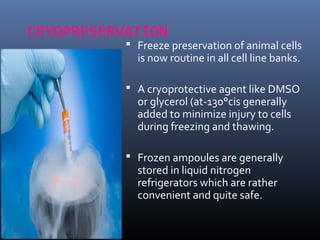
CRYOPRESERVATION
 Freeze preservation of animal cells
is now routine in all cell line banks.
 A cryoprotective agent like DMSO
or glycerol (at-130°cis generally
added to minimize injury to cells
during freezing and thawing.
 Frozen ampoules are generally
stored in liquid nitrogen
refrigerators which are rather
convenient and quite safe.
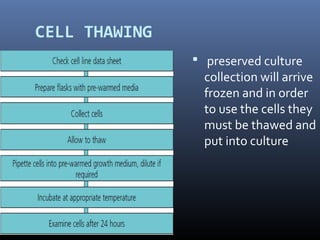
CELL THAWING
 preserved culture
collection will arrive
frozen and in order
to use the cells they
must be thawed and
put into culture
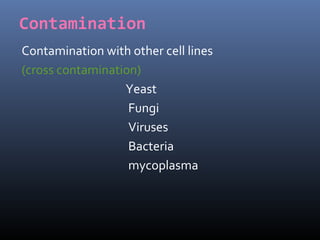
Contamination
Contamination with other cell lines
(cross contamination)
Yeast
Fungi
Viruses
Bacteria
mycoplasma
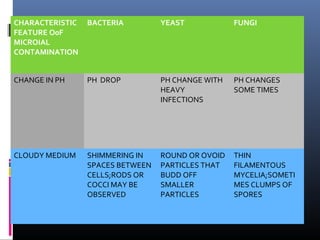
CHARACTERISTIC
FEATURE O0F
MICROIAL
CONTAMINATION
BACTERIA YEAST FUNGI
CHANGE IN PH PH DROP PH CHANGE WITH
HEAVY
INFECTIONS
PH CHANGES
SOME TIMES
CLOUDY MEDIUM SHIMMERING IN
SPACES BETWEEN
CELLS;RODS OR
COCCI MAY BE
OBSERVED
ROUND OR OVOID
PARTICLES THAT
BUDD OFF
SMALLER
PARTICLES
THIN
FILAMENTOUS
MYCELIA;SOMETI
MES CLUMPS OF
SPORES
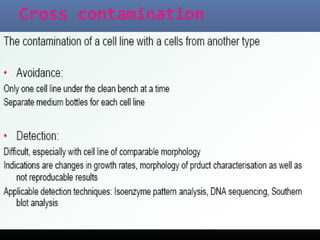
Cross contamination
APPLICATIONS
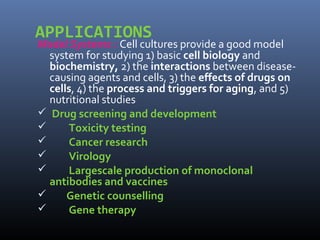
Model Systems : Cell cultures provide a good model
system for studying 1) basic cell biology and
biochemistry, 2) the interactions between disease-
causing agents and cells, 3) the effects of drugs on
cells, 4) the process and triggers for aging, and 5)
nutritional studies
 Drug screening and development
 Toxicity testing
 Cancer research
 Virology
 Largescale production of monoclonal
antibodies and vaccines
 Genetic counselling
 Gene therapy
Thank you

Animal cell lines culturing

  • 1.
  • 2.
    What is CellCulture? Cell culture refers to the removal of cells from an animal or plant and their subsequent growth in a favorable artificial environment.
  • 3.
    •Mouse, mammals, •Embryo •Embryonated Eggs becausestage of differentiation) organ explant Grow in media -monolayer -suspension cells Cell culture Finely cut Finely cut tissue or explant Enzymic digestion
  • 4.
    STAGES OF CULTURE Isolatedtissue (disaggregation) Primary cell culture(limited lifespan after certain proliferations undergo senescence) Finite cell cultures continous cell lines(immortalized cell line acquires ability to proliferate indefinitely by transformation)
  • 5.
  • 7.
    ISOLATION OF TISSUES •Sterilize the site with 70% alcohol. • Remove tissue aseptically. • Transfer to the laboratory in transport medium • If delay in transporting to lab, keep at 4°C for up to 72hour.
  • 9.
    Enzymatic disaggregation •Warm trypsin,37˚C for 30 mins, cell damaged if too long exposure. •Cold pre exposure, soak at 4°C overnight and 37°C for less 30 mins. Advantage: higher yield of viable cells, preserve more cell types •Other enzyme -collagenase benefit for connective tissues and muscle (fibrous tissue) - pronase, dipase, DNase, hyaluronidase Mechanical disaggregation (prevent proteolytic damage) •Scrapping or spillage •Sieving •Syringes DISAGGREGATION
  • 11.
    CULTURE CONDITIONS  Cultureconditions vary widely for each cell type.  a substrate or medium that supplies the essential nutrients (amino acids, carbohydrates, vitamins, minerals)  growth factors  hormones  gases (O2, CO2)  a regulated physico-chemical environment (pH, osmotic pressure, temperature)
  • 12.
    MEDIA AND SERUM Common basal medium include Eagle minimal effective medium,Dulbecco’s Modified eagle medium,RPMI 1640,Ham f10.  The above medium includes aminoacids,glucose,salts,vitam ins and nutrients.  L-glutamate,serum,antibiotics, fungicides are added for complete medium.
  • 13.
     Serum mayor may not be used  Most frequently used serum-fetal calf serum  Less expensive sera such as horse or calf sera can be used.  Serum supports growth of cell.  Antibiotics and fungicides prevent microbial contamination.  Some cell types like primary cell requrie additional supliments(collagen ,fibronectin,epidermal growth factor)to attach culture vessel and proliferate.  Sterility of the medium is tested by incubating small aliquot at 37°c for 48 hours,ifany microial growth the medium should be discarded.
  • 14.
  • 15.
    MODES OF PROPAGATION Depending on their origin, animal cells grow either as adherent monolayers or in suspension.  Adherent cells are anchorage dependent and propagate as monolayer attached to the cell culture vessel.  Eg:cells derived from tissues  Suspension cells:proliferate without being attached to a substratum. Eg:haemopoietic cell,cells derived from tumours
  • 16.
    PRIMARY CULTURE  Capableof only limited number of cell divisions  cells that are placed in culture directly from the tissue of origin.  these are called primary cultures until the first subculture Epithelial cell
  • 17.
    TYPES OF PRIMARYCELL CULTURE Mouse embryos Chick embryos Human biopsy materials Transplantable animal tumour Chick embryo organ rudiments ( brain, heart, lungs, liver, kidney, spinal cord, skin,)
  • 18.
    SUBCULTURING  Subculturing or"splitting cells," is required to periodically provide fresh nutrients and growing space for continuously growing cell lines.  The frequency of subculture and the split ratio, or density of cells plated depend on the characteristics of each cell line being carried.  Sub culturing -  Adherent Cells  Suspension culture.
  • 20.
    CONTINOUS CELL LINES •After the first subculture, primary culture may be called secondary cultures, and thereafter, if continued passage is possible, a continous cell line are formed. • An established or immortalised cell line has acquired the ability to proliferate indefinitely either through random mutation or deliberate modification, such as artificial expression of the telomerase gene.
  • 21.
    EXAMPLES OF ESTABLISHED CELLLINES  May be derived from Normal or Tumor cells. Cell line Organism Origin Tissue HeLa Human Cervical cancer 293-T Human Kidney (embryonic) A-549 Human Lung carcinoma ALC Murine Bone marrow CHO Hamster Ovary HB54 Hybridoma Hybridoma FM3 Human Metastatic lymph node
  • 22.
    Mouse kidney cells SecondaryHamster kidney cells Primary cell cultures split several times:
  • 23.
    INCUBATION CONDITIONS  Cellcultures should incubated in incubators with tightly regulated temperatures(eg:water jacketed incubator)and co2 con.  Most cell lines grows at 37°c and 5%co2 with saturating humidity.
  • 24.
    STERILIZATION OF MEDIUM The various media constituents and other reagents used in cell cultures must be carefully sterilized either by autoclaving or by filtration. Heat stable constituents tike water, salts, supplements like peptone or tryptase etc. are autoclaved at 121°C for 20 min.  But heat labile constituents like serum, trypsin, proteins, growth factors etc. must be sterilized by filtration through a 0.2 mm porosity membrane filter. Each filtrate should be tested for sterility to avoid failure due to contamination. .
  • 25.
    CRYOPRESERVATION  Freeze preservationof animal cells is now routine in all cell line banks.  A cryoprotective agent like DMSO or glycerol (at-130°cis generally added to minimize injury to cells during freezing and thawing.  Frozen ampoules are generally stored in liquid nitrogen refrigerators which are rather convenient and quite safe.
  • 26.
    CELL THAWING  preservedculture collection will arrive frozen and in order to use the cells they must be thawed and put into culture
  • 28.
    Contamination Contamination with othercell lines (cross contamination) Yeast Fungi Viruses Bacteria mycoplasma
  • 29.
    CHARACTERISTIC FEATURE O0F MICROIAL CONTAMINATION BACTERIA YEASTFUNGI CHANGE IN PH PH DROP PH CHANGE WITH HEAVY INFECTIONS PH CHANGES SOME TIMES CLOUDY MEDIUM SHIMMERING IN SPACES BETWEEN CELLS;RODS OR COCCI MAY BE OBSERVED ROUND OR OVOID PARTICLES THAT BUDD OFF SMALLER PARTICLES THIN FILAMENTOUS MYCELIA;SOMETI MES CLUMPS OF SPORES
  • 30.
  • 31.
    APPLICATIONS Model Systems :Cell cultures provide a good model system for studying 1) basic cell biology and biochemistry, 2) the interactions between disease- causing agents and cells, 3) the effects of drugs on cells, 4) the process and triggers for aging, and 5) nutritional studies  Drug screening and development  Toxicity testing  Cancer research  Virology  Largescale production of monoclonal antibodies and vaccines  Genetic counselling  Gene therapy
  • 32.