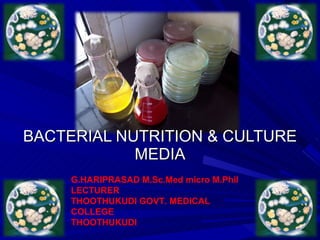
BACTERIAL NUTRITION & CULTURE MEDIA G.HARIPRASAD M.Sc.Med micro M.Phil LECTURER THOOTHUKUDI GOVT. MEDICAL COLLEGE  THOOTHUKUDI
BASIC NUTRITIONAL REQUIREMENTS WATER. CARBON SOURCE. NITROGEN SOURCE. INORGANIC SALTS. Phosphates. Sulfates. Sodium. Potassium. Magnesium. Iron. Manganese. Calcium. BACTERIAL VITAMINS. Thiamine riboflavin nicotinic acid pyridoxine folic acid vitamine B 12.
GASEOUS REQUIREMENTS OXYGEN  Obligate aerobes Facultative anaerobes. Microaerophillic. Obligate anaerobes.  CARBONDIOXIDE: Capnophillic.
TEMPERATURE Psychrophillic  – bacteria that grows at lower temeperature – below 20 ºC. Mesophillic  – bacteria that grows at 25ºC-40ºC. optimum temp range - 37ºC. Thermophillic  – bacteria that grows at high temperatures - 55ºC-80ºC.
H-ION CONCENTRATION (pH) Acidophillic bacteria – pH range below 7. Most pathogens grow at neutral pH range (7.2-7.6). Some grow at alkaline pH range – above 7
CULTURE MEDIA BASIC INGREDIENTS PROTEIN SOURCE  – peptone (a complex mixture of partially digested proteins). - special brands – Neopeptone & proteose peptone - digest broths can also be used. - meat extract (Lab Lemco). MINERAL SALT  – sodium chloride. AGAR - Prepared for using solid media. - Obtained from sea weeds. - Long chain polysaccharides. - Also contains varying amounts of inorganic salts and    small quantities of a protein – like substance. - Hydrolised at high temperature at high acid or alkaline    pH. - Melts at 98 ºC and usually sets at 42ºC depending on    agar concentration. - Approximately 2% agar is used to prepare solid media. - Manufacture either in long shreds or in powder form. WATER- source of hydrogen and oxygen.
TYPES OF CULTURE MEDIA BASED ON THE AGAR CONCENTRATION (Consistency): 1.   Solid media – 2% agar. 2. Liquid media – absence of agar. 3. Semi solid media – 0.2-0.5% agar
TYPES OF CULTURE MEDIA BASED ON THE INGREDIENTS: 1. Simple or basal medium. 2. Complex medium. 3. Synthetic or defined medium. 4. Semisynthetic or semidefined medium. 5. Special medium   a. enriched medium.   b. enrichment medium.   c. selective medium.   d. indicator or differential medium.   e. transport medium.   f.  Anaerobic medium.   g. sugar medium.
SIMPLE OR BASAL MEDIUM Example:  Nutrient agar & Nutrient broth. Consists of peptone, meat extract, sodium chloride and water. Used to isolate separate colonies for studying 1.colony morphology. 2.pigmentation. 3.biochemical identification tests. NUTRIENT AGAR
 
COMPLEX MEDIUM Exact chemical composition of ingredients of culture medium is not known. Widely used for the cultivation of bacteria for diagnostic purposes.
SYNTHETIC & SEMISYNTHETIC MEDIUM SYNTHETIC OR DEFINED MEDIUM: Prepared from pure chemical substances and the exact composition of the medium is known. Used for various special studies such as metabolic requirements. EXAMPLE: Dubo’s medium SEMISYNTHETIC OR SEMIDEFINED MEDIUM: Composition is approximately known.
SPECIAL MEDIUM ENRICHED MEDIUM Substances such as blood, egg, serum are added to the basal medium. Used to grow bacteria which are more exacting in their nutritional needs. EXAMPLE:    Blood agar  – hemolytic properties.   Chocolate agar -  to supply blood factors like X factor (Hemin) and Y factor (NAD)   BLOOD AGAR   CHOCOLATE   AGAR
GAMMA HEMOLYSIS ALPHA HEMOLYSIS WITH GREENISH DISCOLORATION (no clear zone around colonies) BETA HEMOLYSIS (clear zone around colonies)
BETA HEMOLYSIS  UNINOCULATED BLOOD AGAR
BROWN PIGMENT ON BLOOD AGAR PORPHYROMONAS / PREVOTELLA SP., - IMPORTANT DENTAL PATHOGEN
CHOCOLATE AGAR (HEATED BLOOD AGAR)
SPECIAL MEDIUM ENRICHMENT MEDIUM Obtaining the desired bacteria in more numbers from the mixed culture. Contains substances that stimulates the desired bacteria or has inhibitory substances that inhibits the growth of unwanted bacteria. EXAMPLE:  Selenite F broth.   Tetrathionate broth.
TCBS AGAR – FOR VIBRIO CHARCOAL  AGAR  – FOR BORDETELLA DCA  – FOR SALMONELLA MSA – FOR STAPH
EOSIN METHYLENE BLUE  – E.COLI
LOWENSTEIN –JENSEN (LJ) MEDIUM SELECTIVE MEDIUM FOR  MYCOBACTERIUM TUBERCULOSIS
SPECIAL MEDIUM SELECTIVE MEDIUM This media enables a greater number of the required bacteria to form colonies than the other bacteria. EXAMPLE:  LJ medium  for the selective isolation of M.tuberculosis. Desoxy cholate agar  for Salmonella and Shigella Xylose lysine deoxycholate agar for Salmonella and Shigella.
SPECIAL MEDIUM DIFFERENTIAL MEDIUM A medium which has substances incorporated in it, enabling it to bring out differing characteristics of bacteria and thus helping to distinguish between them. EXAMPLE:  MacConkey agar  – consists of peptone, lactose, agar, neutral red and taurocholate – differentiates between lactose fermentors and non-laactose fermentors.
LACTOSE FERMENTERS  (PINK COLONIES) LACTOSE FERMENTERS NON - LACTOSE FERMENTERS
MACCONKEY AGAR  NON-LACTOSE FERMENTER (PALE OR COLORLESS) LACTOSE FERMENTER (PINK COLOUR)
MAC CONKEY AGAR NUTRIENT AGAR  BLOOD AGAR PINK COLOUR (TRANSPARENT) DARK RED COLOUR (OPAQUE) PALE YELLOW COLOUR (TRANSPARENT)
SPECIAL MEDIUM TRANSPORT MEDIUM This media is used in case of delicate organisms which may not survive the time taken for transporting the specimen to the lab or may be overgrown by nonpathogens. EXAMPLE:  Stuart’s medium  – a non nutrient soft agar gel containing -  a reducing agent to prevent    oxidation.  – Charcoal to neutralise certain    bacterial inhibitors (for Gonococci). - buffered glycerol saline – for enteric    bacilli.
SPECIAL MEDIUM ANAEROBIC MEDIUM Media used to grow anaerobic organisms. EXAMPLE:  Robertson’s cooked meat medium  –  contains cooked meat   Thioglycollate broth –  Thioglycollate  Medium may be overlayed with paraffin wax to prevent oxygen entry
ROBERTSON COOKED MEAT BROTH THIOGLYCOLLATE BROTH

Culture media

  • 1.
    BACTERIAL NUTRITION &CULTURE MEDIA G.HARIPRASAD M.Sc.Med micro M.Phil LECTURER THOOTHUKUDI GOVT. MEDICAL COLLEGE THOOTHUKUDI
  • 2.
    BASIC NUTRITIONAL REQUIREMENTSWATER. CARBON SOURCE. NITROGEN SOURCE. INORGANIC SALTS. Phosphates. Sulfates. Sodium. Potassium. Magnesium. Iron. Manganese. Calcium. BACTERIAL VITAMINS. Thiamine riboflavin nicotinic acid pyridoxine folic acid vitamine B 12.
  • 3.
    GASEOUS REQUIREMENTS OXYGEN Obligate aerobes Facultative anaerobes. Microaerophillic. Obligate anaerobes. CARBONDIOXIDE: Capnophillic.
  • 4.
    TEMPERATURE Psychrophillic – bacteria that grows at lower temeperature – below 20 ºC. Mesophillic – bacteria that grows at 25ºC-40ºC. optimum temp range - 37ºC. Thermophillic – bacteria that grows at high temperatures - 55ºC-80ºC.
  • 5.
    H-ION CONCENTRATION (pH)Acidophillic bacteria – pH range below 7. Most pathogens grow at neutral pH range (7.2-7.6). Some grow at alkaline pH range – above 7
  • 6.
    CULTURE MEDIA BASICINGREDIENTS PROTEIN SOURCE – peptone (a complex mixture of partially digested proteins). - special brands – Neopeptone & proteose peptone - digest broths can also be used. - meat extract (Lab Lemco). MINERAL SALT – sodium chloride. AGAR - Prepared for using solid media. - Obtained from sea weeds. - Long chain polysaccharides. - Also contains varying amounts of inorganic salts and small quantities of a protein – like substance. - Hydrolised at high temperature at high acid or alkaline pH. - Melts at 98 ºC and usually sets at 42ºC depending on agar concentration. - Approximately 2% agar is used to prepare solid media. - Manufacture either in long shreds or in powder form. WATER- source of hydrogen and oxygen.
  • 7.
    TYPES OF CULTUREMEDIA BASED ON THE AGAR CONCENTRATION (Consistency): 1. Solid media – 2% agar. 2. Liquid media – absence of agar. 3. Semi solid media – 0.2-0.5% agar
  • 8.
    TYPES OF CULTUREMEDIA BASED ON THE INGREDIENTS: 1. Simple or basal medium. 2. Complex medium. 3. Synthetic or defined medium. 4. Semisynthetic or semidefined medium. 5. Special medium a. enriched medium. b. enrichment medium. c. selective medium. d. indicator or differential medium. e. transport medium. f. Anaerobic medium. g. sugar medium.
  • 9.
    SIMPLE OR BASALMEDIUM Example: Nutrient agar & Nutrient broth. Consists of peptone, meat extract, sodium chloride and water. Used to isolate separate colonies for studying 1.colony morphology. 2.pigmentation. 3.biochemical identification tests. NUTRIENT AGAR
  • 10.
  • 11.
    COMPLEX MEDIUM Exactchemical composition of ingredients of culture medium is not known. Widely used for the cultivation of bacteria for diagnostic purposes.
  • 12.
    SYNTHETIC & SEMISYNTHETICMEDIUM SYNTHETIC OR DEFINED MEDIUM: Prepared from pure chemical substances and the exact composition of the medium is known. Used for various special studies such as metabolic requirements. EXAMPLE: Dubo’s medium SEMISYNTHETIC OR SEMIDEFINED MEDIUM: Composition is approximately known.
  • 13.
    SPECIAL MEDIUM ENRICHEDMEDIUM Substances such as blood, egg, serum are added to the basal medium. Used to grow bacteria which are more exacting in their nutritional needs. EXAMPLE: Blood agar – hemolytic properties. Chocolate agar - to supply blood factors like X factor (Hemin) and Y factor (NAD) BLOOD AGAR CHOCOLATE AGAR
  • 14.
    GAMMA HEMOLYSIS ALPHAHEMOLYSIS WITH GREENISH DISCOLORATION (no clear zone around colonies) BETA HEMOLYSIS (clear zone around colonies)
  • 15.
    BETA HEMOLYSIS UNINOCULATED BLOOD AGAR
  • 16.
    BROWN PIGMENT ONBLOOD AGAR PORPHYROMONAS / PREVOTELLA SP., - IMPORTANT DENTAL PATHOGEN
  • 17.
  • 18.
    SPECIAL MEDIUM ENRICHMENTMEDIUM Obtaining the desired bacteria in more numbers from the mixed culture. Contains substances that stimulates the desired bacteria or has inhibitory substances that inhibits the growth of unwanted bacteria. EXAMPLE: Selenite F broth. Tetrathionate broth.
  • 19.
    TCBS AGAR –FOR VIBRIO CHARCOAL AGAR – FOR BORDETELLA DCA – FOR SALMONELLA MSA – FOR STAPH
  • 20.
  • 21.
    LOWENSTEIN –JENSEN (LJ)MEDIUM SELECTIVE MEDIUM FOR MYCOBACTERIUM TUBERCULOSIS
  • 22.
    SPECIAL MEDIUM SELECTIVEMEDIUM This media enables a greater number of the required bacteria to form colonies than the other bacteria. EXAMPLE: LJ medium for the selective isolation of M.tuberculosis. Desoxy cholate agar for Salmonella and Shigella Xylose lysine deoxycholate agar for Salmonella and Shigella.
  • 23.
    SPECIAL MEDIUM DIFFERENTIALMEDIUM A medium which has substances incorporated in it, enabling it to bring out differing characteristics of bacteria and thus helping to distinguish between them. EXAMPLE: MacConkey agar – consists of peptone, lactose, agar, neutral red and taurocholate – differentiates between lactose fermentors and non-laactose fermentors.
  • 24.
    LACTOSE FERMENTERS (PINK COLONIES) LACTOSE FERMENTERS NON - LACTOSE FERMENTERS
  • 25.
    MACCONKEY AGAR NON-LACTOSE FERMENTER (PALE OR COLORLESS) LACTOSE FERMENTER (PINK COLOUR)
  • 26.
    MAC CONKEY AGARNUTRIENT AGAR BLOOD AGAR PINK COLOUR (TRANSPARENT) DARK RED COLOUR (OPAQUE) PALE YELLOW COLOUR (TRANSPARENT)
  • 27.
    SPECIAL MEDIUM TRANSPORTMEDIUM This media is used in case of delicate organisms which may not survive the time taken for transporting the specimen to the lab or may be overgrown by nonpathogens. EXAMPLE: Stuart’s medium – a non nutrient soft agar gel containing - a reducing agent to prevent oxidation. – Charcoal to neutralise certain bacterial inhibitors (for Gonococci). - buffered glycerol saline – for enteric bacilli.
  • 28.
    SPECIAL MEDIUM ANAEROBICMEDIUM Media used to grow anaerobic organisms. EXAMPLE: Robertson’s cooked meat medium – contains cooked meat Thioglycollate broth – Thioglycollate Medium may be overlayed with paraffin wax to prevent oxygen entry
  • 29.
    ROBERTSON COOKED MEATBROTH THIOGLYCOLLATE BROTH