Biotic Interactions This is the interaction between  living things  Predator/prey relationships  Plant/herbivore relationships Competition  Symbiosis
Abiotic Interactions These are interactions that exist between the  organisms  and the  environment  : - Temperature  -  Light  -  Pressure  -  Salinity  -  Water availability  -  pH  -  Nutrients  -  Exposure to wind or waves
Density Independent Factors These are factors which  reduce  the population numbers  independently  of the  population density   The proportion that dies could be the same whether the population is dense or not - Forest Fire  - Floods  - Volcanic eruptions  - Prolonged drought  - Acid rain
Density Dependent Factors These are all  biotic  interactions These cause the population to  decrease  when the population is  high  and  increase  when the population is  low - Predation  - Competition  - Disease
Inter-specific and Intra-specific Interactions These interactions are always involved in competition  INTER  is competition  between  species   e.g.   GRAZING, PREDATION AND PARASITISM INTRA  is competition  within  the species e.g.   TERRITORIAL BEHAVIOUR, DOMINANCE, MATING, RESOURCES
Predation In a predator/prey relationship  both  the species can  benefit   Predators obtains food  Reduced numbers in prey means more resources for those individuals that are left  Both the predator and prey population is governed by one another, however the exact nature of this can differ
Predator-Prey Relationship The pattern between the two can be grouped into 4 types: 1)  Stable coexistence : where both  populations remain stable  2)  Cyclical variations :  regular increases and  decreases occur in the populations 3)  Erratic swings : large scale “blooms” can take place at an irregular time, due to unstable populations of prey or predator, where a small change in the environment can have a major effect on the animal. 4)  Extinction :  due to over hunting of prey
Predator-Prey Relationship One of these 4 patterns will occur depending on a variety of factors:  The  CARRYING CAPACITY  of the habitat (the maximum number of individuals that can be supported by a particular ecosystem on a long term basis)  The  PREY REPRODUCTION RATE The  PREDATOR REPRODUCTION RATE   The degree of  FLEXIBILITY  of the predator in it’s ability to respond to changes in the prey population
Flexibility of the Predator If the prey increased, the predator would naturally eat  more , but this only happens if the predator is not eating it’s  maximum  number of prey  If the increase in prey is long term, then there will be an increase in the predator offspring that  survive  from reproduction as there is more food available and therefore less competition for food
If the prey population becomes very large there are two possible fates of interaction: STABLE COEXISTENCE  :  Predators prevent prey from exceeding the carrying capacity To do this predators must reproduce quickly compared to prey and to eat more when there are more prey   CYCLICAL VARIATIONS  :  Here the predators are less responsive to fluctuations, due to slow reproductive rate or have reached a maximum level of feeding
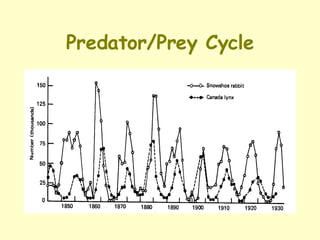
Cycling Cycling results due to time lags, which are the responses of the predator to the change in population numbers of the prey.  The prey increases, then in some time the predator population increases As the predator population rises their prey population begins fall  The lack of food reduces predator number  …………… and so on!
Case Study: Snowshoe Hare and the Canadian Lynx The information on the populations of both animals appears to give the perfect predator/prey relationship in a cycling effect  However, there are many other factors to consider, proving only that an ecosystem is a complicated network of interactions
Predator/Prey Cycle
The Role of Predators in Maintaining Diversity in Ecosystems When different species are competing for the same resources, one will succeed at the expense of another  The weaker species will be lost from the habitat  [COMPETITIVE EXCLUSION]   If, however, predation reduces the numbers of strong competing species, the weaker species have more of a  survival chance This increases the  DIVERSITY OF THE ECOSYSTEM . The more diverse an ecosystem the more stable it becomes,  i.e.  tends towards a  climax community
Defences against predation During the process of evolution, predators have evolved ways to make them more successful at catching their prey ( e.g.  claws, fangs, poisons).  Similarly, prey organisms have evolved adaptations to help them avoid being  caught  or  eaten  by predators
Prey Defences 3 main adaptations: Camoflage - Crypsis - Disruptive colouration Warning Colouration Mimicry
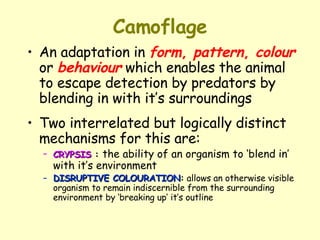
Camoflage An adaptation in  form ,  pattern ,  colour  or  behaviour  which enables the animal to escape detection by predators by blending in with it’s surroundings Two interrelated but logically distinct mechanisms for this are: CRYPSIS  :  the ability of an organism to ‘blend in’ with it’s environment   DISRUPTIVE COLOURATION :  allows an otherwise visible organism to remain indiscernible from the surrounding environment by ‘breaking up’ it’s outline
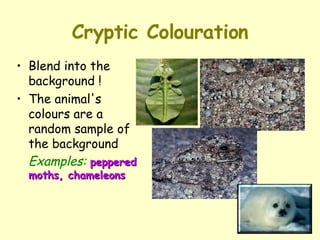
Cryptic Colouration Blend into the background ! The animal's colours are a random sample of the background Examples:   peppered moths, chameleons
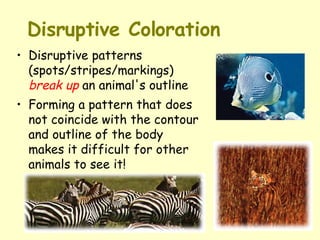
Disruptive Coloration Disruptive patterns (spots/stripes/markings)  break up  an animal's outline Forming a pattern that does not coincide with the contour and outline of the body makes it difficult for other animals to see it!
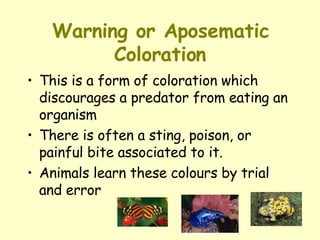
Warning or Aposematic Coloration This is a form of coloration which discourages a predator from eating an organism  There is often a sting, poison, or painful bite associated to it.  Animals learn these colours by trial and error
Red, black and yellow are common colours and are called aposematic colours (meaning ‘away signal’)  Many individual share the same pattern [ convergent evolution ] This prevents young from having to try many combinations to learn all of the animals not to eat This convergent evolution is a form of  mimicry
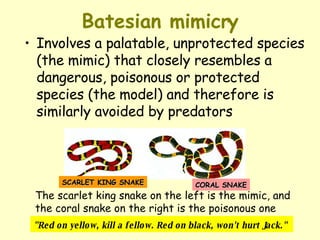
Batesian mimicry Involves a palatable, unprotected species (the mimic) that closely resembles a  dangerous, poisonous  or protected species (the model) and therefore is similarly avoided by predators The scarlet king snake on the left is the mimic, and the coral snake on the right is the poisonous one SCARLET KING SNAKE CORAL SNAKE "Red on yellow, kill a fellow. Red on black, won't hurt Jack."
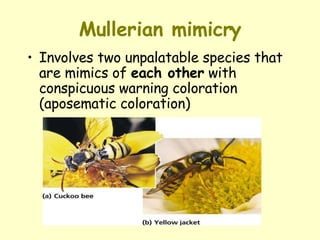
Mullerian mimicry Involves  two unpalatable species that are mimics of  each other  with conspicuous warning coloration (aposematic coloration)
Grazing Grazing is a form of  INTERSPECIFIC INTERACTION A  ‘GRAZER’  = any species that moves from one ‘victim’ to another feeding on part of it without actually killing it outright  e.g.   grasshoppers that jump from plant to plant, chewing a portion of the leaves as they go Grazers, like predators, can both  INCREASE  or  DECREASE  species diversity depending on the  intensity  of the feeding of the grazers and on the  type  of plant being grazed
As an ecosystem tends toward a climax community, the process can be stopped or diverted away from the natural succession  This can be  unnatural  by implementing  agriculture   OR   naturally  by  grazing animals   Grazing animals favour grasses as these species are more vigorous competitors due to low growing points Shrubs have meristems at the tips of shoots, which are easily eaten by grazers
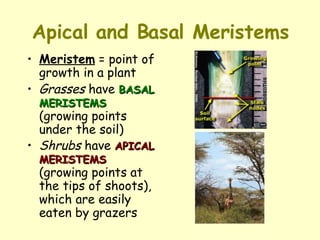
Apical and Basal Meristems Meristem  = point of growth in a plant Grasses  have  BASAL MERISTEMS  (growing points under the soil) Shrubs  have  APICAL MERISTEMS  (growing points at the tips of shoots), which are easily eaten by grazers
Overgrazing When overgrazing occurs, this prevents the build up of leaf litter  Leaf litter is important in starting bush fires by lightning. Bush fires remove the shrubs from the ecosystem, but grasses thrive as they have  basal meristems Therefore if an grassland is overgrazed, shrubs will become more dominant, thus again reducing diversity  Many shrubs are not palatable to grazers, therefore they move away from the habitat
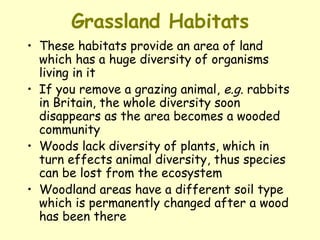
Grassland Habitats These habitats provide an area of land which has a huge diversity of organisms living in it  If you remove a grazing animal,  e.g.  rabbits in Britain, the whole diversity soon disappears as the area becomes a wooded community  Woods lack diversity of plants, which in turn effects animal diversity, thus species can be lost from the ecosystem  Woodland areas have a different soil type which is permanently changed after a wood has been there
Competition Competition is where 2 or more organisms need the  same resource , and the resource is  limited   This does  not always  result in fighting or confrontation ! Where there is competition, one or both of the organisms will lack the resource  When the resource is required by different species, and there is a lack of the resource, then the two organism’s niche overlaps  If the resource is unlimited then the overlapping of their niche is not a problem. The  GREATER  the overlap in the niche the  MORE CHANCE  there is for competition
Interspecific vs Intraspecific   competition INTERSPECIFIC  competition is competition between organisms of two  different species   INTRASPECIFIC  competition is competition between organisms of the  same species   Interspecific competition is not as intense as intraspecific competition, due to organisms of the same species having the greatest overlap in niches
Exploitation and Interference Competition All competitions between organisms can be grouped as  EXPLOITATION  or  INTERFERENCE  competition  EXPLOITATION   is when all individuals have the  equal  access to the resource, but they differ in how fast or how efficiently they can exploit it  INTERFERENCE  is when certain individuals are able to  restrict  or prevent access of others to the resource and so control the use of it
Exploitation Competition There are two possible outcomes from this competition:  They will  co-exist   One of the two will be  excluded   In theory, if there is enough overlap in their requirements, one species will always have a slight advantage and will succeed at the expense of the other
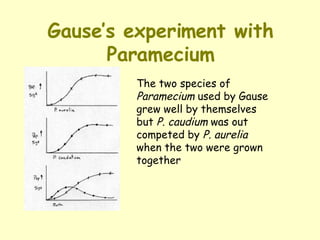
Gause’s experiment with Paramecium The two species of  Paramecium  used by Gause grew well by themselves but  P. caudium  was out competed by  P. aurelia  when the two were grown together
Interference   Competition In this case on organism will often show  AGGRESSION  to prevent another organism sharing a resource,  e.g.  territorial behaviour of the robin. The territory contains just enough resources for the breeding pair In plants, this can be seen in the ability for some to  GROW QUICKLY  and block the sunlight out for others  e.g.  by growing in a lateral manner
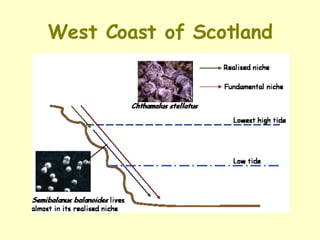
Fundamental Niche and Realised Niche The  FUNDAMENTAL NICHE  is the theoretical niche containing all of the required resources for an idealistic life  This cannot exist as there a huge network of interactions with other species, and each species will try and exploit the resources  The actual resources which a population uses are its  REALISED NICHE
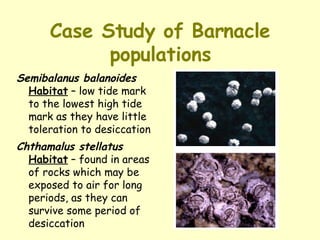
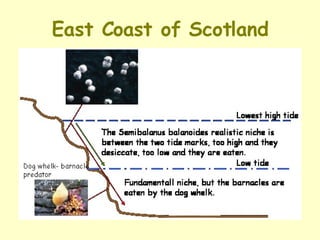
Case Study of Barnacle populations Semibalanus balanoides   Habitat  – low tide mark to the lowest high tide mark as they have little toleration to desiccation  Chthamalus stellatus   Habitat  – found in areas of rocks which may be exposed to air for long periods, as they can survive some period of desiccation
East Coast of Scotland
West Coast of Scotland
Resource Partitioning Species that share the same habitat and have similar needs frequently use resources in somewhat different ways - so that they do not come into direct competition for at least part of the limiting resource This is called  RESOURCE PARTITIONING
The Competitive Exclusion Principle Early in the twentieth century, two mathematical biologists, A.J.Lotka and V. Volterra developed a model of population growth to predict the outcome of competition Their models suggest that two species cannot compete for the same limiting resource for long. Even a minute reproductive advantage leads to the replacement of one species by the other
The Damaging Effects  of Exotic Species The  Rhododendron ponticum  is a shrub which was introduced to Scotland  It is successful competitor in acidic soils, many soils in the Scottish Highlands are acidic  It creates a dense canopy of leaves, which shades smaller shrubs, and therefore is a good  INTERFERING  competitor  In its native habitat it has grazers as they have evolved together, however in Scotland the sheep and rabbits do not eat it
These invasive, non-native species are a major threat to the environment because they ...   can change an entire habitat, placing ecosystems at risk   crowd out or replace native species that are beneficial to a habitat   damage human enterprise, such as fisheries, costing the economy millions of dollars   Other examples: The zebra mussel, accidentally brought to the United States from southern Russia, transforms aquatic habitats by filtering prodigious amounts of water (thereby lowering densities of planktonic organisms) and settling in dense masses over vast areas. At least thirty freshwater mussel species are threatened with extinction by the zebra mussel [HANDOUT / RESEARCH]
The Importance of Survival for Weak Competitors Species diversity  is important to all ecosystems  The diversity provides  flexibility  when the environment changes  Therefore  competitors  change when the  environment  changes  A less competitive species survives as they can adapt its niche slightly, and therefore maintain a presence  They are a valuable reserve for an alternative ecosystem. Without an alternative, if the environment were to change then the stability of the environment would be in jeopardy

Biotic Interactions

  • 1.
    Biotic Interactions Thisis the interaction between living things Predator/prey relationships Plant/herbivore relationships Competition Symbiosis
  • 2.
    Abiotic Interactions Theseare interactions that exist between the organisms and the environment : - Temperature - Light - Pressure - Salinity - Water availability - pH - Nutrients - Exposure to wind or waves
  • 3.
    Density Independent FactorsThese are factors which reduce the population numbers independently of the population density The proportion that dies could be the same whether the population is dense or not - Forest Fire - Floods - Volcanic eruptions - Prolonged drought - Acid rain
  • 4.
    Density Dependent FactorsThese are all biotic interactions These cause the population to decrease when the population is high and increase when the population is low - Predation - Competition - Disease
  • 5.
    Inter-specific and Intra-specificInteractions These interactions are always involved in competition INTER is competition between species e.g. GRAZING, PREDATION AND PARASITISM INTRA is competition within the species e.g. TERRITORIAL BEHAVIOUR, DOMINANCE, MATING, RESOURCES
  • 6.
    Predation In apredator/prey relationship both the species can benefit Predators obtains food Reduced numbers in prey means more resources for those individuals that are left Both the predator and prey population is governed by one another, however the exact nature of this can differ
  • 7.
    Predator-Prey Relationship Thepattern between the two can be grouped into 4 types: 1) Stable coexistence : where both populations remain stable 2) Cyclical variations : regular increases and decreases occur in the populations 3) Erratic swings : large scale “blooms” can take place at an irregular time, due to unstable populations of prey or predator, where a small change in the environment can have a major effect on the animal. 4) Extinction : due to over hunting of prey
  • 8.
    Predator-Prey Relationship Oneof these 4 patterns will occur depending on a variety of factors: The CARRYING CAPACITY of the habitat (the maximum number of individuals that can be supported by a particular ecosystem on a long term basis) The PREY REPRODUCTION RATE The PREDATOR REPRODUCTION RATE The degree of FLEXIBILITY of the predator in it’s ability to respond to changes in the prey population
  • 9.
    Flexibility of thePredator If the prey increased, the predator would naturally eat more , but this only happens if the predator is not eating it’s maximum number of prey If the increase in prey is long term, then there will be an increase in the predator offspring that survive from reproduction as there is more food available and therefore less competition for food
  • 10.
    If the preypopulation becomes very large there are two possible fates of interaction: STABLE COEXISTENCE : Predators prevent prey from exceeding the carrying capacity To do this predators must reproduce quickly compared to prey and to eat more when there are more prey CYCLICAL VARIATIONS : Here the predators are less responsive to fluctuations, due to slow reproductive rate or have reached a maximum level of feeding
  • 11.
    Cycling Cycling resultsdue to time lags, which are the responses of the predator to the change in population numbers of the prey. The prey increases, then in some time the predator population increases As the predator population rises their prey population begins fall The lack of food reduces predator number …………… and so on!
  • 12.
    Case Study: SnowshoeHare and the Canadian Lynx The information on the populations of both animals appears to give the perfect predator/prey relationship in a cycling effect However, there are many other factors to consider, proving only that an ecosystem is a complicated network of interactions
  • 13.
  • 14.
    The Role ofPredators in Maintaining Diversity in Ecosystems When different species are competing for the same resources, one will succeed at the expense of another The weaker species will be lost from the habitat [COMPETITIVE EXCLUSION] If, however, predation reduces the numbers of strong competing species, the weaker species have more of a survival chance This increases the DIVERSITY OF THE ECOSYSTEM . The more diverse an ecosystem the more stable it becomes, i.e. tends towards a climax community
  • 15.
    Defences against predationDuring the process of evolution, predators have evolved ways to make them more successful at catching their prey ( e.g. claws, fangs, poisons). Similarly, prey organisms have evolved adaptations to help them avoid being caught or eaten by predators
  • 16.
    Prey Defences 3main adaptations: Camoflage - Crypsis - Disruptive colouration Warning Colouration Mimicry
  • 17.
    Camoflage An adaptationin form , pattern , colour or behaviour which enables the animal to escape detection by predators by blending in with it’s surroundings Two interrelated but logically distinct mechanisms for this are: CRYPSIS : the ability of an organism to ‘blend in’ with it’s environment DISRUPTIVE COLOURATION : allows an otherwise visible organism to remain indiscernible from the surrounding environment by ‘breaking up’ it’s outline
  • 18.
    Cryptic Colouration Blendinto the background ! The animal's colours are a random sample of the background Examples: peppered moths, chameleons
  • 19.
    Disruptive Coloration Disruptivepatterns (spots/stripes/markings) break up an animal's outline Forming a pattern that does not coincide with the contour and outline of the body makes it difficult for other animals to see it!
  • 20.
    Warning or AposematicColoration This is a form of coloration which discourages a predator from eating an organism There is often a sting, poison, or painful bite associated to it. Animals learn these colours by trial and error
  • 21.
    Red, black andyellow are common colours and are called aposematic colours (meaning ‘away signal’) Many individual share the same pattern [ convergent evolution ] This prevents young from having to try many combinations to learn all of the animals not to eat This convergent evolution is a form of mimicry
  • 22.
    Batesian mimicry Involvesa palatable, unprotected species (the mimic) that closely resembles a dangerous, poisonous or protected species (the model) and therefore is similarly avoided by predators The scarlet king snake on the left is the mimic, and the coral snake on the right is the poisonous one SCARLET KING SNAKE CORAL SNAKE "Red on yellow, kill a fellow. Red on black, won't hurt Jack."
  • 23.
    Mullerian mimicry Involves two unpalatable species that are mimics of each other with conspicuous warning coloration (aposematic coloration)
  • 24.
    Grazing Grazing isa form of INTERSPECIFIC INTERACTION A ‘GRAZER’ = any species that moves from one ‘victim’ to another feeding on part of it without actually killing it outright e.g. grasshoppers that jump from plant to plant, chewing a portion of the leaves as they go Grazers, like predators, can both INCREASE or DECREASE species diversity depending on the intensity of the feeding of the grazers and on the type of plant being grazed
  • 25.
    As an ecosystemtends toward a climax community, the process can be stopped or diverted away from the natural succession This can be unnatural by implementing agriculture OR naturally by grazing animals Grazing animals favour grasses as these species are more vigorous competitors due to low growing points Shrubs have meristems at the tips of shoots, which are easily eaten by grazers
  • 26.
    Apical and BasalMeristems Meristem = point of growth in a plant Grasses have BASAL MERISTEMS (growing points under the soil) Shrubs have APICAL MERISTEMS (growing points at the tips of shoots), which are easily eaten by grazers
  • 27.
    Overgrazing When overgrazingoccurs, this prevents the build up of leaf litter Leaf litter is important in starting bush fires by lightning. Bush fires remove the shrubs from the ecosystem, but grasses thrive as they have basal meristems Therefore if an grassland is overgrazed, shrubs will become more dominant, thus again reducing diversity Many shrubs are not palatable to grazers, therefore they move away from the habitat
  • 28.
    Grassland Habitats Thesehabitats provide an area of land which has a huge diversity of organisms living in it If you remove a grazing animal, e.g. rabbits in Britain, the whole diversity soon disappears as the area becomes a wooded community Woods lack diversity of plants, which in turn effects animal diversity, thus species can be lost from the ecosystem Woodland areas have a different soil type which is permanently changed after a wood has been there
  • 29.
    Competition Competition iswhere 2 or more organisms need the same resource , and the resource is limited This does not always result in fighting or confrontation ! Where there is competition, one or both of the organisms will lack the resource When the resource is required by different species, and there is a lack of the resource, then the two organism’s niche overlaps If the resource is unlimited then the overlapping of their niche is not a problem. The GREATER the overlap in the niche the MORE CHANCE there is for competition
  • 30.
    Interspecific vs Intraspecific competition INTERSPECIFIC competition is competition between organisms of two different species INTRASPECIFIC competition is competition between organisms of the same species Interspecific competition is not as intense as intraspecific competition, due to organisms of the same species having the greatest overlap in niches
  • 31.
    Exploitation and InterferenceCompetition All competitions between organisms can be grouped as EXPLOITATION or INTERFERENCE competition EXPLOITATION is when all individuals have the equal access to the resource, but they differ in how fast or how efficiently they can exploit it INTERFERENCE is when certain individuals are able to restrict or prevent access of others to the resource and so control the use of it
  • 32.
    Exploitation Competition Thereare two possible outcomes from this competition: They will co-exist One of the two will be excluded In theory, if there is enough overlap in their requirements, one species will always have a slight advantage and will succeed at the expense of the other
  • 33.
    Gause’s experiment withParamecium The two species of Paramecium used by Gause grew well by themselves but P. caudium was out competed by P. aurelia when the two were grown together
  • 34.
    Interference Competition In this case on organism will often show AGGRESSION to prevent another organism sharing a resource, e.g. territorial behaviour of the robin. The territory contains just enough resources for the breeding pair In plants, this can be seen in the ability for some to GROW QUICKLY and block the sunlight out for others e.g. by growing in a lateral manner
  • 35.
    Fundamental Niche andRealised Niche The FUNDAMENTAL NICHE is the theoretical niche containing all of the required resources for an idealistic life This cannot exist as there a huge network of interactions with other species, and each species will try and exploit the resources The actual resources which a population uses are its REALISED NICHE
  • 36.
    Case Study ofBarnacle populations Semibalanus balanoides Habitat – low tide mark to the lowest high tide mark as they have little toleration to desiccation Chthamalus stellatus Habitat – found in areas of rocks which may be exposed to air for long periods, as they can survive some period of desiccation
  • 37.
    East Coast ofScotland
  • 38.
    West Coast ofScotland
  • 39.
    Resource Partitioning Speciesthat share the same habitat and have similar needs frequently use resources in somewhat different ways - so that they do not come into direct competition for at least part of the limiting resource This is called RESOURCE PARTITIONING
  • 40.
    The Competitive ExclusionPrinciple Early in the twentieth century, two mathematical biologists, A.J.Lotka and V. Volterra developed a model of population growth to predict the outcome of competition Their models suggest that two species cannot compete for the same limiting resource for long. Even a minute reproductive advantage leads to the replacement of one species by the other
  • 41.
    The Damaging Effects of Exotic Species The Rhododendron ponticum is a shrub which was introduced to Scotland It is successful competitor in acidic soils, many soils in the Scottish Highlands are acidic It creates a dense canopy of leaves, which shades smaller shrubs, and therefore is a good INTERFERING competitor In its native habitat it has grazers as they have evolved together, however in Scotland the sheep and rabbits do not eat it
  • 42.
    These invasive, non-nativespecies are a major threat to the environment because they ... can change an entire habitat, placing ecosystems at risk crowd out or replace native species that are beneficial to a habitat damage human enterprise, such as fisheries, costing the economy millions of dollars Other examples: The zebra mussel, accidentally brought to the United States from southern Russia, transforms aquatic habitats by filtering prodigious amounts of water (thereby lowering densities of planktonic organisms) and settling in dense masses over vast areas. At least thirty freshwater mussel species are threatened with extinction by the zebra mussel [HANDOUT / RESEARCH]
  • 43.
    The Importance ofSurvival for Weak Competitors Species diversity is important to all ecosystems The diversity provides flexibility when the environment changes Therefore competitors change when the environment changes A less competitive species survives as they can adapt its niche slightly, and therefore maintain a presence They are a valuable reserve for an alternative ecosystem. Without an alternative, if the environment were to change then the stability of the environment would be in jeopardy