
Biotechnology Skill Enhancement Program (BiSEP)
Domain: Fermentation and Bio-processing
Seminar Presentation
Seminar Topic: Nutritional Requirements of Cultured cells
Name: SACHIN .B .H
Date: 13/11/2019
Department of Biotechnology, GUK
Synopsis
1) Introduction
2) Animal cell culture
3) Cell culture media
4) Nutrional requirements of cultured cells
5) Characterstics
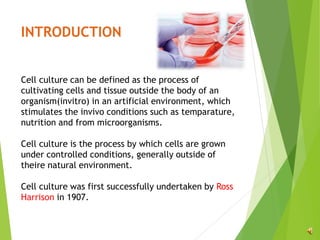
INTRODUCTION
Cell culture can be defined as the process of
cultivating cells and tissue outside the body of an
organism(invitro) in an artificial environment, which
stimulates the invivo conditions such as temparature,
nutrition and from microorganisms.
Cell culture is the process by which cells are grown
under controlled conditions, generally outside of
theire natural environment.
Cell culture was first successfully undertaken by Ross
Harrison in 1907.
ANIMAL CELL CULTURE
1) In vitro cultivation of animal organs, cells,and
tissues at defined temperature using an incubator and
supplemented with a medium containing cell nutrients
and growth factors is collectively known as Animal cell
culture.
2) And will continue to grow if supplied with
appropriate conditions and nutients.
3) Culture process allows the single process to act as
an independent unit.
4) Cells are capable of dividing.
Terminologies
1) Primary Cell culture: When cells are surgically
removed from an organisms and placed into a suitable
culture environment they will attach, divide and grow
2) Cell Line: When the primary culture is subcultured
and they show an ability to continuously propagate.
3) Anchorage depedency: Cells grow as monolayers
adhering to the substrate (glass/plastic).
4) Passaging/subculturing: The process of spliting the
cells.
5) Finite cells: When the cells has finite life span.
Cell Culture Media
Cell culture media generally comprise an appropriate
source of energy and compounds which regulate the
cell cycle.
A typically culture medium is composed
Amino acids
Vitamins
Inorganic salts
Glucose and serum
Nutritional Requirements of
cultured cells
Nutrients:
Components in food that a cell uses to survive and grow are
known as nutrients.
Nutritional Requirements:
1) Amino acids ( arginine, leucine etc)
2) Vitamins ( Riboflavin, biotin, vitamin B12)
3) inorganic ion ( sodium, potassium, calcium)
4) Trace elements ( molybdenum, copper)
5) Monosaccharide ( Sugar, glucose, galactose)
Serum
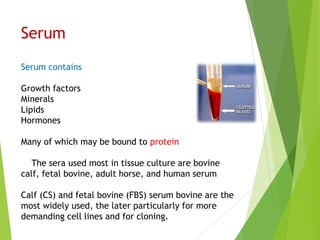
Serum contains
Growth factors
Minerals
Lipids
Hormones
Many of which may be bound to protein
The sera used most in tissue culture are bovine
calf, fetal bovine, adult horse, and human serum
Calf (CS) and fetal bovine (FBS) serum bovine are the
most widely used, the later particularly for more
demanding cell lines and for cloning.
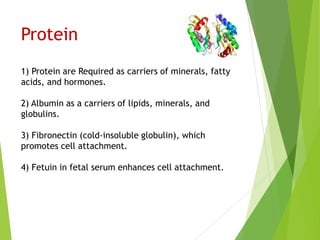
Protein
1) Protein are Required as carriers of minerals, fatty
acids, and hormones.
2) Albumin as a carriers of lipids, minerals, and
globulins.
3) Fibronectin (cold-insoluble globulin), which
promotes cell attachment.
4) Fetuin in fetal serum enhances cell attachment.
Growth factors
1) Natural clot serum stimulates cell proliferation
more than serum from which the cells have been
removed physically
2) This increased stimulation due to growth factors.
3) PDGF- Platelet derived growth factor, from the
platelets during clotting.
4) PDGF Stimulates growth in fibroblasts and glia.
Amino acids
The essentials amino acids are required by Cultured cells
1) plus cystein
2) Arginine
3) Glutamine and tyrosine
4) The concentration of amino acids usually limits the
maximum cell concentration attainable, and the balance
may influence cell survival and growth rate.
Glutamine
1) Glutamine is required by most cells, although some
cell lines will utilize glutamine.
2) Glutamine is also used in cultured cells as a source
of energy and carbon.
3) Glutamine is unstable in culture medium with a
half-life of between 3 and 5 days, and it generates
ammonia, which can be toxic as a by product.
Salts
1) The salts are chiefly those of a Na+, K+, Ca2+, and
HCO3-and are the major components contributing to
the osmolality of the medium.
2) Ca2+, are required by some cell adhesion
molecules, such as the cadherins.
3) Calcium is reduced in suspension cultures in order
to minimize cell aggregation and attachment.
4) Na+, K+, and Cl- regulate membrane potential.
Glucose
1) Glucose is included in most media as a source of
energy.
It is metabolized principally by glycolysis to
form pyruvate, which may be converted to lactate or
acetoacetate and may enter citric acid cycle and be
oxidized to form CO2 and water.
Trace elements
1) Trace elements are often supplemented to serum-
free media to replace those normally found in serum.
2) Trace elements like copper, zinc, selenium, are
needed in minute amounts for proper cell growth.
3) These micronutrients are essential for many
biological process, e.g. the maintenance of the
functionality of enzymes.
Contd…
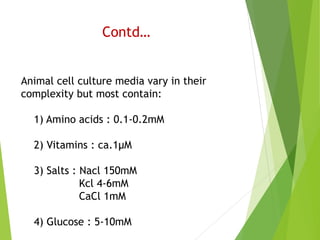
Animal cell culture media vary in their
complexity but most contain:
1) Amino acids : 0.1-0.2mM
2) Vitamins : ca.1µM
3) Salts : Nacl 150mM
Kcl 4-6mM
CaCl 1mM
4) Glucose : 5-10mM
CHARACTERISTICS
1) Animal cells can grow in simple glass or plastic
containers in nutrive media but they grow only to
limited generation.
2) The maintenance of growth of cells under
laboratory conditions in suitable culture medium is
known as PRIMARY CELL CULTURE.
3) Cells can grow as adherent cells ( anchorage
dependent must be cultured while attached to a solid
or semi-solid substrate.
4) or as suspension culture ( anchorage independent
can be grown floating in the culture medium)
Application of cell culture
1) Excellent model systems for studying:
- The normal physiology, cell biology and biochemistry of cells.
- The effects of drugs, radiation and toxic compounds on the cells
- Study mutagenesis and carcinogenesis.
2) Used for gene transfer studies:
- Large scale manufacturing of biological compounds .
- (vaccines, insulin, interferon, other therapeutic protien)
REFERENCES
1) Butler's. (2005) Animal cell culture: recent
achievements and perspective in the
production of biopharmaceuticals.
2)Freshney R.I (2010) Culture of animal cells
3) Gngal.S. (2007). Principle and practice of
animal cell culture.
animal cell culture

animal cell culture

  • 1.
    Biotechnology Skill EnhancementProgram (BiSEP) Domain: Fermentation and Bio-processing Seminar Presentation Seminar Topic: Nutritional Requirements of Cultured cells Name: SACHIN .B .H Date: 13/11/2019 Department of Biotechnology, GUK
  • 2.
    Synopsis 1) Introduction 2) Animalcell culture 3) Cell culture media 4) Nutrional requirements of cultured cells 5) Characterstics
  • 3.
    INTRODUCTION Cell culture canbe defined as the process of cultivating cells and tissue outside the body of an organism(invitro) in an artificial environment, which stimulates the invivo conditions such as temparature, nutrition and from microorganisms. Cell culture is the process by which cells are grown under controlled conditions, generally outside of theire natural environment. Cell culture was first successfully undertaken by Ross Harrison in 1907.
  • 4.
    ANIMAL CELL CULTURE 1)In vitro cultivation of animal organs, cells,and tissues at defined temperature using an incubator and supplemented with a medium containing cell nutrients and growth factors is collectively known as Animal cell culture. 2) And will continue to grow if supplied with appropriate conditions and nutients. 3) Culture process allows the single process to act as an independent unit. 4) Cells are capable of dividing.
  • 5.
    Terminologies 1) Primary Cellculture: When cells are surgically removed from an organisms and placed into a suitable culture environment they will attach, divide and grow 2) Cell Line: When the primary culture is subcultured and they show an ability to continuously propagate. 3) Anchorage depedency: Cells grow as monolayers adhering to the substrate (glass/plastic). 4) Passaging/subculturing: The process of spliting the cells. 5) Finite cells: When the cells has finite life span.
  • 6.
    Cell Culture Media Cellculture media generally comprise an appropriate source of energy and compounds which regulate the cell cycle. A typically culture medium is composed Amino acids Vitamins Inorganic salts Glucose and serum
  • 7.
    Nutritional Requirements of culturedcells Nutrients: Components in food that a cell uses to survive and grow are known as nutrients. Nutritional Requirements: 1) Amino acids ( arginine, leucine etc) 2) Vitamins ( Riboflavin, biotin, vitamin B12) 3) inorganic ion ( sodium, potassium, calcium) 4) Trace elements ( molybdenum, copper) 5) Monosaccharide ( Sugar, glucose, galactose)
  • 8.
    Serum Serum contains Growth factors Minerals Lipids Hormones Manyof which may be bound to protein The sera used most in tissue culture are bovine calf, fetal bovine, adult horse, and human serum Calf (CS) and fetal bovine (FBS) serum bovine are the most widely used, the later particularly for more demanding cell lines and for cloning.
  • 9.
    Protein 1) Protein areRequired as carriers of minerals, fatty acids, and hormones. 2) Albumin as a carriers of lipids, minerals, and globulins. 3) Fibronectin (cold-insoluble globulin), which promotes cell attachment. 4) Fetuin in fetal serum enhances cell attachment.
  • 10.
    Growth factors 1) Naturalclot serum stimulates cell proliferation more than serum from which the cells have been removed physically 2) This increased stimulation due to growth factors. 3) PDGF- Platelet derived growth factor, from the platelets during clotting. 4) PDGF Stimulates growth in fibroblasts and glia.
  • 11.
    Amino acids The essentialsamino acids are required by Cultured cells 1) plus cystein 2) Arginine 3) Glutamine and tyrosine 4) The concentration of amino acids usually limits the maximum cell concentration attainable, and the balance may influence cell survival and growth rate.
  • 12.
    Glutamine 1) Glutamine isrequired by most cells, although some cell lines will utilize glutamine. 2) Glutamine is also used in cultured cells as a source of energy and carbon. 3) Glutamine is unstable in culture medium with a half-life of between 3 and 5 days, and it generates ammonia, which can be toxic as a by product.
  • 13.
    Salts 1) The saltsare chiefly those of a Na+, K+, Ca2+, and HCO3-and are the major components contributing to the osmolality of the medium. 2) Ca2+, are required by some cell adhesion molecules, such as the cadherins. 3) Calcium is reduced in suspension cultures in order to minimize cell aggregation and attachment. 4) Na+, K+, and Cl- regulate membrane potential.
  • 14.
    Glucose 1) Glucose isincluded in most media as a source of energy. It is metabolized principally by glycolysis to form pyruvate, which may be converted to lactate or acetoacetate and may enter citric acid cycle and be oxidized to form CO2 and water.
  • 15.
    Trace elements 1) Traceelements are often supplemented to serum- free media to replace those normally found in serum. 2) Trace elements like copper, zinc, selenium, are needed in minute amounts for proper cell growth. 3) These micronutrients are essential for many biological process, e.g. the maintenance of the functionality of enzymes.
  • 16.
    Contd… Animal cell culturemedia vary in their complexity but most contain: 1) Amino acids : 0.1-0.2mM 2) Vitamins : ca.1µM 3) Salts : Nacl 150mM Kcl 4-6mM CaCl 1mM 4) Glucose : 5-10mM
  • 17.
    CHARACTERISTICS 1) Animal cellscan grow in simple glass or plastic containers in nutrive media but they grow only to limited generation. 2) The maintenance of growth of cells under laboratory conditions in suitable culture medium is known as PRIMARY CELL CULTURE. 3) Cells can grow as adherent cells ( anchorage dependent must be cultured while attached to a solid or semi-solid substrate. 4) or as suspension culture ( anchorage independent can be grown floating in the culture medium)
  • 18.
    Application of cellculture 1) Excellent model systems for studying: - The normal physiology, cell biology and biochemistry of cells. - The effects of drugs, radiation and toxic compounds on the cells - Study mutagenesis and carcinogenesis. 2) Used for gene transfer studies: - Large scale manufacturing of biological compounds . - (vaccines, insulin, interferon, other therapeutic protien)
  • 19.
    REFERENCES 1) Butler's. (2005)Animal cell culture: recent achievements and perspective in the production of biopharmaceuticals. 2)Freshney R.I (2010) Culture of animal cells 3) Gngal.S. (2007). Principle and practice of animal cell culture.