Changes in Ecosystem Complexity Communities are always changing, usually from simple to more complex in a process called  ECOLOGICAL SUCCESSION Succession is not affected by seasons and is the  relatively  orderly and repeatable series of  changes  in the types of species which occupy a given area  through time   It often begins with unstable, immature communities  (pioneering, opportunistic, r-strategists)  and proceeds to more mature, stable communities dominated by  K-strategists
Types of Succession ALLOGENIC SUCCESSION:   species composition is disturbed by  environmental factors unrelated to the organisms present   e.g. Hurricanes, forest fires, flooding, climate changes AUTOGENIC SUCCESSION :   the changes in environmental conditions which leads to changes in species composition in an ecosystem are caused by the  biological processes of the organisms themselves   e.g.  trees shading and killing plants underneath that require high sunlight   [Includes  Primary & Secondary Succession]
Allogenic Succession Serial replacement of species, driven by  changing external geophysical processes Examples: silt deposition in a pond, changing it from an aquatic to a terrestrial habitat increasing salinity of a sea climate change
Autogenic Succession Change of species driven by  biological processes changing conditions and/or resources Examples: organisms living, then dying, on bare rock trees shading and killing plants underneath that require high sunlight
Primary Succession Primary Succession : Occurs on barren habitats  e.g. rock, sand, clay, ice  this means that there is  NO SOIL  present Pioneering organisms colonise and modify the environment until new niches occur Slow process - may take thousands of years Time Unstable PIONEER Community [lichens, mosses] Stable  CLIMAX Community [Trees]
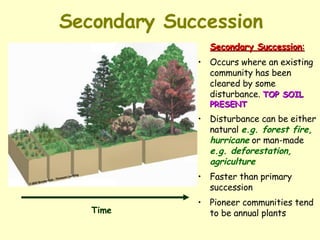
Secondary Succession Secondary Succession : Occurs where an existing community has been cleared by some disturbance.  TOP SOIL PRESENT Disturbance can be either natural  e.g. forest fire, hurricane   or man-made  e.g. deforestation, agriculture Faster than primary succession Pioneer communities tend to be annual plants Time
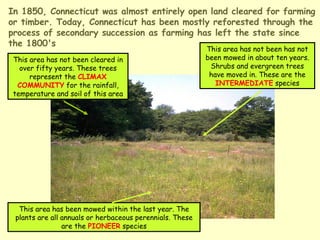
In 1850, Connecticut was almost entirely open land cleared for farming or timber. Today, Connecticut has been mostly reforested through the process of secondary succession as farming has left the state since the 1800's This area has not been cleared in over fifty years. These trees represent the  CLIMAX COMMUNITY  for the rainfall, temperature and soil of this area This area has not been has not been mowed in about ten years. Shrubs and evergreen trees have moved in. These are the  INTERMEDIATE  species This area has been mowed within the last year. The plants are all annuals or herbaceous perennials. These are the  PIONEER  species
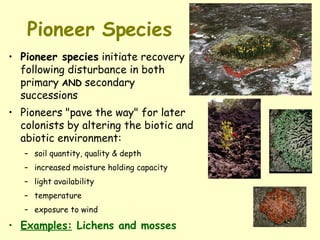
Pioneer Species Pioneer species  initiate recovery following disturbance in both primary  AND  secondary successions  Pioneers "pave the way" for later colonists by altering the biotic and abiotic environment: soil quantity, quality & depth  increased moisture holding capacity  light availability  temperature  exposure to wind Examples:  Lichens and mosses
3. DEGRADATIVE  (HETEROTROPHIC)  SUCCESSION: Sequence of changes associated with  DECOMPOSITION  processes When organisms die and begin to decompose, a repeated sequence of species appears, characteristic of the organism Since no  autotrophs  (green plants) are involved in this process, it is also known as  HETEROTROPHIC SUCCESSION
Example: When an animal dies, bacteria immediately start breaking down the organic materials. This produces a smell which attracts insects such as flies who lay their eggs on the body. Within a few hours the flies' eggs have hatched and the larvae (or maggots) begin to feed on the animal's soft tissue. Several types of beetle also feed on the dead remains, lay eggs and, when hatched, these larvae will feed on the dead remains as well. Now spiders begin to approach, not to feed on the dead animal, but to feed on the insects which are on the animal's body. The fact that degradative succession always occurs in the same sequence is used by forensic entomologists. These scientists can tell approximately when a victim died because of which insects inhabit the body when it is found
Changes in the complexity of ecosystems As succession takes place, the ecosystem tends to become more  COMPLEX  and more  STABLE Human activities, as well as natural disasters, can  reduce  the complexity in ecosystems. This reduction in complexity is shown by, for example, a reduction in the number of species present, a decrease in the number and variety of habitats and niches and a decrease in the complexity of food webs
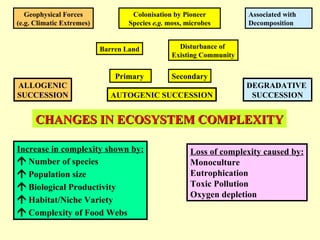
CHANGES IN ECOSYSTEM COMPLEXITY Increase in complexity shown by:    Number of species    Population size    Biological Productivity    Habitat/Niche Variety    Complexity of Food Webs Loss of complexity caused by: Monoculture Eutrophication Toxic Pollution Oxygen depletion AUTOGENIC SUCCESSION ALLOGENIC SUCCESSION DEGRADATIVE  SUCCESSION Geophysical Forces (e.g. Climatic Extremes) Associated with Decomposition Primary  Secondary Barren Land Colonisation by Pioneer Species  e.g.  moss, microbes Disturbance of  Existing Community
Intensive food production In 1999, the human population reached 6 billion It is estimated that by 2050 this figure will increase to 9.4 billion Sustaining this huge and ever increasing population would not be possible without agriculture. According to the World Health Organisation, over 3.5 million tonnes of food are required every day to provide the minimum calorific intake for today's population and this needs to increase by 83,000 tonnes daily to accommodate the increasing population Since only 11% of land surface is suitable for agriculture, the growing demand for food can only be achieved by increasing productivity
Effects of intensive food production :  MONOCULTURE Agriculture or forestry in which a single species is cultivated over a large area for  ECONOMIC EFFICIENCY With increased mechanisation and additional use of  FERTILISERS  and  PESTICIDES , farmers can manage larger areas of land Crops are selected for their  PRODUCTIVITY  (speed of growth/yield) or  DISEASE   RESISTANCE
Problems With Monoculture The farmer is dependant on fertilisers, fuel, machinery and seed Biodiversity is reduced to maximise crop yield by: REMOVAL  of  HEDGES  – loss of shelter USE of  HERBICIDES & PESTICIDES FERTILISERS  (can be toxic to other species) By removing natural trees, shrubs etc nutrients can easily leak out of the soil :  LEACHING
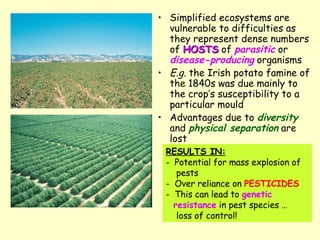
Simplified ecosystems are vulnerable to difficulties as they represent dense numbers of  HOSTS  of  parasitic  or  disease-producing  organisms E.g.  the Irish potato famine of the 1840s was due mainly to the crop’s susceptibility to a particular mould  Advantages due to  diversity  and  physical separation  are lost RESULTS IN: Potential for mass explosion of pests Over reliance on  PESTICIDES This can lead to  genetic  resistance  in pest species … loss of control!
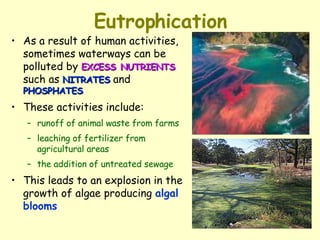
Eutrophication As a result of human activities, sometimes waterways can be polluted by  EXCESS   NUTRIENTS  such as  NITRATES  and  PHOSPHATES These activities include:  runoff of animal waste from farms leaching of fertilizer from agricultural areas the addition of untreated sewage This leads to an explosion in the growth of algae producing  algal blooms
Oxygen Depletion Although these algal blooms may increase oxygen levels in the water during the day,  OXYGEN DEPLETION  will occur at night as a result of  RESPIRATION As the algae die they accumulate at the bottom of the lake, greatly increasing the number of decomposer organisms, which deplete the oxygen levels further This leaves little oxygen for larger animals which die Eventually species diversity in the water is drastically reduced
Toxic pollution Pesticides and herbicides also contain substances which are  toxic  to organisms other than those they are intended to kill As well as these substances, many industrial sites are polluted with toxic heavy metals such as  LEAD ,  CADMIUM   and   MERCURY
Major types of Toxic Pollutants A variety of these toxic chemicals, including unnatural synthetics, have been and are dumped into ecosystems Many cannot be degraded by microbes and persist for years or decades Some are harmless when released but are converted to toxic poisons by reactions with other substances or metabolism of microbes Organisms acquire toxic substances along with nutrients or water, some of which accumulate in their tissues.
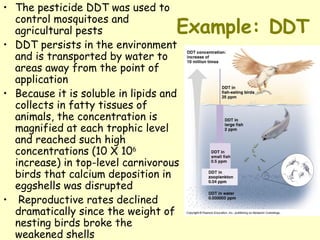
Biological Magnification This is the process by which toxins  e.g.  mercury, poisons, become more and more concentrated with each successive link in a food chain Biomagnification  results from biomass at each trophic level being produced from a much larger biomass ingested from the level below. The top-level carnivores are usually most severely affected by toxic compounds released into the environment
Example: DDT The pesticide DDT was used to control mosquitoes and agricultural pests DDT persists in the environment and is transported by water to areas away from the point of application Because it is soluble in lipids and collects in fatty tissues of animals, the concentration is magnified at each trophic level and reached such high concentrations (10 X 10 6  increase) in top-level carnivorous birds that calcium deposition in eggshells was disrupted Reproductive rates declined dramatically since the weight of nesting birds broke the weakened shells
Nuclear Waste The release of radioisotopes by nuclear accidents and the unsafe storage of nuclear wastes also present a serious environmental threat These contaminants can last for many years due to long half-lives and are also subject to biological magnification
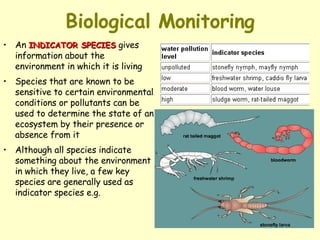
Biological Monitoring An  INDICATOR SPECIES  gives information about the environment in which it is living Species that are known to be sensitive to certain environmental conditions or pollutants can be used to determine the state of an ecosystem by their presence or absence from it Although all species indicate something about the environment in which they live, a few key species are generally used as indicator species e.g.
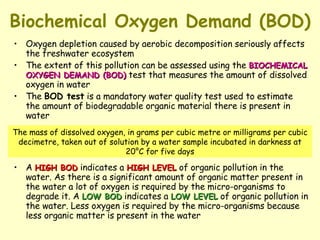
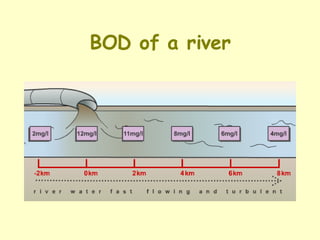
Biochemical Oxygen Demand (BOD) Oxygen depletion caused by aerobic decomposition seriously affects the freshwater ecosystem The extent of this pollution can be assessed using the  BIOCHEMICAL OXYGEN DEMAND (BOD)  test that measures the amount of dissolved oxygen in water The  BOD test  is a mandatory water quality test used to estimate the amount of biodegradable organic material there is present in water A  HIGH BOD  indicates a  HIGH LEVEL  of organic pollution in the water. As there is a significant amount of organic matter present in the water a lot of oxygen is required by the micro-organisms to degrade it. A  LOW BOD  indicates a  LOW LEVEL  of organic pollution in the water. Less oxygen is required by the micro-organisms because less organic matter is present in the water The mass of dissolved oxygen, in grams per cubic metre or milligrams per cubic decimetre, taken out of solution by a water sample incubated in darkness at 20°C for five days
BOD of a river
Increase in Energy Needs The biological world is driven on almost entirely on  SOLAR RADIATION  captured by plants  Major sources of primary energy for humans:  FOSSIL FUELS, NUCLEAR FUELS  and  HYDROPOWER Each form of energy generation has its own environmental consequence Renewable  energy sources harness energy without depletion  e.g.   SOLAR, WIND, WAVE, HYDROGEN, BIOMASS ENERGY PRODUCTION
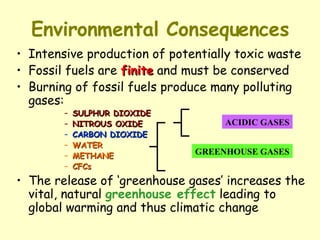
Environmental Consequences Intensive production of potentially toxic waste Fossil fuels are  finite  and must be conserved Burning of fossil fuels produce many polluting gases: SULPHUR DIOXIDE NITROUS OXIDE CARBON DIOXIDE WATER METHANE CFCs The release of ‘greenhouse gases’ increases the vital, natural  greenhouse effect  leading to global warming and thus climatic change ACIDIC GASES GREENHOUSE GASES
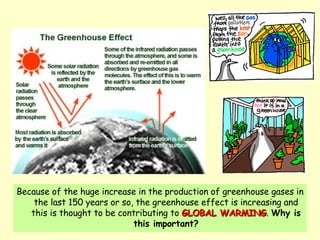
The Greenhouse Effect The greenhouse effect is a natural phenomenon and is responsible for maintaining the planet’s temperature 33°C higher than would otherwise be the case, thus allowing life to exist It is caused when sunlight reaches the Earth’s surface, which is converted into heat. This heat is re-radiated back into space in the form of infra-red radiation Although visible light passes through the atmosphere, some of the infra-red radiation is absorbed by the so-called greenhouse gases
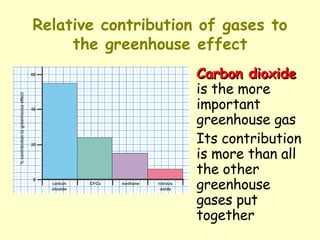
Carbon dioxide  is the more important greenhouse gas Its contribution is more than all the other greenhouse gases put together Relative contribution of gases to the greenhouse effect
Because of the huge increase in the production of greenhouse gases in the last 150 years or so, the greenhouse effect is increasing and this is thought to be contributing to  GLOBAL WARMING .  Why is this important?                                                                                                    
Global Warming The biological effects of the resulting climate change will have an profound effect on ecological niches and the species that live in them Rising global temperatures will bring changes in: Weather patterns (warmer temps, wetter winters, drier summers, less snow) Polar ice caps melting leading to rising sea levels & flooding of coastal areas Increased frequency and intensity of extreme weather events (hurricanes, floods, droughts) Food shortages Increased spread of disease  e.g.  malaria
Climate change is already happening! Globally, the ten hottest years on record have all occurred since the beginning of the 1990s Current climate models predict that global temperatures could warm from between 1.4 o c to 5.8 o c over the next 100 years, depending on the amounts of greenhouse gases emitted and the sensitivity of the climate system
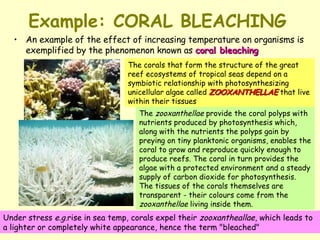
Example: CORAL BLEACHING An example of the effect of increasing temperature on organisms is exemplified by the phenomenon known as  coral bleaching The  zooxanthellae  provide the coral polyps with nutrients produced by photosynthesis which, along with the nutrients the polyps gain by preying on tiny planktonic organisms, enables the coral to grow and reproduce quickly enough to produce reefs. The coral in turn provides the algae with a protected environment and a steady supply of carbon dioxide for photosynthesis. The tissues of the corals themselves are transparent - their colours come from the  zooxanthellae  living inside them. Under stress  e.g. rise in sea temp, corals expel their  zooxantheallae , which leads to a lighter or completely white appearance, hence the term "bleached" The corals that form the structure of the great reef ecosystems of tropical seas depend on a symbiotic relationship with photosynthesizing unicellular algae called  ZOOXANTHELLAE  that live within their tissues

Changes To Ecosystems

  • 1.
    Changes in EcosystemComplexity Communities are always changing, usually from simple to more complex in a process called ECOLOGICAL SUCCESSION Succession is not affected by seasons and is the relatively orderly and repeatable series of changes in the types of species which occupy a given area through time It often begins with unstable, immature communities (pioneering, opportunistic, r-strategists) and proceeds to more mature, stable communities dominated by K-strategists
  • 2.
    Types of SuccessionALLOGENIC SUCCESSION: species composition is disturbed by environmental factors unrelated to the organisms present e.g. Hurricanes, forest fires, flooding, climate changes AUTOGENIC SUCCESSION : the changes in environmental conditions which leads to changes in species composition in an ecosystem are caused by the biological processes of the organisms themselves e.g. trees shading and killing plants underneath that require high sunlight [Includes Primary & Secondary Succession]
  • 3.
    Allogenic Succession Serialreplacement of species, driven by changing external geophysical processes Examples: silt deposition in a pond, changing it from an aquatic to a terrestrial habitat increasing salinity of a sea climate change
  • 4.
    Autogenic Succession Changeof species driven by biological processes changing conditions and/or resources Examples: organisms living, then dying, on bare rock trees shading and killing plants underneath that require high sunlight
  • 5.
    Primary Succession PrimarySuccession : Occurs on barren habitats e.g. rock, sand, clay, ice this means that there is NO SOIL present Pioneering organisms colonise and modify the environment until new niches occur Slow process - may take thousands of years Time Unstable PIONEER Community [lichens, mosses] Stable CLIMAX Community [Trees]
  • 6.
    Secondary Succession SecondarySuccession : Occurs where an existing community has been cleared by some disturbance. TOP SOIL PRESENT Disturbance can be either natural e.g. forest fire, hurricane or man-made e.g. deforestation, agriculture Faster than primary succession Pioneer communities tend to be annual plants Time
  • 7.
    In 1850, Connecticutwas almost entirely open land cleared for farming or timber. Today, Connecticut has been mostly reforested through the process of secondary succession as farming has left the state since the 1800's This area has not been cleared in over fifty years. These trees represent the CLIMAX COMMUNITY for the rainfall, temperature and soil of this area This area has not been has not been mowed in about ten years. Shrubs and evergreen trees have moved in. These are the INTERMEDIATE species This area has been mowed within the last year. The plants are all annuals or herbaceous perennials. These are the PIONEER species
  • 8.
    Pioneer Species Pioneerspecies initiate recovery following disturbance in both primary AND secondary successions Pioneers "pave the way" for later colonists by altering the biotic and abiotic environment: soil quantity, quality & depth increased moisture holding capacity light availability temperature exposure to wind Examples: Lichens and mosses
  • 9.
    3. DEGRADATIVE (HETEROTROPHIC) SUCCESSION: Sequence of changes associated with DECOMPOSITION processes When organisms die and begin to decompose, a repeated sequence of species appears, characteristic of the organism Since no autotrophs (green plants) are involved in this process, it is also known as HETEROTROPHIC SUCCESSION
  • 10.
    Example: When ananimal dies, bacteria immediately start breaking down the organic materials. This produces a smell which attracts insects such as flies who lay their eggs on the body. Within a few hours the flies' eggs have hatched and the larvae (or maggots) begin to feed on the animal's soft tissue. Several types of beetle also feed on the dead remains, lay eggs and, when hatched, these larvae will feed on the dead remains as well. Now spiders begin to approach, not to feed on the dead animal, but to feed on the insects which are on the animal's body. The fact that degradative succession always occurs in the same sequence is used by forensic entomologists. These scientists can tell approximately when a victim died because of which insects inhabit the body when it is found
  • 11.
    Changes in thecomplexity of ecosystems As succession takes place, the ecosystem tends to become more COMPLEX and more STABLE Human activities, as well as natural disasters, can reduce the complexity in ecosystems. This reduction in complexity is shown by, for example, a reduction in the number of species present, a decrease in the number and variety of habitats and niches and a decrease in the complexity of food webs
  • 12.
    CHANGES IN ECOSYSTEMCOMPLEXITY Increase in complexity shown by:  Number of species  Population size  Biological Productivity  Habitat/Niche Variety  Complexity of Food Webs Loss of complexity caused by: Monoculture Eutrophication Toxic Pollution Oxygen depletion AUTOGENIC SUCCESSION ALLOGENIC SUCCESSION DEGRADATIVE SUCCESSION Geophysical Forces (e.g. Climatic Extremes) Associated with Decomposition Primary Secondary Barren Land Colonisation by Pioneer Species e.g. moss, microbes Disturbance of Existing Community
  • 13.
    Intensive food productionIn 1999, the human population reached 6 billion It is estimated that by 2050 this figure will increase to 9.4 billion Sustaining this huge and ever increasing population would not be possible without agriculture. According to the World Health Organisation, over 3.5 million tonnes of food are required every day to provide the minimum calorific intake for today's population and this needs to increase by 83,000 tonnes daily to accommodate the increasing population Since only 11% of land surface is suitable for agriculture, the growing demand for food can only be achieved by increasing productivity
  • 14.
    Effects of intensivefood production : MONOCULTURE Agriculture or forestry in which a single species is cultivated over a large area for ECONOMIC EFFICIENCY With increased mechanisation and additional use of FERTILISERS and PESTICIDES , farmers can manage larger areas of land Crops are selected for their PRODUCTIVITY (speed of growth/yield) or DISEASE RESISTANCE
  • 15.
    Problems With MonocultureThe farmer is dependant on fertilisers, fuel, machinery and seed Biodiversity is reduced to maximise crop yield by: REMOVAL of HEDGES – loss of shelter USE of HERBICIDES & PESTICIDES FERTILISERS (can be toxic to other species) By removing natural trees, shrubs etc nutrients can easily leak out of the soil : LEACHING
  • 16.
    Simplified ecosystems arevulnerable to difficulties as they represent dense numbers of HOSTS of parasitic or disease-producing organisms E.g. the Irish potato famine of the 1840s was due mainly to the crop’s susceptibility to a particular mould Advantages due to diversity and physical separation are lost RESULTS IN: Potential for mass explosion of pests Over reliance on PESTICIDES This can lead to genetic resistance in pest species … loss of control!
  • 17.
    Eutrophication As aresult of human activities, sometimes waterways can be polluted by EXCESS NUTRIENTS such as NITRATES and PHOSPHATES These activities include: runoff of animal waste from farms leaching of fertilizer from agricultural areas the addition of untreated sewage This leads to an explosion in the growth of algae producing algal blooms
  • 18.
    Oxygen Depletion Althoughthese algal blooms may increase oxygen levels in the water during the day, OXYGEN DEPLETION will occur at night as a result of RESPIRATION As the algae die they accumulate at the bottom of the lake, greatly increasing the number of decomposer organisms, which deplete the oxygen levels further This leaves little oxygen for larger animals which die Eventually species diversity in the water is drastically reduced
  • 19.
    Toxic pollution Pesticidesand herbicides also contain substances which are toxic to organisms other than those they are intended to kill As well as these substances, many industrial sites are polluted with toxic heavy metals such as LEAD , CADMIUM and MERCURY
  • 20.
    Major types ofToxic Pollutants A variety of these toxic chemicals, including unnatural synthetics, have been and are dumped into ecosystems Many cannot be degraded by microbes and persist for years or decades Some are harmless when released but are converted to toxic poisons by reactions with other substances or metabolism of microbes Organisms acquire toxic substances along with nutrients or water, some of which accumulate in their tissues.
  • 21.
    Biological Magnification Thisis the process by which toxins e.g. mercury, poisons, become more and more concentrated with each successive link in a food chain Biomagnification results from biomass at each trophic level being produced from a much larger biomass ingested from the level below. The top-level carnivores are usually most severely affected by toxic compounds released into the environment
  • 22.
    Example: DDT Thepesticide DDT was used to control mosquitoes and agricultural pests DDT persists in the environment and is transported by water to areas away from the point of application Because it is soluble in lipids and collects in fatty tissues of animals, the concentration is magnified at each trophic level and reached such high concentrations (10 X 10 6 increase) in top-level carnivorous birds that calcium deposition in eggshells was disrupted Reproductive rates declined dramatically since the weight of nesting birds broke the weakened shells
  • 23.
    Nuclear Waste Therelease of radioisotopes by nuclear accidents and the unsafe storage of nuclear wastes also present a serious environmental threat These contaminants can last for many years due to long half-lives and are also subject to biological magnification
  • 24.
    Biological Monitoring An INDICATOR SPECIES gives information about the environment in which it is living Species that are known to be sensitive to certain environmental conditions or pollutants can be used to determine the state of an ecosystem by their presence or absence from it Although all species indicate something about the environment in which they live, a few key species are generally used as indicator species e.g.
  • 25.
    Biochemical Oxygen Demand(BOD) Oxygen depletion caused by aerobic decomposition seriously affects the freshwater ecosystem The extent of this pollution can be assessed using the BIOCHEMICAL OXYGEN DEMAND (BOD) test that measures the amount of dissolved oxygen in water The BOD test is a mandatory water quality test used to estimate the amount of biodegradable organic material there is present in water A HIGH BOD indicates a HIGH LEVEL of organic pollution in the water. As there is a significant amount of organic matter present in the water a lot of oxygen is required by the micro-organisms to degrade it. A LOW BOD indicates a LOW LEVEL of organic pollution in the water. Less oxygen is required by the micro-organisms because less organic matter is present in the water The mass of dissolved oxygen, in grams per cubic metre or milligrams per cubic decimetre, taken out of solution by a water sample incubated in darkness at 20°C for five days
  • 26.
    BOD of ariver
  • 27.
    Increase in EnergyNeeds The biological world is driven on almost entirely on SOLAR RADIATION captured by plants Major sources of primary energy for humans: FOSSIL FUELS, NUCLEAR FUELS and HYDROPOWER Each form of energy generation has its own environmental consequence Renewable energy sources harness energy without depletion e.g. SOLAR, WIND, WAVE, HYDROGEN, BIOMASS ENERGY PRODUCTION
  • 28.
    Environmental Consequences Intensiveproduction of potentially toxic waste Fossil fuels are finite and must be conserved Burning of fossil fuels produce many polluting gases: SULPHUR DIOXIDE NITROUS OXIDE CARBON DIOXIDE WATER METHANE CFCs The release of ‘greenhouse gases’ increases the vital, natural greenhouse effect leading to global warming and thus climatic change ACIDIC GASES GREENHOUSE GASES
  • 29.
    The Greenhouse EffectThe greenhouse effect is a natural phenomenon and is responsible for maintaining the planet’s temperature 33°C higher than would otherwise be the case, thus allowing life to exist It is caused when sunlight reaches the Earth’s surface, which is converted into heat. This heat is re-radiated back into space in the form of infra-red radiation Although visible light passes through the atmosphere, some of the infra-red radiation is absorbed by the so-called greenhouse gases
  • 30.
    Carbon dioxide is the more important greenhouse gas Its contribution is more than all the other greenhouse gases put together Relative contribution of gases to the greenhouse effect
  • 31.
    Because of thehuge increase in the production of greenhouse gases in the last 150 years or so, the greenhouse effect is increasing and this is thought to be contributing to GLOBAL WARMING . Why is this important?                                                                                                    
  • 32.
    Global Warming Thebiological effects of the resulting climate change will have an profound effect on ecological niches and the species that live in them Rising global temperatures will bring changes in: Weather patterns (warmer temps, wetter winters, drier summers, less snow) Polar ice caps melting leading to rising sea levels & flooding of coastal areas Increased frequency and intensity of extreme weather events (hurricanes, floods, droughts) Food shortages Increased spread of disease e.g. malaria
  • 33.
    Climate change isalready happening! Globally, the ten hottest years on record have all occurred since the beginning of the 1990s Current climate models predict that global temperatures could warm from between 1.4 o c to 5.8 o c over the next 100 years, depending on the amounts of greenhouse gases emitted and the sensitivity of the climate system
  • 34.
    Example: CORAL BLEACHINGAn example of the effect of increasing temperature on organisms is exemplified by the phenomenon known as coral bleaching The zooxanthellae provide the coral polyps with nutrients produced by photosynthesis which, along with the nutrients the polyps gain by preying on tiny planktonic organisms, enables the coral to grow and reproduce quickly enough to produce reefs. The coral in turn provides the algae with a protected environment and a steady supply of carbon dioxide for photosynthesis. The tissues of the corals themselves are transparent - their colours come from the zooxanthellae living inside them. Under stress e.g. rise in sea temp, corals expel their zooxantheallae , which leads to a lighter or completely white appearance, hence the term "bleached" The corals that form the structure of the great reef ecosystems of tropical seas depend on a symbiotic relationship with photosynthesizing unicellular algae called ZOOXANTHELLAE that live within their tissues