Circulation of Nutrients Despite an inexhaustible influx of energy in the form of sunlight, continuation of life depends on recycling of essential chemical elements. These elements are continually cycled between the environment and living organisms as nutrients are absorbed and wastes released.   The  cycling  of nutrients from the  decomposition  of  dead or decaying matter , provides essential elements required for metabolic processes, such as photosynthesis, and constructing fundamental organic molecules, such as amino acids and nucleic acids.
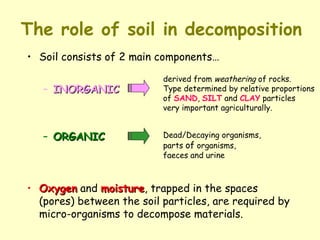
The role of soil in decomposition Soil consists of 2 main components… INORGANIC ORGANIC  Oxygen  and  moisture , trapped in the spaces (pores) between the soil particles, are required by micro-organisms to decompose materials. Dead/Decaying organisms,  parts  of  organisms,  faeces and urine derived from  weathering  of rocks.  Type determined by relative proportions  of  SAND ,  SILT  and  CLAY  particles very important agriculturally.
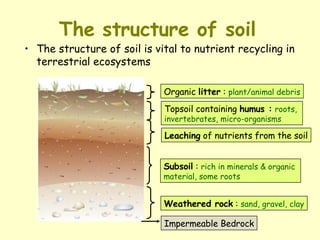
The structure of soil   The structure of soil is vital to nutrient recycling in terrestrial ecosystems Organic  litter  :  plant/animal debris Topsoil containing  humus :   roots,  invertebrates, micro-organisms Leaching  of nutrients from the soil Subsoil  :  rich in minerals & organic  material, some roots Weathered rock  :  sand, gravel, clay Impermeable Bedrock
Soil fauna Wide variety including … FUNGI BACTERIA  -  [Insert Soil micro-organisms table] INVERTEBRATES  -   worms, woodlice, spiders,   nematodes, larvae Essential to soil  productivity  - directly affect  quality  of soil
Rhizosphere The area where  plant roots  and  soil  come into contact.  There are large numbers of  micro-organisms  here that differ in species composition.  The major micro-organisms found are the bacteria whose growth is stimulated by various nutrients released by the plant roots. In exchange, the by-products of microbial metabolism that are released into the soil stimulate plant growth.
Decomposers and Detritivores These organisms feed on  waste or dead organic matter  such as dead leaves, dead bodies, or waste products, decomposing it by producing enzymes to break it down. Action of  detritivores   increases  the activity of  decomposers :- DETRITIVORES : Detritus eating soil invertebrates  e.g.   Earthworms, woodlice, spiders and nematodes . Physically reduce  detritus  particle sizes to produce  humus   [ FRAGMENTATION = Larger surface area for decomposers to work on!] Enhance fertility of the soil by incorporating leaf surface litter into the soil PHYSICAL DECOMPOSITION DECOMPOSERS : Fungi & Bacteria  Use waste materials as energy, carbon & nutrient sources Carry out respiration to release CO 2 Chemically breakdown [using  ENZYMES ]  detritus  (decaying matter) to release inorganic ions ( mineralisation ) CHEMICAL DECOMPOSITION
Detritus Food Chain   A food chain based on  dead organic material A food chain containing a primary producer which is a  soil invertebrate   e.g.  Earthworm. A Detritus food chain is essential to the energy flow of an ecosystem.
Decomposition The breakdown of dead organic matter(involving both  physical  and  biological  processes) with the release of inorganic nutrients into the soil.  These nutrients are then available for uptake by plants and other primary producers Undecomposed  material =  LITTER [DETRITUS] Completely decomposed  matter =  HUMUS
Humus Completely decomposed material Dark brown in colour Composition varies depending on which organic molecules are present Improves aeration, water and nutrient   retention; and so soil structure    Humus content =    soil fertility
Mineralisation Occurs at the same time as humus is being formed Process which changes  essential minerals   e.g.   N ,  P  and  S  from  Organic    Inorganic compounds   e.g.   ammonium ,  orthophosphate  and  sulphate Results in nutrients and minerals being released from dead organisms into a food chain
Rate Of Decomposition   This varies within different biomes and is dependent on several factors: Type  of organic matter Number  and  types  of decomposers and detritivores Environmental conditions   i.e.   temp, moisture   etc
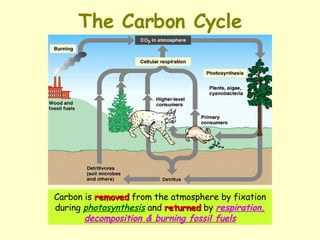
The Carbon Cycle Carbon is  removed  from the atmosphere by fixation during  photosynthesis  and  returned  by  respiration, decomposition & burning fossil fuels
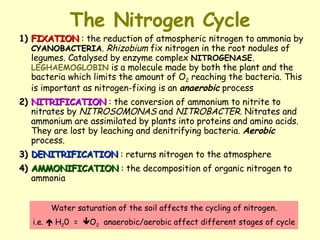
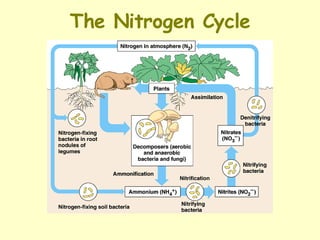
The Nitrogen Cycle 1) FIXATION  : the reduction of atmospheric nitrogen to ammonia by  CYANOBACTERIA .  Rhizobium  fix nitrogen in the root nodules of legumes. Catalysed by enzyme complex  NITROGENASE .  LEGHAEMOGLOBIN  is a molecule made by both the plant and the bacteria which limits the amount of O 2  reaching the bacteria. This is important as nitrogen-fixing is an  anaerobic  process 2) NITRIFICATION  : the conversion of ammonium to nitrite to nitrates by  NITROSOMONAS  and  NITROBACTER.  Nitrates and ammonium are assimilated by plants into proteins and amino acids. They are lost by leaching and denitrifying bacteria.  Aerobic  process. 3) DENITRIFICATION   : returns nitrogen to the atmosphere 4) AMMONIFICATION  : the decomposition of organic nitrogen to ammonia  Water saturation of the soil affects the cycling of nitrogen. i.e.    H 2 0  =   O 2   anaerobic/aerobic affect different stages of cycle
The Nitrogen Cycle
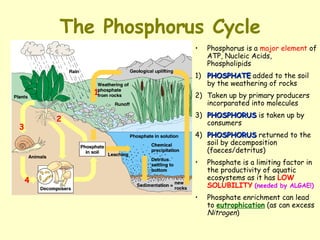
The Phosphorus Cycle Phosphorus is a  major element  of ATP, Nucleic Acids, Phospholipids 1) PHOSPHATE  added to the soil by the weathering of rocks  2) Taken up by primary producers incorparated into molecules 3) PHOSPHORUS  is taken up by consumers 4) PHOSPHORUS  returned to the soil by decomposition (faeces/detritus) Phosphate is a limiting factor in the productivity of aquatic ecosystems as it has  LOW   SOLUBILITY   (needed by ALGAE!) Phosphate enrichment can lead to  eutrophication  (as can excess  Nitrogen )  1 2 3 4

Circulation Of Nutrients

  • 1.
    Circulation of NutrientsDespite an inexhaustible influx of energy in the form of sunlight, continuation of life depends on recycling of essential chemical elements. These elements are continually cycled between the environment and living organisms as nutrients are absorbed and wastes released. The cycling of nutrients from the decomposition of dead or decaying matter , provides essential elements required for metabolic processes, such as photosynthesis, and constructing fundamental organic molecules, such as amino acids and nucleic acids.
  • 2.
    The role ofsoil in decomposition Soil consists of 2 main components… INORGANIC ORGANIC Oxygen and moisture , trapped in the spaces (pores) between the soil particles, are required by micro-organisms to decompose materials. Dead/Decaying organisms, parts of organisms, faeces and urine derived from weathering of rocks. Type determined by relative proportions of SAND , SILT and CLAY particles very important agriculturally.
  • 3.
    The structure ofsoil The structure of soil is vital to nutrient recycling in terrestrial ecosystems Organic litter : plant/animal debris Topsoil containing humus : roots, invertebrates, micro-organisms Leaching of nutrients from the soil Subsoil : rich in minerals & organic material, some roots Weathered rock : sand, gravel, clay Impermeable Bedrock
  • 4.
    Soil fauna Widevariety including … FUNGI BACTERIA - [Insert Soil micro-organisms table] INVERTEBRATES - worms, woodlice, spiders, nematodes, larvae Essential to soil productivity - directly affect quality of soil
  • 5.
    Rhizosphere The areawhere plant roots and soil come into contact. There are large numbers of micro-organisms here that differ in species composition. The major micro-organisms found are the bacteria whose growth is stimulated by various nutrients released by the plant roots. In exchange, the by-products of microbial metabolism that are released into the soil stimulate plant growth.
  • 6.
    Decomposers and DetritivoresThese organisms feed on waste or dead organic matter such as dead leaves, dead bodies, or waste products, decomposing it by producing enzymes to break it down. Action of detritivores increases the activity of decomposers :- DETRITIVORES : Detritus eating soil invertebrates e.g. Earthworms, woodlice, spiders and nematodes . Physically reduce detritus particle sizes to produce humus [ FRAGMENTATION = Larger surface area for decomposers to work on!] Enhance fertility of the soil by incorporating leaf surface litter into the soil PHYSICAL DECOMPOSITION DECOMPOSERS : Fungi & Bacteria Use waste materials as energy, carbon & nutrient sources Carry out respiration to release CO 2 Chemically breakdown [using ENZYMES ] detritus (decaying matter) to release inorganic ions ( mineralisation ) CHEMICAL DECOMPOSITION
  • 7.
    Detritus Food Chain A food chain based on dead organic material A food chain containing a primary producer which is a soil invertebrate e.g. Earthworm. A Detritus food chain is essential to the energy flow of an ecosystem.
  • 8.
    Decomposition The breakdownof dead organic matter(involving both physical and biological processes) with the release of inorganic nutrients into the soil. These nutrients are then available for uptake by plants and other primary producers Undecomposed material = LITTER [DETRITUS] Completely decomposed matter = HUMUS
  • 9.
    Humus Completely decomposedmaterial Dark brown in colour Composition varies depending on which organic molecules are present Improves aeration, water and nutrient retention; and so soil structure  Humus content =  soil fertility
  • 10.
    Mineralisation Occurs atthe same time as humus is being formed Process which changes essential minerals e.g. N , P and S from Organic  Inorganic compounds e.g. ammonium , orthophosphate and sulphate Results in nutrients and minerals being released from dead organisms into a food chain
  • 11.
    Rate Of Decomposition This varies within different biomes and is dependent on several factors: Type of organic matter Number and types of decomposers and detritivores Environmental conditions i.e. temp, moisture etc
  • 12.
    The Carbon CycleCarbon is removed from the atmosphere by fixation during photosynthesis and returned by respiration, decomposition & burning fossil fuels
  • 13.
    The Nitrogen Cycle1) FIXATION : the reduction of atmospheric nitrogen to ammonia by CYANOBACTERIA . Rhizobium fix nitrogen in the root nodules of legumes. Catalysed by enzyme complex NITROGENASE . LEGHAEMOGLOBIN is a molecule made by both the plant and the bacteria which limits the amount of O 2 reaching the bacteria. This is important as nitrogen-fixing is an anaerobic process 2) NITRIFICATION : the conversion of ammonium to nitrite to nitrates by NITROSOMONAS and NITROBACTER. Nitrates and ammonium are assimilated by plants into proteins and amino acids. They are lost by leaching and denitrifying bacteria. Aerobic process. 3) DENITRIFICATION : returns nitrogen to the atmosphere 4) AMMONIFICATION : the decomposition of organic nitrogen to ammonia Water saturation of the soil affects the cycling of nitrogen. i.e.  H 2 0 =  O 2 anaerobic/aerobic affect different stages of cycle
  • 14.
  • 15.
    The Phosphorus CyclePhosphorus is a major element of ATP, Nucleic Acids, Phospholipids 1) PHOSPHATE added to the soil by the weathering of rocks 2) Taken up by primary producers incorparated into molecules 3) PHOSPHORUS is taken up by consumers 4) PHOSPHORUS returned to the soil by decomposition (faeces/detritus) Phosphate is a limiting factor in the productivity of aquatic ecosystems as it has LOW SOLUBILITY (needed by ALGAE!) Phosphate enrichment can lead to eutrophication (as can excess Nitrogen ) 1 2 3 4