Measurement of KLa
Presented by
SHINDE ASHOK SAKHARAM
UPSTREAM PROCESS DEVELOPMENT (ANIMAL CELL
CULTURE) 1
 The determination of the KLa value for fermentation is
important in order to maintain adequate transfer of oxygen in
a bioreactor, for laboratory scale use or when scaling up to a
larger process
 The volumetric mass transfer coefficient, (KLa) indicates the
rate of oxygen used for fermentation, taking into account all
oxygen-consuming variables in the bioreactor
 KLa values are used in scaling up from laboratory scale to
pilot scale or production scale bioreactors
2
INTRODUCTION OF KLa
F. Garcia-Ochoa, E. Gomez / Biotechnology Advances 27 (2009) 153–176
 The determination of the KLa of a fermenter is essential in
order
 To establish its aeration efficiency and
 To quantify the effects of operating variables on the provision
of oxygen
 The equations describing oxygen transfer are based on
dissolved oxygen concentration
 The solubility of oxygen is affected by dissolved solutes
therefore pure water and a fermentation medium saturated
with oxygen have different dissolved oxygen concentrations
3
Cont…
F. Garcia-Ochoa, E. Gomez / Biotechnology Advances 27 (2009) 153–176
I) CHEMICAL METHOD
a) Sodium sulphite oxidation
b) Carbon dioxide
c) Hydrazine oxidation
d) Catechol oxidation
e) Glucose oxidase
f) Kryptone absorption
4
Determination of KLa method
Biotechnol. Bioeng. 43: 1139–1145.
Determination of KLa method
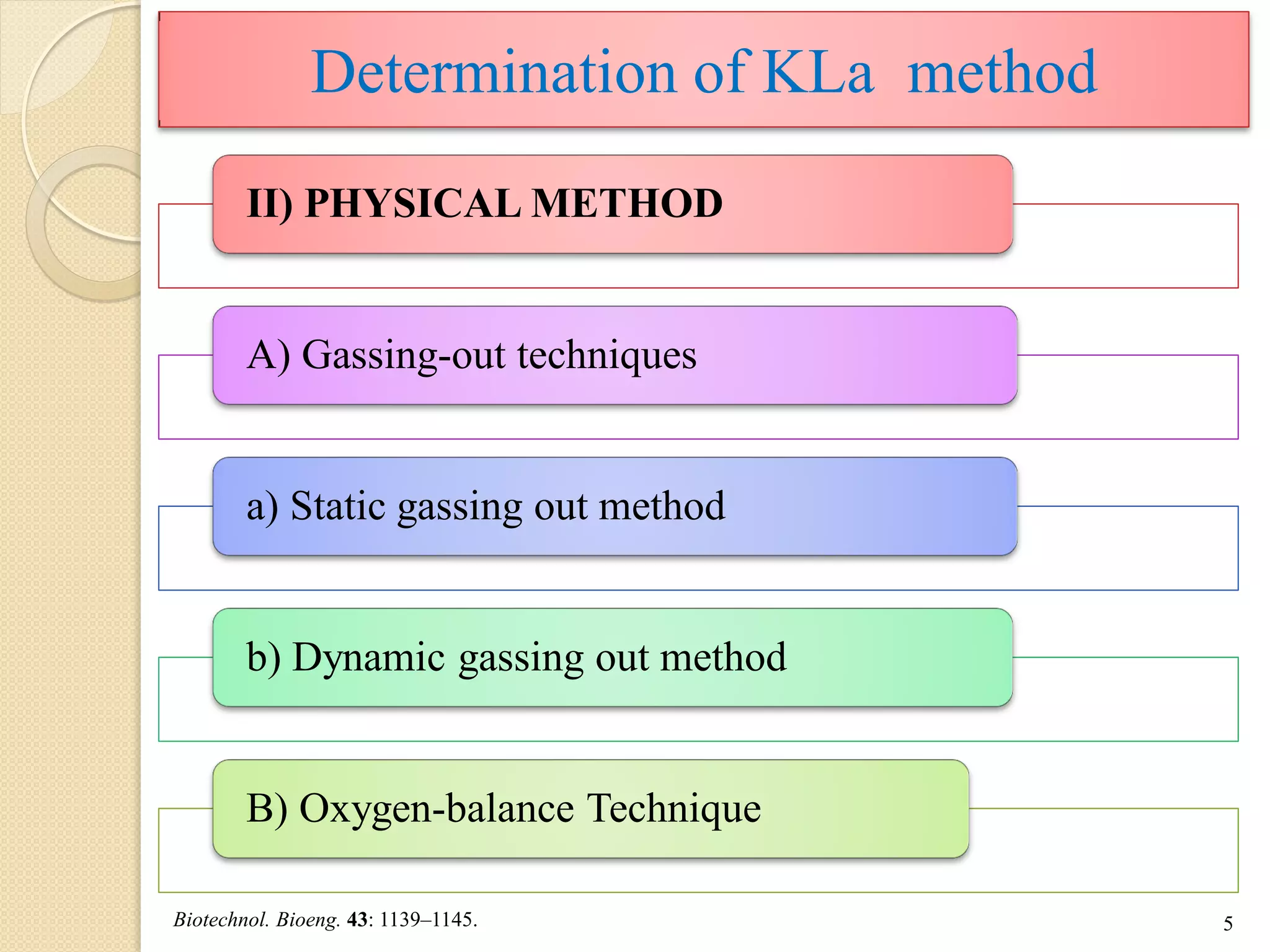
II) PHYSICAL METHOD
A) Gassing-out techniques
a) Static gassing out method
b) Dynamic gassing out method
B) Oxygen-balance Technique
5Biotechnol. Bioeng. 43: 1139–1145.
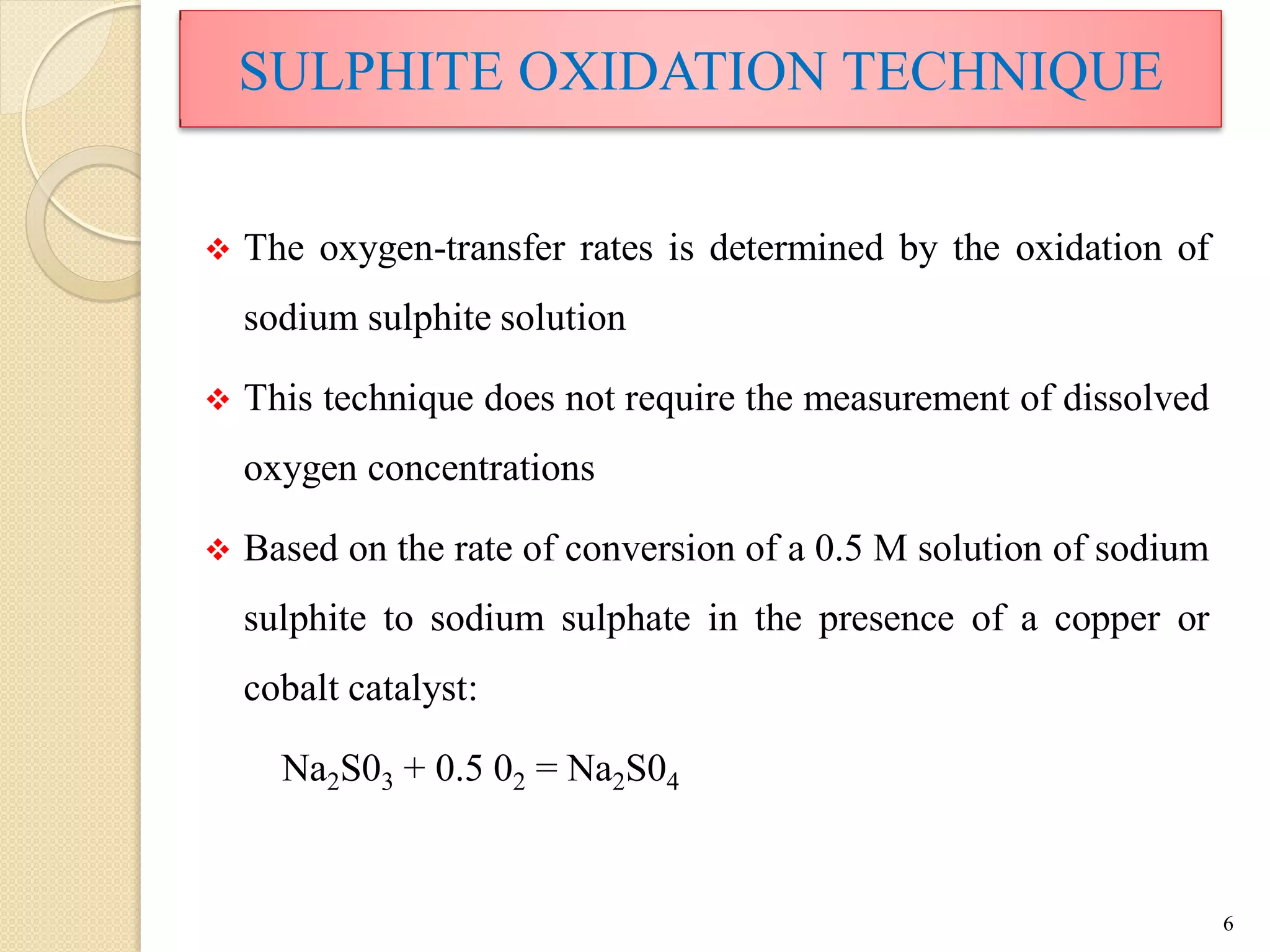
 The oxygen-transfer rates is determined by the oxidation of
sodium sulphite solution
 This technique does not require the measurement of dissolved
oxygen concentrations
 Based on the rate of conversion of a 0.5 M solution of sodium
sulphite to sodium sulphate in the presence of a copper or
cobalt catalyst:
Na2S03 + 0.5 02 = Na2S04
6
SULPHITE OXIDATION TECHNIQUE
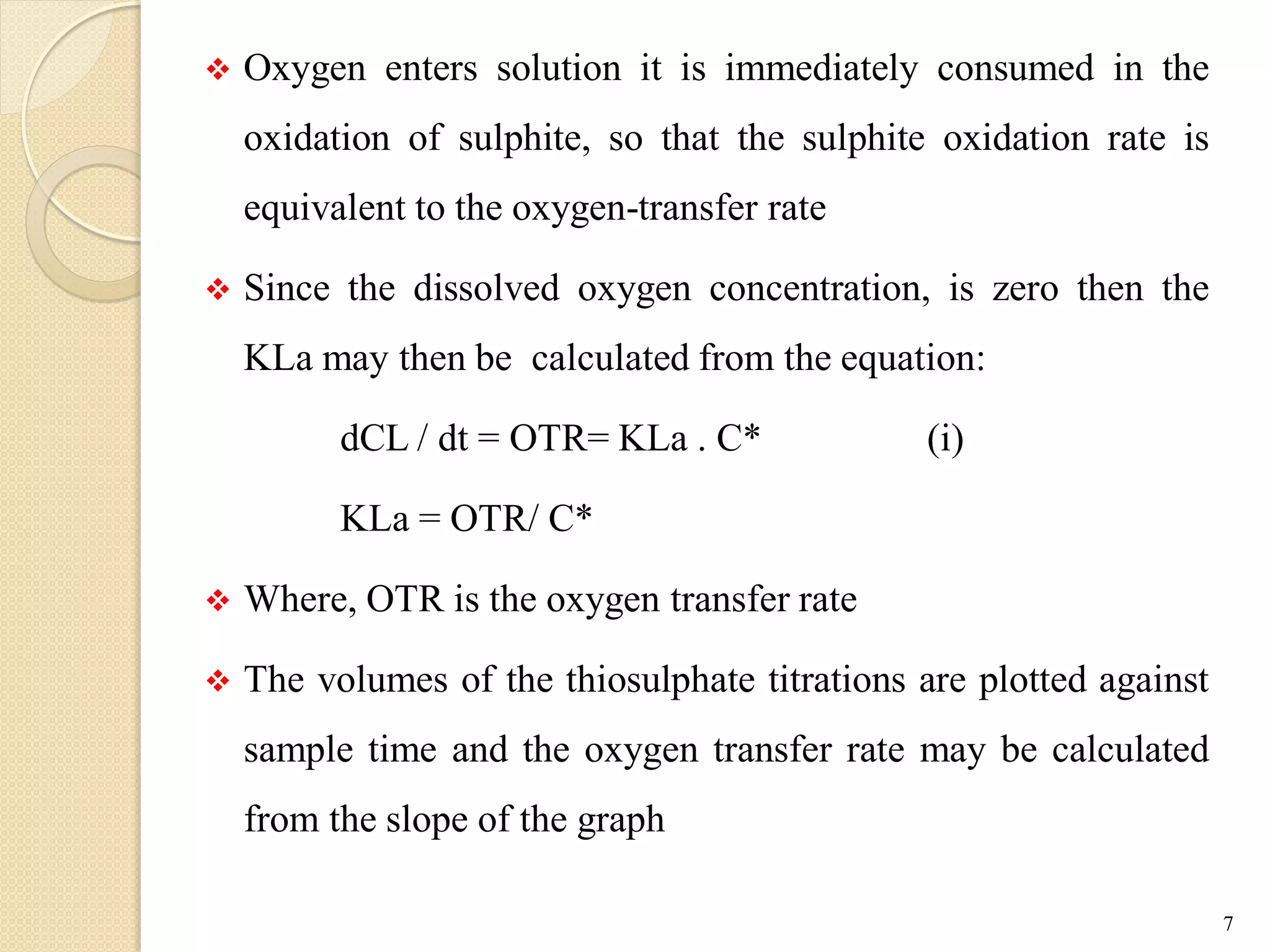
 Oxygen enters solution it is immediately consumed in the
oxidation of sulphite, so that the sulphite oxidation rate is
equivalent to the oxygen-transfer rate
 Since the dissolved oxygen concentration, is zero then the
KLa may then be calculated from the equation:
dCL / dt = OTR= KLa . C* (i)
KLa = OTR/ C*
 Where, OTR is the oxygen transfer rate
 The volumes of the thiosulphate titrations are plotted against
sample time and the oxygen transfer rate may be calculated
from the slope of the graph
7
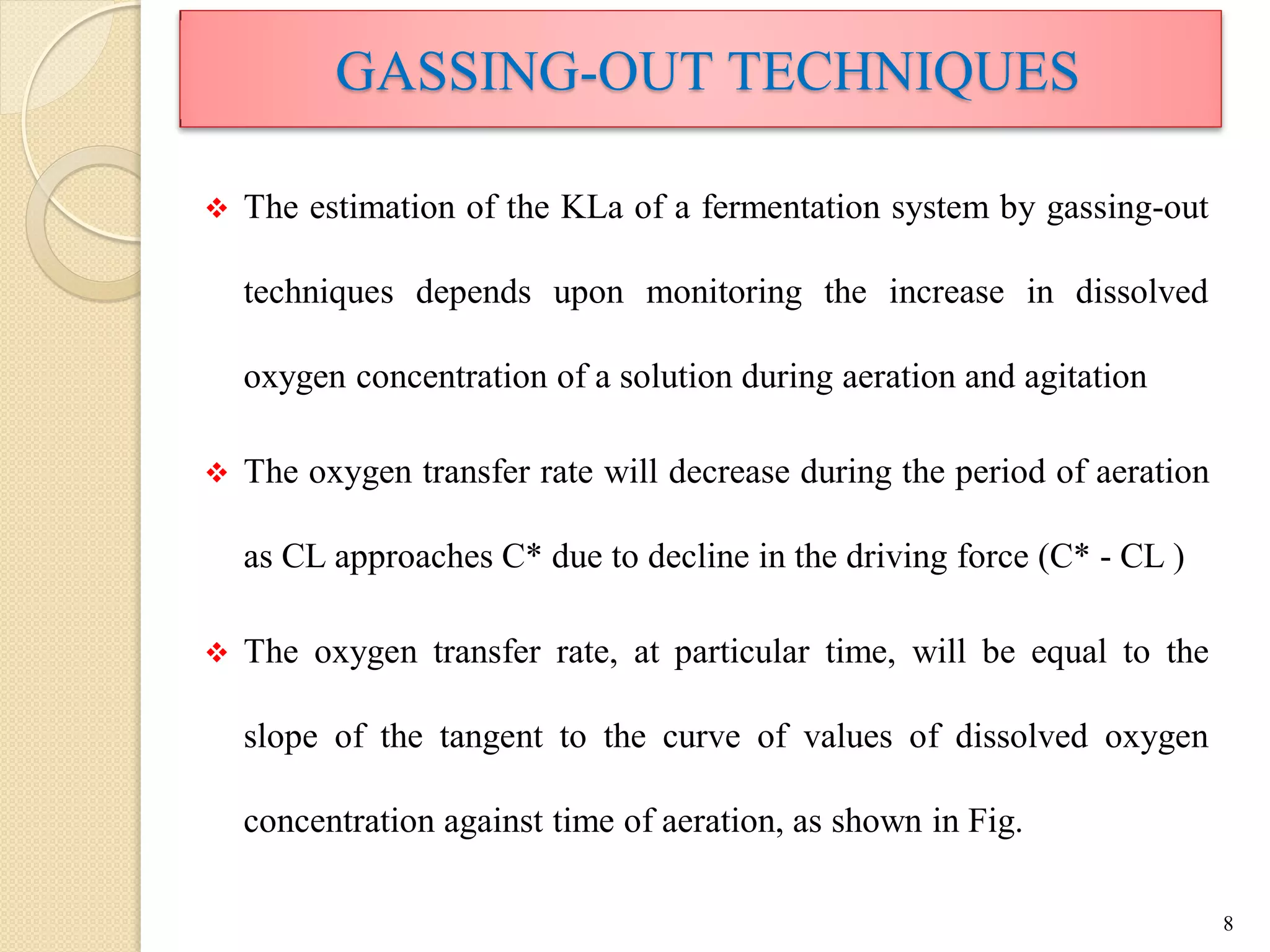
 The estimation of the KLa of a fermentation system by gassing-out
techniques depends upon monitoring the increase in dissolved
oxygen concentration of a solution during aeration and agitation
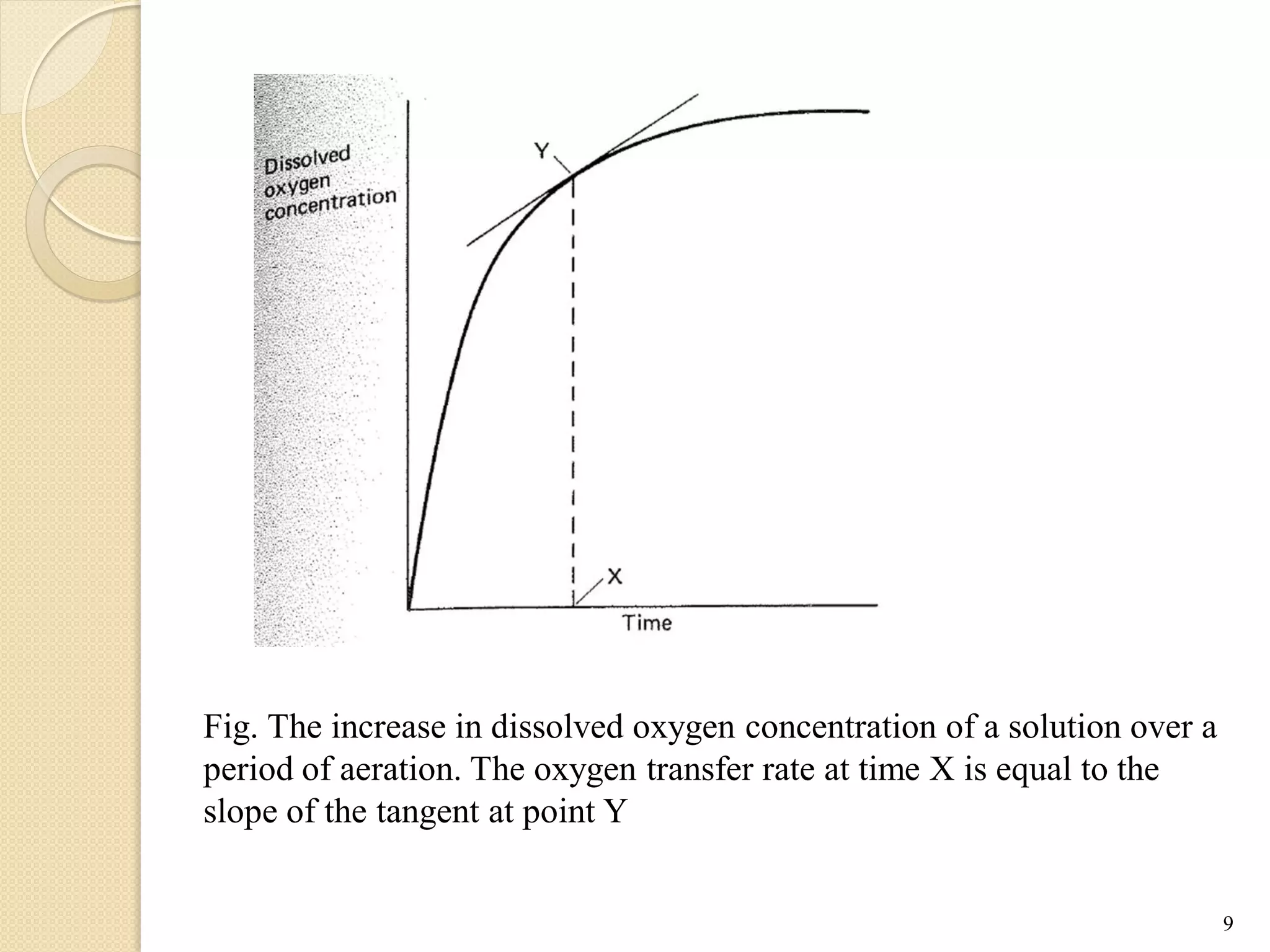
 The oxygen transfer rate will decrease during the period of aeration
as CL approaches C* due to decline in the driving force (C* - CL )
 The oxygen transfer rate, at particular time, will be equal to the
slope of the tangent to the curve of values of dissolved oxygen
concentration against time of aeration, as shown in Fig.
8
GASSING-OUT TECHNIQUES
Fig. The increase in dissolved oxygen concentration of a solution over a
period of aeration. The oxygen transfer rate at time X is equal to the
slope of the tangent at point Y
9
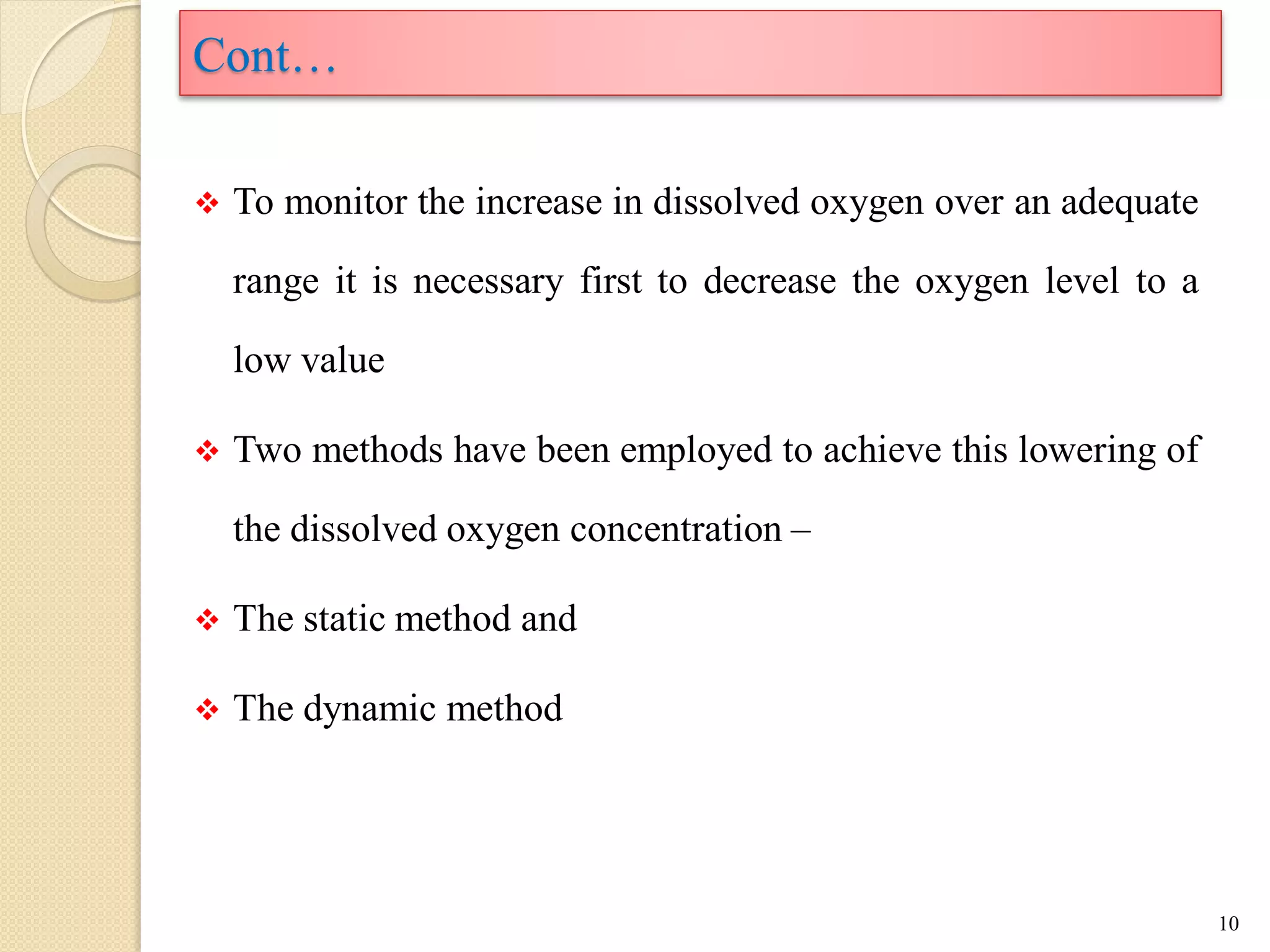
 To monitor the increase in dissolved oxygen over an adequate
range it is necessary first to decrease the oxygen level to a
low value
 Two methods have been employed to achieve this lowering of
the dissolved oxygen concentration –
 The static method and
 The dynamic method
10
Cont…
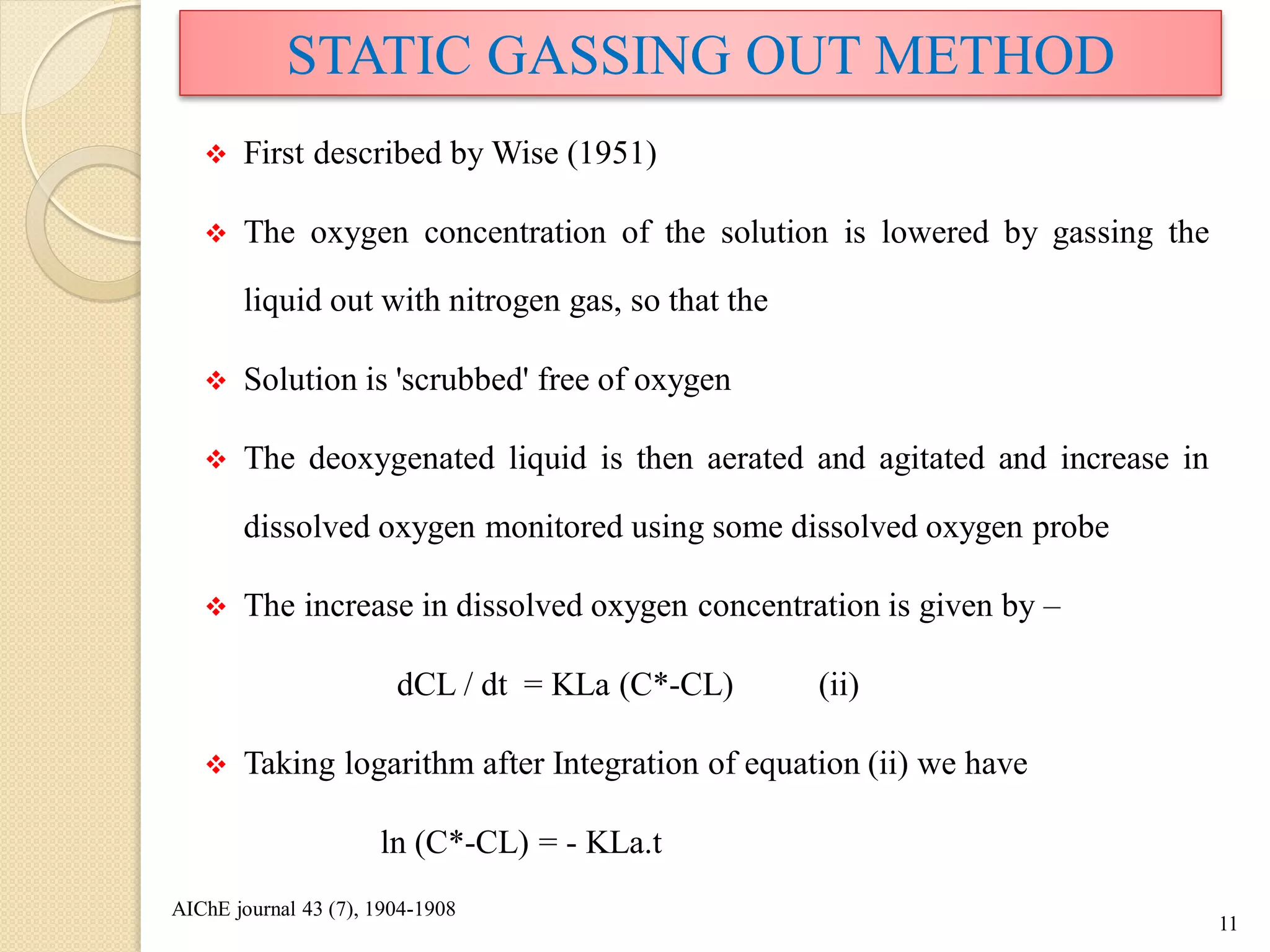
 First described by Wise (1951)
 The oxygen concentration of the solution is lowered by gassing the
liquid out with nitrogen gas, so that the
 Solution is 'scrubbed' free of oxygen
 The deoxygenated liquid is then aerated and agitated and increase in
dissolved oxygen monitored using some dissolved oxygen probe
 The increase in dissolved oxygen concentration is given by –
dCL / dt = KLa (C*-CL) (ii)
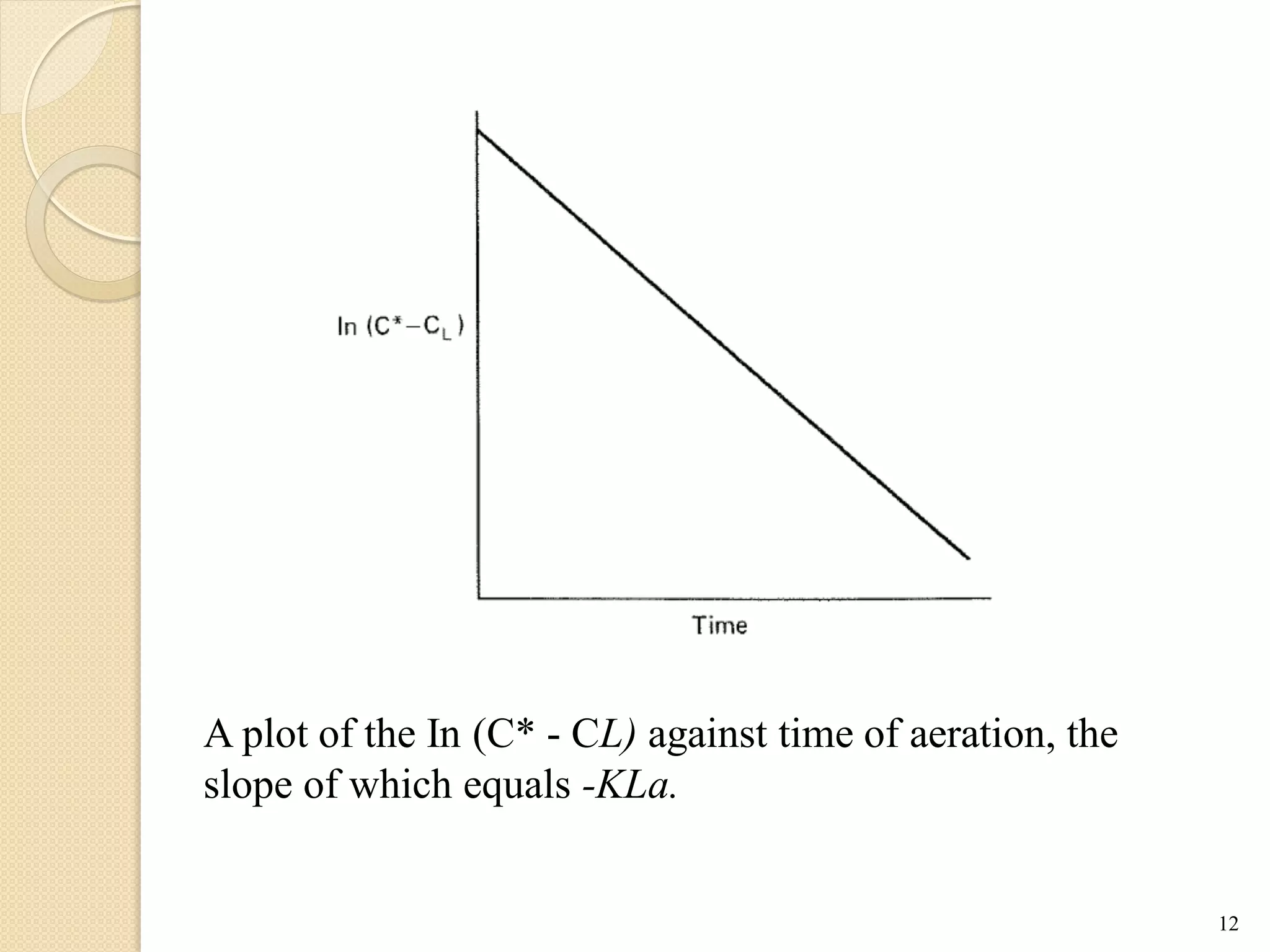
 Taking logarithm after Integration of equation (ii) we have
ln (C*-CL) = - KLa.t
11
STATIC GASSING OUT METHOD
AIChE journal 43 (7), 1904-1908
A plot of the In (C* - CL) against time of aeration, the
slope of which equals -KLa.
12
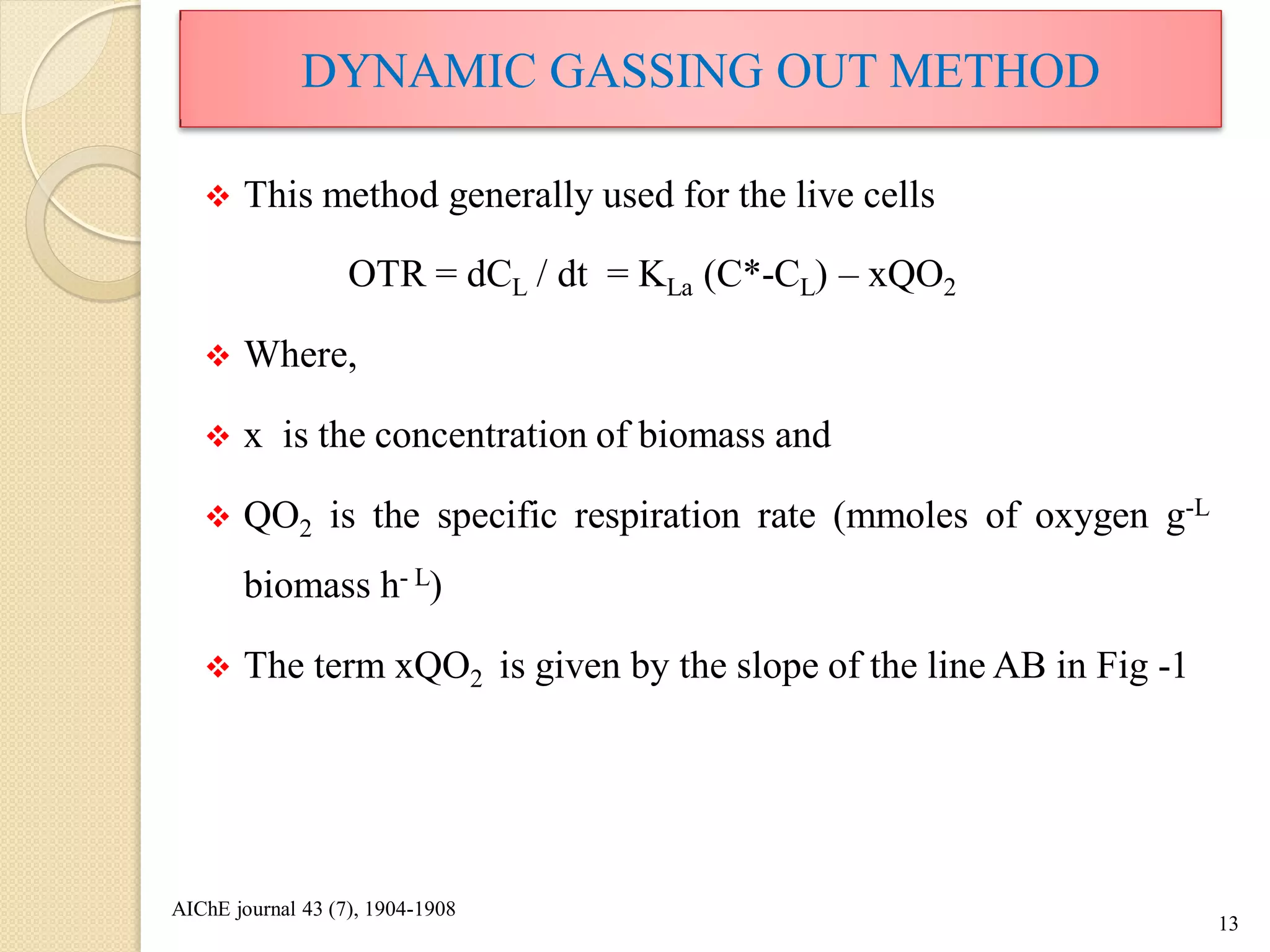
 This method generally used for the live cells
OTR = dCL / dt = KLa (C*-CL) – xQO2
 Where,
 x is the concentration of biomass and
 QO2 is the specific respiration rate (mmoles of oxygen g-L
biomass h- L)
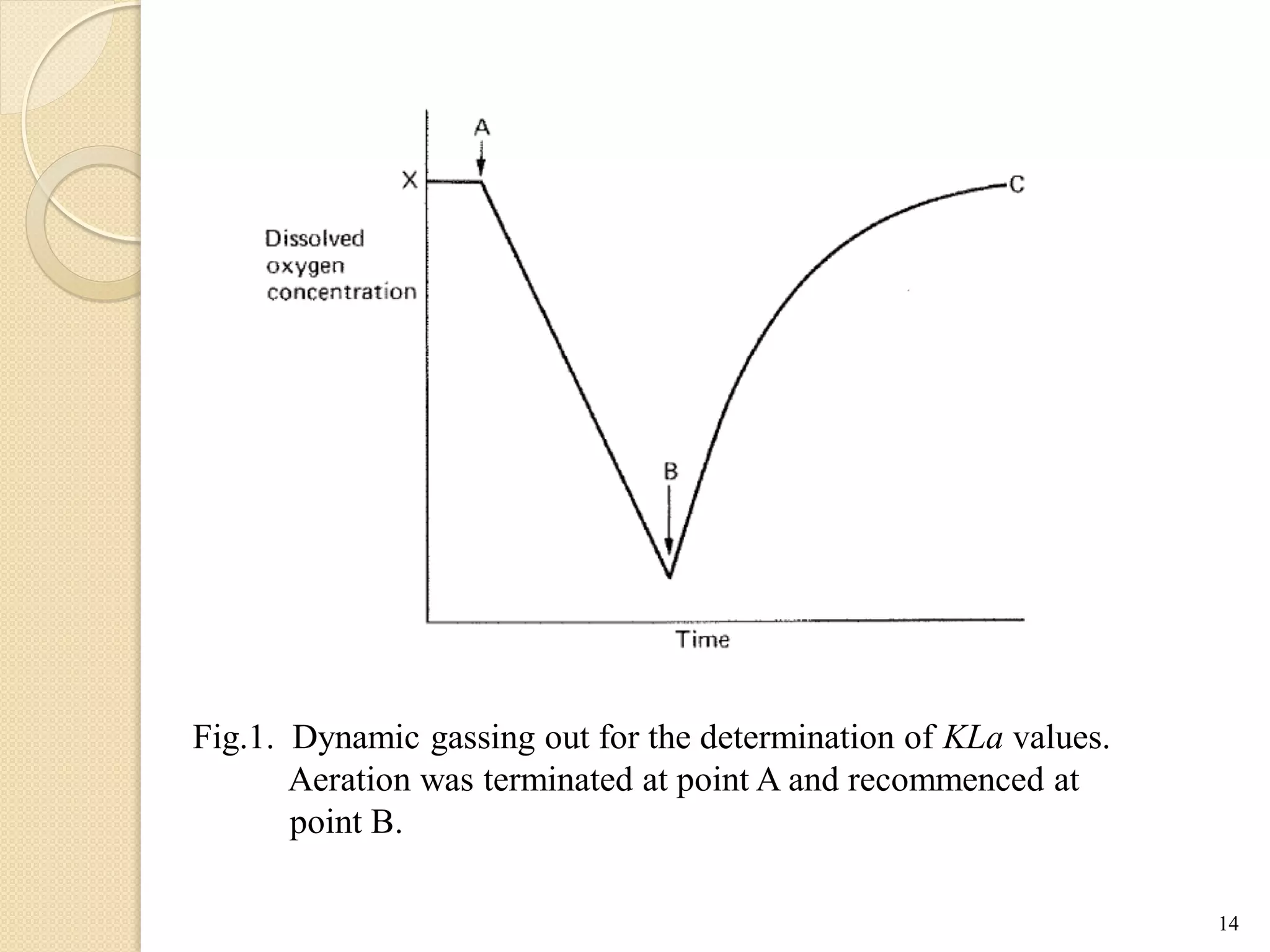
 The term xQO2 is given by the slope of the line AB in Fig -1
13
DYNAMIC GASSING OUT METHOD
AIChE journal 43 (7), 1904-1908
Fig.1. Dynamic gassing out for the determination of KLa values.
Aeration was terminated at point A and recommenced at
point B.
14
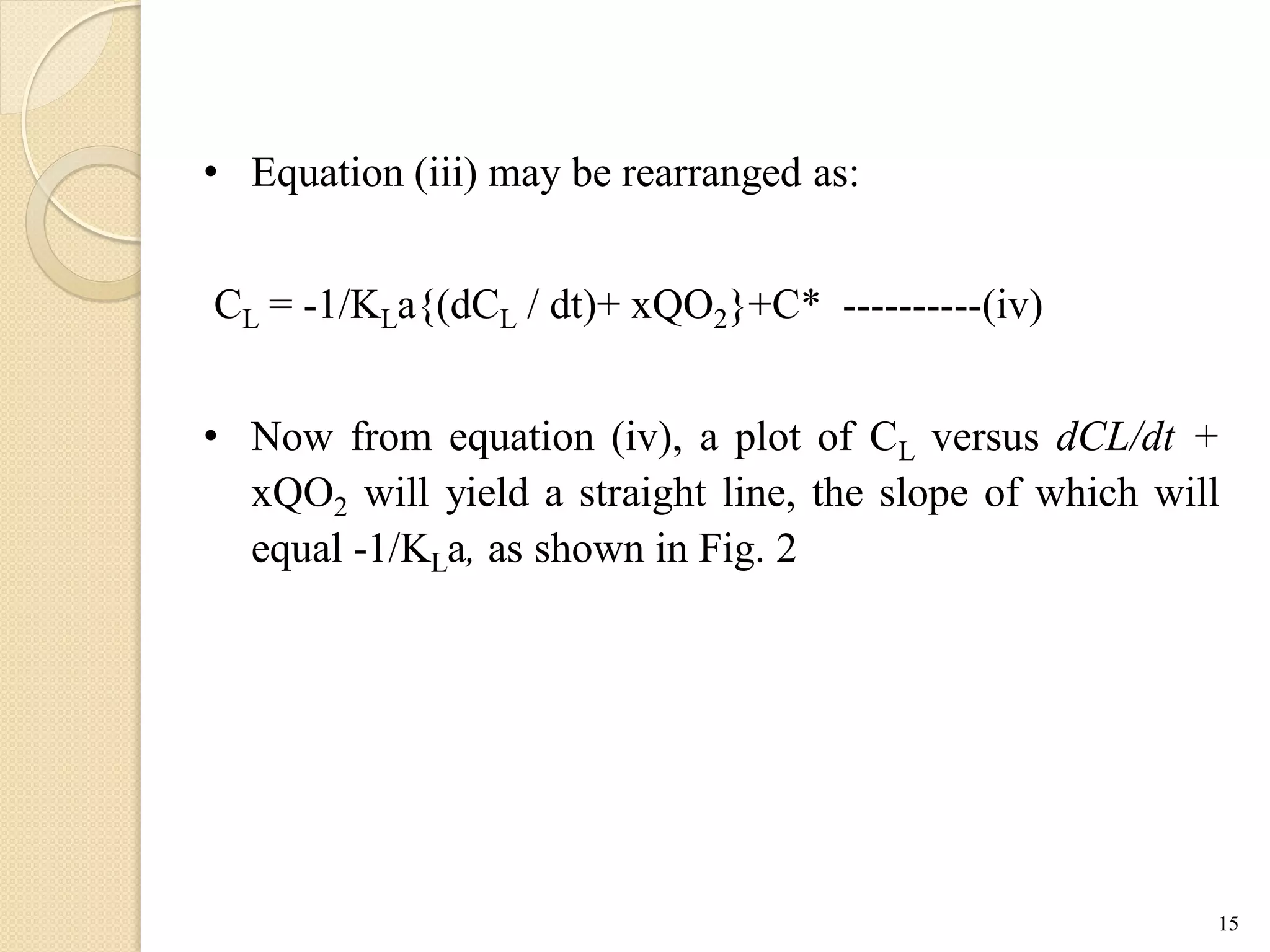
• Equation (iii) may be rearranged as:
CL = -1/KLa{(dCL / dt)+ xQO2}+C* ----------(iv)
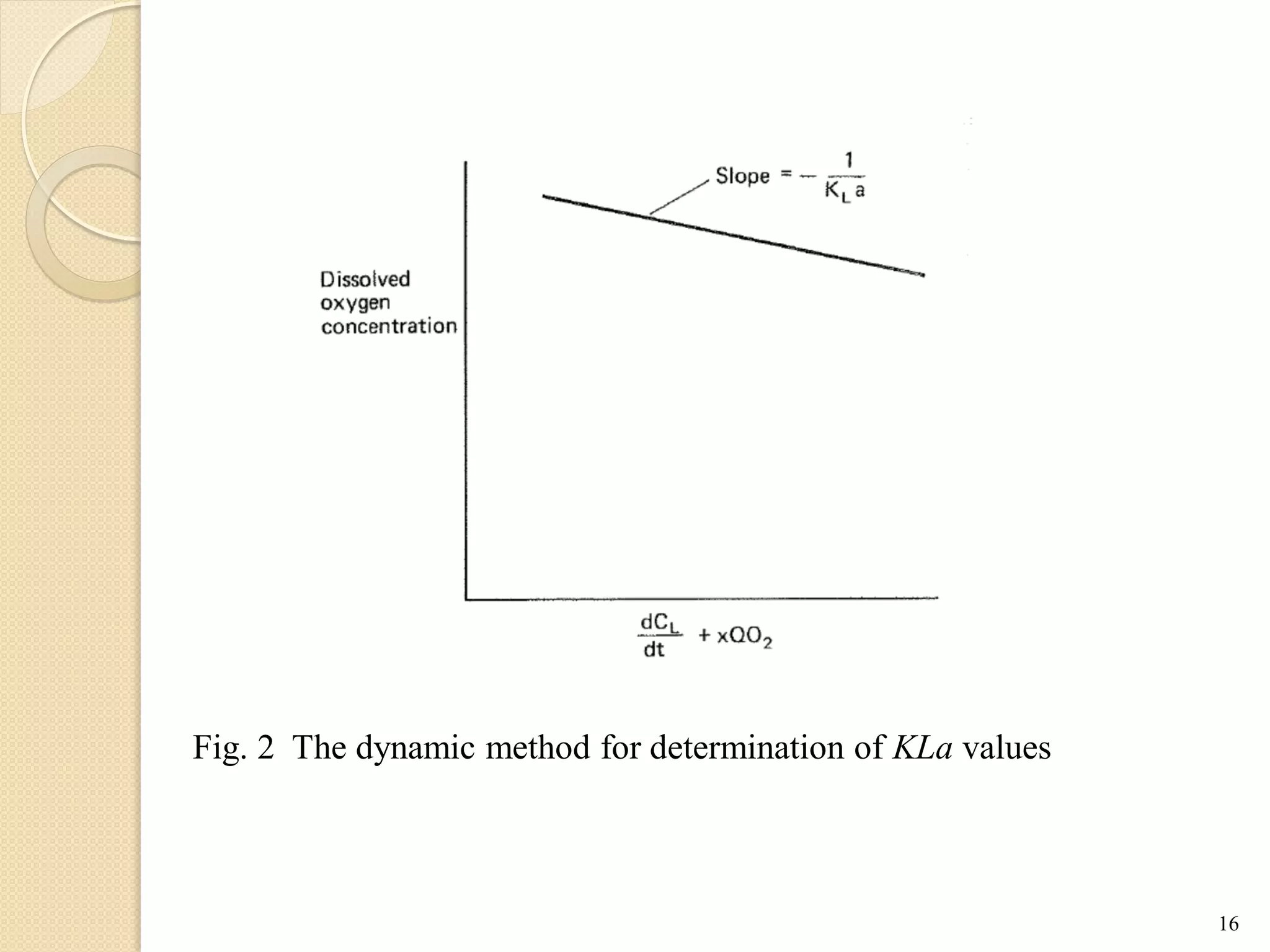
• Now from equation (iv), a plot of CL versus dCL/dt +
xQO2 will yield a straight line, the slope of which will
equal -1/KLa, as shown in Fig. 2
15
Fig. 2 The dynamic method for determination of KLa values
16
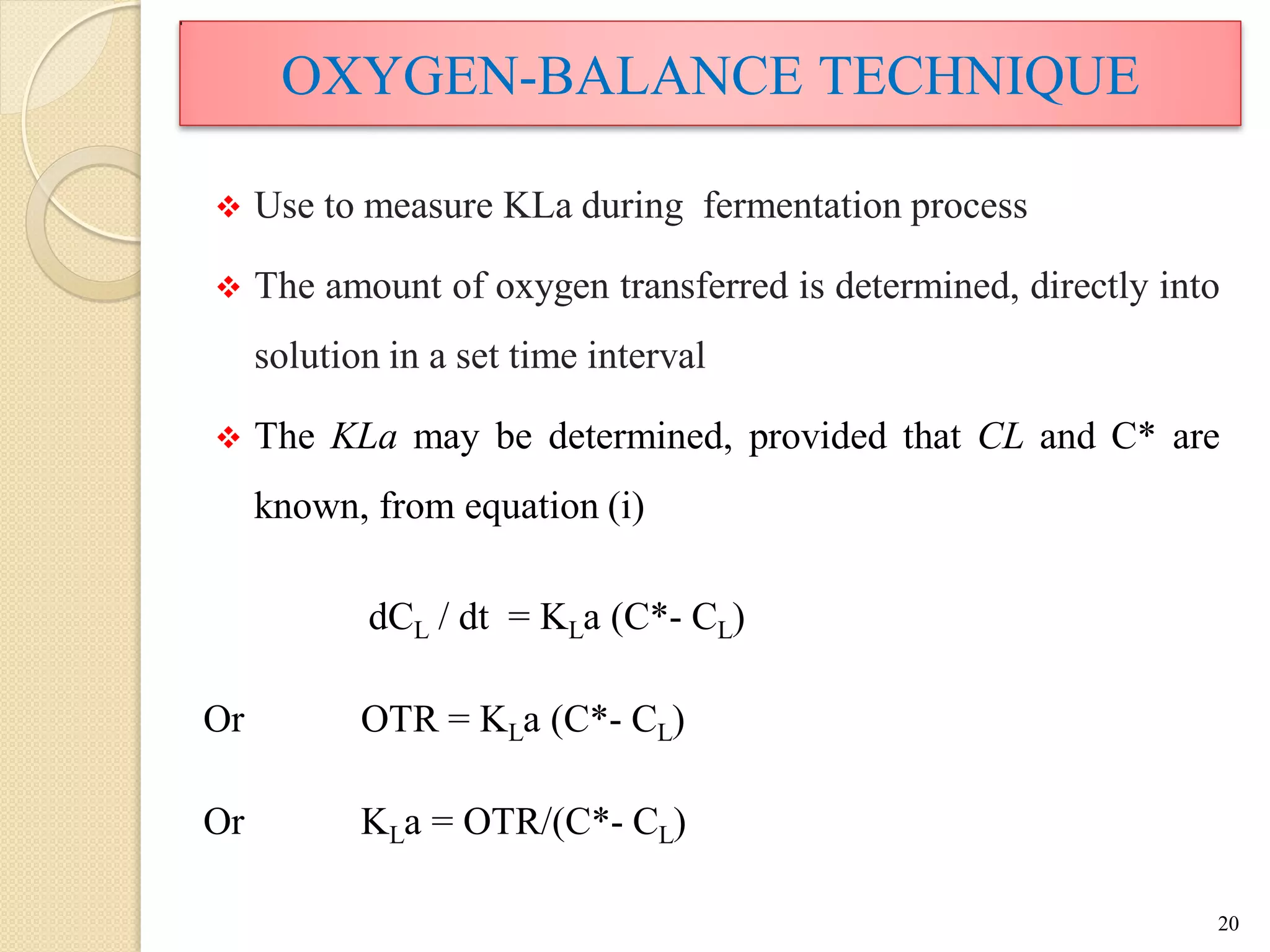
Fig. 3. The occurrence of oxygen limitation during the dynamic
gassing out of a fermentation
17
ADVANTAGES
 The dynamic gassing-out method has the advantage over the
previous methods of determining the KLa during an actual
fermentation and may be used to determine KLa values at different
stages in the process
 The technique is also rapid and only requires the use of a dissolved-
oxygen probe, of the membrane type
18
LIMITATIONS
 A major limitation in the operation of the technique is the range
over which the increase in dissolved oxygen concentration may be
measured
 It may be difficult to apply the technique during a fermentation
which has an oxygen demand close to the supply capacity of the
fermenter
 Both the dynamic and static methods are also unsuitable for
measuring KLa values in viscous systems
19
OXYGEN-BALANCE TECHNIQUE
 Use to measure KLa during fermentation process
 The amount of oxygen transferred is determined, directly into
solution in a set time interval
 The KLa may be determined, provided that CL and C* are
known, from equation (i)
dCL / dt = KLa (C*- CL)
Or OTR = KLa (C*- CL)
Or KLa = OTR/(C*- CL)
20
 The oxygen-balance technique appears to be the simplest
method for the assessment of KLa and
 Has the advantage of measuring aeration efficiency during a
fermentation
21
FACTORS AFFECTING KLa VALUES IN
FERMENTATION VESSELS
 A number of factors have been demonstrated to affect the KLa
value. Such factors include
 The air-flow rate employed in vessels
 The degree of agitation inside vessels
 The rheological properties of the culture broth and
 The presence of antifoam agents
22
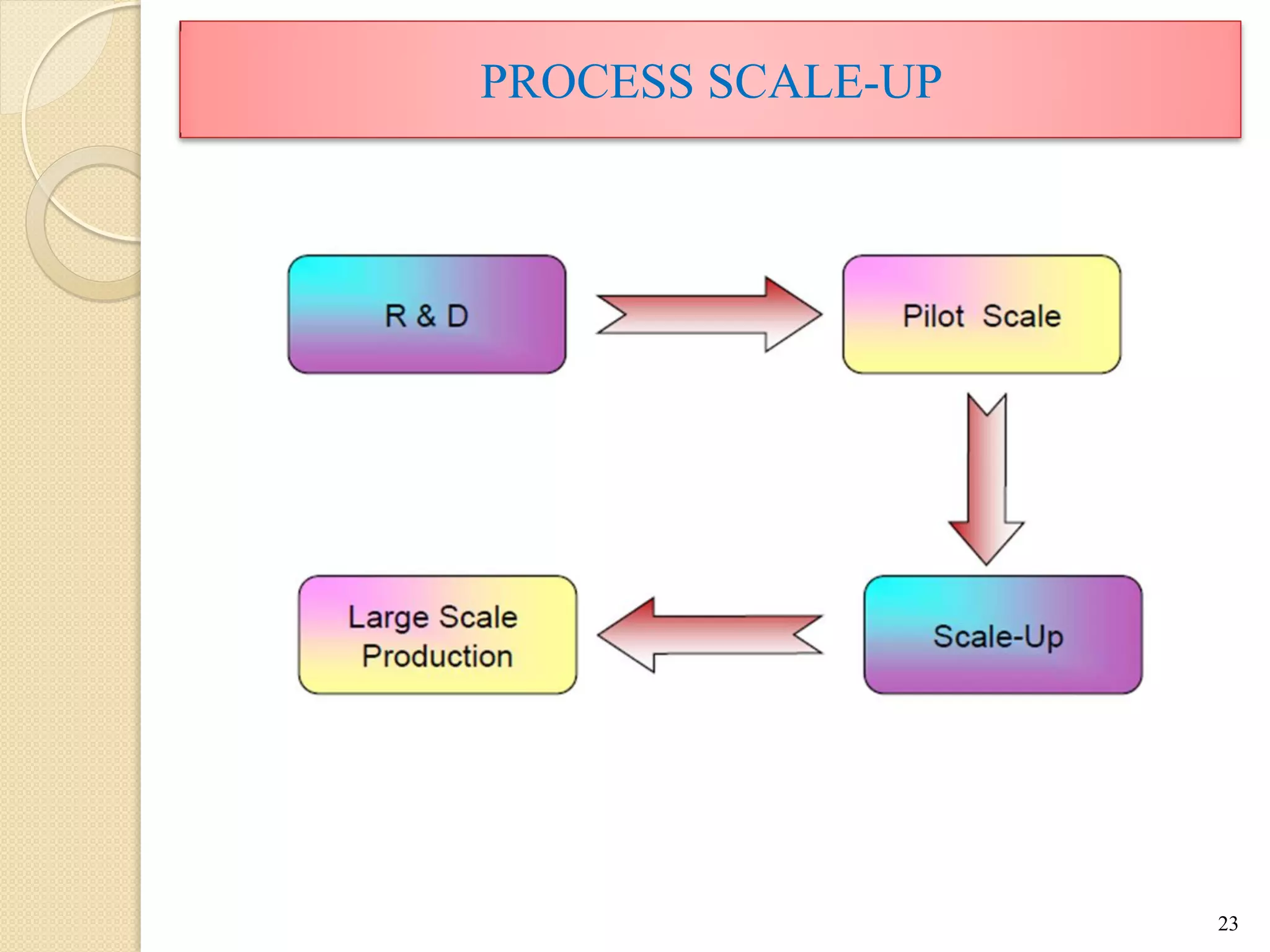
PROCESS SCALE-UP
23
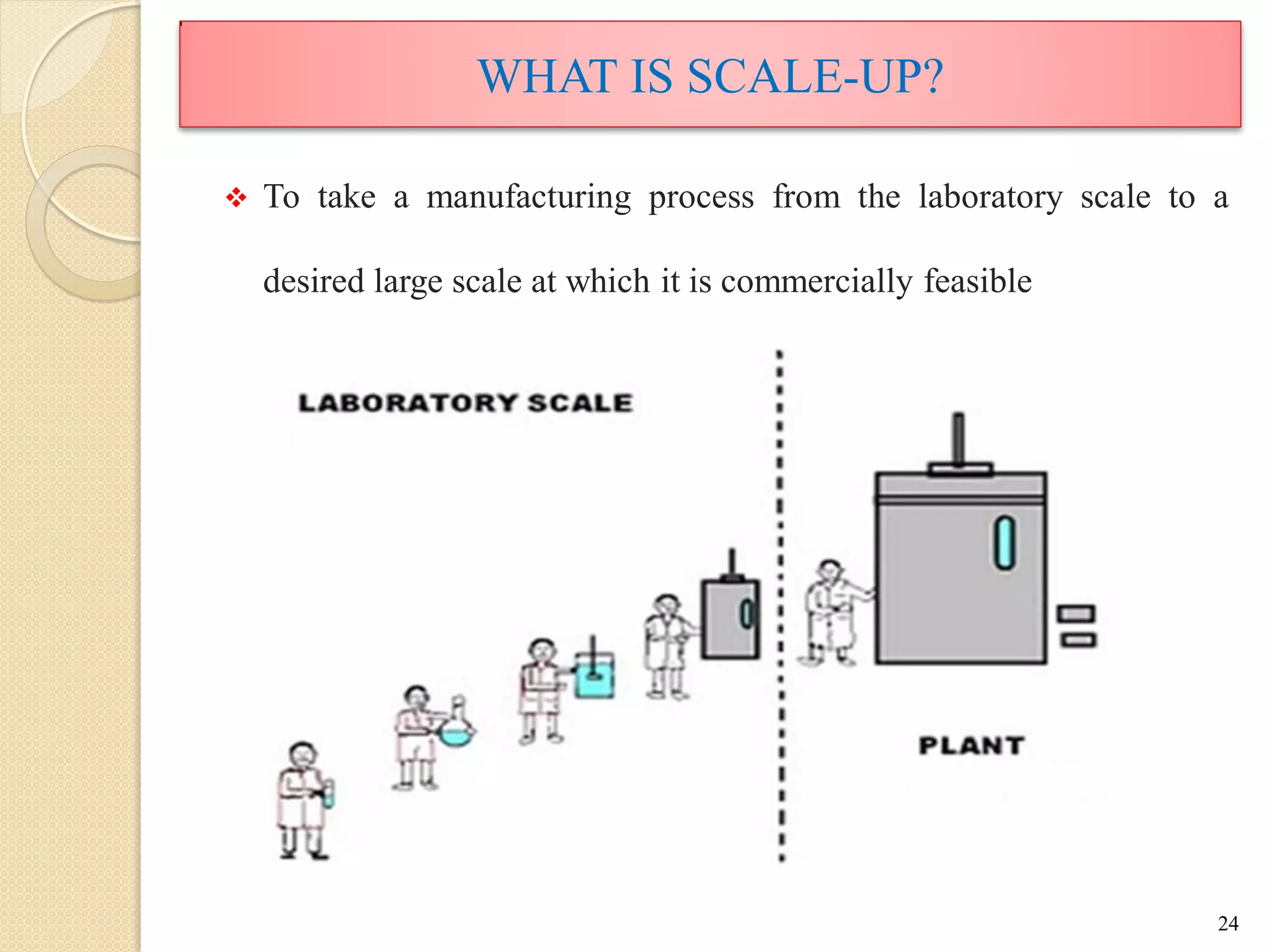
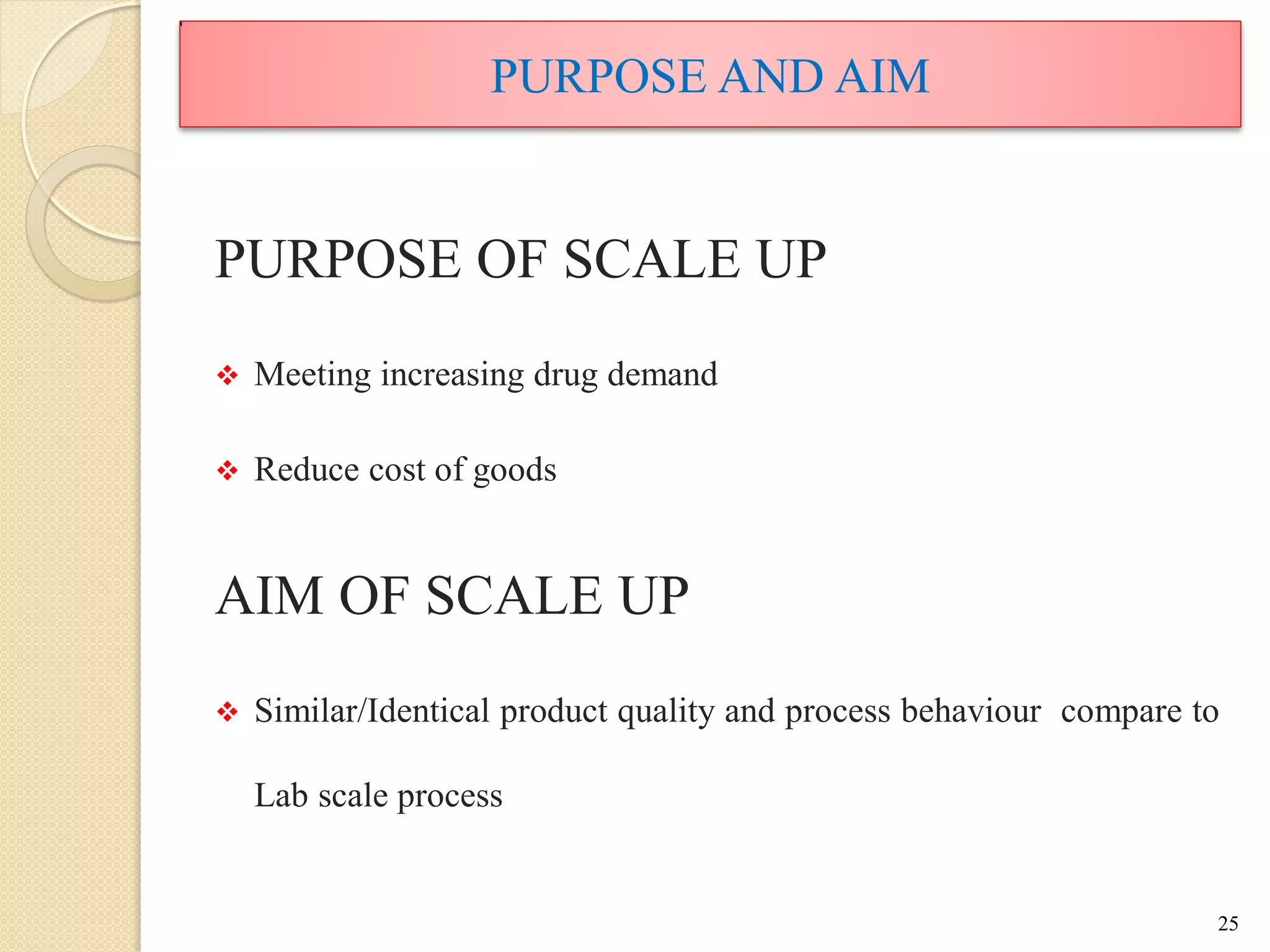
WHAT IS SCALE-UP?
 To take a manufacturing process from the laboratory scale to a
desired large scale at which it is commercially feasible
24
PURPOSE OF SCALE UP
 Meeting increasing drug demand
 Reduce cost of goods
AIM OF SCALE UP
 Similar/Identical product quality and process behaviour compare to
Lab scale process
25
PURPOSE AND AIM
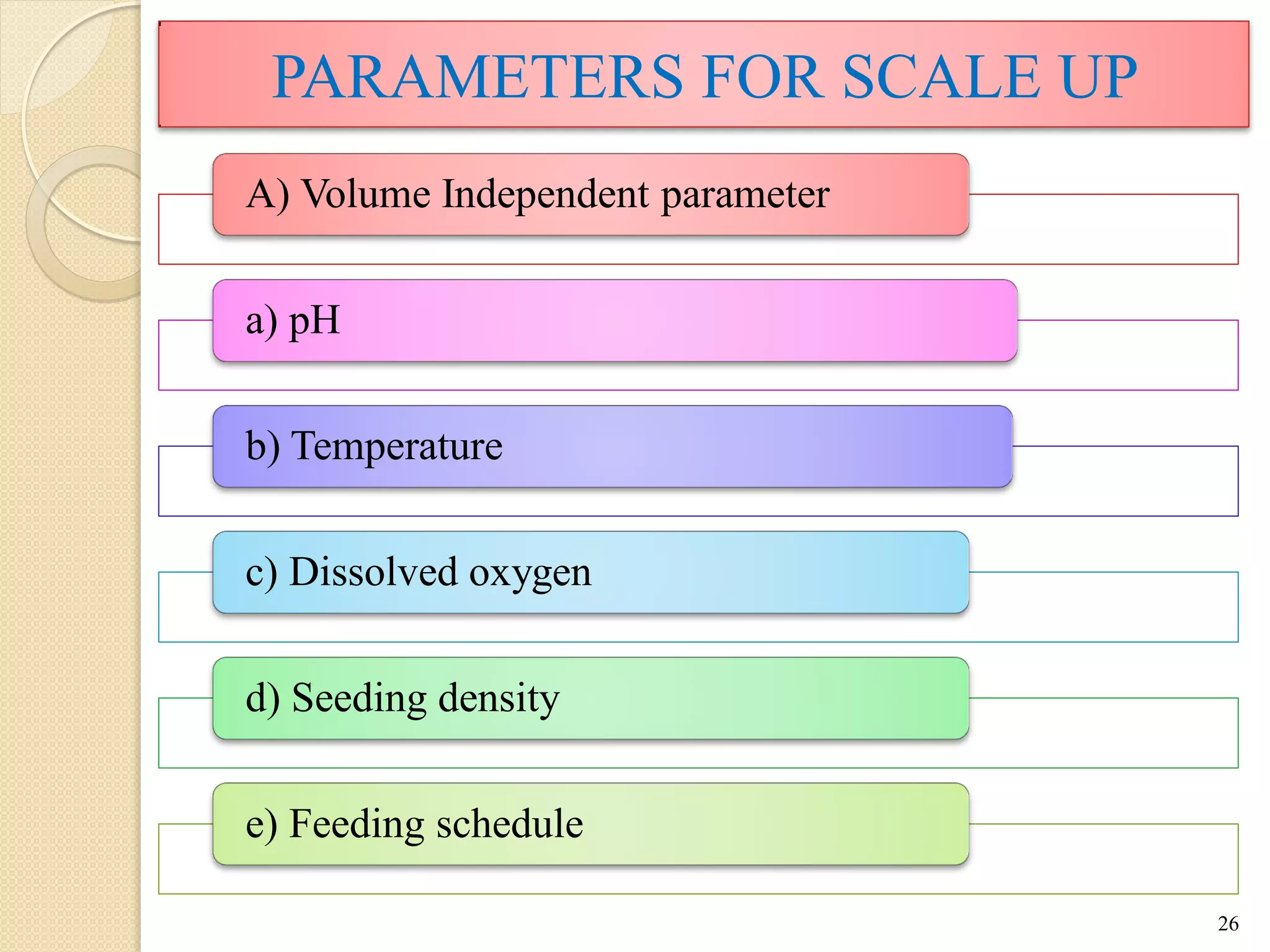
A) Volume Independent parameter
a) pH
b) Temperature
c) Dissolved oxygen
d) Seeding density
e) Feeding schedule
26
PARAMETERS FOR SCALE UP
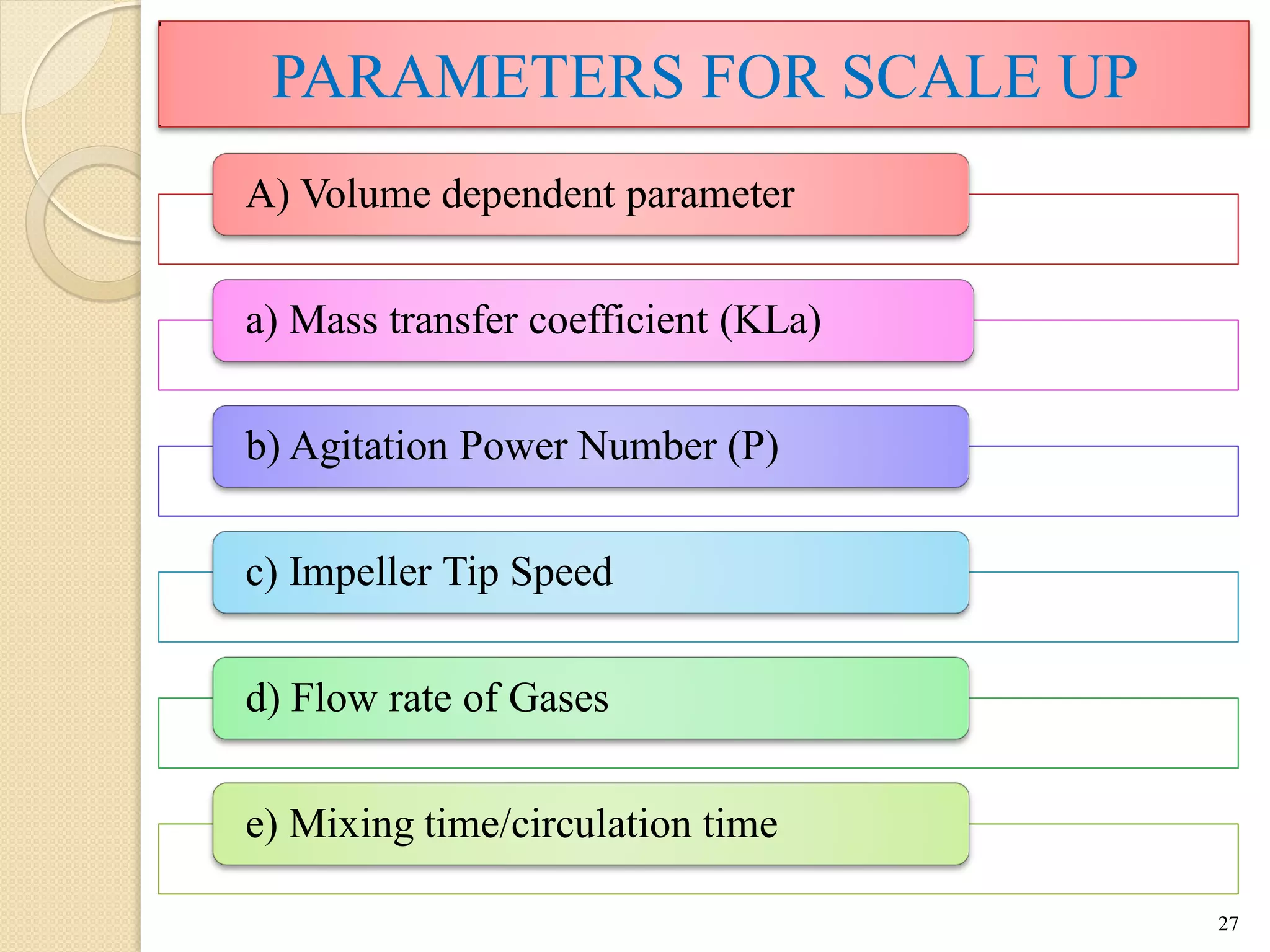
A) Volume dependent parameter
a) Mass transfer coefficient (KLa)
b) Agitation Power Number (P)
c) Impeller Tip Speed
d) Flow rate of Gases
e) Mixing time/circulation time
27
PARAMETERS FOR SCALE UP
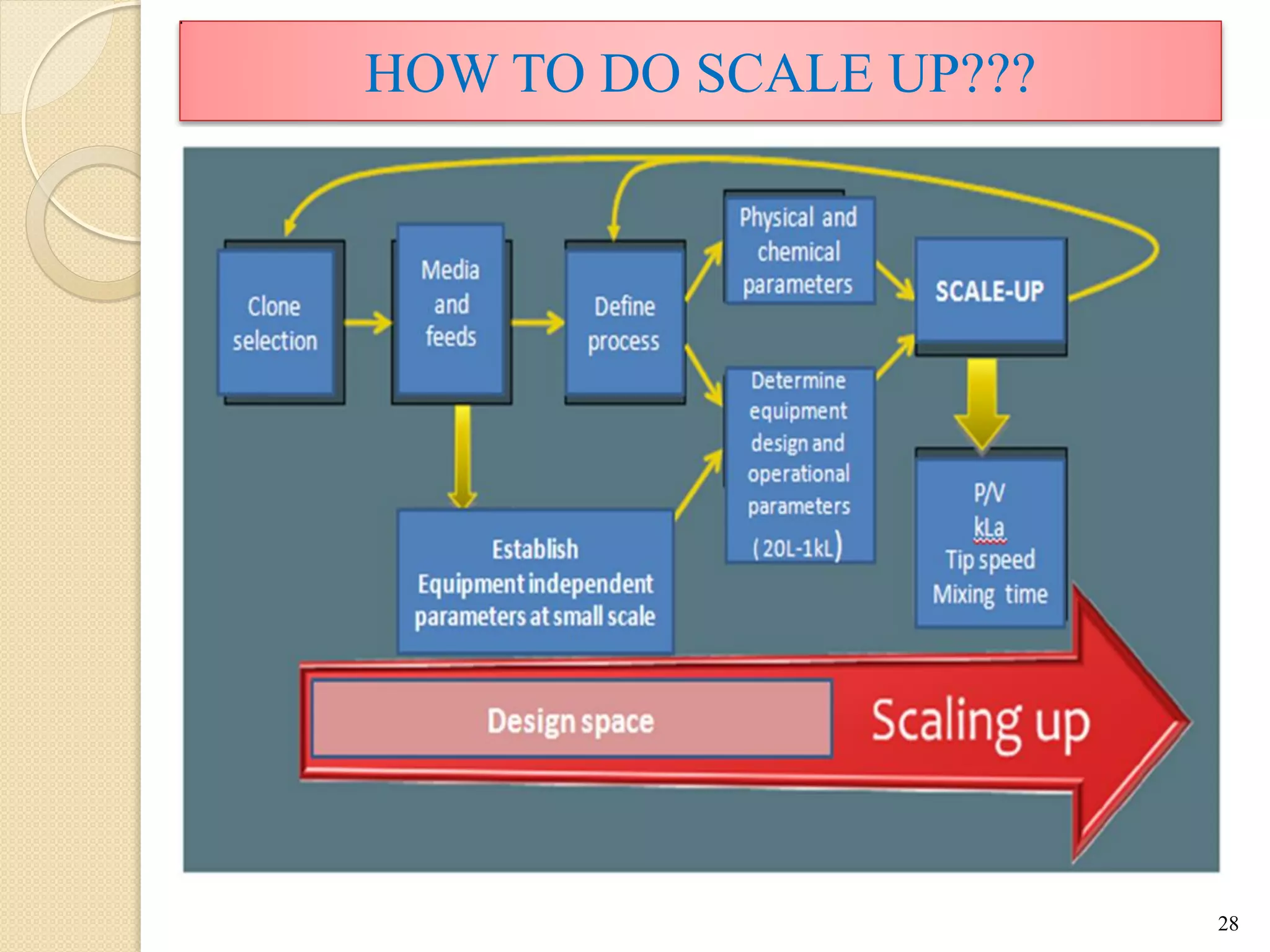
HOW TO DO SCALE UP???
28
AGITATION PARAMETERS
29
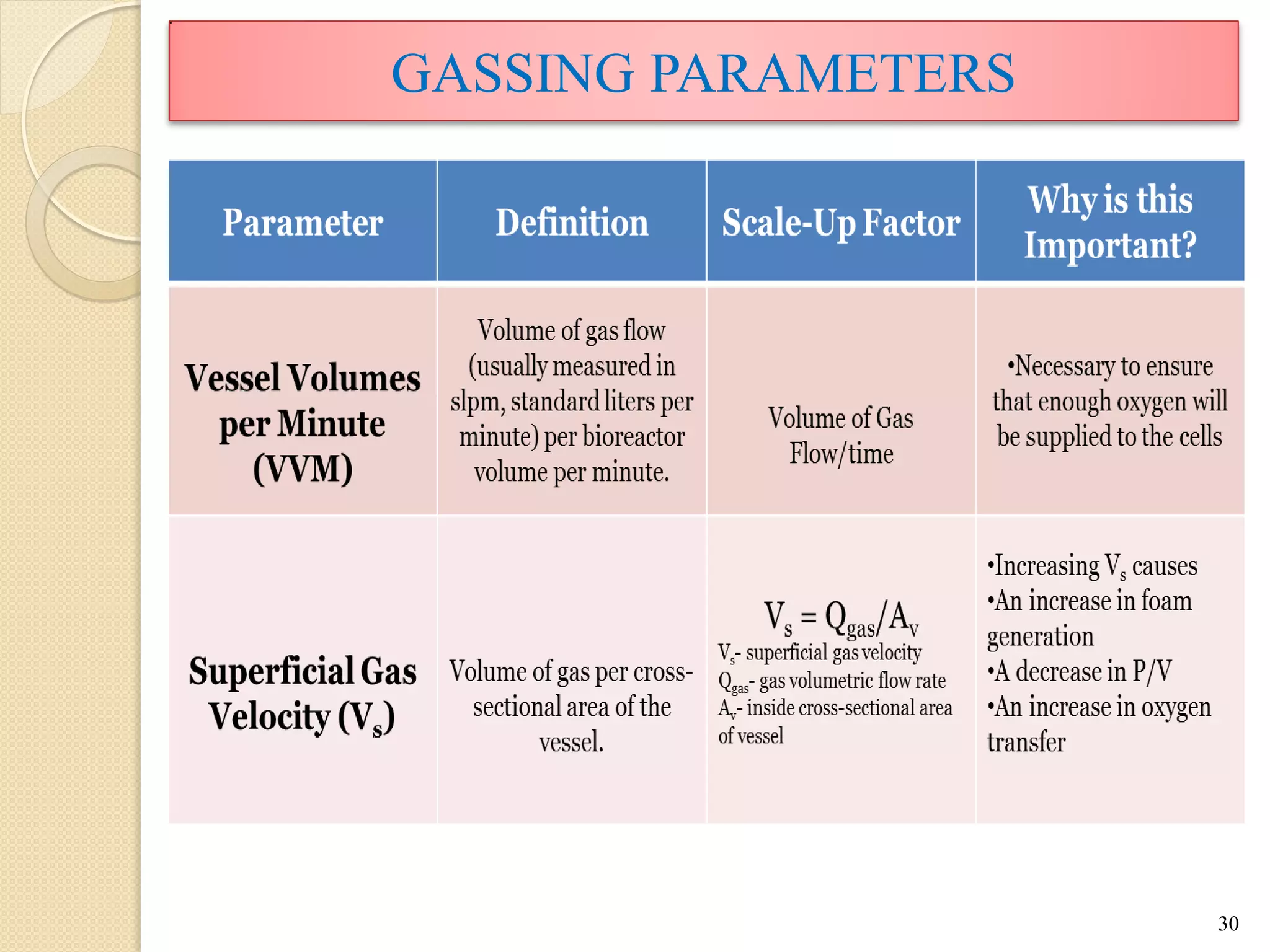
GASSING PARAMETERS
30
31

Measurement of mass transfer coefficient (k la)

  • 1.
    Measurement of KLa Presentedby SHINDE ASHOK SAKHARAM UPSTREAM PROCESS DEVELOPMENT (ANIMAL CELL CULTURE) 1
  • 2.
     The determinationof the KLa value for fermentation is important in order to maintain adequate transfer of oxygen in a bioreactor, for laboratory scale use or when scaling up to a larger process  The volumetric mass transfer coefficient, (KLa) indicates the rate of oxygen used for fermentation, taking into account all oxygen-consuming variables in the bioreactor  KLa values are used in scaling up from laboratory scale to pilot scale or production scale bioreactors 2 INTRODUCTION OF KLa F. Garcia-Ochoa, E. Gomez / Biotechnology Advances 27 (2009) 153–176
  • 3.
     The determinationof the KLa of a fermenter is essential in order  To establish its aeration efficiency and  To quantify the effects of operating variables on the provision of oxygen  The equations describing oxygen transfer are based on dissolved oxygen concentration  The solubility of oxygen is affected by dissolved solutes therefore pure water and a fermentation medium saturated with oxygen have different dissolved oxygen concentrations 3 Cont… F. Garcia-Ochoa, E. Gomez / Biotechnology Advances 27 (2009) 153–176
  • 4.
    I) CHEMICAL METHOD a)Sodium sulphite oxidation b) Carbon dioxide c) Hydrazine oxidation d) Catechol oxidation e) Glucose oxidase f) Kryptone absorption 4 Determination of KLa method Biotechnol. Bioeng. 43: 1139–1145.
  • 5.
    Determination of KLamethod II) PHYSICAL METHOD A) Gassing-out techniques a) Static gassing out method b) Dynamic gassing out method B) Oxygen-balance Technique 5Biotechnol. Bioeng. 43: 1139–1145.
  • 6.
     The oxygen-transferrates is determined by the oxidation of sodium sulphite solution  This technique does not require the measurement of dissolved oxygen concentrations  Based on the rate of conversion of a 0.5 M solution of sodium sulphite to sodium sulphate in the presence of a copper or cobalt catalyst: Na2S03 + 0.5 02 = Na2S04 6 SULPHITE OXIDATION TECHNIQUE
  • 7.
     Oxygen enterssolution it is immediately consumed in the oxidation of sulphite, so that the sulphite oxidation rate is equivalent to the oxygen-transfer rate  Since the dissolved oxygen concentration, is zero then the KLa may then be calculated from the equation: dCL / dt = OTR= KLa . C* (i) KLa = OTR/ C*  Where, OTR is the oxygen transfer rate  The volumes of the thiosulphate titrations are plotted against sample time and the oxygen transfer rate may be calculated from the slope of the graph 7
  • 8.
     The estimationof the KLa of a fermentation system by gassing-out techniques depends upon monitoring the increase in dissolved oxygen concentration of a solution during aeration and agitation  The oxygen transfer rate will decrease during the period of aeration as CL approaches C* due to decline in the driving force (C* - CL )  The oxygen transfer rate, at particular time, will be equal to the slope of the tangent to the curve of values of dissolved oxygen concentration against time of aeration, as shown in Fig. 8 GASSING-OUT TECHNIQUES
  • 9.
    Fig. The increasein dissolved oxygen concentration of a solution over a period of aeration. The oxygen transfer rate at time X is equal to the slope of the tangent at point Y 9
  • 10.
     To monitorthe increase in dissolved oxygen over an adequate range it is necessary first to decrease the oxygen level to a low value  Two methods have been employed to achieve this lowering of the dissolved oxygen concentration –  The static method and  The dynamic method 10 Cont…
  • 11.
     First describedby Wise (1951)  The oxygen concentration of the solution is lowered by gassing the liquid out with nitrogen gas, so that the  Solution is 'scrubbed' free of oxygen  The deoxygenated liquid is then aerated and agitated and increase in dissolved oxygen monitored using some dissolved oxygen probe  The increase in dissolved oxygen concentration is given by – dCL / dt = KLa (C*-CL) (ii)  Taking logarithm after Integration of equation (ii) we have ln (C*-CL) = - KLa.t 11 STATIC GASSING OUT METHOD AIChE journal 43 (7), 1904-1908
  • 12.
    A plot ofthe In (C* - CL) against time of aeration, the slope of which equals -KLa. 12
  • 13.
     This methodgenerally used for the live cells OTR = dCL / dt = KLa (C*-CL) – xQO2  Where,  x is the concentration of biomass and  QO2 is the specific respiration rate (mmoles of oxygen g-L biomass h- L)  The term xQO2 is given by the slope of the line AB in Fig -1 13 DYNAMIC GASSING OUT METHOD AIChE journal 43 (7), 1904-1908
  • 14.
    Fig.1. Dynamic gassingout for the determination of KLa values. Aeration was terminated at point A and recommenced at point B. 14
  • 15.
    • Equation (iii)may be rearranged as: CL = -1/KLa{(dCL / dt)+ xQO2}+C* ----------(iv) • Now from equation (iv), a plot of CL versus dCL/dt + xQO2 will yield a straight line, the slope of which will equal -1/KLa, as shown in Fig. 2 15
  • 16.
    Fig. 2 Thedynamic method for determination of KLa values 16
  • 17.
    Fig. 3. Theoccurrence of oxygen limitation during the dynamic gassing out of a fermentation 17
  • 18.
    ADVANTAGES  The dynamicgassing-out method has the advantage over the previous methods of determining the KLa during an actual fermentation and may be used to determine KLa values at different stages in the process  The technique is also rapid and only requires the use of a dissolved- oxygen probe, of the membrane type 18
  • 19.
    LIMITATIONS  A majorlimitation in the operation of the technique is the range over which the increase in dissolved oxygen concentration may be measured  It may be difficult to apply the technique during a fermentation which has an oxygen demand close to the supply capacity of the fermenter  Both the dynamic and static methods are also unsuitable for measuring KLa values in viscous systems 19
  • 20.
    OXYGEN-BALANCE TECHNIQUE  Useto measure KLa during fermentation process  The amount of oxygen transferred is determined, directly into solution in a set time interval  The KLa may be determined, provided that CL and C* are known, from equation (i) dCL / dt = KLa (C*- CL) Or OTR = KLa (C*- CL) Or KLa = OTR/(C*- CL) 20
  • 21.
     The oxygen-balancetechnique appears to be the simplest method for the assessment of KLa and  Has the advantage of measuring aeration efficiency during a fermentation 21
  • 22.
    FACTORS AFFECTING KLaVALUES IN FERMENTATION VESSELS  A number of factors have been demonstrated to affect the KLa value. Such factors include  The air-flow rate employed in vessels  The degree of agitation inside vessels  The rheological properties of the culture broth and  The presence of antifoam agents 22
  • 23.
  • 24.
    WHAT IS SCALE-UP? To take a manufacturing process from the laboratory scale to a desired large scale at which it is commercially feasible 24
  • 25.
    PURPOSE OF SCALEUP  Meeting increasing drug demand  Reduce cost of goods AIM OF SCALE UP  Similar/Identical product quality and process behaviour compare to Lab scale process 25 PURPOSE AND AIM
  • 26.
    A) Volume Independentparameter a) pH b) Temperature c) Dissolved oxygen d) Seeding density e) Feeding schedule 26 PARAMETERS FOR SCALE UP
  • 27.
    A) Volume dependentparameter a) Mass transfer coefficient (KLa) b) Agitation Power Number (P) c) Impeller Tip Speed d) Flow rate of Gases e) Mixing time/circulation time 27 PARAMETERS FOR SCALE UP
  • 28.
    HOW TO DOSCALE UP??? 28
  • 29.
  • 30.
  • 31.