Oxygen transfer in bioreactors
• The majority of fermentation processes
are aerobic
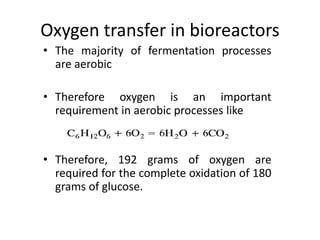
• Therefore oxygen is an important
requirement in aerobic processes like
• Therefore, 192 grams of oxygen are
required for the complete oxidation of 180
grams of glucose.
The oxygen demand of an industrial fermentation
process is normally satisfied by aerating and agitating the
fermentation broth.
The productivity of many fermentations is limited by oxygen
availability.
Therefore, it is an important factors which affect a efficiency
of fermenter in aerobic fermentation processes.
• The effect of dissolved oxygen concentration
on the specific oxygen uptake rate is follow
the Michaelis-Menten type curve given below
• (Qo2)
– is mmoles of oxygen consumed per gram dry
weight of cells per hour.
The above figure shows the specific oxygen uptake rate increases with increase in
the dissolved oxygen concentration up to a certain point (referred to as Ccrit ) above
which no further increase in oxygen uptake rate occurs.
Some examples of the critical oxygen levels for a range of micro-organisms are given
in Table
• Therefore, maximum biomass production may be
achieved by satisfying the organism's maximum specific
oxygen demand by maintaining the dissolved oxygen
concentration greater than the critical level.
• If the dissolved oxygen concentration were to fall below
the critical level then the cells may be metabolically
disturbed.
• Critical dissolved oxygen concentrations for a
range of micro-organisms (Riviere, 1977)
• Oxygen is normally supplied to microbial cultures in
the form of air, because air is the cheapest available
source of the gas.
• The method for supply of air in a culture is varies
with the scale of the process:
Oxygen transfer in large vessels
(i) At laboratory-scale cultures may be aerated
by means of the shake-flask technique
where the culture is grown in a conical flask
shaken on a platform contained in a
controlled environment of chamber.
(ii) Pilot- and industrial-scale fermentations
broth or culture is aerated by
-stirred or agitation method,
(iii) Some bioreactor or fermenter are so
designed that adequate supply of oxygen is
obtained without agitation and such
bioreactor or fermenter are called bubble
columns and air-lift fermenter
• Bartholomew et at. (1950) represented the transfer
of oxygen from air to the cell, during a fermentation,
as occurring in a number of steps:
– (i) The transfer of oxygen from an air bubble into solution.
– (ii) The transfer of the dissolved oxygen through the
fermentation medium to the microbial cell.
– (iii) The uptake of the dissolved oxygen by the cell.
The individual steps involved in oxygen transfer from a gas
bubble to the reaction site inside the individual cell
• The rate of oxygen transfer from air bubble to the liquid phase may be described by the
equation:
dCL / dt = KLa(C*-CL) (1)
where ,
• CL is the concentration of dissolved oxygen in the fermentation broth (in
mmoles dm-3)
• t is time (in hours),
• dCL / dt is the change in oxygen concentration over a time period, i.e. the
oxygen transfer rate (mmoles O2 dm-3 h- 1),
• KL is the mass transfer coefficient (cm h- 1),
• a is the gas/liquid interface area per liquid volume (cm2 cm- 3),
• C* is the saturated dissolved oxygen concentration (mmoles dm-3 ).
• KL may be considered as the sum of the
reciprocals of the resistances to the transfer of
oxygen from gas to liquid
• (C* - CL ) may be considered as the 'driving
force' across the resistances.

4.1

  • 1.
    Oxygen transfer inbioreactors • The majority of fermentation processes are aerobic • Therefore oxygen is an important requirement in aerobic processes like • Therefore, 192 grams of oxygen are required for the complete oxidation of 180 grams of glucose.
  • 2.
    The oxygen demandof an industrial fermentation process is normally satisfied by aerating and agitating the fermentation broth. The productivity of many fermentations is limited by oxygen availability. Therefore, it is an important factors which affect a efficiency of fermenter in aerobic fermentation processes.
  • 3.
    • The effectof dissolved oxygen concentration on the specific oxygen uptake rate is follow the Michaelis-Menten type curve given below • (Qo2) – is mmoles of oxygen consumed per gram dry weight of cells per hour.
  • 4.
    The above figureshows the specific oxygen uptake rate increases with increase in the dissolved oxygen concentration up to a certain point (referred to as Ccrit ) above which no further increase in oxygen uptake rate occurs.
  • 5.
    Some examples ofthe critical oxygen levels for a range of micro-organisms are given in Table
  • 6.
    • Therefore, maximumbiomass production may be achieved by satisfying the organism's maximum specific oxygen demand by maintaining the dissolved oxygen concentration greater than the critical level. • If the dissolved oxygen concentration were to fall below the critical level then the cells may be metabolically disturbed.
  • 7.
    • Critical dissolvedoxygen concentrations for a range of micro-organisms (Riviere, 1977)
  • 8.
    • Oxygen isnormally supplied to microbial cultures in the form of air, because air is the cheapest available source of the gas. • The method for supply of air in a culture is varies with the scale of the process: Oxygen transfer in large vessels
  • 9.
    (i) At laboratory-scalecultures may be aerated by means of the shake-flask technique where the culture is grown in a conical flask shaken on a platform contained in a controlled environment of chamber. (ii) Pilot- and industrial-scale fermentations broth or culture is aerated by -stirred or agitation method,
  • 10.
    (iii) Some bioreactoror fermenter are so designed that adequate supply of oxygen is obtained without agitation and such bioreactor or fermenter are called bubble columns and air-lift fermenter
  • 11.
    • Bartholomew etat. (1950) represented the transfer of oxygen from air to the cell, during a fermentation, as occurring in a number of steps: – (i) The transfer of oxygen from an air bubble into solution. – (ii) The transfer of the dissolved oxygen through the fermentation medium to the microbial cell. – (iii) The uptake of the dissolved oxygen by the cell.
  • 12.
    The individual stepsinvolved in oxygen transfer from a gas bubble to the reaction site inside the individual cell
  • 14.
    • The rateof oxygen transfer from air bubble to the liquid phase may be described by the equation: dCL / dt = KLa(C*-CL) (1) where , • CL is the concentration of dissolved oxygen in the fermentation broth (in mmoles dm-3) • t is time (in hours), • dCL / dt is the change in oxygen concentration over a time period, i.e. the oxygen transfer rate (mmoles O2 dm-3 h- 1), • KL is the mass transfer coefficient (cm h- 1), • a is the gas/liquid interface area per liquid volume (cm2 cm- 3), • C* is the saturated dissolved oxygen concentration (mmoles dm-3 ).
  • 15.
    • KL maybe considered as the sum of the reciprocals of the resistances to the transfer of oxygen from gas to liquid • (C* - CL ) may be considered as the 'driving force' across the resistances.