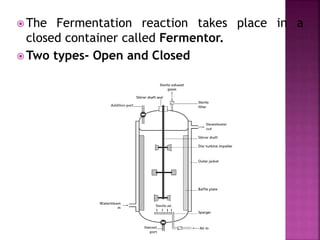
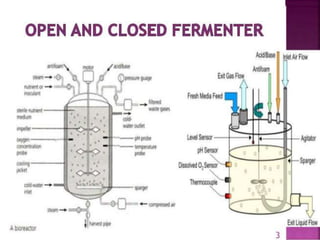
 The Fermentation reaction takes place in a
closed container called Fermentor.
 Two types- Open and Closed
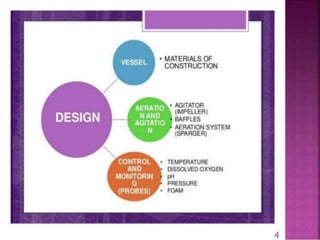
 Construction materials of Fermentor will differ
with Small scale, Pilot and Large scale. Glass
(borosilicate glass) or stainless steel for small
scale process. Stainless steel (>4 % chromium),
Mild steel (coated with glass or epoxy material),
Wood, Plastic or Concrete for Pilot and Large
scale process.
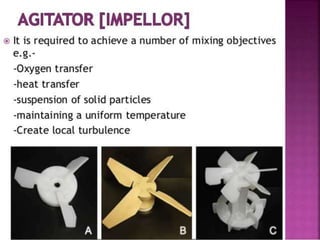
 Fermentor have mechanically moving Agitators
or Impellers within a baffled cylindrical vessel.
 Baffles are usually flat vertical plates whose
width is about one-tenth of the vessel diameter.
Normally, 4 – 6 baffle plates are fitted to the
inside vessel walls to aid mixing and mass
transfer by increasing turbulence, preventing
vortex formation and eliminating ‘dead spaces’.
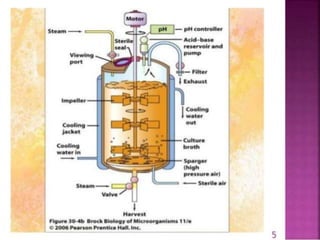
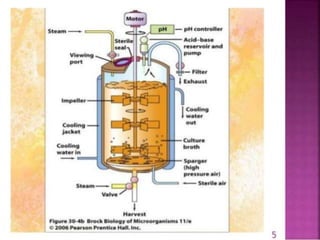
 Within each vessel the Impeller is connected to an
external motor which drives the stirrer system.
 The agitator assembly, including the seal, is often a
potential route of contamination. To prevent this
problem, the Shaft has to pass into the fermentor
through a set of aseptic Stirrer shaft seals.
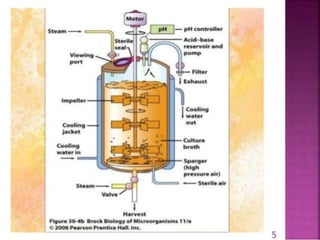
 The Sterile air (Oxygen) required for the
fermentation process are passed to the
Fermentor through Sparger.
 Sample Addition Port and Sterile Gas
Exhaust are present on the top region of
Fermentor.
 Water/Steam In and Water/Steam Out are
present on the both sides of the Fermentor.
 Harvest Port is present on the bottom region
of Fermentor.
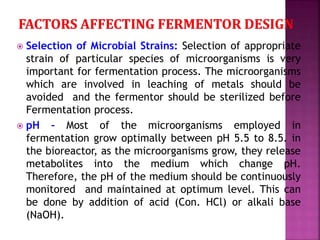
 Selection of Microbial Strains: Selection of appropriate
strain of particular species of microorganisms is very
important for fermentation process. The microorganisms
which are involved in leaching of metals should be
avoided and the fermentor should be sterilized before
Fermentation process.
 pH – Most of the microorganisms employed in
fermentation grow optimally between pH 5.5 to 8.5. in
the bioreactor, as the microorganisms grow, they release
metabolites into the medium which change pH.
Therefore, the pH of the medium should be continuously
monitored and maintained at optimum level. This can
be done by addition of acid (Con. HCl) or alkali base
(NaOH).
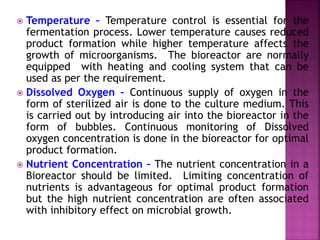
 Temperature – Temperature control is essential for the
fermentation process. Lower temperature causes reduced
product formation while higher temperature affects the
growth of microorganisms. The bioreactor are normally
equipped with heating and cooling system that can be
used as per the requirement.
 Dissolved Oxygen – Continuous supply of oxygen in the
form of sterilized air is done to the culture medium. This
is carried out by introducing air into the bioreactor in the
form of bubbles. Continuous monitoring of Dissolved
oxygen concentration is done in the bioreactor for optimal
product formation.
 Nutrient Concentration – The nutrient concentration in a
Bioreactor should be limited. Limiting concentration of
nutrients is advantageous for optimal product formation
but the high nutrient concentration are often associated
with inhibitory effect on microbial growth.
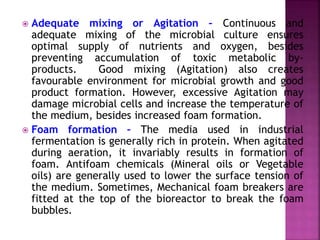
 Adequate mixing or Agitation – Continuous and
adequate mixing of the microbial culture ensures
optimal supply of nutrients and oxygen, besides
preventing accumulation of toxic metabolic by-
products. Good mixing (Agitation) also creates
favourable environment for microbial growth and good
product formation. However, excessive Agitation may
damage microbial cells and increase the temperature of
the medium, besides increased foam formation.
 Foam formation – The media used in industrial
fermentation is generally rich in protein. When agitated
during aeration, it invariably results in formation of
foam. Antifoam chemicals (Mineral oils or Vegetable
oils) are generally used to lower the surface tension of
the medium. Sometimes, Mechanical foam breakers are
fitted at the top of the bioreactor to break the foam
bubbles.
Fermentor design

Fermentor design

  • 2.
     The Fermentationreaction takes place in a closed container called Fermentor.  Two types- Open and Closed
  • 6.
     Construction materialsof Fermentor will differ with Small scale, Pilot and Large scale. Glass (borosilicate glass) or stainless steel for small scale process. Stainless steel (>4 % chromium), Mild steel (coated with glass or epoxy material), Wood, Plastic or Concrete for Pilot and Large scale process.
  • 8.
     Fermentor havemechanically moving Agitators or Impellers within a baffled cylindrical vessel.  Baffles are usually flat vertical plates whose width is about one-tenth of the vessel diameter. Normally, 4 – 6 baffle plates are fitted to the inside vessel walls to aid mixing and mass transfer by increasing turbulence, preventing vortex formation and eliminating ‘dead spaces’.
  • 10.
     Within eachvessel the Impeller is connected to an external motor which drives the stirrer system.  The agitator assembly, including the seal, is often a potential route of contamination. To prevent this problem, the Shaft has to pass into the fermentor through a set of aseptic Stirrer shaft seals.
  • 12.
     The Sterileair (Oxygen) required for the fermentation process are passed to the Fermentor through Sparger.  Sample Addition Port and Sterile Gas Exhaust are present on the top region of Fermentor.  Water/Steam In and Water/Steam Out are present on the both sides of the Fermentor.  Harvest Port is present on the bottom region of Fermentor.
  • 14.
     Selection ofMicrobial Strains: Selection of appropriate strain of particular species of microorganisms is very important for fermentation process. The microorganisms which are involved in leaching of metals should be avoided and the fermentor should be sterilized before Fermentation process.  pH – Most of the microorganisms employed in fermentation grow optimally between pH 5.5 to 8.5. in the bioreactor, as the microorganisms grow, they release metabolites into the medium which change pH. Therefore, the pH of the medium should be continuously monitored and maintained at optimum level. This can be done by addition of acid (Con. HCl) or alkali base (NaOH).
  • 15.
     Temperature –Temperature control is essential for the fermentation process. Lower temperature causes reduced product formation while higher temperature affects the growth of microorganisms. The bioreactor are normally equipped with heating and cooling system that can be used as per the requirement.  Dissolved Oxygen – Continuous supply of oxygen in the form of sterilized air is done to the culture medium. This is carried out by introducing air into the bioreactor in the form of bubbles. Continuous monitoring of Dissolved oxygen concentration is done in the bioreactor for optimal product formation.  Nutrient Concentration – The nutrient concentration in a Bioreactor should be limited. Limiting concentration of nutrients is advantageous for optimal product formation but the high nutrient concentration are often associated with inhibitory effect on microbial growth.
  • 16.
     Adequate mixingor Agitation – Continuous and adequate mixing of the microbial culture ensures optimal supply of nutrients and oxygen, besides preventing accumulation of toxic metabolic by- products. Good mixing (Agitation) also creates favourable environment for microbial growth and good product formation. However, excessive Agitation may damage microbial cells and increase the temperature of the medium, besides increased foam formation.  Foam formation – The media used in industrial fermentation is generally rich in protein. When agitated during aeration, it invariably results in formation of foam. Antifoam chemicals (Mineral oils or Vegetable oils) are generally used to lower the surface tension of the medium. Sometimes, Mechanical foam breakers are fitted at the top of the bioreactor to break the foam bubbles.