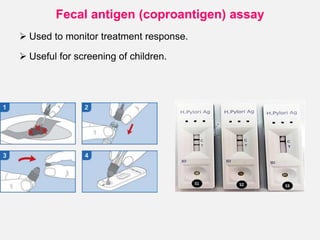
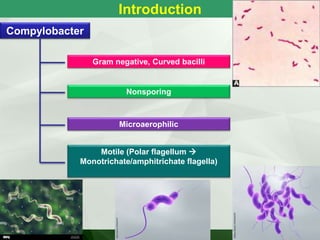
Campylobacter and Helicobacter are Gram-negative, microaerophilic bacteria. Campylobacter species cause diarrheal disease and are commonly found in animal intestines. C. jejuni is the most frequent cause of foodborne illness. Helicobacter pylori colonizes the stomach and is associated with peptic ulcer disease and gastric cancer through production of toxins and induction of inflammation. Diagnosis involves culture, biopsy tests detecting urease activity, and breath and stool antigen tests. Both genera are important human and animal pathogens.
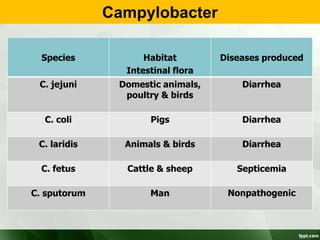
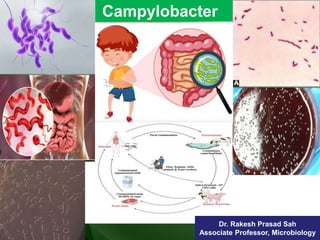
Campylobacter
Species Habitat
Intestinal flora
Diseasesproduced
C. jejuni Domestic animals,
poultry & birds
Diarrhea
C. coli Pigs Diarrhea
C. laridis Animals & birds Diarrhea
C. fetus Cattle & sheep Septicemia
C. sputorum Man Nonpathogenic
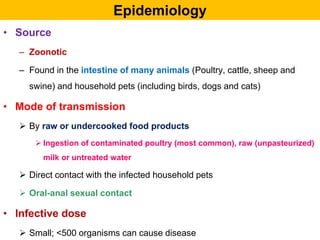
Epidemiology
• Source
– Zoonotic
–Found in the intestine of many animals (Poultry, cattle, sheep and
swine) and household pets (including birds, dogs and cats)
• Mode of transmission
By raw or undercooked food products
Ingestion of contaminated poultry (most common), raw (unpasteurized)
milk or untreated water
Direct contact with the infected household pets
Oral-anal sexual contact
• Infective dose
Small; <500 organisms can cause disease
8.
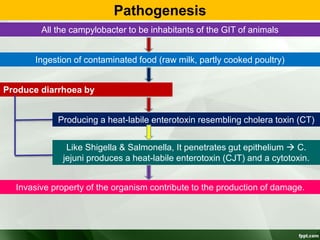
Pathogenesis
All the campylobacterto be inhabitants of the GIT of animals
Ingestion of contaminated food (raw milk, partly cooked poultry)
Produce diarrhoea by
Producing a heat-labile enterotoxin resembling cholera toxin (CT)
Like Shigella & Salmonella, It penetrates gut epithelium C.
jejuni produces a heat-labile enterotoxin (CJT) and a cytotoxin.
Invasive property of the organism contribute to the production of damage.
9.
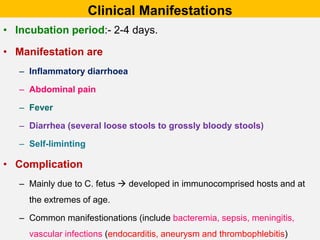
Clinical Manifestations
• Incubationperiod:- 2-4 days.
• Manifestation are
– Inflammatory diarrhoea
– Abdominal pain
– Fever
– Diarrhea (several loose stools to grossly bloody stools)
– Self-liminting
• Complication
– Mainly due to C. fetus developed in immunocomprised hosts and at
the extremes of age.
– Common manifestionations (include bacteremia, sepsis, meningitis,
vascular infections (endocarditis, aneurysm and thrombophlebitis)
10.
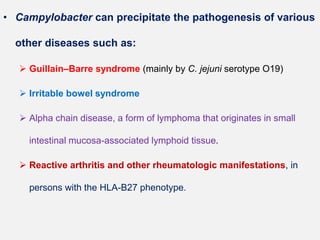
• Campylobacter canprecipitate the pathogenesis of various
other diseases such as:
Guillain–Barre syndrome (mainly by C. jejuni serotype O19)
Irritable bowel syndrome
Alpha chain disease, a form of lymphoma that originates in small
intestinal mucosa-associated lymphoid tissue.
Reactive arthritis and other rheumatologic manifestations, in
persons with the HLA-B27 phenotype.
11.
Laboratory Diagnosis
• Freshlycollected stool specimen and rectal swab are the
preferred specimens.
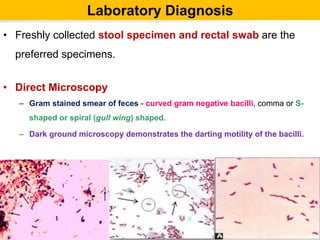
• Direct Microscopy
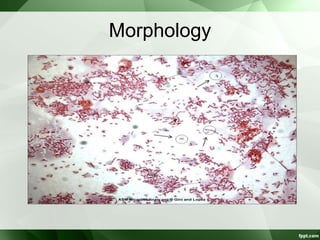
– Gram stained smear of feces - curved gram negative bacilli, comma or S-
shaped or spiral (gull wing) shaped.
– Dark ground microscopy demonstrates the darting motility of the bacilli.
12.
Culture
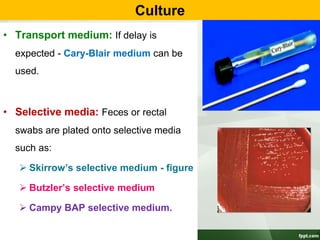
• Transport medium:If delay is
expected - Cary-Blair medium can be
used.
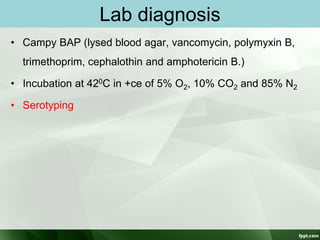
• Selective media: Feces or rectal
swabs are plated onto selective media
such as:
Skirrow’s selective medium - figure
Butzler’s selective medium
Campy BAP selective medium.
13.
Lab diagnosis
• CampyBAP (lysed blood agar, vancomycin, polymyxin B,
trimethoprim, cephalothin and amphotericin B.)
• Incubation at 420C in +ce of 5% O2, 10% CO2 and 85% N2
• Serotyping
14.
• Culture conditions:Incubated at - Microaerophilic condition (5%
oxygen)
• Growth at 42°C: Thermophilic Campylobacter species (C. jejuni, C.
coli and C. lari) – differentiated from C. fetus, which is
nonthermophilic.
15.
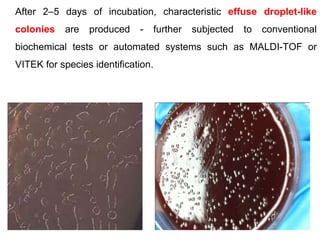
After 2–5 daysof incubation, characteristic effuse droplet-like
colonies are produced - further subjected to conventional
biochemical tests or automated systems such as MALDI-TOF or
VITEK for species identification.
16.
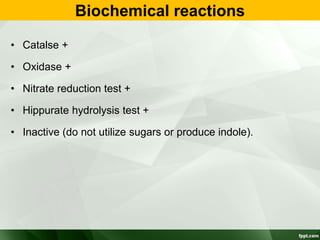
Biochemical reactions
• Catalse+
• Oxidase +
• Nitrate reduction test +
• Hippurate hydrolysis test +
• Inactive (do not utilize sugars or produce indole).
17.
Species other thanjejuni
• C. coli
• Diarrhea
• C.concicus
• Gingivitis &
periodontal disease
• C.fetus (370C)
• Abortion in cattle &
sheep
• Septicemia
• C. hyointetinalis
• Diarrhea & proctitis
[homosexuals]
• C.lari
• Diarrhea
• C.sputorum
• Diarrhea &
septicemia
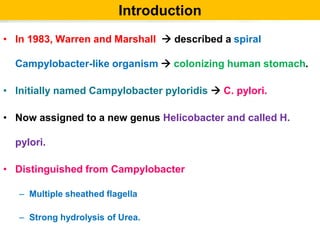
Introduction
• In 1983,Warren and Marshall described a spiral
Campylobacter-like organism colonizing human stomach.
• Initially named Campylobacter pyloridis C. pylori.
• Now assigned to a new genus Helicobacter and called H.
pylori.
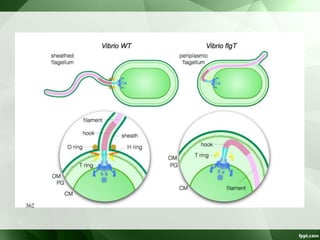
• Distinguished from Campylobacter
– Multiple sheathed flagella
– Strong hydrolysis of Urea.
21.
Introduction
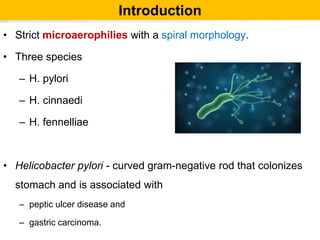
• Strict microaerophilieswith a spiral morphology.
• Three species
– H. pylori
– H. cinnaedi
– H. fennelliae
• Helicobacter pylori - curved gram-negative rod that colonizes
stomach and is associated with
– peptic ulcer disease and
– gastric carcinoma.
22.
Morphology
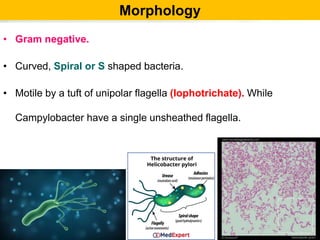
• Gram negative.
•Curved, Spiral or S shaped bacteria.
• Motile by a tuft of unipolar flagella (lophotrichate). While
Campylobacter have a single unsheathed flagella.
23.
Pathogenesis
• Colonization ofthe Gastric Mucosa (Gastric
antrum) - 50% of the world’s population (30%
in developed & nearly 80% in developing
countries)
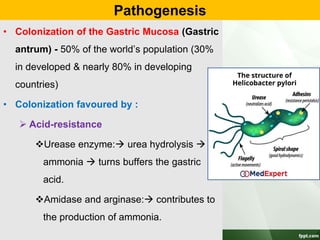
• Colonization favoured by :
Acid-resistance
Urease enzyme: urea hydrolysis
ammonia turns buffers the gastric
acid.
Amidase and arginase: contributes to
the production of ammonia.
24.
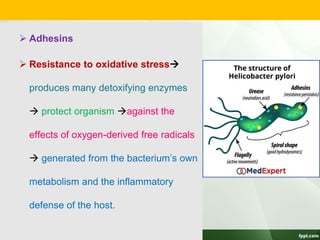
Adhesins
Resistanceto oxidative stress
produces many detoxifying enzymes
protect organism against the
effects of oxygen-derived free radicals
generated from the bacterium’s own
metabolism and the inflammatory
defense of the host.
25.
Induces Pathological Changes
Vacuolating cytotoxin (VacA) secretes VacA induces
formation of vacuoles in the cytoplasm of epithelial cells.
Cytotoxin-associated gene A (CagA) helps the bacterium to
modulate certain aspects of the host cell’s metabolism including:
Cytoskeleton rearrangements (structure that helps cells maintain their shape
and internal organization)
Host-cell morphological changes
Expression of proto-oncogenes
Release of proinflammatory cytokines from gastric epithelial cells.
26.
Molecular mimicry
Lipopolysaccharides of H. pylori (glycoprotein moiety) is identical
to the lewis blood group Ag expressed on gastrical parietal
cells which may result in:
Immune tolerance by downregulating T cells
Induction of autoantibodies that cross-react with mucosal epitopes and
contribute to the development of chronic active gastritis.
Alteration in gastric mucus
Inhibits glycosylation and sulfation of gastric mucus, which may
impede its protective function and increase the vulnerability of the
epithelial surface to gastric acidity.
27.
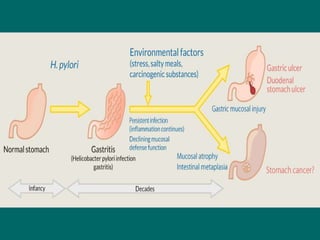
Host factors
People with polymorphisms in cytokine genes (e.g. interleukin-1) or
genes coding Toll-like receptors increased risk of gastric
adenocarcinoma.
Environmental risk factors
– Smoking increases the risk of ulcers and cancer in H. pylori colonized
individuals.
– Diets high in salts and preserved foods increases cancer risk,
whereas diets high in antioxidants and vitamins C are protective.
29.
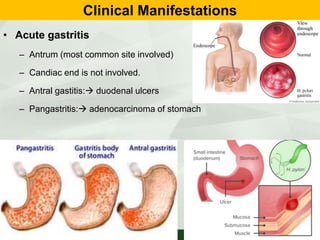
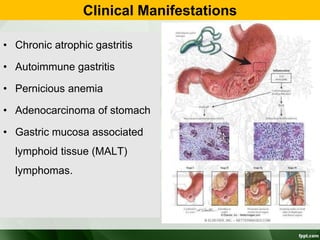
Clinical Manifestations
• Acutegastritis
– Antrum (most common site involved)
– Candiac end is not involved.
– Antral gastitis: duodenal ulcers
– Pangastritis: adenocarcinoma of stomach
30.
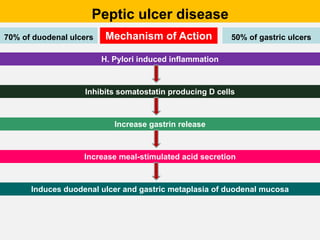
Peptic ulcer disease
70%of duodenal ulcers 50% of gastric ulcers
Mechanism of Action
H. Pylori induced inflammation
Inhibits somatostatin producing D cells
Increase gastrin release
Increase meal-stimulated acid secretion
Induces duodenal ulcer and gastric metaplasia of duodenal mucosa
31.
Peptic ulcer disease
•Though it is not clear.
• However it is believed, there is hypochondria despited increased
gastrin release.
• Epigastric Pain with burning sensation
– Most common presentation;
– Develops either following a meal (as in duodenal ulcer) or in empty stomach
(as in gastric ulcer.)
50% of gastric ulcers
Mechanism of Action
Lab Diagnosis
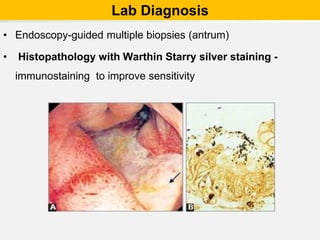
• Endoscopy-guidedmultiple biopsies (antrum)
• Histopathology with Warthin Starry silver staining -
immunostaining to improve sensitivity
34.
Microbiological methods
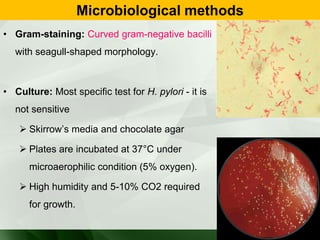
• Gram-staining:Curved gram-negative bacilli
with seagull-shaped morphology.
• Culture: Most specific test for H. pylori - it is
not sensitive
Skirrow’s media and chocolate agar
Plates are incubated at 37°C under
microaerophilic condition (5% oxygen).
High humidity and 5-10% CO2 required
for growth.
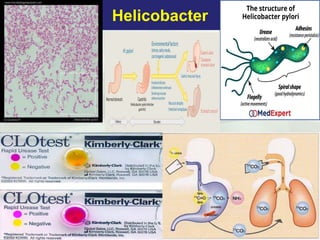
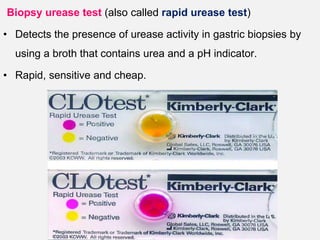
Biopsy urease test(also called rapid urease test)
• Detects the presence of urease activity in gastric biopsies by
using a broth that contains urea and a pH indicator.
• Rapid, sensitive and cheap.
37.
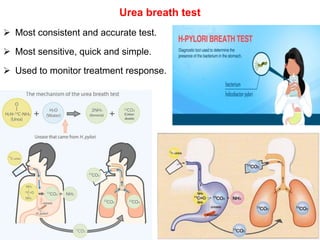
Urea breath test
Most consistent and accurate test.
Most sensitive, quick and simple.
Used to monitor treatment response.