
Clostridium
Dr. Kanwal Deep Singh Lyall
M.D. Microbiology
Sporogenous Gram Positive Bacilli
Aerobic Bacilli Anaerobic Clostridia
Non- bulging spores bulging spores
General features
• Anaerobic, sporing, bulging spores
• Kloster = spindle
• Saprophytes – soil, water
• Or live in GIT – C. tetani, C. perfringens
• Cause three major diseases : Tetanus, Gas
gangrene and food poisoning
• All are motile except C. perfringens & C. tetani
type VI
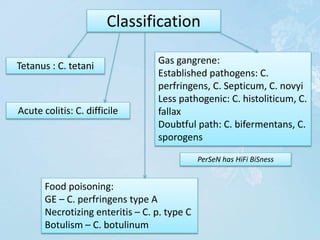
Classification
Tetanus : C. tetani
Acute colitis: C. difficile
Food poisoning:
GE – C. perfringens type A
Necrotizing enteritis – C. p. type C
Botulism – C. botulinum
Gas gangrene:
Established pathogens: C.
perfringens, C. Septicum, C. novyi
Less pathogenic: C. histoliticum, C.
fallax
Doubtful path: C. bifermentans, C.
sporogens
PerSeN has HiFi BiSness
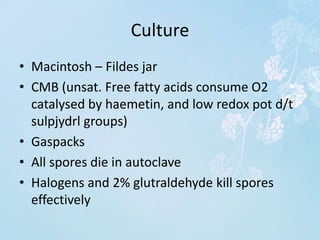
Culture
• Macintosh – Fildes jar
• CMB (unsat. Free fatty acids consume O2
catalysed by haemetin, and low redox pot d/t
sulpjydrl groups)
• Gaspacks
• All spores die in autoclave
• Halogens and 2% glutraldehyde kill spores
effectively
C. Perfringens (welchii)
• Capsulated & NM, Subterminal spores
• M/I cause of gas gangrene, causes food
poisoning & necrotizing enteritis
• Commensal in GIT
• Soil & dust
• Spores rarely seen in cultures or tissues &
absent spores characteristic feature
• Glucose BA – Target haemolysis
Alpha toxin
Theta toxin
Biochemical reactions
• Sacchrolytic I pink
• G/L/S – acid + gas
• Abundant H2S
• Stormy fermentation reaction: litmus milk –
lactose ferm. Leads to acid production – color
changes blue to red – acid clots milk – gas
disrupts the clot
Classification
• 12 types of toxins
• Alpha, beta, epsilon & iota (αβει)
• Type A : α,
• Type B : α, β,ε
• Type C : α, β
• Type D : α, ε
• Type E : α, ι
• Alpha – m/I : gas gangrene & food poisoning
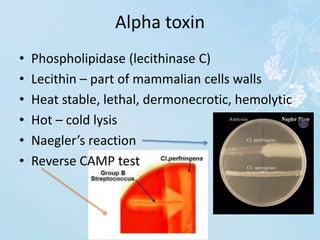
Alpha toxin
• Phospholipidase (lecithinase C)
• Lecithin – part of mammalian cells walls
• Heat stable, lethal, dermonecrotic, hemolytic
• Hot – cold lysis
• Naegler’s reaction
• Reverse CAMP test
Pathogenesis
• Gas gangrene 6h 6 wks , anaerobic cellulitis,
myonecrosis
• Food poisoning: type A, 8-12 hrs, meat,
poultry – like enterotoxin of V. cholerae
• Necrotic enteritis
Diagnosis = clinical
Lab diagnosis
Gram stain: GPB without spores, pleomorphic GPB (Citron bodies, leaf or
boat shapes) in C. septicum, large GPB & oval subterminal spores – C. novyi
Culture: heated BA , CMB
Colony morphology, biochemical reactions, reverse CAMP test etc.
Animal pathogenicity , RCM i/m GP – death – heart, spleen
Food poisoning: RCM inculated - heated @ 100 C x 30 m – cooled –
incubated @ 37 C x overnight – s/c on selective media – S. A . above
Prophylaxis & Treatment
• Surgery – debridement, irrigation
• Antibiotics – metronidazole, sulphonamides,
tetracycline, amoxycillin etc.
• Antitoxin
• Hyperbaric O2
Cl. Tetani
• Soil and GIT
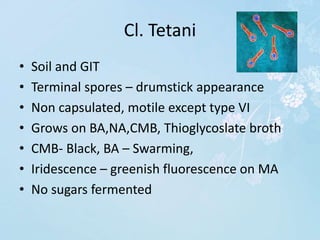
• Terminal spores – drumstick appearance
• Non capsulated, motile except type VI
• Grows on BA,NA,CMB, Thioglycoslate broth
• CMB- Black, BA – Swarming,
• Iridescence – greenish fluorescence on MA
• No sugars fermented
• Spores survive in soil for years
• Ten serological types based on flagellar (H) Ag
• Type VI – non-flagellated
• All produce same toxin
• Toxins:
– Tetanolysin (heat & O2 labile, lysis RBC &
WBC),
– Tetanospasmin (heat labile, O2 stable,
powerful neurotoxin, rapidly destroyed by
proteolytic enzymes, plasmid coded,
neutralized by AB
Pathogenesis
• Little invasiveness
• Toxin – acts presynaptically – blocks synaptic
inhibition in spinal cord – continuous spread
of spread of impulses – muscles rigidity &
spasm
• Diagnosis – clinical grounds
• Lab diagnosis – GPB with terminal spores
• Cl. tetanomorphium & Cl. spheroides – similar
apperance on GS – hence GS unreliable
Lab diagnosis
• Only for confirmation
• Gram stain – drumstick GPB
• Culture: sample – Fresh BA + Poly B –
swarming
• CMB x 3 tubes – 1st – 80° C X 15 m, 2nd 80° C x
5 m and 3rd unheated (kills vegetative
bacteria) – s/c daily x 4 days
• 02 ml CMB – mice tail – rigidity in 2 – 4 days –
ascending paralysis – death
Prophylaxis
• Surgical debridement – prevent anaerobiasis
• Antibiotics – destroy or inhibit bacterial load
• Immunization – vaccination with toxoid, ATS
or combined
• Protect patients from light & noise
• Clinical attacks don’t provide protection
Cl. Botulinum
• Botulus = sausages
• Soil, manure, vegetables
• Strict aerobes grow on ordinary media
• Large fimbriate irregular colonies
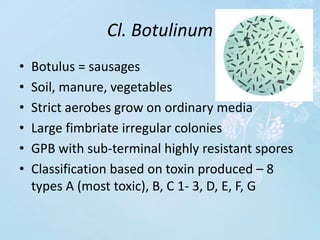
• GPB with sub-terminal highly resistant spores
• Classification based on toxin produced – 8
types A (most toxic), B, C 1- 3, D, E, F, G
Toxin
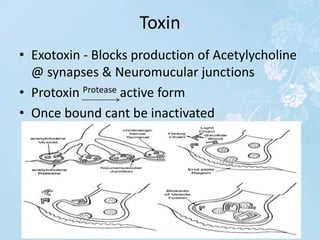
• Exotoxin - Blocks production of Acetylycholine
@ synapses & Neuromucular junctions
• Protoxin Protease active form
• Once bound cant be inactivated
Pathogenesis (Non-invasive)
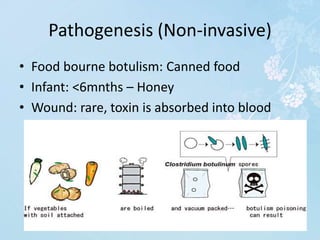
• Food bourne botulism: Canned food
• Infant: <6mnths – Honey
• Wound: rare, toxin is absorbed into blood
Lab diagnosis
• Gram stain
• Culture
• Animal inoculation
Prophylaxis
• Proper processing of canned food
Cl. Difficile
• Newborn’s feces
• Difficult to culture
• GPB with terminal spores
• Toxin: Toxin A (Enterotoxin),Toxin B (Cytotoxic)
• AAD & Pseudomembranous colitis
• Lincomycin, Clindamycin
• Diagnosis: Culture & Toxin detection
• Treatment: Metronidazole, Vancomycin
X

Clostridium

  • 1.
    Clostridium Dr. Kanwal DeepSingh Lyall M.D. Microbiology
  • 2.
    Sporogenous Gram PositiveBacilli Aerobic Bacilli Anaerobic Clostridia Non- bulging spores bulging spores
  • 3.
    General features • Anaerobic,sporing, bulging spores • Kloster = spindle • Saprophytes – soil, water • Or live in GIT – C. tetani, C. perfringens • Cause three major diseases : Tetanus, Gas gangrene and food poisoning • All are motile except C. perfringens & C. tetani type VI
  • 4.
    Classification Tetanus : C.tetani Acute colitis: C. difficile Food poisoning: GE – C. perfringens type A Necrotizing enteritis – C. p. type C Botulism – C. botulinum Gas gangrene: Established pathogens: C. perfringens, C. Septicum, C. novyi Less pathogenic: C. histoliticum, C. fallax Doubtful path: C. bifermentans, C. sporogens PerSeN has HiFi BiSness
  • 5.
    Culture • Macintosh –Fildes jar • CMB (unsat. Free fatty acids consume O2 catalysed by haemetin, and low redox pot d/t sulpjydrl groups) • Gaspacks • All spores die in autoclave • Halogens and 2% glutraldehyde kill spores effectively
  • 6.
    C. Perfringens (welchii) •Capsulated & NM, Subterminal spores • M/I cause of gas gangrene, causes food poisoning & necrotizing enteritis • Commensal in GIT • Soil & dust • Spores rarely seen in cultures or tissues & absent spores characteristic feature • Glucose BA – Target haemolysis Alpha toxin Theta toxin
  • 7.
    Biochemical reactions • SacchrolyticI pink • G/L/S – acid + gas • Abundant H2S • Stormy fermentation reaction: litmus milk – lactose ferm. Leads to acid production – color changes blue to red – acid clots milk – gas disrupts the clot
  • 8.
    Classification • 12 typesof toxins • Alpha, beta, epsilon & iota (αβει) • Type A : α, • Type B : α, β,ε • Type C : α, β • Type D : α, ε • Type E : α, ι • Alpha – m/I : gas gangrene & food poisoning
  • 9.
    Alpha toxin • Phospholipidase(lecithinase C) • Lecithin – part of mammalian cells walls • Heat stable, lethal, dermonecrotic, hemolytic • Hot – cold lysis • Naegler’s reaction • Reverse CAMP test
  • 10.
    Pathogenesis • Gas gangrene6h 6 wks , anaerobic cellulitis, myonecrosis • Food poisoning: type A, 8-12 hrs, meat, poultry – like enterotoxin of V. cholerae • Necrotic enteritis
  • 11.
    Diagnosis = clinical Labdiagnosis Gram stain: GPB without spores, pleomorphic GPB (Citron bodies, leaf or boat shapes) in C. septicum, large GPB & oval subterminal spores – C. novyi Culture: heated BA , CMB Colony morphology, biochemical reactions, reverse CAMP test etc. Animal pathogenicity , RCM i/m GP – death – heart, spleen Food poisoning: RCM inculated - heated @ 100 C x 30 m – cooled – incubated @ 37 C x overnight – s/c on selective media – S. A . above
  • 12.
    Prophylaxis & Treatment •Surgery – debridement, irrigation • Antibiotics – metronidazole, sulphonamides, tetracycline, amoxycillin etc. • Antitoxin • Hyperbaric O2
  • 13.
    Cl. Tetani • Soiland GIT • Terminal spores – drumstick appearance • Non capsulated, motile except type VI • Grows on BA,NA,CMB, Thioglycoslate broth • CMB- Black, BA – Swarming, • Iridescence – greenish fluorescence on MA • No sugars fermented
  • 14.
    • Spores survivein soil for years • Ten serological types based on flagellar (H) Ag • Type VI – non-flagellated • All produce same toxin • Toxins: – Tetanolysin (heat & O2 labile, lysis RBC & WBC), – Tetanospasmin (heat labile, O2 stable, powerful neurotoxin, rapidly destroyed by proteolytic enzymes, plasmid coded, neutralized by AB
  • 15.
    Pathogenesis • Little invasiveness •Toxin – acts presynaptically – blocks synaptic inhibition in spinal cord – continuous spread of spread of impulses – muscles rigidity & spasm • Diagnosis – clinical grounds • Lab diagnosis – GPB with terminal spores • Cl. tetanomorphium & Cl. spheroides – similar apperance on GS – hence GS unreliable
  • 18.
    Lab diagnosis • Onlyfor confirmation • Gram stain – drumstick GPB • Culture: sample – Fresh BA + Poly B – swarming • CMB x 3 tubes – 1st – 80° C X 15 m, 2nd 80° C x 5 m and 3rd unheated (kills vegetative bacteria) – s/c daily x 4 days • 02 ml CMB – mice tail – rigidity in 2 – 4 days – ascending paralysis – death
  • 19.
    Prophylaxis • Surgical debridement– prevent anaerobiasis • Antibiotics – destroy or inhibit bacterial load • Immunization – vaccination with toxoid, ATS or combined • Protect patients from light & noise • Clinical attacks don’t provide protection
  • 20.
    Cl. Botulinum • Botulus= sausages • Soil, manure, vegetables • Strict aerobes grow on ordinary media • Large fimbriate irregular colonies • GPB with sub-terminal highly resistant spores • Classification based on toxin produced – 8 types A (most toxic), B, C 1- 3, D, E, F, G
  • 21.
    Toxin • Exotoxin -Blocks production of Acetylycholine @ synapses & Neuromucular junctions • Protoxin Protease active form • Once bound cant be inactivated
  • 22.
    Pathogenesis (Non-invasive) • Foodbourne botulism: Canned food • Infant: <6mnths – Honey • Wound: rare, toxin is absorbed into blood
  • 24.
    Lab diagnosis • Gramstain • Culture • Animal inoculation Prophylaxis • Proper processing of canned food
  • 25.
    Cl. Difficile • Newborn’sfeces • Difficult to culture • GPB with terminal spores • Toxin: Toxin A (Enterotoxin),Toxin B (Cytotoxic) • AAD & Pseudomembranous colitis • Lincomycin, Clindamycin • Diagnosis: Culture & Toxin detection • Treatment: Metronidazole, Vancomycin
  • 26.