
Disinfection
By Dr. Rakesh Prasad Sah
Associate Professor, Microbiology
Definition
• Sterilization : process of 100 % killing of m.os. either pathogenic
or non-pathogenic including spores from any article, surface or
objects.
• Process that destroys all (100%) pathogenic microorganisms but may
or may not destroy bacterial spores is called Disinfection.
• Agents  Disinfectants.
Definitions
• Antiseptics  type of disinfectant  safe to apply on body surface
(skin & mucosa)  destruction of organisms  present on the body
surfaces  type of disinfection is termed as Asepsis.
• Sanitizer: an agent reduces but may not eliminate m.os. To safe
level.
• Decontamination  process  removes/destroys all pathogenic
m.os. From an object to make it safe to handle.
Definitions
• Asepsis : refers to a technique that aids in preventing the onset of
infection in uninfected tissue.
• Cidal : Killing of m.os.
• Static : inhibit the growth of m.os.
• Germicide : agents which kills pathogenic m.os. (germs). includes
both antiseptics and disinfectants.
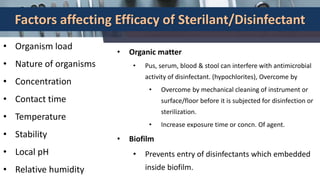
Factors affecting Efficacy of Sterilant/Disinfectant
• Organism load
• Nature of organisms
• Concentration
• Contact time
• Temperature
• Stability
• Local pH
• Relative humidity
• Organic matter
• Pus, serum, blood & stool can interfere with antimicrobial
activity of disinfectant. (hypochlorites), Overcome by
• Overcome by mechanical cleaning of instrument or
surface/floor before it is subjected for disinfection or
sterilization.
• Increase exposure time or concn. Of agent.
• Biofilm
• Prevents entry of disinfectants which embedded
inside biofilm.
Property of an Ideal Disinfectant
• Broader microbicidal activity.
• Fast acting.
• Not affected by environmental factors such as organic matter.
• Nontoxic.
• Compatible with surfaces/materials to which it is used.
• Environmental friendly.
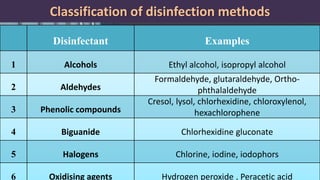
Classification of disinfection methods
Disinfectant Examples
1 Alcohols Ethyl alcohol, isopropyl alcohol
2 Aldehydes
Formaldehyde, glutaraldehyde, Ortho-
phthalaldehyde
3 Phenolic compounds
Cresol, lysol, chlorhexidine, chloroxylenol,
hexachlorophene
4 Biguanide Chlorhexidine gluconate
5 Halogens Chlorine, iodine, iodophors
6 Oxidising agents Hydrogen peroxide , Peracetic acid
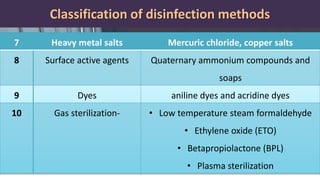
Classification of disinfection methods
7 Heavy metal salts Mercuric chloride, copper salts
8 Surface active agents Quaternary ammonium compounds and
soaps
9 Dyes aniline dyes and acridine dyes
10 Gas sterilization- • Low temperature steam formaldehyde
• Ethylene oxide (ETO)
• Betapropiolactone (BPL)
• Plasma sterilization
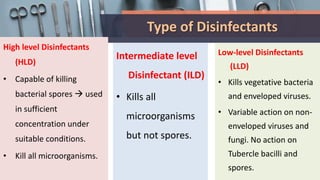
Type of Disinfectants
High level Disinfectants
(HLD)
• Capable of killing
bacterial spores  used
in sufficient
concentration under
suitable conditions.
• Kill all microorganisms.
Intermediate level
Disinfectant (ILD)
• Kills all
microorganisms
but not spores.
Low-level Disinfectants
(LLD)
• Kills vegetative bacteria
and enveloped viruses.
• Variable action on non-
enveloped viruses and
fungi. No action on
Tubercle bacilli and
spores.
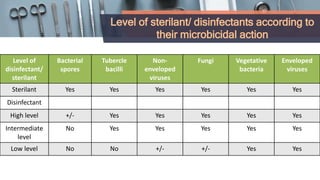
Level of sterilant/ disinfectants according to
their microbicidal action
Level of
disinfectant/
sterilant
Bacterial
spores
Tubercle
bacilli
Non-
enveloped
viruses
Fungi Vegetative
bacteria
Enveloped
viruses
Sterilant Yes Yes Yes Yes Yes Yes
Disinfectant
High level +/- Yes Yes Yes Yes Yes
Intermediate
level
No Yes Yes Yes Yes Yes
Low level No No +/- +/- Yes Yes
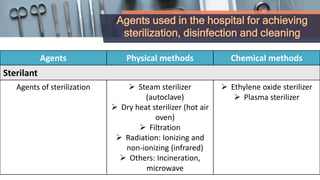
Agents used in the hospital for achieving
sterilization, disinfection and cleaning
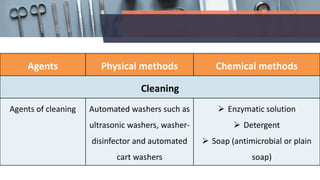
Agents Physical methods Chemical methods
Sterilant
Agents of sterilization  Steam sterilizer
(autoclave)
 Dry heat sterilizer (hot air
oven)
 Filtration
 Radiation: Ionizing and
non-ionizing (infrared)
 Others: Incineration,
microwave
 Ethylene oxide sterilizer
 Plasma sterilizer
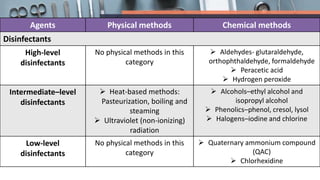
Agents Physical methods Chemical methods
Disinfectants
High-level
disinfectants
No physical methods in this
category
 Aldehydes- glutaraldehyde,
orthophthaldehyde, formaldehyde
 Peracetic acid
 Hydrogen peroxide
Intermediate–level
disinfectants
 Heat-based methods:
Pasteurization, boiling and
steaming
 Ultraviolet (non-ionizing)
radiation
 Alcohols–ethyl alcohol and
isopropyl alcohol
 Phenolics–phenol, cresol, lysol
 Halogens–iodine and chlorine
Low-level
disinfectants
No physical methods in this
category
 Quaternary ammonium compound
(QAC)
 Chlorhexidine
Agents Physical methods Chemical methods
Cleaning
Agents of cleaning Automated washers such as
ultrasonic washers, washer-
disinfector and automated
cart washers
 Enzymatic solution
 Detergent
 Soap (antimicrobial or plain
soap)
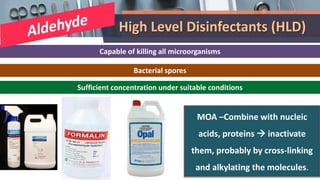
High Level Disinfectants (HLD)
Capable of killing all microorganisms
Bacterial spores
Sufficient concentration under suitable conditions
MOA –Combine with nucleic
acids, proteins  inactivate
them, probably by cross-linking
and alkylating the molecules.
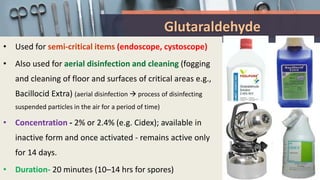
Glutaraldehyde
• Used for semi-critical items (endoscope, cystoscope)
• Also used for aerial disinfection and cleaning (fogging
and cleaning of floor and surfaces of critical areas e.g.,
Bacillocid Extra) (aerial disinfection  process of disinfecting
suspended particles in the air for a period of time)
• Concentration - 2% or 2.4% (e.g. Cidex); available in
inactive form and once activated - remains active only
for 14 days.
• Duration- 20 minutes (10–14 hrs for spores)
• Advantages: Remains active in the presence of organic matter, has
excellent material compatibility.
• Disadvantages: Pungent odour, can produce eye irritation,
occupational asthma and contact dermatitis.
Ortho-phthalaldehyde (0.55%)
• Used for disinfection of semi-critical items, has many advantages over
glutaraldehyde—
 Does not require activation
 Better odor
 Less eye irritation
 Acts faster (5–10 min).
• OPA does not kill spores effectively and stains skin gray.
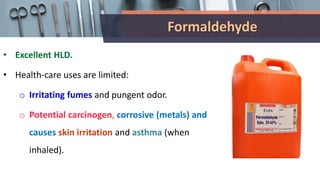
Formaldehyde
• Excellent HLD.
• Health-care uses are limited:
o Irritating fumes and pungent odor.
o Potential carcinogen, corrosive (metals) and
causes skin irritation and asthma (when
inhaled).
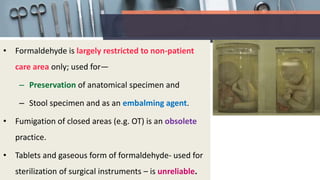
• Formaldehyde is largely restricted to non-patient
care area only; used for—
– Preservation of anatomical specimen and
– Stool specimen and as an embalming agent.
• Fumigation of closed areas (e.g. OT) is an obsolete
practice.
• Tablets and gaseous form of formaldehyde- used for
sterilization of surgical instruments – is unreliable.
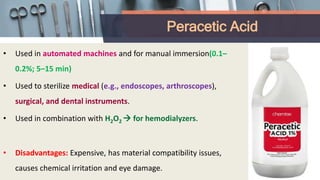
Peracetic Acid
• Used in automated machines and for manual immersion(0.1–
0.2%; 5–15 min)
• Used to sterilize medical (e.g., endoscopes, arthroscopes),
surgical, and dental instruments.
• Used in combination with H2O2  for hemodialyzers.
• Disadvantages: Expensive, has material compatibility issues,
causes chemical irritation and eye damage.
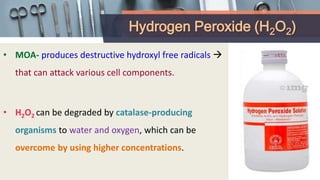
Hydrogen Peroxide (H2O2)
• MOA- produces destructive hydroxyl free radicals 
that can attack various cell components.
• H2O2 can be degraded by catalase-producing
organisms to water and oxygen, which can be
overcome by using higher concentrations.
Uses
• Sporicidal only at >4–5%.
• 3% H2O2 – Environmental surface disinfection, fogging & for wound cleaning
• 3–6% H2O2 – Disinfect soft contact lens, tonometer biprisms, ventilators,
fabrics, and endoscopes, etc.
• 6–7.5% H2O2 - used as chemical sterilant in plasma sterilization.
• Vaporized H2O2 - Industrial sterilization of medical devices and for
decontamination of large and small area.
Advantages:
• It is rapid in action, nontoxic.
• Has detergent properties with good
cleaning ability.
• Active in the presence of organic
material.
Disadvantages:
• Expensive
• Material compatibility issue
(contraindicated for use on Cu, brass, Zn2+
etc).
• Can produce chemical irritation and
corneal damage.
• Should be properly stored in dark
containers.
Intermediate Level Disinfectants
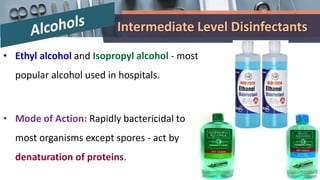
• Ethyl alcohol and Isopropyl alcohol - most
popular alcohol used in hospitals.
• Mode of Action: Rapidly bactericidal to
most organisms except spores - act by
denaturation of proteins.
Uses
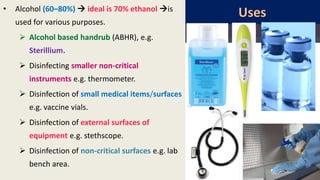
• Alcohol (60–80%)  ideal is 70% ethanol is
used for various purposes.
 Alcohol based handrub (ABHR), e.g.
Sterillium.
 Disinfecting smaller non-critical
instruments e.g. thermometer.
 Disinfection of small medical items/surfaces
e.g. vaccine vials.
 Disinfection of external surfaces of
equipment e.g. stethscope.
 Disinfection of non-critical surfaces e.g. lab
bench area.
Disadvantages
• Flammable and must be stored in a cool, well-ventilated area.
• Evaporate rapidly.
• May damage tonometer tips and lenses.
• Inactivated by organic matter.
Phenolics
• Phenol (carbolic acid) - first widely used
antiseptic and disinfectant (Joseph Lister )
• Phenol and its derivatives - produced by
distillation of coal tar.
• MOA: Act as protoplasmic poison, disrupt the
cell wall and cell proteins
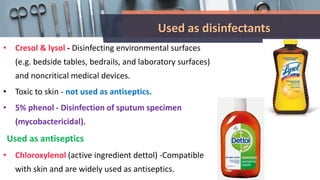
Used as disinfectants
• Cresol & lysol - Disinfecting environmental surfaces
(e.g. bedside tables, bedrails, and laboratory surfaces)
and noncritical medical devices.
• Toxic to skin - not used as antiseptics.
• 5% phenol - Disinfection of sputum specimen
(mycobactericidal).
Used as antiseptics
• Chloroxylenol (active ingredient dettol) -Compatible
with skin and are widely used as antiseptics.
• Advantages: only ILD that retain activity in the presence of organic
materials.
• Disadvantages: can cause hyperbilirubinemia in infants
Halogens
• Iodine and chlorine have antimicrobial activity.
• Exist in free state and form salt with sodium and other metals.
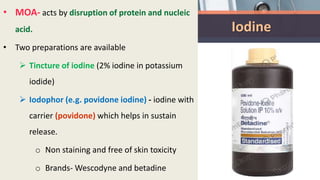
Iodine
• MOA- acts by disruption of protein and nucleic
acid.
• Two preparations are available
 Tincture of iodine (2% iodine in potassium
iodide)
 Iodophor (e.g. povidone iodine) - iodine with
carrier (povidone) which helps in sustain
release.
o Non staining and free of skin toxicity
o Brands- Wescodyne and betadine
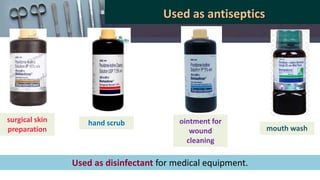
Used as antiseptics
surgical skin
preparation
hand scrub ointment for
wound
cleaning
mouth wash
Used as disinfectant for medical equipment.
Chlorine and Hypochlorite
• MOA –All preparations yield hypochlorous acid (HClO) -causes oxidation of
cellular materials and destruction of vegetative bacteria and fungi.
Chlorine and Hypochlorite
Preparations: Chlorine occurs as—
• Free chlorine
• Hypochlorite—it is available in two preparations.
 Liquid form (sodium hypochlorite or household bleach)
 Powder form (calcium hypochlorite or bleaching powder)
 Other forms: sodium dichloroisocyanurate (NaDCC) tablets and chlorine
dioxide
Uses (free chlorine)
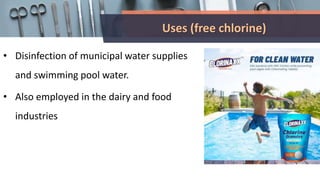
• Disinfection of municipal water supplies
and swimming pool water.
• Also employed in the dairy and food
industries
Uses (sodium hypochlorite)
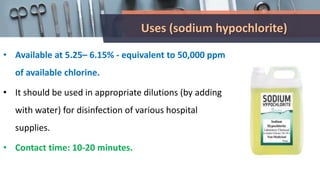
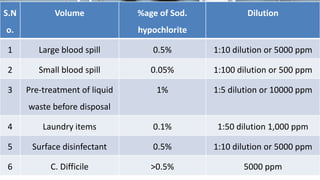
• Available at 5.25– 6.15% - equivalent to 50,000 ppm
of available chlorine.
• It should be used in appropriate dilutions (by adding
with water) for disinfection of various hospital
supplies.
• Contact time: 10-20 minutes.
S.N
o.
Volume %age of Sod.
hypochlorite
Dilution
1 Large blood spill 0.5% 1:10 dilution or 5000 ppm
2 Small blood spill 0.05% 1:100 dilution or 500 ppm
3 Pre-treatment of liquid
waste before disposal
1% 1:5 dilution or 10000 ppm
4 Laundry items 0.1% 1:50 dilution 1,000 ppm
5 Surface disinfectant 0.5% 1:10 dilution or 5000 ppm
6 C. Difficile >0.5% 5000 ppm
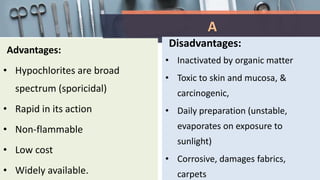
A
Advantages:
• Hypochlorites are broad
spectrum (sporicidal)
• Rapid in its action
• Non-flammable
• Low cost
• Widely available.
Disadvantages:
• Inactivated by organic matter
• Toxic to skin and mucosa, &
carcinogenic,
• Daily preparation (unstable,
evaporates on exposure to
sunlight)
• Corrosive, damages fabrics,
carpets
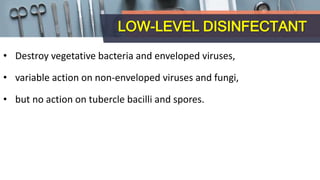
LOW-LEVEL DISINFECTANT
• Destroy vegetative bacteria and enveloped viruses,
• variable action on non-enveloped viruses and fungi,
• but no action on tubercle bacilli and spores.
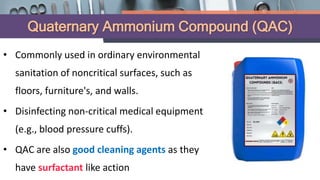
Quaternary Ammonium Compound (QAC)
• Commonly used in ordinary environmental
sanitation of noncritical surfaces, such as
floors, furniture's, and walls.
• Disinfecting non-critical medical equipment
(e.g., blood pressure cuffs).
• QAC are also good cleaning agents as they
have surfactant like action
• MOA:
– Inactivation of energy producing enzymes,
– denaturation of essential cell proteins, and
– disruption of the cell membrane.
• QAC formulations: Benzyl ammonium chloride - most popular QAC.
• Does not act in the presence of hard water.
• Newer generation of QACs (e.g. didecyl dimethyl ammonium
bromide) -remain active in hard water and are better compatible.
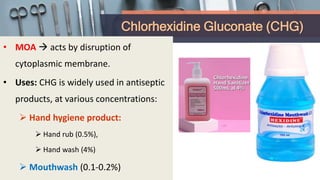
Chlorhexidine Gluconate (CHG)
• MOA  acts by disruption of
cytoplasmic membrane.
• Uses: CHG is widely used in antiseptic
products, at various concentrations:
 Hand hygiene product:
 Hand rub (0.5%),
 Hand wash (4%)
 Mouthwash (0.1-0.2%)
Chlorhexidine Gluconate (CHG)
 Body wash solutions (used before
surgery)
 Skin disinfectant before surgery (2%)
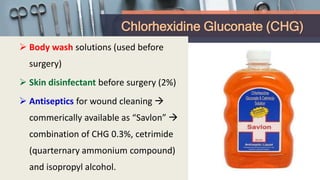
 Antiseptics for wound cleaning 
commerically available as “Savlon” 
combination of CHG 0.3%, cetrimide
(quarternary ammonium compound)
and isopropyl alcohol.
• Advantages:
– Residual activity (prolonged action than alcohol hand rub) and
– is less irritant.
• Disadvantages:
– Slower in action.
– Activity is pH dependent and is greatly reduced in the presence of
organic matter.
– Produces dermatitis on prolonged use as handrub.
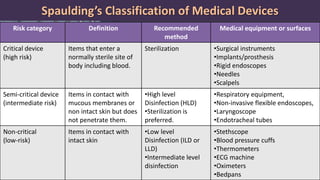
Spaulding’s Classification of Medical Devices
Risk category Definition Recommended
method
Medical equipment or surfaces
Critical device
(high risk)
Items that enter a
normally sterile site of
body including blood.
Sterilization •Surgical instruments
•Implants/prosthesis
•Rigid endoscopes
•Needles
•Scalpels
Semi-critical device
(intermediate risk)
Items in contact with
mucous membranes or
non intact skin but does
not penetrate them.
•High level
Disinfection (HLD)
•Sterilization is
preferred.
•Respiratory equipment,
•Non-invasive flexible endoscopes,
•Laryngoscope
•Endotracheal tubes
Non-critical
(low-risk)
Items in contact with
intact skin
•Low level
Disinfection (ILD or
LLD)
•Intermediate level
disinfection
•Stethscope
•Blood pressure cuffs
•Thermometers
•ECG machine
•Oximeters
•Bedpans
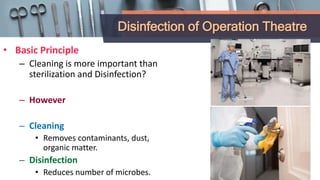
Disinfection of Operation Theatre
• Basic Principle
– Cleaning is more important than
sterilization and Disinfection?
– However
– Cleaning
• Removes contaminants, dust,
organic matter.
– Disinfection
• Reduces number of microbes.
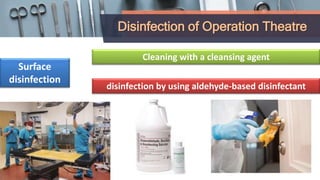
Disinfection of Operation Theatre
Surface
disinfection
Cleaning with a cleansing agent
disinfection by using aldehyde-based disinfectant
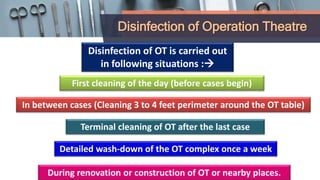
Disinfection of Operation Theatre
First cleaning of the day (before cases begin)
In between cases (Cleaning 3 to 4 feet perimeter around the OT table)
Disinfection of OT is carried out
in following situations :
Terminal cleaning of OT after the last case
Detailed wash-down of the OT complex once a week
During renovation or construction of OT or nearby places.
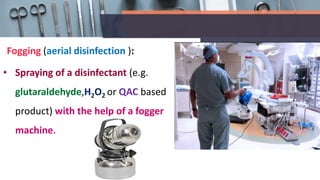
Fogging (aerial disinfection ):
• Spraying of a disinfectant (e.g.
glutaraldehyde,H2O2 or QAC based
product) with the help of a fogger
machine.
Cleaning (Decontamination)
• Reduction in the pathogenic microbial population to a level at
which items are considered safe without protective attire.
• Achieved by
– manual cleaning with soap and detergents to eliminate debris or
organic matter from medical devices or surfaces.
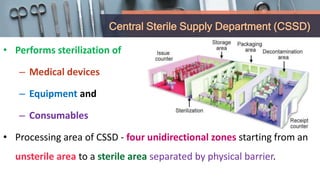
Central Sterile Supply Department (CSSD)
• Performs sterilization of
– Medical devices
– Equipment and
– Consumables
• Processing area of CSSD - four unidirectional zones starting from an
unsterile area to a sterile area separated by physical barrier.
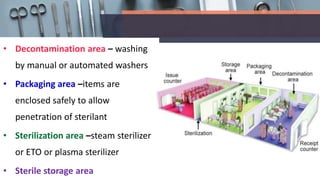
• Decontamination area – washing
by manual or automated washers
• Packaging area –items are
enclosed safely to allow
penetration of sterilant
• Sterilization area –steam sterilizer
or ETO or plasma sterilizer
• Sterile storage area
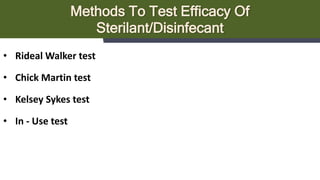
Methods To Test Efficacy Of
Sterilant/Disinfecant
• Rideal Walker test
• Chick Martin test
• Kelsey Sykes test
• In - Use test
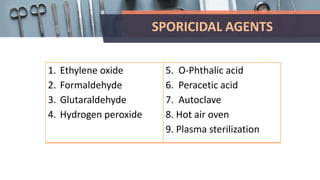
SPORICIDAL AGENTS
1. Ethylene oxide
2. Formaldehyde
3. Glutaraldehyde
4. Hydrogen peroxide
5. O-Phthalic acid
6. Peracetic acid
7. Autoclave
8. Hot air oven
9. Plasma sterilization
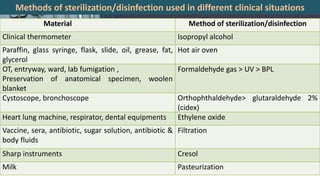
Methods of sterilization/disinfection used in different clinical situations
Material Method of sterilization/disinfection
Clinical thermometer Isopropyl alcohol
Paraffin, glass syringe, flask, slide, oil, grease, fat,
glycerol
Hot air oven
OT, entryway, ward, lab fumigation ,
Preservation of anatomical specimen, woolen
blanket
Formaldehyde gas > UV > BPL
Cystoscope, bronchoscope Orthophthaldehyde> glutaraldehyde 2%
(cidex)
Heart lung machine, respirator, dental equipments Ethylene oxide
Vaccine, sera, antibiotic, sugar solution, antibiotic &
body fluids
Filtration
Sharp instruments Cresol
Milk Pasteurization
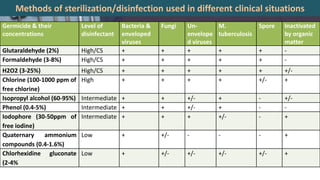
Methods of sterilization/disinfection used in different clinical situations
Germicide & their
concentrations
Level of
disinfectant
Bacteria &
enveloped
viruses
Fungi Un-
envelope
d viruses
M.
tuberculosis
Spore Inactivated
by organic
matter
Glutaraldehyde (2%) High/CS + + + + + -
Formaldehyde (3-8%) High/CS + + + + + -
H2O2 (3-25%) High/CS + + + + + +/-
Chlorine (100-1000 ppm of
free chlorine)
High + + + + +/- +
Isopropyl alcohol (60-95%) Intermediate + + +/- + - +/-
Phenol (0.4-5%) Intermediate + + +/- + - -
Iodophore (30-50ppm of
free iodine)
Intermediate + + + +/- - +
Quaternary ammonium
compounds (0.4-1.6%)
Low + +/- - - - +
Chlorhexidine gluconate
(2-4%
Low + +/- +/- +/- +/- +
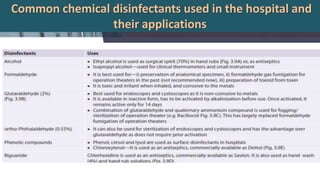
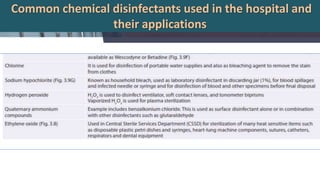
Common chemical disinfectants used in the hospital and
their applications
Common chemical disinfectants used in the hospital and
their applications
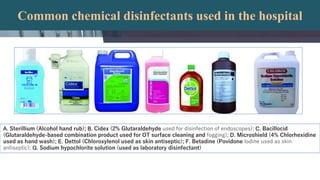
Common chemical disinfectants used in the hospital
A. Sterillium (Alcohol hand rub); B. Cidex (2% Glutaraldehyde used for disinfection of endoscopes); C. Bacillocid
(Glutaraldehyde-based combination product used for OT surface cleaning and fogging); D. Microshield (4% Chlorhexidine
used as hand wash); E. Dettol (Chloroxylenol used as skin antiseptic); F. Betadine (Povidone Iodine used as skin
antiseptic); G. Sodium hypochlorite solution (used as laboratory disinfectant)
Disinfection.pptx

Disinfection.pptx

  • 1.
    Disinfection By Dr. RakeshPrasad Sah Associate Professor, Microbiology
  • 2.
    Definition • Sterilization :process of 100 % killing of m.os. either pathogenic or non-pathogenic including spores from any article, surface or objects. • Process that destroys all (100%) pathogenic microorganisms but may or may not destroy bacterial spores is called Disinfection. • Agents  Disinfectants.
  • 3.
    Definitions • Antiseptics type of disinfectant  safe to apply on body surface (skin & mucosa)  destruction of organisms  present on the body surfaces  type of disinfection is termed as Asepsis. • Sanitizer: an agent reduces but may not eliminate m.os. To safe level. • Decontamination  process  removes/destroys all pathogenic m.os. From an object to make it safe to handle.
  • 4.
    Definitions • Asepsis :refers to a technique that aids in preventing the onset of infection in uninfected tissue. • Cidal : Killing of m.os. • Static : inhibit the growth of m.os. • Germicide : agents which kills pathogenic m.os. (germs). includes both antiseptics and disinfectants.
  • 5.
    Factors affecting Efficacyof Sterilant/Disinfectant • Organism load • Nature of organisms • Concentration • Contact time • Temperature • Stability • Local pH • Relative humidity • Organic matter • Pus, serum, blood & stool can interfere with antimicrobial activity of disinfectant. (hypochlorites), Overcome by • Overcome by mechanical cleaning of instrument or surface/floor before it is subjected for disinfection or sterilization. • Increase exposure time or concn. Of agent. • Biofilm • Prevents entry of disinfectants which embedded inside biofilm.
  • 6.
    Property of anIdeal Disinfectant • Broader microbicidal activity. • Fast acting. • Not affected by environmental factors such as organic matter. • Nontoxic. • Compatible with surfaces/materials to which it is used. • Environmental friendly.
  • 7.
    Classification of disinfectionmethods Disinfectant Examples 1 Alcohols Ethyl alcohol, isopropyl alcohol 2 Aldehydes Formaldehyde, glutaraldehyde, Ortho- phthalaldehyde 3 Phenolic compounds Cresol, lysol, chlorhexidine, chloroxylenol, hexachlorophene 4 Biguanide Chlorhexidine gluconate 5 Halogens Chlorine, iodine, iodophors 6 Oxidising agents Hydrogen peroxide , Peracetic acid
  • 8.
    Classification of disinfectionmethods 7 Heavy metal salts Mercuric chloride, copper salts 8 Surface active agents Quaternary ammonium compounds and soaps 9 Dyes aniline dyes and acridine dyes 10 Gas sterilization- • Low temperature steam formaldehyde • Ethylene oxide (ETO) • Betapropiolactone (BPL) • Plasma sterilization
  • 9.
    Type of Disinfectants Highlevel Disinfectants (HLD) • Capable of killing bacterial spores  used in sufficient concentration under suitable conditions. • Kill all microorganisms. Intermediate level Disinfectant (ILD) • Kills all microorganisms but not spores. Low-level Disinfectants (LLD) • Kills vegetative bacteria and enveloped viruses. • Variable action on non- enveloped viruses and fungi. No action on Tubercle bacilli and spores.
  • 10.
    Level of sterilant/disinfectants according to their microbicidal action Level of disinfectant/ sterilant Bacterial spores Tubercle bacilli Non- enveloped viruses Fungi Vegetative bacteria Enveloped viruses Sterilant Yes Yes Yes Yes Yes Yes Disinfectant High level +/- Yes Yes Yes Yes Yes Intermediate level No Yes Yes Yes Yes Yes Low level No No +/- +/- Yes Yes
  • 11.
    Agents used inthe hospital for achieving sterilization, disinfection and cleaning Agents Physical methods Chemical methods Sterilant Agents of sterilization  Steam sterilizer (autoclave)  Dry heat sterilizer (hot air oven)  Filtration  Radiation: Ionizing and non-ionizing (infrared)  Others: Incineration, microwave  Ethylene oxide sterilizer  Plasma sterilizer
  • 12.
    Agents Physical methodsChemical methods Disinfectants High-level disinfectants No physical methods in this category  Aldehydes- glutaraldehyde, orthophthaldehyde, formaldehyde  Peracetic acid  Hydrogen peroxide Intermediate–level disinfectants  Heat-based methods: Pasteurization, boiling and steaming  Ultraviolet (non-ionizing) radiation  Alcohols–ethyl alcohol and isopropyl alcohol  Phenolics–phenol, cresol, lysol  Halogens–iodine and chlorine Low-level disinfectants No physical methods in this category  Quaternary ammonium compound (QAC)  Chlorhexidine
  • 13.
    Agents Physical methodsChemical methods Cleaning Agents of cleaning Automated washers such as ultrasonic washers, washer- disinfector and automated cart washers  Enzymatic solution  Detergent  Soap (antimicrobial or plain soap)
  • 14.
    High Level Disinfectants(HLD) Capable of killing all microorganisms Bacterial spores Sufficient concentration under suitable conditions MOA –Combine with nucleic acids, proteins  inactivate them, probably by cross-linking and alkylating the molecules.
  • 15.
    Glutaraldehyde • Used forsemi-critical items (endoscope, cystoscope) • Also used for aerial disinfection and cleaning (fogging and cleaning of floor and surfaces of critical areas e.g., Bacillocid Extra) (aerial disinfection  process of disinfecting suspended particles in the air for a period of time) • Concentration - 2% or 2.4% (e.g. Cidex); available in inactive form and once activated - remains active only for 14 days. • Duration- 20 minutes (10–14 hrs for spores)
  • 16.
    • Advantages: Remainsactive in the presence of organic matter, has excellent material compatibility. • Disadvantages: Pungent odour, can produce eye irritation, occupational asthma and contact dermatitis.
  • 17.
    Ortho-phthalaldehyde (0.55%) • Usedfor disinfection of semi-critical items, has many advantages over glutaraldehyde—  Does not require activation  Better odor  Less eye irritation  Acts faster (5–10 min). • OPA does not kill spores effectively and stains skin gray.
  • 18.
    Formaldehyde • Excellent HLD. •Health-care uses are limited: o Irritating fumes and pungent odor. o Potential carcinogen, corrosive (metals) and causes skin irritation and asthma (when inhaled).
  • 19.
    • Formaldehyde islargely restricted to non-patient care area only; used for— – Preservation of anatomical specimen and – Stool specimen and as an embalming agent. • Fumigation of closed areas (e.g. OT) is an obsolete practice. • Tablets and gaseous form of formaldehyde- used for sterilization of surgical instruments – is unreliable.
  • 20.
    Peracetic Acid • Usedin automated machines and for manual immersion(0.1– 0.2%; 5–15 min) • Used to sterilize medical (e.g., endoscopes, arthroscopes), surgical, and dental instruments. • Used in combination with H2O2  for hemodialyzers. • Disadvantages: Expensive, has material compatibility issues, causes chemical irritation and eye damage.
  • 21.
    Hydrogen Peroxide (H2O2) •MOA- produces destructive hydroxyl free radicals  that can attack various cell components. • H2O2 can be degraded by catalase-producing organisms to water and oxygen, which can be overcome by using higher concentrations.
  • 22.
    Uses • Sporicidal onlyat >4–5%. • 3% H2O2 – Environmental surface disinfection, fogging & for wound cleaning • 3–6% H2O2 – Disinfect soft contact lens, tonometer biprisms, ventilators, fabrics, and endoscopes, etc. • 6–7.5% H2O2 - used as chemical sterilant in plasma sterilization. • Vaporized H2O2 - Industrial sterilization of medical devices and for decontamination of large and small area.
  • 23.
    Advantages: • It israpid in action, nontoxic. • Has detergent properties with good cleaning ability. • Active in the presence of organic material. Disadvantages: • Expensive • Material compatibility issue (contraindicated for use on Cu, brass, Zn2+ etc). • Can produce chemical irritation and corneal damage. • Should be properly stored in dark containers.
  • 24.
    Intermediate Level Disinfectants •Ethyl alcohol and Isopropyl alcohol - most popular alcohol used in hospitals. • Mode of Action: Rapidly bactericidal to most organisms except spores - act by denaturation of proteins.
  • 25.
    Uses • Alcohol (60–80%) ideal is 70% ethanol is used for various purposes.  Alcohol based handrub (ABHR), e.g. Sterillium.  Disinfecting smaller non-critical instruments e.g. thermometer.  Disinfection of small medical items/surfaces e.g. vaccine vials.  Disinfection of external surfaces of equipment e.g. stethscope.  Disinfection of non-critical surfaces e.g. lab bench area.
  • 26.
    Disadvantages • Flammable andmust be stored in a cool, well-ventilated area. • Evaporate rapidly. • May damage tonometer tips and lenses. • Inactivated by organic matter.
  • 27.
    Phenolics • Phenol (carbolicacid) - first widely used antiseptic and disinfectant (Joseph Lister ) • Phenol and its derivatives - produced by distillation of coal tar. • MOA: Act as protoplasmic poison, disrupt the cell wall and cell proteins
  • 28.
    Used as disinfectants •Cresol & lysol - Disinfecting environmental surfaces (e.g. bedside tables, bedrails, and laboratory surfaces) and noncritical medical devices. • Toxic to skin - not used as antiseptics. • 5% phenol - Disinfection of sputum specimen (mycobactericidal). Used as antiseptics • Chloroxylenol (active ingredient dettol) -Compatible with skin and are widely used as antiseptics.
  • 29.
    • Advantages: onlyILD that retain activity in the presence of organic materials. • Disadvantages: can cause hyperbilirubinemia in infants
  • 30.
    Halogens • Iodine andchlorine have antimicrobial activity. • Exist in free state and form salt with sodium and other metals.
  • 31.
    Iodine • MOA- actsby disruption of protein and nucleic acid. • Two preparations are available  Tincture of iodine (2% iodine in potassium iodide)  Iodophor (e.g. povidone iodine) - iodine with carrier (povidone) which helps in sustain release. o Non staining and free of skin toxicity o Brands- Wescodyne and betadine
  • 32.
    Used as antiseptics surgicalskin preparation hand scrub ointment for wound cleaning mouth wash Used as disinfectant for medical equipment.
  • 33.
    Chlorine and Hypochlorite •MOA –All preparations yield hypochlorous acid (HClO) -causes oxidation of cellular materials and destruction of vegetative bacteria and fungi.
  • 34.
    Chlorine and Hypochlorite Preparations:Chlorine occurs as— • Free chlorine • Hypochlorite—it is available in two preparations.  Liquid form (sodium hypochlorite or household bleach)  Powder form (calcium hypochlorite or bleaching powder)  Other forms: sodium dichloroisocyanurate (NaDCC) tablets and chlorine dioxide
  • 35.
    Uses (free chlorine) •Disinfection of municipal water supplies and swimming pool water. • Also employed in the dairy and food industries
  • 36.
    Uses (sodium hypochlorite) •Available at 5.25– 6.15% - equivalent to 50,000 ppm of available chlorine. • It should be used in appropriate dilutions (by adding with water) for disinfection of various hospital supplies. • Contact time: 10-20 minutes.
  • 37.
    S.N o. Volume %age ofSod. hypochlorite Dilution 1 Large blood spill 0.5% 1:10 dilution or 5000 ppm 2 Small blood spill 0.05% 1:100 dilution or 500 ppm 3 Pre-treatment of liquid waste before disposal 1% 1:5 dilution or 10000 ppm 4 Laundry items 0.1% 1:50 dilution 1,000 ppm 5 Surface disinfectant 0.5% 1:10 dilution or 5000 ppm 6 C. Difficile >0.5% 5000 ppm
  • 38.
    A Advantages: • Hypochlorites arebroad spectrum (sporicidal) • Rapid in its action • Non-flammable • Low cost • Widely available. Disadvantages: • Inactivated by organic matter • Toxic to skin and mucosa, & carcinogenic, • Daily preparation (unstable, evaporates on exposure to sunlight) • Corrosive, damages fabrics, carpets
  • 39.
    LOW-LEVEL DISINFECTANT • Destroyvegetative bacteria and enveloped viruses, • variable action on non-enveloped viruses and fungi, • but no action on tubercle bacilli and spores.
  • 40.
    Quaternary Ammonium Compound(QAC) • Commonly used in ordinary environmental sanitation of noncritical surfaces, such as floors, furniture's, and walls. • Disinfecting non-critical medical equipment (e.g., blood pressure cuffs). • QAC are also good cleaning agents as they have surfactant like action
  • 41.
    • MOA: – Inactivationof energy producing enzymes, – denaturation of essential cell proteins, and – disruption of the cell membrane. • QAC formulations: Benzyl ammonium chloride - most popular QAC. • Does not act in the presence of hard water. • Newer generation of QACs (e.g. didecyl dimethyl ammonium bromide) -remain active in hard water and are better compatible.
  • 42.
    Chlorhexidine Gluconate (CHG) •MOA  acts by disruption of cytoplasmic membrane. • Uses: CHG is widely used in antiseptic products, at various concentrations:  Hand hygiene product:  Hand rub (0.5%),  Hand wash (4%)  Mouthwash (0.1-0.2%)
  • 43.
    Chlorhexidine Gluconate (CHG) Body wash solutions (used before surgery)  Skin disinfectant before surgery (2%)  Antiseptics for wound cleaning  commerically available as “Savlon”  combination of CHG 0.3%, cetrimide (quarternary ammonium compound) and isopropyl alcohol.
  • 44.
    • Advantages: – Residualactivity (prolonged action than alcohol hand rub) and – is less irritant. • Disadvantages: – Slower in action. – Activity is pH dependent and is greatly reduced in the presence of organic matter. – Produces dermatitis on prolonged use as handrub.
  • 45.
    Spaulding’s Classification ofMedical Devices Risk category Definition Recommended method Medical equipment or surfaces Critical device (high risk) Items that enter a normally sterile site of body including blood. Sterilization •Surgical instruments •Implants/prosthesis •Rigid endoscopes •Needles •Scalpels Semi-critical device (intermediate risk) Items in contact with mucous membranes or non intact skin but does not penetrate them. •High level Disinfection (HLD) •Sterilization is preferred. •Respiratory equipment, •Non-invasive flexible endoscopes, •Laryngoscope •Endotracheal tubes Non-critical (low-risk) Items in contact with intact skin •Low level Disinfection (ILD or LLD) •Intermediate level disinfection •Stethscope •Blood pressure cuffs •Thermometers •ECG machine •Oximeters •Bedpans
  • 46.
    Disinfection of OperationTheatre • Basic Principle – Cleaning is more important than sterilization and Disinfection? – However – Cleaning • Removes contaminants, dust, organic matter. – Disinfection • Reduces number of microbes.
  • 47.
    Disinfection of OperationTheatre Surface disinfection Cleaning with a cleansing agent disinfection by using aldehyde-based disinfectant
  • 48.
    Disinfection of OperationTheatre First cleaning of the day (before cases begin) In between cases (Cleaning 3 to 4 feet perimeter around the OT table) Disinfection of OT is carried out in following situations : Terminal cleaning of OT after the last case Detailed wash-down of the OT complex once a week During renovation or construction of OT or nearby places.
  • 49.
    Fogging (aerial disinfection): • Spraying of a disinfectant (e.g. glutaraldehyde,H2O2 or QAC based product) with the help of a fogger machine.
  • 50.
    Cleaning (Decontamination) • Reductionin the pathogenic microbial population to a level at which items are considered safe without protective attire. • Achieved by – manual cleaning with soap and detergents to eliminate debris or organic matter from medical devices or surfaces.
  • 51.
    Central Sterile SupplyDepartment (CSSD) • Performs sterilization of – Medical devices – Equipment and – Consumables • Processing area of CSSD - four unidirectional zones starting from an unsterile area to a sterile area separated by physical barrier.
  • 52.
    • Decontamination area– washing by manual or automated washers • Packaging area –items are enclosed safely to allow penetration of sterilant • Sterilization area –steam sterilizer or ETO or plasma sterilizer • Sterile storage area
  • 53.
    Methods To TestEfficacy Of Sterilant/Disinfecant • Rideal Walker test • Chick Martin test • Kelsey Sykes test • In - Use test
  • 54.
    SPORICIDAL AGENTS 1. Ethyleneoxide 2. Formaldehyde 3. Glutaraldehyde 4. Hydrogen peroxide 5. O-Phthalic acid 6. Peracetic acid 7. Autoclave 8. Hot air oven 9. Plasma sterilization
  • 55.
    Methods of sterilization/disinfectionused in different clinical situations Material Method of sterilization/disinfection Clinical thermometer Isopropyl alcohol Paraffin, glass syringe, flask, slide, oil, grease, fat, glycerol Hot air oven OT, entryway, ward, lab fumigation , Preservation of anatomical specimen, woolen blanket Formaldehyde gas > UV > BPL Cystoscope, bronchoscope Orthophthaldehyde> glutaraldehyde 2% (cidex) Heart lung machine, respirator, dental equipments Ethylene oxide Vaccine, sera, antibiotic, sugar solution, antibiotic & body fluids Filtration Sharp instruments Cresol Milk Pasteurization
  • 56.
    Methods of sterilization/disinfectionused in different clinical situations Germicide & their concentrations Level of disinfectant Bacteria & enveloped viruses Fungi Un- envelope d viruses M. tuberculosis Spore Inactivated by organic matter Glutaraldehyde (2%) High/CS + + + + + - Formaldehyde (3-8%) High/CS + + + + + - H2O2 (3-25%) High/CS + + + + + +/- Chlorine (100-1000 ppm of free chlorine) High + + + + +/- + Isopropyl alcohol (60-95%) Intermediate + + +/- + - +/- Phenol (0.4-5%) Intermediate + + +/- + - - Iodophore (30-50ppm of free iodine) Intermediate + + + +/- - + Quaternary ammonium compounds (0.4-1.6%) Low + +/- - - - + Chlorhexidine gluconate (2-4% Low + +/- +/- +/- +/- +
  • 57.
    Common chemical disinfectantsused in the hospital and their applications
  • 58.
    Common chemical disinfectantsused in the hospital and their applications
  • 59.
    Common chemical disinfectantsused in the hospital A. Sterillium (Alcohol hand rub); B. Cidex (2% Glutaraldehyde used for disinfection of endoscopes); C. Bacillocid (Glutaraldehyde-based combination product used for OT surface cleaning and fogging); D. Microshield (4% Chlorhexidine used as hand wash); E. Dettol (Chloroxylenol used as skin antiseptic); F. Betadine (Povidone Iodine used as skin antiseptic); G. Sodium hypochlorite solution (used as laboratory disinfectant)