Antigen
Dr. Rakesh Prasad Sah
Associate Professor, Microbiology
Introduction
• Antigens are substance  introduced into body  evokes an
immune response (humoral and cell mediated) either by sensitizing
T cell or B cells or both  has ability to combine with final products
of two immune responses i.e. Abs of humoral response and T-
lymphocytes surface receptors in CMI.
Introduction
Antigen
Humoral Immunity Cell Mediated Immunity
Ag + B lymphocytes Ag + T lymphocytes
Effector B lymphocyte
(Plasma cells)
Effector T lymphocytes
(Helper T lymphocytes/
Cytotoxic T lymphocytes)
Antibodies
• Defined as any substance that satisfies two distinct immunologic
properties-
 Immunogenicity
 Antigenicity.
Immunogenicity
• Ability of an antigen to induce immune response in the body
(both humoral and/or cell mediated).
 B cells + antigen → effector B cells (plasma cell) + memory B
cells
 T cells + antigen → effector T cells (helper T cell or cytotoxic
T cell) + memory T cells
• Substance that satisfies immunogenicity - more appropriately
called as ‘immunogen’ rather than ‘antigen’.
Antigenicity (immunological reactivity)
• Ability of an antigen to combine specifically with the final
products antibodies and/or T cell-surface receptors.
• All molecules having immunogenicity property, also show
antigenicity, but the reverse is not true.
 E.g. Haptens- which are antigenic but not immunogenic.
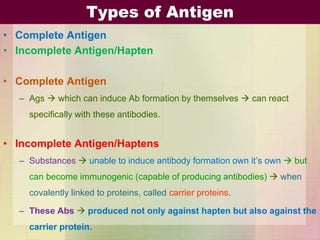
Epitope or antigenic determinant
• Smallest unit of antigenicity on antigen is called Epitope or
antigenic determinant.
• Specific site of an antibody that reacts with the
corresponding epitope of an antigen is called as Paratope.
Types of Antigen
• Complete Antigen
• Incomplete Antigen/Hapten
• Complete Antigen
– Ags  which can induce Ab formation by themselves  can react
specifically with these antibodies.
• Incomplete Antigen/Haptens
– Substances  unable to induce antibody formation own it’s own  but
can become immunogenic (capable of producing antibodies)  when
covalently linked to proteins, called carrier proteins.
– These Abs  produced not only against hapten but also against the
carrier protein.
Classification
• Complex haptens - contain two or more epitopes.
• Simple haptens - contain only one epitope.
ANTIGEN-HOST RELATIONSHIP
• Based on the antigen-host relationship, antigens can be grouped into
two groups:
 Self or auto antigens
 Non-self or foreign antigens
Self or auto antigens:
• Belong to the host itself - not immunogenic.
• Hosts  do not react to their own antigens by exhibiting a
mechanism called  immunological tolerance.
• Sometimes, the self-antigens are biologically altered (e.g. as in
cancer cells) and can become immunogenic.
Non-self or foreign antigens
• Immunogenic and are of three types based on their phylogenetic
distance to the host.
 Alloantigens : are species specific. Tissues of all individuals in
a species contain species-specific antigens.
 Isoantigens : Ags present in subsets of species, e.g. blood
group Ags and histocompatibility Ags.
 Heteroantigens: Ags belonging to two different species are
called heteroantigens. E.g. Ag of plant or animal or
microorganisms.
Heterophile Antigens
• Type of heteroantigens that are present in two different species; but
they share epitopes with each other.
• Antibody produced against antigen of one species can react with the
other and vice versa.
Diagnostic Application
• Heterophile antigens can be used in various serological tests.
• Antibody against one antigen can be detected in patient’s serum by
employing a different antigen which is heterophile (cross reactive) to
the first antigen. Examples:
 Weil-Felix reaction
 Paul-Bunnell test
 Cold agglutination test and Streptococcus MG test
Factors of Antigenicity
• Foreignness
• Size
• Chemical Nature
• Susceptibility to Tissue Enzymes
• Adjuvant
• Species specificity
• Isospecificity
• Autospecificity
• Organ specificity
• Heterophile specificity
Factors of Antigenicity
• Foreignness
• Size
– large molecules  highly Antigenic
– Low mol wt. (less than 10,000) either non-antigenic or weakly antigenic.
• Chemical Nature
– Natually occuring Ags are either proteins or polysaccharides
– Protein are more effective Ags.
– Exception is gelatin (low tyrosine content) (aromatic radical).
– Lipids and nucleic acids are less antigenic but become more antigenic
when combines to proteins.
Factors of Antigenicity
• Susceptibility to Tissue Enzymes
– Only substances that are susceptible to the action of tissue enzymes are
immunogenic.
– Degradation of the antigen by the tissue enzymes produces several
immunogenic fragments having more number of epitopes exposed.
• Adjuvant
– Any substance that enhances the immunogenicity of an Ag  is called
Adjuvant.
• Species specificity
• Isospecificity
Factors of Antigenicity
• Autospecificity
– Self Ag are  non-antigenic  exceptions (lens protein and sperm)
 not recognized as self Ags.
– Lens protein  confined within capsule  does not come in contact with
immune system  therefore not recognized.
– Similarly, Ag (sperm)  absent during embryonic life and develop later,
 also not recognized by immune system.
– When these Ag  released into tissue after injury  Abs produced
against them  leading to autoimmune diseases.
Factors of Antigenicity
• Organ specificity
– Confined to particular organ.
– Like brain, kidney and lens proteins of one species  shares specificity
with that of another species.
– As brain specific Ags  shared by man and sheep  antirabies
vaccines (Sheep brain vaccines)  may cause neuroparalytic
complications in man.
• Heterophile specificity
BIOLOGICAL CLASSES OF ANTIGENS
• Depending on the mechanisms of inducing antibody formation,
antigens are classified as:
 T cell dependent (TD) antigens.
 T cell independent (TI) antigens.
T cell dependent (TD) antigens.
• Most of the normal antigens are T cell dependent, they are
processed and presented by APCs to T cells which leads to T
cell activation.
• Activated T cells secrete cytokines that in turn stimulate the B
cells to produce antibodies.
T cell independent (TI) antigens
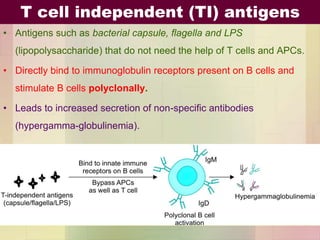
• Antigens such as bacterial capsule, flagella and LPS
(lipopolysaccharide) that do not need the help of T cells and APCs.
• Directly bind to immunoglobulin receptors present on B cells and
stimulate B cells polyclonally.
• Leads to increased secretion of non-specific antibodies
(hypergamma-globulinemia).
Differences between T-independent antigens and T-
dependent antigen
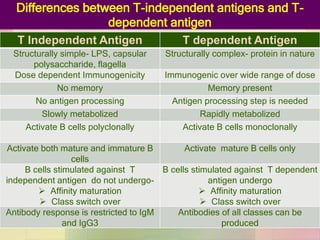
T Independent Antigen T dependent Antigen
Structurally simple- LPS, capsular
polysaccharide, flagella
Structurally complex- protein in nature
Dose dependent Immunogenicity Immunogenic over wide range of dose
No memory Memory present
No antigen processing Antigen processing step is needed
Slowly metabolized Rapidly metabolized
Activate B cells polyclonally Activate B cells monoclonally
Activate both mature and immature B
cells
Activate mature B cells only
B cells stimulated against T
independent antigen do not undergo-
 Affinity maturation
 Class switch over
B cells stimulated against T dependent
antigen undergo
 Affinity maturation
 Class switch over
Antibody response is restricted to IgM
and IgG3
Antibodies of all classes can be
produced
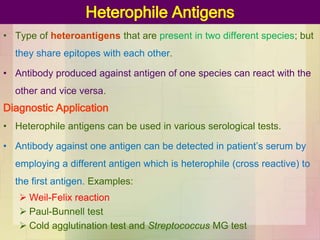
Superantigens
• Superantigens are the third variety of biological class of antigens,
recently described in the last decade.
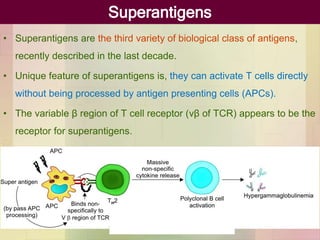
• Unique feature of superantigens is, they can activate T cells directly
without being processed by antigen presenting cells (APCs).
• The variable β region of T cell receptor (vβ of TCR) appears to be the
receptor for superantigens.
Superantigens
• Directly bridge non-specifically between major histocompatibility
complex (MHC)-II of APCs and T cells.
• Non-specific activation of T cells leads to massive release of
cytokines which can activate B cell polyclonally, which leads to
increased secretion of non- specific antibodies
(hypergammaglobulinemia)
Bacterial superantigen
Staphylococcal toxin-
 Toxic shock syndrome toxin-1(TSST-1); Exfoliative toxin; Enterotoxins
Streptococcal toxin- Streptococcal pyrogenic exotoxin (SPE)-A and C
Mycoplasma arthritidis mitogen-I
Yersinia enterocolitica
Yersinia pseudotuberculosis
Viral superantigen
Epstein-Barr virus associated superantigen
Cytomegalovirus associated superantigen
Rabies nucleocapsid
HIV encoded superantigen (nef- negative regulatory factor)
Fungal superantigen
Malassezia furfur
Diseases Associated with Superantigens
• Conditions associated with staphylococcal toxins are as follows-
 Toxic shock syndrome
 Food poisoning
 Scalded skin syndrome
 Rare conditions such as-
Atopic dermatitis
Kawasaki syndrome
Psoriasis
Acute disseminated encephalomyelitis.
Antigen.pptx

Antigen.pptx

  • 1.
    Antigen Dr. Rakesh PrasadSah Associate Professor, Microbiology
  • 2.
    Introduction • Antigens aresubstance  introduced into body  evokes an immune response (humoral and cell mediated) either by sensitizing T cell or B cells or both  has ability to combine with final products of two immune responses i.e. Abs of humoral response and T- lymphocytes surface receptors in CMI.
  • 3.
    Introduction Antigen Humoral Immunity CellMediated Immunity Ag + B lymphocytes Ag + T lymphocytes Effector B lymphocyte (Plasma cells) Effector T lymphocytes (Helper T lymphocytes/ Cytotoxic T lymphocytes) Antibodies
  • 4.
    • Defined asany substance that satisfies two distinct immunologic properties-  Immunogenicity  Antigenicity. Immunogenicity • Ability of an antigen to induce immune response in the body (both humoral and/or cell mediated).  B cells + antigen → effector B cells (plasma cell) + memory B cells  T cells + antigen → effector T cells (helper T cell or cytotoxic T cell) + memory T cells
  • 5.
    • Substance thatsatisfies immunogenicity - more appropriately called as ‘immunogen’ rather than ‘antigen’. Antigenicity (immunological reactivity) • Ability of an antigen to combine specifically with the final products antibodies and/or T cell-surface receptors. • All molecules having immunogenicity property, also show antigenicity, but the reverse is not true.  E.g. Haptens- which are antigenic but not immunogenic.
  • 6.
    Epitope or antigenicdeterminant • Smallest unit of antigenicity on antigen is called Epitope or antigenic determinant. • Specific site of an antibody that reacts with the corresponding epitope of an antigen is called as Paratope.
  • 7.
    Types of Antigen •Complete Antigen • Incomplete Antigen/Hapten • Complete Antigen – Ags  which can induce Ab formation by themselves  can react specifically with these antibodies. • Incomplete Antigen/Haptens – Substances  unable to induce antibody formation own it’s own  but can become immunogenic (capable of producing antibodies)  when covalently linked to proteins, called carrier proteins. – These Abs  produced not only against hapten but also against the carrier protein.
  • 8.
    Classification • Complex haptens- contain two or more epitopes. • Simple haptens - contain only one epitope.
  • 9.
    ANTIGEN-HOST RELATIONSHIP • Basedon the antigen-host relationship, antigens can be grouped into two groups:  Self or auto antigens  Non-self or foreign antigens Self or auto antigens: • Belong to the host itself - not immunogenic. • Hosts  do not react to their own antigens by exhibiting a mechanism called  immunological tolerance. • Sometimes, the self-antigens are biologically altered (e.g. as in cancer cells) and can become immunogenic.
  • 10.
    Non-self or foreignantigens • Immunogenic and are of three types based on their phylogenetic distance to the host.  Alloantigens : are species specific. Tissues of all individuals in a species contain species-specific antigens.  Isoantigens : Ags present in subsets of species, e.g. blood group Ags and histocompatibility Ags.  Heteroantigens: Ags belonging to two different species are called heteroantigens. E.g. Ag of plant or animal or microorganisms.
  • 11.
    Heterophile Antigens • Typeof heteroantigens that are present in two different species; but they share epitopes with each other. • Antibody produced against antigen of one species can react with the other and vice versa. Diagnostic Application • Heterophile antigens can be used in various serological tests. • Antibody against one antigen can be detected in patient’s serum by employing a different antigen which is heterophile (cross reactive) to the first antigen. Examples:  Weil-Felix reaction  Paul-Bunnell test  Cold agglutination test and Streptococcus MG test
  • 12.
    Factors of Antigenicity •Foreignness • Size • Chemical Nature • Susceptibility to Tissue Enzymes • Adjuvant • Species specificity • Isospecificity • Autospecificity • Organ specificity • Heterophile specificity
  • 13.
    Factors of Antigenicity •Foreignness • Size – large molecules  highly Antigenic – Low mol wt. (less than 10,000) either non-antigenic or weakly antigenic. • Chemical Nature – Natually occuring Ags are either proteins or polysaccharides – Protein are more effective Ags. – Exception is gelatin (low tyrosine content) (aromatic radical). – Lipids and nucleic acids are less antigenic but become more antigenic when combines to proteins.
  • 14.
    Factors of Antigenicity •Susceptibility to Tissue Enzymes – Only substances that are susceptible to the action of tissue enzymes are immunogenic. – Degradation of the antigen by the tissue enzymes produces several immunogenic fragments having more number of epitopes exposed. • Adjuvant – Any substance that enhances the immunogenicity of an Ag  is called Adjuvant. • Species specificity • Isospecificity
  • 15.
    Factors of Antigenicity •Autospecificity – Self Ag are  non-antigenic  exceptions (lens protein and sperm)  not recognized as self Ags. – Lens protein  confined within capsule  does not come in contact with immune system  therefore not recognized. – Similarly, Ag (sperm)  absent during embryonic life and develop later,  also not recognized by immune system. – When these Ag  released into tissue after injury  Abs produced against them  leading to autoimmune diseases.
  • 16.
    Factors of Antigenicity •Organ specificity – Confined to particular organ. – Like brain, kidney and lens proteins of one species  shares specificity with that of another species. – As brain specific Ags  shared by man and sheep  antirabies vaccines (Sheep brain vaccines)  may cause neuroparalytic complications in man. • Heterophile specificity
  • 17.
    BIOLOGICAL CLASSES OFANTIGENS • Depending on the mechanisms of inducing antibody formation, antigens are classified as:  T cell dependent (TD) antigens.  T cell independent (TI) antigens.
  • 18.
    T cell dependent(TD) antigens. • Most of the normal antigens are T cell dependent, they are processed and presented by APCs to T cells which leads to T cell activation. • Activated T cells secrete cytokines that in turn stimulate the B cells to produce antibodies.
  • 19.
    T cell independent(TI) antigens • Antigens such as bacterial capsule, flagella and LPS (lipopolysaccharide) that do not need the help of T cells and APCs. • Directly bind to immunoglobulin receptors present on B cells and stimulate B cells polyclonally. • Leads to increased secretion of non-specific antibodies (hypergamma-globulinemia).
  • 20.
    Differences between T-independentantigens and T- dependent antigen T Independent Antigen T dependent Antigen Structurally simple- LPS, capsular polysaccharide, flagella Structurally complex- protein in nature Dose dependent Immunogenicity Immunogenic over wide range of dose No memory Memory present No antigen processing Antigen processing step is needed Slowly metabolized Rapidly metabolized Activate B cells polyclonally Activate B cells monoclonally Activate both mature and immature B cells Activate mature B cells only B cells stimulated against T independent antigen do not undergo-  Affinity maturation  Class switch over B cells stimulated against T dependent antigen undergo  Affinity maturation  Class switch over Antibody response is restricted to IgM and IgG3 Antibodies of all classes can be produced
  • 21.
    Superantigens • Superantigens arethe third variety of biological class of antigens, recently described in the last decade. • Unique feature of superantigens is, they can activate T cells directly without being processed by antigen presenting cells (APCs). • The variable β region of T cell receptor (vβ of TCR) appears to be the receptor for superantigens.
  • 22.
    Superantigens • Directly bridgenon-specifically between major histocompatibility complex (MHC)-II of APCs and T cells. • Non-specific activation of T cells leads to massive release of cytokines which can activate B cell polyclonally, which leads to increased secretion of non- specific antibodies (hypergammaglobulinemia)
  • 24.
    Bacterial superantigen Staphylococcal toxin- Toxic shock syndrome toxin-1(TSST-1); Exfoliative toxin; Enterotoxins Streptococcal toxin- Streptococcal pyrogenic exotoxin (SPE)-A and C Mycoplasma arthritidis mitogen-I Yersinia enterocolitica Yersinia pseudotuberculosis Viral superantigen Epstein-Barr virus associated superantigen Cytomegalovirus associated superantigen Rabies nucleocapsid HIV encoded superantigen (nef- negative regulatory factor) Fungal superantigen Malassezia furfur
  • 25.
    Diseases Associated withSuperantigens • Conditions associated with staphylococcal toxins are as follows-  Toxic shock syndrome  Food poisoning  Scalded skin syndrome  Rare conditions such as- Atopic dermatitis Kawasaki syndrome Psoriasis Acute disseminated encephalomyelitis.