PRESENTED BY:
NOMAN HAFEEZ KHOSA
ABDUL SAMI FARHAN
MISBAH SADIQ
ANUM AJMAL
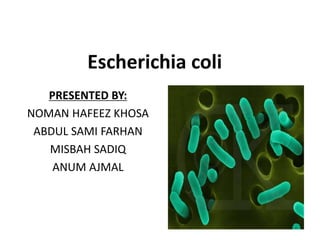
Escherichia coli
2
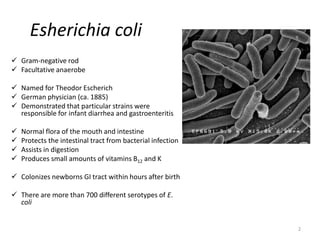
Esherichia coli
 Gram-negative rod
 Facultative anaerobe
 Named for Theodor Escherich
 German physician (ca. 1885)
 Demonstrated that particular strains were
responsible for infant diarrhea and gastroenteritis
 Normal flora of the mouth and intestine
 Protects the intestinal tract from bacterial infection
 Assists in digestion
 Produces small amounts of vitamins B12 and K
 Colonizes newborns GI tract within hours after birth
 There are more than 700 different serotypes of E.
coli
Morphology
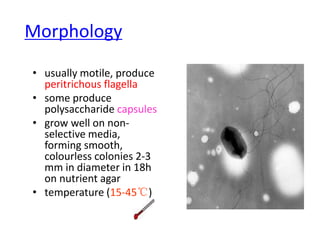
• usually motile, produce
peritrichous flagella
• some produce
polysaccharide capsules
• grow well on non-
selective media,
forming smooth,
colourless colonies 2-3
mm in diameter in 18h
on nutrient agar
• temperature (15-45℃)
4
Many strains
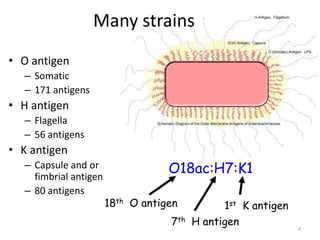
• O antigen
– Somatic
– 171 antigens
• H antigen
– Flagella
– 56 antigens
• K antigen
– Capsule and or
fimbrial antigen
– 80 antigens
O18ac:H7:K1
18th O antigen 1st K antigen
7th H antigen
Diseases caused by E. coli
• E. coli is responsible for three types of
infections in humans:
urinary tract infections (UTI),
neonatal meningitis,
intestinal diseases (gastroenteritis).
6
Neonatal Meningitis E. coli NMEC
• Meningitis in an infection of the fluid and membranes that cover the brain and spinal cord
– Bacteria
– Viruses
– Fungi
• E. coli incites between 1/4 and 1/3 of meningitis cases in newborns
– Less than 2% of cases of meningitis at all other ages
• Approximately 1 out of 5 newborns with E. coli meningitis dies
– Survivors frequently sustain permanent brain damage
• The majority of cases occur in premature babies
• K-1
– 80% of NMEC E. coli strains produce K-1 capsular antigens
– K1 capsular polysaccharide
– O18ac:H7:K1
– Inhibits phagocytosis
• Siderophore production
– Sequesters Fe
• Endotoxin
7
Enteric / diarrheal diseases
E. coli can adhere to the mucosa of the large
intestine
8
• Transmitted via food
– Ground beef
– Raw milk
– Lamb meat
– Venison jerky
– Salami and other fermented dried meat products
– Lettuce, spinach, alfalfa sprouts
– Unpasteurized apple cider
• Transmitted via water
– Drinking and swimming in unchlorinated water
• Direct person to person contact
– Diaper changing
– Improper sanitation
– Day care & chronic adult care facilities
9
Identification
• MacConkey agar (SMAC)
– Does not ferment sorbitol rapidly
– Forms colorless colonies on sorbitol containing
MacConkey agar
• Serology
– Colorless colonies on SMAC are screened for the
0157 antigen
Prevention in Humans
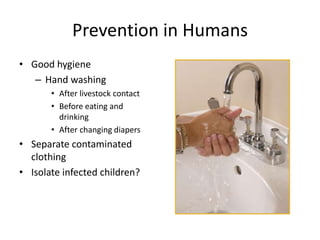
• Good hygiene
– Hand washing
• After livestock contact
• Before eating and
drinking
• After changing diapers
• Separate contaminated
clothing
• Isolate infected children?
Prevention in Humans
• Don’t cross-contaminate
– Wash hands, counters, cutting boards, utensils
after contact with raw meat
• Thoroughly cook meats
• Avoid unpasteurized products
• Wash fruits/vegetables before eating
• Keep livestock away from private water
supplies
Center for Food Security and Public
Health, Iowa State University, 2012
Treatment
• treatment is based on
symptomatology.
• fluid replacement is the
primary treatmen
• Antibiotics are generally
not used except in
severe disease or
disease that has
progressed to a
systemic stage
(e.g.hemolytic-uremia
syndrome).

E coli

  • 1.
    PRESENTED BY: NOMAN HAFEEZKHOSA ABDUL SAMI FARHAN MISBAH SADIQ ANUM AJMAL Escherichia coli
  • 2.
    2 Esherichia coli  Gram-negativerod  Facultative anaerobe  Named for Theodor Escherich  German physician (ca. 1885)  Demonstrated that particular strains were responsible for infant diarrhea and gastroenteritis  Normal flora of the mouth and intestine  Protects the intestinal tract from bacterial infection  Assists in digestion  Produces small amounts of vitamins B12 and K  Colonizes newborns GI tract within hours after birth  There are more than 700 different serotypes of E. coli
  • 3.
    Morphology • usually motile,produce peritrichous flagella • some produce polysaccharide capsules • grow well on non- selective media, forming smooth, colourless colonies 2-3 mm in diameter in 18h on nutrient agar • temperature (15-45℃)
  • 4.
    4 Many strains • Oantigen – Somatic – 171 antigens • H antigen – Flagella – 56 antigens • K antigen – Capsule and or fimbrial antigen – 80 antigens O18ac:H7:K1 18th O antigen 1st K antigen 7th H antigen
  • 5.
    Diseases caused byE. coli • E. coli is responsible for three types of infections in humans: urinary tract infections (UTI), neonatal meningitis, intestinal diseases (gastroenteritis).
  • 6.
    6 Neonatal Meningitis E.coli NMEC • Meningitis in an infection of the fluid and membranes that cover the brain and spinal cord – Bacteria – Viruses – Fungi • E. coli incites between 1/4 and 1/3 of meningitis cases in newborns – Less than 2% of cases of meningitis at all other ages • Approximately 1 out of 5 newborns with E. coli meningitis dies – Survivors frequently sustain permanent brain damage • The majority of cases occur in premature babies • K-1 – 80% of NMEC E. coli strains produce K-1 capsular antigens – K1 capsular polysaccharide – O18ac:H7:K1 – Inhibits phagocytosis • Siderophore production – Sequesters Fe • Endotoxin
  • 7.
    7 Enteric / diarrhealdiseases E. coli can adhere to the mucosa of the large intestine
  • 8.
    8 • Transmitted viafood – Ground beef – Raw milk – Lamb meat – Venison jerky – Salami and other fermented dried meat products – Lettuce, spinach, alfalfa sprouts – Unpasteurized apple cider • Transmitted via water – Drinking and swimming in unchlorinated water • Direct person to person contact – Diaper changing – Improper sanitation – Day care & chronic adult care facilities
  • 9.
    9 Identification • MacConkey agar(SMAC) – Does not ferment sorbitol rapidly – Forms colorless colonies on sorbitol containing MacConkey agar • Serology – Colorless colonies on SMAC are screened for the 0157 antigen
  • 10.
    Prevention in Humans •Good hygiene – Hand washing • After livestock contact • Before eating and drinking • After changing diapers • Separate contaminated clothing • Isolate infected children?
  • 11.
    Prevention in Humans •Don’t cross-contaminate – Wash hands, counters, cutting boards, utensils after contact with raw meat • Thoroughly cook meats • Avoid unpasteurized products • Wash fruits/vegetables before eating • Keep livestock away from private water supplies Center for Food Security and Public Health, Iowa State University, 2012
  • 12.
    Treatment • treatment isbased on symptomatology. • fluid replacement is the primary treatmen • Antibiotics are generally not used except in severe disease or disease that has progressed to a systemic stage (e.g.hemolytic-uremia syndrome).

Editor's Notes

  • #11 Frequent hand washing, especially before eating or preparing food, and good hygiene are important in preventing transmission from animals and their environment. Hand washing facilities should be available in petting zoos and other areas where the public may contact livestock, and eating and drinking should be discouraged at these sites. Thorough hand washing is especially important after changing diapers, after using the toilet, and before eating or preparing food. To protect children and other household members, people who work with animals should keep their work clothing, including shoes, away from the main living areas and launder these items separately. Bed linens, towels and soiled clothing from patients with hemorrhagic colitis should be washed separately, and toilet seats and flush handles should be cleaned appropriately. In some areas, regulations may prohibit infected children from attending daycare or school until they are no longer shedding organisms. Some authors suggest that isolating infected children from their young siblings or other young household members can significantly decrease the risk of secondary spread. [Photo: Hand washing. Source: Centers for Disease Control and Prevention]
  • #12 To prevent cross-contamination during food preparation, consumers should wash their hands, counters, cutting boards, and utensils thoroughly after they have been in contact with raw meat. Meat should be cooked thoroughly to kill E. coli. Unpasteurized milk or other dairy products and unpasteurized juices should be avoided. Water that may be contaminated should not be used to irrigate vegetable crops, and untreated manure/ effluents should not be used on fruits or vegetables that will be eaten raw. Post-harvest measures include thorough washing of vegetables under running water to reduce bacterial numbers. Vegetables can also be disinfected with a dilute chlorine solution. It is safest to wash vegetables immediately before use; under some environmental conditions, populations of bacteria can build up again after a few days. EHEC carried internally in plant tissues are difficult to destroy except by irradiation or cooking. Contamination of public water supplies is prevented by standard water treatment procedures. Livestock-should be kept away from private water supplies. Microbiological testing can also be considered. To the extent possible, people should avoid swallowing water when swimming or playing in lakes, ponds and streams.