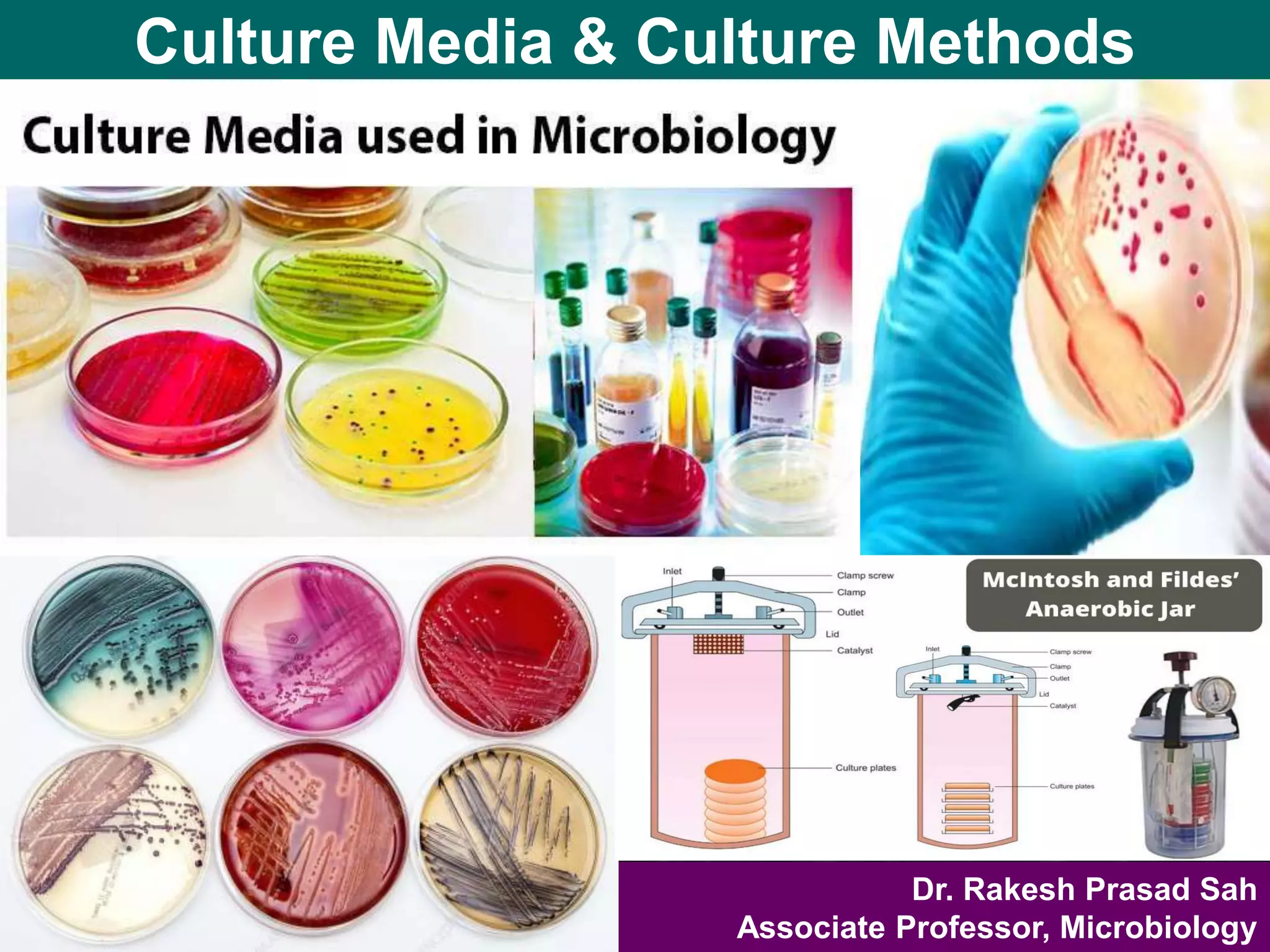

Culture Media & Culture Methods
Dr. Rakesh Prasad Sah
Associate Professor, Microbiology
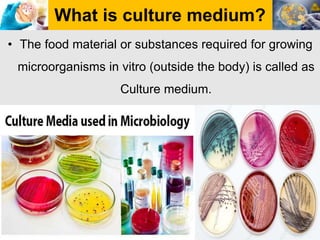
What is culture medium?
• The food material or substances required for growing
microorganisms in vitro (outside the body) is called as
Culture medium.
Uses of culture medium
• Important to grow mos.  outside the body  for
following purposes:-
– To Identify the cause of infection from clinical samples
 so proper treatment can be given.
– To study characteristics or properties of m.os.
– To prepare biological products like
• Vaccines
• Toxoides
• Antigens…….etc.
Composition of culture medium
• Water
• Energy source
• Carbon source
• Nitrogen source
• Mineral salts
• Special growth factors
Types of culture media
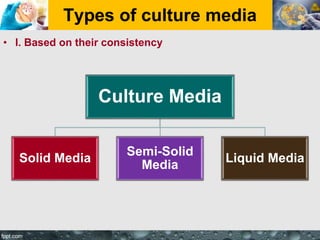
• I. Based on their consistency
Culture Media
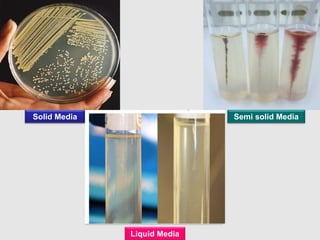
Solid Media
Semi-Solid
Media
Liquid Media
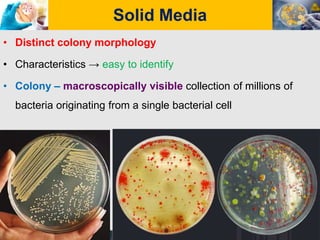
Solid Media
• Distinct colony morphology
• Characteristics → easy to identify
• Colony – macroscopically visible collection of millions of
bacteria originating from a single bacterial cell
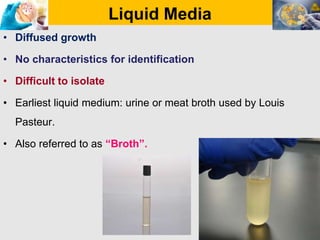
Liquid Media
• Diffused growth
• No characteristics for identification
• Difficult to isolate
• Earliest liquid medium: urine or meat broth used by Louis
Pasteur.
• Also referred to as “Broth”.
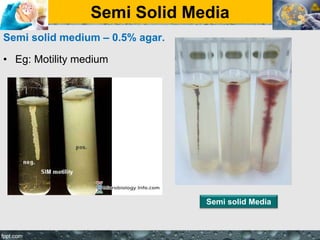
Semi solid medium – 0.5% agar.
• Eg: Motility medium
Semi Solid Media
Semi solid Media
Solid Media
Liquid Media
Semi solid Media
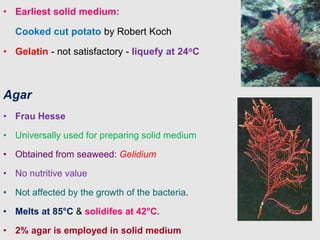
• Earliest solid medium:
Cooked cut potato by Robert Koch
• Gelatin - not satisfactory - liquefy at 24oC
Agar
• Frau Hesse
• Universally used for preparing solid medium
• Obtained from seaweed: Gelidium
• No nutritive value
• Not affected by the growth of the bacteria.
• Melts at 85°C & solidifes at 42°C.
• 2% agar is employed in solid medium
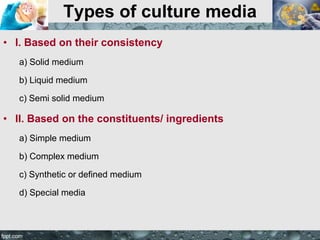
Types of culture media
• I. Based on their consistency
a) Solid medium
b) Liquid medium
c) Semi solid medium
• II. Based on the constituents/ ingredients
a) Simple medium
b) Complex medium
c) Synthetic or defined medium
d) Special media
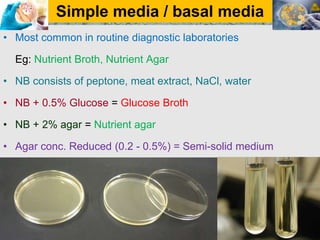
Simple media / basal media
• Most common in routine diagnostic laboratories
Eg: Nutrient Broth, Nutrient Agar
• NB consists of peptone, meat extract, NaCl, water
• NB + 0.5% Glucose = Glucose Broth
• NB + 2% agar = Nutrient agar
• Agar conc. Reduced (0.2 - 0.5%) = Semi-solid medium
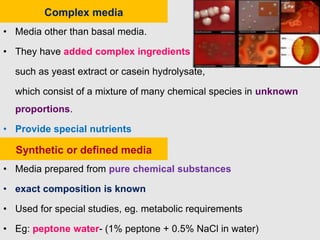
• Media other than basal media.
• They have added complex ingredients
such as yeast extract or casein hydrolysate,
which consist of a mixture of many chemical species in unknown
proportions.
• Provide special nutrients
• Media prepared from pure chemical substances
• exact composition is known
• Used for special studies, eg. metabolic requirements
• Eg: peptone water- (1% peptone + 0.5% NaCl in water)
Complex media
Synthetic or defined media
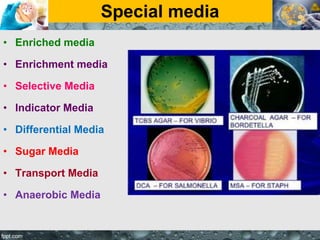
Special media
• Enriched media
• Enrichment media
• Selective Media
• Indicator Media
• Differential Media
• Sugar Media
• Transport Media
• Anaerobic Media
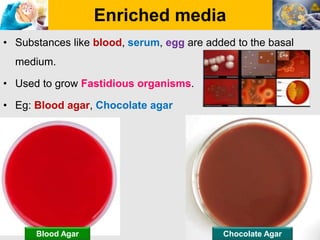
Enriched media
• Substances like blood, serum, egg are added to the basal
medium.
• Used to grow Fastidious organisms.
• Eg: Blood agar, Chocolate agar
Chocolate Agar
Blood Agar
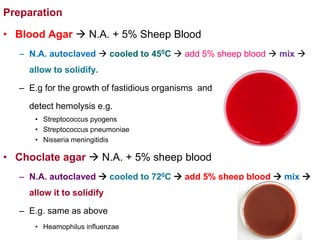
Preparation
• Blood Agar  N.A. + 5% Sheep Blood
– N.A. autoclaved  cooled to 450C  add 5% sheep blood  mix 
allow to solidify.
– E.g for the growth of fastidious organisms and
detect hemolysis e.g.
• Streptococcus pyogens
• Streptococcus pneumoniae
• Nisseria meningitidis
• Choclate agar  N.A. + 5% sheep blood
– N.A. autoclaved  cooled to 720C  add 5% sheep blood  mix 
allow it to solidify
– E.g. same as above
• Heamophilus influenzae
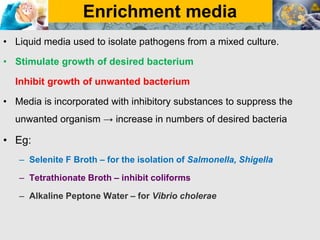
Enrichment media
• Liquid media used to isolate pathogens from a mixed culture.
• Stimulate growth of desired bacterium
Inhibit growth of unwanted bacterium
• Media is incorporated with inhibitory substances to suppress the
unwanted organism → increase in numbers of desired bacteria
• Eg:
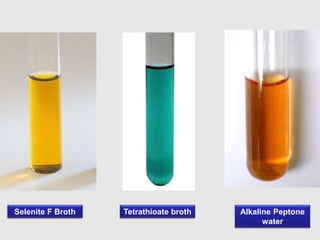
– Selenite F Broth – for the isolation of Salmonella, Shigella
– Tetrathionate Broth – inhibit coliforms
– Alkaline Peptone Water – for Vibrio cholerae
Selenite F Broth Tetrathioate broth Alkaline Peptone
water
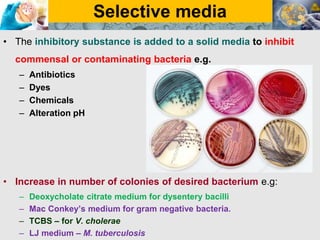
Selective media
• The inhibitory substance is added to a solid media to inhibit
commensal or contaminating bacteria e.g.
– Antibiotics
– Dyes
– Chemicals
– Alteration pH
• Increase in number of colonies of desired bacterium e.g:
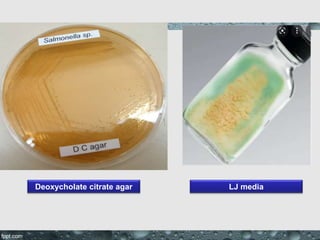
– Deoxycholate citrate medium for dysentery bacilli
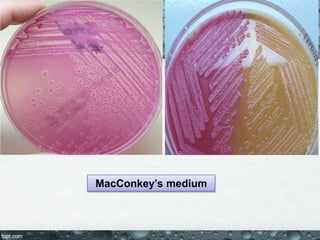
– Mac Conkey’s medium for gram negative bacteria.
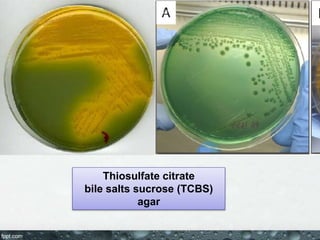
– TCBS – for V. cholerae
– LJ medium – M. tuberculosis
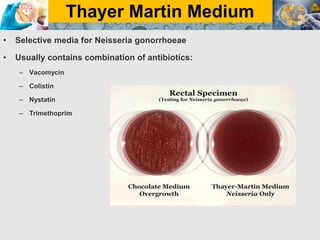
Thayer Martin Medium
• Selective media for Neisseria gonorrhoeae
• Usually contains combination of antibiotics:
– Vacomycin
– Colistin
– Nystatin
– Trimethoprim
MacConkey’s medium
Thiosulfate citrate
bile salts sucrose (TCBS)
agar
Deoxycholate citrate agar LJ media
Indicator media
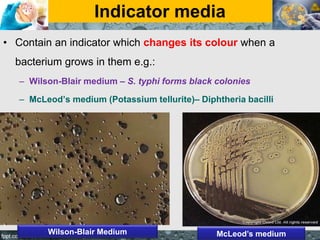
• Contain an indicator which changes its colour when a
bacterium grows in them e.g.:
– Wilson-Blair medium – S. typhi forms black colonies
– McLeod’s medium (Potassium tellurite)– Diphtheria bacilli
Wilson-Blair Medium McLeod’s medium
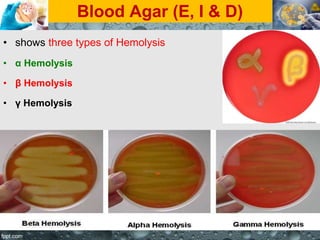
Blood Agar (E, I & D)
• shows three types of Hemolysis
• α Hemolysis
• β Hemolysis
• γ Hemolysis
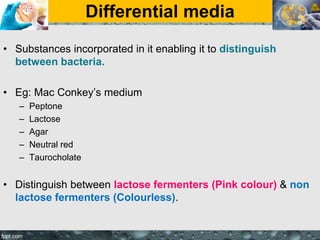
Differential media
• Substances incorporated in it enabling it to distinguish
between bacteria.
• Eg: Mac Conkey’s medium
– Peptone
– Lactose
– Agar
– Neutral red
– Taurocholate
• Distinguish between lactose fermenters (Pink colour) & non
lactose fermenters (Colourless).
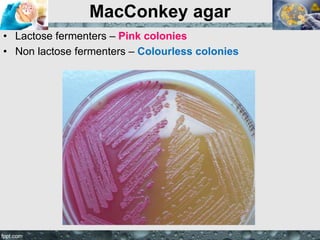
MacConkey agar
• Lactose fermenters – Pink colonies
• Non lactose fermenters – Colourless colonies
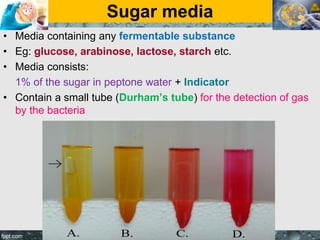
Sugar media
• Media containing any fermentable substance
• Eg: glucose, arabinose, lactose, starch etc.
• Media consists:
1% of the sugar in peptone water + Indicator
• Contain a small tube (Durham’s tube) for the detection of gas
by the bacteria
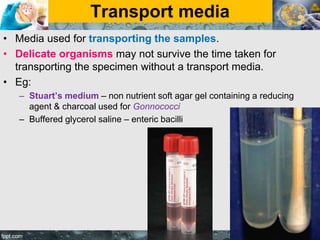
Transport media
• Media used for transporting the samples.
• Delicate organisms may not survive the time taken for
transporting the specimen without a transport media.
• Eg:
– Stuart’s medium – non nutrient soft agar gel containing a reducing
agent & charcoal used for Gonnococci
– Buffered glycerol saline – enteric bacilli
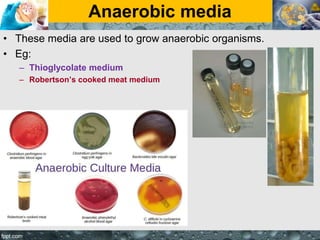
Anaerobic media
• These media are used to grow anaerobic organisms.
• Eg:
– Thioglycolate medium
– Robertson’s cooked meat medium
CULTURE METHODS
• Culture methods employed depend on the purpose for which
they are intended.
Purposes:
– To isolate bacteria in pure cultures.
– To demonstrate their properties.
– To obtain sufficient growth for the preparation of antigens and for
other tests.
– To determine sensitivity to antibiotics.
– To estimate viable counts.
– Maintain stock cultures.
Culture methods
• Include
– Streak culture
– Lawn culture
– Stroke culture
– Stab culture
– Pour plate method
– Liquid culture
– Anaerobic culture methods
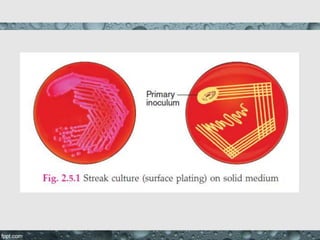
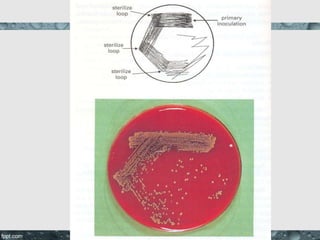
STREAK CULTURE
• Used for the isolation of bacteria in pure culture from clinical
specimens.
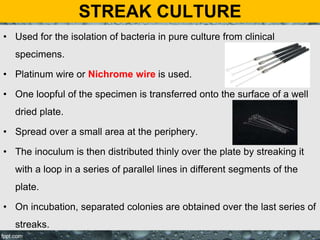
• Platinum wire or Nichrome wire is used.
• One loopful of the specimen is transferred onto the surface of a well
dried plate.
• Spread over a small area at the periphery.
• The inoculum is then distributed thinly over the plate by streaking it
with a loop in a series of parallel lines in different segments of the
plate.
• On incubation, separated colonies are obtained over the last series of
streaks.
LAWN CULTURE
• Provides a uniform surface growth of the bacterium.
• Uses
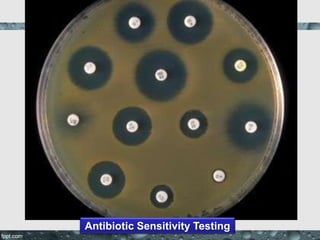
– Antibiotic sensitivity testing.
– In the preparation of bacterial antigens and vaccines.
– Lawn cultures are prepared by flooding the surface of the plate
with a liquid suspension of the bacterium.
Antibiotic Sensitivity Testing
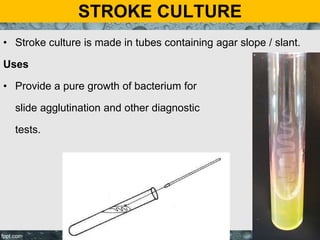
STROKE CULTURE
• Stroke culture is made in tubes containing agar slope / slant.
Uses
• Provide a pure growth of bacterium for
slide agglutination and other diagnostic
tests.
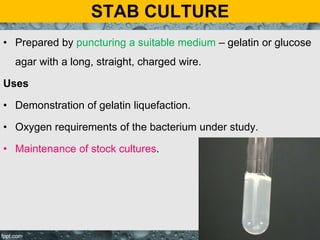
STAB CULTURE
• Prepared by puncturing a suitable medium – gelatin or glucose
agar with a long, straight, charged wire.
Uses
• Demonstration of gelatin liquefaction.
• Oxygen requirements of the bacterium under study.
• Maintenance of stock cultures.
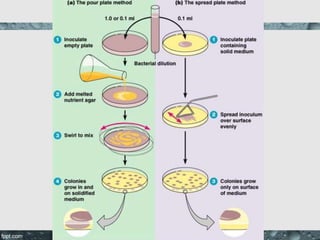
POUR PLATE CULTURE
• Agar medium is melted (15 ml) and cooled to 45oC.
• 1 ml of the inoculum is added to the molten agar.
• Mix well and pour to a sterile petri-dish.
• Allow it to set.
• Incubate at 37oC, colonies will be distributed throughout the
depth of the medium.
• Uses
– Gives an estimate of the viable bacterial count in a suspension.
– For the quantitative urine cultures.
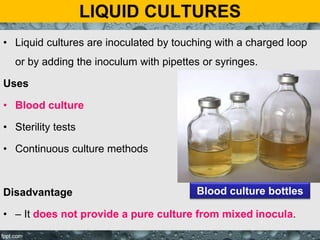
LIQUID CULTURES
• Liquid cultures are inoculated by touching with a charged loop
or by adding the inoculum with pipettes or syringes.
Uses
• Blood culture
• Sterility tests
• Continuous culture methods
Disadvantage
• – It does not provide a pure culture from mixed inocula.
Blood culture bottles
ANAEROBIC CULTURE METHODS
• Anaerobic bacteria differ in their requirement and sensitivity
to oxygen.
• Cl. tetani is a strict anaerobe.
• Methods:
– Production of vacuum
– Displacement of oxygen with other gases
– Chemical method
– Biological method
– Reduction of medium
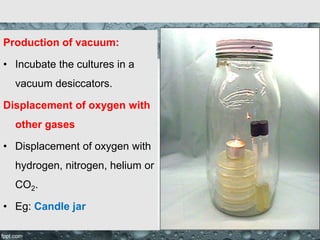
Production of vacuum:
• Incubate the cultures in a
vacuum desiccators.
Displacement of oxygen with
other gases
• Displacement of oxygen with
hydrogen, nitrogen, helium or
CO2.
• Eg: Candle jar
Chemical method
• Alkaline pyrogallol absorbs oxygen.
• Chromium and Sulphuric acid.
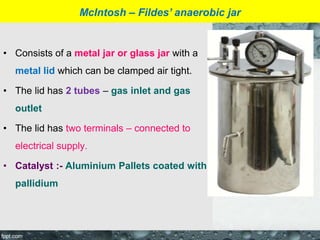
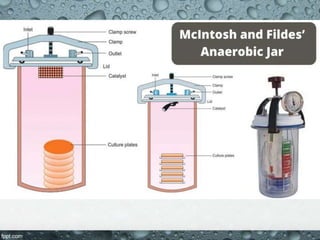
• Consists of a metal jar or glass jar with a
metal lid which can be clamped air tight.
• The lid has 2 tubes – gas inlet and gas
outlet
• The lid has two terminals – connected to
electrical supply.
• Catalyst :- Aluminium Pallets coated with
pallidium
McIntosh – Fildes’ anaerobic jar
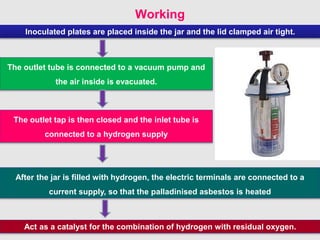
Working
Inoculated plates are placed inside the jar and the lid clamped air tight.
The outlet tube is connected to a vacuum pump and
the air inside is evacuated.
The outlet tap is then closed and the inlet tube is
connected to a hydrogen supply
After the jar is filled with hydrogen, the electric terminals are connected to a
current supply, so that the palladinised asbestos is heated
Act as a catalyst for the combination of hydrogen with residual oxygen.
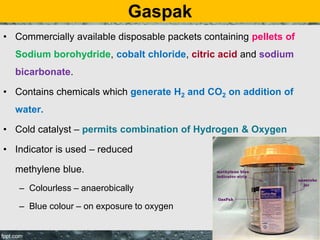
Gaspak
• Commercially available disposable packets containing pellets of
Sodium borohydride, cobalt chloride, citric acid and sodium
bicarbonate.
• Contains chemicals which generate H2 and CO2 on addition of
water.
• Cold catalyst – permits combination of Hydrogen & Oxygen
• Indicator is used – reduced
methylene blue.
– Colourless – anaerobically
– Blue colour – on exposure to oxygen
Reduction Agents
• Oxygen in culture media  reduced by various agents e.g.
thioglycollate, cooked meat pieces, cysteine and ascorbic acid.
• By using reducing agents – 1% Thioglycolate.
• Robertson’s cooked meat (RCM) medium.
Culture Media and Methods.ppt

Culture Media and Methods.ppt

  • 1.
    Culture Media &Culture Methods Dr. Rakesh Prasad Sah Associate Professor, Microbiology
  • 2.
    What is culturemedium? • The food material or substances required for growing microorganisms in vitro (outside the body) is called as Culture medium.
  • 3.
    Uses of culturemedium • Important to grow mos.  outside the body  for following purposes:- – To Identify the cause of infection from clinical samples  so proper treatment can be given. – To study characteristics or properties of m.os. – To prepare biological products like • Vaccines • Toxoides • Antigens…….etc.
  • 4.
    Composition of culturemedium • Water • Energy source • Carbon source • Nitrogen source • Mineral salts • Special growth factors
  • 5.
    Types of culturemedia • I. Based on their consistency Culture Media Solid Media Semi-Solid Media Liquid Media
  • 6.
    Solid Media • Distinctcolony morphology • Characteristics → easy to identify • Colony – macroscopically visible collection of millions of bacteria originating from a single bacterial cell
  • 7.
    Liquid Media • Diffusedgrowth • No characteristics for identification • Difficult to isolate • Earliest liquid medium: urine or meat broth used by Louis Pasteur. • Also referred to as “Broth”.
  • 8.
    Semi solid medium– 0.5% agar. • Eg: Motility medium Semi Solid Media Semi solid Media
  • 9.
  • 10.
    • Earliest solidmedium: Cooked cut potato by Robert Koch • Gelatin - not satisfactory - liquefy at 24oC Agar • Frau Hesse • Universally used for preparing solid medium • Obtained from seaweed: Gelidium • No nutritive value • Not affected by the growth of the bacteria. • Melts at 85°C & solidifes at 42°C. • 2% agar is employed in solid medium
  • 11.
    Types of culturemedia • I. Based on their consistency a) Solid medium b) Liquid medium c) Semi solid medium • II. Based on the constituents/ ingredients a) Simple medium b) Complex medium c) Synthetic or defined medium d) Special media
  • 12.
    Simple media /basal media • Most common in routine diagnostic laboratories Eg: Nutrient Broth, Nutrient Agar • NB consists of peptone, meat extract, NaCl, water • NB + 0.5% Glucose = Glucose Broth • NB + 2% agar = Nutrient agar • Agar conc. Reduced (0.2 - 0.5%) = Semi-solid medium
  • 13.
    • Media otherthan basal media. • They have added complex ingredients such as yeast extract or casein hydrolysate, which consist of a mixture of many chemical species in unknown proportions. • Provide special nutrients • Media prepared from pure chemical substances • exact composition is known • Used for special studies, eg. metabolic requirements • Eg: peptone water- (1% peptone + 0.5% NaCl in water) Complex media Synthetic or defined media
  • 14.
    Special media • Enrichedmedia • Enrichment media • Selective Media • Indicator Media • Differential Media • Sugar Media • Transport Media • Anaerobic Media
  • 15.
    Enriched media • Substanceslike blood, serum, egg are added to the basal medium. • Used to grow Fastidious organisms. • Eg: Blood agar, Chocolate agar Chocolate Agar Blood Agar
  • 16.
    Preparation • Blood Agar N.A. + 5% Sheep Blood – N.A. autoclaved  cooled to 450C  add 5% sheep blood  mix  allow to solidify. – E.g for the growth of fastidious organisms and detect hemolysis e.g. • Streptococcus pyogens • Streptococcus pneumoniae • Nisseria meningitidis • Choclate agar  N.A. + 5% sheep blood – N.A. autoclaved  cooled to 720C  add 5% sheep blood  mix  allow it to solidify – E.g. same as above • Heamophilus influenzae
  • 17.
    Enrichment media • Liquidmedia used to isolate pathogens from a mixed culture. • Stimulate growth of desired bacterium Inhibit growth of unwanted bacterium • Media is incorporated with inhibitory substances to suppress the unwanted organism → increase in numbers of desired bacteria • Eg: – Selenite F Broth – for the isolation of Salmonella, Shigella – Tetrathionate Broth – inhibit coliforms – Alkaline Peptone Water – for Vibrio cholerae
  • 18.
    Selenite F BrothTetrathioate broth Alkaline Peptone water
  • 19.
    Selective media • Theinhibitory substance is added to a solid media to inhibit commensal or contaminating bacteria e.g. – Antibiotics – Dyes – Chemicals – Alteration pH • Increase in number of colonies of desired bacterium e.g: – Deoxycholate citrate medium for dysentery bacilli – Mac Conkey’s medium for gram negative bacteria. – TCBS – for V. cholerae – LJ medium – M. tuberculosis
  • 20.
    Thayer Martin Medium •Selective media for Neisseria gonorrhoeae • Usually contains combination of antibiotics: – Vacomycin – Colistin – Nystatin – Trimethoprim
  • 21.
  • 22.
    Thiosulfate citrate bile saltssucrose (TCBS) agar
  • 23.
  • 24.
    Indicator media • Containan indicator which changes its colour when a bacterium grows in them e.g.: – Wilson-Blair medium – S. typhi forms black colonies – McLeod’s medium (Potassium tellurite)– Diphtheria bacilli Wilson-Blair Medium McLeod’s medium
  • 26.
    Blood Agar (E,I & D) • shows three types of Hemolysis • α Hemolysis • β Hemolysis • γ Hemolysis
  • 27.
    Differential media • Substancesincorporated in it enabling it to distinguish between bacteria. • Eg: Mac Conkey’s medium – Peptone – Lactose – Agar – Neutral red – Taurocholate • Distinguish between lactose fermenters (Pink colour) & non lactose fermenters (Colourless).
  • 28.
    MacConkey agar • Lactosefermenters – Pink colonies • Non lactose fermenters – Colourless colonies
  • 29.
    Sugar media • Mediacontaining any fermentable substance • Eg: glucose, arabinose, lactose, starch etc. • Media consists: 1% of the sugar in peptone water + Indicator • Contain a small tube (Durham’s tube) for the detection of gas by the bacteria
  • 30.
    Transport media • Mediaused for transporting the samples. • Delicate organisms may not survive the time taken for transporting the specimen without a transport media. • Eg: – Stuart’s medium – non nutrient soft agar gel containing a reducing agent & charcoal used for Gonnococci – Buffered glycerol saline – enteric bacilli
  • 31.
    Anaerobic media • Thesemedia are used to grow anaerobic organisms. • Eg: – Thioglycolate medium – Robertson’s cooked meat medium
  • 33.
    CULTURE METHODS • Culturemethods employed depend on the purpose for which they are intended. Purposes: – To isolate bacteria in pure cultures. – To demonstrate their properties. – To obtain sufficient growth for the preparation of antigens and for other tests. – To determine sensitivity to antibiotics. – To estimate viable counts. – Maintain stock cultures.
  • 34.
    Culture methods • Include –Streak culture – Lawn culture – Stroke culture – Stab culture – Pour plate method – Liquid culture – Anaerobic culture methods
  • 35.
    STREAK CULTURE • Usedfor the isolation of bacteria in pure culture from clinical specimens. • Platinum wire or Nichrome wire is used. • One loopful of the specimen is transferred onto the surface of a well dried plate. • Spread over a small area at the periphery. • The inoculum is then distributed thinly over the plate by streaking it with a loop in a series of parallel lines in different segments of the plate. • On incubation, separated colonies are obtained over the last series of streaks.
  • 38.
    LAWN CULTURE • Providesa uniform surface growth of the bacterium. • Uses – Antibiotic sensitivity testing. – In the preparation of bacterial antigens and vaccines. – Lawn cultures are prepared by flooding the surface of the plate with a liquid suspension of the bacterium.
  • 39.
  • 40.
    STROKE CULTURE • Strokeculture is made in tubes containing agar slope / slant. Uses • Provide a pure growth of bacterium for slide agglutination and other diagnostic tests.
  • 41.
    STAB CULTURE • Preparedby puncturing a suitable medium – gelatin or glucose agar with a long, straight, charged wire. Uses • Demonstration of gelatin liquefaction. • Oxygen requirements of the bacterium under study. • Maintenance of stock cultures.
  • 42.
    POUR PLATE CULTURE •Agar medium is melted (15 ml) and cooled to 45oC. • 1 ml of the inoculum is added to the molten agar. • Mix well and pour to a sterile petri-dish. • Allow it to set. • Incubate at 37oC, colonies will be distributed throughout the depth of the medium. • Uses – Gives an estimate of the viable bacterial count in a suspension. – For the quantitative urine cultures.
  • 44.
    LIQUID CULTURES • Liquidcultures are inoculated by touching with a charged loop or by adding the inoculum with pipettes or syringes. Uses • Blood culture • Sterility tests • Continuous culture methods Disadvantage • – It does not provide a pure culture from mixed inocula. Blood culture bottles
  • 45.
    ANAEROBIC CULTURE METHODS •Anaerobic bacteria differ in their requirement and sensitivity to oxygen. • Cl. tetani is a strict anaerobe. • Methods: – Production of vacuum – Displacement of oxygen with other gases – Chemical method – Biological method – Reduction of medium
  • 46.
    Production of vacuum: •Incubate the cultures in a vacuum desiccators. Displacement of oxygen with other gases • Displacement of oxygen with hydrogen, nitrogen, helium or CO2. • Eg: Candle jar
  • 47.
    Chemical method • Alkalinepyrogallol absorbs oxygen. • Chromium and Sulphuric acid.
  • 48.
    • Consists ofa metal jar or glass jar with a metal lid which can be clamped air tight. • The lid has 2 tubes – gas inlet and gas outlet • The lid has two terminals – connected to electrical supply. • Catalyst :- Aluminium Pallets coated with pallidium McIntosh – Fildes’ anaerobic jar
  • 50.
    Working Inoculated plates areplaced inside the jar and the lid clamped air tight. The outlet tube is connected to a vacuum pump and the air inside is evacuated. The outlet tap is then closed and the inlet tube is connected to a hydrogen supply After the jar is filled with hydrogen, the electric terminals are connected to a current supply, so that the palladinised asbestos is heated Act as a catalyst for the combination of hydrogen with residual oxygen.
  • 51.
    Gaspak • Commercially availabledisposable packets containing pellets of Sodium borohydride, cobalt chloride, citric acid and sodium bicarbonate. • Contains chemicals which generate H2 and CO2 on addition of water. • Cold catalyst – permits combination of Hydrogen & Oxygen • Indicator is used – reduced methylene blue. – Colourless – anaerobically – Blue colour – on exposure to oxygen
  • 52.
    Reduction Agents • Oxygenin culture media  reduced by various agents e.g. thioglycollate, cooked meat pieces, cysteine and ascorbic acid. • By using reducing agents – 1% Thioglycolate. • Robertson’s cooked meat (RCM) medium.