Done By
B.Saraswathi
I M.Sc Applied Microbiology
Scientific Classification
 Domain: Bacteria
 Phylum: Proteobacteria
 Class: Epsilonproteobacteria
 Order: Campylobacterales
 Family: Helicobacteraceae
 Genus: Helicobacter
 Species: H. pylori
 Binomial name: Helicobacter pylori
Previously called Campylobacter
pylori.
1800s-Spirochetes
Identified in 1982 by Australian
Scientists, Barry Marshal and Robin
Warren in Chronic gastritis and gastric
ulcers.
2005-Nobel Prize in Medicine for the
discovery.
About 50% of worlds population have
this bacteria in the upper IT.
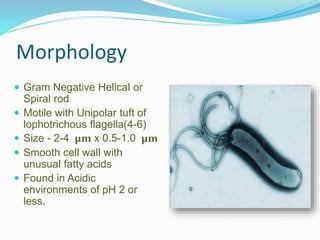
Morphology
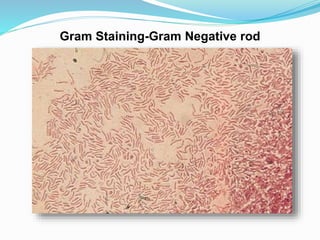
 Gram Negative Helical or
Spiral rod
 Motile with Unipolar tuft of
lophotrichous flagella(4-6)
 Size - 2-4 µm x 0.5-1.0 µm
 Smooth cell wall with
unusual fatty acids
 Found in Acidic
environments of pH 2 or
less.
Gram Staining-Gram Negative rod
 They are micro-aerophilic, require 5-10% CO2 and high
humidity.
 They are fastidious organism.
 Blood agar and chocolate agar after incubation for 2-5
days. Colonies are circular, convex and translucent and
grow bigger than 2 mm in diameter.
 On Egg Yolk Emulsion Agar – give large (~ 3mm) and red
color colony against yellow background.
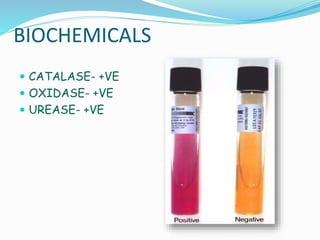
BIOCHEMICALS
 CATALASE- +VE
 OXIDASE- +VE
 UREASE- +VE
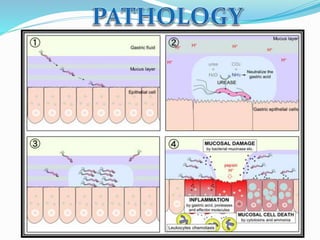
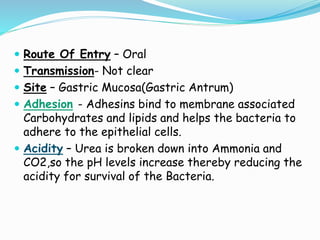
 Route Of Entry – Oral
 Transmission- Not clear
 Site – Gastric Mucosa(Gastric Antrum)
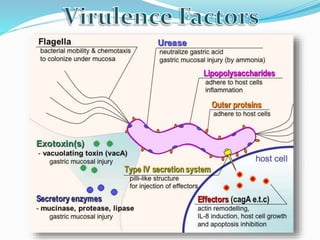
 Adhesion - Adhesins bind to membrane associated
Carbohydrates and lipids and helps the bacteria to
adhere to the epithelial cells.
 Acidity – Urea is broken down into Ammonia and
CO2,so the pH levels increase thereby reducing the
acidity for survival of the Bacteria.
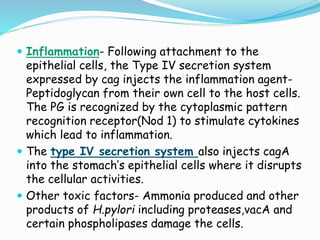
 Inflammation- Following attachment to the
epithelial cells, the Type IV secretion system
expressed by cag injects the inflammation agent-
Peptidoglycan from their own cell to the host cells.
The PG is recognized by the cytoplasmic pattern
recognition receptor(Nod 1) to stimulate cytokines
which lead to inflammation.
 The type IV secretion system also injects cagA
into the stomach’s epithelial cells where it disrupts
the cellular activities.
 Other toxic factors- Ammonia produced and other
products of H.pylori including proteases,vacA and
certain phospholipases damage the cells.
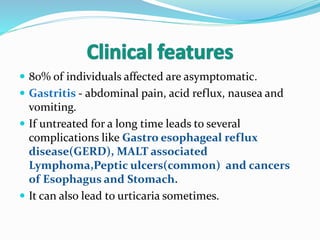
 80% of individuals affected are asymptomatic.
 Gastritis - abdominal pain, acid reflux, nausea and
vomiting.
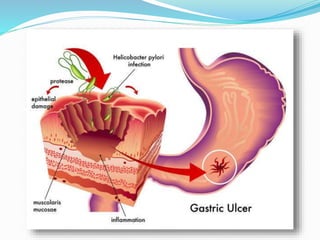
 If untreated for a long time leads to several
complications like Gastro esophageal reflux
disease(GERD), MALT associated
Lymphoma,Peptic ulcers(common) and cancers
of Esophagus and Stomach.
 It can also lead to urticaria sometimes.
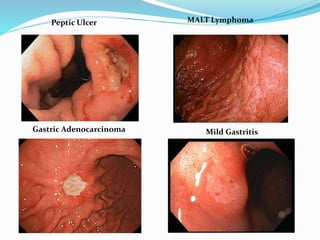
Peptic Ulcer MALT Lymphoma
Gastric Adenocarcinoma Mild Gastritis
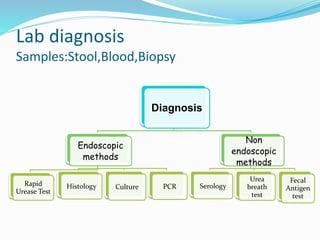
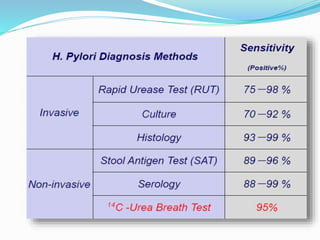
Lab diagnosis
Samples:Stool,Blood,Biopsy
Diagnosis
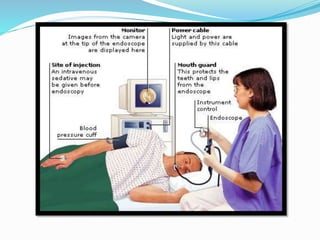
Endoscopic
methods
Rapid
Urease Test
Histology Culture PCR
Non
endoscopic
methods
Serology
Urea
breath
test
Fecal
Antigen
test
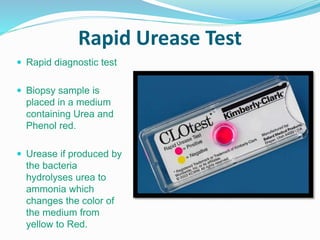
Rapid Urease Test
 Rapid diagnostic test
 Biopsy sample is
placed in a medium
containing Urea and
Phenol red.
 Urease if produced by
the bacteria
hydrolyses urea to
ammonia which
changes the color of
the medium from
yellow to Red.
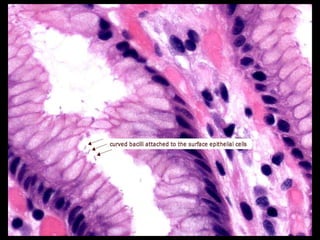
 Hematoxylin Eosin Staining
 Giemsa Stain
 Genta Stain
 Immunohistochemical Stain
 Warthin Starry Silver Stain
Culture
 Egg yolk Emulsion Agar (EYE)
 Skirrows and Dents selective media
 On Modified Columbia urea agar (MCUA) – give
small-middle size rounded and creamy color
colony. Change in the color of the slant MCUA
tube from orange to pink.
 On Marshall’s Brain Heart Infusion medium along
with Vancomycin, Nalidixic acid and Amphotericin
– give discrete dome shaped colonies.
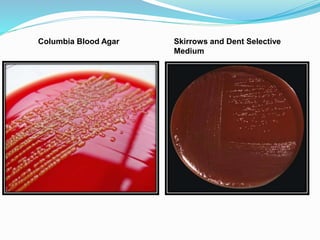
Columbia Blood Agar Skirrows and Dent Selective
Medium
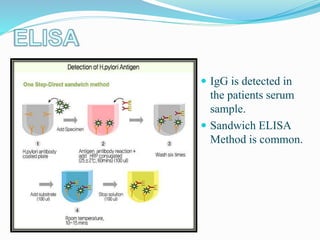
 IgG is detected in
the patients serum
sample.
 Sandwich ELISA
Method is common.
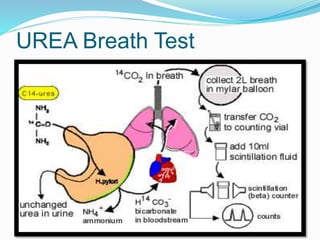
UREA Breath Test
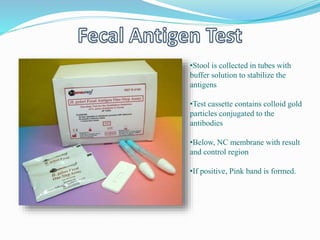
•Stool is collected in tubes with
buffer solution to stabilize the
antigens
•Test cassette contains colloid gold
particles conjugated to the
antibodies
•Below, NC membrane with result
and control region
•If positive, Pink band is formed.
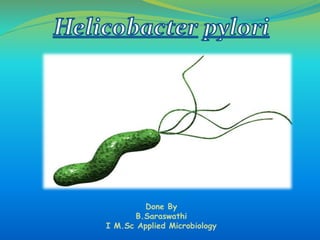
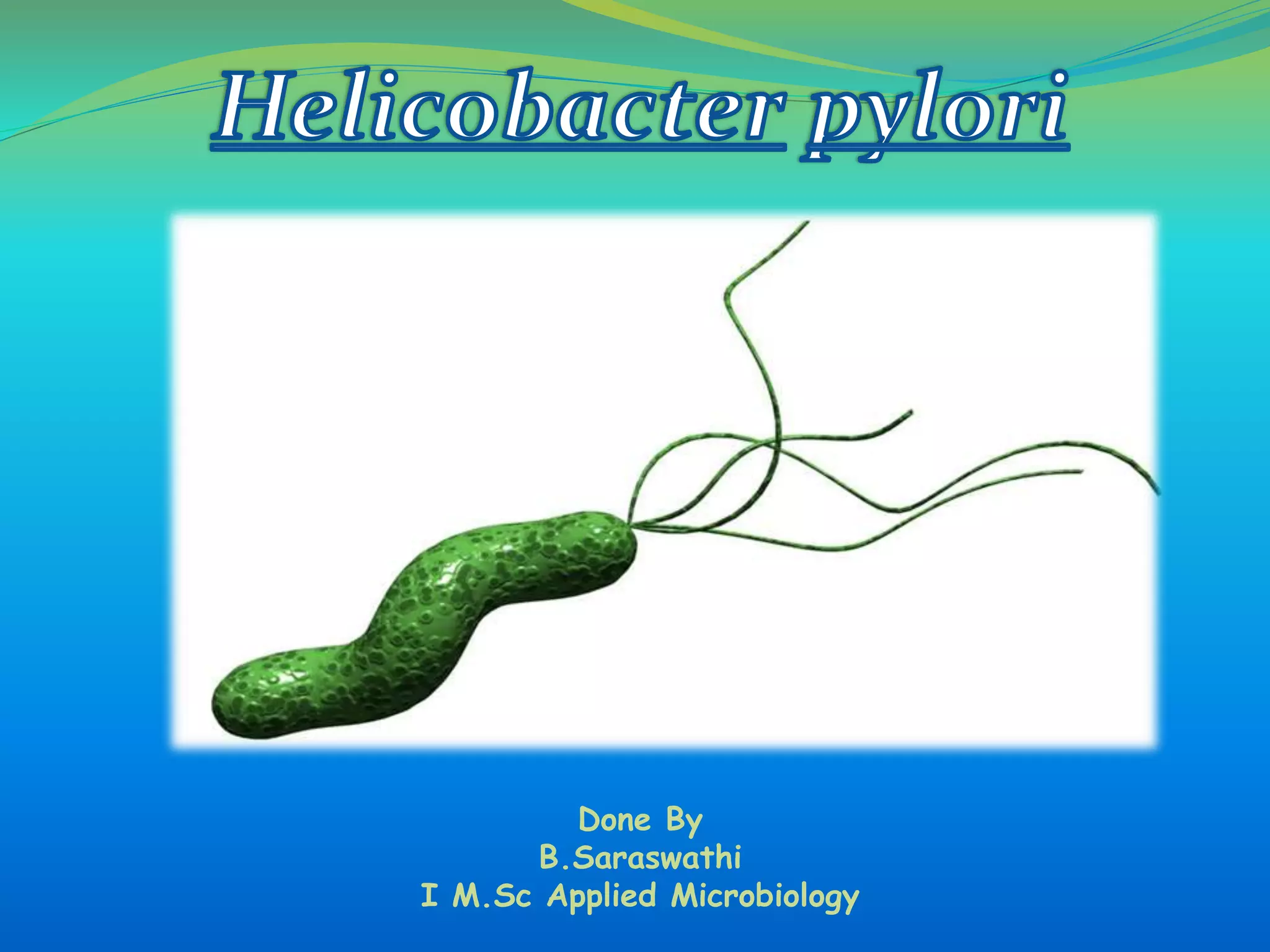
Helicobacter pylori
Helicobacter pylori
Helicobacter pylori

Helicobacter pylori

  • 1.
    Done By B.Saraswathi I M.ScApplied Microbiology
  • 2.
    Scientific Classification  Domain:Bacteria  Phylum: Proteobacteria  Class: Epsilonproteobacteria  Order: Campylobacterales  Family: Helicobacteraceae  Genus: Helicobacter  Species: H. pylori  Binomial name: Helicobacter pylori
  • 3.
    Previously called Campylobacter pylori. 1800s-Spirochetes Identifiedin 1982 by Australian Scientists, Barry Marshal and Robin Warren in Chronic gastritis and gastric ulcers. 2005-Nobel Prize in Medicine for the discovery. About 50% of worlds population have this bacteria in the upper IT.
  • 4.
    Morphology  Gram NegativeHelical or Spiral rod  Motile with Unipolar tuft of lophotrichous flagella(4-6)  Size - 2-4 µm x 0.5-1.0 µm  Smooth cell wall with unusual fatty acids  Found in Acidic environments of pH 2 or less.
  • 5.
  • 6.
     They aremicro-aerophilic, require 5-10% CO2 and high humidity.  They are fastidious organism.  Blood agar and chocolate agar after incubation for 2-5 days. Colonies are circular, convex and translucent and grow bigger than 2 mm in diameter.  On Egg Yolk Emulsion Agar – give large (~ 3mm) and red color colony against yellow background.
  • 7.
    BIOCHEMICALS  CATALASE- +VE OXIDASE- +VE  UREASE- +VE
  • 10.
     Route OfEntry – Oral  Transmission- Not clear  Site – Gastric Mucosa(Gastric Antrum)  Adhesion - Adhesins bind to membrane associated Carbohydrates and lipids and helps the bacteria to adhere to the epithelial cells.  Acidity – Urea is broken down into Ammonia and CO2,so the pH levels increase thereby reducing the acidity for survival of the Bacteria.
  • 11.
     Inflammation- Followingattachment to the epithelial cells, the Type IV secretion system expressed by cag injects the inflammation agent- Peptidoglycan from their own cell to the host cells. The PG is recognized by the cytoplasmic pattern recognition receptor(Nod 1) to stimulate cytokines which lead to inflammation.  The type IV secretion system also injects cagA into the stomach’s epithelial cells where it disrupts the cellular activities.  Other toxic factors- Ammonia produced and other products of H.pylori including proteases,vacA and certain phospholipases damage the cells.
  • 13.
     80% ofindividuals affected are asymptomatic.  Gastritis - abdominal pain, acid reflux, nausea and vomiting.  If untreated for a long time leads to several complications like Gastro esophageal reflux disease(GERD), MALT associated Lymphoma,Peptic ulcers(common) and cancers of Esophagus and Stomach.  It can also lead to urticaria sometimes.
  • 14.
    Peptic Ulcer MALTLymphoma Gastric Adenocarcinoma Mild Gastritis
  • 16.
    Lab diagnosis Samples:Stool,Blood,Biopsy Diagnosis Endoscopic methods Rapid Urease Test HistologyCulture PCR Non endoscopic methods Serology Urea breath test Fecal Antigen test
  • 17.
    Rapid Urease Test Rapid diagnostic test  Biopsy sample is placed in a medium containing Urea and Phenol red.  Urease if produced by the bacteria hydrolyses urea to ammonia which changes the color of the medium from yellow to Red.
  • 18.
     Hematoxylin EosinStaining  Giemsa Stain  Genta Stain  Immunohistochemical Stain  Warthin Starry Silver Stain
  • 20.
    Culture  Egg yolkEmulsion Agar (EYE)  Skirrows and Dents selective media  On Modified Columbia urea agar (MCUA) – give small-middle size rounded and creamy color colony. Change in the color of the slant MCUA tube from orange to pink.  On Marshall’s Brain Heart Infusion medium along with Vancomycin, Nalidixic acid and Amphotericin – give discrete dome shaped colonies.
  • 21.
    Columbia Blood AgarSkirrows and Dent Selective Medium
  • 22.
     IgG isdetected in the patients serum sample.  Sandwich ELISA Method is common.
  • 23.
  • 24.
    •Stool is collectedin tubes with buffer solution to stabilize the antigens •Test cassette contains colloid gold particles conjugated to the antibodies •Below, NC membrane with result and control region •If positive, Pink band is formed.