Vibrio cholerae
T.SATHYA,
II MSC MICROBIOLOGY.
Vibrio cholera
Cholera is a serious bacterial disease that usually
causes severe diarrhea and dehydration. The disease is
typically spread through contaminated water.
Modern sewage and water treatment have effectively
eliminated cholera in most countries. It’s still a problem in
countries like Asia, America and Africa. Mostly in India.
Countries affected by war, poverty, and natural disasters
have the greatest risk for a cholera outbreak.
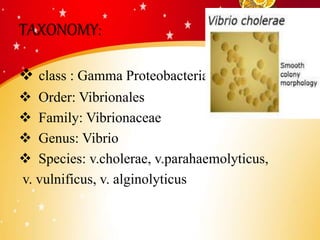
TAXONOMY:
 class : Gamma Proteobacteria
 Order: Vibrionales
 Family: Vibrionaceae
 Genus: Vibrio
 Species: v.cholerae, v.parahaemolyticus,
v. vulnificus, v. alginolyticus
MORPHOLOGY:
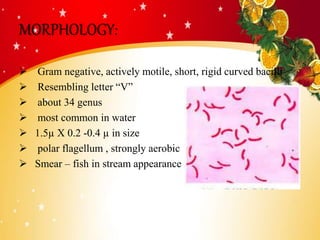
 Gram negative, actively motile, short, rigid curved bacilli
 Resembling letter “V”
 about 34 genus
 most common in water
 1.5µ X 0.2 -0.4 µ in size
 polar flagellum , strongly aerobic
 Smear – fish in stream appearance ( koch)
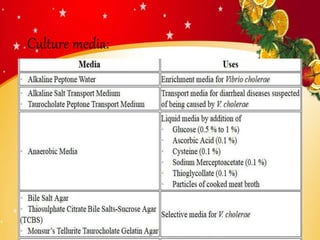
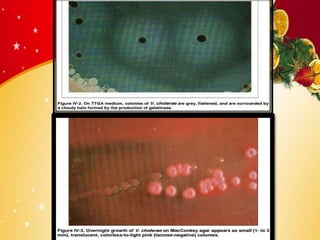
Culture media:
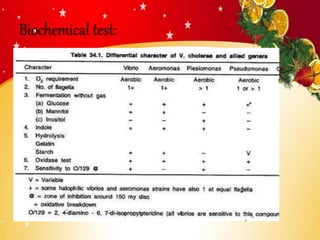
Biochemical test:
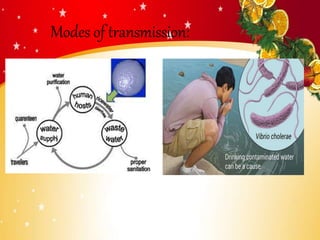
Modes of transmission:
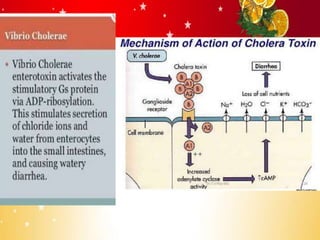
Pathogenesis:
Source: Ingestion of contaminated water, food,
fruits and vegetables etc.,
Incubation periods: 1-5 days
Symptoms: Watery diarrhoea, vomiting, thirst,
dehydration, muscle cramps
Complications: muscular pain, renal failure,
pulmonary edema, cardiac arrhythrnias
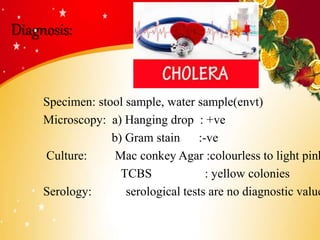
Diagnosis:
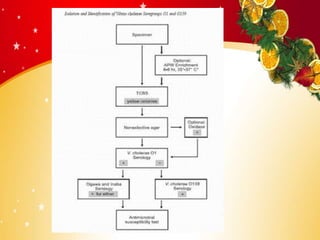
Specimen: stool sample, water sample(envt)
Microscopy: a) Hanging drop : +ve
b) Gram stain :-ve
Culture: Mac conkey Agar :colourless to light pink
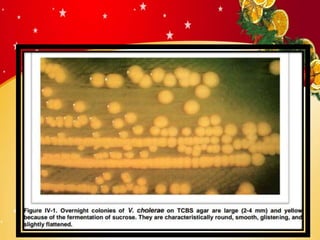
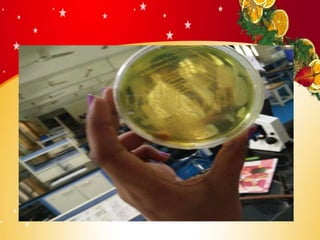
TCBS : yellow colonies
Serology: serological tests are no diagnostic value
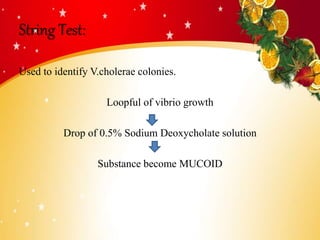
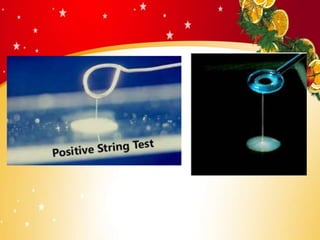
String Test:
Used to identify V.cholerae colonies.
Loopful of vibrio growth
Drop of 0.5% Sodium Deoxycholate solution
Substance become MUCOID
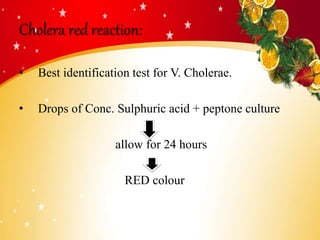
Cholera red reaction:
• Best identification test for V. Cholerae.
• Drops of Conc. Sulphuric acid + peptone culture
allow for 24 hours
RED colour
Treatment:
• Adequate replacement of fluids and electrolytes.
• Oral tetracycline reduces the period of vibrio
excreation.
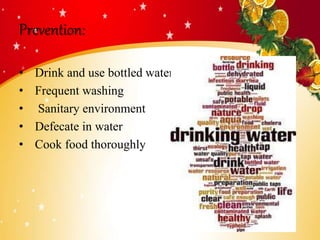
Prevention:
• Drink and use bottled water
• Frequent washing
• Sanitary environment
• Defecate in water
• Cook food thoroughly
Vibrio cholerae PPT for students

Vibrio cholerae PPT for students

  • 1.
  • 3.
    Vibrio cholera Cholera isa serious bacterial disease that usually causes severe diarrhea and dehydration. The disease is typically spread through contaminated water. Modern sewage and water treatment have effectively eliminated cholera in most countries. It’s still a problem in countries like Asia, America and Africa. Mostly in India. Countries affected by war, poverty, and natural disasters have the greatest risk for a cholera outbreak.
  • 4.
    TAXONOMY:  class :Gamma Proteobacteria  Order: Vibrionales  Family: Vibrionaceae  Genus: Vibrio  Species: v.cholerae, v.parahaemolyticus, v. vulnificus, v. alginolyticus
  • 5.
    MORPHOLOGY:  Gram negative,actively motile, short, rigid curved bacilli  Resembling letter “V”  about 34 genus  most common in water  1.5µ X 0.2 -0.4 µ in size  polar flagellum , strongly aerobic  Smear – fish in stream appearance ( koch)
  • 6.
  • 10.
  • 11.
  • 12.
    Pathogenesis: Source: Ingestion ofcontaminated water, food, fruits and vegetables etc., Incubation periods: 1-5 days Symptoms: Watery diarrhoea, vomiting, thirst, dehydration, muscle cramps Complications: muscular pain, renal failure, pulmonary edema, cardiac arrhythrnias
  • 14.
    Diagnosis: Specimen: stool sample,water sample(envt) Microscopy: a) Hanging drop : +ve b) Gram stain :-ve Culture: Mac conkey Agar :colourless to light pink TCBS : yellow colonies Serology: serological tests are no diagnostic value
  • 15.
    String Test: Used toidentify V.cholerae colonies. Loopful of vibrio growth Drop of 0.5% Sodium Deoxycholate solution Substance become MUCOID
  • 17.
    Cholera red reaction: •Best identification test for V. Cholerae. • Drops of Conc. Sulphuric acid + peptone culture allow for 24 hours RED colour
  • 19.
    Treatment: • Adequate replacementof fluids and electrolytes. • Oral tetracycline reduces the period of vibrio excreation.
  • 20.
    Prevention: • Drink anduse bottled water • Frequent washing • Sanitary environment • Defecate in water • Cook food thoroughly