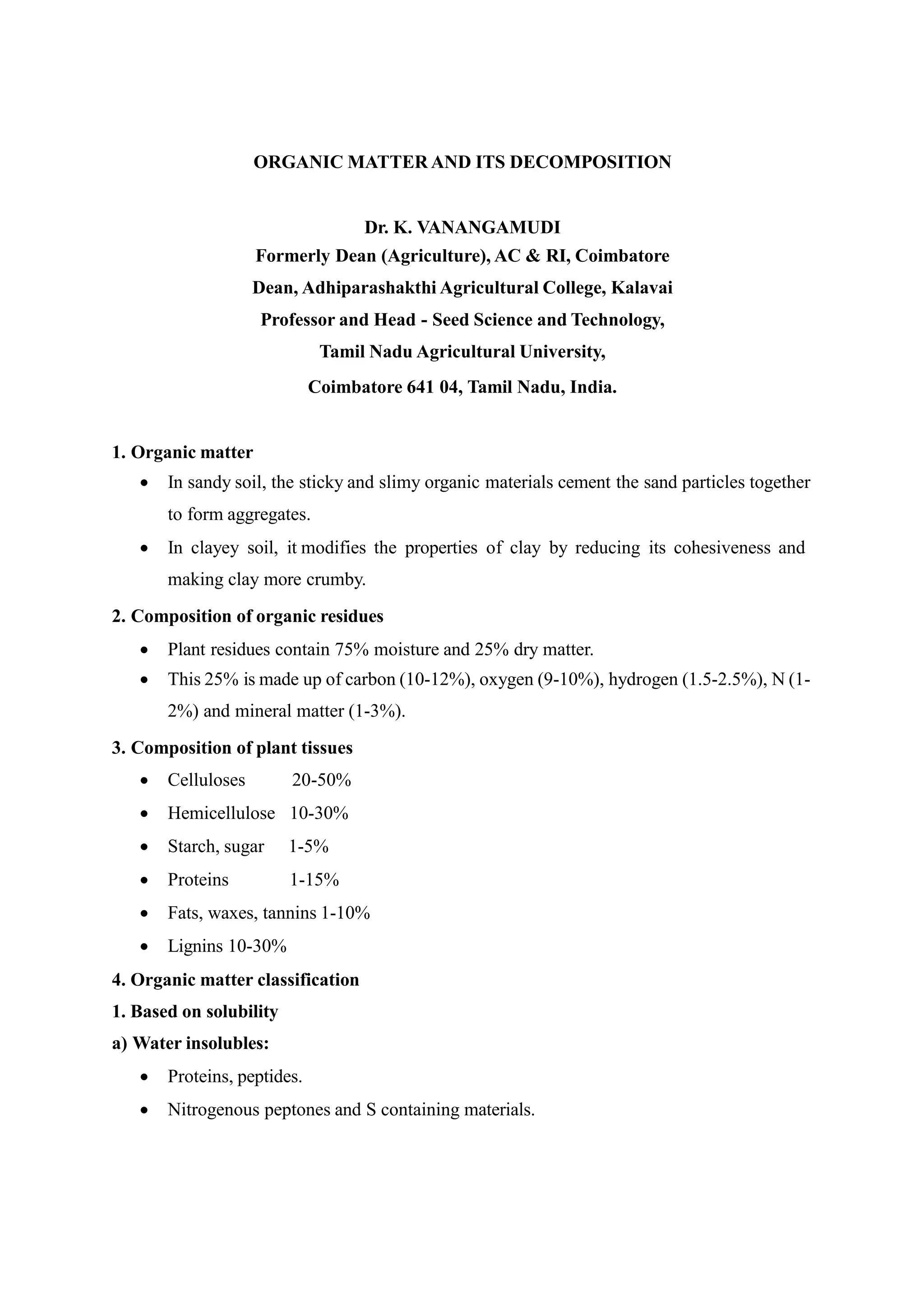
ORGANIC MATTER AND ITS DECOMPOSITION
Dr. K. VANANGAMUDI
Formerly Dean (Agriculture), AC & RI, Coimbatore
Dean, Adhiparashakthi Agricultural College, Kalavai
Professor and Head - Seed Science and Technology,
Tamil Nadu Agricultural University,
Coimbatore 641 04, Tamil Nadu, India.
1. Organic matter
 In sandy soil, the sticky and slimy organic materials cement the sand particles together
to form aggregates.
 In clayey soil, it modifies the properties of clay by reducing its cohesiveness and
making clay more crumby.
2. Composition of organic residues
 Plant residues contain 75% moisture and 25% dry matter.
 This 25% is made up of carbon (10-12%), oxygen (9-10%), hydrogen (1.5-2.5%), N (1-
2%) and mineral matter (1-3%).
3. Composition of plant tissues
20-50%
10-30%
1-5%
1-15%
 Celluloses
 Hemicellulose
 Starch, sugar
 Proteins
 Fats, waxes, tannins 1-10%
 Lignins 10-30%
4. Organic matter classification
1. Based on solubility
a) Water insolubles:
 Proteins, peptides.
 Nitrogenous peptones and S containing materials.
b) Water soluble:
 NO3, NH4 compounds.
 Non nitrogenous carbohydrates (celluloses, hemicellulose, starch, sugar etc.,).
c) Ether soluble:
 Fats, oils, waxes, resins etc., lignins.
2. Based on rate of decomposition
a) Rapidly decomposed: Sugars, starches, proteins etc.
b) Less rapidly decomposed: Hemicelluloses, celluloses etc.
c) Very slowly decomposed: Fats, waxes, resins, lignins etc.
5. Decomposition of soil organic matter
 Enzymatic oxidation of the bulk with the release of CO2, water, energy and heat.
 Essential elements are released (N, P, S etc.,) and immobilized by a series of reactions.
 Formation of compounds which are resistant to microbial action.
 Aerobic condition:
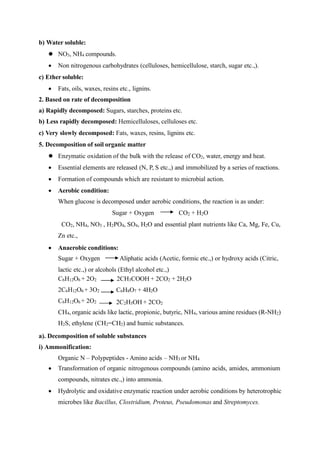
When glucose is decomposed under aerobic conditions, the reaction is as under:
Sugar + Oxygen CO2 + H2O
CO2, NH4, NO3 , H2PO4, SO4, H2O and essential plant nutrients like Ca, Mg, Fe, Cu,
Zn etc.,
 Anaerobic conditions:
Sugar + Oxygen Aliphatic acids (Acetic, formic etc.,) or hydroxy acids (Citric,
lactic etc.,) or alcohols (Ethyl alcohol etc.,)
C6H12O6 + 2O2
2C6H12O6 + 3O2
C6H12O6 + 2O2
2CH3COOH + 2CO2 + 2H2O
C6H8O7 + 4H2O
2C2H5OH + 2CO2
CH4, organic acids like lactic, propionic, butyric, NH4, various amine residues (R-NH2)
H2S, ethylene (CH2=CH2) and humic substances.
a). Decomposition of soluble substances
i) Ammonification:
Organic N – Polypeptides - Amino acids – NH3 or NH4
 Transformation of organic nitrogenous compounds (amino acids, amides, ammonium
compounds, nitrates etc.,) into ammonia.
 Hydrolytic and oxidative enzymatic reaction under aerobic conditions by heterotrophic
microbes like Bacillus, Clostridium, Proteus, Pseudomonas and Streptomyces.
ii) Nitrification:
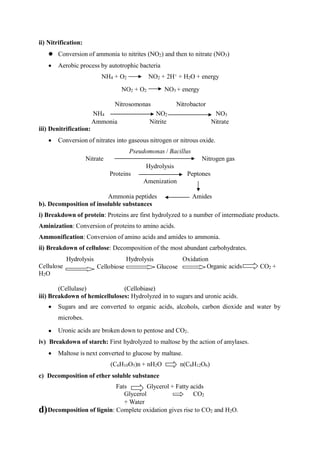
 Conversion of ammonia to nitrites (NO2) and then to nitrate (NO3)
 Aerobic process by autotrophic bacteria
NH4 + O2 NO2 + 2H+ + H2O + energy
NO2 + O2 NO3 + energy
Nitrosomonas Nitrobactor
NH4 NO2
Ammonia Nitrite
NO3
Nitrate
iii) Denitrification:
 Conversion of nitrates into gaseous nitrogen or nitrous oxide.
Pseudomonas / Bacillus
Nitrate Nitrogen gas
Hydrolysis
Proteins Peptones
Amenization
Ammonia peptides Amides
b). Decomposition of insoluble substances
i) Breakdown of protein: Proteins are first hydrolyzed to a number of intermediate products.
Aminization: Conversion of proteins to amino acids.
Ammonification: Conversion of amino acids and amides to ammonia.
ii) Breakdown of cellulose: Decomposition of the most abundant carbohydrates.
Hydrolysis Hydrolysis Oxidation
Organic acids CO2 +
Cellulose
H2O
Cellobiose Glucose
(Cellulase) (Cellobiase)
iii) Breakdown of hemicelluloses: Hydrolyzed in to sugars and uronic acids.

 Sugars and are converted to organic acids, alcohols, carbon dioxide and water by
microbes.
Uronic acids are broken down to pentose and CO2.
iv) Breakdown of starch: First hydrolyzed to maltose by the action of amylases.
 Maltose is next converted to glucose by maltase.
(C6H10O5)n + nH2O n(C6H12O6)
c) Decomposition of ether soluble substance
Fats Glycerol + Fatty acids
Glycerol CO2
+ Water
d)Decomposition of lignin: Complete oxidation gives rise to CO2 and H2O.
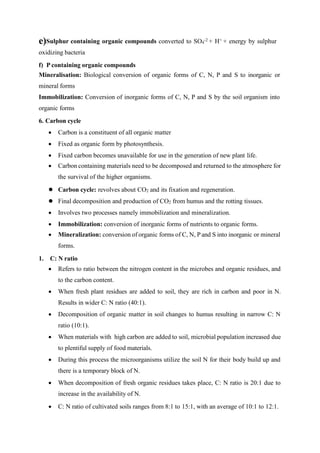
e)Sulphur containing organic compounds converted to SO4
-2 + H+ + energy by sulphur
oxidizing bacteria
f) P containing organic compounds
Mineralisation: Biological conversion of organic forms of C, N, P and S to inorganic or
mineral forms
Immobilization: Conversion of inorganic forms of C, N, P and S by the soil organism into
organic forms
6. Carbon cycle
 Carbon is a constituent of all organic matter
 Fixed as organic form by photosynthesis.
 Fixed carbon becomes unavailable for use in the generation of new plant life.
 Carbon containing materials need to be decomposed and returned to the atmosphere for
the survival of the higher organisms.
 Carbon cycle: revolves about CO2 and its fixation and regeneration.
 Final decomposition and production of CO2 from humus and the rotting tissues.
 Involves two processes namely immobilization and mineralization.
 Immobilization: conversion of inorganic forms of nutrients to organic forms.
 Mineralization: conversion of organic forms of C, N, P and S into inorganic or mineral
forms.
1. C: N ratio
 Refers to ratio between the nitrogen content in the microbes and organic residues, and
to the carbon content.
 When fresh plant residues are added to soil, they are rich in carbon and poor in N.
Results in wider C: N ratio (40:1).
 Decomposition of organic matter in soil changes to humus resulting in narrow C: N
ratio (10:1).
 When materials with high carbon are added to soil, microbial population increased due
to plentiful supply of food materials.
 During this process the microorganisms utilize the soil N for their body build up and
there is a temporary block of N.
 When decomposition of fresh organic residues takes place, C: N ratio is 20:1 due to
increase in the availability of N.
 C: N ratio of cultivated soils ranges from 8:1 to 15:1, with an average of 10:1 to 12:1.
 Legumes and farm manures: 20:1 – 30:1.
 Straw: 100:1
 Saw Dust: 400:1
 In microorganisms: 4:1 to 9:1
 Humus: 10:1
 C: N ratio is lower in soils of arid regions than humid regions.
 C: N ratio is smaller in subsoils.
7. Role of organic matter
 Creates a granular condition of soil which favours aeration and permeability.
 Water holding capacity of soil is increased by reducing surface runoff, erosion etc., and
results in good infiltration.
 Surface mulching with coarse organic matter lowers wind erosion and soil temperatures
in the summer and keeps the soil warmer in winter.
 Organic matter serves as a source of energy for the microbes
 Reservoir of nutrients, hormones and antibiotics that is essential for plant growth.
 Supplies food for earthworms, ants and rodents.
 Makes soil P readily available in acid soils.
 Organic acids released from decomposing organic matter help to reduce alkalinity in
soils
 Humus (a highly decomposed organic matter) provides a storehouse for the
exchangeable and available cations.
 Acts as a buffering agent which checks rapid chemical changes in pH and soil reaction.
8. Factors affecting soil organic matter
1. Climate:
a.Temperature: Decomposition of organic matter is accelerated in warm climates as
compared to cooler climates.
b. Rainfall: Increase in organic matter with an increase in rainfall.
2.Natural vegetation: Total organic matter is higher in soils developed under grasslands than
those under forests.
3. Texture: Fine textured soils are generally higher in organic matter than coarse textured soils.
4.Drainage: Poorly drained soils because of their high moisture content and relatively poor
aeration are much higher in organic matter and N than well drained soils.
5.Cropping and tillage: Cropped lands have much low N and organic matter than comparable
virgin soils.
6.Rotations, residues and plant nutrients: Crop rotations of cereals with legumes results in
higher soil organic matter.
9. Factors affecting decomposition
1. Temperature: Warm summers may permit plant growth and humus accumulation.
2.Soil moisture: Extremes of both arid and anaerobic conditions reduce plant growth and
microbial decomposition.
3. Nutrients: Lack of N slows down decomposition.
4.Soil pH: Microbes grow best at pH 6 to 8. Severely inhibited below pH 4.5 and above pH
8.5.

ORGANIC MATTER AND ITS DECOMPOSITION.pptx

  • 1.
    ORGANIC MATTER ANDITS DECOMPOSITION Dr. K. VANANGAMUDI Formerly Dean (Agriculture), AC & RI, Coimbatore Dean, Adhiparashakthi Agricultural College, Kalavai Professor and Head - Seed Science and Technology, Tamil Nadu Agricultural University, Coimbatore 641 04, Tamil Nadu, India. 1. Organic matter  In sandy soil, the sticky and slimy organic materials cement the sand particles together to form aggregates.  In clayey soil, it modifies the properties of clay by reducing its cohesiveness and making clay more crumby. 2. Composition of organic residues  Plant residues contain 75% moisture and 25% dry matter.  This 25% is made up of carbon (10-12%), oxygen (9-10%), hydrogen (1.5-2.5%), N (1- 2%) and mineral matter (1-3%). 3. Composition of plant tissues 20-50% 10-30% 1-5% 1-15%  Celluloses  Hemicellulose  Starch, sugar  Proteins  Fats, waxes, tannins 1-10%  Lignins 10-30% 4. Organic matter classification 1. Based on solubility a) Water insolubles:  Proteins, peptides.  Nitrogenous peptones and S containing materials.
  • 2.
    b) Water soluble: NO3, NH4 compounds.  Non nitrogenous carbohydrates (celluloses, hemicellulose, starch, sugar etc.,). c) Ether soluble:  Fats, oils, waxes, resins etc., lignins. 2. Based on rate of decomposition a) Rapidly decomposed: Sugars, starches, proteins etc. b) Less rapidly decomposed: Hemicelluloses, celluloses etc. c) Very slowly decomposed: Fats, waxes, resins, lignins etc. 5. Decomposition of soil organic matter  Enzymatic oxidation of the bulk with the release of CO2, water, energy and heat.  Essential elements are released (N, P, S etc.,) and immobilized by a series of reactions.  Formation of compounds which are resistant to microbial action.  Aerobic condition: When glucose is decomposed under aerobic conditions, the reaction is as under: Sugar + Oxygen CO2 + H2O CO2, NH4, NO3 , H2PO4, SO4, H2O and essential plant nutrients like Ca, Mg, Fe, Cu, Zn etc.,  Anaerobic conditions: Sugar + Oxygen Aliphatic acids (Acetic, formic etc.,) or hydroxy acids (Citric, lactic etc.,) or alcohols (Ethyl alcohol etc.,) C6H12O6 + 2O2 2C6H12O6 + 3O2 C6H12O6 + 2O2 2CH3COOH + 2CO2 + 2H2O C6H8O7 + 4H2O 2C2H5OH + 2CO2 CH4, organic acids like lactic, propionic, butyric, NH4, various amine residues (R-NH2) H2S, ethylene (CH2=CH2) and humic substances. a). Decomposition of soluble substances i) Ammonification: Organic N – Polypeptides - Amino acids – NH3 or NH4  Transformation of organic nitrogenous compounds (amino acids, amides, ammonium compounds, nitrates etc.,) into ammonia.  Hydrolytic and oxidative enzymatic reaction under aerobic conditions by heterotrophic microbes like Bacillus, Clostridium, Proteus, Pseudomonas and Streptomyces.
  • 3.
    ii) Nitrification:  Conversionof ammonia to nitrites (NO2) and then to nitrate (NO3)  Aerobic process by autotrophic bacteria NH4 + O2 NO2 + 2H+ + H2O + energy NO2 + O2 NO3 + energy Nitrosomonas Nitrobactor NH4 NO2 Ammonia Nitrite NO3 Nitrate iii) Denitrification:  Conversion of nitrates into gaseous nitrogen or nitrous oxide. Pseudomonas / Bacillus Nitrate Nitrogen gas Hydrolysis Proteins Peptones Amenization Ammonia peptides Amides b). Decomposition of insoluble substances i) Breakdown of protein: Proteins are first hydrolyzed to a number of intermediate products. Aminization: Conversion of proteins to amino acids. Ammonification: Conversion of amino acids and amides to ammonia. ii) Breakdown of cellulose: Decomposition of the most abundant carbohydrates. Hydrolysis Hydrolysis Oxidation Organic acids CO2 + Cellulose H2O Cellobiose Glucose (Cellulase) (Cellobiase) iii) Breakdown of hemicelluloses: Hydrolyzed in to sugars and uronic acids.   Sugars and are converted to organic acids, alcohols, carbon dioxide and water by microbes. Uronic acids are broken down to pentose and CO2. iv) Breakdown of starch: First hydrolyzed to maltose by the action of amylases.  Maltose is next converted to glucose by maltase. (C6H10O5)n + nH2O n(C6H12O6) c) Decomposition of ether soluble substance Fats Glycerol + Fatty acids Glycerol CO2 + Water d)Decomposition of lignin: Complete oxidation gives rise to CO2 and H2O.
  • 4.
    e)Sulphur containing organiccompounds converted to SO4 -2 + H+ + energy by sulphur oxidizing bacteria f) P containing organic compounds Mineralisation: Biological conversion of organic forms of C, N, P and S to inorganic or mineral forms Immobilization: Conversion of inorganic forms of C, N, P and S by the soil organism into organic forms 6. Carbon cycle  Carbon is a constituent of all organic matter  Fixed as organic form by photosynthesis.  Fixed carbon becomes unavailable for use in the generation of new plant life.  Carbon containing materials need to be decomposed and returned to the atmosphere for the survival of the higher organisms.  Carbon cycle: revolves about CO2 and its fixation and regeneration.  Final decomposition and production of CO2 from humus and the rotting tissues.  Involves two processes namely immobilization and mineralization.  Immobilization: conversion of inorganic forms of nutrients to organic forms.  Mineralization: conversion of organic forms of C, N, P and S into inorganic or mineral forms. 1. C: N ratio  Refers to ratio between the nitrogen content in the microbes and organic residues, and to the carbon content.  When fresh plant residues are added to soil, they are rich in carbon and poor in N. Results in wider C: N ratio (40:1).  Decomposition of organic matter in soil changes to humus resulting in narrow C: N ratio (10:1).  When materials with high carbon are added to soil, microbial population increased due to plentiful supply of food materials.  During this process the microorganisms utilize the soil N for their body build up and there is a temporary block of N.  When decomposition of fresh organic residues takes place, C: N ratio is 20:1 due to increase in the availability of N.  C: N ratio of cultivated soils ranges from 8:1 to 15:1, with an average of 10:1 to 12:1.
  • 5.
     Legumes andfarm manures: 20:1 – 30:1.  Straw: 100:1  Saw Dust: 400:1  In microorganisms: 4:1 to 9:1  Humus: 10:1  C: N ratio is lower in soils of arid regions than humid regions.  C: N ratio is smaller in subsoils. 7. Role of organic matter  Creates a granular condition of soil which favours aeration and permeability.  Water holding capacity of soil is increased by reducing surface runoff, erosion etc., and results in good infiltration.  Surface mulching with coarse organic matter lowers wind erosion and soil temperatures in the summer and keeps the soil warmer in winter.  Organic matter serves as a source of energy for the microbes  Reservoir of nutrients, hormones and antibiotics that is essential for plant growth.  Supplies food for earthworms, ants and rodents.  Makes soil P readily available in acid soils.  Organic acids released from decomposing organic matter help to reduce alkalinity in soils  Humus (a highly decomposed organic matter) provides a storehouse for the exchangeable and available cations.  Acts as a buffering agent which checks rapid chemical changes in pH and soil reaction. 8. Factors affecting soil organic matter 1. Climate: a.Temperature: Decomposition of organic matter is accelerated in warm climates as compared to cooler climates. b. Rainfall: Increase in organic matter with an increase in rainfall. 2.Natural vegetation: Total organic matter is higher in soils developed under grasslands than those under forests. 3. Texture: Fine textured soils are generally higher in organic matter than coarse textured soils. 4.Drainage: Poorly drained soils because of their high moisture content and relatively poor aeration are much higher in organic matter and N than well drained soils.
  • 6.
    5.Cropping and tillage:Cropped lands have much low N and organic matter than comparable virgin soils. 6.Rotations, residues and plant nutrients: Crop rotations of cereals with legumes results in higher soil organic matter. 9. Factors affecting decomposition 1. Temperature: Warm summers may permit plant growth and humus accumulation. 2.Soil moisture: Extremes of both arid and anaerobic conditions reduce plant growth and microbial decomposition. 3. Nutrients: Lack of N slows down decomposition. 4.Soil pH: Microbes grow best at pH 6 to 8. Severely inhibited below pH 4.5 and above pH 8.5.