SOIL
MICROBIOLOGY
POOJA S NATHAN
S3 BT 44
SOIL MICROBIOLOGY
• Soil microbiology is the study of
organisms in soil, their functions,
and how they affect soil properties.
• Microorganisms in soil are important
because they affect soil structure
and fertility.
• Soil microorganisms can be
classified as bacteria,
actinomycetes,fungi,
algae and protozoa
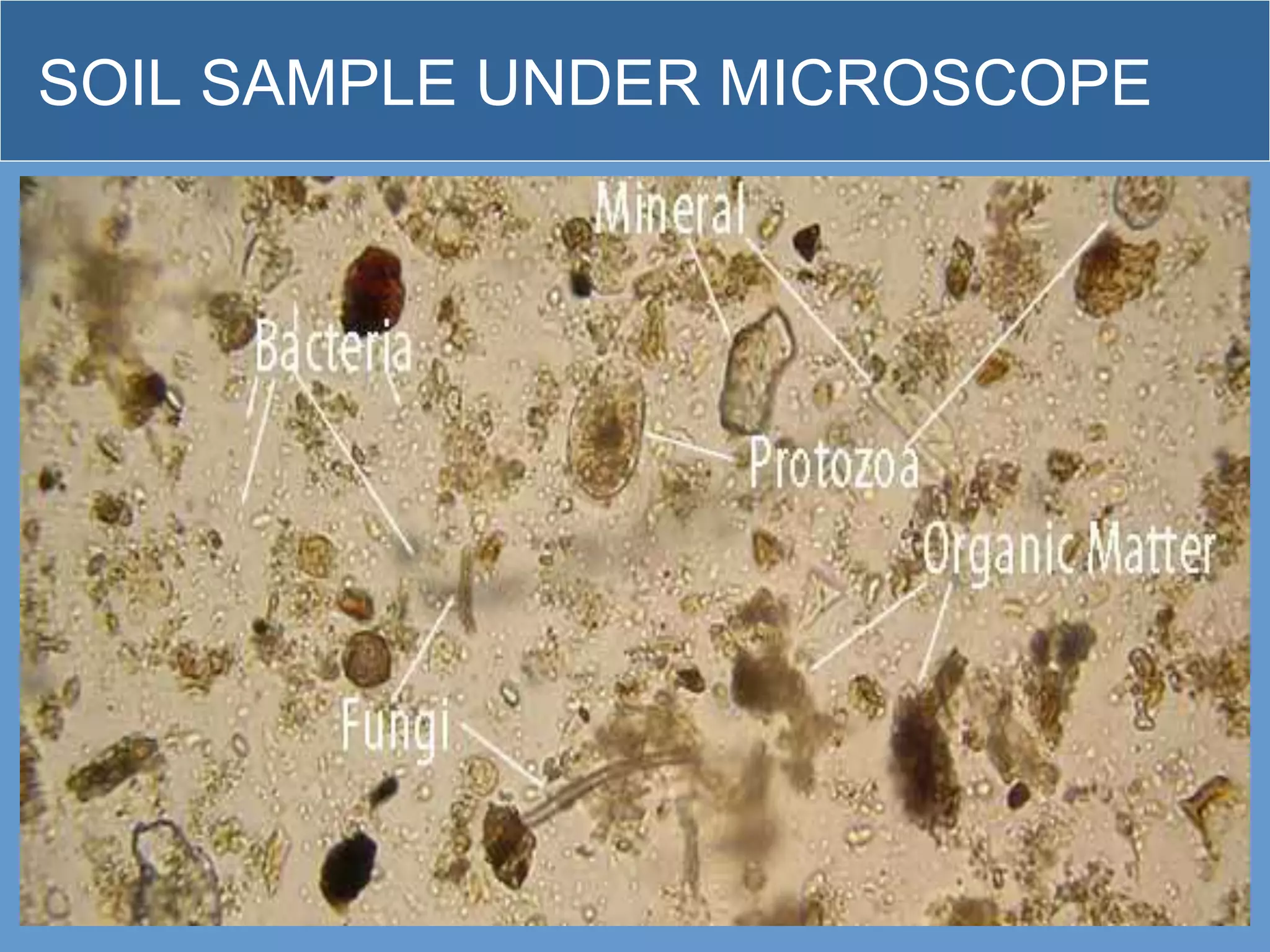
SOIL SAMPLE UNDER MICROSCOPE
MICROBIAL DISTRIBUTION IN SOIL
Earthworms
12%
other macro
fauna
5%
Bacteria and
Actinomycete
s
40%
Other micro
flaura(eg:fung
i and algae)
40%
Mesofauna
3%
1.BACTERIA
• Bacteria and Archaea are the
smallest organisms in soil apart
from viruses.
• Bacteria and Archaea
are prokaryotic. All of the other
microorganisms are eukaryotic.
• Most soil bacteria live close to plant
roots and are often referred to as
rhizobacteria(lives on rhizosphere)
RHIZOSPHERE
• 1/10 inch.
• Exudates: carbohydrates
and proteins secreted by
roots.
• Attracts bacteria, fungi,
nematodes, protozoa.
Rhizosphere
EXAMPLES: :
Some genera like
• Pseudomonas,
• Arthrobacter,
• Clostridium,
• Achromobacter,
• Sarcina,
• Enterobacter etc.
PICS:
2.ACTINOMYCETES
• Actinomycetes are a fungi-like
bacteria forming long filaments that
stretch through the soil.
• Actinomycetes live predominantly
aerobically and are heterotrophs.
• They have sometimes been
classed as fungi because they
both look like, and decompose
similar material as fungi.
• Antibacterial agents work against
them but antifungal agents do not.
• Make “earthy” smell by producing
geosmin
• Adaptable to drought
• Can act in high pH
• Break down “recalcitrant”
compounds
• One of the most notable
characteristics of the
Actinomycetes is their ability to
produce antibiotics ,like
Streptomycin
EXAMPLES:
• Nocardia asteroides
• Dermatophilus congolensis
• Streptomyces etc.
PICS:
3.FUNGI
• Fungi are important in the soil as
food sources for other, larger
organisms, pathogens, beneficial
symbiotic relationships with plants or
other organisms and soil health.
• Most of the environmental factors
that influence the growth and
distribution of bacteria and
Actinomycetes also influence fungi.
• The quality as well as quantity of
organic matter in the soil has a direct
correlation to the growth of fungi,
because most fungi consume organic
matter for nutrition.
• Fungi thrive in acidic environments,
while bacteria and Actinomycetes
cannot survive in acid.
EXAMPLES:
1.Saprophytic fungi (decomposers)
– Pleurotus ostreatus (oyster mushroom)
– Lentinula edodes (shiitake)
– Stropharia rugosoannulata (king
Stropharia).
2. Mutualists Fungi
– Zygomycota
– Basidiomycota
3.Pathogenic fungi
– Pythium,
–Rhizoctonia,
–Phytophthora
–Verticillium.
PICS:
4.ALGAE
• Filamentous, colonial, unicellular
• Photosynthetic
• Algae can be split up into three main
groups:
– Cyanophyceae
– Chlorophyceae
– Bacillariaceae
• Blue-green algae(Cyanophyceae)
are responsible for nitrogen fixation.
EXAMPLES:
• Cyanophyta (Blue-green algae)
• Chlorophyta (Grass-green algae)
• Xanthophyta (Yellow-green algae)
• Bacillariophyta (diatoms or golden-
brown algae)
PICS:
5.PROTOZOA
• Protozoa are eukaryotic
organisms
• The first microorganisms to
reproduce sexually, a significant
evolutionary step from
duplication of spores, like those
that many other soil
microorganisms depend on.
• Protozoa can be split up into
three categories
–Flagellates
–Amoebae
–Ciliates.
EXAMPLES:
• Flagellates
–(e.g., Giardia lamblia)
• Amoeboids
–(e.g., Entamoeba histolytica)
• Sporozoans
–(e.g., Plasmodium knowlesi)
PICS:
IMPORTANCE OF SOIL MICROBES
• Organic matter decomposition
and soil aggregation;
• Breakdown of toxic compounds
• Inorganic transformations that
make available nitrates,
sulphates and phosphates as
well as essential elements such
as Fe and Mn;
• N fixation into forms usable by higher
plants.
• Mycorrhizae or root fungi form a
dense network of thin filaments that
reach far into the soil, acting as
extensions of the plant roots they live
on or in.
• Pathogenic microbes are also there
but beneficial is out numbered
DESTRUCTION OF SOIL MICROBES
• Natural disturbances
– Wind and water erosion
– Flood
– Fire
– Seasonal changes
• Disturbances due to land
management
– Chemical fertilizers and pesticides used
for cultivation.
– Vehicles used for cultivation
• Disturbances associated with
dispersal of waste and
industrial activities.
– Sewage sludge and manure
– Elevated levels of atmospheric
carbon dioxide.
– Plastic wastes
Any

Soil Microbiology

  • 1.
  • 2.
    SOIL MICROBIOLOGY • Soilmicrobiology is the study of organisms in soil, their functions, and how they affect soil properties. • Microorganisms in soil are important because they affect soil structure and fertility. • Soil microorganisms can be classified as bacteria, actinomycetes,fungi, algae and protozoa
  • 3.
  • 4.
    MICROBIAL DISTRIBUTION INSOIL Earthworms 12% other macro fauna 5% Bacteria and Actinomycete s 40% Other micro flaura(eg:fung i and algae) 40% Mesofauna 3%
  • 5.
  • 6.
    • Bacteria andArchaea are the smallest organisms in soil apart from viruses. • Bacteria and Archaea are prokaryotic. All of the other microorganisms are eukaryotic. • Most soil bacteria live close to plant roots and are often referred to as rhizobacteria(lives on rhizosphere)
  • 7.
    RHIZOSPHERE • 1/10 inch. •Exudates: carbohydrates and proteins secreted by roots. • Attracts bacteria, fungi, nematodes, protozoa.
  • 8.
  • 9.
    EXAMPLES: : Some generalike • Pseudomonas, • Arthrobacter, • Clostridium, • Achromobacter, • Sarcina, • Enterobacter etc.
  • 10.
  • 11.
  • 12.
    • Actinomycetes area fungi-like bacteria forming long filaments that stretch through the soil. • Actinomycetes live predominantly aerobically and are heterotrophs. • They have sometimes been classed as fungi because they both look like, and decompose similar material as fungi.
  • 13.
    • Antibacterial agentswork against them but antifungal agents do not. • Make “earthy” smell by producing geosmin • Adaptable to drought • Can act in high pH • Break down “recalcitrant” compounds
  • 14.
    • One ofthe most notable characteristics of the Actinomycetes is their ability to produce antibiotics ,like Streptomycin
  • 15.
    EXAMPLES: • Nocardia asteroides •Dermatophilus congolensis • Streptomyces etc.
  • 16.
  • 17.
  • 18.
    • Fungi areimportant in the soil as food sources for other, larger organisms, pathogens, beneficial symbiotic relationships with plants or other organisms and soil health. • Most of the environmental factors that influence the growth and distribution of bacteria and Actinomycetes also influence fungi.
  • 19.
    • The qualityas well as quantity of organic matter in the soil has a direct correlation to the growth of fungi, because most fungi consume organic matter for nutrition. • Fungi thrive in acidic environments, while bacteria and Actinomycetes cannot survive in acid.
  • 20.
    EXAMPLES: 1.Saprophytic fungi (decomposers) –Pleurotus ostreatus (oyster mushroom) – Lentinula edodes (shiitake) – Stropharia rugosoannulata (king Stropharia). 2. Mutualists Fungi – Zygomycota – Basidiomycota
  • 21.
  • 22.
  • 23.
  • 24.
    • Filamentous, colonial,unicellular • Photosynthetic • Algae can be split up into three main groups: – Cyanophyceae – Chlorophyceae – Bacillariaceae • Blue-green algae(Cyanophyceae) are responsible for nitrogen fixation.
  • 25.
    EXAMPLES: • Cyanophyta (Blue-greenalgae) • Chlorophyta (Grass-green algae) • Xanthophyta (Yellow-green algae) • Bacillariophyta (diatoms or golden- brown algae)
  • 26.
  • 27.
  • 28.
    • Protozoa areeukaryotic organisms • The first microorganisms to reproduce sexually, a significant evolutionary step from duplication of spores, like those that many other soil microorganisms depend on.
  • 29.
    • Protozoa canbe split up into three categories –Flagellates –Amoebae –Ciliates.
  • 30.
    EXAMPLES: • Flagellates –(e.g., Giardialamblia) • Amoeboids –(e.g., Entamoeba histolytica) • Sporozoans –(e.g., Plasmodium knowlesi)
  • 31.
  • 32.
    IMPORTANCE OF SOILMICROBES • Organic matter decomposition and soil aggregation; • Breakdown of toxic compounds • Inorganic transformations that make available nitrates, sulphates and phosphates as well as essential elements such as Fe and Mn;
  • 33.
    • N fixationinto forms usable by higher plants. • Mycorrhizae or root fungi form a dense network of thin filaments that reach far into the soil, acting as extensions of the plant roots they live on or in. • Pathogenic microbes are also there but beneficial is out numbered
  • 34.
    DESTRUCTION OF SOILMICROBES • Natural disturbances – Wind and water erosion – Flood – Fire – Seasonal changes • Disturbances due to land management – Chemical fertilizers and pesticides used for cultivation. – Vehicles used for cultivation
  • 35.
    • Disturbances associatedwith dispersal of waste and industrial activities. – Sewage sludge and manure – Elevated levels of atmospheric carbon dioxide. – Plastic wastes
  • 36.