THE ROLE OF MICRO-ORGANISMS
IN THE DECOMPOSITION OF
ORGANIC MATTER AND THE
RECYCLING OF CARBON
TRUE OR FALSE?
1. Decomposition is described as having three components
2.
3.
4.
5.
6.

(True/False)
The skin turns to different shades of brown and green
during decomposition (True/False)
Bacteria produce gases causing the body to bloat
(True/False)
The Salmonella bacteria is found on a corpse (True/False)
Decomposition isn’t a part of the carbon cycle
(True/False)
Carbon Dioxide is released into the atmosphere by
respiring decomposers (True/False)

Answers: 1. False (there are only two) 2. True 3.True 4. True 5. False 6. True
ROLE OF MICROORGANISMS IN
THE DECOMPOSITION OF
ORGANIC MATTER

Decomposition refers to the breakdown of the
body which occurs following a death
Two Components of Decomposition
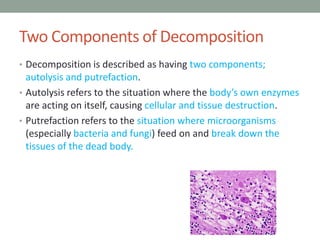
• Decomposition is described as having two components;

autolysis and putrefaction.
• Autolysis refers to the situation where the body’s own enzymes
are acting on itself, causing cellular and tissue destruction.
• Putrefaction refers to the situation where microorganisms
(especially bacteria and fungi) feed on and break down the
tissues of the dead body.
Process of Decomposition by Microorganisms
• Within a very short time period microorganisms can breakdown and

digest a large amount of soft tissue, resulting in a large production of
gas and ‘decomposition fluid’
• As decomposition proceeds, the skin

begins to darken to various shades of
green and brown. This is usually first
seen within the right lower abdominal
quadrant (image below)
• The body becomes somewhat bloated due to the decomposition gases

produced, and the decomposition fluid is frequently expelled from the
mouth, nose or other opening in the presence of a red-brown fluid
ROLE OF
MICROORGANISMS IN
THE RECYCLING OF
CARBON
Bacteria and fungi contribute to the decay of
the body.
Other decomposers
• Insects are not the only organisms involved in decomposition of
•
•

•
•

•

a body.
Bacteria also plays a major role.
Those found in the gut invade the dead tissues after death of a
body as well as other fungi and bacteria from surroundings
colonising the corpse.
This in turn leads to decay.
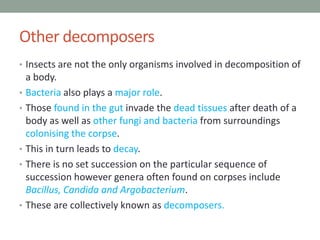
There is no set succession on the particular sequence of
succession however genera often found on corpses include
Bacillus, Candida and Argobacterium.
These are collectively known as decomposers.
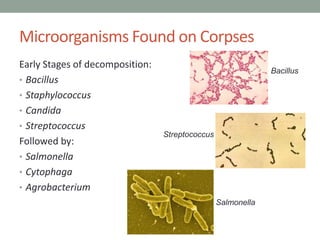
Microorganisms Found on Corpses
Early Stages of decomposition:
• Bacillus
• Staphylococcus
• Candida
• Streptococcus
Followed by:
• Salmonella
• Cytophaga
• Agrobacterium

Bacillus

Streptococcus

Salmonella
Microorganisms are Collectively known as
Decomposers
• Decomposers obtain a great source of energy from the body

such as proteins, fats, organic carbohydrates and nucleic acids
which are used as a food source.
• This energy is then released through aerobic/anaerobic
respiration.
• This energy allows rapid multiplication which leads to more
decomposition.
The Carbon Cycle
EXAM QUESTIONS
The Role of Micro-Organisms in the Decomposition of Organic Matter and the Recycling of Carbon

The Role of Micro-Organisms in the Decomposition of Organic Matter and the Recycling of Carbon

  • 1.
    THE ROLE OFMICRO-ORGANISMS IN THE DECOMPOSITION OF ORGANIC MATTER AND THE RECYCLING OF CARBON
  • 2.
    TRUE OR FALSE? 1.Decomposition is described as having three components 2. 3. 4. 5. 6. (True/False) The skin turns to different shades of brown and green during decomposition (True/False) Bacteria produce gases causing the body to bloat (True/False) The Salmonella bacteria is found on a corpse (True/False) Decomposition isn’t a part of the carbon cycle (True/False) Carbon Dioxide is released into the atmosphere by respiring decomposers (True/False) Answers: 1. False (there are only two) 2. True 3.True 4. True 5. False 6. True
  • 3.
    ROLE OF MICROORGANISMSIN THE DECOMPOSITION OF ORGANIC MATTER Decomposition refers to the breakdown of the body which occurs following a death
  • 4.
    Two Components ofDecomposition • Decomposition is described as having two components; autolysis and putrefaction. • Autolysis refers to the situation where the body’s own enzymes are acting on itself, causing cellular and tissue destruction. • Putrefaction refers to the situation where microorganisms (especially bacteria and fungi) feed on and break down the tissues of the dead body.
  • 5.
    Process of Decompositionby Microorganisms • Within a very short time period microorganisms can breakdown and digest a large amount of soft tissue, resulting in a large production of gas and ‘decomposition fluid’ • As decomposition proceeds, the skin begins to darken to various shades of green and brown. This is usually first seen within the right lower abdominal quadrant (image below) • The body becomes somewhat bloated due to the decomposition gases produced, and the decomposition fluid is frequently expelled from the mouth, nose or other opening in the presence of a red-brown fluid
  • 6.
    ROLE OF MICROORGANISMS IN THERECYCLING OF CARBON Bacteria and fungi contribute to the decay of the body.
  • 7.
    Other decomposers • Insectsare not the only organisms involved in decomposition of • • • • • a body. Bacteria also plays a major role. Those found in the gut invade the dead tissues after death of a body as well as other fungi and bacteria from surroundings colonising the corpse. This in turn leads to decay. There is no set succession on the particular sequence of succession however genera often found on corpses include Bacillus, Candida and Argobacterium. These are collectively known as decomposers.
  • 8.
    Microorganisms Found onCorpses Early Stages of decomposition: • Bacillus • Staphylococcus • Candida • Streptococcus Followed by: • Salmonella • Cytophaga • Agrobacterium Bacillus Streptococcus Salmonella
  • 9.
    Microorganisms are Collectivelyknown as Decomposers • Decomposers obtain a great source of energy from the body such as proteins, fats, organic carbohydrates and nucleic acids which are used as a food source. • This energy is then released through aerobic/anaerobic respiration. • This energy allows rapid multiplication which leads to more decomposition.
  • 10.
  • 11.