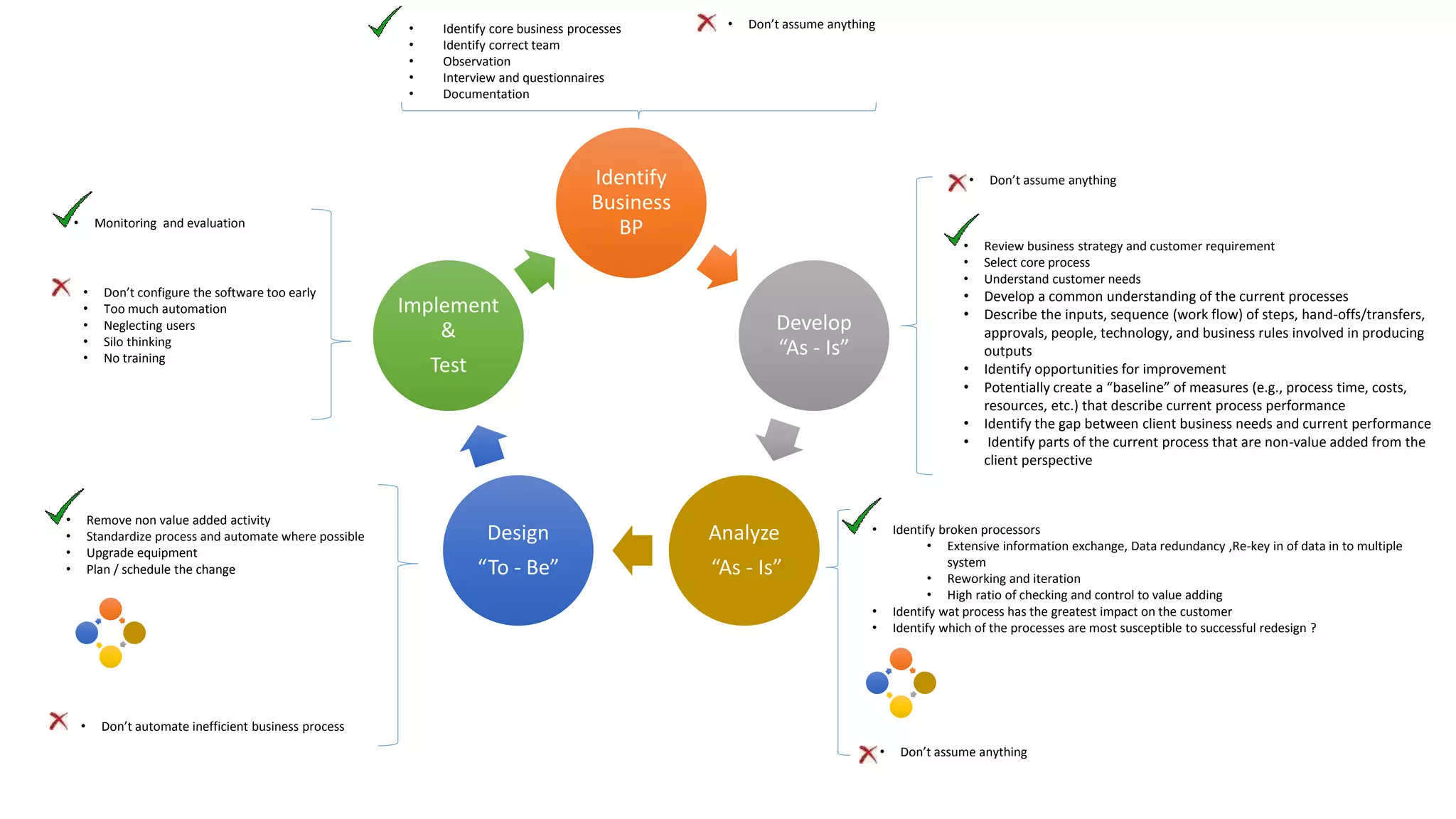
Identify
Business
BP
Develop
“As - Is”
Analyze
“As - Is”
Design
“To - Be”
Implement
&
Test
• Review business strategy and customer requirement
• Select core process
• Understand customer needs
• Develop a common understanding of the current processes
• Describe the inputs, sequence (work flow) of steps, hand-offs/transfers,
approvals, people, technology, and business rules involved in producing
outputs
• Identify opportunities for improvement
• Potentially create a “baseline” of measures (e.g., process time, costs,
resources, etc.) that describe current process performance
• Identify the gap between client business needs and current performance
• Identify parts of the current process that are non-value added from the
client perspective
• Don’t assume anything• Identify core business processes
• Identify correct team
• Observation
• Interview and questionnaires
• Documentation
• Don’t assume anything
• Identify broken processors
• Extensive information exchange, Data redundancy ,Re-key in of data in to multiple
system
• Reworking and iteration
• High ratio of checking and control to value adding
• Identify wat process has the greatest impact on the customer
• Identify which of the processes are most susceptible to successful redesign ?
• Don’t assume anything
• Remove non value added activity
• Standardize process and automate where possible
• Upgrade equipment
• Plan / schedule the change
• Don’t automate inefficient business process
• Monitoring and evaluation
• Don’t configure the software too early
• Too much automation
• Neglecting users
• Silo thinking
• No training
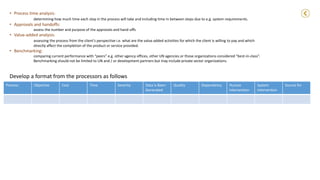
• Process time analysis:
determining how much time each step in the process will take and including time in between steps due to e.g. system requirements.
• Approvals and handoffs:
assess the number and purpose of the approvals and hand-offs
• Value-added analysis:
assessing the process from the client’s perspective i.e. what are the value added activities for which the client is willing to pay and which
directly affect the completion of the product or service provided.
• Benchmarking:
comparing current performance with “peers” e.g. other agency offices, other UN agencies or those organizations considered “best-in-class”.
Benchmarking should not be limited to UN and / or development partners but may include private sector organizations.
Develop a format from the processors as follows
Process Objective Cost Time Severity Data is Been
Generated
Quality Dependency Human
intervention
System
intervention
Source for
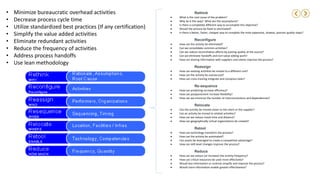
• Minimize bureaucratic overhead activities
• Decrease process cycle time
• Utilize standardized best practices (If any certification)
• Simplify the value added activities
• Eliminate redundant activities
• Reduce the frequency of activities
• Address process handoffs
• Use lean methodology
Rethink
 What is the root cause of the problem?
 Why do it this way? What are the assumptions?
 Is there a completely different way to accomplish this objective?
 Should the process be fixed or eliminated?
 Is there a better, faster, cheaper way to complete the most expensive, slowest, poorest quality steps?
Reconfigure
 How can the activity be eliminated?
 Can we consolidate common activities?
 Can we reduce reconciliation efforts by putting quality at the source?
 Can we eliminate handoffs and non-value adding work?
 How can sharing information with suppliers and clients improve the process?
Reassign
 How can existing activities be moved to a different unit?
 How can the activity be outsourced?
 How can cross-training integrate and compress tasks?
Re-sequence
 How can predicting increase efficiency?
 How can postponement increase flexibility?
 How can we minimize the number of interconnections and dependencies?
Relocate
 Can the activity be moved closer to the client or the supplier?
 Can an activity be moved to related activities?
 How can we reduce travel time and distance?
 How can geographically virtual organizations be created?
Retool
 How can technology transform the process?
 How can the activity be automated?
 Can assets be leveraged to create a competitive advantage?
 How can skill-level changes improve the process?
Reduce
 How can we reduce (or increase) the activity frequency?
 How can critical resources be used more effectively?
 Would less information or controls simplify and improve the process?
 Would more information enable greater effectiveness?
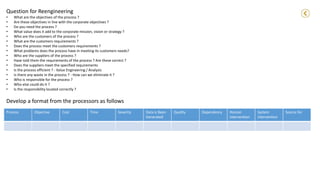
Develop a format from the processors as follows
Process Objective Cost Time Severity Data is Been
Generated
Quality Dependency Human
intervention
System
intervention
Source for
Question for Reengineering
• What are the objectives of the process ?
• Are these objectives in line with the corporate objectives ?
• Do you need the process ?
• What value does it add to the corporate mission, vision or strategy ?
• Who are the customers of the process ?
• What are the customers requirements ?
• Does the process meet the customers requirements ?
• What problems does the process have in meeting its customers needs?
• Who are the suppliers of the process ?
• Have told them the requirements of the process ? Are these correct ?
• Does the suppliers meet the specified requirements
• Is the process efficient ? - Value Engineering / Analysis
• Is there any waste in the process ? - How can we eliminate it ?
• Who is responsible for the process ?
• Who else could do it ?
• Is the responsibility located correctly ?

Business process reengineering

  • 1.
    Identify Business BP Develop “As - Is” Analyze “As- Is” Design “To - Be” Implement & Test • Review business strategy and customer requirement • Select core process • Understand customer needs • Develop a common understanding of the current processes • Describe the inputs, sequence (work flow) of steps, hand-offs/transfers, approvals, people, technology, and business rules involved in producing outputs • Identify opportunities for improvement • Potentially create a “baseline” of measures (e.g., process time, costs, resources, etc.) that describe current process performance • Identify the gap between client business needs and current performance • Identify parts of the current process that are non-value added from the client perspective • Don’t assume anything• Identify core business processes • Identify correct team • Observation • Interview and questionnaires • Documentation • Don’t assume anything • Identify broken processors • Extensive information exchange, Data redundancy ,Re-key in of data in to multiple system • Reworking and iteration • High ratio of checking and control to value adding • Identify wat process has the greatest impact on the customer • Identify which of the processes are most susceptible to successful redesign ? • Don’t assume anything • Remove non value added activity • Standardize process and automate where possible • Upgrade equipment • Plan / schedule the change • Don’t automate inefficient business process • Monitoring and evaluation • Don’t configure the software too early • Too much automation • Neglecting users • Silo thinking • No training
  • 2.
    • Process timeanalysis: determining how much time each step in the process will take and including time in between steps due to e.g. system requirements. • Approvals and handoffs: assess the number and purpose of the approvals and hand-offs • Value-added analysis: assessing the process from the client’s perspective i.e. what are the value added activities for which the client is willing to pay and which directly affect the completion of the product or service provided. • Benchmarking: comparing current performance with “peers” e.g. other agency offices, other UN agencies or those organizations considered “best-in-class”. Benchmarking should not be limited to UN and / or development partners but may include private sector organizations. Develop a format from the processors as follows Process Objective Cost Time Severity Data is Been Generated Quality Dependency Human intervention System intervention Source for
  • 3.
    • Minimize bureaucraticoverhead activities • Decrease process cycle time • Utilize standardized best practices (If any certification) • Simplify the value added activities • Eliminate redundant activities • Reduce the frequency of activities • Address process handoffs • Use lean methodology Rethink  What is the root cause of the problem?  Why do it this way? What are the assumptions?  Is there a completely different way to accomplish this objective?  Should the process be fixed or eliminated?  Is there a better, faster, cheaper way to complete the most expensive, slowest, poorest quality steps? Reconfigure  How can the activity be eliminated?  Can we consolidate common activities?  Can we reduce reconciliation efforts by putting quality at the source?  Can we eliminate handoffs and non-value adding work?  How can sharing information with suppliers and clients improve the process? Reassign  How can existing activities be moved to a different unit?  How can the activity be outsourced?  How can cross-training integrate and compress tasks? Re-sequence  How can predicting increase efficiency?  How can postponement increase flexibility?  How can we minimize the number of interconnections and dependencies? Relocate  Can the activity be moved closer to the client or the supplier?  Can an activity be moved to related activities?  How can we reduce travel time and distance?  How can geographically virtual organizations be created? Retool  How can technology transform the process?  How can the activity be automated?  Can assets be leveraged to create a competitive advantage?  How can skill-level changes improve the process? Reduce  How can we reduce (or increase) the activity frequency?  How can critical resources be used more effectively?  Would less information or controls simplify and improve the process?  Would more information enable greater effectiveness?
  • 4.
    Develop a formatfrom the processors as follows Process Objective Cost Time Severity Data is Been Generated Quality Dependency Human intervention System intervention Source for Question for Reengineering • What are the objectives of the process ? • Are these objectives in line with the corporate objectives ? • Do you need the process ? • What value does it add to the corporate mission, vision or strategy ? • Who are the customers of the process ? • What are the customers requirements ? • Does the process meet the customers requirements ? • What problems does the process have in meeting its customers needs? • Who are the suppliers of the process ? • Have told them the requirements of the process ? Are these correct ? • Does the suppliers meet the specified requirements • Is the process efficient ? - Value Engineering / Analysis • Is there any waste in the process ? - How can we eliminate it ? • Who is responsible for the process ? • Who else could do it ? • Is the responsibility located correctly ?