SAP SD OVERVIEW
BY
Om Prakash Jha
SD CONSULTANT


                 1
WELCOME TO THE
WORLD OF
SAP R/3
             2
ERP
Enterprise Resources Planning
Enterprise


 Where customers get the
  satisfaction.
 Where the resources are available
  for the people needs.
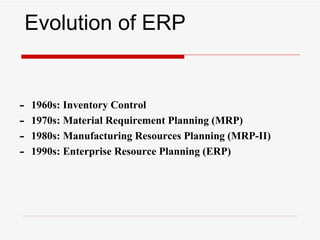
Evolution of ERP


-   1960s: Inventory Control
-   1970s: Material Requirement Planning (MRP)
-   1980s: Manufacturing Resources Planning (MRP-II)
-   1990s: Enterprise Resource Planning (ERP)
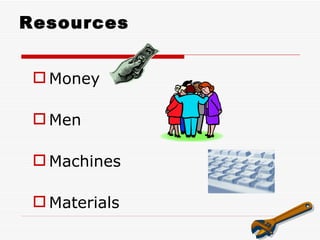
Resources


  Money

  Men

  Machines

  Materials
Planning


    Proper Planning and Optimization of the valuable
     resources make enterprise run into profits.
 Def of ERP


A Software Solution that addresses the
ENTERPRISE NEEDS taking the PROCESS
VIEW of an organization to meet the
ORGANIZATIONAL          GOALS         tightly
INTEGRATING all functions of an enterprise.
Need for ERP
   Integration of Business Processes
   Online information at the corporate office
   Standardization of systems across Locations
   Reduce cash to cash cycle times
   Faster Consolidation at Head office for statutory
    reporting
Problems Tackled by ERP Systems


     Material Shortages
     Productivity Enhancements
     Customer Service
     Cash Management
     Inventory Problems
     Quality Problems
ERP Products


         SAP
         BAAN
         Oracle APPS
         People Soft
         JD Edwards
         Marshall
         Etc..
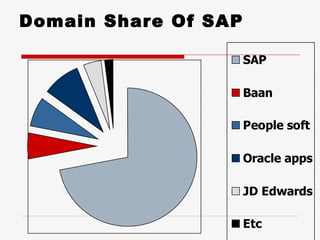
Domain Share Of SAP

                      SAP

                      Baan

                      People soft

                      Oracle apps

                      JD Edwards

                      Etc
SAP & Competitors


 SAP R/3 had competition with Software giants
 like Oracle Corp, People Soft & Bann.
  Oracle with its E-biz suit packed to excel with
 142 modules.
 People Soft with its extra ordinary performance in
 HR has stormed the market.
 But finally failed to gain the confidence of Big
 Enterprises.
 Result is SAP Has become giant in ERP.
Few SAP Customers

    IBM               TATA’s
    COMPAQ            Dr.Reddy’s Labs
    Hewlett Packard   Ranbaxy
                       L& T
    AMD
                       Reliance Industries
    Boeing            Glaxo
    Mercedez          Mahindra & Mahindra
    Toyota            Hero Honda
    Lucent            Growel
    Hitachi           Colgate Palmolive
    Nike
Consulting Companies

   Price Water House Coopers.
   KPMG.
   Siemens.
   Delloitte.
   Accenture.
   Cap Gemini.
   IntelliGroup
   TCS.
SAP R/3
What is all about


 Systems Applications &
Products in Data Processing
SAP & Modules


  SAP Package is strategically divided
   into 2 main areas.
  Functional & Technical.
  People with domain experience can
   work on functional modules.
  2 Technical modules are ABAP/4 &
   Basis.
  Cross Applications are used for ALE
   Purpose.
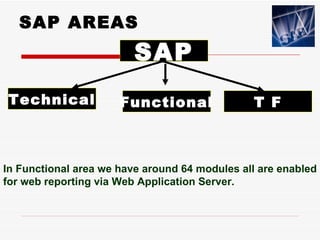
SAP AREAS
                         SAP
Technical             Functional               T F


In Functional area we have around 64 modules all are enabled
for web reporting via Web Application Server.
How Can a Carrier Be Planned?
 After completion of training one can be :

    End-User
    Functional Consultant
Roles in functional modules
 SAP SD Counsultant
 SAP Support Counsultant
Role Of A Functional Counsultant
   A functional consultant is expected to generate
    knowledge about the current business process, design
    current business flows, study current business processes
    and its complication - in all we can say that this is
    getting through with the current business setup.
   "Everything configured has to be documented according
    to their categories in the form of predefined templates;
    these then have to be approved by the team leads or
    who ever the consultant is reporting to.
   "End user manual and user training is also expected
    from Functional Consultants.
   There will also be interaction with other modules
    consultants
   Updation of project status to Project Manager & other
    concerned persons.
 Interaction with core team members, end users &
  other team members (consultants)
 A Functional consultant has to be a good
  communicator he has to communicate with Custom
  er ERP core team, implementing team, Technical co
  nsultant and his project leader.Written communicati
  on skill is to be demonstrate by a functional consult
  ant to e-mail to different groups, documentation ab
  out the erp, reports generation. Verbal communicati
  on is to understand the requirement , interact with
  customer, to explain and convince the customer.
Role of Support Counsultant
   Primarily responsible for Handling tickets/tasks and application support

    to the end-users
   When an issue comes to diagnose, analyze and solve it.
   Also responsible for enhancements.
   Interaction with client/end users & updating the status.

   Training the end users and preparing end user training material
Some SAP R/3 Success Stories
   Abroad
     Microsoft
     IBM
     Sony Europe
   In India
     Tata Group-Tata Motors.,TISCO
     Reliance Group-Reliance Industry,Reliance Energy
     Jet Airlines
     ONGC
Which Companies Will Provide
Employments?
   End User Companies
     Bajaj Autos
     Sudarshan Chem.
     Thomas Cook
     Glenmark
   ERP Implementation
     Satyam
     Wipro
     Infosys
     IBM
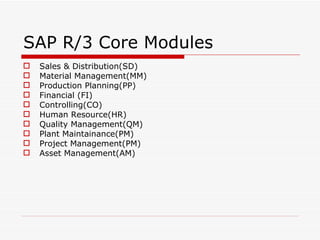
SAP R/3 Core Modules
   Sales & Distribution(SD)
   Material Management(MM)
   Production Planning(PP)
   Financial (FI)
   Controlling(CO)
   Human Resource(HR)
   Quality Management(QM)
   Plant Maintainance(PM)
   Project Management(PM)
   Asset Management(AM)
Our Placement Partners….
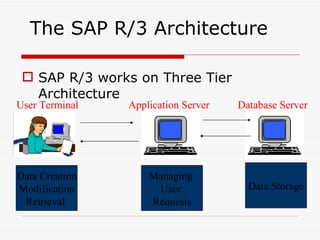
The SAP R/3 Architecture

  SAP R/3 works on Three Tier
   Architecture
User Terminal   Application Server   Database Server


Data Creation       Managing
Modification         User              Data Storage
 Retrieval          Requests
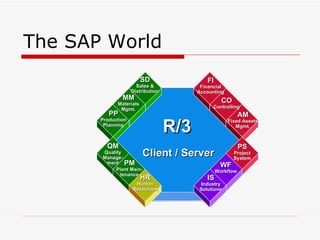
The SAP World
                         SD                 FI
                      Sales &             Financial
                    Distribution         Accounting
               MM                                  CO
             Materials
              Mgmt.                            Controlling
          PP                                                AM

                                   R/3
       Production                                     Fixed Assets
        Planning                                         Mgmt.


         QM                                                 PS
       Quality
       Manage-
                         Client / Server                Project
                                                        System
        ment PM
                                                  WF
            Plant Main-                          Workflow
              tenance
                         HR                 IS
                     Human               Industry
                    Resources            Solutions
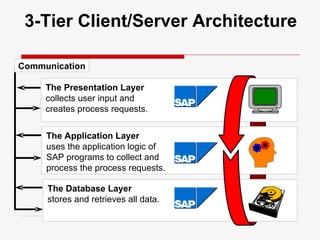
3-Tier Client/Server Architecture

Communication

     The Presentation Layer
     collects user input and
     creates process requests.


     The Application Layer
     uses the application logic of
     SAP programs to collect and
     process the process requests.

     The Database Layer
     stores and retrieves all data.
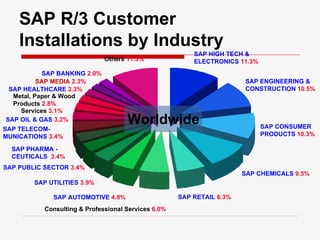
SAP R/3 Customer
    Installations by Industry
                                                         SAP HIGH TECH &
                               Others 11.5%              ELECTRONICS 11.3%
            SAP BANKING 2.0%
          SAP MEDIA 2.3%                                               SAP ENGINEERING &
 SAP HEALTHCARE 2.3%                                                   CONSTRUCTION 10.5%
  Metal, Paper & Wood
  Products 2.8%
    Services 3.1%
SAP OIL & GAS 3.2%                    Worldwide                              SAP CONSUMER
SAP TELECOM-
MUNICATIONS 3.4%                                                             PRODUCTS 10.3%

  SAP PHARMA -
  CEUTICALS 3.4%
SAP PUBLIC SECTOR 3.4%
                                                                       SAP CHEMICALS 9.5%
        SAP UTILITIES 3.9%

             SAP AUTOMOTIVE 4.8%                     SAP RETAIL 6.3%
           Consulting & Professional Services 6.0%
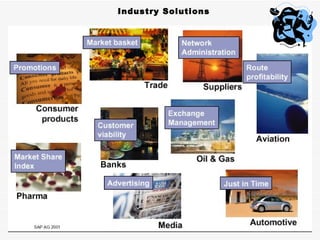
Industry Solutions
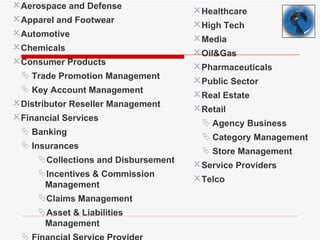
Aerospace and Defense                Healthcare
Apparel and Footwear                 High Tech
Automotive                           Media
Chemicals                            Oil&Gas
Consumer Products                    Pharmaceuticals
   Trade Promotion Management
                                      Public Sector
   Key Account Management
                                      Real Estate
Distributor Reseller Management      Retail
Financial Services                      Agency Business
   Banking
                                         Category Management
   Insurances
                                         Store Management
      Collections and Disbursement
                                      Service Providers
      Incentives & Commission
       Management
                                      Telco
      Claims Management
      Asset & Liabilities
       Management
  
SAP - characteristics

   Highly Integrated solution covering entire business processes
   Technically capable of utilizing the network infrastructure
   Open system to ensure freedom to choose
   Provides multiple ways of configuring business processes
   Solutions in areas where currently no systems
   Workflow enabled business processes
   Enables to exploit the power of Intranet and Internet
Common SAP objectives

 Cost Control & increased profitability
 Increased productivity of all resources – man, material &
  money
 Process Standardization
 Transparency in operations, resulting in better
  communication
 Shift from post-mortem scenario to predictive scenario
Results of Integration

 Focus on Business Processes
 Elimination of Redundant Data (Common Constant
  Data)
 Easier Corporate Consolidation
 Better Managerial Control
 Elimination of Interfaces
 Faster reaction to changing structures
Success factors for SAP
 implementation

 Top Management Commitment & communication down-
  the-line
 Empowerment
 Change management
 Training
 Compliance to methodology
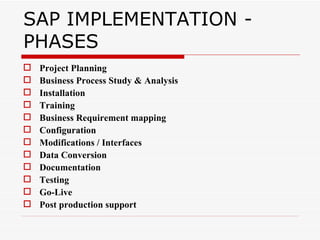
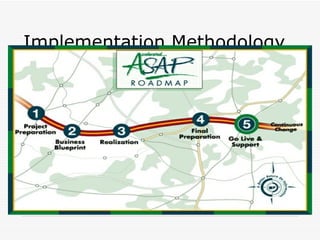
SAP IMPLEMENTATION -
PHASES
   Project Planning
   Business Process Study & Analysis
   Installation
   Training
   Business Requirement mapping
   Configuration
   Modifications / Interfaces
   Data Conversion
   Documentation
   Testing
   Go-Live
   Post production support
Implementation Methodology
SALES AND
 DISTRIBUTION
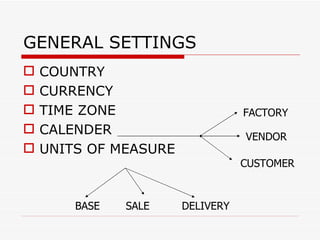
GENERAL SETTINGS
   COUNTRY
   CURRENCY
   TIME ZONE                     FACTORY
   CALENDER                      VENDOR
   UNITS OF MEASURE
                                  CUSTOMER


        BASE   SALE    DELIVERY
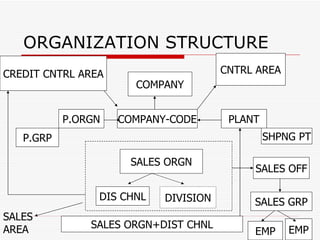
ORGANIZATION STRUCTURE
CREDIT CNTRL AREA                     CNTRL AREA
                      COMPANY


           P.ORGN   COMPANY-CODE       PLANT
   P.GRP                                       SHPNG PT

                     SALES ORGN
                                           SALES OFF

                DIS CHNL   DIVISION        SALES GRP
SALES
AREA           SALES ORGN+DIST CHNL
                                           EMP     EMP
MASTER DATA


Organizational Master
Customer Master Record
Material Master Record
CMIR
Condition Master
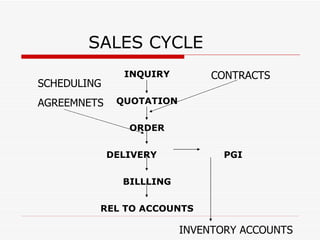
SALES CYCLE
               INQUIRY         CONTRACTS
SCHEDULING
AGREEMNETS    QUOTATION


                ORDER


             DELIVERY            PGI


               BILLLING


         REL TO ACCOUNTS

                          INVENTORY ACCOUNTS
BASIC FUNCTIONS
 Condition Technique for Pricing
 Condition Tables
 Access Sequence
 Condition Type
 Pricing Procedure
 Pricing Procedure Determination
 Condition Records
 Pricing: Condition Exclusion
 Free Goods Determination
BASIC FUCNTIONS
  Partner Determination
  Out Put Determination
  Material Determination
  Product Proposal
  Item Proposal
  Incompletion Procedure
  Availability Check
  Credit Management
  Number Ranges
SHIPPING

Delivery Document Types
Schedule Category
Schedule Line category Determination
Shipping point Determination
Storage Location Determination
BILLING


Billing Documents
Billing Plans(Periodic,Milestone)
Cancellation of Invoices
Invoice lists
SPECIAL FUNCTIONALITIES


 Third Party Order
 Individual Purchase Order
 Consignment Sales
Special Topics
REBATE PROCESSING
VARIANT CONFIGURATION
TRANSFER ORDER
INTEGRATION
DATA TRANFER TECHNIQUE
REPORTS
ADDITIONALS
   DAY TO DAY NOTES(SOFT COPY)
   PRESENTATIONS
   EVALUATIONS
   DISCUSSIONS
THANK YOU

SAP Demo

  • 1.
    SAP SD OVERVIEW BY OmPrakash Jha SD CONSULTANT 1
  • 2.
  • 3.
  • 4.
    Enterprise  Where customersget the satisfaction.  Where the resources are available for the people needs.
  • 5.
    Evolution of ERP - 1960s: Inventory Control - 1970s: Material Requirement Planning (MRP) - 1980s: Manufacturing Resources Planning (MRP-II) - 1990s: Enterprise Resource Planning (ERP)
  • 6.
    Resources  Money  Men  Machines  Materials
  • 7.
    Planning  Proper Planning and Optimization of the valuable resources make enterprise run into profits. Def of ERP A Software Solution that addresses the ENTERPRISE NEEDS taking the PROCESS VIEW of an organization to meet the ORGANIZATIONAL GOALS tightly INTEGRATING all functions of an enterprise.
  • 8.
    Need for ERP  Integration of Business Processes  Online information at the corporate office  Standardization of systems across Locations  Reduce cash to cash cycle times  Faster Consolidation at Head office for statutory reporting
  • 9.
    Problems Tackled byERP Systems Material Shortages Productivity Enhancements Customer Service Cash Management Inventory Problems Quality Problems
  • 10.
    ERP Products  SAP  BAAN  Oracle APPS  People Soft  JD Edwards  Marshall  Etc..
  • 11.
    Domain Share OfSAP SAP Baan People soft Oracle apps JD Edwards Etc
  • 12.
    SAP & Competitors SAP R/3 had competition with Software giants like Oracle Corp, People Soft & Bann. Oracle with its E-biz suit packed to excel with 142 modules. People Soft with its extra ordinary performance in HR has stormed the market. But finally failed to gain the confidence of Big Enterprises. Result is SAP Has become giant in ERP.
  • 13.
    Few SAP Customers  IBM TATA’s  COMPAQ Dr.Reddy’s Labs  Hewlett Packard Ranbaxy L& T  AMD Reliance Industries  Boeing Glaxo  Mercedez Mahindra & Mahindra  Toyota Hero Honda  Lucent Growel  Hitachi Colgate Palmolive  Nike
  • 14.
    Consulting Companies  Price Water House Coopers.  KPMG.  Siemens.  Delloitte.  Accenture.  Cap Gemini.  IntelliGroup  TCS.
  • 15.
    SAP R/3 What isall about Systems Applications & Products in Data Processing
  • 16.
    SAP & Modules  SAP Package is strategically divided into 2 main areas.  Functional & Technical.  People with domain experience can work on functional modules.  2 Technical modules are ABAP/4 & Basis.  Cross Applications are used for ALE Purpose.
  • 17.
    SAP AREAS SAP Technical Functional T F In Functional area we have around 64 modules all are enabled for web reporting via Web Application Server.
  • 18.
    How Can aCarrier Be Planned?  After completion of training one can be :  End-User  Functional Consultant
  • 19.
    Roles in functionalmodules  SAP SD Counsultant  SAP Support Counsultant
  • 20.
    Role Of AFunctional Counsultant  A functional consultant is expected to generate knowledge about the current business process, design current business flows, study current business processes and its complication - in all we can say that this is getting through with the current business setup.  "Everything configured has to be documented according to their categories in the form of predefined templates; these then have to be approved by the team leads or who ever the consultant is reporting to.  "End user manual and user training is also expected from Functional Consultants.  There will also be interaction with other modules consultants  Updation of project status to Project Manager & other concerned persons.
  • 21.
     Interaction withcore team members, end users & other team members (consultants)  A Functional consultant has to be a good communicator he has to communicate with Custom er ERP core team, implementing team, Technical co nsultant and his project leader.Written communicati on skill is to be demonstrate by a functional consult ant to e-mail to different groups, documentation ab out the erp, reports generation. Verbal communicati on is to understand the requirement , interact with customer, to explain and convince the customer.
  • 22.
    Role of SupportCounsultant  Primarily responsible for Handling tickets/tasks and application support to the end-users  When an issue comes to diagnose, analyze and solve it.  Also responsible for enhancements.  Interaction with client/end users & updating the status.  Training the end users and preparing end user training material
  • 23.
    Some SAP R/3Success Stories  Abroad  Microsoft  IBM  Sony Europe  In India  Tata Group-Tata Motors.,TISCO  Reliance Group-Reliance Industry,Reliance Energy  Jet Airlines  ONGC
  • 24.
    Which Companies WillProvide Employments?  End User Companies  Bajaj Autos  Sudarshan Chem.  Thomas Cook  Glenmark  ERP Implementation  Satyam  Wipro  Infosys  IBM
  • 25.
    SAP R/3 CoreModules  Sales & Distribution(SD)  Material Management(MM)  Production Planning(PP)  Financial (FI)  Controlling(CO)  Human Resource(HR)  Quality Management(QM)  Plant Maintainance(PM)  Project Management(PM)  Asset Management(AM)
  • 26.
  • 27.
    The SAP R/3Architecture  SAP R/3 works on Three Tier Architecture User Terminal Application Server Database Server Data Creation Managing Modification User Data Storage Retrieval Requests
  • 28.
    The SAP World SD FI Sales & Financial Distribution Accounting MM CO Materials Mgmt. Controlling PP AM R/3 Production Fixed Assets Planning Mgmt. QM PS Quality Manage- Client / Server Project System ment PM WF Plant Main- Workflow tenance HR IS Human Industry Resources Solutions
  • 29.
    3-Tier Client/Server Architecture Communication The Presentation Layer collects user input and creates process requests. The Application Layer uses the application logic of SAP programs to collect and process the process requests. The Database Layer stores and retrieves all data.
  • 30.
    SAP R/3 Customer Installations by Industry SAP HIGH TECH & Others 11.5% ELECTRONICS 11.3% SAP BANKING 2.0% SAP MEDIA 2.3% SAP ENGINEERING & SAP HEALTHCARE 2.3% CONSTRUCTION 10.5% Metal, Paper & Wood Products 2.8% Services 3.1% SAP OIL & GAS 3.2% Worldwide SAP CONSUMER SAP TELECOM- MUNICATIONS 3.4% PRODUCTS 10.3% SAP PHARMA - CEUTICALS 3.4% SAP PUBLIC SECTOR 3.4% SAP CHEMICALS 9.5% SAP UTILITIES 3.9% SAP AUTOMOTIVE 4.8% SAP RETAIL 6.3% Consulting & Professional Services 6.0%
  • 31.
  • 32.
    Aerospace and Defense Healthcare Apparel and Footwear High Tech Automotive Media Chemicals Oil&Gas Consumer Products Pharmaceuticals  Trade Promotion Management Public Sector  Key Account Management Real Estate Distributor Reseller Management Retail Financial Services  Agency Business  Banking  Category Management  Insurances  Store Management Collections and Disbursement Service Providers Incentives & Commission Management Telco Claims Management Asset & Liabilities Management 
  • 33.
    SAP - characteristics  Highly Integrated solution covering entire business processes  Technically capable of utilizing the network infrastructure  Open system to ensure freedom to choose  Provides multiple ways of configuring business processes  Solutions in areas where currently no systems  Workflow enabled business processes  Enables to exploit the power of Intranet and Internet
  • 34.
    Common SAP objectives Cost Control & increased profitability  Increased productivity of all resources – man, material & money  Process Standardization  Transparency in operations, resulting in better communication  Shift from post-mortem scenario to predictive scenario
  • 35.
    Results of Integration Focus on Business Processes  Elimination of Redundant Data (Common Constant Data)  Easier Corporate Consolidation  Better Managerial Control  Elimination of Interfaces  Faster reaction to changing structures
  • 36.
    Success factors forSAP implementation  Top Management Commitment & communication down- the-line  Empowerment  Change management  Training  Compliance to methodology
  • 37.
    SAP IMPLEMENTATION - PHASES  Project Planning  Business Process Study & Analysis  Installation  Training  Business Requirement mapping  Configuration  Modifications / Interfaces  Data Conversion  Documentation  Testing  Go-Live  Post production support
  • 38.
  • 39.
  • 40.
    GENERAL SETTINGS  COUNTRY  CURRENCY  TIME ZONE FACTORY  CALENDER VENDOR  UNITS OF MEASURE CUSTOMER BASE SALE DELIVERY
  • 41.
    ORGANIZATION STRUCTURE CREDIT CNTRLAREA CNTRL AREA COMPANY P.ORGN COMPANY-CODE PLANT P.GRP SHPNG PT SALES ORGN SALES OFF DIS CHNL DIVISION SALES GRP SALES AREA SALES ORGN+DIST CHNL EMP EMP
  • 42.
    MASTER DATA Organizational Master CustomerMaster Record Material Master Record CMIR Condition Master
  • 43.
    SALES CYCLE INQUIRY CONTRACTS SCHEDULING AGREEMNETS QUOTATION ORDER DELIVERY PGI BILLLING REL TO ACCOUNTS INVENTORY ACCOUNTS
  • 44.
    BASIC FUNCTIONS ConditionTechnique for Pricing Condition Tables Access Sequence Condition Type Pricing Procedure Pricing Procedure Determination Condition Records Pricing: Condition Exclusion Free Goods Determination
  • 45.
    BASIC FUCNTIONS Partner Determination Out Put Determination Material Determination Product Proposal Item Proposal Incompletion Procedure Availability Check Credit Management Number Ranges
  • 46.
    SHIPPING Delivery Document Types ScheduleCategory Schedule Line category Determination Shipping point Determination Storage Location Determination
  • 47.
  • 48.
    SPECIAL FUNCTIONALITIES ThirdParty Order Individual Purchase Order Consignment Sales
  • 49.
    Special Topics REBATE PROCESSING VARIANTCONFIGURATION TRANSFER ORDER INTEGRATION DATA TRANFER TECHNIQUE REPORTS
  • 50.
    ADDITIONALS  DAY TO DAY NOTES(SOFT COPY)  PRESENTATIONS  EVALUATIONS  DISCUSSIONS
  • 51.