Business Process Re-engineering 05 – Process Mapping Tools and Techniques
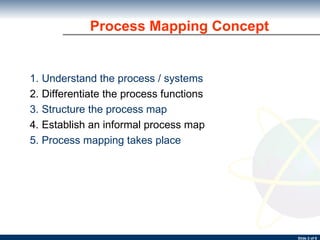
Process Mapping Concept 1. Understand the process / systems 2. Differentiate the process functions 3. Structure the process map  4. Establish an informal process map  5. Process mapping takes place
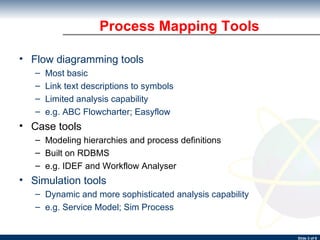
Process Mapping Tools Flow diagramming tools Most basic Link text descriptions to symbols Limited analysis capability e.g. ABC Flowcharter; Easyflow Case tools Modeling hierarchies and process definitions Built on RDBMS e.g. IDEF and Workflow Analyser Simulation tools Dynamic and more sophisticated analysis capability e.g. Service Model; Sim Process
Process workshops - approach Select a team of people who understand the process from beginning to end Determine key processes activities - don’t go down to the task level yet Capture and validate  key process information
Information gathering Some of the methods to information gathering include: Interviews (one to one) Workshops Workflow tracing Feedback sessions Questionnaires - for “customer” information Activity analysis - observe and record actions
Approach to take Interview first line managers/ supervisors Focus and activities performed and the outcomes Identify what ACTUALLY gets done Find the most significant cost/time/quality problems Identify process exceptions that confuse a clean process flow Identify critical information that is currently used Identify critical information that is needed (but not available) Seek  ideas for improvement
Key outcomes The outcome or result of a process workshop is as follows: Process maps and relationship models “ As-Is” process metrics - cycle time, cost, quality Process issues - findings Understanding of scope for improvement Rapid improvement opportunities
Modeling – from “As-is” to “To-be” Map existing processes: capture detail across the whole process diagrammatically adjust level of detail to capture key issues and opportunities Identify key performance factors: cycle times, costs, resource levels failures and root causes
Modeling – from “As-is”  to “To-be” Model new processes: remove redundancy, seek concurrency Animate new process: validate cycle times illustrate the new processes to those who will run them

Bpr 05 Process Mapping Tools

  • 1.
    Business Process Re-engineering05 – Process Mapping Tools and Techniques
  • 2.
    Process Mapping Concept1. Understand the process / systems 2. Differentiate the process functions 3. Structure the process map 4. Establish an informal process map 5. Process mapping takes place
  • 3.
    Process Mapping ToolsFlow diagramming tools Most basic Link text descriptions to symbols Limited analysis capability e.g. ABC Flowcharter; Easyflow Case tools Modeling hierarchies and process definitions Built on RDBMS e.g. IDEF and Workflow Analyser Simulation tools Dynamic and more sophisticated analysis capability e.g. Service Model; Sim Process
  • 4.
    Process workshops -approach Select a team of people who understand the process from beginning to end Determine key processes activities - don’t go down to the task level yet Capture and validate key process information
  • 5.
    Information gathering Someof the methods to information gathering include: Interviews (one to one) Workshops Workflow tracing Feedback sessions Questionnaires - for “customer” information Activity analysis - observe and record actions
  • 6.
    Approach to takeInterview first line managers/ supervisors Focus and activities performed and the outcomes Identify what ACTUALLY gets done Find the most significant cost/time/quality problems Identify process exceptions that confuse a clean process flow Identify critical information that is currently used Identify critical information that is needed (but not available) Seek ideas for improvement
  • 7.
    Key outcomes Theoutcome or result of a process workshop is as follows: Process maps and relationship models “ As-Is” process metrics - cycle time, cost, quality Process issues - findings Understanding of scope for improvement Rapid improvement opportunities
  • 8.
    Modeling – from“As-is” to “To-be” Map existing processes: capture detail across the whole process diagrammatically adjust level of detail to capture key issues and opportunities Identify key performance factors: cycle times, costs, resource levels failures and root causes
  • 9.
    Modeling – from“As-is” to “To-be” Model new processes: remove redundancy, seek concurrency Animate new process: validate cycle times illustrate the new processes to those who will run them