BUSINESS PROCESS
REENGINEERING
DHRUV MUKESHKUMAR PRAJAPATI
Traditional organization Transformed organization
Structure Hierarchical Networked
Worker focus Blue-collar/white collar Knowledge worker
Scale Large, stable Flexible
Orientation Operations Customer
Effort Individual Team
Key resources Capital People, information
Rewards Loyalty and seniority Performance and competence
Economic relationships Mergers and acquisitions Strategic alliances
Competitive calibration Multinational Global
Information technology Support Enabling
Direction Sound management Leadership
Organizational Transformation
These changes are arising from the new realities, which
include:
• Customers demand unique products and faster service.
• Technological innovations happen at a faster rate.
• New products develop more quickly.
• Product life cycles are shorter.
• Governments are forced to reduce deficits.
• Global economy is experiencing low growth.
• No protection exists from global competition.
What Is BUSINESS PROCESS REENGINEERING?
A business process is an activity or set of activities that will accomplish a
specific organizational goal.
Business process reengineering (BPR) is the fundamental redesign of an
organization and its operations to achieve dramatic performance
improvements in the areas of cost, quality, and cycle time.
Two types of Business processes:
1. Operational/core processes carried out by frontline workers in
delivering services to customers
2. Management support processes that assist the frontline workers in
delivering customer services
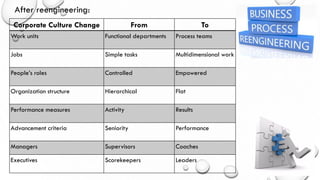
Corporate Culture Change From To
Work units Functional departments Process teams
Jobs Simple tasks Multidimensional work
People’s roles Controlled Empowered
Organization structure Hierarchical Flat
Performance measures Activity Results
Advancement criteria Seniority Performance
Managers Supervisors Coaches
Executives Scorekeepers Leaders
After reengineering:
Where BPR Can Be Applied?
BPR can be applied to virtually any organization in both the public and
private sectors. Industries that have achieved significant success with BPR
include banking and finance, construction, insurance, airlines, and
manufacturing.
Benefits from BPR:
• Costs can be dramatically reduced.
• Quality can be improved.
• Processes are streamlined.
• The work environment is enhanced.
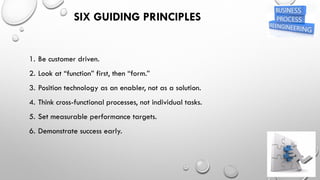
SIX GUIDING PRINCIPLES
1. Be customer driven.
2. Look at “function” first, then “form.”
3. Position technology as an enabler, not as a solution.
4. Think cross-functional processes, not individual tasks.
5. Set measurable performance targets.
6. Demonstrate success early.
ORGANIZING TO REENGINEER
Reengineering project is usually organized around four separate
entities.
1. The sponsor.
2. The project management team.
3. Design teams.
4. Steering committee.
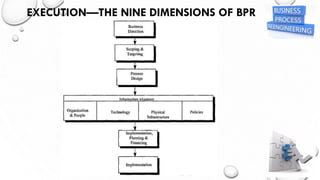
EXECUTION—THE NINE DIMENSIONS OF BPR
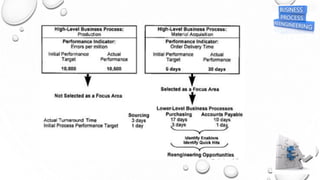
#1. BUSINESS DIRECTION
Since this step will determine the focus for the entire reengineering program, it requires a
great deal of emphasis. The critical elements of the business are as follows:
1. Confirming the mandate.
2. Identifying our critical success factors.
3. Identifying our reengineering targets.
4. Determine the measurable results.
5. Confirming our shared values and principles.
Customer-focused Reengineering Targets:
Customer stakeholder
requirements
Performance indicators Reengineering targets
Quick and on-time service Cycle time per
transaction
Reduce service delivery cycle time by
30%
Accuracy Number of errors Reduce number of errors to 0%
Cost Cost of service Reduce cost by 40%
#2. SCOPING AND TARGETING
When the business direction has been confirmed, it is possible to begin the
step of reviewing existing business processes and selecting those to be
redesigned.
1. Information Gathering and Data Collection (Multiple Lines of Evidence).
• As-is process modeling
• Interviews
• Research
2. Identification of Opportunities.
• Analysis based on the process models
i. Identification of bottlenecks, redundancies, and inefficiencies.
ii. Assessment of current performance and refining performance targets.
iii. Identification of potential enablers,
• Benchmarking.
• Ideas from interviews with staff.
• Screening of opportunities.
i. Proof of concept
ii. Project team challenge
iii. Cost-benefit analysis
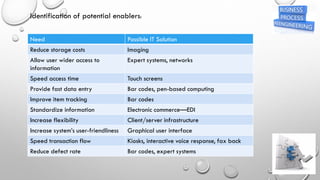
Identification of potential enablers:
Need Possible IT Solution
Reduce storage costs Imaging
Allow user wider access to
information
Expert systems, networks
Speed access time Touch screens
Provide fast data entry Bar codes, pen-based computing
Improve item tracking Bar codes
Standardize information Electronic commerce—EDI
Increase flexibility Client/server infrastructure
Increase system’s user-friendliness Graphical user interface
Speed transaction flow Kiosks, interactive voice response, fax back
Reduce defect rate Bar codes, expert systems
#3.PROCESS DESIGN
• The key to achieving breakthroughs in productivity is to start with a clean
slate. Trying to build on existing process designs tends to limit creativity and
will usually not yield the dramatic improvement that management is seeking
through BPR. By starting fresh, process design can reflect the full creative
forces of the design team and often leads to entirely new and better ways of
achieving the desired result.
• Principles :
1. Identify what, not who or where.
2. Design processes for the vast majority of situations, then look after the
exceptions.
3. Minimize permanent control functions.
4. Confirm that each function adds value to the delivery of products or
services.
5. Screen all functions for consequences of elimination.
6. Confirm consistency with the business direction.
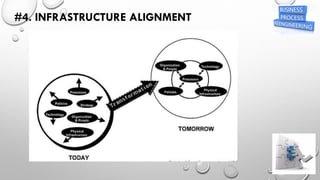
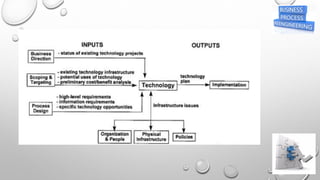
#4. INFRASTRUCTURE ALIGNMENT
#5. IMPLEMENTATION PLANNING AND FINANCING
The outputs from this dimension will include:
• Detailed implementation work packages.
• Bundling of work packages into transition phases.
• Final cost estimates for reengineering initiatives.
• Schedule for each phase.
• Financing options for the transition period.
#6. IMPLEMENTATION
CHANGE MANAGEMENT
• At the Start of the Project
• Throughout the Project
• Continuous Improvement
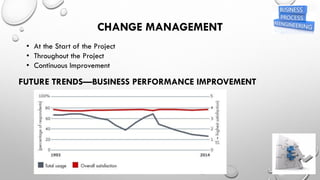
FUTURE TRENDS—BUSINESS PERFORMANCE IMPROVEMENT
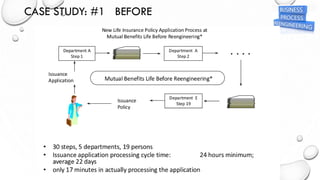
CASE STUDY: #1 BEFORE
AFTER
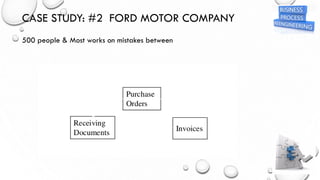
CASE STUDY: #2 FORD MOTOR COMPANY
500 people & Most works on mistakes between
BEFORE
AFTER
Business Process Re engineering

Business Process Re engineering

  • 1.
  • 2.
    Traditional organization Transformedorganization Structure Hierarchical Networked Worker focus Blue-collar/white collar Knowledge worker Scale Large, stable Flexible Orientation Operations Customer Effort Individual Team Key resources Capital People, information Rewards Loyalty and seniority Performance and competence Economic relationships Mergers and acquisitions Strategic alliances Competitive calibration Multinational Global Information technology Support Enabling Direction Sound management Leadership Organizational Transformation
  • 3.
    These changes arearising from the new realities, which include: • Customers demand unique products and faster service. • Technological innovations happen at a faster rate. • New products develop more quickly. • Product life cycles are shorter. • Governments are forced to reduce deficits. • Global economy is experiencing low growth. • No protection exists from global competition.
  • 4.
    What Is BUSINESSPROCESS REENGINEERING? A business process is an activity or set of activities that will accomplish a specific organizational goal. Business process reengineering (BPR) is the fundamental redesign of an organization and its operations to achieve dramatic performance improvements in the areas of cost, quality, and cycle time. Two types of Business processes: 1. Operational/core processes carried out by frontline workers in delivering services to customers 2. Management support processes that assist the frontline workers in delivering customer services
  • 5.
    Corporate Culture ChangeFrom To Work units Functional departments Process teams Jobs Simple tasks Multidimensional work People’s roles Controlled Empowered Organization structure Hierarchical Flat Performance measures Activity Results Advancement criteria Seniority Performance Managers Supervisors Coaches Executives Scorekeepers Leaders After reengineering:
  • 6.
    Where BPR CanBe Applied? BPR can be applied to virtually any organization in both the public and private sectors. Industries that have achieved significant success with BPR include banking and finance, construction, insurance, airlines, and manufacturing. Benefits from BPR: • Costs can be dramatically reduced. • Quality can be improved. • Processes are streamlined. • The work environment is enhanced.
  • 7.
    SIX GUIDING PRINCIPLES 1.Be customer driven. 2. Look at “function” first, then “form.” 3. Position technology as an enabler, not as a solution. 4. Think cross-functional processes, not individual tasks. 5. Set measurable performance targets. 6. Demonstrate success early.
  • 8.
    ORGANIZING TO REENGINEER Reengineeringproject is usually organized around four separate entities. 1. The sponsor. 2. The project management team. 3. Design teams. 4. Steering committee.
  • 9.
  • 10.
    #1. BUSINESS DIRECTION Sincethis step will determine the focus for the entire reengineering program, it requires a great deal of emphasis. The critical elements of the business are as follows: 1. Confirming the mandate. 2. Identifying our critical success factors. 3. Identifying our reengineering targets. 4. Determine the measurable results. 5. Confirming our shared values and principles. Customer-focused Reengineering Targets: Customer stakeholder requirements Performance indicators Reengineering targets Quick and on-time service Cycle time per transaction Reduce service delivery cycle time by 30% Accuracy Number of errors Reduce number of errors to 0% Cost Cost of service Reduce cost by 40%
  • 11.
    #2. SCOPING ANDTARGETING When the business direction has been confirmed, it is possible to begin the step of reviewing existing business processes and selecting those to be redesigned. 1. Information Gathering and Data Collection (Multiple Lines of Evidence). • As-is process modeling • Interviews • Research 2. Identification of Opportunities. • Analysis based on the process models i. Identification of bottlenecks, redundancies, and inefficiencies. ii. Assessment of current performance and refining performance targets. iii. Identification of potential enablers, • Benchmarking. • Ideas from interviews with staff. • Screening of opportunities. i. Proof of concept ii. Project team challenge iii. Cost-benefit analysis
  • 12.
    Identification of potentialenablers: Need Possible IT Solution Reduce storage costs Imaging Allow user wider access to information Expert systems, networks Speed access time Touch screens Provide fast data entry Bar codes, pen-based computing Improve item tracking Bar codes Standardize information Electronic commerce—EDI Increase flexibility Client/server infrastructure Increase system’s user-friendliness Graphical user interface Speed transaction flow Kiosks, interactive voice response, fax back Reduce defect rate Bar codes, expert systems
  • 14.
    #3.PROCESS DESIGN • Thekey to achieving breakthroughs in productivity is to start with a clean slate. Trying to build on existing process designs tends to limit creativity and will usually not yield the dramatic improvement that management is seeking through BPR. By starting fresh, process design can reflect the full creative forces of the design team and often leads to entirely new and better ways of achieving the desired result. • Principles : 1. Identify what, not who or where. 2. Design processes for the vast majority of situations, then look after the exceptions. 3. Minimize permanent control functions. 4. Confirm that each function adds value to the delivery of products or services. 5. Screen all functions for consequences of elimination. 6. Confirm consistency with the business direction.
  • 15.
  • 17.
    #5. IMPLEMENTATION PLANNINGAND FINANCING The outputs from this dimension will include: • Detailed implementation work packages. • Bundling of work packages into transition phases. • Final cost estimates for reengineering initiatives. • Schedule for each phase. • Financing options for the transition period.
  • 18.
  • 19.
    CHANGE MANAGEMENT • Atthe Start of the Project • Throughout the Project • Continuous Improvement FUTURE TRENDS—BUSINESS PERFORMANCE IMPROVEMENT
  • 20.
  • 21.
  • 22.
    CASE STUDY: #2FORD MOTOR COMPANY 500 people & Most works on mistakes between
  • 23.
  • 24.