Dr. Joseph A. De Feo, President & CEO
4 Steps
Drive
Process Innovation
To
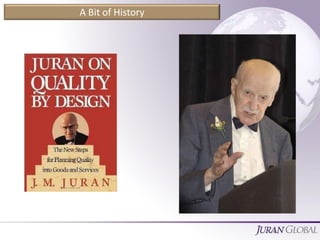
A Bit of History
Learning Objectives
1. Understand the four factors to means to systematically
create process innovations.
2. Understand how a systematic design method can
enhance innovation.
3. Assure process capability of key operational processes—
before delivery of new designs.
A process must be:
 Effective: Meeting the CTQ product/service goals
 Efficient: Cost, resource consumption, zero waste
 Timely: Takt time, cycle times, lead times, response times
 Goal oriented
 Simple and systematic
 Capable and repeatable
Are Your Processes Capable of Meeting CTQs?
What is a Business Process?
Supplier(s) Customer(s)
The Business Process
A process is a systematic series of actions
directed to the achievement of a goal.
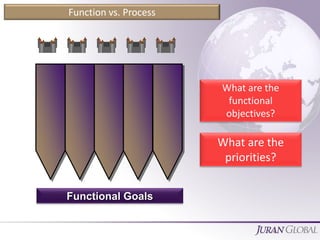
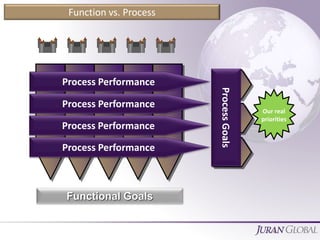
Functional Goals
Function vs. Process
What are the
functional
objectives?
What are the
priorities?
ProcessGoals
Our real
priorities
Functional Goals
Function vs. Process
 Strategic positioning within
organization and new product design
 Improvement project driven
 Financial/Business targets (revenue,
profit, market share, etc.)
 Unmet customer needs
 Reduce complexity and cost
 New technology
Why Innovate Processes?
“Process innovation is the implementation of a new
or significantly improved production, delivery or
business process method. This includes significant
changes in technology, techniques, methods,
equipment, software and talented people.”
What is Process Innovation?
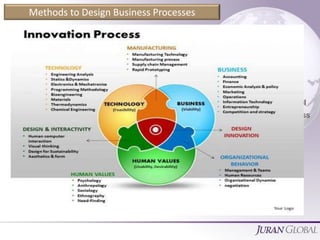
Methods to Design Business Processes
Initiate
Business
Process
Management
 Select
processes
 Identify
owners and
teams
 Process control
 Periodic process
review and
assessment
 RCCA
 Process
definition
 Customer
needs and
process flow
 Process
measurement
 Process
analysis
 Process design
or redesign
 Action plan for
implementation
 Plan
deployment
Phase One
Planning
Phase Two
Transfer
Phase Three
Operational
Management
Quality by Design Method
1. Evaluate Current Process Capability
2. Determine to Design or Redesign
Processes
3. Develop high-level process features and
goals
4. Develop detailed process features and
goals
5. Optimize Processes
6. Develop Process Capability
7. Publish final process designDeliver
Results
Design
Product
Define
Opportunity
Discover
Customer Needs
Develop
Process
Process Design Begins with Product DesignCustomers
Effect
Needs
(CTQs)
Goals
ProcessControl
Features
Effect
Control
Features
Goals
Needs
(CTQs)
Effect
Product
Functions
Goals
Product
Functions
Effect
Product
Features
Goals
Product
Features
Effect
Process
Features
Goals
Prioritized
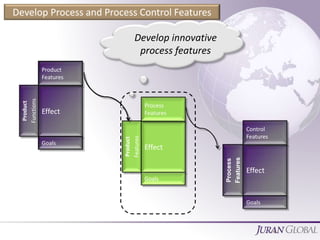
Develop Process and Process Control Features
Process
Features
Effect
Control
Features
Goals
Product
Functions
Effect
Product
Features
Goals
Product
Features
Effect
Process
Features
Goals
Develop innovative
process features
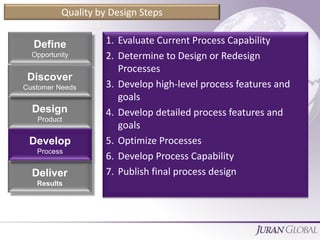
Quality by Design Steps
1. Evaluate Current Process Capability
2. Determine to Design or Redesign
Processes
3. Develop high-level process features and
goals
4. Develop detailed process features and
goals
5. Optimize Processes
6. Develop Process Capability
7. Publish final process designDeliver
Results
Design
Product
Define
Opportunity
Discover
Customer Needs
Develop
Process
Step 1: Collect Known Baselines
– Confirm all product features and goals
– Identify operating conditions
• Outside organization
• Within organization
• Physical and human
– History of effectiveness and efficiency of:
• Existing processes
• Existing sourced processes
• Similar processes
• Competitive or other production processes
• Benchmarked processes
• Customer experience
• Professional literature
• Simulation and estimation
– Add innovative ideas for new processes
 Regulators
 Payers
 Media
 Public
 Processors
 Distributors
 Consumers
 Users
External Customers
Step 1a: Define the Target Customers
Internal Customers
 Shipping
 Management
 Accounting
 Legal
 Governance
 Downstream
departments
 Potential
 Purchasing
 Sales
 Operations
Customers are a Cast
of Characters
Example: Relocation Service Customers
Steps in the Process Internal Customers
(Relocation Company)
External
Customers
Obvious
External Customers
Less Obvious
Agreement Sales force who negotiate service
contract
Client contract administration Senior Management client
company
Selection Relationship manager who services
client and client contact. Also resolves
differences that may arise either within
own organization or with client
Client contact person identifies
relocating transferee.
Also resolves differences that
may arise either within own
organization or with relocation
company
Intake Intake clerks who prepare "file" of
new transferee entering system
Transferee and his or her family
members
Transferee new manager
Relocation Service personnel, in branch locations,
who work with transferee until property
is sold or taken into inventory to be
marketed at a later date
Current manager of transferee Appraisers, title company, banks,
inspectors, real estate brokers,
government agencies, etc.
Individuals who close the file after
property has been sold to outside
buyer
Real estate attorneys: Buyer and
seller
Resale department which maintains
and sells inventoried properties
Gardeners, painters, home
repair contractors
Closing Ancillary departments (e.g.,
transportation and home finding) that
provide additional services to transferee
New manager of transferee Movers, real estate
agents, banks, school
systems
Accounts Receivable, Accounts Payable Accounts Payable, Internal
departments which support the
transferee and interface with
him/her
Transferee tax preparer
Step 1b: Define the Boundaries
START
Boundary
STOP
Boundary
Process
What must
suppliers provide?
The final
product
or service
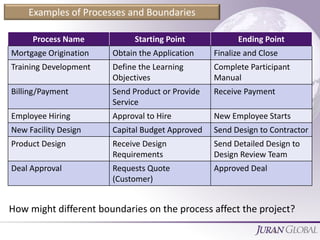
Examples of Processes and Boundaries
Process Name Starting Point Ending Point
Mortgage Origination Obtain the Application Finalize and Close
Training Development Define the Learning
Objectives
Complete Participant
Manual
Billing/Payment Send Product or Provide
Service
Receive Payment
Employee Hiring Approval to Hire New Employee Starts
New Facility Design Capital Budget Approved Send Design to Contractor
Product Design Receive Design
Requirements
Send Detailed Design to
Design Review Team
Deal Approval Requests Quote
(Customer)
Approved Deal
How might different boundaries on the process affect the project?
Step 1c: Set Performance Goals and Targets
– Goals for a design project are much more
complicated and extensive than for DMAIC
– They must still be SMART
 Customer and Quality
– Satisfaction, Loyalty
– No defects
 Financial
– Revenue
– Cost
– Margin
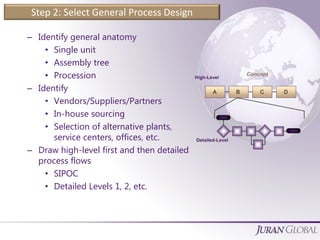
Step 2: Select General Process Design
– Identify general anatomy
• Single unit
• Assembly tree
• Procession
– Identify
• Vendors/Suppliers/Partners
• In-house sourcing
• Selection of alternative plants,
service centers, offices, etc.
– Draw high-level first and then detailed
process flows
• SIPOC
• Detailed Levels 1, 2, etc.
Multiple
Inputs
Single Unit
Vendors In House Subassembly Final Assembly
Assembly Tree
Procession
Step 2: Select General Process Design
Step 3: Identify High-Level Features & Goals
– Include in your design all departments and all suppliers with any
inputs for the product/service
• Remember customer inputs
– Create a Value Stream Map of the desired state
• Forecast demand  Takt time
• Maximize yield
• Identify constraints
– Balanced flow
• Minimize lead time
• Minimize inventories
• Minimize eight deadly wastes
– Maximize yield of the process by minimizing the defects produced
Process Maps to
define the steps
needed to achieve
the outcome
Step 3: Construct High-level Flow
Detailed
Process
Measures
PS I O C
Suppliers Inputs Process Outputs Customers or
Internal
Customer
CTQs CTQs
Measures
SIPOC Example
SIPOC - Customer Complaint Process
SUPPLIER
INPUT
(use nouns)
PROCESS
(use verbs)
OUTPUT
(use nouns)
CUSTOMER
Consumer
Complaints &
Returns
Customer Dissatisfier captured
(Customer Service Rep)
Documentation of
Disasatisfaction
Customer Service Center
Customer Service Center Information about Dissatisfaction
Dissatisfier acknowledged and
verified
(Customer Service Rep)
Acknowlegement
Communication
Consumer
Operations
Customer Service Center
Operations
Transaction History
Dissatisfier researched
(Operations)
Root Cause Analysis
Operations
Customer Service Center
Operations Root Cause Information
Determine resolution
(Operations)
Problem Remedy and Service
Recovery Actions
Customer Service Center
Operations
Problem Remedy and Service
Recovery Actions
Resolution communicated
(Customer Service)
Resolution Communication Consumer
Operations
Problem Remedy and Service
Recovery Actions
Effectuate resolution
(Operations)
Completed Remendy and
Service Recover Actions
Consumer
Operations
Customer Service Center
Dissatisfier Information
Root Cause Information
Dissatisfier tracking and learning
(Customer Retention)
Analysis of Customer
Dissatisfiers
Company Management
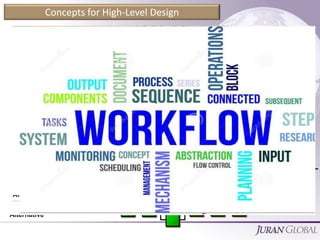
Concepts for High-Level Design
Optimum
Alternative
Functions
Process Concept
Capability
Analysis
Concept
#1
Concept
#2
Concept
#3
Generate &
Evaluate
Concept
#4
Step 4: Identify Detailed Features & Goals
– Facilities, equipment, staffing, training, maintenance
– Standard Operating Procedures
– Standard Work and Visual Factory, including 6S
– Optimize
• Set targets and spec limits for inputs
– Conduct tests:
• Individual steps
• Individual transactions
• Sub processes
• Full pilot/prototype run
– Create Process Spreadsheet with detailed features and goals
The Design Spreadsheets
OutputFeatures
Process Features
Deal with
contradictions up
front.
Process Design Spreadsheet
.
Loaddatabaseengine
Loaddatabasestructure
Burnindatabase
Runsetupquery
MoldTemperature
MoldSpeed
MoldPressure
Score* Detailed Product Features Weight
6.5 2.1 Meg query 0.305 9 9 1 9 28
4.1 Mega Hard database engine 0.193 9 9
3.0 500 Meg data storage 0.141 9 9 18
1.7 Carbon composite case 0.081 9 3 9 21
1.7 Auto web access option 0.078 0
1.4 0.3 mm pitch connectors 0.064 0
1.2 AHP Validation Rules 0.059 0
1.2 ICD10 & CPT coding 0.059 0
0.4 Quarterly code update 0.020 0
4.5 4.0 1.6 2.7 0.7 0.2 0.7
Unit of Measure MIPS Mbit MIPS Sec o
C rpm Bar
Target 14 537 14 0.11 180 120 90
USL 0.13 185 125 92
LSL 13.5 467 13.5 175 115 88
Maximum allowable defect rate (ppm) 4 4 4 1,000 5,000 5,000 5,000
* Raw score from Detailed Design analysis. Weight normalizes sum to 100.
Goal
Detailed Product Features to Process Features
What impact does each process feature
have on each detailed product feature? Total
Relationship
Total Ranking
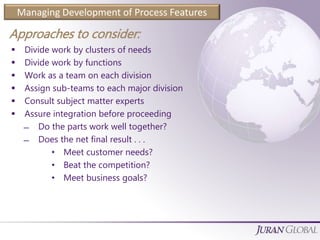
Managing Development of Process Features
Approaches to consider:
 Divide work by clusters of needs
 Divide work by functions
 Work as a team on each division
 Assign sub-teams to each major division
 Consult subject matter experts
 Assure integration before proceeding
̶ Do the parts work well together?
̶ Does the net final result . . .
• Meet customer needs?
• Beat the competition?
• Meet business goals?
Step 5: Optimize Features & Goals
 Effectiveness:
– DPU and FTY
– Tolerances
– COPQ
– Review and adapt:
• Criticality analysis
• FMEA
• Fault tree analysis
• Value analysis
 Timeliness:
– Minimum lead time
– Optimal service levels
 Efficiency:
– Optimal process load
– Optimal line balance
– Minimize change over
– Minimum inventories
– Minimum staffing
Design Considerations
Constraints include:
– Capital cost
– Available space
– Safety concerns
– Environmental impact and projected effluents and
emissions
– Waste production
– Operating and maintenance costs
Designs have objectives and constraints, and even a
simple process requires a trade-off among such factors
Step 6: Establish Process Capability
– Pause and complete Development of Controls before Design
Verification Test
– Complete Design Verification Test
Step 7: Set & Publish Final Process Design
– Complete Process Design Review based on Design
Verification Test
– Complete and publish all documentation
– Plan for transfer to operations
4 Steps for Successful Design Innovation
1. Be systematic – record information on spreadsheets.
- Apply new and proven tools.
- Include cross-functional staff in design review.
2. Focus on the user or the customer.
- Discover hidden customers and hidden needs.
3. Confront contradictions or challenges directly.
- Do not take “no” or “can’t” for an answer.
4. Design WORKFLOWS to deliver benefits that meet
customer and business needs.
Connect With Us
@Juran_Institute
www.youtube.com/user/JuranInstitut
e
www.facebook.com/JuranInstitute
www.linkedin.com/company/juran-
institute
More Resources
 business innovation
 business process improvement
 continuous improvement
 dmaic
 juran quality handbook
 lean manufacturing
 lean six sigma
 lean transformation
 operational excellence
 process innovation
 quality assurance
 quality control
 quality improvement
 management consulting firm
 iso 9000 2015
 six sigma certification
 what is lean
 what is six sigma
Click any link for more information
Thank You!
Copyright ©2015, Juran Institute, Inc.
For more information, please visit www.juran.com
Contact us at: info@juran.com
We hope to see you in our future
webinars!
If you would like a copy of this
presentation or would like to
discuss this topic with your
organization, contact me at:
jdefeo@juran.com
Thank You and DO NOT FORGET!

4 Steps to Drive Process Innovation

  • 1.
    Dr. Joseph A.De Feo, President & CEO 4 Steps Drive Process Innovation To
  • 2.
    A Bit ofHistory
  • 3.
    Learning Objectives 1. Understandthe four factors to means to systematically create process innovations. 2. Understand how a systematic design method can enhance innovation. 3. Assure process capability of key operational processes— before delivery of new designs.
  • 4.
    A process mustbe:  Effective: Meeting the CTQ product/service goals  Efficient: Cost, resource consumption, zero waste  Timely: Takt time, cycle times, lead times, response times  Goal oriented  Simple and systematic  Capable and repeatable Are Your Processes Capable of Meeting CTQs?
  • 5.
    What is aBusiness Process? Supplier(s) Customer(s) The Business Process A process is a systematic series of actions directed to the achievement of a goal.
  • 6.
    Functional Goals Function vs.Process What are the functional objectives? What are the priorities?
  • 7.
  • 8.
     Strategic positioningwithin organization and new product design  Improvement project driven  Financial/Business targets (revenue, profit, market share, etc.)  Unmet customer needs  Reduce complexity and cost  New technology Why Innovate Processes?
  • 9.
    “Process innovation isthe implementation of a new or significantly improved production, delivery or business process method. This includes significant changes in technology, techniques, methods, equipment, software and talented people.” What is Process Innovation?
  • 10.
    Methods to DesignBusiness Processes Initiate Business Process Management  Select processes  Identify owners and teams  Process control  Periodic process review and assessment  RCCA  Process definition  Customer needs and process flow  Process measurement  Process analysis  Process design or redesign  Action plan for implementation  Plan deployment Phase One Planning Phase Two Transfer Phase Three Operational Management
  • 11.
    Quality by DesignMethod 1. Evaluate Current Process Capability 2. Determine to Design or Redesign Processes 3. Develop high-level process features and goals 4. Develop detailed process features and goals 5. Optimize Processes 6. Develop Process Capability 7. Publish final process designDeliver Results Design Product Define Opportunity Discover Customer Needs Develop Process
  • 12.
    Process Design Beginswith Product DesignCustomers Effect Needs (CTQs) Goals ProcessControl Features Effect Control Features Goals Needs (CTQs) Effect Product Functions Goals Product Functions Effect Product Features Goals Product Features Effect Process Features Goals Prioritized
  • 13.
    Develop Process andProcess Control Features Process Features Effect Control Features Goals Product Functions Effect Product Features Goals Product Features Effect Process Features Goals Develop innovative process features
  • 14.
    Quality by DesignSteps 1. Evaluate Current Process Capability 2. Determine to Design or Redesign Processes 3. Develop high-level process features and goals 4. Develop detailed process features and goals 5. Optimize Processes 6. Develop Process Capability 7. Publish final process designDeliver Results Design Product Define Opportunity Discover Customer Needs Develop Process
  • 15.
    Step 1: CollectKnown Baselines – Confirm all product features and goals – Identify operating conditions • Outside organization • Within organization • Physical and human – History of effectiveness and efficiency of: • Existing processes • Existing sourced processes • Similar processes • Competitive or other production processes • Benchmarked processes • Customer experience • Professional literature • Simulation and estimation – Add innovative ideas for new processes
  • 16.
     Regulators  Payers Media  Public  Processors  Distributors  Consumers  Users External Customers Step 1a: Define the Target Customers Internal Customers  Shipping  Management  Accounting  Legal  Governance  Downstream departments  Potential  Purchasing  Sales  Operations Customers are a Cast of Characters
  • 17.
    Example: Relocation ServiceCustomers Steps in the Process Internal Customers (Relocation Company) External Customers Obvious External Customers Less Obvious Agreement Sales force who negotiate service contract Client contract administration Senior Management client company Selection Relationship manager who services client and client contact. Also resolves differences that may arise either within own organization or with client Client contact person identifies relocating transferee. Also resolves differences that may arise either within own organization or with relocation company Intake Intake clerks who prepare "file" of new transferee entering system Transferee and his or her family members Transferee new manager Relocation Service personnel, in branch locations, who work with transferee until property is sold or taken into inventory to be marketed at a later date Current manager of transferee Appraisers, title company, banks, inspectors, real estate brokers, government agencies, etc. Individuals who close the file after property has been sold to outside buyer Real estate attorneys: Buyer and seller Resale department which maintains and sells inventoried properties Gardeners, painters, home repair contractors Closing Ancillary departments (e.g., transportation and home finding) that provide additional services to transferee New manager of transferee Movers, real estate agents, banks, school systems Accounts Receivable, Accounts Payable Accounts Payable, Internal departments which support the transferee and interface with him/her Transferee tax preparer
  • 18.
    Step 1b: Definethe Boundaries START Boundary STOP Boundary Process What must suppliers provide? The final product or service
  • 19.
    Examples of Processesand Boundaries Process Name Starting Point Ending Point Mortgage Origination Obtain the Application Finalize and Close Training Development Define the Learning Objectives Complete Participant Manual Billing/Payment Send Product or Provide Service Receive Payment Employee Hiring Approval to Hire New Employee Starts New Facility Design Capital Budget Approved Send Design to Contractor Product Design Receive Design Requirements Send Detailed Design to Design Review Team Deal Approval Requests Quote (Customer) Approved Deal How might different boundaries on the process affect the project?
  • 20.
    Step 1c: SetPerformance Goals and Targets – Goals for a design project are much more complicated and extensive than for DMAIC – They must still be SMART  Customer and Quality – Satisfaction, Loyalty – No defects  Financial – Revenue – Cost – Margin
  • 21.
    Step 2: SelectGeneral Process Design – Identify general anatomy • Single unit • Assembly tree • Procession – Identify • Vendors/Suppliers/Partners • In-house sourcing • Selection of alternative plants, service centers, offices, etc. – Draw high-level first and then detailed process flows • SIPOC • Detailed Levels 1, 2, etc.
  • 22.
    Multiple Inputs Single Unit Vendors InHouse Subassembly Final Assembly Assembly Tree Procession Step 2: Select General Process Design
  • 23.
    Step 3: IdentifyHigh-Level Features & Goals – Include in your design all departments and all suppliers with any inputs for the product/service • Remember customer inputs – Create a Value Stream Map of the desired state • Forecast demand  Takt time • Maximize yield • Identify constraints – Balanced flow • Minimize lead time • Minimize inventories • Minimize eight deadly wastes – Maximize yield of the process by minimizing the defects produced
  • 24.
    Process Maps to definethe steps needed to achieve the outcome Step 3: Construct High-level Flow Detailed Process Measures PS I O C Suppliers Inputs Process Outputs Customers or Internal Customer CTQs CTQs Measures
  • 25.
    SIPOC Example SIPOC -Customer Complaint Process SUPPLIER INPUT (use nouns) PROCESS (use verbs) OUTPUT (use nouns) CUSTOMER Consumer Complaints & Returns Customer Dissatisfier captured (Customer Service Rep) Documentation of Disasatisfaction Customer Service Center Customer Service Center Information about Dissatisfaction Dissatisfier acknowledged and verified (Customer Service Rep) Acknowlegement Communication Consumer Operations Customer Service Center Operations Transaction History Dissatisfier researched (Operations) Root Cause Analysis Operations Customer Service Center Operations Root Cause Information Determine resolution (Operations) Problem Remedy and Service Recovery Actions Customer Service Center Operations Problem Remedy and Service Recovery Actions Resolution communicated (Customer Service) Resolution Communication Consumer Operations Problem Remedy and Service Recovery Actions Effectuate resolution (Operations) Completed Remendy and Service Recover Actions Consumer Operations Customer Service Center Dissatisfier Information Root Cause Information Dissatisfier tracking and learning (Customer Retention) Analysis of Customer Dissatisfiers Company Management
  • 26.
    Concepts for High-LevelDesign Optimum Alternative Functions Process Concept Capability Analysis Concept #1 Concept #2 Concept #3 Generate & Evaluate Concept #4
  • 27.
    Step 4: IdentifyDetailed Features & Goals – Facilities, equipment, staffing, training, maintenance – Standard Operating Procedures – Standard Work and Visual Factory, including 6S – Optimize • Set targets and spec limits for inputs – Conduct tests: • Individual steps • Individual transactions • Sub processes • Full pilot/prototype run – Create Process Spreadsheet with detailed features and goals
  • 28.
    The Design Spreadsheets OutputFeatures ProcessFeatures Deal with contradictions up front.
  • 29.
    Process Design Spreadsheet . Loaddatabaseengine Loaddatabasestructure Burnindatabase Runsetupquery MoldTemperature MoldSpeed MoldPressure Score*Detailed Product Features Weight 6.5 2.1 Meg query 0.305 9 9 1 9 28 4.1 Mega Hard database engine 0.193 9 9 3.0 500 Meg data storage 0.141 9 9 18 1.7 Carbon composite case 0.081 9 3 9 21 1.7 Auto web access option 0.078 0 1.4 0.3 mm pitch connectors 0.064 0 1.2 AHP Validation Rules 0.059 0 1.2 ICD10 & CPT coding 0.059 0 0.4 Quarterly code update 0.020 0 4.5 4.0 1.6 2.7 0.7 0.2 0.7 Unit of Measure MIPS Mbit MIPS Sec o C rpm Bar Target 14 537 14 0.11 180 120 90 USL 0.13 185 125 92 LSL 13.5 467 13.5 175 115 88 Maximum allowable defect rate (ppm) 4 4 4 1,000 5,000 5,000 5,000 * Raw score from Detailed Design analysis. Weight normalizes sum to 100. Goal Detailed Product Features to Process Features What impact does each process feature have on each detailed product feature? Total Relationship Total Ranking
  • 30.
    Managing Development ofProcess Features Approaches to consider:  Divide work by clusters of needs  Divide work by functions  Work as a team on each division  Assign sub-teams to each major division  Consult subject matter experts  Assure integration before proceeding ̶ Do the parts work well together? ̶ Does the net final result . . . • Meet customer needs? • Beat the competition? • Meet business goals?
  • 31.
    Step 5: OptimizeFeatures & Goals  Effectiveness: – DPU and FTY – Tolerances – COPQ – Review and adapt: • Criticality analysis • FMEA • Fault tree analysis • Value analysis  Timeliness: – Minimum lead time – Optimal service levels  Efficiency: – Optimal process load – Optimal line balance – Minimize change over – Minimum inventories – Minimum staffing
  • 32.
    Design Considerations Constraints include: –Capital cost – Available space – Safety concerns – Environmental impact and projected effluents and emissions – Waste production – Operating and maintenance costs Designs have objectives and constraints, and even a simple process requires a trade-off among such factors
  • 33.
    Step 6: EstablishProcess Capability – Pause and complete Development of Controls before Design Verification Test – Complete Design Verification Test
  • 34.
    Step 7: Set& Publish Final Process Design – Complete Process Design Review based on Design Verification Test – Complete and publish all documentation – Plan for transfer to operations
  • 35.
    4 Steps forSuccessful Design Innovation 1. Be systematic – record information on spreadsheets. - Apply new and proven tools. - Include cross-functional staff in design review. 2. Focus on the user or the customer. - Discover hidden customers and hidden needs. 3. Confront contradictions or challenges directly. - Do not take “no” or “can’t” for an answer. 4. Design WORKFLOWS to deliver benefits that meet customer and business needs.
  • 36.
  • 37.
    More Resources  businessinnovation  business process improvement  continuous improvement  dmaic  juran quality handbook  lean manufacturing  lean six sigma  lean transformation  operational excellence  process innovation  quality assurance  quality control  quality improvement  management consulting firm  iso 9000 2015  six sigma certification  what is lean  what is six sigma Click any link for more information
  • 38.
    Thank You! Copyright ©2015,Juran Institute, Inc. For more information, please visit www.juran.com Contact us at: info@juran.com
  • 39.
    We hope tosee you in our future webinars! If you would like a copy of this presentation or would like to discuss this topic with your organization, contact me at: jdefeo@juran.com Thank You and DO NOT FORGET!