Five step Methodology to
     implement BPR


            Roy Antony Arnold G
            Lecturer/CSE
            Infant Jesus College of Engineering
            Tuticorin, Tamilnadu, India
Performance Levels of 3 major process:

   Customer Orders – Took too long to procure,
    record and transmit for execution
   Customer Service – Was error-prone, time
    consuming and suffered from stock-out problems.
   Customer Feedback – Was not regular, and
    even when it did take place was done only on
    sampling basis.
Changes to be made…
 Instead of having three points of contact with the customer,
  namely Sales Executive, the Service and Installation
  Technician and the Market Researcher, there will be only
  a Customer Executive who will perform all the functions.
 Instead of an expensive and time consuming hierarchy involving
  branch offices, regional offices and then several layers
  at the Corporate Office, there will only be Office-Cum-
  Depots having direct communication with the
  Marketing Manager at the Corporate Office.
 All Customer Executives are being provided with handheld
  computers which can be used for booking orders, for
  providing help during installation and service and for
  recording customer responses and feedback.
This is no
   longer a
choice, it is an
imperative for
   survival
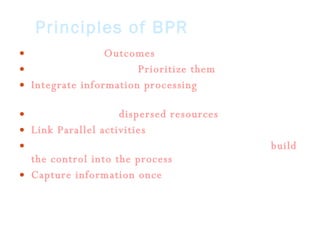
Principles of BPR
 Organize around Outcomes, not the task.
 Identify all Processes and Prioritize them in order of redesign.
 Integrate information processing work into real work that
    produces the information.
   Treat geographically dispersed resources
   Link Parallel activities to integrate the results.
   Put the decision point where the work is performed, and build
    the control into the process.
   Capture information once and at the source .
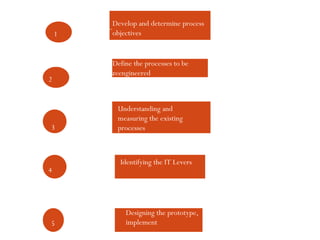
Develop and determine process    Develop Vision
    1   objectives


        Define the processes to be
                                        Define Process
        reengineered
2


         Understanding and
         measuring the existing         Measure Process
3        processes


          Identifying the IT Levers
4                                       Identify IT Lever


            Designing the prototype,
5           implement                   Prototype
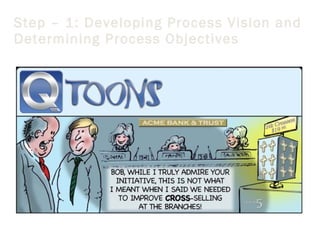
Step – 1: Developing Process Vision and
Determining Process Objectives
Step – 1: Developing Process Vision and
Determining Process Objectives
   The organization should focus on the future competition, products
    and customer expectations, and the plan model to succeed in the
    environment.
   This first step recognizes following:
       Market/Customer driven Business Vision and Goals
       Achievement of business vision may involve reengineering of more
        than one process
       Process attributes (cost, quality, time etc.) and process measures (half
        the cost, in a day etc) need to be derived.
   At the end of this step, we would be clear on
       What are the key process? (Identification)
       How will they reengineered process perform qualitatively and
        quantitatively? (Vision & Objectives)
2: Defining the Process to be
Reengineered
2: Defining the Process to be
  Reengineered
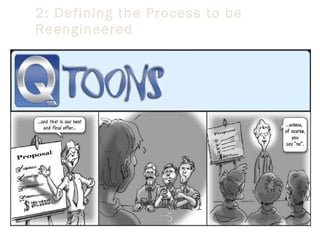
 Develop and establish a common understanding of each
 process across all executives, clerks and workers involved in the
 execution of the respective processes.
 Ask probing questions in order to obtain clarity on
 what we mean by an order fulfillment process.
 Control and ensure the process outcome
   Amber alert (x days) to division head for unfilled orders
   Red alert (y days) to CEO for unfilled orders
   Spare lie in stock for more than z months, red alert to
   CEO
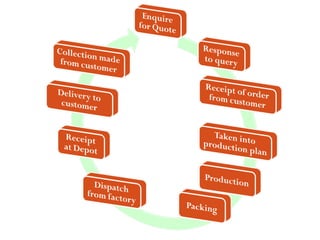
Order Fulfillment
    Process

     Di
        s
    Lo trib
       gi uti
          st on
            ic
               s
Step 2: Contd…
 Performance metrics are measured..
   Planning – lead time committed for orders,
    percentage of delayed deliveries
   Production – yields and efficiency, capacity
    utilization
   Shipment – Cost of shipment
 If no value to customer – No reengineering
 This step helps to create an early vision of the
  reengineered process for the departments covered by the
  process.
3: Understanding and Measuring
Existing Processes
3: Understanding and Measuring
Existing Processes
 Go through a presentation of how the existing system
  works, and find, whenever possible, the current
  process measures available.
 Otherwise, poor performance levels of the existing process may
  inhibit us.
    Example: 50% of the orders were termed complex or special. It
     took 12 to 18 weeks to be shipped.
 This step forces the enterprise to obtain a common understanding
  of terms like,
   Waiting time, Response time, etc.,
 If it is first time, the result of performance measures on the
  existing system may lead to dissatisfaction.
4: Identifying IT Levers
 Every effort in reengineering is also an initiative in process
  improvement.
 Reengineering can be differentiated on the basis of two factors:
   1. Reengineering should lead to a dramatic
      improvement in process performance on the
      selected measures.
   2. Reengineering should end up achieving process
      destruction through effective or innovative
      deployment of IT.
 Need to visualize scenarios where IT could be wisely
  deployed to drastically simplify the process.
    Example: Using bar-code scanners
5: Designing & Building
Prototype
5: Designing & Building
   Prototype
 In any reengineering activity “Ideas are Acts”.
 When the core group of the organization spends valuable time and
  invaluable thoughts on visualizing the reengineered processes,
  simultaneously, owners who would construct the reengineered
  processes are created. This is action.
 This final stage of implementation is unique to each organization and
  project because it involves issues that are multi-dimensional in
  nature -
   Issues relating to managing technology
   Changing people’s attitudes and mindsets
   Creating new organization structures and
   Managing the entire change process
Contd…
 It would be difficult for people who were managing the earlier
  system to adapt themselves to a new “revolutionary way
  of doing things”.
 Prototype prove to be very valuable in working on mindsets
  as they provide a “learning environment” for people to
  adapt to the new system.
 Prototypes always need tuning, more tuning, and still
  more tuning and that makes the job of implementation
  considerably easy and smooth.
BPR Drivers
 ICT Developments (info, commu, tech)
 Broken Processes.
 Local, Global & Faster Competition
 Rising overhead costs.
 Shorter product life cycles
 Stagnant business conditions
 Unsatisfied Customers.
Why Organizations Don’t Reengineer?

   Complacency( Satisfaction)


   Political Resistance


   New Developments


   Fear of Unknown and Failure
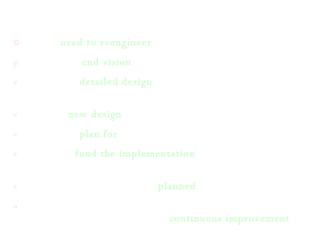
Eight Decision Points in any BPR
Project
 o   Do we need to reengineer this business operation?
 p   What is the end vision of the results of our reengineering?
 e   What is the detailed design for our reengineered business
     operation?
 e   Will our new design for the business operation is suitable?
 s   What is the plan for getting that design implemented?
 s   Should we fund the implementation of the business
     reengineering design?
 s   Is the implementation going as planned?
 a   Is the reengineered business operation ready to take on
                      responsibility for continuous improvement to
     the process?
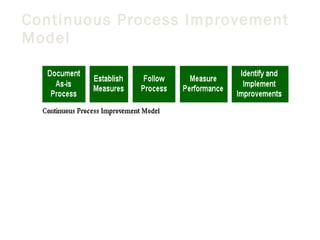
Continuous Process Improvement
Model


This method for improving business processes is
effective to obtain gradual, incremental improvement
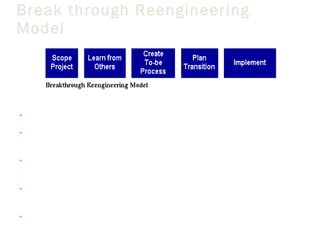
Break through Reengineering
Model


•Defining the scope and objectives of your reengineering project,
•Learning process (with your customers, your employees, your
competitors and non-competitors, and with new technology).
•Create a vision for the future and design new business processes.
("to be" state)
•Create a plan of action based on the gap between your current
processes, technologies and structures.
•Implementing your solution.
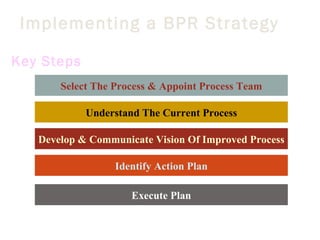
Implementing a BPR Strategy

Key Steps
       Select The Process & Appoint Process Team

            Understand The Current Process

   Develop & Communicate Vision Of Improved Process

                  Identify Action Plan

                     Execute Plan

Five Step Methodology To Implement Bpr

  • 1.
    Five step Methodologyto implement BPR Roy Antony Arnold G Lecturer/CSE Infant Jesus College of Engineering Tuticorin, Tamilnadu, India
  • 2.
    Performance Levels of3 major process:  Customer Orders – Took too long to procure, record and transmit for execution  Customer Service – Was error-prone, time consuming and suffered from stock-out problems.  Customer Feedback – Was not regular, and even when it did take place was done only on sampling basis.
  • 3.
    Changes to bemade…  Instead of having three points of contact with the customer, namely Sales Executive, the Service and Installation Technician and the Market Researcher, there will be only a Customer Executive who will perform all the functions.  Instead of an expensive and time consuming hierarchy involving branch offices, regional offices and then several layers at the Corporate Office, there will only be Office-Cum- Depots having direct communication with the Marketing Manager at the Corporate Office.  All Customer Executives are being provided with handheld computers which can be used for booking orders, for providing help during installation and service and for recording customer responses and feedback.
  • 4.
    This is no longer a choice, it is an imperative for survival
  • 5.
    Principles of BPR Organize around Outcomes, not the task.  Identify all Processes and Prioritize them in order of redesign.  Integrate information processing work into real work that produces the information.  Treat geographically dispersed resources  Link Parallel activities to integrate the results.  Put the decision point where the work is performed, and build the control into the process.  Capture information once and at the source .
  • 6.
    Develop and determineprocess Develop Vision 1 objectives Define the processes to be Define Process reengineered 2 Understanding and measuring the existing Measure Process 3 processes Identifying the IT Levers 4 Identify IT Lever Designing the prototype, 5 implement Prototype
  • 7.
    Step – 1:Developing Process Vision and Determining Process Objectives
  • 8.
    Step – 1:Developing Process Vision and Determining Process Objectives  The organization should focus on the future competition, products and customer expectations, and the plan model to succeed in the environment.  This first step recognizes following:  Market/Customer driven Business Vision and Goals  Achievement of business vision may involve reengineering of more than one process  Process attributes (cost, quality, time etc.) and process measures (half the cost, in a day etc) need to be derived.  At the end of this step, we would be clear on  What are the key process? (Identification)  How will they reengineered process perform qualitatively and quantitatively? (Vision & Objectives)
  • 9.
    2: Defining theProcess to be Reengineered
  • 10.
    2: Defining theProcess to be Reengineered  Develop and establish a common understanding of each process across all executives, clerks and workers involved in the execution of the respective processes.  Ask probing questions in order to obtain clarity on what we mean by an order fulfillment process.  Control and ensure the process outcome  Amber alert (x days) to division head for unfilled orders  Red alert (y days) to CEO for unfilled orders  Spare lie in stock for more than z months, red alert to CEO
  • 11.
    Order Fulfillment Process Di s Lo trib gi uti st on ic s
  • 12.
    Step 2: Contd… Performance metrics are measured..  Planning – lead time committed for orders, percentage of delayed deliveries  Production – yields and efficiency, capacity utilization  Shipment – Cost of shipment  If no value to customer – No reengineering  This step helps to create an early vision of the reengineered process for the departments covered by the process.
  • 13.
    3: Understanding andMeasuring Existing Processes
  • 14.
    3: Understanding andMeasuring Existing Processes  Go through a presentation of how the existing system works, and find, whenever possible, the current process measures available.  Otherwise, poor performance levels of the existing process may inhibit us.  Example: 50% of the orders were termed complex or special. It took 12 to 18 weeks to be shipped.  This step forces the enterprise to obtain a common understanding of terms like,  Waiting time, Response time, etc.,  If it is first time, the result of performance measures on the existing system may lead to dissatisfaction.
  • 15.
  • 16.
    4: Identifying ITLevers  Every effort in reengineering is also an initiative in process improvement.  Reengineering can be differentiated on the basis of two factors: 1. Reengineering should lead to a dramatic improvement in process performance on the selected measures. 2. Reengineering should end up achieving process destruction through effective or innovative deployment of IT.  Need to visualize scenarios where IT could be wisely deployed to drastically simplify the process.  Example: Using bar-code scanners
  • 17.
    5: Designing &Building Prototype
  • 18.
    5: Designing &Building Prototype  In any reengineering activity “Ideas are Acts”.  When the core group of the organization spends valuable time and invaluable thoughts on visualizing the reengineered processes, simultaneously, owners who would construct the reengineered processes are created. This is action.  This final stage of implementation is unique to each organization and project because it involves issues that are multi-dimensional in nature -  Issues relating to managing technology  Changing people’s attitudes and mindsets  Creating new organization structures and  Managing the entire change process
  • 19.
    Contd…  It wouldbe difficult for people who were managing the earlier system to adapt themselves to a new “revolutionary way of doing things”.  Prototype prove to be very valuable in working on mindsets as they provide a “learning environment” for people to adapt to the new system.  Prototypes always need tuning, more tuning, and still more tuning and that makes the job of implementation considerably easy and smooth.
  • 21.
    BPR Drivers  ICTDevelopments (info, commu, tech)  Broken Processes.  Local, Global & Faster Competition  Rising overhead costs.  Shorter product life cycles  Stagnant business conditions  Unsatisfied Customers.
  • 22.
    Why Organizations Don’tReengineer?  Complacency( Satisfaction)  Political Resistance  New Developments  Fear of Unknown and Failure
  • 23.
    Eight Decision Pointsin any BPR Project o Do we need to reengineer this business operation? p What is the end vision of the results of our reengineering? e What is the detailed design for our reengineered business operation? e Will our new design for the business operation is suitable? s What is the plan for getting that design implemented? s Should we fund the implementation of the business reengineering design? s Is the implementation going as planned? a Is the reengineered business operation ready to take on responsibility for continuous improvement to the process?
  • 24.
    Continuous Process Improvement Model Thismethod for improving business processes is effective to obtain gradual, incremental improvement
  • 25.
    Break through Reengineering Model •Definingthe scope and objectives of your reengineering project, •Learning process (with your customers, your employees, your competitors and non-competitors, and with new technology). •Create a vision for the future and design new business processes. ("to be" state) •Create a plan of action based on the gap between your current processes, technologies and structures. •Implementing your solution.
  • 26.
    Implementing a BPRStrategy Key Steps Select The Process & Appoint Process Team Understand The Current Process Develop & Communicate Vision Of Improved Process Identify Action Plan Execute Plan