Lean Thinking Travis Eck / Senior Business Process Analyst [email_address] 406-239-3773
Lean Thinking Fundamental Objective:  To create the most value while consuming the fewest resources. Define value from the  customer’s perspective. Identify which process steps  create value  and which are only  waste  ( muda ). Work to eliminate the root causes of the waste and allow for one-piece, continuous flow.
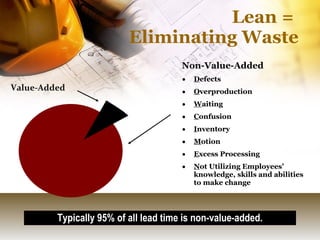
Lean =  Eliminating Waste Non-Value-Added D efects O verproduction W aiting C onfusion I nventory M otion E xcess Processing N ot Utilizing Employees’ knowledge, skills and abilities to make change Typically 95% of all lead time is non-value-added. Value-Added
Waste Overproduction Inventory Waiting Excess Processing Defects Excess Motion Confusion Underutilized People Types of Waste:
Value Stream Mapping Follow a “product” or “service” from  beginning to end , and draw a  visual representation  of every process in the  material & information flow .  Then, draw (using icons) a “future state” map of how value should flow.
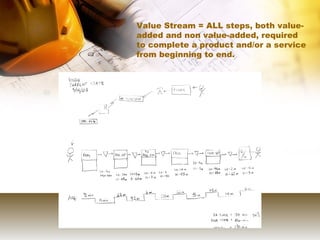
Value Stream = ALL steps, both value-added and non value-added, required to complete a product and/or a service from beginning to end.
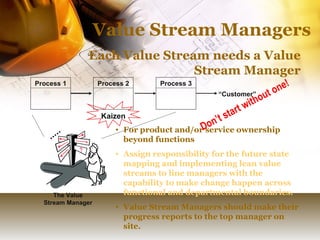
Value Stream Managers Each Value Stream needs a Value Stream Manager For product and/or service ownership beyond functions   Assign responsibility for the future state mapping and implementing lean value streams to line managers with the capability to make change happen across functional and departmental boundaries.   Value Stream Managers should make their progress reports to the top manager on site.  “ Customer” The Value Stream Manager Kaizen Don’t start without one! Process 1 Process 2 Process 3
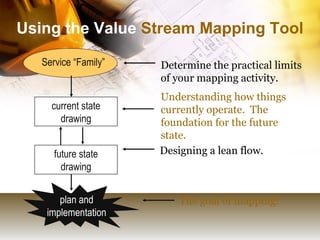
Using the Value  Stream Mapping Tool Understanding how things  currently operate.  The foundation for the future state.   Service “Family” plan and implementation Designing a lean flow.   current state drawing future state drawing Determine the practical limits of your mapping activity.   The goal of mapping!
Moving to a Future State
Lean Thinking  for Future State What Steps Truly Add Value?   Which are Waste? What “service level” does the customer need? Desired response or turnaround time Expected quality level of the output
Lean Thinking  for Future State System impact of controls and administrative guidelines: What are the rules and assumptions that underlie the structure and performance of the current process? Are the current rules and assumptions still valid? Are the current controls still appropriate? What is the “cost” of the current rules and controls?  What are the benefits – real or perceived? Are there better ways to provide the desired control?
Lean Thinking  for Future State Applicability of technology-based solutions How can entire processes or steps be eliminated? How can the time required for a process or step be reduced? How can the dependency on knowledge and skill be reduced? Can bar-coding, internet, automation, etc. help speed the process?
Future  State Questions Can  Technology Help? What does the customer really need? How often will we check our performance to customer needs? Which steps create value and which are waste--what can we eliminate? What administrative controls do we have in our way? How can we flow work with fewer interruptions? How will work be prioritized? Is there an opportunity to balance the work load or different activities?  What process improvements will be necessary?
Who wants the output of the process? What do they want? When/how often is it required? At what quality level? What Does the Customer Really Need?
2.  How Often Will We Check Performance?   At what frequency will the system be reviewed to verify it is satisfying customer needs at the desired time or service level?  How will we measure it?
3. What Steps  Create Value and  Which  are Waste? Challenge every step – ask the following: What is really needed by the customer? Why are the current steps performed? What can be done differently or not at all? Is the order of steps creating waste?  Where should decisions be made? What assumptions underlie the current process? Are existing controls and administrative guidelines appropriate? What knowledge and skills are truly required to perform the step(s)?
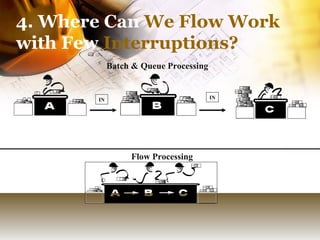
Batch & Queue Processing Flow Processing 4. Where Can  We Flow Work  with Few  Interruptions? IN IN
5.  How Will  Work be  Prioritized? How can existing “subject-matter-expert knowledge” be brought out in the open for everyone’s use and understanding? Examples: Enhanced decision-making tools Checklist Flow Chart Visual Controls Making status visual for everyone at the same time Work Standardization
6. How Will  We Balance  the  Work Load? Does the “mix” (e.g. order type) impact the value stream or particular steps in any way? Example: Transfer Patient vs. ED Admit vs. OR Admit Does the “volume” (e.g. demand variation) impact the system in any way? Example: Middle of the day vs. Middle of the night
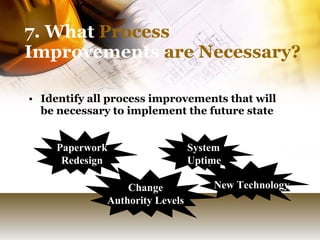
7. What  Process  Improvements  are Necessary? Identify all process improvements that will be necessary to implement the future state System Uptime Paperwork Redesign Change Authority Levels New Technology
Future State  Questions Can Technol ogy Help? What does the customer really need? How often will we check our performance to customer needs? Which steps create value and which are waste--what can we eliminate? What administrative controls do we have in our way? How can we flow work with fewer interruptions? How will work be prioritized? Is there an opportunity to balance the work load or different activities?  What process improvements will be necessary?
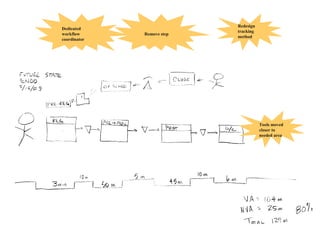
Dedicated workflow coordinator Redesign tracking method Tools moved closer to needed area Remove step
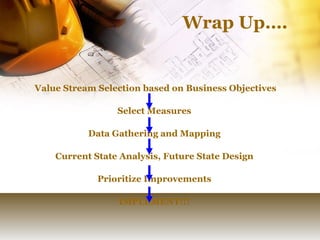
Wrap Up…. Value Stream Selection based on Business Objectives Select Measures Data Gathering and Mapping Current State Analysis, Future State Design Prioritize Improvements IMPLEMENT!!!

Lean thinking

  • 1.
    Lean Thinking TravisEck / Senior Business Process Analyst [email_address] 406-239-3773
  • 2.
    Lean Thinking FundamentalObjective: To create the most value while consuming the fewest resources. Define value from the customer’s perspective. Identify which process steps create value and which are only waste ( muda ). Work to eliminate the root causes of the waste and allow for one-piece, continuous flow.
  • 3.
    Lean = Eliminating Waste Non-Value-Added D efects O verproduction W aiting C onfusion I nventory M otion E xcess Processing N ot Utilizing Employees’ knowledge, skills and abilities to make change Typically 95% of all lead time is non-value-added. Value-Added
  • 4.
    Waste Overproduction InventoryWaiting Excess Processing Defects Excess Motion Confusion Underutilized People Types of Waste:
  • 5.
    Value Stream MappingFollow a “product” or “service” from beginning to end , and draw a visual representation of every process in the material & information flow . Then, draw (using icons) a “future state” map of how value should flow.
  • 6.
    Value Stream =ALL steps, both value-added and non value-added, required to complete a product and/or a service from beginning to end.
  • 7.
    Value Stream ManagersEach Value Stream needs a Value Stream Manager For product and/or service ownership beyond functions Assign responsibility for the future state mapping and implementing lean value streams to line managers with the capability to make change happen across functional and departmental boundaries. Value Stream Managers should make their progress reports to the top manager on site. “ Customer” The Value Stream Manager Kaizen Don’t start without one! Process 1 Process 2 Process 3
  • 8.
    Using the Value Stream Mapping Tool Understanding how things currently operate. The foundation for the future state. Service “Family” plan and implementation Designing a lean flow. current state drawing future state drawing Determine the practical limits of your mapping activity. The goal of mapping!
  • 9.
    Moving to aFuture State
  • 10.
    Lean Thinking for Future State What Steps Truly Add Value? Which are Waste? What “service level” does the customer need? Desired response or turnaround time Expected quality level of the output
  • 11.
    Lean Thinking for Future State System impact of controls and administrative guidelines: What are the rules and assumptions that underlie the structure and performance of the current process? Are the current rules and assumptions still valid? Are the current controls still appropriate? What is the “cost” of the current rules and controls? What are the benefits – real or perceived? Are there better ways to provide the desired control?
  • 12.
    Lean Thinking for Future State Applicability of technology-based solutions How can entire processes or steps be eliminated? How can the time required for a process or step be reduced? How can the dependency on knowledge and skill be reduced? Can bar-coding, internet, automation, etc. help speed the process?
  • 13.
    Future StateQuestions Can Technology Help? What does the customer really need? How often will we check our performance to customer needs? Which steps create value and which are waste--what can we eliminate? What administrative controls do we have in our way? How can we flow work with fewer interruptions? How will work be prioritized? Is there an opportunity to balance the work load or different activities? What process improvements will be necessary?
  • 14.
    Who wants theoutput of the process? What do they want? When/how often is it required? At what quality level? What Does the Customer Really Need?
  • 15.
    2. HowOften Will We Check Performance? At what frequency will the system be reviewed to verify it is satisfying customer needs at the desired time or service level? How will we measure it?
  • 16.
    3. What Steps Create Value and Which are Waste? Challenge every step – ask the following: What is really needed by the customer? Why are the current steps performed? What can be done differently or not at all? Is the order of steps creating waste? Where should decisions be made? What assumptions underlie the current process? Are existing controls and administrative guidelines appropriate? What knowledge and skills are truly required to perform the step(s)?
  • 17.
    Batch & QueueProcessing Flow Processing 4. Where Can We Flow Work with Few Interruptions? IN IN
  • 18.
    5. HowWill Work be Prioritized? How can existing “subject-matter-expert knowledge” be brought out in the open for everyone’s use and understanding? Examples: Enhanced decision-making tools Checklist Flow Chart Visual Controls Making status visual for everyone at the same time Work Standardization
  • 19.
    6. How Will We Balance the Work Load? Does the “mix” (e.g. order type) impact the value stream or particular steps in any way? Example: Transfer Patient vs. ED Admit vs. OR Admit Does the “volume” (e.g. demand variation) impact the system in any way? Example: Middle of the day vs. Middle of the night
  • 20.
    7. What Process Improvements are Necessary? Identify all process improvements that will be necessary to implement the future state System Uptime Paperwork Redesign Change Authority Levels New Technology
  • 21.
    Future State Questions Can Technol ogy Help? What does the customer really need? How often will we check our performance to customer needs? Which steps create value and which are waste--what can we eliminate? What administrative controls do we have in our way? How can we flow work with fewer interruptions? How will work be prioritized? Is there an opportunity to balance the work load or different activities? What process improvements will be necessary?
  • 22.
    Dedicated workflow coordinatorRedesign tracking method Tools moved closer to needed area Remove step
  • 23.
    Wrap Up…. ValueStream Selection based on Business Objectives Select Measures Data Gathering and Mapping Current State Analysis, Future State Design Prioritize Improvements IMPLEMENT!!!