Achieving Change In Today’s Marketplace John Van Horn  01/02/2009
Today’s Manufacturing and Packaging challenges : Producing more from existing equipment Reducing operating costs while meeting marketing demands Reducing maintainability & maintenance costs Generating greater R.O.I. on manufacturing issues Defining the best approaches to solving capacity problems, bottlenecks, training , and defect/variance detection and elimination or minimization Knowing how efficient your key machinery, cells etc. are Identifying which machines are a problem that should be maintained better or replaced outright Identifying by machine, how much downtime you have Measuring actual throughput versus theoretical Identifying what are the current, major, repeating downtime issues that need immediate attention Having real-time asset management Knowing how much it will cost to bring your lines/cells/plant up to near world class O.E.E
In order to insure profitability in today’s economy dynamics in this very competitive marketplace I can  use my unique background to create innovative, effective and efficient concepts to help deal with  constant changes in: Customers Customer requirements Sourcing changes Vendor changes,  Distribution points of activity New product mix, Forecasting errors Impacts of seasonality Inventory costs Constant expediting issues
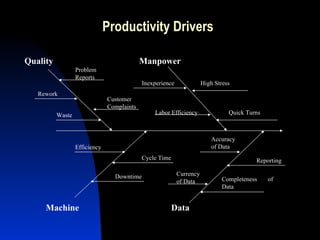
Productivity Drivers Machine Data Quality Manpower Rework Waste Problem Reports Customer Complaints High Stress Quick Turns Labor Efficiency Inexperience Efficiency Downtime Cycle Time Reporting Completeness  of Data Currency of Data Accuracy of Data
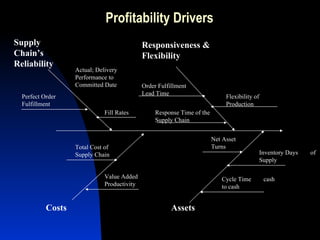
Profitability Drivers Costs Assets Supply Chain’s Reliability Responsiveness & Flexibility Perfect Order Fulfillment Actual; Delivery Performance to Committed Date Fill Rates Flexibility of  Production Response Time of the Supply Chain Order Fulfillment Lead Time Total Cost of Supply Chain Value Added Productivity Inventory Days  of Supply Cycle Time  cash to cash Net Asset Turns
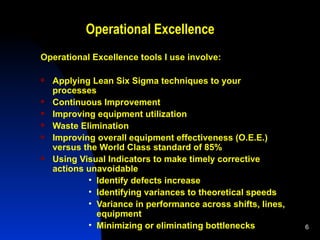
Operational Excellence  Operational Excellence tools I use involve: Applying Lean Six Sigma techniques to your processes Continuous Improvement Improving equipment utilization Waste Elimination Improving overall equipment effectiveness (O.E.E.) versus the World Class standard of 85% Using Visual Indicators to make timely corrective actions unavoidable Identify defects increase Identifying variances to theoretical speeds Variance in performance across shifts, lines, equipment Minimizing or eliminating bottlenecks
Typical Opportunities For Finding and Selection of Lean  Six Sigma Opportunities  Is there a management philosophy of “ How are we doing?’ (doing things  well) as opposed to “Are we doing the right things?” Any step(s) that is/are  consistently  making less than KVI(s) Anything that has recently  been audited Anything that has recently  been rejected Anything that is  handled many times Are there processing steps running at “sub-process cycle times” Any process/step that constantly is a “rush”?  Any inspection steps  Any process with  excessive downtime Any process whose owner is not known and/or who performs the  next task (the customer) Any given  machine with a lot of downtime Any  machine requiring many repetitive spare parts replacement Any  product or process  running on  sub-optimal ines/setups Any steps that are non-value added or value enabling control s?
Value Stream Mapping Checklist For Streamlining Existing or New Processes  W hat does each step cost, how long does it take and can that step  be eliminated or combined at a minimum with another task? Number of times that the product is actually touched (either being moved or processed)? Number of queues (existing or needed / planned for the future state/new process)? Total time at step (in queue for step, processing and transport time)? Individual step and each process distance’s traveled (either current or new process)? Any transports of product where damage might creep in? Any steps with either currently or planned waiting for parts, manpower. Takt time in place?  Would that make sense for a given customer Space required for step?  What are the current or future state constraints? Where are the productivity inhibitors
VSM (continued ) What are the steps that affect processing profitability? Is there adequate cross training in-place for key processing steps? Any potential capacity / throughput bottleneck/constraint? Can the order “born to cradle” cradle time (order generation thru  processing time) be dramatically reduced?  Where is there any opportunity to dramatically cut the total overall cycle down without spending huge capital? Step is or can be mistake proofed? Step has or will be standardized/best practice method ? Is each step value added or non-value added? Can product/package size changeover time be greatly reduced? Does each of the processing steps has adequate SOPs in-place?  The Best Practice / method(s) are now in place? Best equipment / apparatus for the given step is now in-place? Adequate protective elements now in-place to minimize product damage during all of the processing steps? Is the original OEM speed, quality yields, etc. and the equipment’s site acceptance testing levels?  
My   Problem Resolution Process (PRP) Using the PRP master template, I can quickly delve into any  issue/process variations/opportunity as to : What happened? When did it occur?  Where did it occur? Who did it happen to?  Why did it happen?  How often is it occurring?  Which line, which plant (unique to?) What approach will solve the problem/issue? What steps would be needed to resolve the issue? What systems or processes in the company should be addressed or changed to remedy future issue? What resources will be needed (both internal and/or external)?
My Means of Identifying Losses That  Affect  The Throughput of Any Manufacturing ,  Packaging Operation or Supply Chain Throughput Optimization will improve the quality, speed, cost and customer service and that is achieved by identifying : Equipment Downtime Equipment Failures Shutdown Losses Processing Failures Repeated Production Planning Adjustments  Non-Value Added Activities
Project Management I have been either the Project Sponsor, Project Originator, or even  the Project Facilitator for many innovative, successful projects. I know to optimize the key factors involved with successful project management as to: Scope  Deliverables  Milestones  Resources Budget  Issues  Roles/Responsibilities  Risks  I always take into consideration what business processes  and/or business units will be affected, any locations and/or applications that will be changed, the risks involved, any  contingencies needed and insure that the given project meets  the business’s needs when the given project is fully integrated?
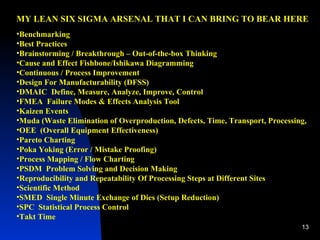
MY LEAN SIX SIGMA ARSENAL THAT I CAN BRING TO BEAR HERE Benchmarking Best Practices Brainstorming / Breakthrough – Out-of-the-box Thinking Cause and Effect Fishbone/Ishikawa Diagramming Continuous / Process Improvement Design For Manufacturability (DFSS) DMAIC  Define, Measure, Analyze, Improve, Control FMEA  Failure Modes & Effects Analysis Tool Kaizen Events Muda (Waste Elimination of Overproduction, Defects, Time, Transport, Processing,  OEE  (Overall Equipment Effectiveness)  Pareto Charting Poka Yoking (Error / Mistake Proofing) Process Mapping / Flow Charting PSDM  Problem Solving and Decision Making Reproducibility and Repeatability Of Processing Steps at Different Sites Scientific Method SMED  Single Minute Exchange of Dies (Setup Reduction) SPC  Statistical Process Control Takt Time
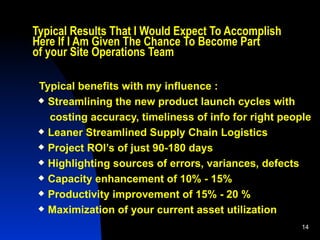
Typical Results That I Would Expect To Accomplish  Here If I Am Given The Chance To Become Part  of your Site Operations Team Typical benefits with my influence :  Streamlining the new product launch cycles with costing accuracy, timeliness of info for right people Leaner Streamlined Supply Chain Logistics Project ROI’s of just 90-180 days Highlighting sources of errors, variances, defects Capacity enhancement of 10% - 15% Productivity improvement of 15% - 20 % Maximization of your current asset utilization

Jvh Lean Presentation For 2009

  • 1.
    Achieving Change InToday’s Marketplace John Van Horn 01/02/2009
  • 2.
    Today’s Manufacturing andPackaging challenges : Producing more from existing equipment Reducing operating costs while meeting marketing demands Reducing maintainability & maintenance costs Generating greater R.O.I. on manufacturing issues Defining the best approaches to solving capacity problems, bottlenecks, training , and defect/variance detection and elimination or minimization Knowing how efficient your key machinery, cells etc. are Identifying which machines are a problem that should be maintained better or replaced outright Identifying by machine, how much downtime you have Measuring actual throughput versus theoretical Identifying what are the current, major, repeating downtime issues that need immediate attention Having real-time asset management Knowing how much it will cost to bring your lines/cells/plant up to near world class O.E.E
  • 3.
    In order toinsure profitability in today’s economy dynamics in this very competitive marketplace I can use my unique background to create innovative, effective and efficient concepts to help deal with constant changes in: Customers Customer requirements Sourcing changes Vendor changes, Distribution points of activity New product mix, Forecasting errors Impacts of seasonality Inventory costs Constant expediting issues
  • 4.
    Productivity Drivers MachineData Quality Manpower Rework Waste Problem Reports Customer Complaints High Stress Quick Turns Labor Efficiency Inexperience Efficiency Downtime Cycle Time Reporting Completeness of Data Currency of Data Accuracy of Data
  • 5.
    Profitability Drivers CostsAssets Supply Chain’s Reliability Responsiveness & Flexibility Perfect Order Fulfillment Actual; Delivery Performance to Committed Date Fill Rates Flexibility of Production Response Time of the Supply Chain Order Fulfillment Lead Time Total Cost of Supply Chain Value Added Productivity Inventory Days of Supply Cycle Time cash to cash Net Asset Turns
  • 6.
    Operational Excellence Operational Excellence tools I use involve: Applying Lean Six Sigma techniques to your processes Continuous Improvement Improving equipment utilization Waste Elimination Improving overall equipment effectiveness (O.E.E.) versus the World Class standard of 85% Using Visual Indicators to make timely corrective actions unavoidable Identify defects increase Identifying variances to theoretical speeds Variance in performance across shifts, lines, equipment Minimizing or eliminating bottlenecks
  • 7.
    Typical Opportunities ForFinding and Selection of Lean Six Sigma Opportunities Is there a management philosophy of “ How are we doing?’ (doing things well) as opposed to “Are we doing the right things?” Any step(s) that is/are consistently making less than KVI(s) Anything that has recently been audited Anything that has recently been rejected Anything that is handled many times Are there processing steps running at “sub-process cycle times” Any process/step that constantly is a “rush”? Any inspection steps Any process with excessive downtime Any process whose owner is not known and/or who performs the next task (the customer) Any given machine with a lot of downtime Any machine requiring many repetitive spare parts replacement Any product or process running on sub-optimal ines/setups Any steps that are non-value added or value enabling control s?
  • 8.
    Value Stream MappingChecklist For Streamlining Existing or New Processes W hat does each step cost, how long does it take and can that step be eliminated or combined at a minimum with another task? Number of times that the product is actually touched (either being moved or processed)? Number of queues (existing or needed / planned for the future state/new process)? Total time at step (in queue for step, processing and transport time)? Individual step and each process distance’s traveled (either current or new process)? Any transports of product where damage might creep in? Any steps with either currently or planned waiting for parts, manpower. Takt time in place? Would that make sense for a given customer Space required for step? What are the current or future state constraints? Where are the productivity inhibitors
  • 9.
    VSM (continued )What are the steps that affect processing profitability? Is there adequate cross training in-place for key processing steps? Any potential capacity / throughput bottleneck/constraint? Can the order “born to cradle” cradle time (order generation thru processing time) be dramatically reduced? Where is there any opportunity to dramatically cut the total overall cycle down without spending huge capital? Step is or can be mistake proofed? Step has or will be standardized/best practice method ? Is each step value added or non-value added? Can product/package size changeover time be greatly reduced? Does each of the processing steps has adequate SOPs in-place? The Best Practice / method(s) are now in place? Best equipment / apparatus for the given step is now in-place? Adequate protective elements now in-place to minimize product damage during all of the processing steps? Is the original OEM speed, quality yields, etc. and the equipment’s site acceptance testing levels?  
  • 10.
    My Problem Resolution Process (PRP) Using the PRP master template, I can quickly delve into any issue/process variations/opportunity as to : What happened? When did it occur? Where did it occur? Who did it happen to? Why did it happen? How often is it occurring? Which line, which plant (unique to?) What approach will solve the problem/issue? What steps would be needed to resolve the issue? What systems or processes in the company should be addressed or changed to remedy future issue? What resources will be needed (both internal and/or external)?
  • 11.
    My Means ofIdentifying Losses That Affect The Throughput of Any Manufacturing , Packaging Operation or Supply Chain Throughput Optimization will improve the quality, speed, cost and customer service and that is achieved by identifying : Equipment Downtime Equipment Failures Shutdown Losses Processing Failures Repeated Production Planning Adjustments Non-Value Added Activities
  • 12.
    Project Management Ihave been either the Project Sponsor, Project Originator, or even the Project Facilitator for many innovative, successful projects. I know to optimize the key factors involved with successful project management as to: Scope Deliverables Milestones Resources Budget Issues Roles/Responsibilities Risks I always take into consideration what business processes and/or business units will be affected, any locations and/or applications that will be changed, the risks involved, any contingencies needed and insure that the given project meets the business’s needs when the given project is fully integrated?
  • 13.
    MY LEAN SIXSIGMA ARSENAL THAT I CAN BRING TO BEAR HERE Benchmarking Best Practices Brainstorming / Breakthrough – Out-of-the-box Thinking Cause and Effect Fishbone/Ishikawa Diagramming Continuous / Process Improvement Design For Manufacturability (DFSS) DMAIC Define, Measure, Analyze, Improve, Control FMEA Failure Modes & Effects Analysis Tool Kaizen Events Muda (Waste Elimination of Overproduction, Defects, Time, Transport, Processing, OEE (Overall Equipment Effectiveness) Pareto Charting Poka Yoking (Error / Mistake Proofing) Process Mapping / Flow Charting PSDM Problem Solving and Decision Making Reproducibility and Repeatability Of Processing Steps at Different Sites Scientific Method SMED Single Minute Exchange of Dies (Setup Reduction) SPC Statistical Process Control Takt Time
  • 14.
    Typical Results ThatI Would Expect To Accomplish Here If I Am Given The Chance To Become Part of your Site Operations Team Typical benefits with my influence : Streamlining the new product launch cycles with costing accuracy, timeliness of info for right people Leaner Streamlined Supply Chain Logistics Project ROI’s of just 90-180 days Highlighting sources of errors, variances, defects Capacity enhancement of 10% - 15% Productivity improvement of 15% - 20 % Maximization of your current asset utilization