Business Process Reengineering Presentation by: Eesha Mehta
Business Process Reengineering Process  a collection of activities that takes one or more kinds of inputs and creates an output that is of value to a customer. Business Process   a group of logically related tasks using the firm's resources  to provide customer-oriented results to support organisation's objectives.
Definition of Process A process is simply a structured, measured set of activities designed to produce a specific output for a particular customers or market.  -- Thomas Davenport Characteristics:  A specific sequencing of work activities across time and place A beginning and an end  Clearly defined inputs and outputs Customer-focus How the work is done Process ownership  Measurable and meaningful performance
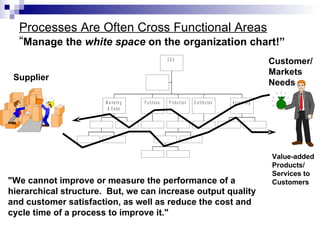
Processes Are Often Cross Functional Areas “ Manage the  white space  on the organization chart!”  Supplier Customer/ Markets Needs Value-added Products/ Services to Customers "We cannot improve or measure the performance of a hierarchical structure.  But, we can increase output quality and customer satisfaction, as well as reduce the cost and cycle time of a process to improve it."
What is Business Process Reengineering? An organizational change method used to redesign an organization to drive improved efficiency, effectiveness, and economy. Organizational change tools may include: Activity based costing analysis Baselining and benchmarking studies Business case analysis Functionality assessment Industrial engineering techniques Organization analysis Productivity assessment Workforce analysis Others, as needed (e.g., human capital tools)
Business Process Reengineering Definition BPR first introduced in 1990 in a Harvard Business Review article by Michael Hammer:  Reengineering Work: Don't Automate, Obliterate.  Hammer/Champy Reengineering the Corporation (1993) Provided this definition: “ Reengineering is the  fundamental  rethinking and  radical  redesign of  business processes  to achieve  dramatic  improvements in critical, contemporary measures of performance, such as cost, quality, service, and speed.”
Business Process Reengineering “ Reengineering is the  fundamental   rethinking and  radical   redesign of business  processes  to achieve  dramatic  improvements in critical, contemporary measures of performance such as cost, quality, service, and speed.”
Key Words Fundamental Why  do we do what we do? Ignore  what is  and concentrate on  what should be. Need to understand why an organization does what it does – question all of the rules and assumptions that exist  Radical Business  reinvention  vs. business improvement  Radical redesign means disregarding all existing structures and procedures, and inventing completely new ways of accomplishing work. Reengineering is about business reinvention, begins with no assumptions and takes nothing for granted.
Key Words Dramatic Reengineering should be brought in “when a need exits for heavy blasting.” Companies in deep trouble. Companies that see trouble coming. Companies that are in peak condition. Not looking for marginal or incremental improvements or modification Goal is dramatic improvements in performance.
Key Words Business Process  a collection of activities that takes one or more kinds of inputs and creates an output that is of value to a customer. Focus on the way the organization adds value – through cross-functional business processes Move away from function view; task based thinking
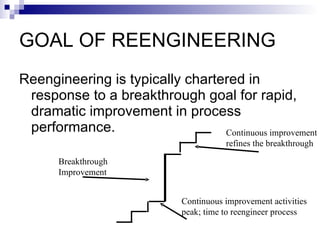
GOAL OF REENGINEERING Reengineering is typically chartered in response to a breakthrough goal for rapid, dramatic improvement in process performance. Continuous improvement activities peak; time to reengineer process Breakthrough Improvement Continuous improvement refines the breakthrough
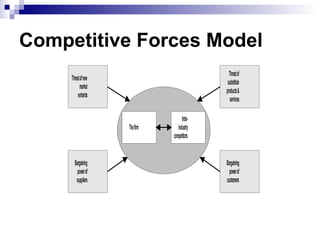
Competitive Forces Model
Why BPR Is Necessary The Virtual Organization:  Three C’s Driving Change   Customers  take charge. Mass market v. a “market of one” Backward integration Informed consumers Demanding Sophistication Changing Needs Competition  intensifies. More and different kinds Local Global Big is not better Technology changes the nature of competition.
Why BPR Is Necessary Change  becomes constant. reduced product cycles reduced time to develop new products more environment scanning Technology Customer Preferences “ Companies created to thrive on mass production, stability, and growth can’t be  fixed  to succeed in [such] a world.” Integrate people, technology, & organizational culture to Respond to rapidly changing technical & business environment and customer’s needs to achieve Big performance gains
Customer Demands expect us to know everything to make the right decisions to do it right now to do it with less resources to make no mistakes expect to be fully informed
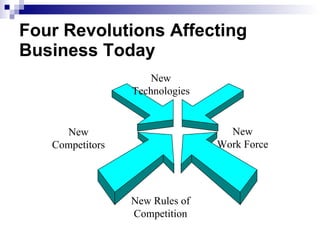
Four Revolutions Affecting Business Today New Competitors New Rules of Competition New Technologies New Work Force
The C’s related to Organization Re-engineering Projects The 3C’s of organization Re-engineering: Customers Competition Change The 4C’s of effective teams: Commitment Cooperation Communication Contribution
Some of the BPR Objectives Improve  Efficiency  e.g reduce time to market, provide quicker response to customers Increase  Effectiveness  e.g deliver higher quality Achieve  Cost Saving  in the longer run Provide more  Meaningful  work for employees Increase  Flexibility  and  Adaptability  to change Enable new business  Growth
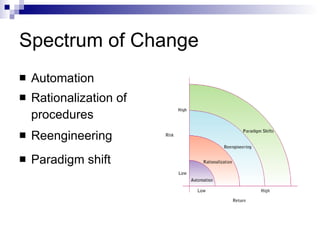
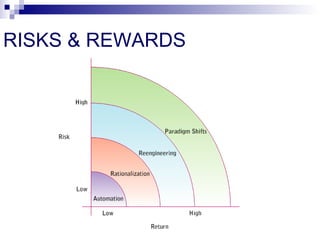
Spectrum of Change Automation Rationalization of procedures Reengineering Paradigm shift
Spectrum of Change Automation- refers to computerizing processes to speed up the existing tasks, improves efficiency and effectiveness. Rationalization of Procedures-refers to streamlining of standard operating procedures, eliminating obvious bottlenecks, so that automation makes operating procedures more efficient,improves efficiency and effectiveness.
Spectrum of Change Business Process Reengineering- refers to radical redesign  of business processes. Aims at eliminating repetitive, paper-intensive, bureaucratic tasks reducing costs significantly improving product/service quality. Paradigm Shift-refers to a more radical form of change where the nature of business and the nature of the organization is questioned, improves strategic standing of the organization.
RISKS & REWARDS
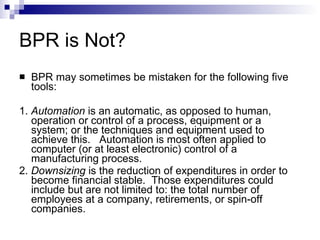
BPR is Not? BPR may sometimes be mistaken for the following five tools: 1.   Automation   is an automatic, as opposed to human, operation or control of a process, equipment or a system; or the techniques and equipment used to achieve this.  Automation is most often applied to computer (or at least electronic) control of a manufacturing process.  2.  Downsizing  is the reduction of expenditures in order to become financial stable.  Those expenditures could include but are not limited to: the total number of employees at a company, retirements, or spin-off companies.
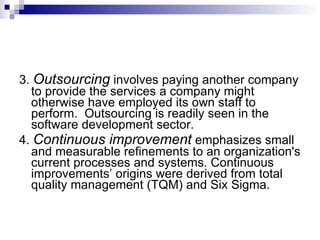
3.  Outsourcing  involves paying another company to provide the services a company might otherwise have employed its own staff to perform.  Outsourcing is readily seen in the software development sector. 4.  Continuous improvement  emphasizes small and measurable refinements to an organization's current processes and systems. Continuous improvements’ origins were derived from total quality management (TQM) and Six Sigma.
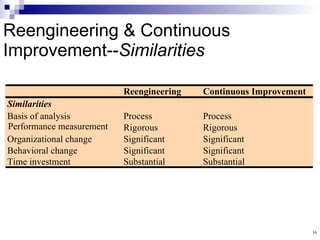
Reengineering & Continuous Improvement-- Similarities 16 Reengineering Continuous Improvement Similarities Basis of analysis Process Process Performance measurement Rigorous Rigorous Organizational change Significant Significant Behavioral change Significant Significant Time investment Substantial Substantial
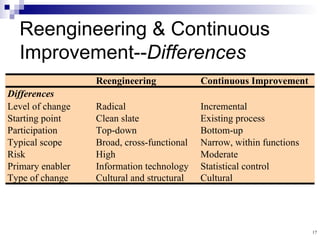
17 Reengineering & Continuous Improvement-- Differences Reengineering Continuous Improvement Differences Level of change Radical Incremental Starting point Clean slate Existing process Participation Top-down Bottom-up Typical scope Broad, cross-functional Narrow, within functions Risk High Moderate Primary enabler Information technology Statistical control Type of change Cultural and structural Cultural
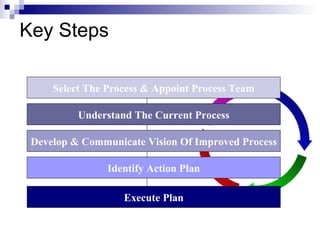
Key Steps Select The Process & Appoint Process Team Understand The Current Process Develop & Communicate Vision Of Improved Process Identify Action Plan Execute Plan
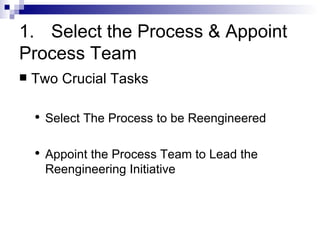
1. Select the Process & Appoint Process Team Two Crucial Tasks Select The Process to be Reengineered Appoint the Process Team to Lead the Reengineering Initiative
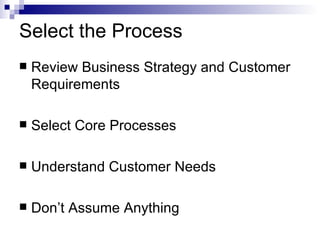
Select the Process Review Business Strategy and Customer Requirements Select Core Processes Understand Customer Needs Don’t Assume Anything
Select the Process Select Correct Path for Change Remember Assumptions can Hide Failures Competition and Choice to Go Elsewhere Ask - Questionnaires, Meetings, Focus Groups
Appoint the Process Team Appoint BPR Champion Identify Process Owners Establish Executive Improvement Team Provide Training to Executive Team
Core Skills Required Capacity to view the organization as a whole Ability to focus on end-customers Ability to challenge fundamental assumptions Courage to deliver and venture into unknown areas Ability to assume individual and collective responsibility
Use of Consultants Used to generate internal capacity Appropriate when a implementation is needed quickly Ensure that adequate consultation is sought from staff so that the initiative is organization-led and  not  consultant-driven Control should  never  be handed over to the consultant
2. Understand the Current  Process Develop a Process Overview Clearly define the process  Mission Scope Boundaries Set business and customer measurements  Understand customers expectations from the process (staff including process team)
2. Understand the Current  Process Clearly Identify Improvement Opportunities Quality Rework Document the Process Cost Time  Value Data Carefully resolve any inconsistencies Existing -- New Process Ideal -- Realistic Process
3. Develop & Communicate Vision  of Improved Process Communicate with all employees so that they are aware of the vision of the future Always provide information on the progress of the BPR initiative - good and bad. Demonstrate assurance that the BPR initiative is both necessary and properly managed
4. Identify Action Plan Develop an Improvement Plan Appoint Process Owners Simplify the Process to Reduce Process Time Remove any Bureaucracy that may hinder implementation Remove no-value-added activities
4. Identify Action Plan Standardize Process and Automate Where Possible Up-grade Equipment Plan/schedule the changes Construct in-house metrics and targets Introduce and firmly establish a feedback system Audit, Audit, Audit
5. Execute Plan Qualify/certify the process Perform periodic qualification reviews Define and eliminate process problems Evaluate the change impact on the business and on customers Benchmark the process Provide advanced team training
Common Problems with BPR Process Simplification is Common - True BPR is Not Desire to Change Not Strong Enough Start Point the Existing Process Not a Blank Slate Commitment to Existing Processes Too Strong REMEMBER - “If it isn’t broke …”
Common Problems with BPR Process under review too big or too small Reliance on existing process too strong The Costs of the Change Seem Too Large BPR Isolated Activity not Aligned to the Business Objectives Allocation of Resources Poor Timing and Planning Keeping the Team and Organization on Target
How to Avoid BPR Failure To avoid failure of the BPR process it is recommended that:  BPR must be accompanied by strategic planning, which addresses leveraging Information technology as a competitive tool.  Place the customer at the centre of the reengineering effort, concentrate on reengineering fragmented processes that lead to delays or other negative impacts on customer service.  BPR must be "owned" throughout the organization, not driven by a group of outside consultants.  Case teams must be comprised of both managers as well as those who will actually do the work.
How to Avoid BPR Failure The Information technology group should be an integral part of the reengineering team from the start.  BPR must be sponsored by top executives, who are not about to leave or retire.  BPR projects must have a timetable, ideally between three to six months, so that the organization is not in a state of "limbo".  BPR must not ignore corporate culture and must emphasize constant communication and feedback.
Case Example:  Kodak In 1987 Kodak’s arch-rival, Fuji came up with a new 35mm single-use camera Kodak has no competitive offering Kodak’s Traditional Product Development Process Slow:  would take 70 weeks to produce a rival to Fuji’s camera! Result: the new process, “Concurrent Engineering” Reduce turnaround time to 38 weeks
Case Example:  Kodak Key Redesign Strategy Apply innovative use of CAD/CAM + integrated product design database Allow engineer to design at computer workstations Database collect each engineer’s work and combines into overall design Each morning, problems are resolved immediately Manufacturing can begin tooling design just 10 weeks into product design instead of 28 weeks in the past
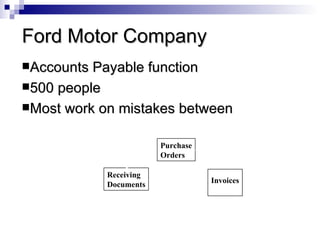
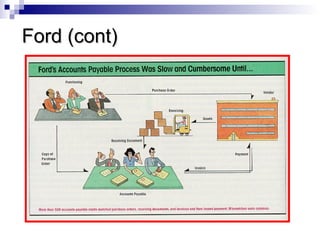
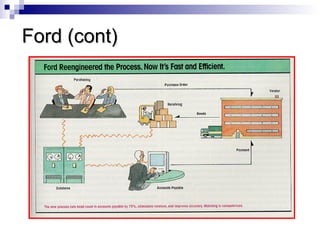
Ford Motor Company Accounts Payable function 500 people Most work on mistakes between Purchase Orders Receiving Documents Invoices
Ford (cont)
Ford (cont)
WHY DOES REENGINEERING FAIL? Trying to fix a process instead of changing it Ignoring everything except the process design Quitting too early Reengineering from the bottom up Neglecting people’s values and beliefs Being willing to settle for minor results Assigning someone who does not understand reengineering to lead the effort
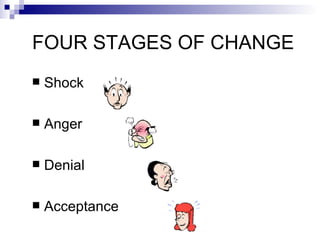
FOUR STAGES OF CHANGE Shock Anger Denial Acceptance
Think about the transition from shock to acceptance and how an organization may overcome them. Shock- usually the first reaction once a change has been announced. " Where in the world did this come from?"  "Why?" Anger- if change is viewed in a negative way, people may react in anger. They blame other persons and begin to not accept or support the change.  "It wont work and I will  not accept this."  This can be very damaging to a process and needs to confronted. Denial- this person begins to make excuses as to why he or she should not be held accountable for anything that may go wrong. " Dont blame me if this doesn't work, it wasn't my idea." Acceptance- this is the goal an organization needs to  get all employees to.  This person has accepted the change and begins to invision his or her role in the new situation.  "How can I help my organization in this process."
HOW TO IMPLEMENT 3 steps to transition of change 1.  Discontinuation of the old way of doing business 2.  Migration 3.  Starting the new way of doing business
Conclusion BPR is a multi-discipline approach for strategic change Methodology provides missing “how to” that must follow the “why” BPR must be managed as a project BPR must be owned by the organization, not driven by consultants BPR requires constant communication and feedback

Business process reengineering

  • 1.
    Business Process ReengineeringPresentation by: Eesha Mehta
  • 2.
    Business Process ReengineeringProcess a collection of activities that takes one or more kinds of inputs and creates an output that is of value to a customer. Business Process a group of logically related tasks using the firm's resources to provide customer-oriented results to support organisation's objectives.
  • 3.
    Definition of ProcessA process is simply a structured, measured set of activities designed to produce a specific output for a particular customers or market. -- Thomas Davenport Characteristics: A specific sequencing of work activities across time and place A beginning and an end Clearly defined inputs and outputs Customer-focus How the work is done Process ownership Measurable and meaningful performance
  • 4.
    Processes Are OftenCross Functional Areas “ Manage the white space on the organization chart!” Supplier Customer/ Markets Needs Value-added Products/ Services to Customers "We cannot improve or measure the performance of a hierarchical structure. But, we can increase output quality and customer satisfaction, as well as reduce the cost and cycle time of a process to improve it."
  • 5.
    What is BusinessProcess Reengineering? An organizational change method used to redesign an organization to drive improved efficiency, effectiveness, and economy. Organizational change tools may include: Activity based costing analysis Baselining and benchmarking studies Business case analysis Functionality assessment Industrial engineering techniques Organization analysis Productivity assessment Workforce analysis Others, as needed (e.g., human capital tools)
  • 6.
    Business Process ReengineeringDefinition BPR first introduced in 1990 in a Harvard Business Review article by Michael Hammer: Reengineering Work: Don't Automate, Obliterate. Hammer/Champy Reengineering the Corporation (1993) Provided this definition: “ Reengineering is the fundamental rethinking and radical redesign of business processes to achieve dramatic improvements in critical, contemporary measures of performance, such as cost, quality, service, and speed.”
  • 7.
    Business Process Reengineering“ Reengineering is the fundamental rethinking and radical redesign of business processes to achieve dramatic improvements in critical, contemporary measures of performance such as cost, quality, service, and speed.”
  • 8.
    Key Words FundamentalWhy do we do what we do? Ignore what is and concentrate on what should be. Need to understand why an organization does what it does – question all of the rules and assumptions that exist Radical Business reinvention vs. business improvement Radical redesign means disregarding all existing structures and procedures, and inventing completely new ways of accomplishing work. Reengineering is about business reinvention, begins with no assumptions and takes nothing for granted.
  • 9.
    Key Words DramaticReengineering should be brought in “when a need exits for heavy blasting.” Companies in deep trouble. Companies that see trouble coming. Companies that are in peak condition. Not looking for marginal or incremental improvements or modification Goal is dramatic improvements in performance.
  • 10.
    Key Words BusinessProcess a collection of activities that takes one or more kinds of inputs and creates an output that is of value to a customer. Focus on the way the organization adds value – through cross-functional business processes Move away from function view; task based thinking
  • 11.
    GOAL OF REENGINEERINGReengineering is typically chartered in response to a breakthrough goal for rapid, dramatic improvement in process performance. Continuous improvement activities peak; time to reengineer process Breakthrough Improvement Continuous improvement refines the breakthrough
  • 12.
  • 13.
    Why BPR IsNecessary The Virtual Organization: Three C’s Driving Change Customers take charge. Mass market v. a “market of one” Backward integration Informed consumers Demanding Sophistication Changing Needs Competition intensifies. More and different kinds Local Global Big is not better Technology changes the nature of competition.
  • 14.
    Why BPR IsNecessary Change becomes constant. reduced product cycles reduced time to develop new products more environment scanning Technology Customer Preferences “ Companies created to thrive on mass production, stability, and growth can’t be fixed to succeed in [such] a world.” Integrate people, technology, & organizational culture to Respond to rapidly changing technical & business environment and customer’s needs to achieve Big performance gains
  • 15.
    Customer Demands expectus to know everything to make the right decisions to do it right now to do it with less resources to make no mistakes expect to be fully informed
  • 16.
    Four Revolutions AffectingBusiness Today New Competitors New Rules of Competition New Technologies New Work Force
  • 17.
    The C’s relatedto Organization Re-engineering Projects The 3C’s of organization Re-engineering: Customers Competition Change The 4C’s of effective teams: Commitment Cooperation Communication Contribution
  • 18.
    Some of theBPR Objectives Improve Efficiency e.g reduce time to market, provide quicker response to customers Increase Effectiveness e.g deliver higher quality Achieve Cost Saving in the longer run Provide more Meaningful work for employees Increase Flexibility and Adaptability to change Enable new business Growth
  • 19.
    Spectrum of ChangeAutomation Rationalization of procedures Reengineering Paradigm shift
  • 20.
    Spectrum of ChangeAutomation- refers to computerizing processes to speed up the existing tasks, improves efficiency and effectiveness. Rationalization of Procedures-refers to streamlining of standard operating procedures, eliminating obvious bottlenecks, so that automation makes operating procedures more efficient,improves efficiency and effectiveness.
  • 21.
    Spectrum of ChangeBusiness Process Reengineering- refers to radical redesign of business processes. Aims at eliminating repetitive, paper-intensive, bureaucratic tasks reducing costs significantly improving product/service quality. Paradigm Shift-refers to a more radical form of change where the nature of business and the nature of the organization is questioned, improves strategic standing of the organization.
  • 22.
  • 23.
    BPR is Not?BPR may sometimes be mistaken for the following five tools: 1. Automation is an automatic, as opposed to human, operation or control of a process, equipment or a system; or the techniques and equipment used to achieve this. Automation is most often applied to computer (or at least electronic) control of a manufacturing process. 2. Downsizing is the reduction of expenditures in order to become financial stable. Those expenditures could include but are not limited to: the total number of employees at a company, retirements, or spin-off companies.
  • 24.
    3. Outsourcing involves paying another company to provide the services a company might otherwise have employed its own staff to perform. Outsourcing is readily seen in the software development sector. 4. Continuous improvement emphasizes small and measurable refinements to an organization's current processes and systems. Continuous improvements’ origins were derived from total quality management (TQM) and Six Sigma.
  • 25.
    Reengineering & ContinuousImprovement-- Similarities 16 Reengineering Continuous Improvement Similarities Basis of analysis Process Process Performance measurement Rigorous Rigorous Organizational change Significant Significant Behavioral change Significant Significant Time investment Substantial Substantial
  • 26.
    17 Reengineering &Continuous Improvement-- Differences Reengineering Continuous Improvement Differences Level of change Radical Incremental Starting point Clean slate Existing process Participation Top-down Bottom-up Typical scope Broad, cross-functional Narrow, within functions Risk High Moderate Primary enabler Information technology Statistical control Type of change Cultural and structural Cultural
  • 27.
    Key Steps SelectThe Process & Appoint Process Team Understand The Current Process Develop & Communicate Vision Of Improved Process Identify Action Plan Execute Plan
  • 28.
    1. Select theProcess & Appoint Process Team Two Crucial Tasks Select The Process to be Reengineered Appoint the Process Team to Lead the Reengineering Initiative
  • 29.
    Select the ProcessReview Business Strategy and Customer Requirements Select Core Processes Understand Customer Needs Don’t Assume Anything
  • 30.
    Select the ProcessSelect Correct Path for Change Remember Assumptions can Hide Failures Competition and Choice to Go Elsewhere Ask - Questionnaires, Meetings, Focus Groups
  • 31.
    Appoint the ProcessTeam Appoint BPR Champion Identify Process Owners Establish Executive Improvement Team Provide Training to Executive Team
  • 32.
    Core Skills RequiredCapacity to view the organization as a whole Ability to focus on end-customers Ability to challenge fundamental assumptions Courage to deliver and venture into unknown areas Ability to assume individual and collective responsibility
  • 33.
    Use of ConsultantsUsed to generate internal capacity Appropriate when a implementation is needed quickly Ensure that adequate consultation is sought from staff so that the initiative is organization-led and not consultant-driven Control should never be handed over to the consultant
  • 34.
    2. Understand theCurrent Process Develop a Process Overview Clearly define the process Mission Scope Boundaries Set business and customer measurements Understand customers expectations from the process (staff including process team)
  • 35.
    2. Understand theCurrent Process Clearly Identify Improvement Opportunities Quality Rework Document the Process Cost Time Value Data Carefully resolve any inconsistencies Existing -- New Process Ideal -- Realistic Process
  • 36.
    3. Develop &Communicate Vision of Improved Process Communicate with all employees so that they are aware of the vision of the future Always provide information on the progress of the BPR initiative - good and bad. Demonstrate assurance that the BPR initiative is both necessary and properly managed
  • 37.
    4. Identify ActionPlan Develop an Improvement Plan Appoint Process Owners Simplify the Process to Reduce Process Time Remove any Bureaucracy that may hinder implementation Remove no-value-added activities
  • 38.
    4. Identify ActionPlan Standardize Process and Automate Where Possible Up-grade Equipment Plan/schedule the changes Construct in-house metrics and targets Introduce and firmly establish a feedback system Audit, Audit, Audit
  • 39.
    5. Execute PlanQualify/certify the process Perform periodic qualification reviews Define and eliminate process problems Evaluate the change impact on the business and on customers Benchmark the process Provide advanced team training
  • 40.
    Common Problems withBPR Process Simplification is Common - True BPR is Not Desire to Change Not Strong Enough Start Point the Existing Process Not a Blank Slate Commitment to Existing Processes Too Strong REMEMBER - “If it isn’t broke …”
  • 41.
    Common Problems withBPR Process under review too big or too small Reliance on existing process too strong The Costs of the Change Seem Too Large BPR Isolated Activity not Aligned to the Business Objectives Allocation of Resources Poor Timing and Planning Keeping the Team and Organization on Target
  • 42.
    How to AvoidBPR Failure To avoid failure of the BPR process it is recommended that: BPR must be accompanied by strategic planning, which addresses leveraging Information technology as a competitive tool. Place the customer at the centre of the reengineering effort, concentrate on reengineering fragmented processes that lead to delays or other negative impacts on customer service. BPR must be "owned" throughout the organization, not driven by a group of outside consultants. Case teams must be comprised of both managers as well as those who will actually do the work.
  • 43.
    How to AvoidBPR Failure The Information technology group should be an integral part of the reengineering team from the start. BPR must be sponsored by top executives, who are not about to leave or retire. BPR projects must have a timetable, ideally between three to six months, so that the organization is not in a state of "limbo". BPR must not ignore corporate culture and must emphasize constant communication and feedback.
  • 44.
    Case Example: Kodak In 1987 Kodak’s arch-rival, Fuji came up with a new 35mm single-use camera Kodak has no competitive offering Kodak’s Traditional Product Development Process Slow: would take 70 weeks to produce a rival to Fuji’s camera! Result: the new process, “Concurrent Engineering” Reduce turnaround time to 38 weeks
  • 45.
    Case Example: Kodak Key Redesign Strategy Apply innovative use of CAD/CAM + integrated product design database Allow engineer to design at computer workstations Database collect each engineer’s work and combines into overall design Each morning, problems are resolved immediately Manufacturing can begin tooling design just 10 weeks into product design instead of 28 weeks in the past
  • 46.
    Ford Motor CompanyAccounts Payable function 500 people Most work on mistakes between Purchase Orders Receiving Documents Invoices
  • 47.
  • 48.
  • 49.
    WHY DOES REENGINEERINGFAIL? Trying to fix a process instead of changing it Ignoring everything except the process design Quitting too early Reengineering from the bottom up Neglecting people’s values and beliefs Being willing to settle for minor results Assigning someone who does not understand reengineering to lead the effort
  • 50.
    FOUR STAGES OFCHANGE Shock Anger Denial Acceptance
  • 51.
    Think about thetransition from shock to acceptance and how an organization may overcome them. Shock- usually the first reaction once a change has been announced. " Where in the world did this come from?" "Why?" Anger- if change is viewed in a negative way, people may react in anger. They blame other persons and begin to not accept or support the change. "It wont work and I will not accept this." This can be very damaging to a process and needs to confronted. Denial- this person begins to make excuses as to why he or she should not be held accountable for anything that may go wrong. " Dont blame me if this doesn't work, it wasn't my idea." Acceptance- this is the goal an organization needs to get all employees to. This person has accepted the change and begins to invision his or her role in the new situation. "How can I help my organization in this process."
  • 52.
    HOW TO IMPLEMENT3 steps to transition of change 1. Discontinuation of the old way of doing business 2. Migration 3. Starting the new way of doing business
  • 53.
    Conclusion BPR isa multi-discipline approach for strategic change Methodology provides missing “how to” that must follow the “why” BPR must be managed as a project BPR must be owned by the organization, not driven by consultants BPR requires constant communication and feedback