Business Process Re-engineering 02 – Principles & Dimensions
Dimensions & Characteristics Fundamental   changes to process, technology and human factors to achieve  dramatic  improvements in key measures The dimensions & characteristics: Balanced attention to processes, people and technology  Cross functional, process based perspective  Judged by measurable results achieved
Process: The Basic Concept What is a process? -  “a collection of business activities that creates value for a  customer -  a transformation of inputs(s) into output(s):  a state of change Re-engineer processes, not  functions  or  organisations Some typical processes: -  concept to prototype : develop product -  target to customer order  : acquire customer -  customer order to pay  : fulfill order -  purchase request to payment : procure materials -  enquiry to resolution  : service
Process viewpoint Identification and mapping -  identify, name and relate the processes to each other Ownership -  assigning owners for all processes Measurement -  establishing and communicating end-to-end customer driven process measures and measurement mechanisms
Process viewpoint Management -  evaluate process performance against customer needs and competitive  benchmarks Awareness -  creating appreciation of the organisation’s processes and customers -  develop a process-oriented mindset
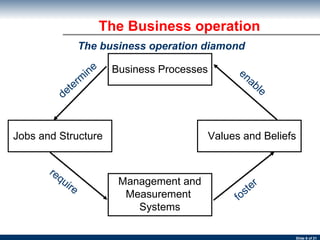
The Business operation Business Processes Values and Beliefs Management and Measurement  Systems Jobs and Structure determine require enable foster The business operation diamond
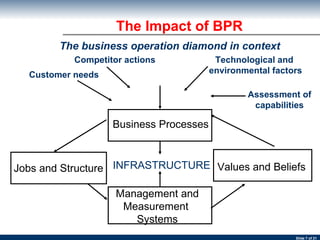
The Impact of BPR The business operation diamond in context Business Processes Values and Beliefs Management and Measurement  Systems Jobs and Structure INFRASTRUCTURE Customer needs Competitor actions Technological and  environmental factors Assessment of capabilities
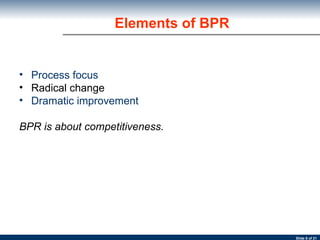
Elements of BPR Process focus  Radical change Dramatic improvement BPR is about competitiveness.
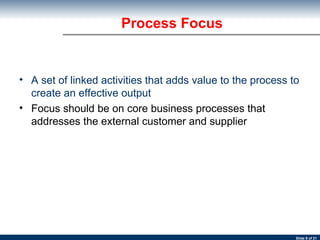
Process Focus A set of linked activities that adds value to the process to create an effective output Focus should be on core business processes that addresses the external customer and supplier
The objective is to address competitiveness and market-dominance Radical change provides  a new way of building core competencies and good investment management Radical Change
Dramatic improvement To achieve major improvement in the core process Planning, procedures and resources are required Measure, control and manage the process
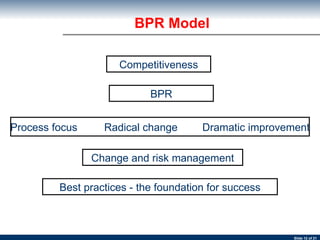
BPR Model Best practices - the foundation for success Change and risk management Competitiveness BPR Process focus  Radical change Dramatic improvement
Downsizing / Rightsizing Customer satisfaction Quality improvement goals Functional performance improvement Reduce costs Increase speed (of service) Overcome a competitive threat Change of organisational structure Why re-engineer ?
Process Improvement Possibilities Eliminate duplicate activities Combine related activities Eliminate multiple reviews and approvals Eliminate inspections Simplify processes Reduce batch size Outsource inefficient activities Centralise or decentralise functions / activities
Invisible Managers delegate their knowledge Process performance is not measured Inconsistent Jobs, measures and infrastructure are not aligned with the current process Ignored Processes often unmanaged and rarely updated Ill conceived Processes and policies are developed piecemeal and informally rather than designed as a whole Reasons to improve processes
BPR is different High ambition Improvements in key performance measures, such as cost, quality, service or speed  Process focus   A customer-oriented viewpoint. No organisational boundaries
Creative rule-breaking Finding assumptions about normal business practice and customers’ needs Information technology to enable the above IT enables new ways of working through substitution and automation BPR is different
Improve customer service Reduce cycle time Improve quality Reduce costs Increase market share Reduce product development time Increase sales Think of specific examples for various processes Typical benefits BPR produces
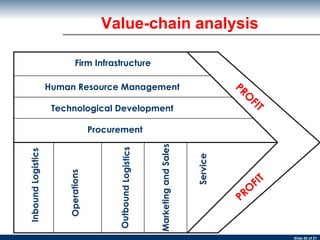
Developed by Michael Porter : To classify, understand and analyse an organisation’s value-added processes to achieve competitive advantage To analyse how to improve cost structure (productivity) and add value (differentiation) Applicable to any industry Processes classifed into 5 Primary activities and 4 Support activities Value-chain analysis
Value-chain analysis PROFIT PROFIT Firm Infrastructure Human Resource Management Technological Development Procurement Inbound Logistics Operations Outbound Logistics Marketing and Sales Service
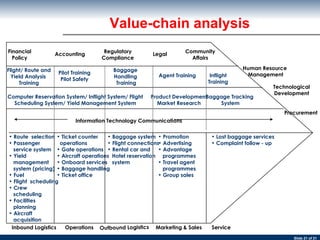
Value-chain analysis Human Resource Management Technological Development Procurement Inbound Logistics Operations Outbound Logistics Marketing & Sales Service Financial Policy Accounting Regulatory Compliance Legal Community Affairs Flight/ Route and Yield Analysis  Training Pilot Training Pilot Safety Baggage  Handling  Training Agent Training Inflight Training Computer Reservation System/ Inflight System/ Flight Scheduling System/ Yield Management System Product Development Market Research Baggage Tracking  System Information Technology Communications Route  selection Passenger  service system Yield  management system (pricing) Fuel Flight  scheduling  Crew scheduling Facilities planning Aircraft  acquisition Ticket counter operations Gate operations Aircraft operations Onboard services Baggage handling Ticket office  Baggage system Flight connections Rental car and Hotel reservation system  Promotion Advertising Advantage programmes Travel agent programmes Group sales Lost baggage services Complaint follow - up

Bpr 02 Principles

  • 1.
    Business Process Re-engineering02 – Principles & Dimensions
  • 2.
    Dimensions & CharacteristicsFundamental changes to process, technology and human factors to achieve dramatic improvements in key measures The dimensions & characteristics: Balanced attention to processes, people and technology Cross functional, process based perspective Judged by measurable results achieved
  • 3.
    Process: The BasicConcept What is a process? - “a collection of business activities that creates value for a customer - a transformation of inputs(s) into output(s): a state of change Re-engineer processes, not functions or organisations Some typical processes: - concept to prototype : develop product - target to customer order : acquire customer - customer order to pay : fulfill order - purchase request to payment : procure materials - enquiry to resolution : service
  • 4.
    Process viewpoint Identificationand mapping - identify, name and relate the processes to each other Ownership - assigning owners for all processes Measurement - establishing and communicating end-to-end customer driven process measures and measurement mechanisms
  • 5.
    Process viewpoint Management- evaluate process performance against customer needs and competitive benchmarks Awareness - creating appreciation of the organisation’s processes and customers - develop a process-oriented mindset
  • 6.
    The Business operationBusiness Processes Values and Beliefs Management and Measurement Systems Jobs and Structure determine require enable foster The business operation diamond
  • 7.
    The Impact ofBPR The business operation diamond in context Business Processes Values and Beliefs Management and Measurement Systems Jobs and Structure INFRASTRUCTURE Customer needs Competitor actions Technological and environmental factors Assessment of capabilities
  • 8.
    Elements of BPRProcess focus Radical change Dramatic improvement BPR is about competitiveness.
  • 9.
    Process Focus Aset of linked activities that adds value to the process to create an effective output Focus should be on core business processes that addresses the external customer and supplier
  • 10.
    The objective isto address competitiveness and market-dominance Radical change provides a new way of building core competencies and good investment management Radical Change
  • 11.
    Dramatic improvement Toachieve major improvement in the core process Planning, procedures and resources are required Measure, control and manage the process
  • 12.
    BPR Model Bestpractices - the foundation for success Change and risk management Competitiveness BPR Process focus Radical change Dramatic improvement
  • 13.
    Downsizing / RightsizingCustomer satisfaction Quality improvement goals Functional performance improvement Reduce costs Increase speed (of service) Overcome a competitive threat Change of organisational structure Why re-engineer ?
  • 14.
    Process Improvement PossibilitiesEliminate duplicate activities Combine related activities Eliminate multiple reviews and approvals Eliminate inspections Simplify processes Reduce batch size Outsource inefficient activities Centralise or decentralise functions / activities
  • 15.
    Invisible Managers delegatetheir knowledge Process performance is not measured Inconsistent Jobs, measures and infrastructure are not aligned with the current process Ignored Processes often unmanaged and rarely updated Ill conceived Processes and policies are developed piecemeal and informally rather than designed as a whole Reasons to improve processes
  • 16.
    BPR is differentHigh ambition Improvements in key performance measures, such as cost, quality, service or speed Process focus A customer-oriented viewpoint. No organisational boundaries
  • 17.
    Creative rule-breaking Findingassumptions about normal business practice and customers’ needs Information technology to enable the above IT enables new ways of working through substitution and automation BPR is different
  • 18.
    Improve customer serviceReduce cycle time Improve quality Reduce costs Increase market share Reduce product development time Increase sales Think of specific examples for various processes Typical benefits BPR produces
  • 19.
    Developed by MichaelPorter : To classify, understand and analyse an organisation’s value-added processes to achieve competitive advantage To analyse how to improve cost structure (productivity) and add value (differentiation) Applicable to any industry Processes classifed into 5 Primary activities and 4 Support activities Value-chain analysis
  • 20.
    Value-chain analysis PROFITPROFIT Firm Infrastructure Human Resource Management Technological Development Procurement Inbound Logistics Operations Outbound Logistics Marketing and Sales Service
  • 21.
    Value-chain analysis HumanResource Management Technological Development Procurement Inbound Logistics Operations Outbound Logistics Marketing & Sales Service Financial Policy Accounting Regulatory Compliance Legal Community Affairs Flight/ Route and Yield Analysis Training Pilot Training Pilot Safety Baggage Handling Training Agent Training Inflight Training Computer Reservation System/ Inflight System/ Flight Scheduling System/ Yield Management System Product Development Market Research Baggage Tracking System Information Technology Communications Route selection Passenger service system Yield management system (pricing) Fuel Flight scheduling Crew scheduling Facilities planning Aircraft acquisition Ticket counter operations Gate operations Aircraft operations Onboard services Baggage handling Ticket office Baggage system Flight connections Rental car and Hotel reservation system Promotion Advertising Advantage programmes Travel agent programmes Group sales Lost baggage services Complaint follow - up