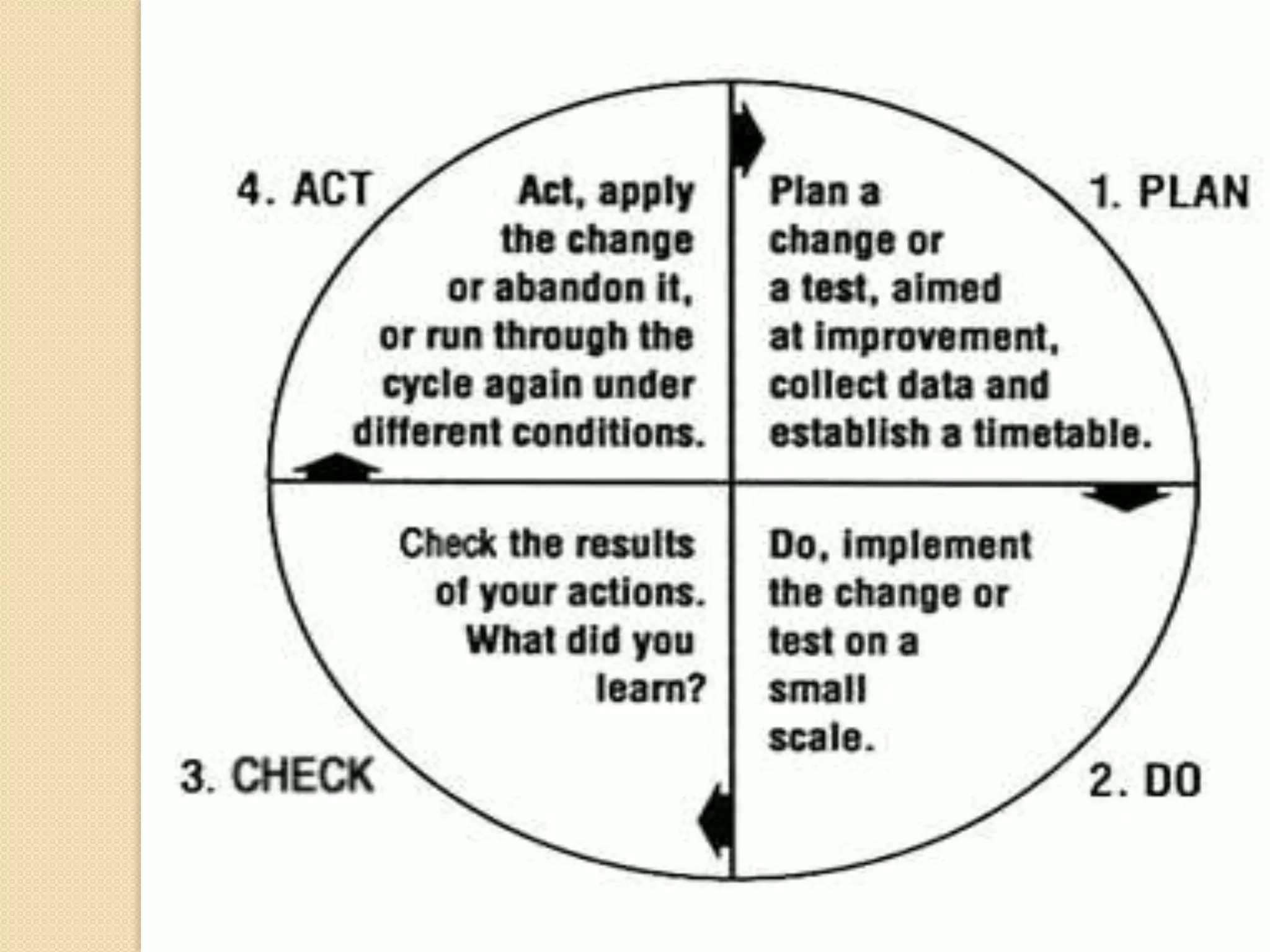
This document discusses continuous process improvement strategies. It describes 5 ways to improve a process including reducing inputs, reducing errors, meeting or exceeding customer expectations, making the process safer, and making it more satisfying for employees. Improvement strategies include repairing issues, refining incremental improvements, renovating with breakthrough improvements, and reinventing with new outputs. The 7-step problem solving method is outlined as identifying opportunities, analyzing the current process, developing optimal solutions, implementing changes, studying results, standardizing solutions, and planning for the future. Kaizen is also discussed as a philosophy of continuous improvement through small increments.
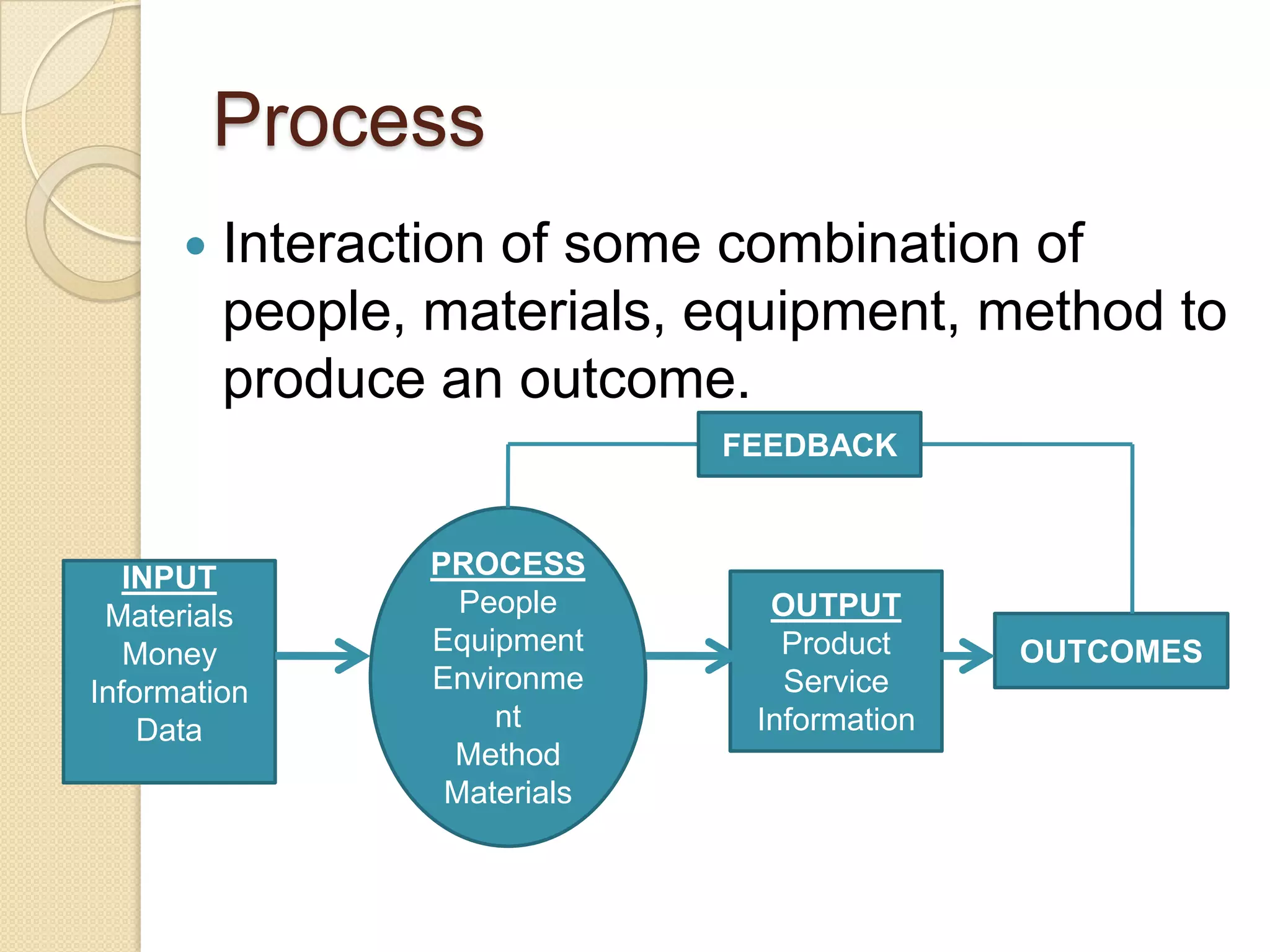
Process
Interaction of some combination of
people, materials, equipment, method to
produce an outcome.
FEEDBACK
INPUT PROCESS
Materials People OUTPUT
Money Equipment Product OUTCOMES
Information Environme Service
Data nt Information
Method
Materials
3.
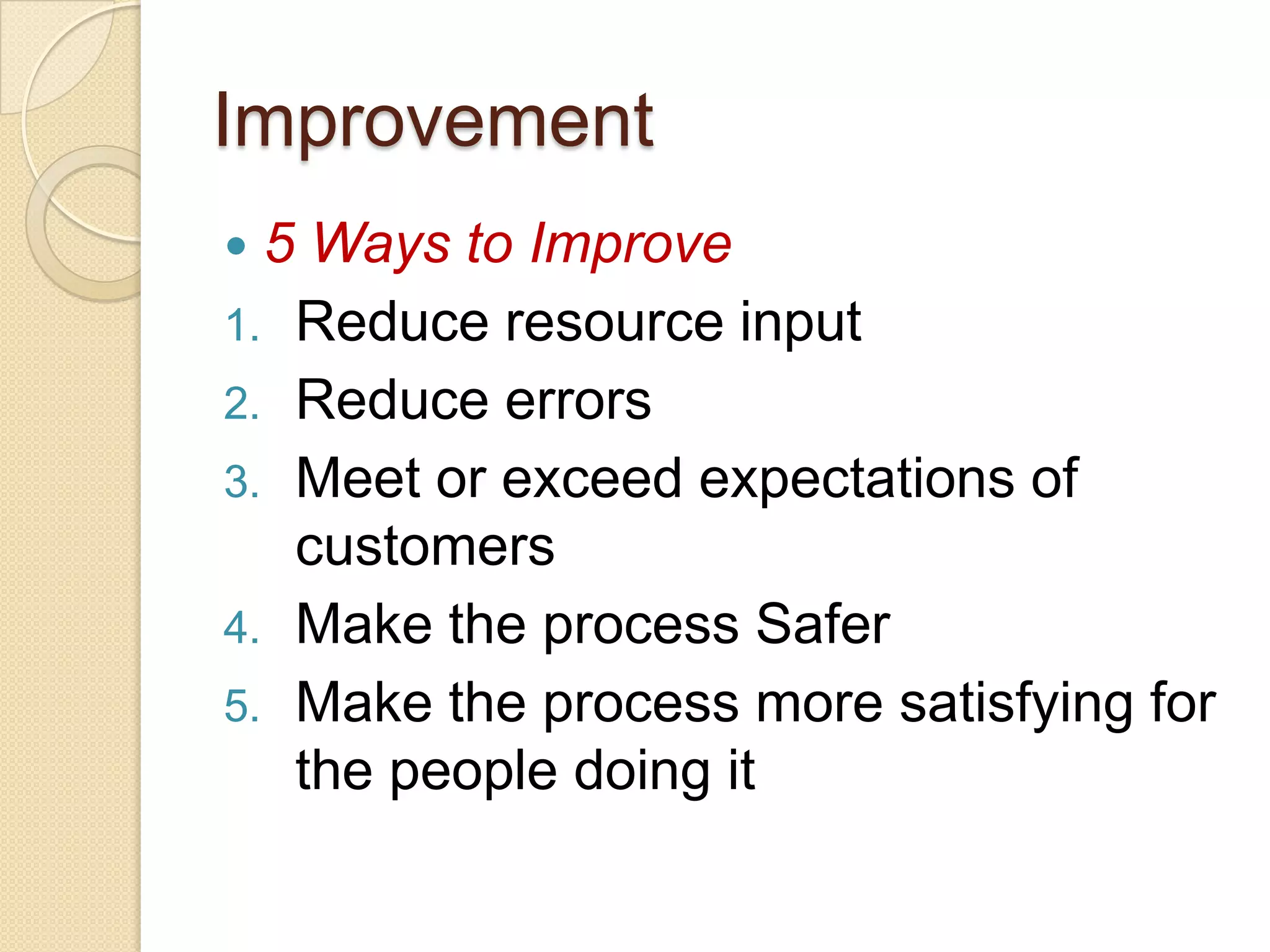
Improvement
5 Waysto Improve
1. Reduce resource input
2. Reduce errors
3. Meet or exceed expectations of
customers
4. Make the process Safer
5. Make the process more satisfying for
the people doing it
4.
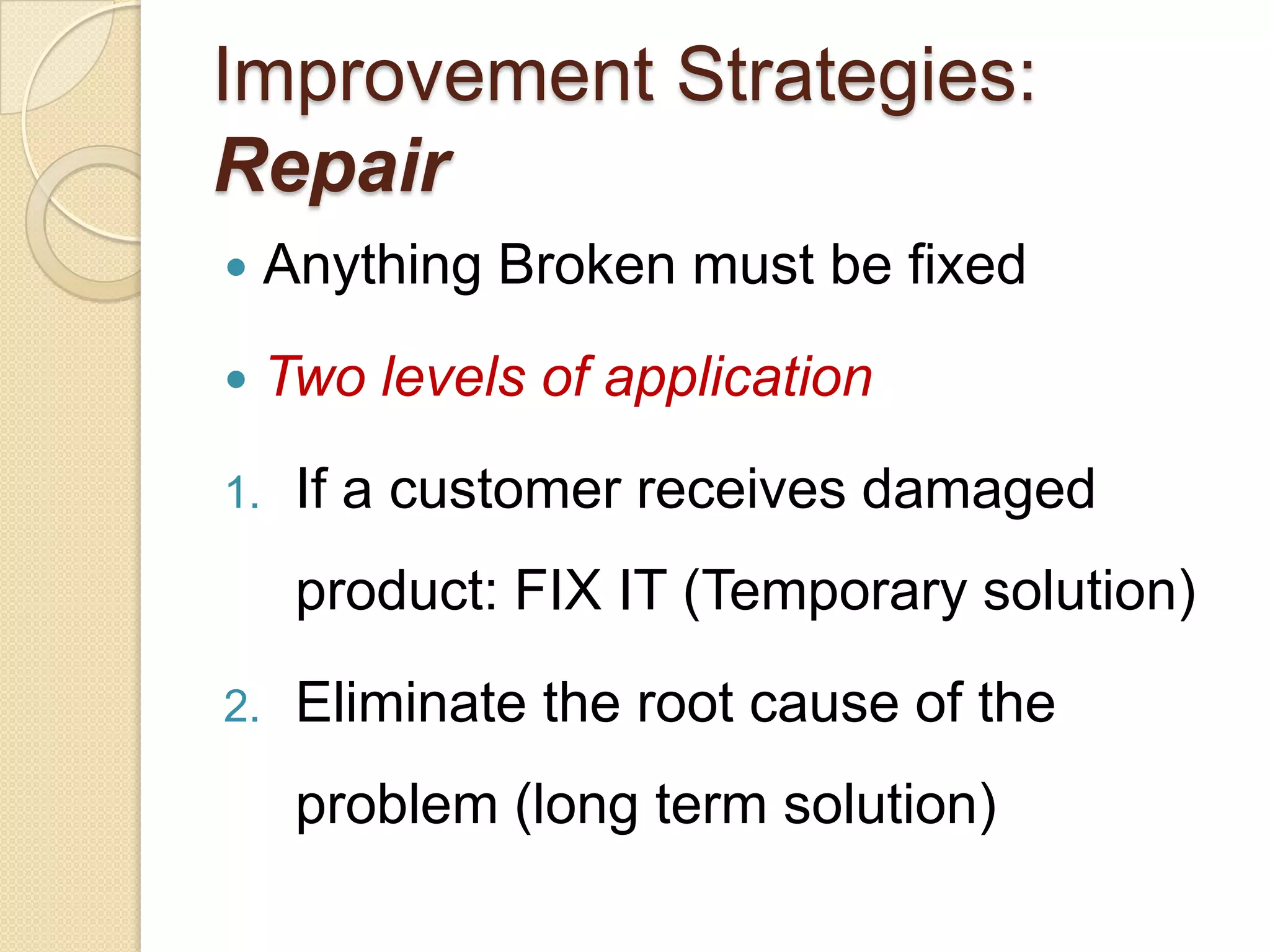
Improvement Strategies:
Repair
Anything Broken must be fixed
Two levels of application
1. If a customer receives damaged
product: FIX IT (Temporary solution)
2. Eliminate the root cause of the
problem (long term solution)
5.
Improvement Strategies:
Refine
Continuallyimprove the process that
is not broken
Incremental improvements in
products, processes, services
A strategy for both individuals & teams
Doing things just a bit quicker, better,
easier or with less waste
Benefit: Little resistance from
employees
Drawback: Gradual change might not
be recognized or rewarded by
6.
Improvement Strategies:
Renovate
Major break through improvements
Output may appear to be the same
Innovation & technology
advancements are key factors in this
approach
More expensive
7.
Improvement Strategies:
Reinvent
Mostdemanding strategy
Thinking process: Current approach
will never satisfy customer
requirements
A new output (product, service or
activity) might be developed
Start with the imagination that
previous system does not exist
Benefit: Potential competitive
advantage
8.
Types of Problems
Compliance (Specified by standards)
Unstructured (Not specified by
standards)
Efficiency (from operations viewpoint)
Process Design
Product Design
10.
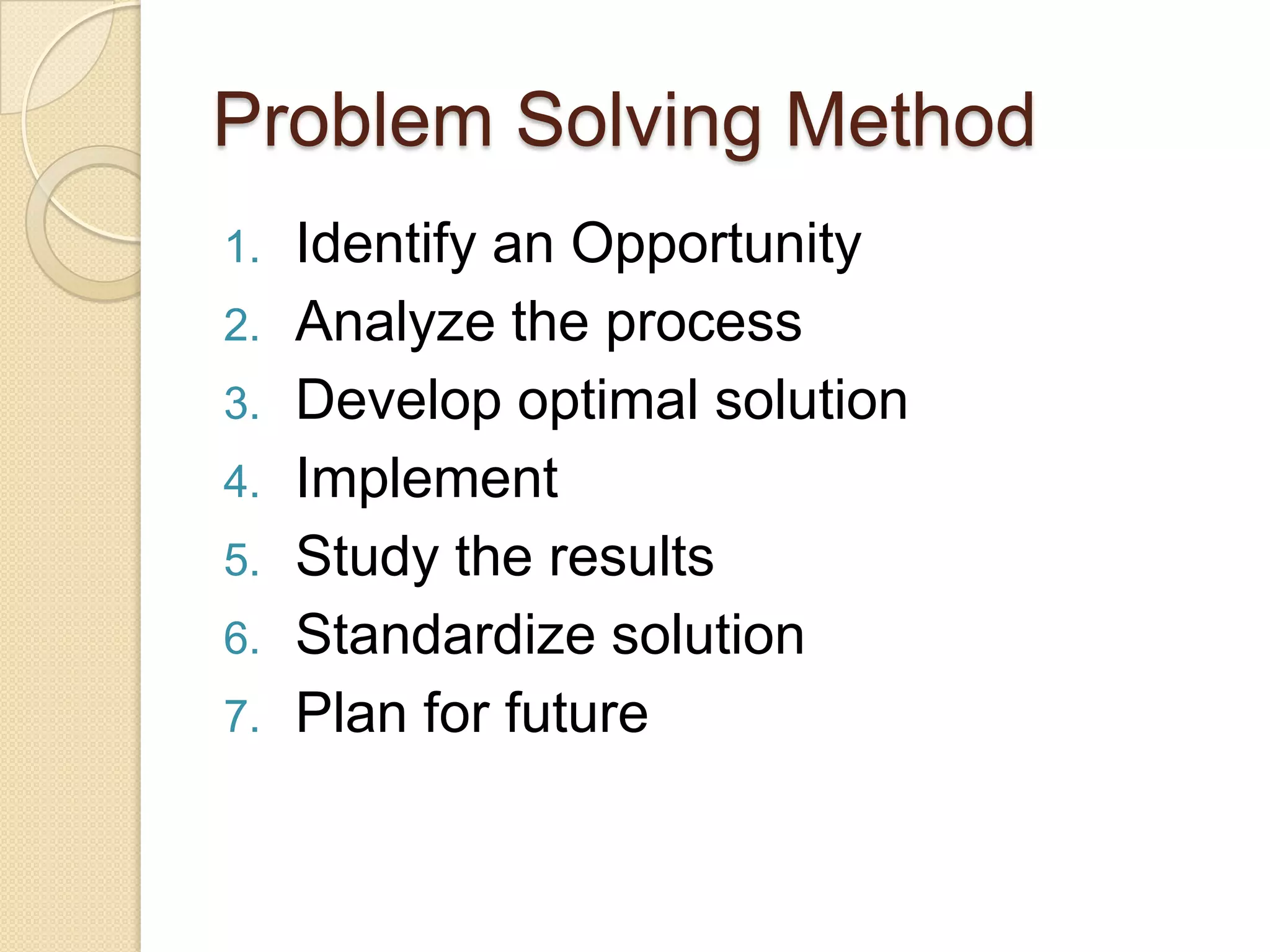
Problem Solving Method
1. Identify an Opportunity
2. Analyze the process
3. Develop optimal solution
4. Implement
5. Study the results
6. Standardize solution
7. Plan for future
11.
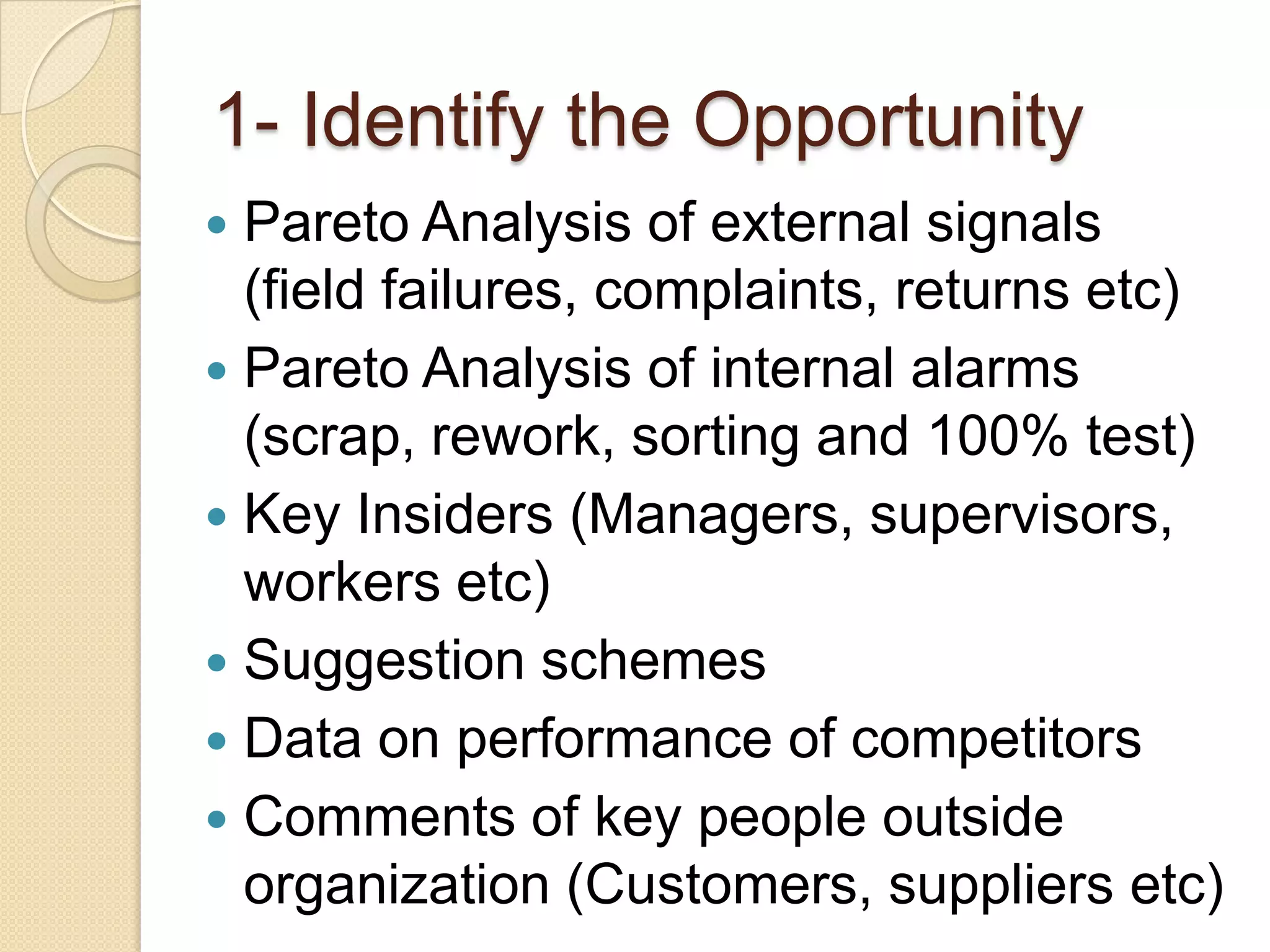
1- Identify theOpportunity
Pareto Analysis of external signals
(field failures, complaints, returns etc)
Pareto Analysis of internal alarms
(scrap, rework, sorting and 100% test)
Key Insiders (Managers, supervisors,
workers etc)
Suggestion schemes
Data on performance of competitors
Comments of key people outside
organization (Customers, suppliers etc)
12.
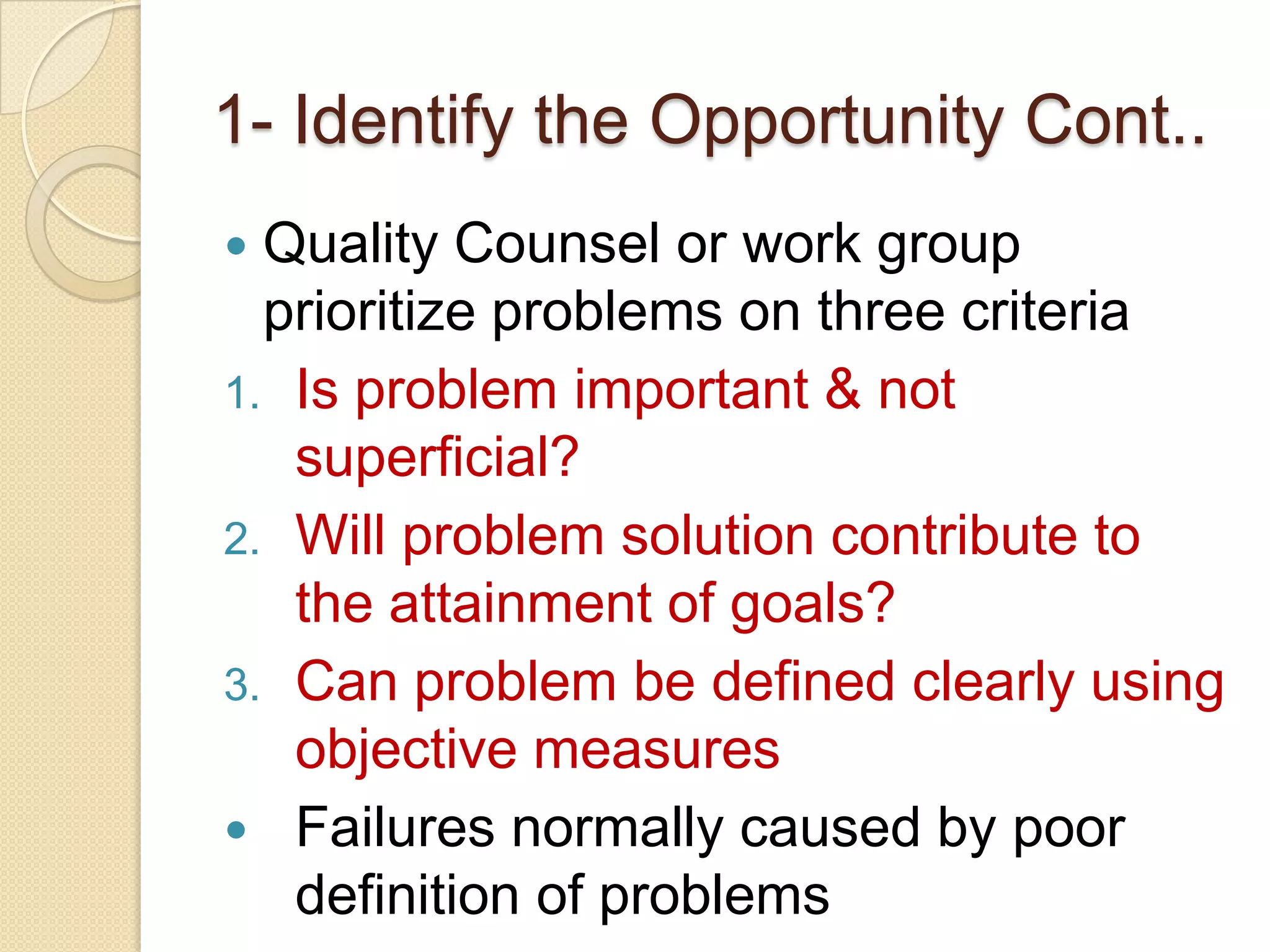
1- Identify theOpportunity Cont..
Quality Counsel or work group
prioritize problems on three criteria
1. Is problem important & not
superficial?
2. Will problem solution contribute to
the attainment of goals?
3. Can problem be defined clearly using
objective measures
Failures normally caused by poor
definition of problems
13.
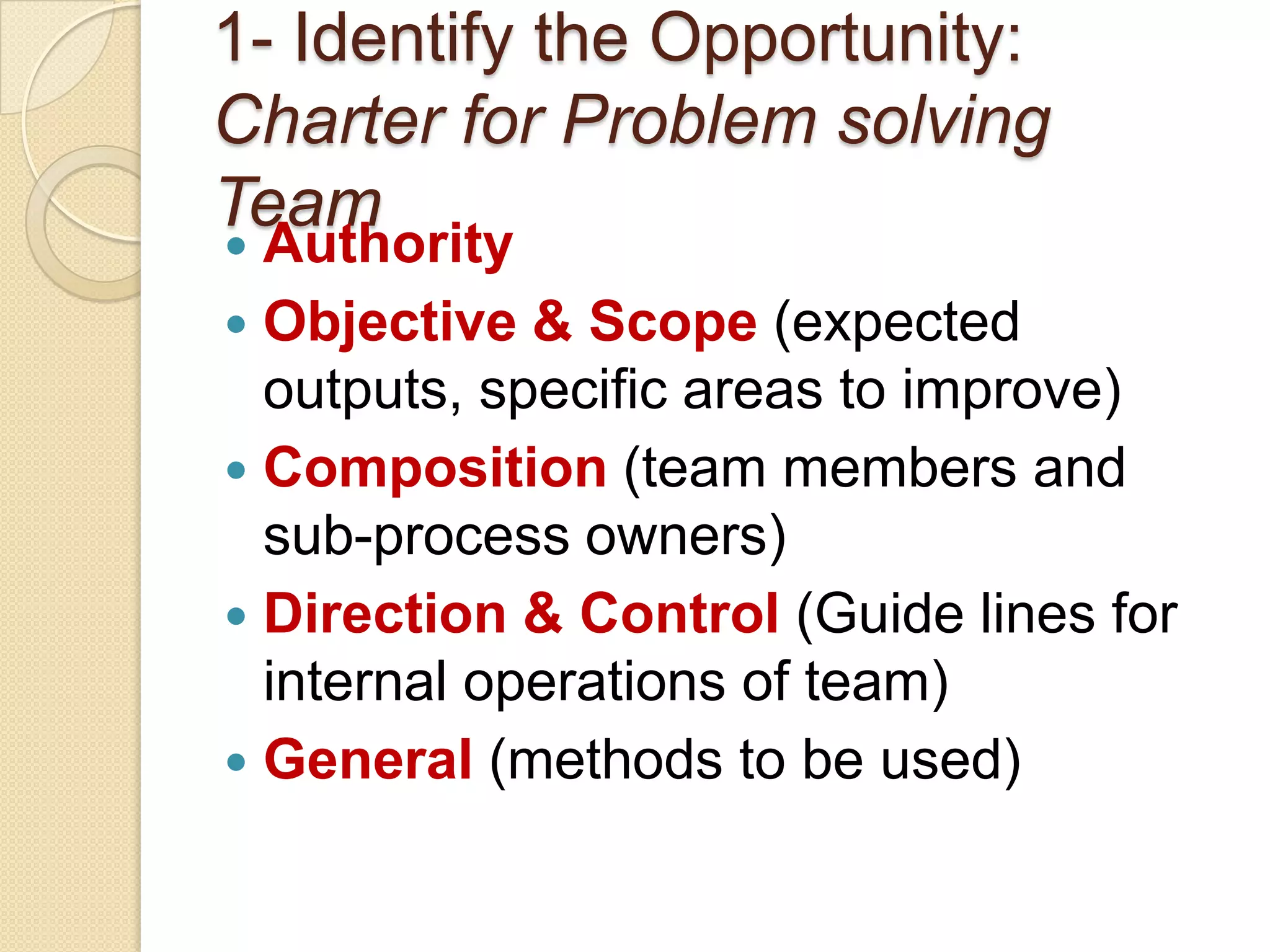
1- Identify theOpportunity:
Charter for Problem solving
Team
Authority
Objective & Scope (expected
outputs, specific areas to improve)
Composition (team members and
sub-process owners)
Direction & Control (Guide lines for
internal operations of team)
General (methods to be used)
14.
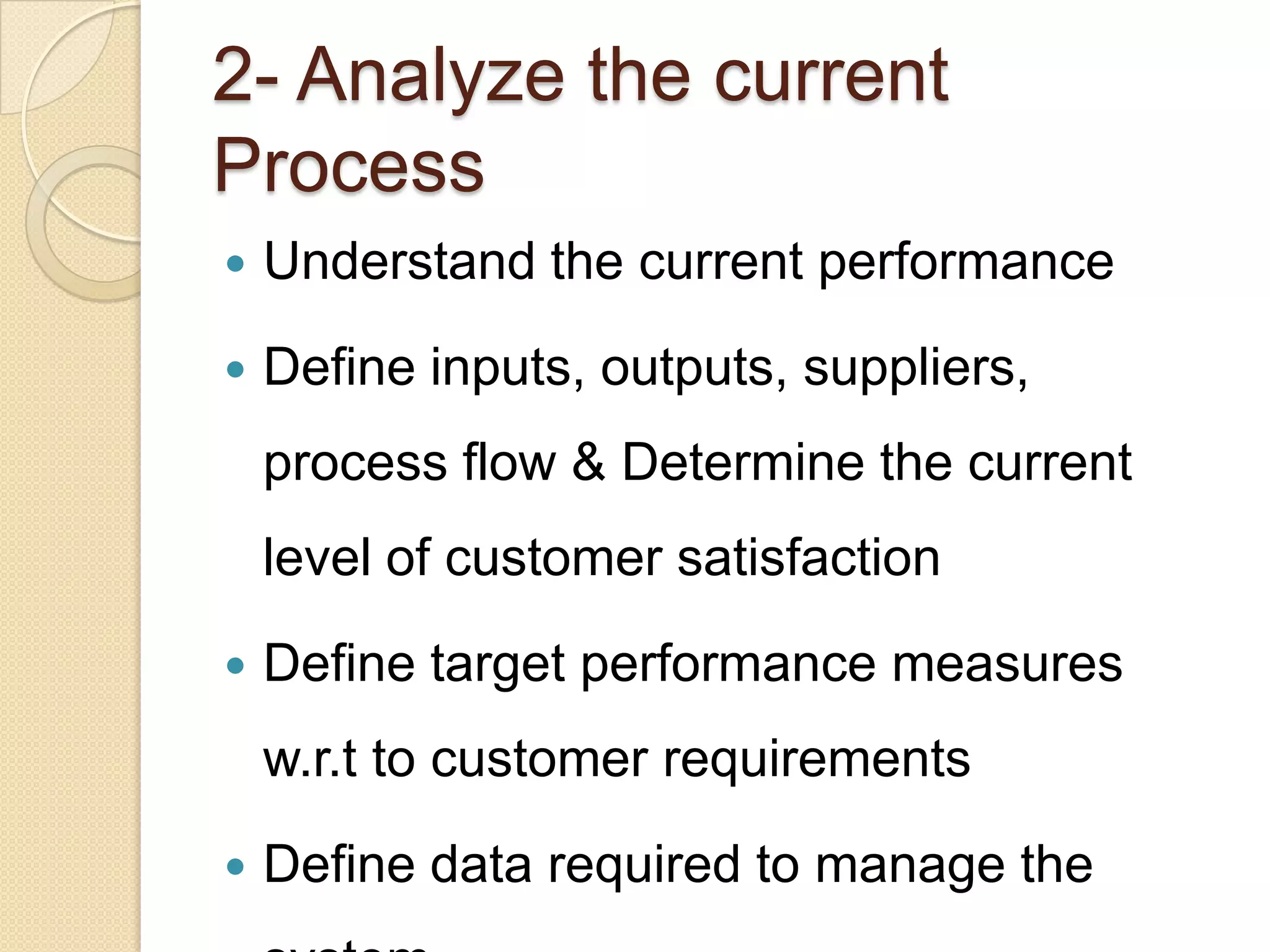
2- Analyze thecurrent
Process
Understand the current performance
Define inputs, outputs, suppliers,
process flow & Determine the current
level of customer satisfaction
Define target performance measures
w.r.t to customer requirements
Define data required to manage the
15.
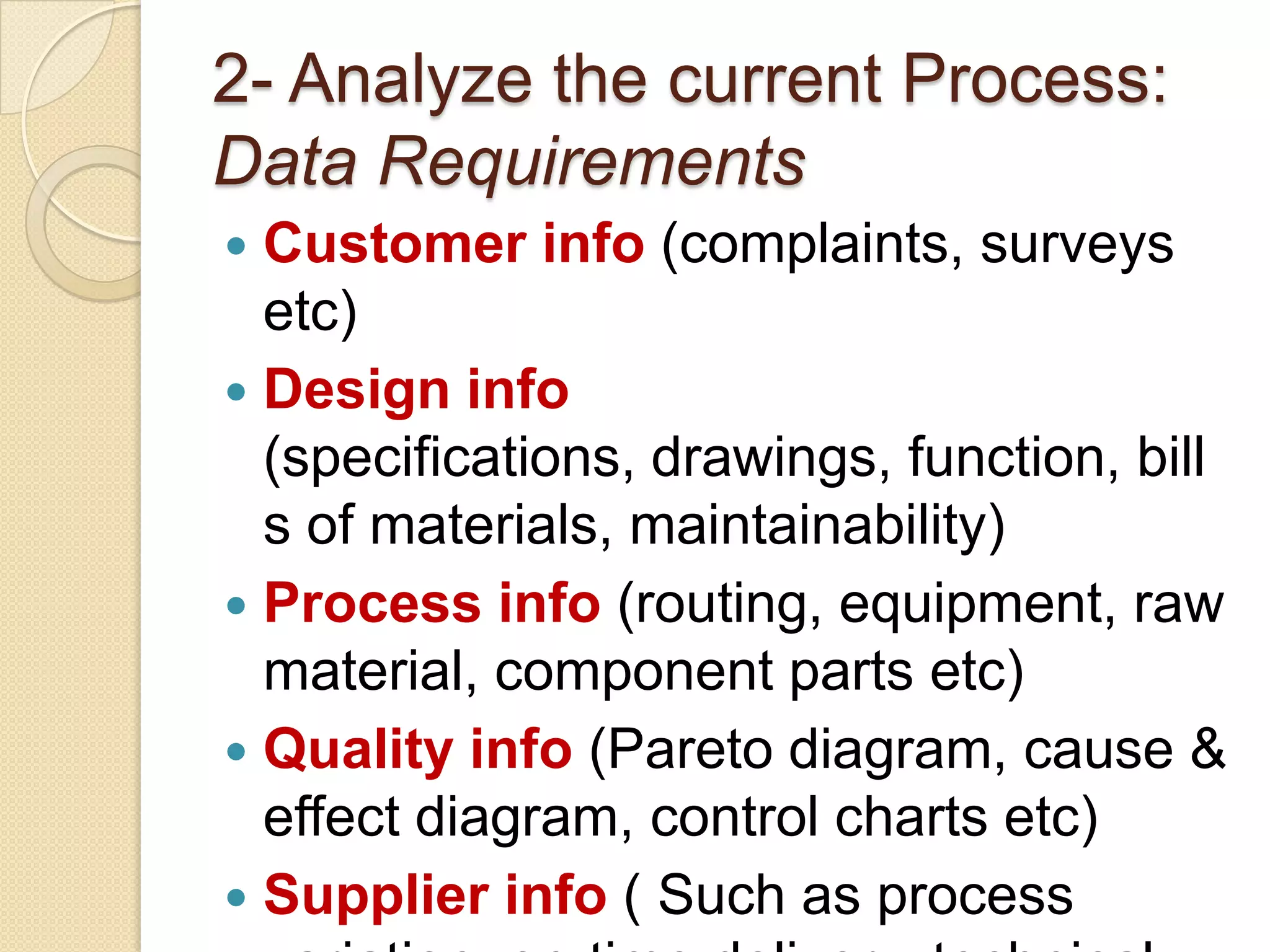
2- Analyze thecurrent Process:
Data Requirements
Customer info (complaints, surveys
etc)
Design info
(specifications, drawings, function, bill
s of materials, maintainability)
Process info (routing, equipment, raw
material, component parts etc)
Quality info (Pareto diagram, cause &
effect diagram, control charts etc)
Supplier info ( Such as process
16.
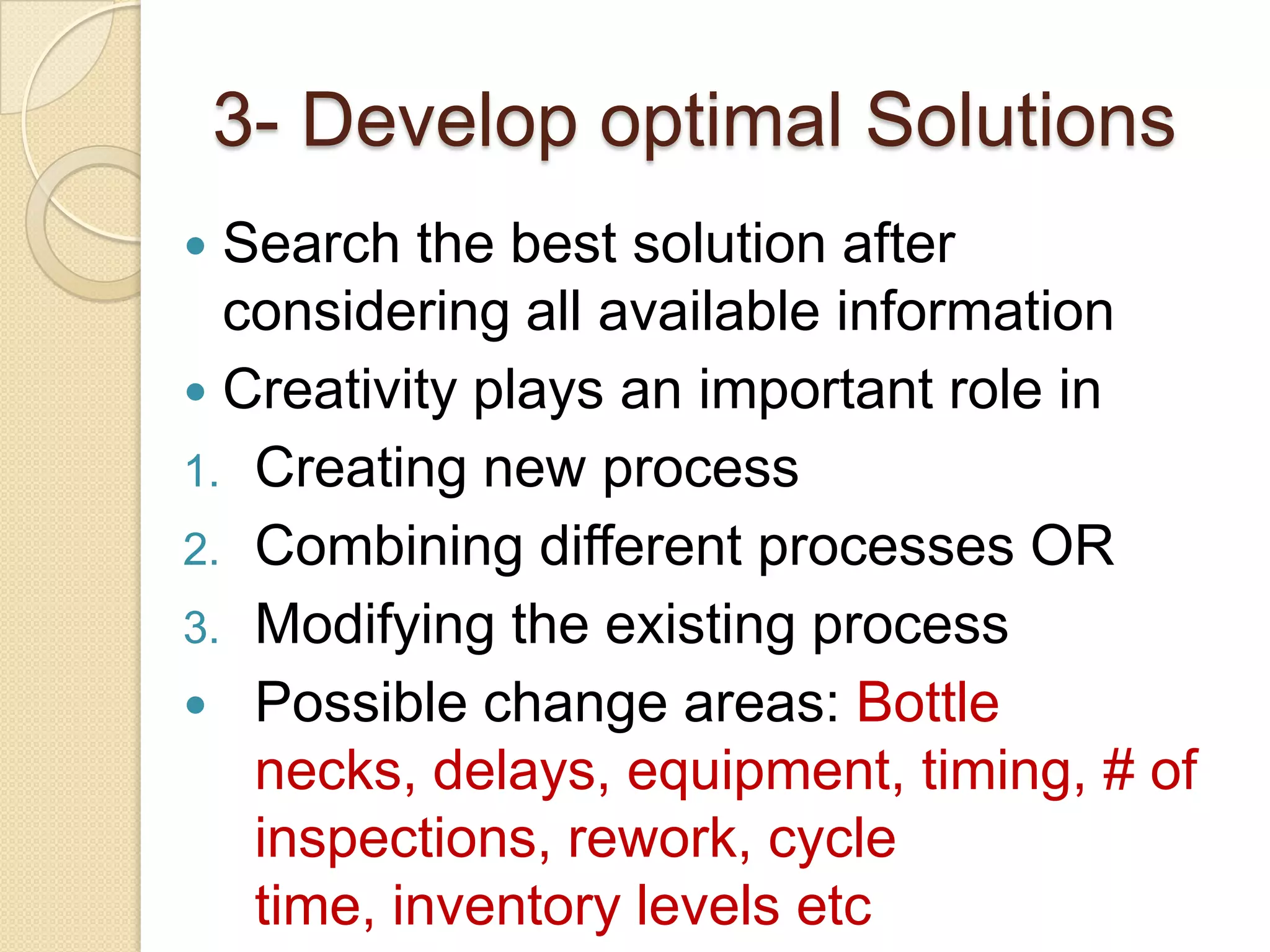
3- Develop optimalSolutions
Search the best solution after
considering all available information
Creativity plays an important role in
1. Creating new process
2. Combining different processes OR
3. Modifying the existing process
Possible change areas: Bottle
necks, delays, equipment, timing, # of
inspections, rework, cycle
time, inventory levels etc
17.
4- Implement Changes
Implementation plan should describe
Why will it be done?
How will it be done?
When will it be done?
Who will do it?
Where will it be done?
Also the critical info and details about
measurement of information
18.
5- Study theresults
Track the effectiveness of the
improvement
Important to Institutionalize meaningful
change
Ensure ongoing measurement &
evaluation efforts to achieve continuous
improvement
Project team should meet periodically
during this phase to evaluate the results
Some phases to be repeated if team is
19.
6- Standardize thesolution
Positive control specifies variables
that need to be kept under control
What, who, how, where and when of
the process
Standardizing the solution prevents
backsliding
20.
7- Plan forthe Future
Improvement process continues
TQM addresses the Quality of
management as well as Management
of Quality
Every one in the organization is
involved in long term endeavor of
continuous improvement
21.
KAIZEN
Japanese philosophythat defines role
of management in continuous
improvement
Process of continuous improvement in
small increments that make process
more efficient, effective, under control
and adaptable
Accomplished with little or no expense
and without using sophisticated
techniques or expensive equipment.