CONTINUAL IMPROVEMENT
PROCESS
THE CONCEPT & TOOLS
CONCEPT
• Organization spent or invest in many aspects of managing their
business in order to remain competitive.
• There is one single concept that provide competitive edge in
business environments. This concept is responsible for bottom
line profit.
• In management process there is always a room for
improvement.
• This whole concept and process is known as “Continuous
Improvement Process”
PRINCIPAL AREAS OF IMPROVEMENT
• There are three key areas which contribute to the efficiency and
effectiveness of an organization;
• The reduction of waste of resources
• The way we do our job
• The way any process is undertaken
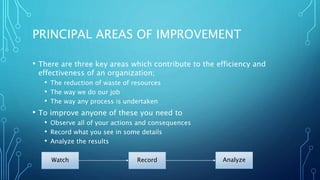
• To improve anyone of these you need to
• Observe all of your actions and consequences
• Record what you see in some details
• Analyze the results
Watch Record Analyze
DISCUSSION
• A healthy discussion is required to get the information which
areas in your organization would benefit from improvement
• Have to make a list for future reference
• Make a note what is required to measure?
• More……
BUILDING BACKGROUND
• How you can reduce waste?
• Where do you start?
• How do you begin to break the task into manageable activities?
• How can be customer satisfy?
• More……….
PROCESS?
• A process in simple can be anything from production line to serving a
customer.
• To improve a process we need a clear picture of what’s actually
happening, not what you think is happening.
• Information gathering is necessary about the process by talking to
the people involved, watching and recording.
• In end you need to analyze the information to isolate the opportunity
to improve the process.
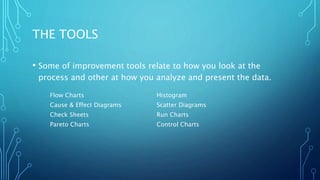
THE TOOLS
• Some of improvement tools relate to how you look at the
process and other at how you analyze and present the data.
Flow Charts Histogram
Cause & Effect Diagrams Scatter Diagrams
Check Sheets Run Charts
Pareto Charts Control Charts
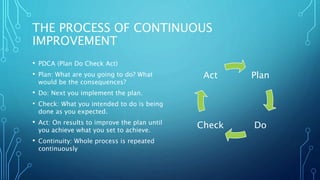
THE PROCESS OF CONTINUOUS
IMPROVEMENT
• PDCA (Plan Do Check Act)
• Plan: What are you going to do? What
would be the consequences?
• Do: Next you implement the plan.
• Check: What you intended to do is being
done as you expected.
• Act: On results to improve the plan until
you achieve what you set to achieve.
• Continuity: Whole process is repeated
continuously
Plan
DoCheck
Act
OTHER SIGNIFICANT PROCESSES
• Six Sigma (DMAIC): The process is consist of; Define Measure
Analyze Improve and Control
• Six Sigma (DMADV): The process is consist of; Define Measure
Analyze Design and Verify
• Lean Sigma: Combination of Lean & Sigma, Lean means quick
and speed action (reducing unneeded waiting time) whereas
Sigma means identify defects and eliminating them

Continual Improvement Process-Basic Idea

  • 1.
  • 2.
    CONCEPT • Organization spentor invest in many aspects of managing their business in order to remain competitive. • There is one single concept that provide competitive edge in business environments. This concept is responsible for bottom line profit. • In management process there is always a room for improvement. • This whole concept and process is known as “Continuous Improvement Process”
  • 3.
    PRINCIPAL AREAS OFIMPROVEMENT • There are three key areas which contribute to the efficiency and effectiveness of an organization; • The reduction of waste of resources • The way we do our job • The way any process is undertaken • To improve anyone of these you need to • Observe all of your actions and consequences • Record what you see in some details • Analyze the results Watch Record Analyze
  • 4.
    DISCUSSION • A healthydiscussion is required to get the information which areas in your organization would benefit from improvement • Have to make a list for future reference • Make a note what is required to measure? • More……
  • 5.
    BUILDING BACKGROUND • Howyou can reduce waste? • Where do you start? • How do you begin to break the task into manageable activities? • How can be customer satisfy? • More……….
  • 6.
    PROCESS? • A processin simple can be anything from production line to serving a customer. • To improve a process we need a clear picture of what’s actually happening, not what you think is happening. • Information gathering is necessary about the process by talking to the people involved, watching and recording. • In end you need to analyze the information to isolate the opportunity to improve the process.
  • 7.
    THE TOOLS • Someof improvement tools relate to how you look at the process and other at how you analyze and present the data. Flow Charts Histogram Cause & Effect Diagrams Scatter Diagrams Check Sheets Run Charts Pareto Charts Control Charts
  • 8.
    THE PROCESS OFCONTINUOUS IMPROVEMENT • PDCA (Plan Do Check Act) • Plan: What are you going to do? What would be the consequences? • Do: Next you implement the plan. • Check: What you intended to do is being done as you expected. • Act: On results to improve the plan until you achieve what you set to achieve. • Continuity: Whole process is repeated continuously Plan DoCheck Act
  • 9.
    OTHER SIGNIFICANT PROCESSES •Six Sigma (DMAIC): The process is consist of; Define Measure Analyze Improve and Control • Six Sigma (DMADV): The process is consist of; Define Measure Analyze Design and Verify • Lean Sigma: Combination of Lean & Sigma, Lean means quick and speed action (reducing unneeded waiting time) whereas Sigma means identify defects and eliminating them