Developing Meaningful Metrics:
  Driving Action for Results!
                               Presented to

 ASQ St. Petersburg-Tampa-Section 1508

                             08 February 2010

                                   by


                  T. M. Kubiak, President
            Performance Improvement Solutions

Conquering the Challenge!™           1           Copyright T. M. Kubiak 1996-2010
                                                Performance Improvement Solutions
If you don’t have confidence in
the diagnosis, you won’t have
confidence in the prescription.

                               — Steven Covey

  Conquering the Challenge!™   2     Copyright T. M. Kubiak 1996-2010
                                    Performance Improvement Solutions
Conquering the Challenge!™   3    Copyright T. M. Kubiak 1996-2010
                                 Performance Improvement Solutions
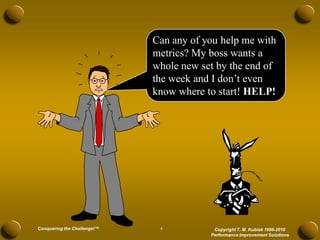
Can any of you help me with
                             metrics? My boss wants a
                             whole new set by the end of
                             the week and I don’t even
                             know where to start! HELP!


Conquering the Challenge!™    4           Copyright T. M. Kubiak 1996-2010
                                         Performance Improvement Solutions
Overview
 The Driving Force                Characteristics of Measures

 Definitions                      Development Considerations

 Why Measure?                     Principles of Measurement

 Barriers to Measurement          Where Should You Measure?

 Pitfalls to Avoid                Goals, Targets, & Benchmarks

 What Measures Measure            Evolution of a Measure

 The “E’s” of Measurement         Examples of Measures

 Different Views of Measures      Some Final Words...
     Conquering the Challenge!™   5           Copyright T. M. Kubiak 1996-2010
                                             Performance Improvement Solutions
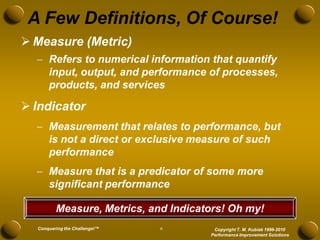
A Few Definitions, Of Course!
 Measure (Metric)
   Refers to numerical information that quantify
    input, output, and performance of processes,
    products, and services

 Indicator
   Measurement that relates to performance, but
    is not a direct or exclusive measure of such
    performance
   Measure that is a predicator of some more
    significant performance

         Measure, Metrics, and Indicators! Oh my!
  Conquering the Challenge!™   6       Copyright T. M. Kubiak 1996-2010
                                      Performance Improvement Solutions
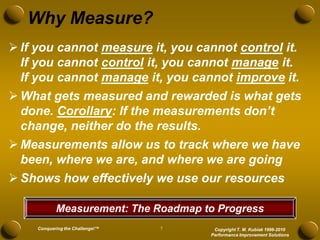
Why Measure?
 If you cannot measure it, you cannot control it.
  If you cannot control it, you cannot manage it.
  If you cannot manage it, you cannot improve it.
 What gets measured and rewarded is what gets
  done. Corollary: If the measurements don’t
  change, neither do the results.
 Measurements allow us to track where we have
  been, where we are, and where we are going
 Shows how effectively we use our resources

           Measurement: The Roadmap to Progress
    Conquering the Challenge!™   7    Copyright T. M. Kubiak 1996-2010
                                     Performance Improvement Solutions
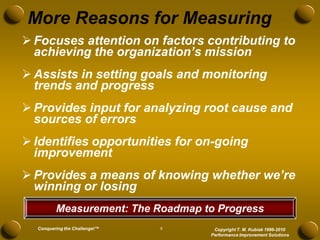
More Reasons for Measuring
 Focuses attention on factors contributing to
  achieving the organization’s mission
 Assists in setting goals and monitoring
  trends and progress
 Provides input for analyzing root cause and
  sources of errors
 Identifies opportunities for on-going
  improvement
 Provides a means of knowing whether we’re
  winning or losing
         Measurement: The Roadmap to Progress
  Conquering the Challenge!™   8    Copyright T. M. Kubiak 1996-2010
                                   Performance Improvement Solutions
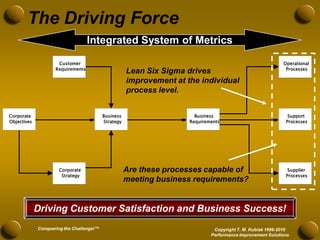
The Driving Force
                                   Integrated System of Metrics

                     Customer                                                                              Operational
                    Requirements                                                                            Processes
                                                     Lean Six Sigma drives
                                                     improvement at the individual
                                                     process level.


Corporate                                 Business                     Business                              Support
Objectives                                Strategy                   Requirements                           Processes


                      Corporate                      Are these processes capable of                          Supplier
                       Strategy                                                                             Processes
                                                     meeting business requirements?


             Driving Customer Satisfaction and Business Success!
             Conquering the Challenge!™                                       Copyright T. M. Kubiak 1996-2010
                                                                             Performance Improvement Solutions
Barriers to Measurement
 Thinking some jobs can’t be measured
 Thinking there isn’t enough time to measure
 The process of accomplishing a task is not
  understood
 Fear that the measurement will become a club


    Conquering the Challenge!™   10    Copyright T. M. Kubiak 1996-2010
                                      Performance Improvement Solutions
Pitfalls to Avoid!
 Using the measure as a carrot or a stick
  Reason: the goal becomes to manipulate the number


  Conquering the Challenge!™   11    Copyright T. M. Kubiak 1996-2010
                                    Performance Improvement Solutions
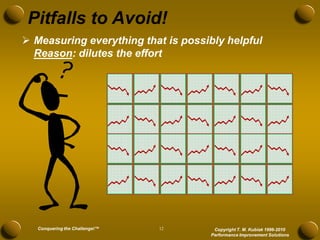
Pitfalls to Avoid!
 Measuring everything that is possibly helpful
  Reason: dilutes the effort


   Conquering the Challenge!™   12    Copyright T. M. Kubiak 1996-2010
                                     Performance Improvement Solutions
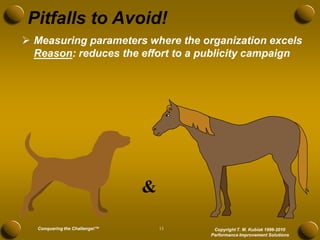
Pitfalls to Avoid!
 Measuring parameters where the organization excels
  Reason: reduces the effort to a publicity campaign


  Conquering the Challenge!™   13    Copyright T. M. Kubiak 1996-2010
                                    Performance Improvement Solutions
Pitfalls to Avoid!
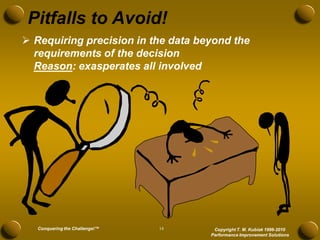
 Requiring precision in the data beyond the
  requirements of the decision
  Reason: exasperates all involved


   Conquering the Challenge!™   14    Copyright T. M. Kubiak 1996-2010
                                     Performance Improvement Solutions
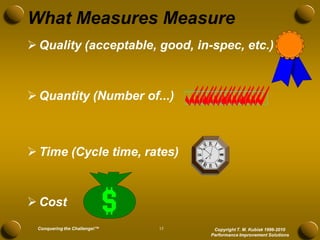
What Measures Measure
 Quality (acceptable, good, in-spec, etc.)


 Quantity (Number of...)


 Time (Cycle time, rates)


 Cost
 Conquering the Challenge!™   15    Copyright T. M. Kubiak 1996-2010
                                   Performance Improvement Solutions
The “E’s” of Measurement!
 Extent (volume-based or deployment)
   How much?
 Efficiency (productivity-based, usually
  expressed as a rate)
   How fast?
 Effectiveness (customer-based or
  objective-based)
   How well?

                          If It Were Only That Easy!
  Conquering the Challenge!™          16          Copyright T. M. Kubiak 1996-2010
                                                 Performance Improvement Solutions
Different Views of Measures
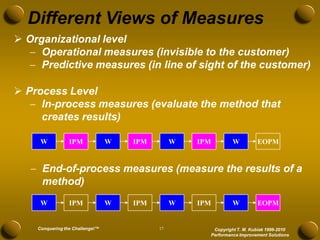
 Organizational level
   Operational measures (invisible to the customer)
   Predictive measures (in line of sight of the customer)

 Process Level
    In-process measures (evaluate the method that
     creates results)

     W           IPM             W   IPM        W   IPM        W         EOPM


    End-of-process measures (measure the results of a
     method)
     W           IPM             W   IPM        W   IPM        W         EOPM


    Conquering the Challenge!™             17          Copyright T. M. Kubiak 1996-2010
                                                      Performance Improvement Solutions
Characteristics of Measures

 Actionable (So What?)                             Relevant

 Easily measurable                                 Specific

 Economical to collect                             Timely

 Focused on processes                              Traceable

 Objective                                         Understandable

                               If It Ain’t Actionable...
  Conquering the Challenge!™               18           Copyright T. M. Kubiak 1996-2010
                                                       Performance Improvement Solutions
Development Considerations
 How often will the measure be computed and
  posted?
 What about data stratification/aggregation?
 Where will the data come from?
 Is the data source reliable?
 Can/should the data be normalized?
 How will the measure be presented?
 Who will see them?
   Critical Questions Require Thoughtful Answers
  Conquering the Challenge!™   19    Copyright T. M. Kubiak 1996-2010
                                    Performance Improvement Solutions
Operational Definition
 Answers: Who, How, What, Where, When
 Defines: formulas and terms
 Defines: interpretation (e.g., up is good)
 Example:


                      What is a “month?”


 Establishes a common language and understanding
  Conquering the Challenge!™   20     Copyright T. M. Kubiak 1996-2010
                                     Performance Improvement Solutions
Cash for Clunkers Example                                        Source: WSJ 09-08-05


 Issue: 78 cars bumped from the list
 Threshold: 18 mpg
 Reason: More precise data (4 decimals) caused the
  revisions (Note: 0.0001 miles is ½ drop of fuel based on
  18 mpg)
 Measurement Methods:
    Older: Dynamometer, fuel consumption measured,
      measured to 4 decimals, numbers rounded
    Newer: Tailpipe emissions, measured to 4 decimals
 Fix: Old data updated to be “effectively equivalent”
 Quote: “Repeatability and accuracy is something we
  spend a lot of time on.” EPA scientist

                               Hey, Joe! Gotta light?
  Conquering the Challenge!™             21          Copyright T. M. Kubiak 1996-2010
                                                    Performance Improvement Solutions
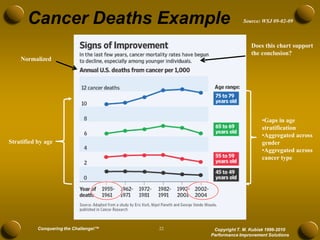
Cancer Deaths Example                              Source: WSJ 09-02-09


                                                              Does this chart support
                                                              the conclusion?
    Normalized


                                                                  •Gaps in age
                                                                  stratification
                                                                  •Aggregated across
Stratified by age                                                 gender
                                                                  •Aggregated across
                                                                  cancer type


           Conquering the Challenge!™   22    Copyright T. M. Kubiak 1996-2010
                                             Performance Improvement Solutions
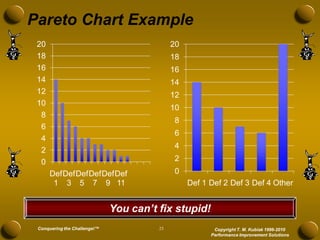
Pareto Chart Example
 20                                          20
 18                                          18
 16                                          16
 14                                          14
 12                                          12
 10
                                             10
  8
                                              8
  6
                                              6
  4
                                              4
  2
  0                                           2
      Def Def Def Def Def Def                 0
       1 3 5 7 9 11                               Def 1 Def 2 Def 3 Def 4 Other


                              You can’t fix stupid!
 Conquering the Challenge!™             23               Copyright T. M. Kubiak 1996-2010
                                                        Performance Improvement Solutions
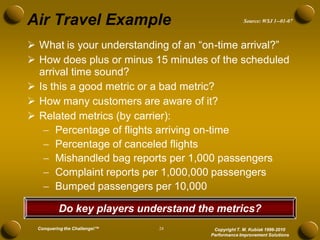
Air Travel Example                                 Source: WSJ 1--01-07


 What is your understanding of an “on-time arrival?”
 How does plus or minus 15 minutes of the scheduled
  arrival time sound?
 Is this a good metric or a bad metric?
 How many customers are aware of it?
 Related metrics (by carrier):
    Percentage of flights arriving on-time
    Percentage of canceled flights
    Mishandled bag reports per 1,000 passengers
    Complaint reports per 1,000,000 passengers
    Bumped passengers per 10,000

          Do key players understand the metrics?
  Conquering the Challenge!™   24      Copyright T. M. Kubiak 1996-2010
                                      Performance Improvement Solutions
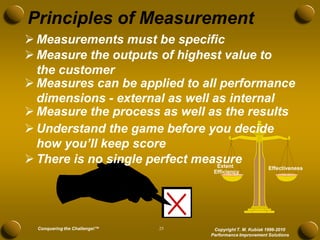
Principles of Measurement
 Measurements must be specific
 Measure the outputs of highest value to
  the customer
 Measures can be applied to all performance
  dimensions - external as well as internal
 Measure the process as well as the results
 Understand the game before you decide
  how you’ll keep score
 There is no single perfect measure
                                 Extent                     Effectiveness
                                     Efficiency


  Conquering the Challenge!™   25    Copyright T. M. Kubiak 1996-2010
                                    Performance Improvement Solutions
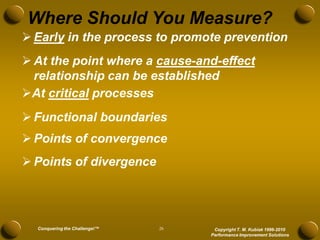
Where Should You Measure?
 Early in the process to promote prevention
 At the point where a cause-and-effect
  relationship can be established
At critical processes
 Functional boundaries
 Points of convergence
 Points of divergence


  Conquering the Challenge!™   26    Copyright T. M. Kubiak 1996-2010
                                    Performance Improvement Solutions
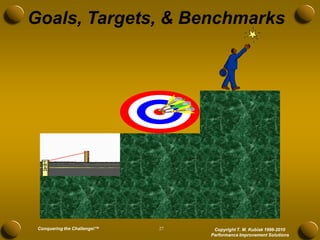
Goals, Targets, & Benchmarks


 Conquering the Challenge!™   27    Copyright T. M. Kubiak 1996-2010
                                   Performance Improvement Solutions
If you can’t win the race, make
sure the guy ahead of you
breaks the record.

          — Steve Prefontaine (1951-
             1975), American runner

  Conquering the Challenge!™   28    Copyright T. M. Kubiak 1996-2010
                                    Performance Improvement Solutions
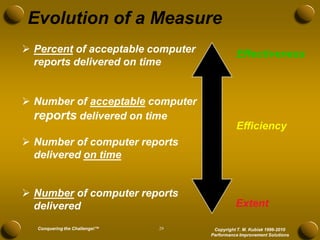
Evolution of a Measure
 Percent of acceptable computer              Effectiveness
  reports delivered on time


 Number of acceptable computer
  reports delivered on time
                                              Efficiency
 Number of computer reports
  delivered on time


 Number of computer reports
  delivered                                   Extent

  Conquering the Challenge!™   29    Copyright T. M. Kubiak 1996-2010
                                    Performance Improvement Solutions
Examples of Measures
 Measure: Trouble calls received/week

    The value of this measure is unclear. It is not
     customer-focused nor does it measure the
     ability of an organization to deal with incoming
     trouble calls since no processing of trouble
     calls is evident in the metric. Essentially, this
     metric measures nothing more than the
     volume of incoming trouble calls. The fact that
     it is expressed in the form of a rate is
     misleading and may fool one into thinking it is
     a measure of efficiency.
 Type of Measure: Extent


  Conquering the Challenge!™   30     Copyright T. M. Kubiak 1996-2010
                                     Performance Improvement Solutions
Examples of Measures
 Measure: Job Scheduled

    This metric focuses on measuring nothing
     more than the volume of jobs scheduled. Other
     than that, it provides little insight into the
     underlying process of “scheduling jobs.” The
     metric is not actionable.


 Type of Measure: Extent


  Conquering the Challenge!™   31    Copyright T. M. Kubiak 1996-2010
                                    Performance Improvement Solutions
Examples of Measures
 Measure: Actual versus planned sales

    Measures the planning/forecasting process.


 Type of Measure: Effectiveness


  Conquering the Challenge!™   32    Copyright T. M. Kubiak 1996-2010
                                    Performance Improvement Solutions
Examples of Measures
 Measure: Sales/employee

    This metric is highly misleading and often
     used for organization to organization
     comparisons. It falsely assumes that all
     employees generate sales and does not
     consider the product being sold or the
     associated supporting infrastructure required
     to produce and sell the product.


 Type of Measure: Efficiency


  Conquering the Challenge!™   33    Copyright T. M. Kubiak 1996-2010
                                    Performance Improvement Solutions
Examples of Measures
 Measure: Number of training hours/employee

    This metric measures the deployment of
     training hours to the workforce.


 Type of Measure: Extent


  Conquering the Challenge!™   34    Copyright T. M. Kubiak 1996-2010
                                    Performance Improvement Solutions
Examples of Measures
 Measure: Revenue/sales training hour

    This metric measures the impact of training the
     sales workforce so long as a clear cause-and-
     effect relationship can be established between
     training and revenue.


 Type of Measure: Effectiveness


  Conquering the Challenge!™   35    Copyright T. M. Kubiak 1996-2010
                                    Performance Improvement Solutions
Examples of Measures
 Measure: Engineering change orders/drawing

    This metric measure the design process from
     the point of view of the drawings. However,
     note that this metric does not normalize or
     adjust for the complexity of a given drawing.


 Type of Measure: Effectiveness


  Conquering the Challenge!™   36    Copyright T. M. Kubiak 1996-2010
                                    Performance Improvement Solutions
Some Final Words...
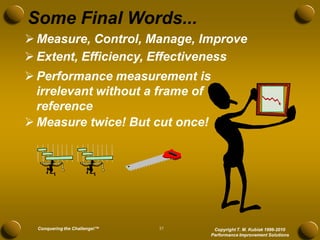
 Measure, Control, Manage, Improve
 Extent, Efficiency, Effectiveness
 Performance measurement is
  irrelevant without a frame of
  reference
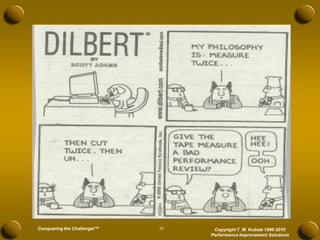
 Measure twice! But cut once!


  Conquering the Challenge!™   37    Copyright T. M. Kubiak 1996-2010
                                    Performance Improvement Solutions
People without information are
unable to change; those with
information are compelled to
change.


  Conquering the Challenge!™   38    Copyright T. M. Kubiak 1996-2010
                                    Performance Improvement Solutions
Conquering the Challenge!™   39    Copyright T. M. Kubiak 1996-2010
                                  Performance Improvement Solutions
Conquering the Challenge!™   40    Copyright T. M. Kubiak 1996-2010
                                  Performance Improvement Solutions

Quality Metrics

  • 1.
    Developing Meaningful Metrics: Driving Action for Results! Presented to ASQ St. Petersburg-Tampa-Section 1508 08 February 2010 by T. M. Kubiak, President Performance Improvement Solutions Conquering the Challenge!™ 1 Copyright T. M. Kubiak 1996-2010 Performance Improvement Solutions
  • 2.
    If you don’thave confidence in the diagnosis, you won’t have confidence in the prescription. — Steven Covey Conquering the Challenge!™ 2 Copyright T. M. Kubiak 1996-2010 Performance Improvement Solutions
  • 3.
    Conquering the Challenge!™ 3 Copyright T. M. Kubiak 1996-2010 Performance Improvement Solutions
  • 4.
    Can any ofyou help me with metrics? My boss wants a whole new set by the end of the week and I don’t even know where to start! HELP! Conquering the Challenge!™ 4 Copyright T. M. Kubiak 1996-2010 Performance Improvement Solutions
  • 5.
    Overview  The DrivingForce  Characteristics of Measures  Definitions  Development Considerations  Why Measure?  Principles of Measurement  Barriers to Measurement  Where Should You Measure?  Pitfalls to Avoid  Goals, Targets, & Benchmarks  What Measures Measure  Evolution of a Measure  The “E’s” of Measurement  Examples of Measures  Different Views of Measures  Some Final Words... Conquering the Challenge!™ 5 Copyright T. M. Kubiak 1996-2010 Performance Improvement Solutions
  • 6.
    A Few Definitions,Of Course!  Measure (Metric)  Refers to numerical information that quantify input, output, and performance of processes, products, and services  Indicator  Measurement that relates to performance, but is not a direct or exclusive measure of such performance  Measure that is a predicator of some more significant performance Measure, Metrics, and Indicators! Oh my! Conquering the Challenge!™ 6 Copyright T. M. Kubiak 1996-2010 Performance Improvement Solutions
  • 7.
    Why Measure?  Ifyou cannot measure it, you cannot control it. If you cannot control it, you cannot manage it. If you cannot manage it, you cannot improve it.  What gets measured and rewarded is what gets done. Corollary: If the measurements don’t change, neither do the results.  Measurements allow us to track where we have been, where we are, and where we are going  Shows how effectively we use our resources Measurement: The Roadmap to Progress Conquering the Challenge!™ 7 Copyright T. M. Kubiak 1996-2010 Performance Improvement Solutions
  • 8.
    More Reasons forMeasuring  Focuses attention on factors contributing to achieving the organization’s mission  Assists in setting goals and monitoring trends and progress  Provides input for analyzing root cause and sources of errors  Identifies opportunities for on-going improvement  Provides a means of knowing whether we’re winning or losing Measurement: The Roadmap to Progress Conquering the Challenge!™ 8 Copyright T. M. Kubiak 1996-2010 Performance Improvement Solutions
  • 9.
    The Driving Force Integrated System of Metrics Customer Operational Requirements Processes Lean Six Sigma drives improvement at the individual process level. Corporate Business Business Support Objectives Strategy Requirements Processes Corporate Are these processes capable of Supplier Strategy Processes meeting business requirements? Driving Customer Satisfaction and Business Success! Conquering the Challenge!™ Copyright T. M. Kubiak 1996-2010 Performance Improvement Solutions
  • 10.
    Barriers to Measurement Thinking some jobs can’t be measured  Thinking there isn’t enough time to measure  The process of accomplishing a task is not understood  Fear that the measurement will become a club Conquering the Challenge!™ 10 Copyright T. M. Kubiak 1996-2010 Performance Improvement Solutions
  • 11.
    Pitfalls to Avoid! Using the measure as a carrot or a stick Reason: the goal becomes to manipulate the number Conquering the Challenge!™ 11 Copyright T. M. Kubiak 1996-2010 Performance Improvement Solutions
  • 12.
    Pitfalls to Avoid! Measuring everything that is possibly helpful Reason: dilutes the effort Conquering the Challenge!™ 12 Copyright T. M. Kubiak 1996-2010 Performance Improvement Solutions
  • 13.
    Pitfalls to Avoid! Measuring parameters where the organization excels Reason: reduces the effort to a publicity campaign Conquering the Challenge!™ 13 Copyright T. M. Kubiak 1996-2010 Performance Improvement Solutions
  • 14.
    Pitfalls to Avoid! Requiring precision in the data beyond the requirements of the decision Reason: exasperates all involved Conquering the Challenge!™ 14 Copyright T. M. Kubiak 1996-2010 Performance Improvement Solutions
  • 15.
    What Measures Measure Quality (acceptable, good, in-spec, etc.)  Quantity (Number of...)  Time (Cycle time, rates)  Cost Conquering the Challenge!™ 15 Copyright T. M. Kubiak 1996-2010 Performance Improvement Solutions
  • 16.
    The “E’s” ofMeasurement!  Extent (volume-based or deployment)  How much?  Efficiency (productivity-based, usually expressed as a rate)  How fast?  Effectiveness (customer-based or objective-based)  How well? If It Were Only That Easy! Conquering the Challenge!™ 16 Copyright T. M. Kubiak 1996-2010 Performance Improvement Solutions
  • 17.
    Different Views ofMeasures  Organizational level  Operational measures (invisible to the customer)  Predictive measures (in line of sight of the customer)  Process Level  In-process measures (evaluate the method that creates results) W IPM W IPM W IPM W EOPM  End-of-process measures (measure the results of a method) W IPM W IPM W IPM W EOPM Conquering the Challenge!™ 17 Copyright T. M. Kubiak 1996-2010 Performance Improvement Solutions
  • 18.
    Characteristics of Measures Actionable (So What?)  Relevant  Easily measurable  Specific  Economical to collect  Timely  Focused on processes  Traceable  Objective  Understandable If It Ain’t Actionable... Conquering the Challenge!™ 18 Copyright T. M. Kubiak 1996-2010 Performance Improvement Solutions
  • 19.
    Development Considerations  Howoften will the measure be computed and posted?  What about data stratification/aggregation?  Where will the data come from?  Is the data source reliable?  Can/should the data be normalized?  How will the measure be presented?  Who will see them? Critical Questions Require Thoughtful Answers Conquering the Challenge!™ 19 Copyright T. M. Kubiak 1996-2010 Performance Improvement Solutions
  • 20.
    Operational Definition  Answers:Who, How, What, Where, When  Defines: formulas and terms  Defines: interpretation (e.g., up is good)  Example: What is a “month?” Establishes a common language and understanding Conquering the Challenge!™ 20 Copyright T. M. Kubiak 1996-2010 Performance Improvement Solutions
  • 21.
    Cash for ClunkersExample Source: WSJ 09-08-05  Issue: 78 cars bumped from the list  Threshold: 18 mpg  Reason: More precise data (4 decimals) caused the revisions (Note: 0.0001 miles is ½ drop of fuel based on 18 mpg)  Measurement Methods:  Older: Dynamometer, fuel consumption measured, measured to 4 decimals, numbers rounded  Newer: Tailpipe emissions, measured to 4 decimals  Fix: Old data updated to be “effectively equivalent”  Quote: “Repeatability and accuracy is something we spend a lot of time on.” EPA scientist Hey, Joe! Gotta light? Conquering the Challenge!™ 21 Copyright T. M. Kubiak 1996-2010 Performance Improvement Solutions
  • 22.
    Cancer Deaths Example Source: WSJ 09-02-09 Does this chart support the conclusion? Normalized •Gaps in age stratification •Aggregated across Stratified by age gender •Aggregated across cancer type Conquering the Challenge!™ 22 Copyright T. M. Kubiak 1996-2010 Performance Improvement Solutions
  • 23.
    Pareto Chart Example 20 20 18 18 16 16 14 14 12 12 10 10 8 8 6 6 4 4 2 0 2 Def Def Def Def Def Def 0 1 3 5 7 9 11 Def 1 Def 2 Def 3 Def 4 Other You can’t fix stupid! Conquering the Challenge!™ 23 Copyright T. M. Kubiak 1996-2010 Performance Improvement Solutions
  • 24.
    Air Travel Example Source: WSJ 1--01-07  What is your understanding of an “on-time arrival?”  How does plus or minus 15 minutes of the scheduled arrival time sound?  Is this a good metric or a bad metric?  How many customers are aware of it?  Related metrics (by carrier):  Percentage of flights arriving on-time  Percentage of canceled flights  Mishandled bag reports per 1,000 passengers  Complaint reports per 1,000,000 passengers  Bumped passengers per 10,000 Do key players understand the metrics? Conquering the Challenge!™ 24 Copyright T. M. Kubiak 1996-2010 Performance Improvement Solutions
  • 25.
    Principles of Measurement Measurements must be specific  Measure the outputs of highest value to the customer  Measures can be applied to all performance dimensions - external as well as internal  Measure the process as well as the results  Understand the game before you decide how you’ll keep score  There is no single perfect measure Extent Effectiveness Efficiency Conquering the Challenge!™ 25 Copyright T. M. Kubiak 1996-2010 Performance Improvement Solutions
  • 26.
    Where Should YouMeasure?  Early in the process to promote prevention  At the point where a cause-and-effect relationship can be established At critical processes  Functional boundaries  Points of convergence  Points of divergence Conquering the Challenge!™ 26 Copyright T. M. Kubiak 1996-2010 Performance Improvement Solutions
  • 27.
    Goals, Targets, &Benchmarks Conquering the Challenge!™ 27 Copyright T. M. Kubiak 1996-2010 Performance Improvement Solutions
  • 28.
    If you can’twin the race, make sure the guy ahead of you breaks the record. — Steve Prefontaine (1951- 1975), American runner Conquering the Challenge!™ 28 Copyright T. M. Kubiak 1996-2010 Performance Improvement Solutions
  • 29.
    Evolution of aMeasure  Percent of acceptable computer Effectiveness reports delivered on time  Number of acceptable computer reports delivered on time Efficiency  Number of computer reports delivered on time  Number of computer reports delivered Extent Conquering the Challenge!™ 29 Copyright T. M. Kubiak 1996-2010 Performance Improvement Solutions
  • 30.
    Examples of Measures Measure: Trouble calls received/week  The value of this measure is unclear. It is not customer-focused nor does it measure the ability of an organization to deal with incoming trouble calls since no processing of trouble calls is evident in the metric. Essentially, this metric measures nothing more than the volume of incoming trouble calls. The fact that it is expressed in the form of a rate is misleading and may fool one into thinking it is a measure of efficiency.  Type of Measure: Extent Conquering the Challenge!™ 30 Copyright T. M. Kubiak 1996-2010 Performance Improvement Solutions
  • 31.
    Examples of Measures Measure: Job Scheduled  This metric focuses on measuring nothing more than the volume of jobs scheduled. Other than that, it provides little insight into the underlying process of “scheduling jobs.” The metric is not actionable.  Type of Measure: Extent Conquering the Challenge!™ 31 Copyright T. M. Kubiak 1996-2010 Performance Improvement Solutions
  • 32.
    Examples of Measures Measure: Actual versus planned sales  Measures the planning/forecasting process.  Type of Measure: Effectiveness Conquering the Challenge!™ 32 Copyright T. M. Kubiak 1996-2010 Performance Improvement Solutions
  • 33.
    Examples of Measures Measure: Sales/employee  This metric is highly misleading and often used for organization to organization comparisons. It falsely assumes that all employees generate sales and does not consider the product being sold or the associated supporting infrastructure required to produce and sell the product.  Type of Measure: Efficiency Conquering the Challenge!™ 33 Copyright T. M. Kubiak 1996-2010 Performance Improvement Solutions
  • 34.
    Examples of Measures Measure: Number of training hours/employee  This metric measures the deployment of training hours to the workforce.  Type of Measure: Extent Conquering the Challenge!™ 34 Copyright T. M. Kubiak 1996-2010 Performance Improvement Solutions
  • 35.
    Examples of Measures Measure: Revenue/sales training hour  This metric measures the impact of training the sales workforce so long as a clear cause-and- effect relationship can be established between training and revenue.  Type of Measure: Effectiveness Conquering the Challenge!™ 35 Copyright T. M. Kubiak 1996-2010 Performance Improvement Solutions
  • 36.
    Examples of Measures Measure: Engineering change orders/drawing  This metric measure the design process from the point of view of the drawings. However, note that this metric does not normalize or adjust for the complexity of a given drawing.  Type of Measure: Effectiveness Conquering the Challenge!™ 36 Copyright T. M. Kubiak 1996-2010 Performance Improvement Solutions
  • 37.
    Some Final Words... Measure, Control, Manage, Improve  Extent, Efficiency, Effectiveness  Performance measurement is irrelevant without a frame of reference  Measure twice! But cut once! Conquering the Challenge!™ 37 Copyright T. M. Kubiak 1996-2010 Performance Improvement Solutions
  • 38.
    People without informationare unable to change; those with information are compelled to change. Conquering the Challenge!™ 38 Copyright T. M. Kubiak 1996-2010 Performance Improvement Solutions
  • 39.
    Conquering the Challenge!™ 39 Copyright T. M. Kubiak 1996-2010 Performance Improvement Solutions
  • 40.
    Conquering the Challenge!™ 40 Copyright T. M. Kubiak 1996-2010 Performance Improvement Solutions