Lean Six Sigma
A Methodology for Cultural
Change and Continuous Process
Improvement (CPI)
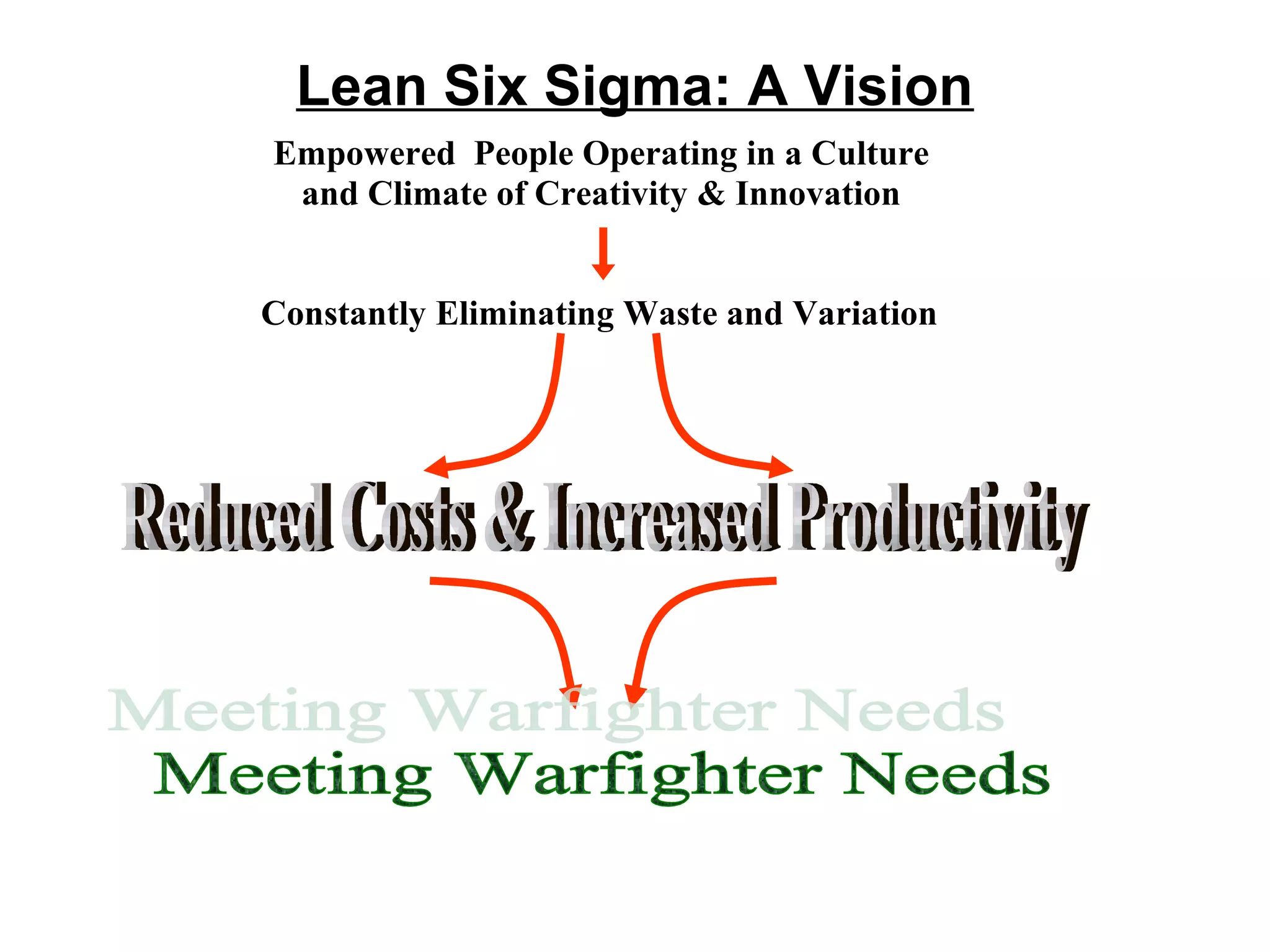
Lean Six Sigma: A Vision
Empowered People Operating in a Culture
and Climate of Creativity & Innovation
Constantly Eliminating Waste and Variation
Lean Six Sigma: What is it?
• Lean and Six Sigma are both process improvement
methodologies
• Lean is about speed and efficiency
• Six Sigma is about precision and accuracy –
leading to data-driven decisions
• Both rooted in the 1980s (and earlier)
– Lean arose as a method to optimize auto manufacturing
– Six Sigma evolved as a quality initiative to reduce
variance in the semiconductor industry
Why Lean and Six Sigma
• Six Sigma will eliminate defects but it will not address the
question of how to optimize process flow
• Lean principles exclude the advanced statistical tools
often required to achieve the process capabilities needed
to be truly 'lean‘
• Each approach can result in dramatic improvement,
while utilizing both methods simultaneously holds the
promise of being able to address all types of process
problems with the most appropriate toolkit.
– For example, inventory reduction not only requires reducing batch sizes
and linking operations by using Lean, but also minimizing process
variation by utilizing Six Sigma tools.
Lean Six Sigma Goals and Benefits
• Achieve total customer satisfaction and improved
operational effectiveness and efficiency
– Remove wasteful/non-value added activities
– Decrease defects and cycle time, and increase first pass
yields
• Improve communication and teamwork through a
common set of tools and techniques
(a disciplined, repeatable methodology)
• Develop leaders in breakthrough technologies to
meet stretch goals of producing better products and
services delivered faster and at lower cost
Lean Six Sigma
Requires Behavioral Change
• Lean Six Sigma Challenges Us to:
– Think Differently
– Work Differently
– Ask Questions and Challenge the
Status Quo
– Make Decisions With Facts and Data
– Use New Principles, Tools and
Methodologies
“Early-on, when culture and change compete, culture wins.”
- Tom Quan, GlaxoSmithKline
To Successfully Deploy Lean Six Sigma
• Start with the customer … listen, listen, listen
• Leadership commitment and alignment … go beyond the words
… change behavior
– Create momentum for change
– Develop need, vision and plan
– Communicate, communicate, communicate
– Repeatedly execute and assess
– Develop necessary skill sets to obtain the desired future state
at all levels of the organization
• Involve Everyone: Leadership, Champion, Master Black Belt,
Black Belt, Green Belt, Employees
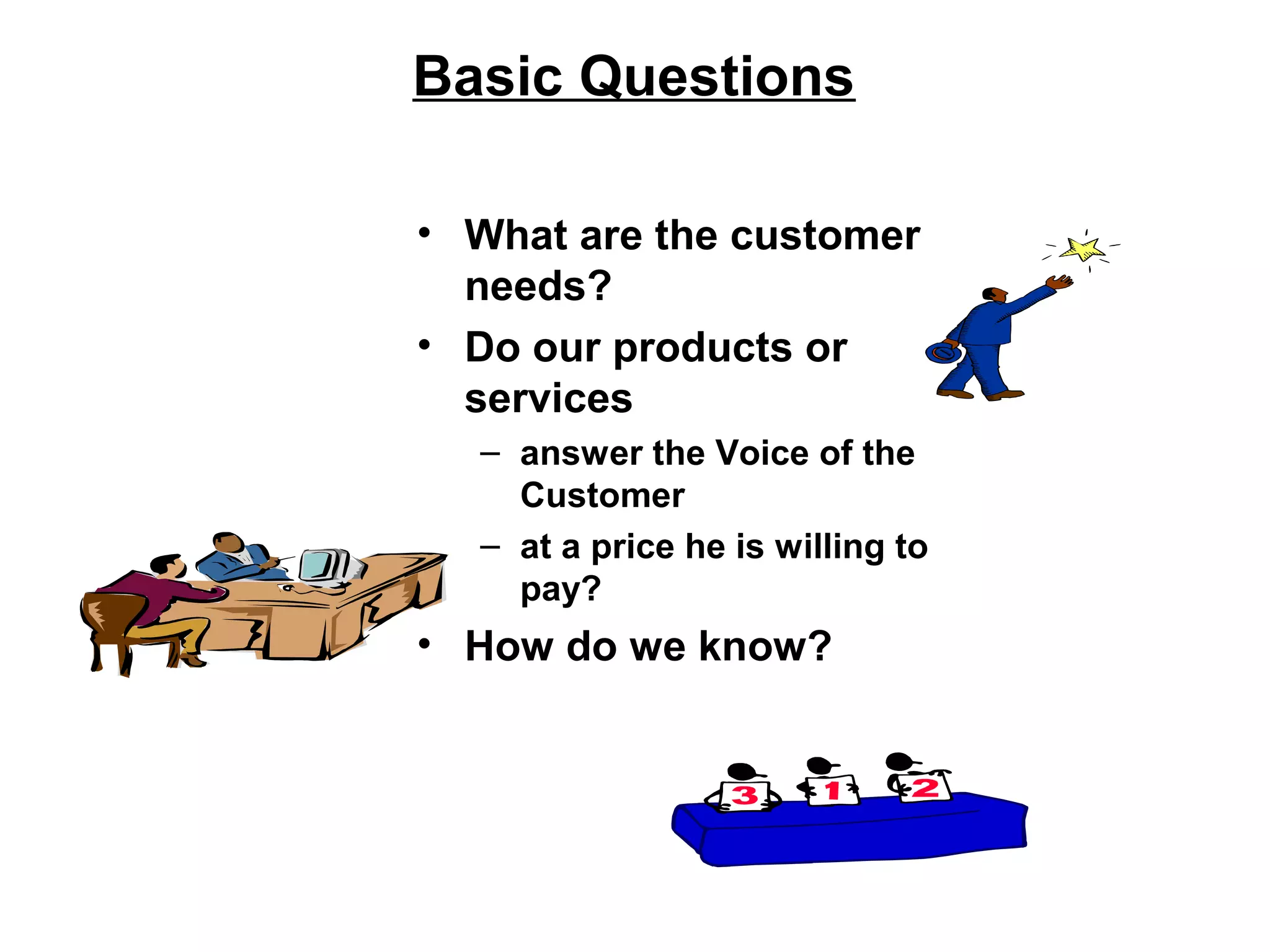
Basic Questions
• What are the customer
needs?
• Do our products or
services
– answer the Voice of the
Customer
– at a price he is willing to
pay?
• How do we know?
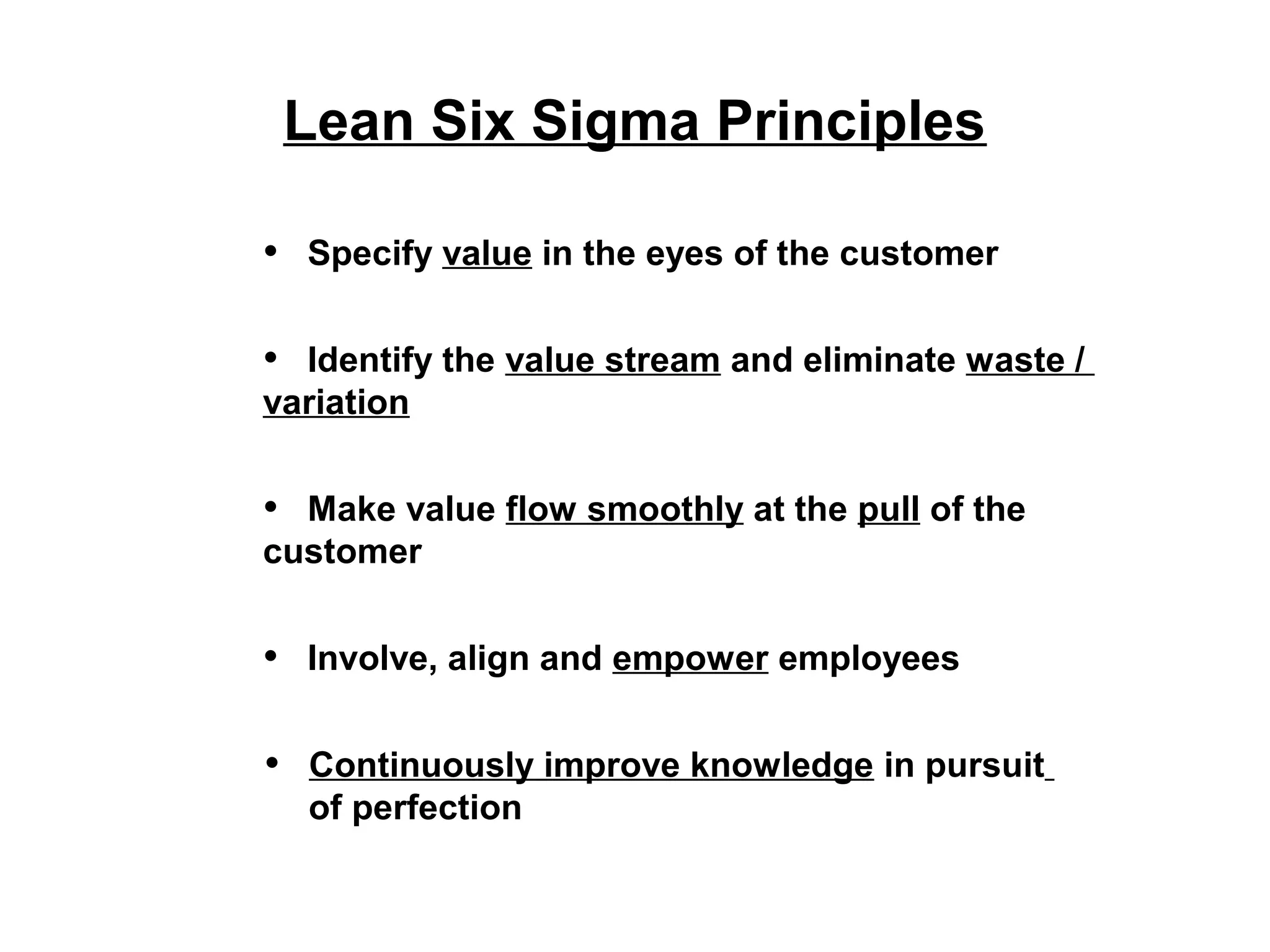
Lean Six Sigma Principles
• Specify value in the eyes of the customer
• Identify the value stream and eliminate waste /
variation
• Make value flow smoothly at the pull of the
customer
• Involve, align and empower employees
• Continuously improve knowledge in pursuit
of perfection
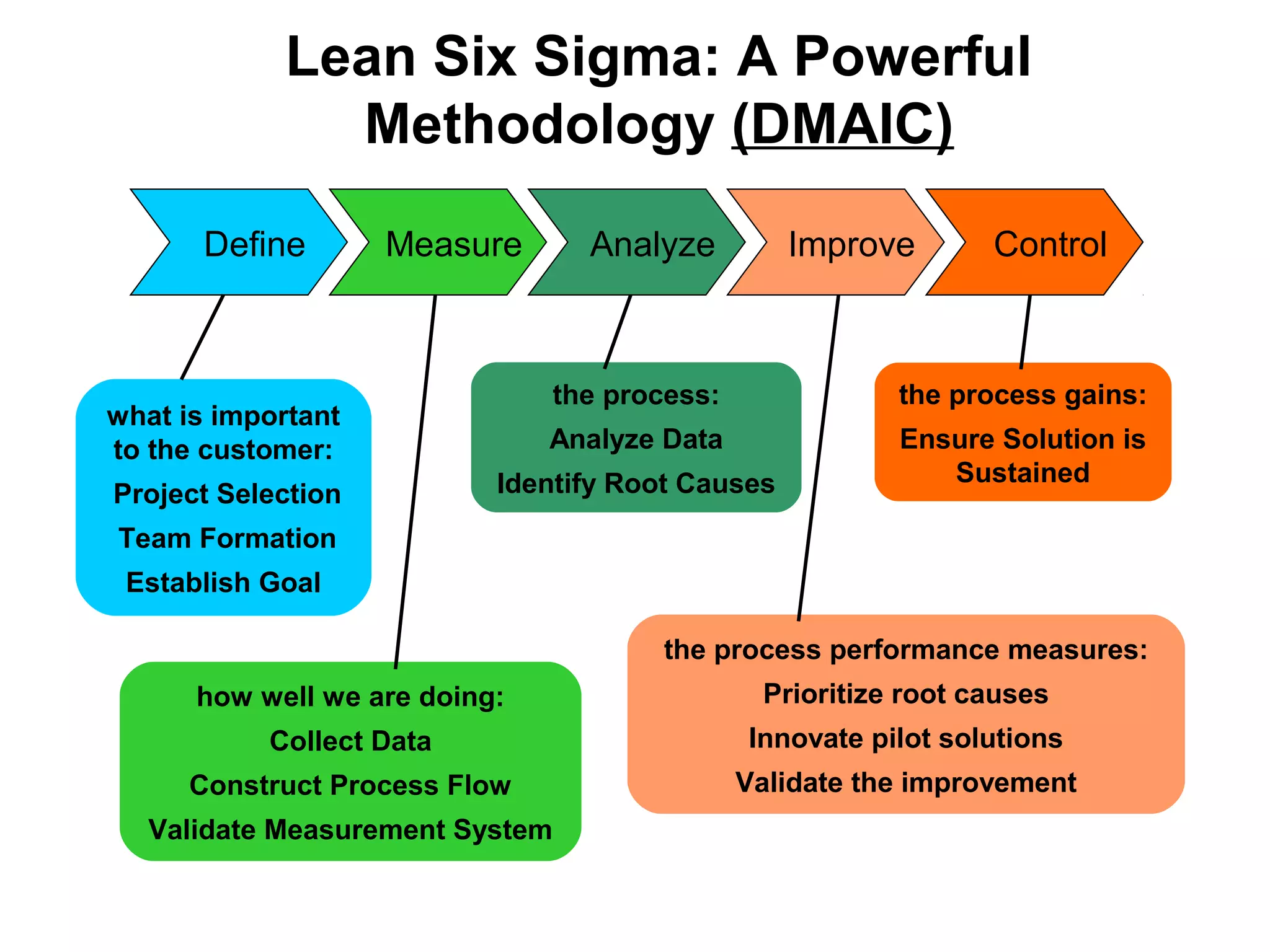
Lean Six Sigma: A Powerful
Methodology (DMAIC)
MeasureDefine ImproveAnalyze Control
what is important
to the customer:
Project Selection
Team Formation
Establish Goal
how well we are doing:
Collect Data
Construct Process Flow
Validate Measurement System
the process:
Analyze Data
Identify Root Causes
the process gains:
Ensure Solution is
Sustained
the process performance measures:
Prioritize root causes
Innovate pilot solutions
Validate the improvement
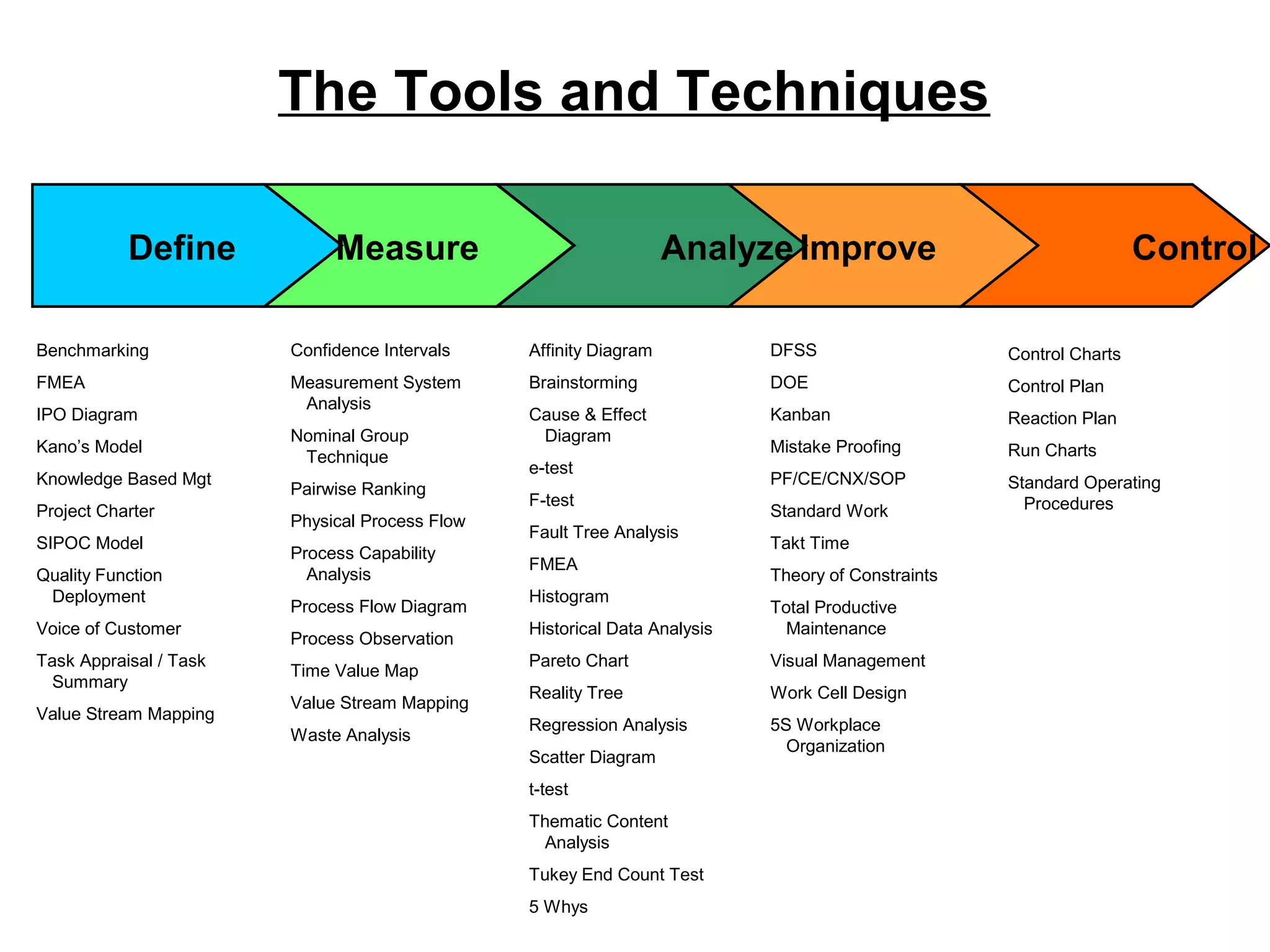
The Tools and Techniques
Define Measure Analyze Improve Control
Benchmarking
FMEA
IPO Diagram
Kano’s Model
Knowledge Based Mgt
Project Charter
SIPOC Model
Quality Function
Deployment
Voice of Customer
Task Appraisal / Task
Summary
Value Stream Mapping
Confidence Intervals
Measurement System
Analysis
Nominal Group
Technique
Pairwise Ranking
Physical Process Flow
Process Capability
Analysis
Process Flow Diagram
Process Observation
Time Value Map
Value Stream Mapping
Waste Analysis
Affinity Diagram
Brainstorming
Cause & Effect
Diagram
e-test
F-test
Fault Tree Analysis
FMEA
Histogram
Historical Data Analysis
Pareto Chart
Reality Tree
Regression Analysis
Scatter Diagram
t-test
Thematic Content
Analysis
Tukey End Count Test
5 Whys
DFSS
DOE
Kanban
Mistake Proofing
PF/CE/CNX/SOP
Standard Work
Takt Time
Theory of Constraints
Total Productive
Maintenance
Visual Management
Work Cell Design
5S Workplace
Organization
Control Charts
Control Plan
Reaction Plan
Run Charts
Standard Operating
Procedures
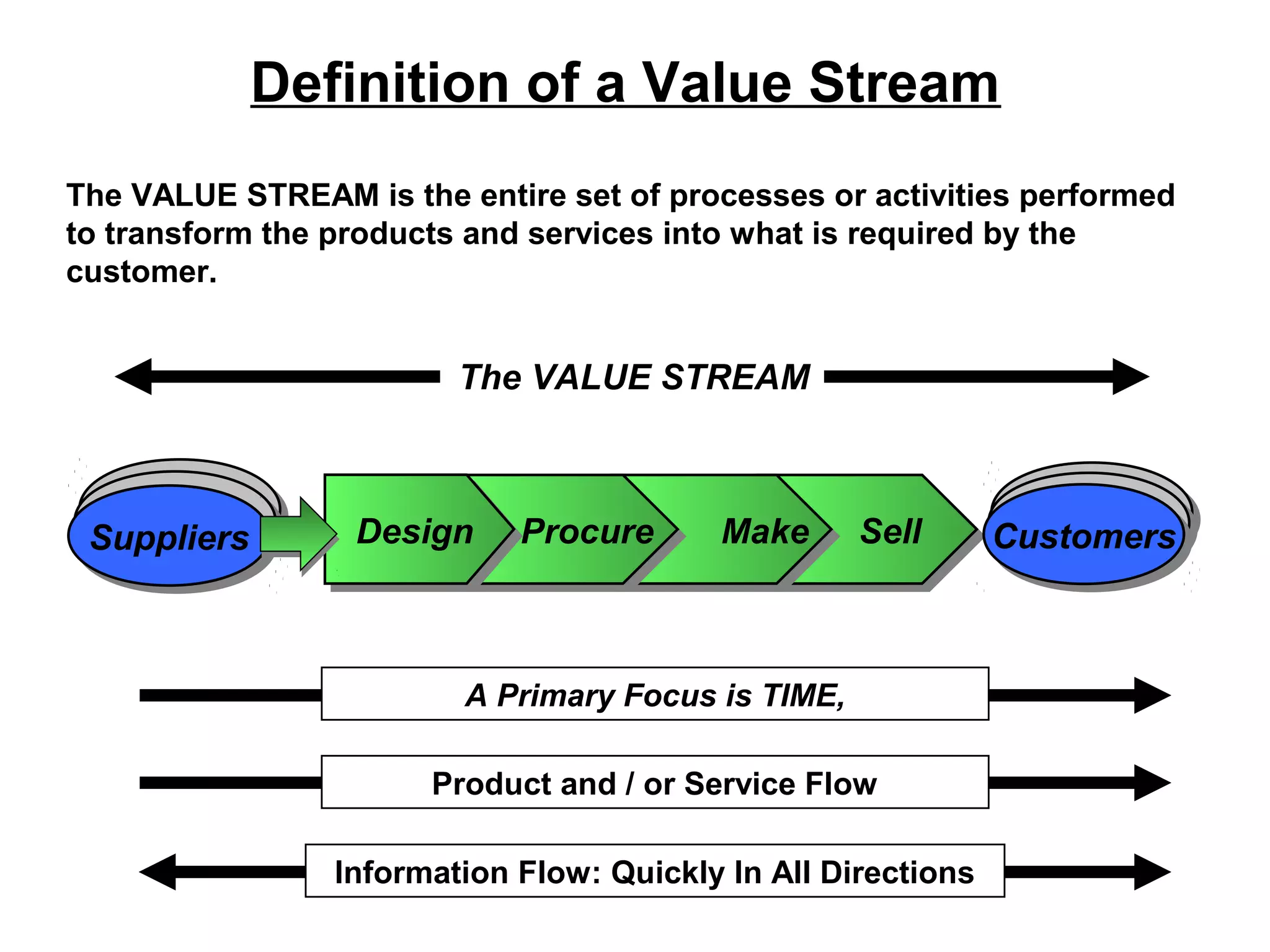
Definition of a Value Stream
The VALUE STREAM is the entire set of processes or activities performed
to transform the products and services into what is required by the
customer.
A Primary Focus is TIME,
Product and / or Service Flow
Information Flow: Quickly In All Directions
The VALUE STREAM
SellSell CustomersCustomersSuppliersSuppliers MakeMakeProcureProcureDesignDesign
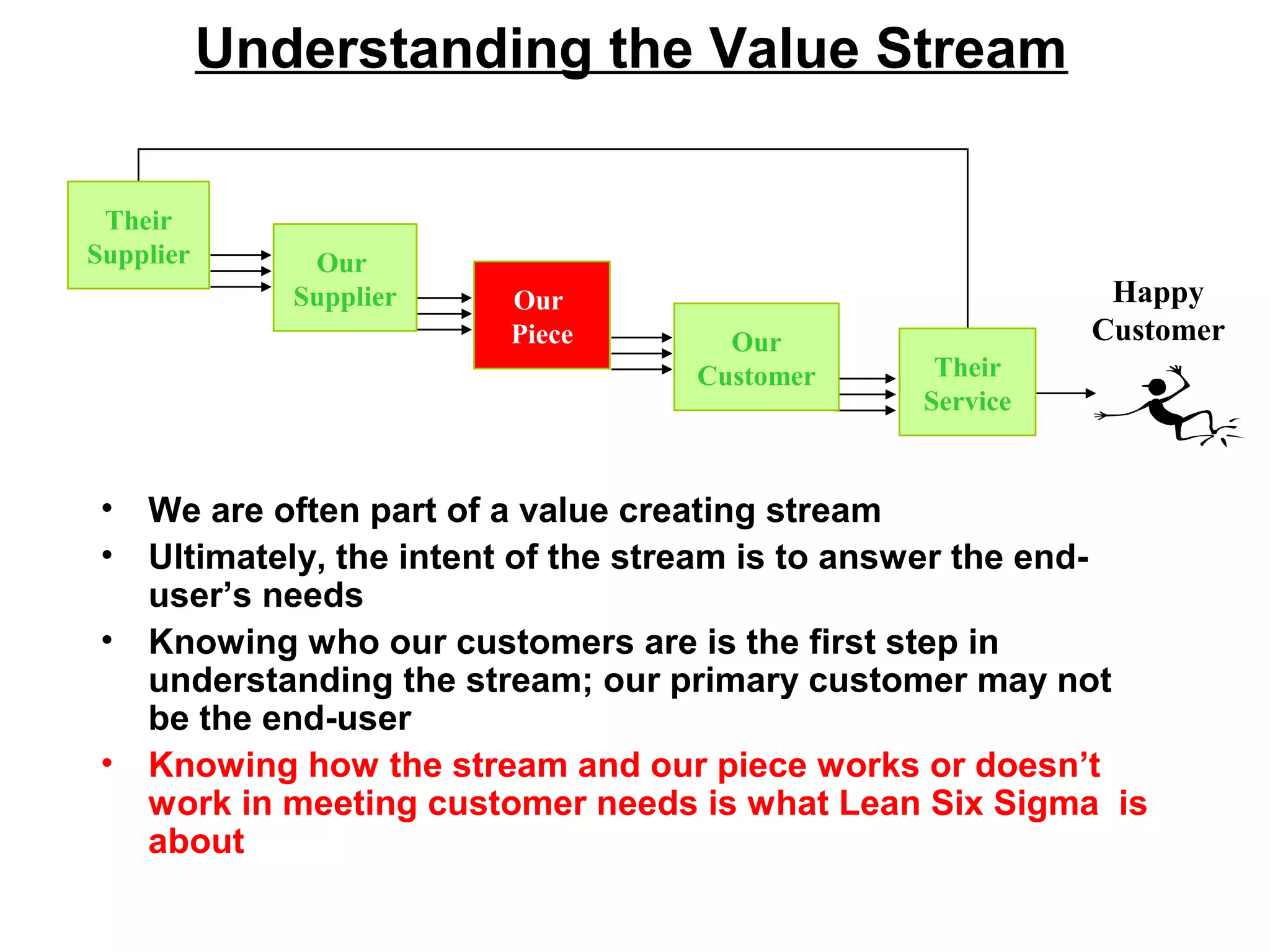
Understanding the Value Stream
• We are often part of a value creating stream
• Ultimately, the intent of the stream is to answer the end-
user’s needs
• Knowing who our customers are is the first step in
understanding the stream; our primary customer may not
be the end-user
• Knowing how the stream and our piece works or doesn’t
work in meeting customer needs is what Lean Six Sigma is
about
Happy
Customer
Their
Supplier
Our
Piece
Their
Service
Our
Supplier
Our
Customer
• Provides a world class business strategy
• Encourages a common vision and common language
shared by all
• Promotes teamwork and REWARDS success
• Combines aggressive goals with a method and a set of
tools
• Requires the application of tools throughout entire lifecycle
of a product or service
• Produces knowledge for improved cycle time, reduced
defects, and lower cost
Better products and services
delivered faster and at lower cost
=
Improved Customer Value
Summarizing the Power
of Lean Six Sigma

Six sigma basic_965

  • 1.
    Lean Six Sigma AMethodology for Cultural Change and Continuous Process Improvement (CPI)
  • 2.
    Lean Six Sigma:A Vision Empowered People Operating in a Culture and Climate of Creativity & Innovation Constantly Eliminating Waste and Variation
  • 3.
    Lean Six Sigma:What is it? • Lean and Six Sigma are both process improvement methodologies • Lean is about speed and efficiency • Six Sigma is about precision and accuracy – leading to data-driven decisions • Both rooted in the 1980s (and earlier) – Lean arose as a method to optimize auto manufacturing – Six Sigma evolved as a quality initiative to reduce variance in the semiconductor industry
  • 4.
    Why Lean andSix Sigma • Six Sigma will eliminate defects but it will not address the question of how to optimize process flow • Lean principles exclude the advanced statistical tools often required to achieve the process capabilities needed to be truly 'lean‘ • Each approach can result in dramatic improvement, while utilizing both methods simultaneously holds the promise of being able to address all types of process problems with the most appropriate toolkit. – For example, inventory reduction not only requires reducing batch sizes and linking operations by using Lean, but also minimizing process variation by utilizing Six Sigma tools.
  • 5.
    Lean Six SigmaGoals and Benefits • Achieve total customer satisfaction and improved operational effectiveness and efficiency – Remove wasteful/non-value added activities – Decrease defects and cycle time, and increase first pass yields • Improve communication and teamwork through a common set of tools and techniques (a disciplined, repeatable methodology) • Develop leaders in breakthrough technologies to meet stretch goals of producing better products and services delivered faster and at lower cost
  • 6.
    Lean Six Sigma RequiresBehavioral Change • Lean Six Sigma Challenges Us to: – Think Differently – Work Differently – Ask Questions and Challenge the Status Quo – Make Decisions With Facts and Data – Use New Principles, Tools and Methodologies “Early-on, when culture and change compete, culture wins.” - Tom Quan, GlaxoSmithKline
  • 7.
    To Successfully DeployLean Six Sigma • Start with the customer … listen, listen, listen • Leadership commitment and alignment … go beyond the words … change behavior – Create momentum for change – Develop need, vision and plan – Communicate, communicate, communicate – Repeatedly execute and assess – Develop necessary skill sets to obtain the desired future state at all levels of the organization • Involve Everyone: Leadership, Champion, Master Black Belt, Black Belt, Green Belt, Employees
  • 8.
    Basic Questions • Whatare the customer needs? • Do our products or services – answer the Voice of the Customer – at a price he is willing to pay? • How do we know?
  • 9.
    Lean Six SigmaPrinciples • Specify value in the eyes of the customer • Identify the value stream and eliminate waste / variation • Make value flow smoothly at the pull of the customer • Involve, align and empower employees • Continuously improve knowledge in pursuit of perfection
  • 10.
    Lean Six Sigma:A Powerful Methodology (DMAIC) MeasureDefine ImproveAnalyze Control what is important to the customer: Project Selection Team Formation Establish Goal how well we are doing: Collect Data Construct Process Flow Validate Measurement System the process: Analyze Data Identify Root Causes the process gains: Ensure Solution is Sustained the process performance measures: Prioritize root causes Innovate pilot solutions Validate the improvement
  • 11.
    The Tools andTechniques Define Measure Analyze Improve Control Benchmarking FMEA IPO Diagram Kano’s Model Knowledge Based Mgt Project Charter SIPOC Model Quality Function Deployment Voice of Customer Task Appraisal / Task Summary Value Stream Mapping Confidence Intervals Measurement System Analysis Nominal Group Technique Pairwise Ranking Physical Process Flow Process Capability Analysis Process Flow Diagram Process Observation Time Value Map Value Stream Mapping Waste Analysis Affinity Diagram Brainstorming Cause & Effect Diagram e-test F-test Fault Tree Analysis FMEA Histogram Historical Data Analysis Pareto Chart Reality Tree Regression Analysis Scatter Diagram t-test Thematic Content Analysis Tukey End Count Test 5 Whys DFSS DOE Kanban Mistake Proofing PF/CE/CNX/SOP Standard Work Takt Time Theory of Constraints Total Productive Maintenance Visual Management Work Cell Design 5S Workplace Organization Control Charts Control Plan Reaction Plan Run Charts Standard Operating Procedures
  • 12.
    Definition of aValue Stream The VALUE STREAM is the entire set of processes or activities performed to transform the products and services into what is required by the customer. A Primary Focus is TIME, Product and / or Service Flow Information Flow: Quickly In All Directions The VALUE STREAM SellSell CustomersCustomersSuppliersSuppliers MakeMakeProcureProcureDesignDesign
  • 13.
    Understanding the ValueStream • We are often part of a value creating stream • Ultimately, the intent of the stream is to answer the end- user’s needs • Knowing who our customers are is the first step in understanding the stream; our primary customer may not be the end-user • Knowing how the stream and our piece works or doesn’t work in meeting customer needs is what Lean Six Sigma is about Happy Customer Their Supplier Our Piece Their Service Our Supplier Our Customer
  • 14.
    • Provides aworld class business strategy • Encourages a common vision and common language shared by all • Promotes teamwork and REWARDS success • Combines aggressive goals with a method and a set of tools • Requires the application of tools throughout entire lifecycle of a product or service • Produces knowledge for improved cycle time, reduced defects, and lower cost Better products and services delivered faster and at lower cost = Improved Customer Value Summarizing the Power of Lean Six Sigma