&
Benefit of Sematic Web Concepts in the
Organization
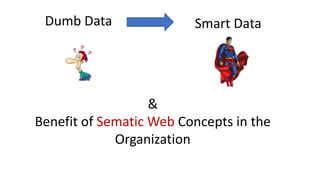
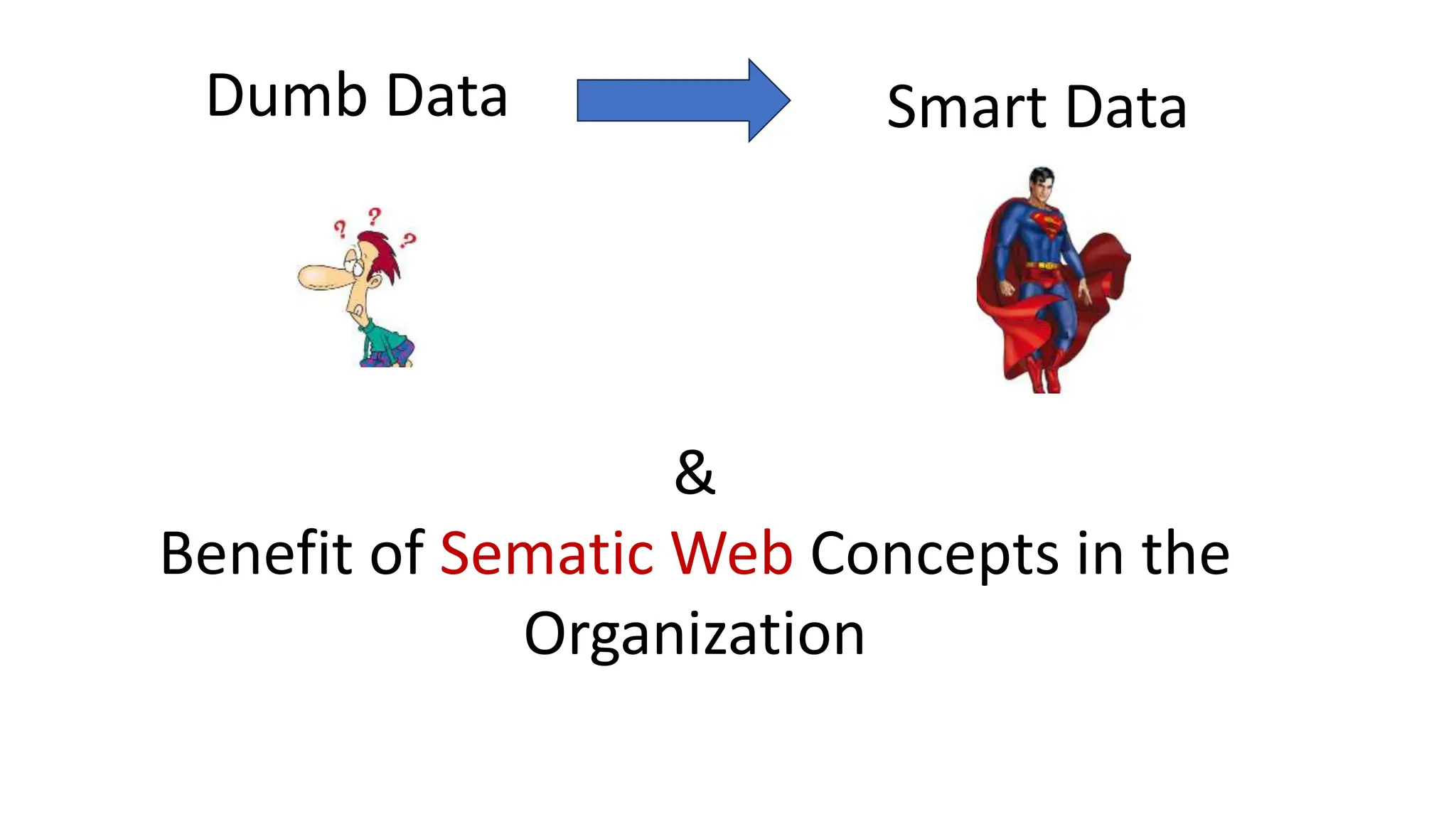
Smart Data
Dumb Data
Why Dumb Data
Lack of Context and Meaning
Contains information without any context or semantics. For example, a CSV file with numbers and text but without
labels or relationships between the data points.
Inability to Understand Relationships
Does not inherently capture the relationships between different pieces of information. It is just a collection of
isolated data points.
Limited Machine Interpretability
Requires significant preprocessing and interpretation to be used effectively by algorithms and machines.
Challenges in Integration and Interoperability
Often siloed, inconsistent, and difficult to integrate with other data sources.
Inefficiency in Querying and Retrieval
Searching and retrieving specific information can be inefficient and complex due to the lack of structure and indexing.
Difficulty in Ensuring Data Quality and Consistency
Prone to inconsistencies, redundancies, and errors, which are hard to detect and correct.
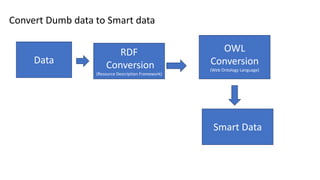
Convert Dumb data to Smart data
Data
RDF
Conversion
(Resource Description Framework)
OWL
Conversion
(Web Ontology Language)
Smart Data
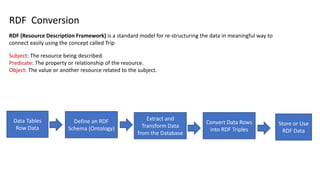
RDF Conversion
RDF (Resource Description Framework) is a standard model for re-structuring the data in meaningful way to
connect easily using the concept called Trip
Subject: The resource being described.
Predicate: The property or relationship of the resource.
Object: The value or another resource related to the subject.
Data Tables
Row Data
Define an RDF
Schema (Ontology)
Extract and
Transform Data
from the Database
Convert Data Rows
into RDF Triples
Store or Use
RDF Data
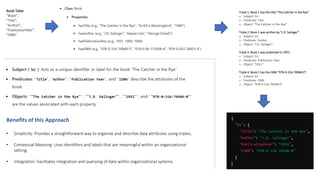
Book Table
"Book",
"Title",
"Author",
"PublicationYear",
"ISBN".
Triple 1: Book 1 has the title "The Catcher in the Rye".
o Subject: b1
o Predicate: Title
o Object: "The Catcher in the Rye“
Triple 2: Book 1 was written by "J.D. Salinger".
o Subject: b1
o Predicate: Author
o Object: "J.D. Salinger“
Triple 3: Book 1 was published in 1951.
o Subject: b1
o Predicate: Publication Year
o Object: "1951“
Triple 4: Book 1 has the ISBN "978-0-316-76948-0".
o Subject: b1
o Predicate: ISBN
o Object: "978-0-316-76948-0"
Benefits of this Approach
• Simplicity: Provides a straightforward way to organize and describe data attributes using triples.
• Contextual Meaning: Uses identifiers and labels that are meaningful within an organizational
setting.
• Integration: Facilitates integration and querying of data within organizational systems
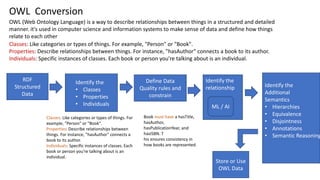
OWL Conversion
OWL (Web Ontology Language) is a way to describe relationships between things in a structured and detailed
manner. it's used in computer science and information systems to make sense of data and define how things
relate to each other
RDF
Structured
Data
Define Data
Quality rules and
constrain
Classes: Like categories or types of things. For example, "Person" or "Book".
Properties: Describe relationships between things. For instance, "hasAuthor" connects a book to its author.
Individuals: Specific instances of classes. Each book or person you're talking about is an individual.
Identify the
• Classes
• Properties
• Individuals
Classes: Like categories or types of things. For
example, "Person" or "Book".
Properties: Describe relationships between
things. For instance, "hasAuthor" connects a
book to its author.
Individuals: Specific instances of classes. Each
book or person you're talking about is an
individual.
Book must have a hasTitle,
hasAuthor,
hasPublicationYear, and
hasISBN. T
his ensures consistency in
how books are represented.
Identify the
relationship
ML / AI
Identify the
Additional
Semantics
• Hierarchies
• Equivalence
• Disjointness
• Annotations
• Semantic Reasoning
Store or Use
OWL Data
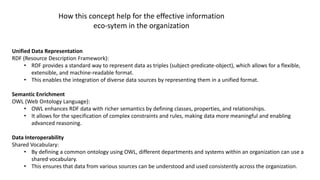
How this concept help for the effective information
eco-sytem in the organization
Unified Data Representation
RDF (Resource Description Framework):
• RDF provides a standard way to represent data as triples (subject-predicate-object), which allows for a flexible,
extensible, and machine-readable format.
• This enables the integration of diverse data sources by representing them in a unified format.
Semantic Enrichment
OWL (Web Ontology Language):
• OWL enhances RDF data with richer semantics by defining classes, properties, and relationships.
• It allows for the specification of complex constraints and rules, making data more meaningful and enabling
advanced reasoning.
Data Interoperability
Shared Vocabulary:
• By defining a common ontology using OWL, different departments and systems within an organization can use a
shared vocabulary.
• This ensures that data from various sources can be understood and used consistently across the organization.
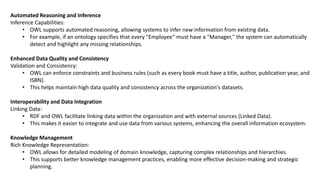
Automated Reasoning and Inference
Inference Capabilities:
• OWL supports automated reasoning, allowing systems to infer new information from existing data.
• For example, if an ontology specifies that every "Employee" must have a "Manager," the system can automatically
detect and highlight any missing relationships.
Enhanced Data Quality and Consistency
Validation and Consistency:
• OWL can enforce constraints and business rules (such as every book must have a title, author, publication year, and
ISBN).
• This helps maintain high data quality and consistency across the organization's datasets.
Interoperability and Data Integration
Linking Data:
• RDF and OWL facilitate linking data within the organization and with external sources (Linked Data).
• This makes it easier to integrate and use data from various systems, enhancing the overall information ecosystem.
Knowledge Management
Rich Knowledge Representation:
• OWL allows for detailed modeling of domain knowledge, capturing complex relationships and hierarchies.
• This supports better knowledge management practices, enabling more effective decision-making and strategic
planning.

Semantic Web and organizational data .pptx

  • 1.
    & Benefit of SematicWeb Concepts in the Organization Smart Data Dumb Data
  • 2.
    Why Dumb Data Lackof Context and Meaning Contains information without any context or semantics. For example, a CSV file with numbers and text but without labels or relationships between the data points. Inability to Understand Relationships Does not inherently capture the relationships between different pieces of information. It is just a collection of isolated data points. Limited Machine Interpretability Requires significant preprocessing and interpretation to be used effectively by algorithms and machines. Challenges in Integration and Interoperability Often siloed, inconsistent, and difficult to integrate with other data sources. Inefficiency in Querying and Retrieval Searching and retrieving specific information can be inefficient and complex due to the lack of structure and indexing. Difficulty in Ensuring Data Quality and Consistency Prone to inconsistencies, redundancies, and errors, which are hard to detect and correct.
  • 3.
    Convert Dumb datato Smart data Data RDF Conversion (Resource Description Framework) OWL Conversion (Web Ontology Language) Smart Data
  • 4.
    RDF Conversion RDF (ResourceDescription Framework) is a standard model for re-structuring the data in meaningful way to connect easily using the concept called Trip Subject: The resource being described. Predicate: The property or relationship of the resource. Object: The value or another resource related to the subject. Data Tables Row Data Define an RDF Schema (Ontology) Extract and Transform Data from the Database Convert Data Rows into RDF Triples Store or Use RDF Data
  • 5.
    Book Table "Book", "Title", "Author", "PublicationYear", "ISBN". Triple 1:Book 1 has the title "The Catcher in the Rye". o Subject: b1 o Predicate: Title o Object: "The Catcher in the Rye“ Triple 2: Book 1 was written by "J.D. Salinger". o Subject: b1 o Predicate: Author o Object: "J.D. Salinger“ Triple 3: Book 1 was published in 1951. o Subject: b1 o Predicate: Publication Year o Object: "1951“ Triple 4: Book 1 has the ISBN "978-0-316-76948-0". o Subject: b1 o Predicate: ISBN o Object: "978-0-316-76948-0" Benefits of this Approach • Simplicity: Provides a straightforward way to organize and describe data attributes using triples. • Contextual Meaning: Uses identifiers and labels that are meaningful within an organizational setting. • Integration: Facilitates integration and querying of data within organizational systems
  • 6.
    OWL Conversion OWL (WebOntology Language) is a way to describe relationships between things in a structured and detailed manner. it's used in computer science and information systems to make sense of data and define how things relate to each other RDF Structured Data Define Data Quality rules and constrain Classes: Like categories or types of things. For example, "Person" or "Book". Properties: Describe relationships between things. For instance, "hasAuthor" connects a book to its author. Individuals: Specific instances of classes. Each book or person you're talking about is an individual. Identify the • Classes • Properties • Individuals Classes: Like categories or types of things. For example, "Person" or "Book". Properties: Describe relationships between things. For instance, "hasAuthor" connects a book to its author. Individuals: Specific instances of classes. Each book or person you're talking about is an individual. Book must have a hasTitle, hasAuthor, hasPublicationYear, and hasISBN. T his ensures consistency in how books are represented. Identify the relationship ML / AI Identify the Additional Semantics • Hierarchies • Equivalence • Disjointness • Annotations • Semantic Reasoning Store or Use OWL Data
  • 8.
    How this concepthelp for the effective information eco-sytem in the organization Unified Data Representation RDF (Resource Description Framework): • RDF provides a standard way to represent data as triples (subject-predicate-object), which allows for a flexible, extensible, and machine-readable format. • This enables the integration of diverse data sources by representing them in a unified format. Semantic Enrichment OWL (Web Ontology Language): • OWL enhances RDF data with richer semantics by defining classes, properties, and relationships. • It allows for the specification of complex constraints and rules, making data more meaningful and enabling advanced reasoning. Data Interoperability Shared Vocabulary: • By defining a common ontology using OWL, different departments and systems within an organization can use a shared vocabulary. • This ensures that data from various sources can be understood and used consistently across the organization.
  • 9.
    Automated Reasoning andInference Inference Capabilities: • OWL supports automated reasoning, allowing systems to infer new information from existing data. • For example, if an ontology specifies that every "Employee" must have a "Manager," the system can automatically detect and highlight any missing relationships. Enhanced Data Quality and Consistency Validation and Consistency: • OWL can enforce constraints and business rules (such as every book must have a title, author, publication year, and ISBN). • This helps maintain high data quality and consistency across the organization's datasets. Interoperability and Data Integration Linking Data: • RDF and OWL facilitate linking data within the organization and with external sources (Linked Data). • This makes it easier to integrate and use data from various systems, enhancing the overall information ecosystem. Knowledge Management Rich Knowledge Representation: • OWL allows for detailed modeling of domain knowledge, capturing complex relationships and hierarchies. • This supports better knowledge management practices, enabling more effective decision-making and strategic planning.